
Faith with Reason Hegel and Kierkegaard on the





- Slides: 87
Faith with Reason Hegel and Kierkegaard on the nature of religion 1
Heidegger on Plato and Christianity • 1) Heidegger: “Nietzsche was right in saying that Christianity is Platonism for the people. ” • 2) Nietzsche: Christianity is the expression of the slave morality • => two interpretations of Plato • => two interpretations of Christianity • => Hegel on slavery and morality 2
Heidegger/Nietzsche interpretation of Plato • Plato separates reality into two levels: • lower, earthly level: the object of sensation and illusion • higher level: the object of intellect, reason: the ideal world of Reality • => disenchantment of physical, earthly life • Christianity repeats this scheme in the form of popular religion • => material world as object of pragmatic knowledge and control: technological mentality of West 3
Stoicism = Slave morality • Hegel’s dialectic of master/slave • The Master is implicitly overcome by the slave • Stoic resolution: freedom at the mental plane through detachment from emotional attachment • Star Wars re Jedi • = Dualism of inner/mind and outer/ body 4
Two forms of Christianity: Stoic and Platonic • = Philosophy of (Roman) Empire • Should be: Christianity = Stoicism for the masses • Platonism = philosophy of the (Greek) republic • Is there a “Platonic Christianity” as well? • Gospel of Mary Magdalene (Gnostics) 5
Kant’s critique of Stoicism • Stoicism: moral duty is its own reward • Kant: No one can be happy without the satisfaction of basic desires, without finding love in their lives • Hence: morality aims at the Highest Good • Divinity manifested in the here and now, • as in Plato’s Phaedrus • Hegel: Platonism, Stoicism, and Kantian morality are stages in the evolution of humanity whose goal is the realization of 6
Two interpretations of Christianity • 1) Theory of Atonement • The Kid: You saved me • 2) Theory of Jesus as Teacher/Model • Neo: You saved yourself, kid. 7
Two Early Christianities • 1) “Orthodox” interpretation of Jesus as Savior-Redeemer • Need to believe in redeeming blood sacrifice of Jesus to be saved • 2) “Gnostic” interpretation of Jesus as Teacher-Model • Need to understand the deep teachings of Jesus in order to be able to save oneself 8
Fate of Gnostics • Council of Nicea in 325 CE formulates orthodox Christian beliefs (Nicene Creed) • Called by Roman Emperor Constantine • “Gnostic” theories of “inner knowing” are outlawed in 326 CE by the Emperor’s decree • Texts buried in desert of Egypt near Nag Hammadi are discovered in 1945 9
Republic and Empire in Star Wars • Early Republic falls • Empire arises by taking advantage of limitations, divisions of the Republic • New Republicans: Return of the Jedi • = Early Christians express spirit of ancient Roman Republic 10
Two interpretations in early Christianity • 1) “orthodox” Christianity of the Atonement • Required interpretation in 325 CE at Council of Nicea -- called by the Emperor • 2) Gnostic Christians: Jesus as teacher of liberation, enlightenment, through one’s own inner knowing • Star Wars on Republican opposition to Empire • Jesus as Platonic teacher of liberation (The Da Vinci Code) 11
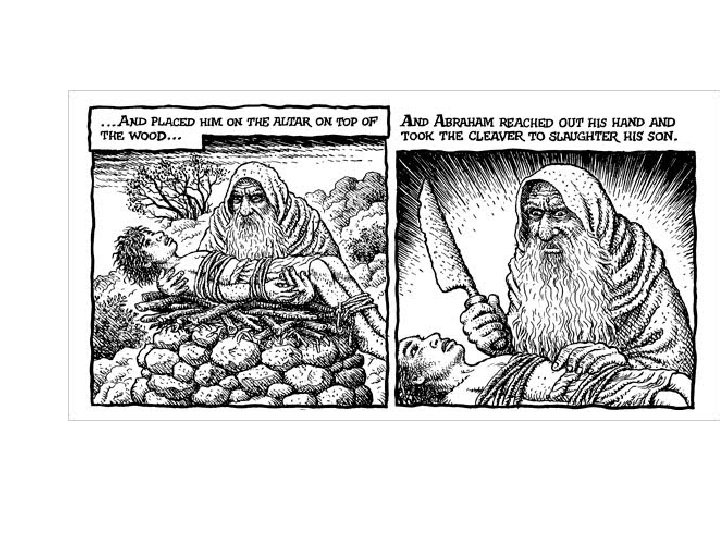
Comment on Biblical religion (Woody Allen) • “The unique thing that happened to the early Israelites was that they conceived a God that cares. He cares but he also demands at the same time that you behave morally. But here comes the paradox. What’s one of the first things that God asks? That God asks Abraham to sacrifice his only son, his beloved son to Him. 12
• “In other words, in spite of millennia of efforts we have not succeeded to create a really and entirely loving image of a God. This was beyond our capacity to imagine. ” • Louis Levy in --Woody Allen, “Crimes and Misdemeanors” • Is the orthodox Christian version of this – God sacrifices His own Son -- an improvement on our image of God? 13
14
A truly loving God? • God commands Abraham to sacrifice his son Isaac • Like the sacrificial lambs of the Day of Atonement (Yom Kippur) 15
Kierkegaard’s defense of orthodox Christianity • Kierkegaard: religion is beyond morality • Morality: the universal, the rational (Kant) • Religion: the individual, beyond rationality, a scandal to rational philosophy (of Hegel) 16
Kierkegaard: What is Christianity? • 1) God is Infinite • 2) Man is finite • 3) Jesus Christ is God and Man: Infinite and Finite • 4) For reason this is a contradiction • Christianity is not just beyond reason (v. Kant) • but in contradiction to reason (v. Hegel) • 5) Requires a leap of faith beyond reason 17
Kierkegaard’s contrast with Hegel • Hegel’s alternative conception of Christianity • based on his distinctive theory of the relation between faith and reason. • Contrast Hegel’s conception of the relation of reason and faith • with that of the Hegel’s later critic, Søren Kierkegaard (1813 -55), 18
God sacrifices his Son • Isn’t it an even greater scandal to all reason and morality, • for God to sacrifice His own Son— • and this time with no scapegoat available as a substitute, • no obvious reward forthcoming as the result of passing such a test of faith, as was the case in the Old Testament story. 19
Who killed Christ? • And so the question, Who killed Christ? • has only one answer: • God Himself, the Father • who sent his only Son to the slaughterhouse. • The fact that God knows that his divine Son is immortal • does not to lessen the sacrifice, the pain, the negativity, the real death, • for the Son is also, incomprehensibly, a fully human being. 20
Religion as feeling, not reason • For most ordinary Christians • focusing on these images of the suffering, death, and resurrection of the Son of God, • this core teaching of Christianity is an unfathomable mystery. • How the infinite God can be at the same time a finite human being • baffles ordinary rationality. • Instead of trying to comprehend the mystery, • the pious Christian normally attempts to feel its meaning, • to experience it awe-inspiring power. 21
Kierkegaard versus rational religion • Kierkegaard seems at first to support this • essentially non-rational, emotional nature of ordinary religious piety. • However, he does so in the context of attacking a theology • that represents Christianity as a doctrine that is addressed primarily to the rational intellect. • Against such a theology, Kierkegaard therefore maintains that • belief in the unity of divine and human in Jesus • requires a surpassing of all logic and all reason, • a leap of faith. 22
Either/or • Christianity is the radical replacement of reason by faith, • the very heart of religion. • Reason separates and compartmentalizes • according to a logic of “either-or. ” • There is either God or man— • there cannot be both. • Here is God—the infinite, the all-powerful, the absolute— • and here is the human—the finite, the impotent, the negative 23
A and not-A • Logic formulates the matter clearly: • there is A and not-A, • the divine and the non-divine, • i. e. , the wretched human, • the almost nothing by comparison with the everything of God. • But Christianity teaches that, • in Christ, A is indeed identical with non-A. 24
Leap of faith • In this core Christian doctrine, therefore, • the fundamental law of reason, the law of noncontradiction, • is flagrantly violated. • To be a Christian, then, • logic must be utterly transcended • by a leap of faith 25
The gadfly of Christendom • Kierkegaard sees himself as • the gadfly of the contemporary “Christendom” of his time, • in both its practical aspects and in its theological doctrine. • In practice, there is nothing in the comfortable lifestyles of the churchmen of his time • to suggest the sacrificial path of worldly renunciation found in the example of Jesus himself. 26
Against Hegelian religion • The theology in vogue, heavily influenced by Hegel, was similarly complacent, • giving the impression that there is nothing in Christianity that a rational individual could not accept. • Kierkegaard pitted himself especially against this “Hegelian” understanding. • Do Christians who hear the words of their faith recognize • how thoroughly they contradict the rationality that guides them in everyday life? 27
Going beyond reason • Such rationality may guide us in the sphere of moral obligations, • as Kant argues. • But religious faith requires that we leap beyond logic and the universal laws of reason, • including the laws of morality. • Religious faith instead is about the unutterably singular— • the meeting with God where no general rule can guide us. 28
An intellectual scandal • When God tells Abraham to sacrifice his son Isaac, • Abraham does not flinch from undertaking • what in the eyes of morality is the most despicable act of murder, • that of one’s own beloved son. • When this story is intoned from the pulpit on a Sunday, • how many who hear the words really listen to what is being said, • and so become fully aware of the intellectual scandal that is posed by their faith? 29
Kantian morality applied to Abraham • Consider Abraham’s action from the point of view of Kantian morality • What is the maxim? • “Be willing to sacrifice your children when God commands you” • It’s ok to kill innocent purpose when it’s for religious reasons. • Can it be universalized? 30
Hegel’s dialectic of finite and infinite • 1) Critique of concept of external creator God • If God is infinite (all reality), there can be nothing outside of God • Orthodox theory of Creation: God is really a finite being because other than his creation. • Reflects Roman stage of history • 2) Hence creation is the manifestation of the Infinite (Spirit): • all is within God; all is (implicitly) God • through the dialectic of involution/evolution 31
May the Force be with you • “The Force? ” asks Luke. • Obi-Wan replies: • • “The Force is what gives the Jedi his power. It’s an energy field created by all living things. It surrounds us and penetrates us. It binds the galaxy together. ” • All living beings create the energy field of the Force, • and at the same time this energy field is essential to living beings, • binding the entire galaxy—ultimately the entire cosmos—in a unified whole. 32
Hegel on Life and Spirit • Recall Hegel on the nature of Life • The living and dying individuals through their flow into one another create Life • And at the same time, Life is realized or expressed in and through them • But the next stage: Life becomes selfconscious: “Spirit” • An I that is We, and a We that is I. 33
Complementarity of religion and philosophy • Religion expresses truth at the level of feelings • Art expresses truth at the level of sensuous representations • Philosophy expresses truth at the level of conceptual thinking • Each stage of history is expressed in its own appropriate religion, art, and philosophy 34
Three stages of religion • 1) Religion of nature • Includes China, India • The divine is in the world: animism (enchanted world) • (Transition: Greek religion of the Beautiful Individual, Division, & Plato’s Philosophical Remedy) • 2) Religion of expediency (Rome) • God/gods as above nature and power over the world • Religion of the separate ego, disenchantment, and Stoicism 35
The consummate religion • 3) The Consummate Religion (Christianity) • Incarnation: God reenters the world, dies on cross (=death of the Ego) • Rebirth of Spirit through the community of free humans 36
Death of God (Hegel) • ““God himself is dead, ” it says in a Lutheran hymn, expressing an awareness that the human, the finite, the fragile, the weak, the negative are themselves moments of the divine, that they are within God himself, that finitude, negativity, otherness are not outside of God and do not, as otherness, hinder unity with God. ” 37
Sin as separation • Death of God: “a monstrous, fearful picture which brings before the imagination the deepest abyss of cleavage. ” • “picture thinking”: image for the sake of feeling • Need complementary conceptual understanding • Orthodox theology of Atonement fails to provide a logically coherent conceptual understanding • Hegel: Need dialectic of the ego 38
Dialectic of the ego > from Stoicism to the Unhappy Consciousness • Stoic consciousness is separated from the empirical world (= Slave morality—be a good slave or master) • Skeptic points out the lack of substance of Stoicism • Han Solo sees no empirical evidence • But Skeptical consciousness is purely negative 39
Tricks and Nonsense? • Han Solo: “Hokey religions and ancient weapons are no match for a good blaster at your side, kid. ” • Luke Skywalker: “You don’t believe in the Force, do you? ” • Han: “Kid, I’ve flown from one side of this galaxy to the other. I’ve seen a lot of strange stuff, but I’ve never seen anything to make me believe there’s one all-powerful force controlling everything. No mystical energy field controls my destiny. It’s just a lot of tricks and nonsense. ” 40
Unhappy Consciousness • Thus: Unhappy Consciousness: Truth as the Unknowable Beyond, and I am powerless, nothing • So Anakin enters the darkness to save love • So Faust makes a bargain with the devil to find love 41
Phenomenological meaning of the death of God • 1) Jesus is fully aware of our essential oneness with God (“Our Father”) • Just as we are when we know that the truth of reality is Spirit (infinity, totality, universal love) • 2) And at the same time he intensely experiences his separation from God (=feeling of abandonment of the Ego: Unhappy Consciousness) • “My God, my God, why have you forsaken me? ” • =Death of the slave consciousness 42
Overcoming sin • Sin = separation (Ego-identification) • Jesus expresses sin (negativity) to the fullest, and also death to this separation • Jesus exemplifies the death of the Ego consciousness: model for all humanity of inner truth • Human evolution = “Calvary of Absolute Spirit” 43
Spirit • Result Spirit: I that is We, and We that is I • Early Christians experience this at level of religious feeling (Pentecost) • But new dialectic is needed to bring this feeling to full rational consciousness 44
Critique of Superman theory of the Savior • 1) Superman saves Lois Lane – after she is killed! • Jor-el sends his son Kal-el to save the earth • 2) Critique of Superman theory in The Matrix: • The Kid: You saved me. • Neo: You saved yourself, kid. • 3) Smallville’s revision: • Chloe to Clark: “Even superheroes need to be saved. ” 45
Savior or Teacher? • 1) Image of Superman in The Matrix • 2) Final words of first film: “I'm going to hang up this phone and then I'm going to show these people what you don't want them to see. I'm going to show them a world without you, a world without rules and controls, without borders or boundaries, a world where anything is possible. ” 46
Figures of the Savior in popular culture • Hacker customer to Neo – “You’re my savior man, my own personal Jesus Christ. ” • He dies and is resurrected through the loving power of Trinity • Buffy: “the chosen one, ” vampire slayer • Anakin Skywalker: born of a virgin, the chosen one (=Messiah, Christ) • He overcomes the dark forces of Empire and brings balance to The Force. 47
Two theories of Justice • 1) This world is inherently weak or corrupted, • and so only an external, superpowerful being can save the day • 2) Justice in this world: • The world is intrinsically moral – crime will be punished and the good will receive their reward • The Simpsons, Buffy, The Matrix, Star Wars, and Woody Allen with his Hollywood Movies 48
Hobbes’ pessimism • Human nature is inherently egotistical • The result is murder and mayhem • Only an outside power can save us from ourselves: • 1) The Leviathan State • 2) The redeeming death of Jesus Christ, Son of God, on the cross 49
Hobbes’ “Scientific Christianity” • The new materialism of science • Human beings are inherently egotistical • Only the State can save us from ourselves • Our lives are determined by outside causes (new physics , law of inertia) • Calvinist beliefs of the time • Human nature is intrinsically corrupt, sinful (original sin) • Only an outside power, God through the redeeming death of Jesus, can save us. • Some are predestined to be saved, others to be damned 50
Kant’s alternative conception of Christianity • 1) Critique of deterministic science • 2) Assertion of human freedom as the basis of morality • 3) Arguments for belief in the possibility of creating a just world (kingdom of God on earth) • 4) Jesus as the model and teacher of morality • 5) Rejection of the doctrine of Original Sin 51
Mel Gibson’s Passion of the Christ • “There is no greater hero story than this one, about the greatest love one can have, which is to lay down one’s life for someone. The Passion is the biggest adventure story of all time. I think it’s the biggest love-story of all time; God becoming man and men killing God. If that’s not action, nothing is…. Christ paid the price for all our sins. ” 52
Jesus as Savior-Redeemer • Redemption: to buy back, “pay the price” for someone who is a captive slave • Supposes that human beings are captives of the Evil One • St. Augustine: We do live in a just world: all of us deserve damnation • Some of us are saved through the mercy of God in sacrificing his only Son to redeem us 53
A perfectly loving God? • “In this is love, not that we have loved God but that he loved us and sent his Son to be the propitiation for our sins. ” 1 John 4: 10 • Recall: God asks Abraham to sacrifice his son Isaac • Here: God sacrifices his own Son 54
Star Wars on Christianity • Anakin is the Chosen One, born of a virgin and the Force • History of struggle between Republic and Empire • Early Republic falls • Empire takes advantage of limitations, divisions • New Republicans: Return of the Jedi • Triumph of Republic again? 55
Republican nature of early Christianity • “As imperial power became increasingly centralized, remote, insensitive, and later unstable, ‘In many ways Christianity represented how Rome liked to idealize its republican past. ’” Spodek, The World’s History, 330 • Early Christians = Republican spirit of “each for all and all to each”: challenges Empire • Episode 5: the Empire Strikes Back 56
Justice in the Hebrew Bible • 1) Story of Job • 2) The Suffering Servant of Isaiah • 3) Christian Interpretation of Isaiah as prophetic of Jesus’ redeeming sacrifice 57
Job complains of God’s injustice • “Why does he look on and laugh, when the unoffending, too, must suffer? So the whole world is given up into the power of wrongdoers; he blinds the eyes of justice. He is answerable for it; who else? ” 9: 23 -4. 58
Job’s alternatives • 1) Suffering is due to sin, disobedience of God’s laws • 2) The just person should not suffer • 3) But Job is just • 4) Therefore there is no justice in the world and God is an evil demon • 5) Missing: “the universe is a pretty cold place. It’s we who invest it with our feelings. ” 59
It is necessary to believe that we live in a moral world • Rabbi Ben: “It’s a fundamental difference in the way we see the world. You see it as harsh and empty of values and pitiless. And I couldn’t go on living if I didn’t feel with all my heart a moral structure, with real meaning, and. . . forgiveness. And some kind of higher power. Otherwise there’s no basis to know how to live. ” • --Woody Allen, Crimes and Misdemeanors 60
Modern atheism • Professor Levy: “Events unfold so unpredictably, so unfairly. Human happiness does not seem to have been included in the design of creation. It is only we with our capacity to love that give meaning to the indifferent universe. And under certain conditions, we feel that the thing isn’t worth it any more. ” 61
God’s reply to Job • “From what vantage point wast thou watching, when I laid the foundations of the earth? Tell me, whence comes this sure knowledge of thine? Tell me, since thou art so wise, was it thou or I designed earth’s plan, measuring it out with the line? ” • Job submits, passes the test, and is rewarded 62
Philosophy and Job • Kant: we cannot know reality in itself; therefore we must believe something • Believe in the possibility of the Highest Good, a just world, where good is rewarded and evil punished • in this life • Hegel: we can know: through dialectical science; dialectic of the ego • Leads to Spirit: an I that is We and a We that is I 63
Conclusions from Job • 1) God works in mysterious ways, beyond our human comprehension • 2) The sufferings of life test our commitment to duty, to goodness • I. e. , we must accept sacrifices for the sake of duty • 3) In the end, Job is rewarded two-fold • 4) Therefore the world is governed by moral law, and the Highest Good (Zion, the Kingdom of God, a just society) is realizable 64
The suffering servant • What about the faithful servant of God who goes to his death? • How is this a “test”? • Where is the reward? • The ancient Jews were a this-worldly people. Happiness should be here and now, with family and friends. 65
Suffering Servant of Isaiah (53) • Despised and rejected by men; • A man of sorrows, and acquainted with grief… • he was despised, and we esteemed him not…. • We did esteem him stricken, smitten by God, and afflicted. • He suffers, and so must be guilty of sin 66
• But he was wounded for our transgressions; • He was crushed for our iniquities; • Upon him was the chastisement that brought us peace, • And with his stripes we are healed. • His suffering is on our behalf 67
• All we like sheep have gone astray; • We have turned every one to his own way; • And the Lord has laid on him the iniquity of us all. • He was oppressed, and he was afflicted, • Yet he opened not his mouth; • Like a lamb that is led to the slaughter… • He is like the sacrificial lamb, the scapegoat 68
• He was cut off out of the land of the living, • Stricken for the transgression of my people…. • There was no deceit in his mouth. • His sufferings are due to our sins, not his 69
• Yet is was the will of the Lord to crush him; • He has put him to grief. • God is the ultimate cause of this man’s death, for God’s providence is behind all such matters • What is the meaning of this providence? Is it comprehensible? 70
• He shall see the travail of his soul, and shall be satisfied; • by his knowledge shall my righteous servant justify many; for he shall bear their iniquities. • Therefore will I divide him a portion with the greater, and he shall divide the spoil with the strong; • because he hath poured out his soul unto death … and he bare the sin of many, and made intercession for the transgressors. 71
The reward • The suffering servant suffers because of the sins of others • Through his suffering others are saved • There is a reward through immortality beyond this life • But it consists in seeing the fruits of his action in his life 72
How does the suffering servant get rewarded? • “Therefore will I divide him a portion with the greater, and he shall divide the spoil with the strong…” • He is rewarded by knowledge of the fruits of his efforts in this life. • Sati: Will we ever see him [Neo] again? • Oracle: I suspect so. Someday. 73
Jewish interpretation of Isaiah • 1) There are good people (not just one) who die without any reward (contrary to Job, but according to Isaiah) • 2) They are like the scapegoats used on the Day of Atonement (Yom Kippur). • 3) They volunteer for the role for the sake of others • 4) Two interpretations of this role 74
The scapegoat • “Using a goat, called Azazel, often translated as scapegoat, the High Priest would place his hands on its head and confess the sins of the nation, essentially laying the blame on the head of the animal. The goat was then pushed off a high cliff to fall to its death. ” • http: //www. everythingjewish. com/Yom. K/YK _origins. htm 75
Contemporary (“liberal”) Jewish interpretation of the scapegoat • “The belief that somehow sins can be transferred from human to animal, has been a controversial subject among rabbis. As a result, this ceremony is no longer (except among the very ultra-orthodox or Hasidic circles) practiced today. Instead, repentance, prayer and giving charity is the accepted Jewish practice for obtaining divine forgiveness. ” 76
Scapegoat interpretation • Some people literally carry the sins of the world on their shoulders, suffer, and die for the sake of others • Christian interpretation: one person does this: the Christ • God forgives the sins of others for the sake of such persons • But how is this justice? 77
Justice? Individual example • 1) X commits a crime • 2) Y says: punish me instead. • 3) An innocent person is punished • 4) and the guilty person is released • Isn’t this the height of injustice? • (Kierkegaard: so you need a leap of faith) 78
Justice? Broaden the scope • 1) Almost all humans are guilty of crimes and so deserve to be punished • A) they have committed evil acts themselves through their own free choices • B) they are born into sin through the choice of Adam and Eve—and cannot avoid evil acts 79
Whom to punish for our sins? • 2 a) God decides to punish/destroy them all, except for the one good person (Noah, and his family) • 2 b) God decides to spare/forgive the wicked and punish the one good person (Jesus, His own Son) • on the condition that the guilty ones believe in this blood sacrifice of the Son of God, join the Church, follow its rules 80
Jewish expectation of a Messiah • Messiah = anointed (chosen) one (Greek: Christos) • Jewish Kings were chosen by God anointed by the high priest • History of salvation by a chosen one of God as was Moses; also Cyrus at the time of the Babylonians. • Roman conquest at the time of Jesus: search for a new Messiah 81
Crisis of belief • Roman joke: INRI attached to crucifix of Jesus: Jesus of Nazarus, King of the Jews • If Jesus was the Messiah, the promised King of the Jews, how could he have been crucified? • One answer: traditional Jewish theory of Atonement, with Isaiah as prophecy. 82
Orthodox Christian interpretation of Isaiah • “God put [Christ] forward as a propitiation by his blood, to be received by faith. This was to show God’s righteousness, because in his divine forbearance he had passed over former sins. ” Paul to Romans 3: 25. ` • Jesus as the “Lamb of God who takes away the sins of the world. ” Catholic mass • Mel Gibson’s Passion: the more sins, the more blood needed to redeem them 83
Nicene Creed (325 AD) • We believe in one Lord, Jesus Christ, the only Son of God, eternally begotten of the Father, God from God, Light from Light, true God from true God … • For our sake he was crucified under Pontius Pilate; he suffered death and was buried. On the third day he rose again in accordance with the Scriptures” 84
Alternative interpretation (1) • 1) Some people suffer by “speaking truth to power” (they do what is right, their duty) • E. g. , Socrates, Neo, (Jesus? ) • 2) They wake people up from their acquiescence to injustice • Awakening from illusion • 3) Through their teachings people reject injustice and create a just world • 4) These enlightenment figures will be happy in the knowledge of their achievements 85
Alternative interpretation (2) • 1) At a particular stage of human evolution, • the Roman Emperor is in full power. • He is “the One” • 2) Jesus teaches an alternative form of existence, • as seen in his “parable of the mustard seed” and other teachings • 3) He dies the ignominious death of a slave for challenging the Roman power 86
• 4) This scenario implicitly represents the death of the Ego • as both powerful (Master) • and powerless (Jesus dies the death of a slave) • 5) His followers embody his teachings (Hegel: Spirit) 87