
Fairness of Dismissal Dr Katarzyna Gromek Broc Who
Fairness of Dismissal Dr Katarzyna Gromek. Broc
Who can claim unfair dismissal? Preliminary Questions n Employees only n Continuous employment n Within the scope of ERA n Has the employee been ‘dismissed’? Effective date of termination (EDT)
Fairness of Dismissal Two stage test of fairness n First: the burden of proof is on the employer to establish the dismissal was for a ‘potentially fair reason’ s 98(1)(a) n Second: When the employer has shown the reason for the dismissal, the tribunal decides whether the employer has ‘acted reasonably or unreasonably’ in treating it as a sufficient reason to dismiss n
First stage of fairness The employer must establish the dismissal was for a ‘potentially fair reason’ s 98(1)(a) Potentially fair reasons: n capability or qualifications: s 98(2)(a) ERA n conduct: s 98(2)(b) ERA n retirement: Section 98 (new since Age Regulations 2006) n redundancy: s 98(2)(c) ERA n contravention of a legal duty: s 98(2)(d) ERA n ‘some other substantial reason’: s 98(1)(b) ERA
Second Stage When the employer has shown the reason for the dismissal, the tribunal decides whether the employer has ‘acted reasonably or unreasonably’ in treating it as a sufficient reason to dismiss n the tribunal should decide reasonableness in the circumstances including the ‘size and administrative resources of the employer’s undertaking’ n reasonableness ‘shall be determined in accordance with equity and the substantial
Second stage n n the ‘range of reasonable responses’ test, the tribunal as an ‘industrial jury’ Iceland Frozen Foods Ltd v. Jones (1983) Browne. Wilkinson J: ‘in judging the reasonableness of the employer’s conduct an industrial tribunal must not substitute its decision as to what was the right course to adopt for that of the employer. . . in many, though not all, cases there is a band of reasonable responses to the employee’s conduct within which one employer might reasonably take one view, another may quite reasonably take another”
Redundancy Theme n To what extent does the law question the basis of managerial decisions on redundancies? n To what extent are employers forced to contribute to the social costs incurred as a consequence of redundancy decisions? )
Redundancy Qualifying conditions to claim redundancy n the right to redundancy pay is available to employees only s 135 ERA (definition of employee: 230 ERA) n 2 years’ continuous employment n excluded categories: persons under 20, retirement age n has the employee been ‘dismissed’? S 136 ERA The claim for redundancy pay must be brought
THE MEANING OF REDUNDANCY How to recognise a statutory redundancy situation n closure of the business as a whole n closure of the particular workplace where the employee was employed, or n a reduction in the size of the workforce
Redundancy How far does the law question the basis of managerial decisions on redundancies? Moon v. Homeworthy Furniture Ltd [1977] ICR 117 EAT Kilner Brown J, there ‘cannot be any investigation into the rights and wrongs of the declared redundancy. ’
Redundancy n 1. The problem with the ‘place where the employee was so employed’ Nelson v. BBC [1977] ICR 649 CA if the employer’s requirement for the employee to the contractual work has ceased or diminished, the worker will be redundant
Redundancy 2. The problem with ‘work of a particular kind’ n Haden Carrier Ltd v. Cowan [1983] ICR 1 EAT n Bass Leisure v. Thomas [1994] IRLR 104 EAT n High Table Ltd v. Horst [1997] IRLR 513 CA it cannot be right to let the contract be the sole determinant, regardless of where the employee actually worked for the employer n
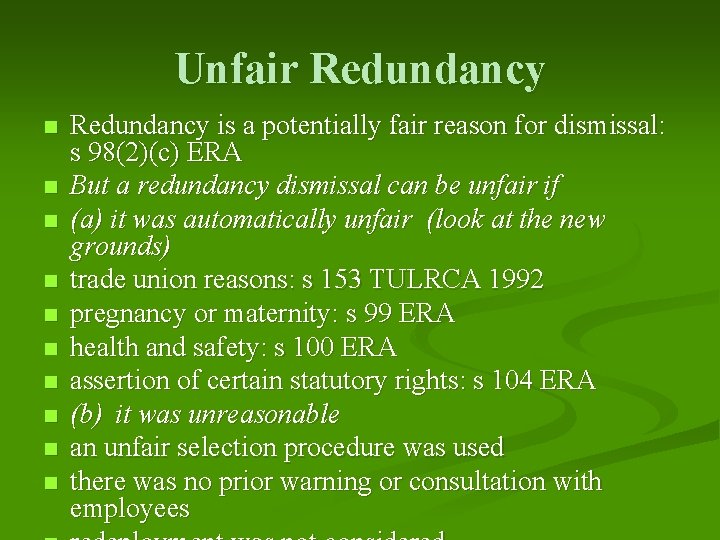
Unfair Redundancy n n n n n Redundancy is a potentially fair reason for dismissal: s 98(2)(c) ERA But a redundancy dismissal can be unfair if (a) it was automatically unfair (look at the new grounds) trade union reasons: s 153 TULRCA 1992 pregnancy or maternity: s 99 ERA health and safety: s 100 ERA assertion of certain statutory rights: s 104 ERA (b) it was unreasonable an unfair selection procedure was used there was no prior warning or consultation with employees
- Slides: 13