
Fairness in AI and Analytics 1 Outline Why
- Slides: 31
Fairness in AI and Analytics 1
Outline • • Why it matters Definitions How we can (try to) measure fairness Steps to make datasets and algorithms more fair • Not included: • A general discussion of Ethics in AI • Explainability • Privacy 2
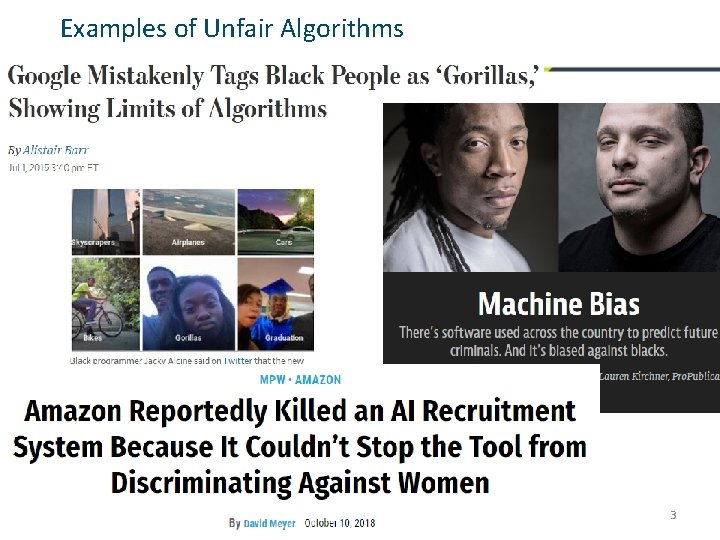
Examples of Unfair Algorithms 3
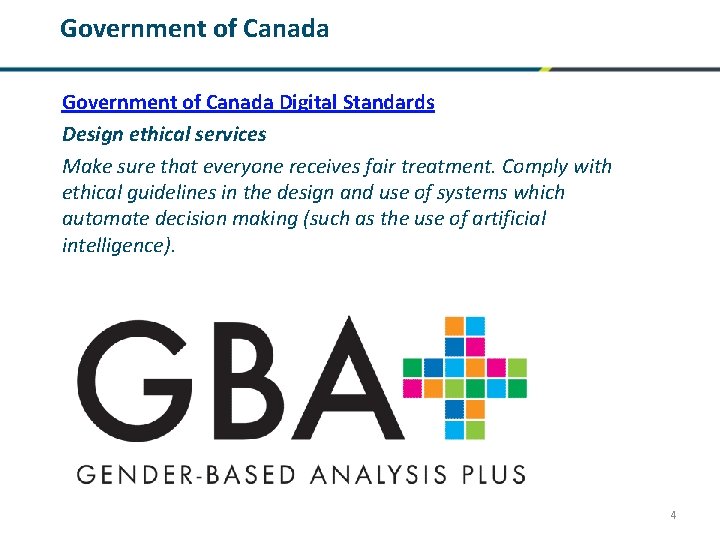
Government of Canada Digital Standards Design ethical services Make sure that everyone receives fair treatment. Comply with ethical guidelines in the design and use of systems which automate decision making (such as the use of artificial intelligence). 4
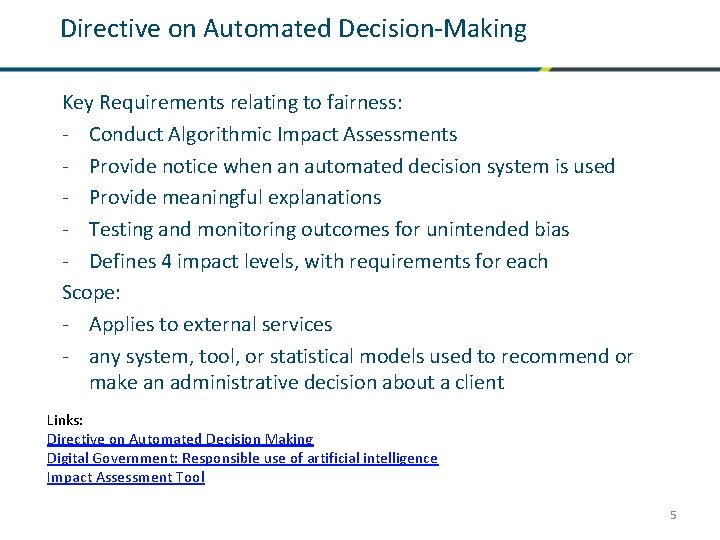
Directive on Automated Decision-Making Key Requirements relating to fairness: - Conduct Algorithmic Impact Assessments - Provide notice when an automated decision system is used - Provide meaningful explanations - Testing and monitoring outcomes for unintended bias - Defines 4 impact levels, with requirements for each Scope: - Applies to external services - any system, tool, or statistical models used to recommend or make an administrative decision about a client Links: Directive on Automated Decision Making Digital Government: Responsible use of artificial intelligence Impact Assessment Tool 5
What is fairness? “Fairness is a multifaceted, context-dependent social construct that defies simple definition. ” (AI Fairness 360 toolkit, IBM) 6
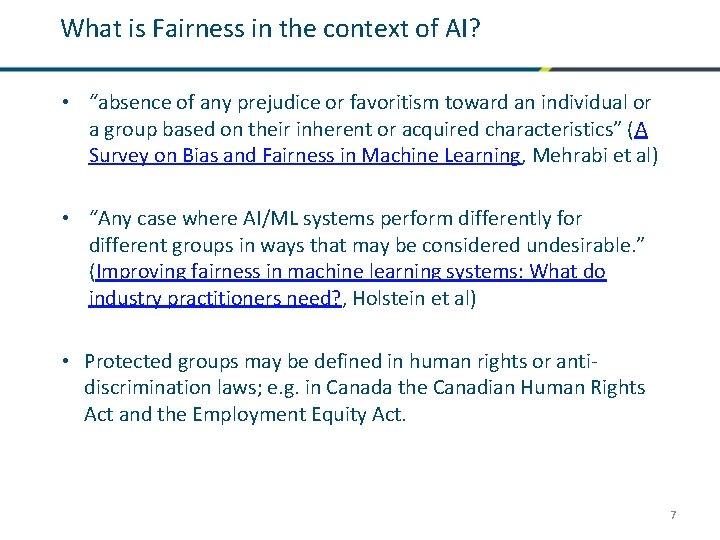
What is Fairness in the context of AI? • “absence of any prejudice or favoritism toward an individual or a group based on their inherent or acquired characteristics” (A Survey on Bias and Fairness in Machine Learning, Mehrabi et al) • “Any case where AI/ML systems perform differently for different groups in ways that may be considered undesirable. ” (Improving fairness in machine learning systems: What do industry practitioners need? , Holstein et al) • Protected groups may be defined in human rights or antidiscrimination laws; e. g. in Canada the Canadian Human Rights Act and the Employment Equity Act. 7
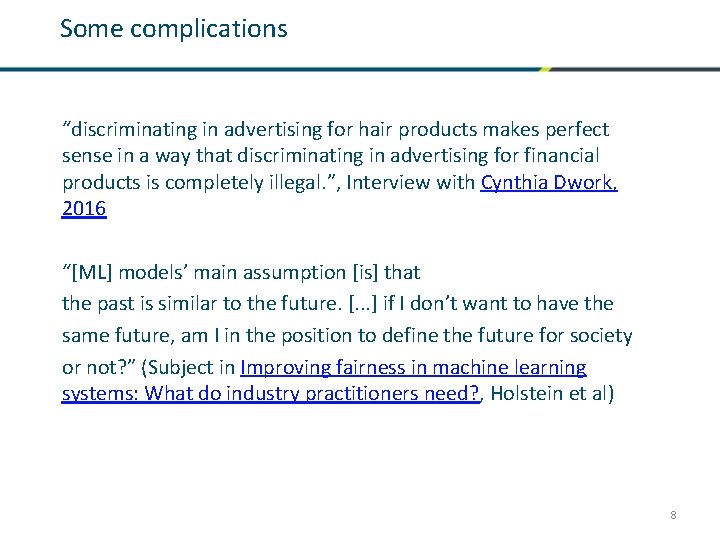
Some complications “discriminating in advertising for hair products makes perfect sense in a way that discriminating in advertising for financial products is completely illegal. ”, Interview with Cynthia Dwork, 2016 “[ML] models’ main assumption [is] that the past is similar to the future. [. . . ] if I don’t want to have the same future, am I in the position to define the future for society or not? ” (Subject in Improving fairness in machine learning systems: What do industry practitioners need? , Holstein et al) 8
Why it’s relevant to AI Automated decision systems have the potential to reduce bias… … but they also have the potential to scale up existing biases Any decision process can be unfair or biased, from judgement of individuals, simple rules, to complex AI systems. Automated Systems are not inherently more or less fair than human decision makers – but they may be unfair in different ways, while having the appearance of being objective. 9
10
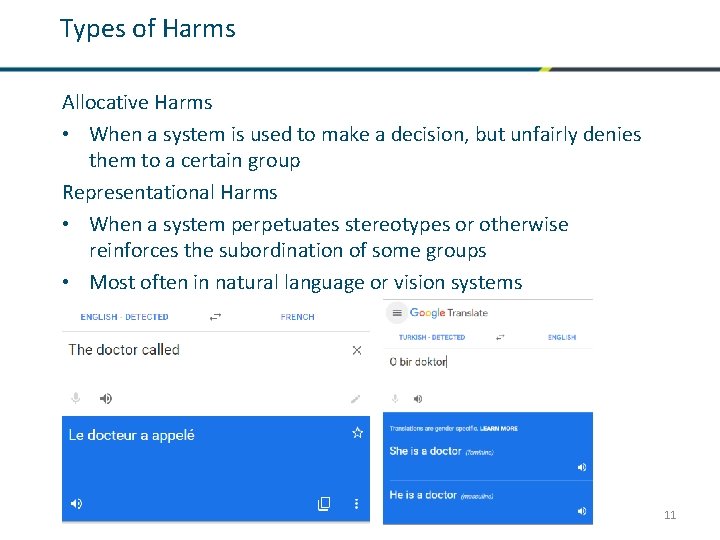
Types of Harms Allocative Harms • When a system is used to make a decision, but unfairly denies them to a certain group Representational Harms • When a system perpetuates stereotypes or otherwise reinforces the subordination of some groups • Most often in natural language or vision systems 11
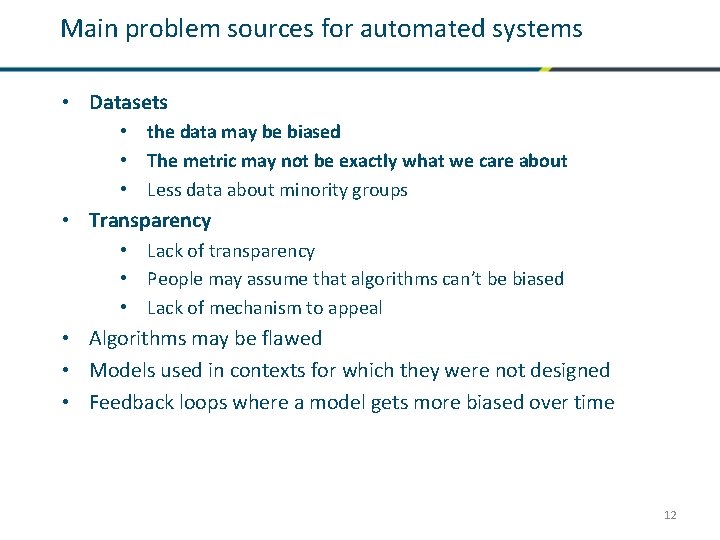
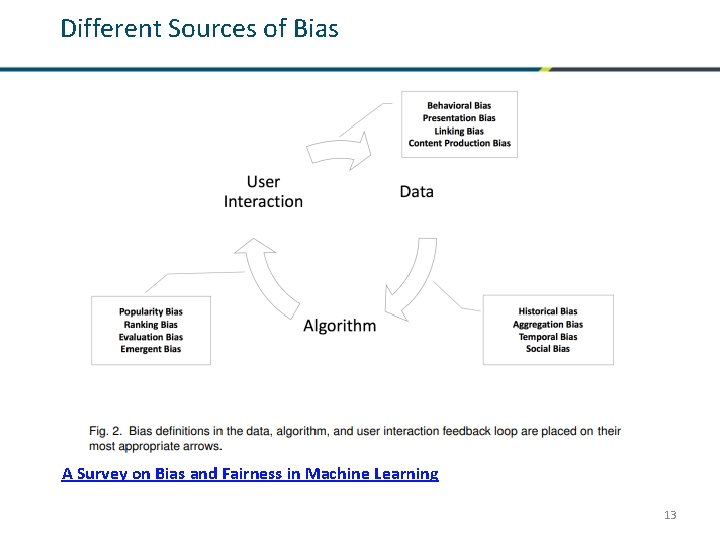
Main problem sources for automated systems • Datasets • the data may be biased • The metric may not be exactly what we care about • Less data about minority groups • Transparency • Lack of transparency • People may assume that algorithms can’t be biased • Lack of mechanism to appeal • Algorithms may be flawed • Models used in contexts for which they were not designed • Feedback loops where a model gets more biased over time 12
Different Sources of Bias A Survey on Bias and Fairness in Machine Learning 13
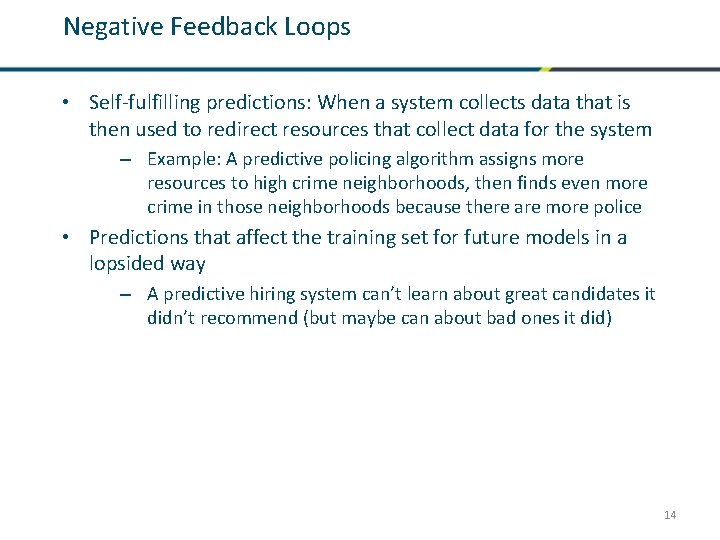
Negative Feedback Loops • Self-fulfilling predictions: When a system collects data that is then used to redirect resources that collect data for the system – Example: A predictive policing algorithm assigns more resources to high crime neighborhoods, then finds even more crime in those neighborhoods because there are more police • Predictions that affect the training set for future models in a lopsided way – A predictive hiring system can’t learn about great candidates it didn’t recommend (but maybe can about bad ones it did) 14
Audience Participation Time! If I search for images of ‘CEOs’, is it more fair to: 1. Over-represent the most common group 2. Represent the current race/gender distribution of CEOs? 3. Represent a diverse set of CEOs? 4. Represent to the demographics of the whole population? 15
Fairness Metrics - Many metrics have been proposed It’s impossible to satisfy all of them at once Different stakeholders may care more about different metrics Most metrics assume access to the sensitive group(s), which may not always be available - There is not, and probably never will be, a universal metric - This goes back at least to work in the Civil Rights era in the US in the context of educational and employment testing, see 50 Years of Test (Un)fairness: Lessons for Machine Learning - Too much focus on metrics can be a bad thing 16
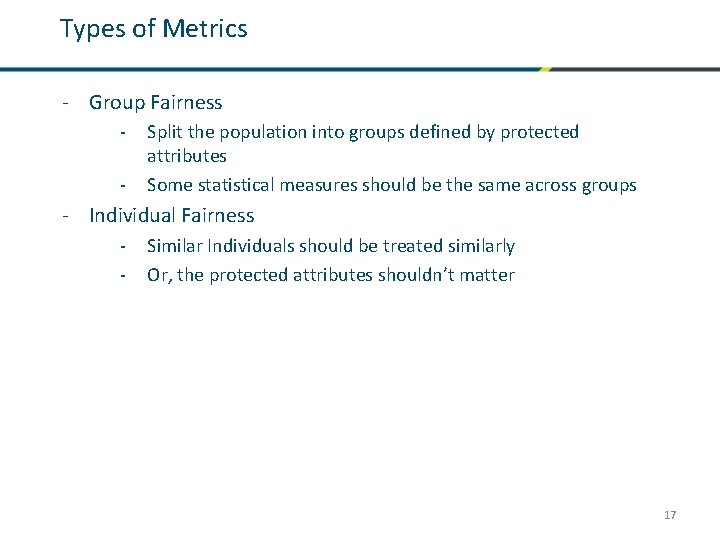
Types of Metrics - Group Fairness - Split the population into groups defined by protected attributes Some statistical measures should be the same across groups - Individual Fairness - Similar Individuals should be treated similarly Or, the protected attributes shouldn’t matter 17
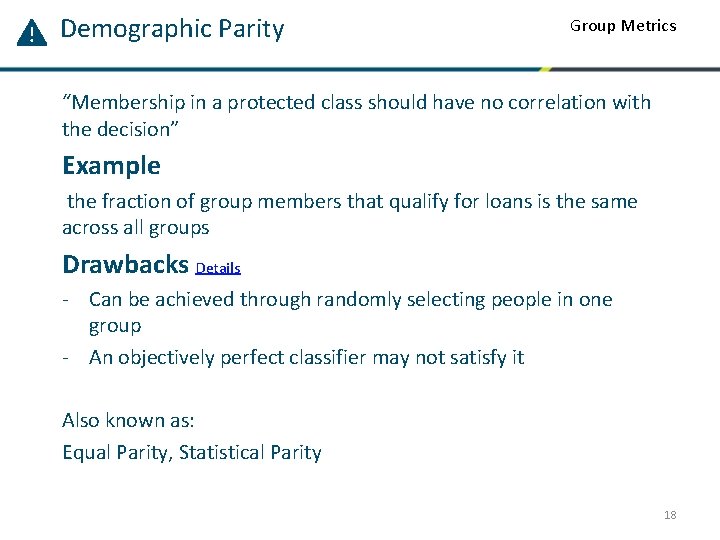
Demographic Parity Group Metrics “Membership in a protected class should have no correlation with the decision” Example the fraction of group members that qualify for loans is the same across all groups Drawbacks Details - Can be achieved through randomly selecting people in one group - An objectively perfect classifier may not satisfy it Also known as: Equal Parity, Statistical Parity 18
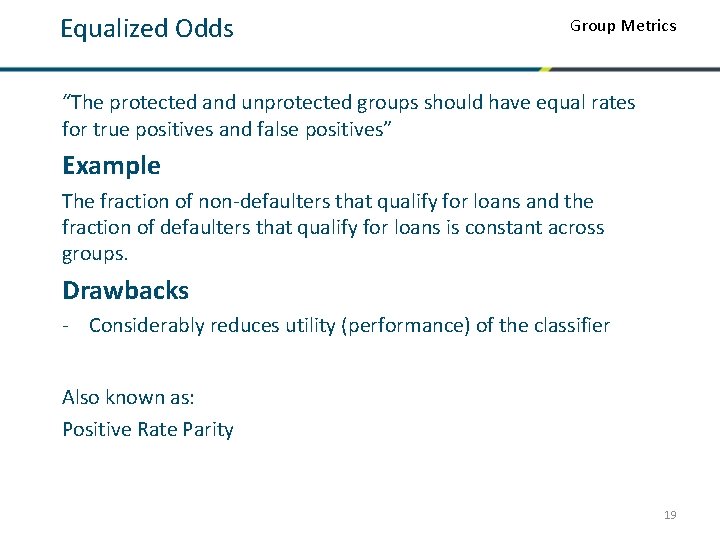
Equalized Odds Group Metrics “The protected and unprotected groups should have equal rates for true positives and false positives” Example The fraction of non-defaulters that qualify for loans and the fraction of defaulters that qualify for loans is constant across groups. Drawbacks - Considerably reduces utility (performance) of the classifier Also known as: Positive Rate Parity 19
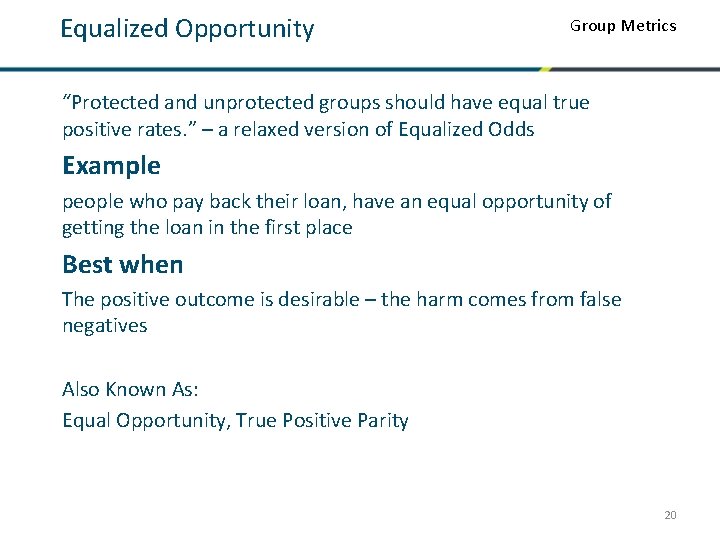
Equalized Opportunity Group Metrics “Protected and unprotected groups should have equal true positive rates. ” – a relaxed version of Equalized Odds Example people who pay back their loan, have an equal opportunity of getting the loan in the first place Best when The positive outcome is desirable – the harm comes from false negatives Also Known As: Equal Opportunity, True Positive Parity 20
Predictive Value Parity Group Metrics When considering people who have a positive outcome, Positive PVP is when the probabilities of a true prediction are the same across groups. Negative PVP is when the probabilities of a negative prediction are the same across groups. PVP is when both are the same. Example People who don’t default are granted and/or denied loans at the same rate across groups Drawbacks - In our loan example, we wouldn’t know whether people we didn’t give a loan to would default 21
Fairness through unawareness Individual Metrics “An algorithm is fair as long as any protected attributes are not explicitly used in the decision-making process” Example: We shouldn’t use race as an attribute in deciding who gets a loan Drawbacks: - Under many circumstances, algorithms will find correlations in other variables that predict sensitive attributes - Under other circumstances, sensitive variables can be used to make models better for protected groups Also known as: Blinding 22
Fairness through awareness Individual Metrics Any two individuals who are similar with respect to a similarity metric defined for a particular task should receive a similar outcome. Drawbacks: - How do you define similarity? 23
Counterfactual Fairness Individual Metrics A decision is fair towards an individual if it is the same in both the actual world and a counterfactual world where the individual belonged to a different demographic group. Drawbacks: - Requires a causal model - Counterfactual scenario may be unrealistic 24
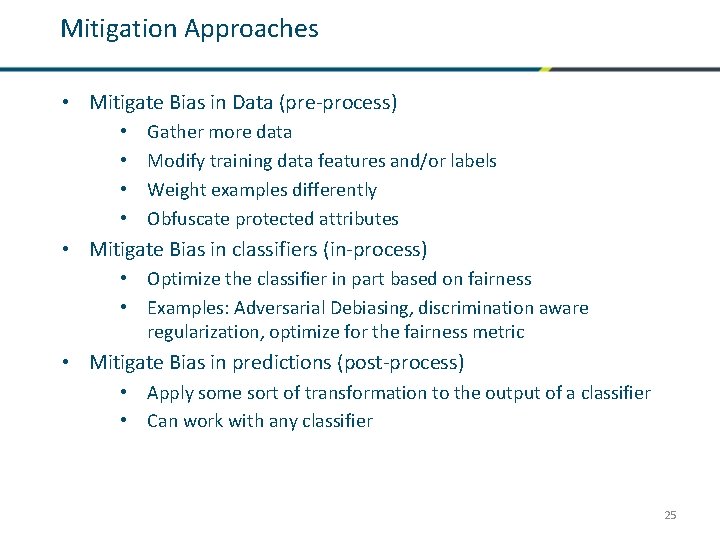
Mitigation Approaches • Mitigate Bias in Data (pre-process) • • Gather more data Modify training data features and/or labels Weight examples differently Obfuscate protected attributes • Mitigate Bias in classifiers (in-process) • Optimize the classifier in part based on fairness • Examples: Adversarial Debiasing, discrimination aware regularization, optimize for the fairness metric • Mitigate Bias in predictions (post-process) • Apply some sort of transformation to the output of a classifier • Can work with any classifier 25
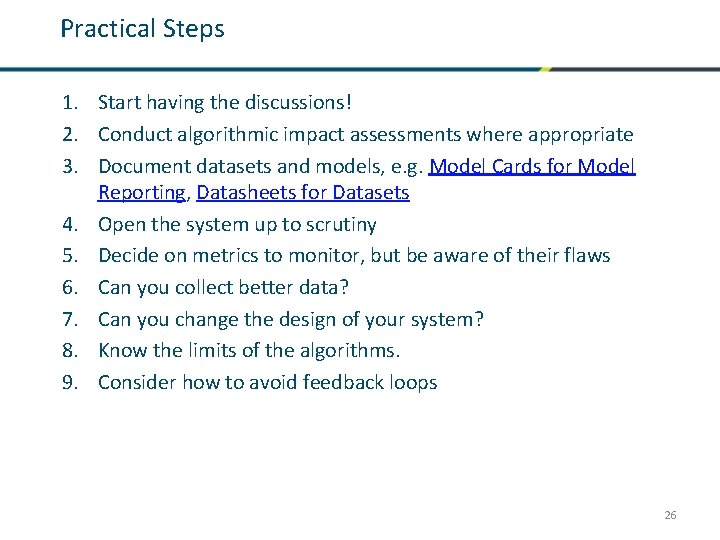
Practical Steps 1. Start having the discussions! 2. Conduct algorithmic impact assessments where appropriate 3. Document datasets and models, e. g. Model Cards for Model Reporting, Datasheets for Datasets 4. Open the system up to scrutiny 5. Decide on metrics to monitor, but be aware of their flaws 6. Can you collect better data? 7. Can you change the design of your system? 8. Know the limits of the algorithms. 9. Consider how to avoid feedback loops 26
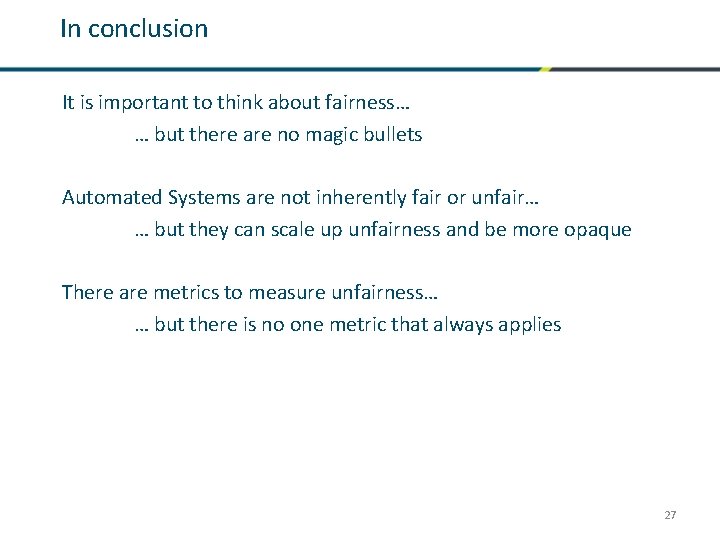
In conclusion It is important to think about fairness… … but there are no magic bullets Automated Systems are not inherently fair or unfair… … but they can scale up unfairness and be more opaque There are metrics to measure unfairness… … but there is no one metric that always applies 27
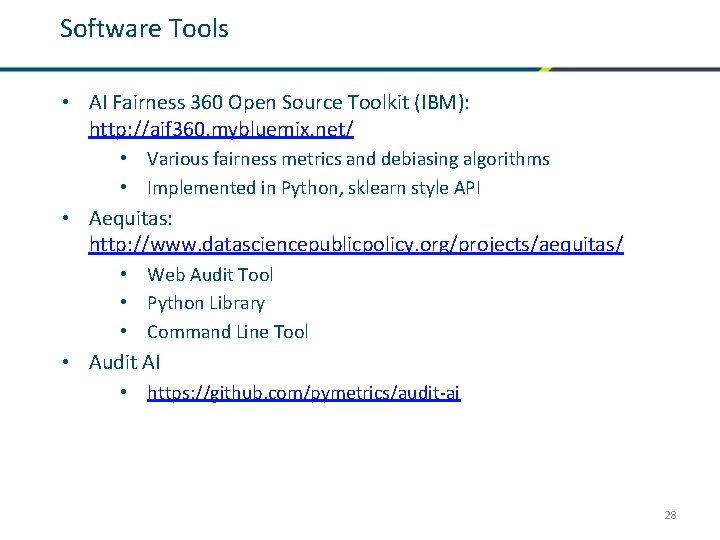
Software Tools • AI Fairness 360 Open Source Toolkit (IBM): http: //aif 360. mybluemix. net/ • Various fairness metrics and debiasing algorithms • Implemented in Python, sklearn style API • Aequitas: http: //www. datasciencepublicpolicy. org/projects/aequitas/ • Web Audit Tool • Python Library • Command Line Tool • Audit AI • https: //github. com/pymetrics/audit-ai 28
High Level Overviews Responsible Artificial Intelligence in the Government of Canada: Digital Disruption White Paper Series Tackling bias in artificial intelligence (and in humans) (Mc. Kinsey Global Institute) Algorithmic Impact Assessments: A Practical Framework for Public Agency Accountability (AI Now Institute) 29
Research Papers and Books Fairness and Accountability Design Needs for Algorithmic Support in High-Stakes Public Sector Decision-Making Approaching Fairness in Machine Learning (Blog) Fairness and Machine Learning (draft): https: //fairmlbook. org/ 30
Talks 21 Definitions of Fairness (Arvind Narayanan) – FAT* 2019 The Trouble with Bias (Kate Crawford) – NIPS 2017 Keynote 31