
Fair Work Improving health safety and wellbeing Professor
Fair Work: Improving health, safety and wellbeing Professor Patricia Findlay Fair Work Convention Co-Chair …………………………………………………………
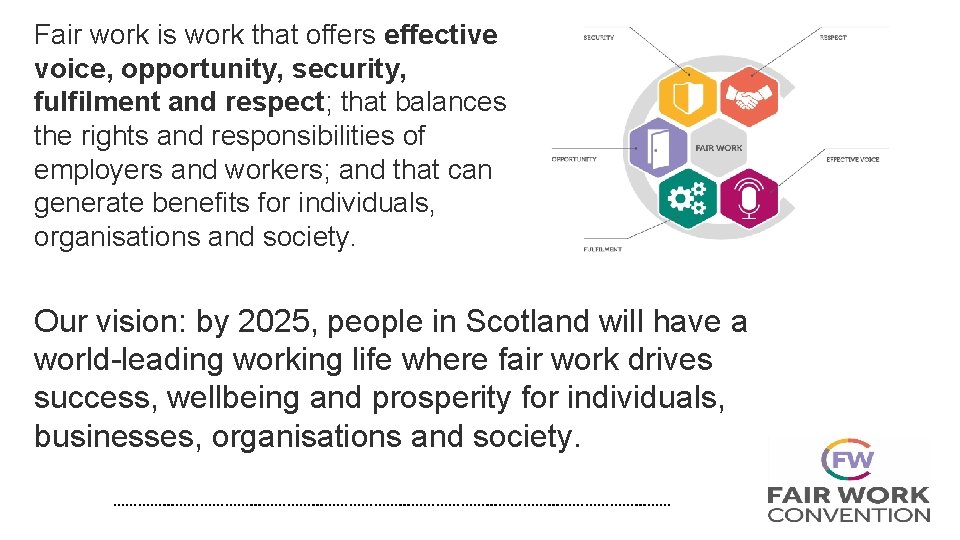
Fair work is work that offers effective voice, opportunity, security, fulfilment and respect; that balances the rights and responsibilities of employers and workers; and that can generate benefits for individuals, organisations and society. Our vision: by 2025, people in Scotland will have a world-leading working life where fair work drives success, wellbeing and prosperity for individuals, businesses, organisations and society. …………………………………………………………………………………………………………………

Thinking behind the FW Framework • Employment quality + job quality + workplace governance • Every dimension of the FW Framework speaks to a broad wellbeing agenda • Finding ways of delivering better outcomes for all lies at the core of FW • Scotland • Businesses/employers • Workers/citizens …………………………………………………………
The ‘Respect’ dimension of Fair Work • Respect for the integrity of the person is fundamental • Health and safety is a core Fair Work issue • Differential physical risks at work – implications for ‘protected categories’ of worker (and for less well protected categories) • Class/socio-economic status • Manual occupation (and ‘hidden’ manual demands of some professional occupations) • Respect, dignity and psychological well-being …………………………………………………………

Security • contractual and job status insecurity • Impact of insecure work (and poor work more generally) • SES 2017: 7% of employees were very anxious that their working hours could change unexpectedly = 1. 7 million employees (much more pervasive than ZHCs est. at 700, 000 for UK) • Insecurity comes in multiples - SES 2017: those working insecure hours also suffered from other types of insecurity such as greater risk of job loss, greater anxiety of job status downgrading and more worry about unfair treatment. In addition, they reported lower pay, speedier dismissal for poor work performance and higher work effort. • SES 2017: 28% of people are anxious about changes in valued aspects of work (though this has fallen by 9% since 2012) …………………………………………………………
Fulfilment • SES 2017: decline in task discretion between 2012 and 2017 – yet task discretion is the type of participation with the strongest association with employee well-being • Sharper decline for intermediate workers for female part-timers. • SES 2017: rise in work intensity – eg 31% of people report working at ‘very high speeds’ (rise of 4%) • SES 2017: Especially high levels of required work intensification in teaching and nursing. • 92% of teachers strongly agreed that their job requires them to work very hard (up 10%) • 90% of teachers and almost 75% of nurses report always coming home exhausted • SES 2017: the proportion of women working in ‘high strain’ jobs, combining very high work effort with low task discretion and therefore creating an elevated risk of workplace stress, rose 5% to 20% • Job demands/resources/control closely linked to well-being …………………………………………………………
Effective voice • absence of collective voice and limitations of some forms of individual voice • SES 2017: decline in formal institutions for organisational participation (consultative meetings, quality circles) between 2012 and 2017 • proportion of employees reporting high influence over organisational decisions that affected their work increased from 26% to 30% • influence through organisational participation was associated with considerable benefits for well-being …………………………………………………………
Scottish Government • National Performance Framework • Work related ill health • Collective bargaining coverage • Influence on reserved matters - but also need to use powers available to Scottish government to fullest extent • Fair Work Action Plan (forthcoming) • Expectation that Fair Work will be mainstreamed across all areas of government (eg health, justice) • Currently being consulted on …. • Fair Work First …………………………………………………………
Relevant future FWC interests • Older workers • Construction • Automation …………………………………………………………
- Slides: 9