
FAIR VALUE ACCOUNTING SLFRF 13 Rangajewa Herath B

FAIR VALUE ACCOUNTING ( SLFRF 13) Rangajewa Herath B. Sc. Accountancy and Financial Management(Sp. ) (Hons. ) (USJ) , Master of Business Administration -PIM(USJ) (Senior Lecturer, University of Sri Jayewardenepura) Rangajeewa Herath 1
Learning Outcomes At end of this session, the students should be able to: n Definition of terms related to Fair Value n Explain and apply Valuation Techniques used in fair value n Describe the Fair Value Hierarchy n Determine the fair value of an asset/ liability Rangajeewa Herath 2
Lesson Outline o Role of Fair Value in Accounting o IFRS/SLFRS 13 Fair Value Measurement n Definition of Fair Value n Valuation Techniques n Fair Value Hierarchy Rangajeewa Herath 3
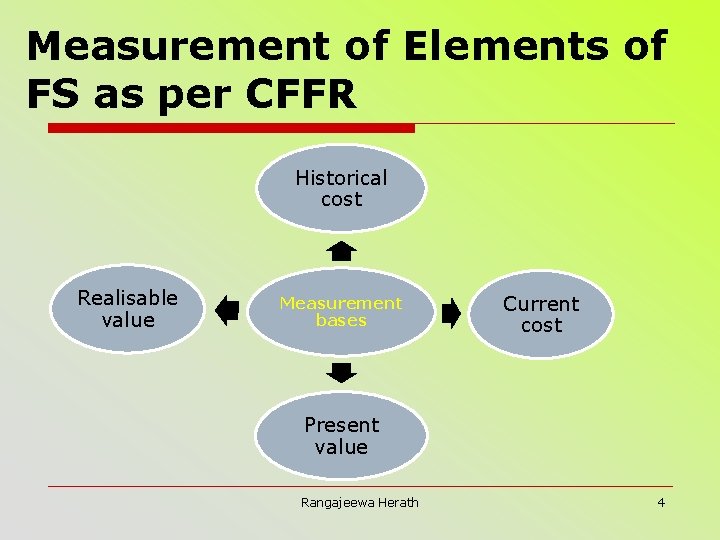
Measurement of Elements of FS as per CFFR Historical cost Realisable value Measurement bases Current cost Present value Rangajeewa Herath 4
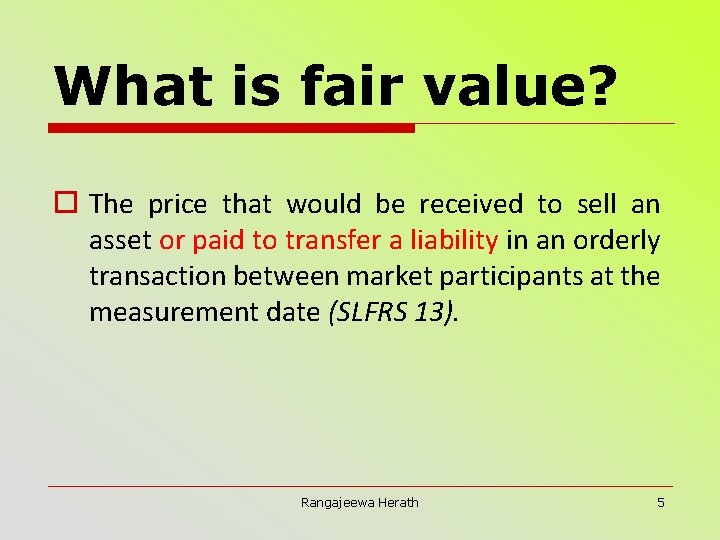
What is fair value? o The price that would be received to sell an asset or paid to transfer a liability in an orderly transaction between market participants at the measurement date (SLFRS 13). Rangajeewa Herath 5

Activity 1 o Identify the accounting standards in which FV based measurement is used. Rangajeewa Herath 6
o Provides guidance on ‘how’ to measure FV rather than ‘when’ to measure FV. n Defines FV n Sets out in a single SLFRS, a framework for measuring fair value FV n Requires disclosures about FV measurements Rangajeewa Herath 7
Scope of SLFRS 13 o Applies when another IFRS requires or permits FV for measurements or disclosures : o Examples: PPE/Investment property/intangibles/ held at FV Biological assets Financial instruments Most assets and liabilities acquired in a business combination n Non-current assets held for sale in accordance with SLFRS 5 n n Rangajeewa Herath 8
Definition of FV o The price that would be received to sell an asset or paid to transfer a liability in an orderly transaction between market participants at the measurement date. n Market-based measurement, not an entity-specific measurement. Rangajeewa Herath 9
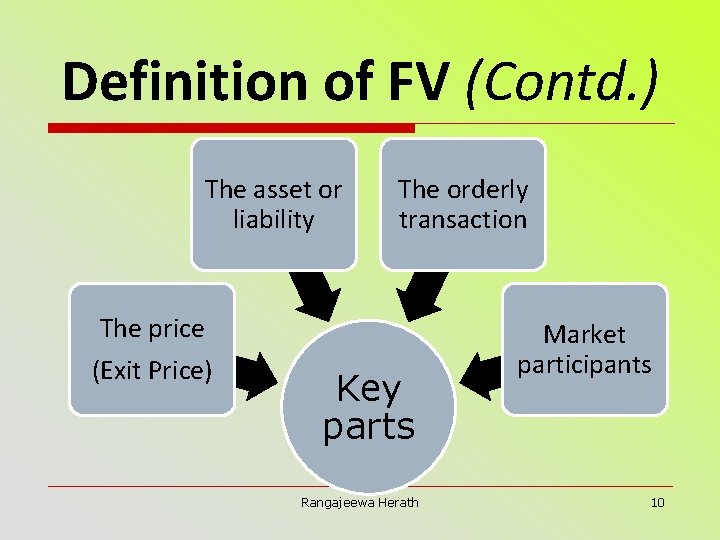
Definition of FV (Contd. ) The asset or liability The price (Exit Price) The orderly transaction Key parts Rangajeewa Herath Market participants 10
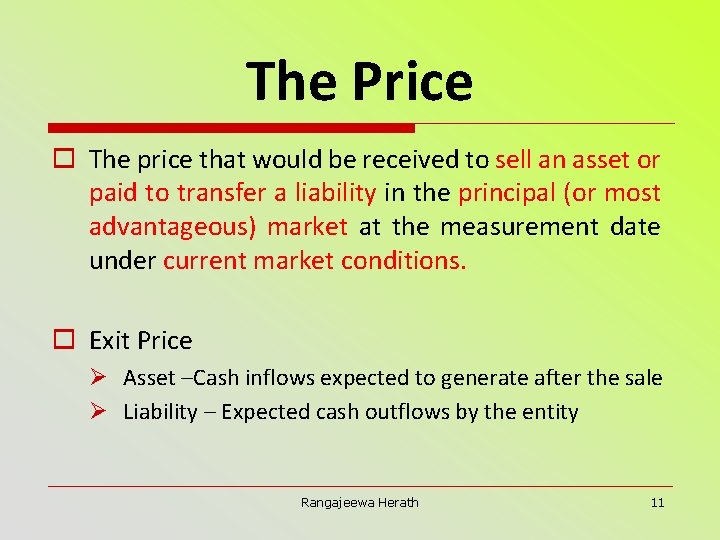
The Price o The price that would be received to sell an asset or paid to transfer a liability in the principal (or most advantageous) market at the measurement date under current market conditions. o Exit Price Ø Asset –Cash inflows expected to generate after the sale Ø Liability – Expected cash outflows by the entity Rangajeewa Herath 11
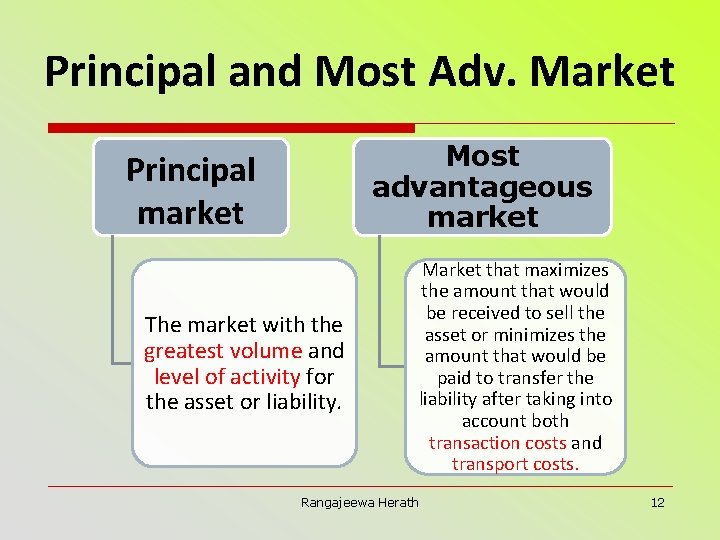
Principal and Most Adv. Market Most advantageous market Principal market The market with the greatest volume and level of activity for the asset or liability. Market that maximizes the amount that would be received to sell the asset or minimizes the amount that would be paid to transfer the liability after taking into account both transaction costs and transport costs. Rangajeewa Herath 12
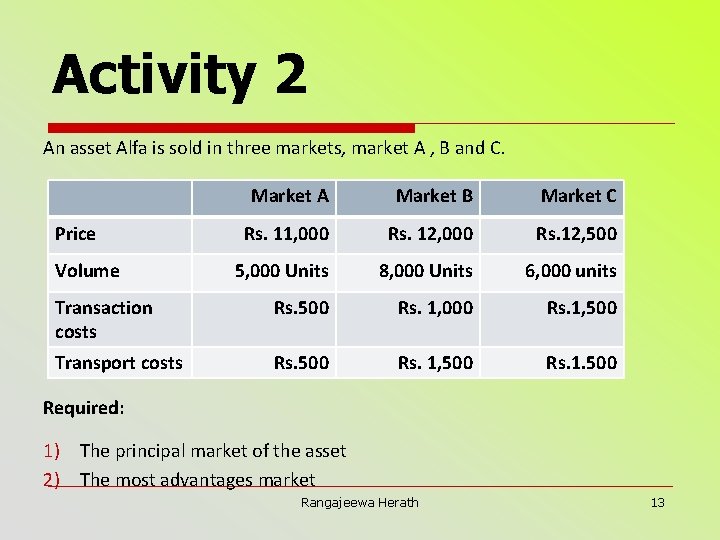
Activity 2 An asset Alfa is sold in three markets, market A , B and C. Market A Market B Market C Rs. 11, 000 Rs. 12, 500 5, 000 Units 8, 000 Units 6, 000 units Transaction costs Rs. 500 Rs. 1, 000 Rs. 1, 500 Transport costs Rs. 500 Rs. 1, 500 Rs. 1. 500 Price Volume Required: 1) The principal market of the asset 2) The most advantages market Rangajeewa Herath 13
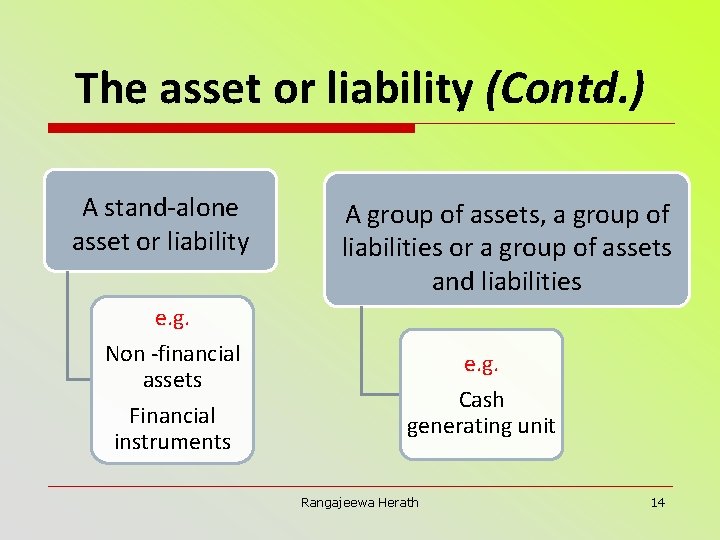
The asset or liability (Contd. ) A stand-alone asset or liability e. g. Non -financial assets Financial instruments A group of assets, a group of liabilities or a group of assets and liabilities e. g. Cash generating unit Rangajeewa Herath 14
Orderly Transaction o A transaction that assumes exposure to the market for a period before the measurement date to allow marketing activities that are usual and customary for transactions involving such assets or liabilities and it is not a forced transaction. Rangajeewa Herath 15
Market Participants o Buyers and sellers in the principal (or most advantageous) market for the asset or liability with the following characteristics: n Independent of each other (Not related parties) n Knowledgeable, with reasonable understanding about the asset or liability and the transaction n Able to enter into a transaction n Willing to enter into a transaction Rangajeewa Herath 16
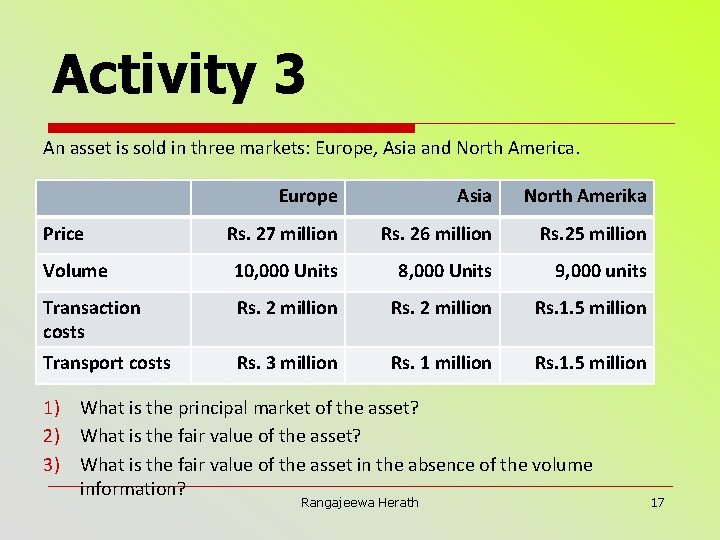
Activity 3 An asset is sold in three markets: Europe, Asia and North America. Europe Asia North Amerika Rs. 27 million Rs. 26 million Rs. 25 million Volume 10, 000 Units 8, 000 Units 9, 000 units Transaction costs Rs. 2 million Rs. 1. 5 million Transport costs Rs. 3 million Rs. 1. 5 million Price 1) What is the principal market of the asset? 2) What is the fair value of the asset? 3) What is the fair value of the asset in the absence of the volume information? Rangajeewa Herath 17
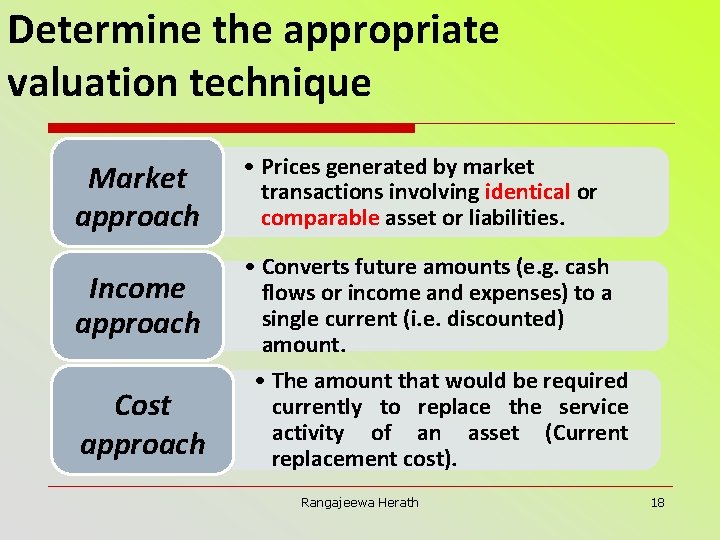
Determine the appropriate valuation technique Market approach Income approach Cost approach • Prices generated by market transactions involving identical or comparable asset or liabilities. • Converts future amounts (e. g. cash flows or income and expenses) to a single current (i. e. discounted) amount. • The amount that would be required currently to replace the service activity of an asset (Current replacement cost). Rangajeewa Herath 18
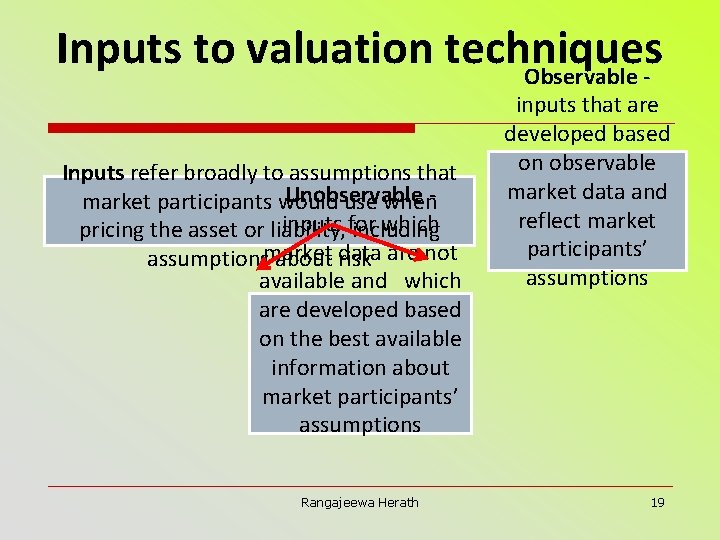
Inputs to valuation techniques Observable Inputs refer broadly to assumptions that Unobservable market participants would use wheninputs for which pricing the asset or liability, including data are not assumptionsmarket about risk available and which are developed based on the best available information about market participants’ assumptions Rangajeewa Herath inputs that are developed based on observable market data and reflect market participants’ assumptions 19
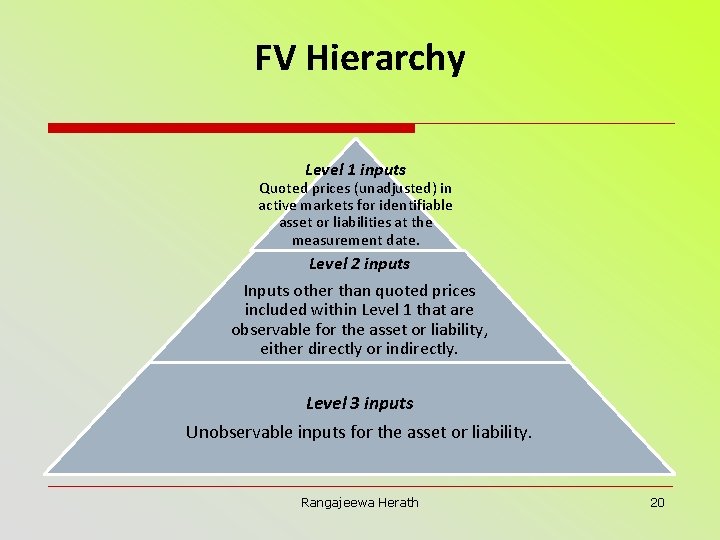
FV Hierarchy Level 1 inputs Quoted prices (unadjusted) in active markets for identifiable asset or liabilities at the measurement date. Level 2 inputs Inputs other than quoted prices included within Level 1 that are observable for the asset or liability, either directly or indirectly. Level 3 inputs Unobservable inputs for the asset or liability. Rangajeewa Herath 20
Summary Rangajeewa Herath 21
LKAS 7 : Statement of cash flows Rangajewa Herath B. Sc. Accountancy and Financial Management(Sp. ) (Hons. ) (USJ) , Master of Business Administration -PIM(USJ) (Senior Lecturer, University of Sri Jayewardenepura) 22
Statement of Cash flows o Statement of Cash Flows is financial statements which provide information on business’s cash flows during the period classified by operating, investing and financing activities. o Cash flows are inflows and outflows of cash and cash equivalents. o Cash comprises cash on hand demand deposits. o Cash equivalents are short-term, highly liquid investments that are readily convertible to known mounts of cash and which are subject to an insignificant risk of changes in value. Rangajeewa Herath 23 (LKAS 07)
Statement of Cash flows o Operating activities are the principal revenueproducing activities of the enterprise and other activities that are not investing or financing activities. o Investing activities are the acquisition and disposal of long-term assets and other investments not included in cash equivalents. o Financing activities are activities that result in changes in the size and composition of the equity capital and borrowings of the enterprise. Rangajeewa Herath 24
Preparation of Statement of Cash Flows o Direct Method o Indirect Method Rangajeewa Herath 25
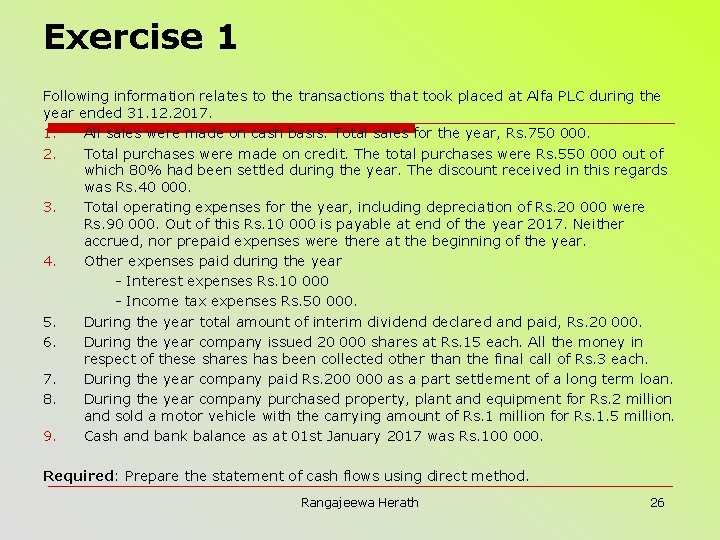
Exercise 1 Following information relates to the transactions that took placed at Alfa PLC during the year ended 31. 12. 2017. 1. All sales were made on cash basis. Total sales for the year, Rs. 750 000. 2. Total purchases were made on credit. The total purchases were Rs. 550 000 out of which 80% had been settled during the year. The discount received in this regards was Rs. 40 000. 3. Total operating expenses for the year, including depreciation of Rs. 20 000 were Rs. 90 000. Out of this Rs. 10 000 is payable at end of the year 2017. Neither accrued, nor prepaid expenses were there at the beginning of the year. 4. Other expenses paid during the year - Interest expenses Rs. 10 000 - Income tax expenses Rs. 50 000. 5. During the year total amount of interim dividend declared and paid, Rs. 20 000. 6. During the year company issued 20 000 shares at Rs. 15 each. All the money in respect of these shares has been collected other than the final call of Rs. 3 each. 7. During the year company paid Rs. 200 000 as a part settlement of a long term loan. 8. During the year company purchased property, plant and equipment for Rs. 2 million and sold a motor vehicle with the carrying amount of Rs. 1 million for Rs. 1. 5 million. 9. Cash and bank balance as at 01 st January 2017 was Rs. 100 000. Required: Prepare the statement of cash flows using direct method. Rangajeewa Herath 26
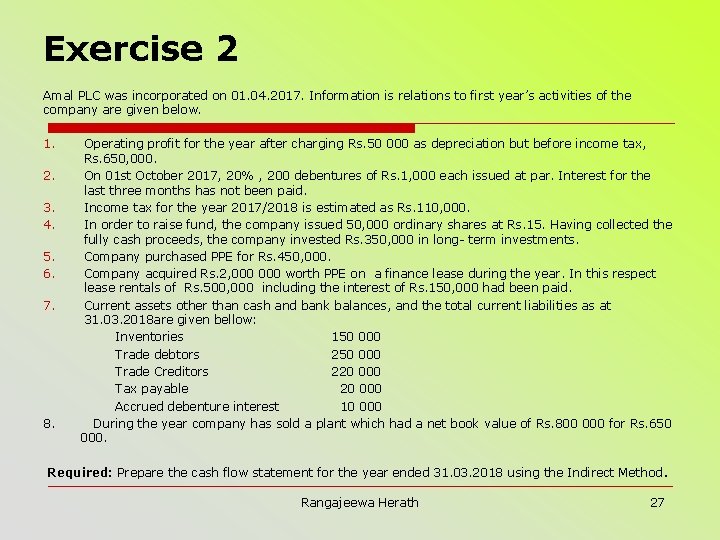
Exercise 2 Amal PLC was incorporated on 01. 04. 2017. Information is relations to first year’s activities of the company are given below. 1. Operating profit for the year after charging Rs. 50 000 as depreciation but before income tax, Rs. 650, 000. 2. On 01 st October 2017, 20% , 200 debentures of Rs. 1, 000 each issued at par. Interest for the last three months has not been paid. 3. Income tax for the year 2017/2018 is estimated as Rs. 110, 000. 4. In order to raise fund, the company issued 50, 000 ordinary shares at Rs. 15. Having collected the fully cash proceeds, the company invested Rs. 350, 000 in long- term investments. 5. Company purchased PPE for Rs. 450, 000. 6. Company acquired Rs. 2, 000 worth PPE on a finance lease during the year. In this respect lease rentals of Rs. 500, 000 including the interest of Rs. 150, 000 had been paid. 7. Current assets other than cash and bank balances, and the total current liabilities as at 31. 03. 2018 are given bellow: Inventories 150 000 Trade debtors 250 000 Trade Creditors 220 000 Tax payable 20 000 Accrued debenture interest 10 000 8. During the year company has sold a plant which had a net book value of Rs. 800 000 for Rs. 650 000. Required: Prepare the cash flow statement for the year ended 31. 03. 2018 using the Indirect Method. Rangajeewa Herath 27
- Slides: 27