
Fair Testing Presenters Maria Barrett JodiAnn Gulley Science
Fair Testing Presenters: Maria Barrett & Jodi-Ann Gulley Science & Engineering Faculty Queensland University of Technology (QUT)
Scope • Fair testing – life skills focus : – ACARA – Science Inquiry Skills focus (also SHE – not covered in this session) – Problem-based learning – Inquiry-based learning • Recognises variations between reporting formats – The ‘scientific method’ is not covered in full in this session • Session will benefit beginning teachers and those seeking more information on fair testing as a process and skill.
What is fair testing? Fair testing is a way to find the answer to a researchable question and know that the answer is correct. It helps us to be sure of the cause of something.
Fair testing • Change one thing • Measure one thing* • Keep all other things the same Doing this means we can tell what causes the change. * Measure can also include observe one thing.
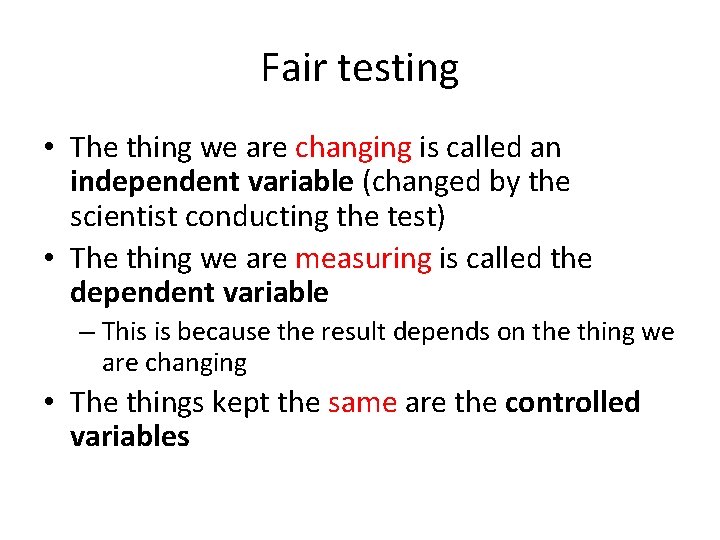
Fair testing • The thing we are changing is called an independent variable (changed by the scientist conducting the test) • The thing we are measuring is called the dependent variable – This is because the result depends on the thing we are changing • The things kept the same are the controlled variables
Example 1 Sherbet Fizz (ACARA Chemical Sciences – Year 6*) Step 1: the research question We know that sherbet fizzes when put in our mouth – but. . . What question do we want to answer? Q: What sherbet ingredients react to cause the fizzing? Note: Those teachers who use Primary Connections may have used a variation of this experiment in the ‘Change Detectives’ unit.
Step 2: the hypothesis • An educated guess about how things work • An easy way to remember: If. . . [I do this]. . . , then. . . [this will happen]*. If I mix [different combinations of sherbet ingredients] with water, then I can find out which ones cause sherbet to fizz. • Needs to be worded so that it can be tested by your experiment * A ‘because’ statement may be added here to determine student prior understanding and reasoning, and for development of argumentation skills. A ‘because’ statement is not used in secondary school contexts when writing hypotheses.
Step 3: test the hypothesis • How will you answer the question? • Design and conduct an experiment using fair testing principles. • Devise method: – Mix ingredients together – Add water – Watch for fizz
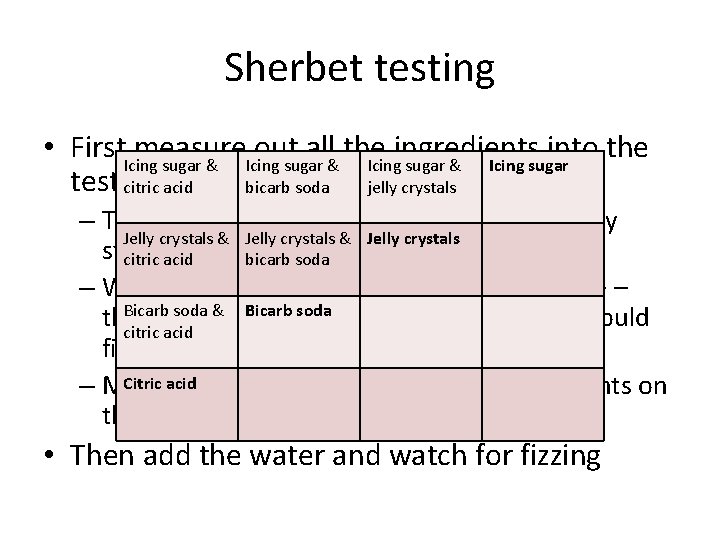
Sherbet testing • First. Icing measure out all the ingredients into the sugar & Icing sugar testing tray inbicarb a logical order citric acid soda jelly crystals – This prevents contamination (using clean, dry Jelly crystals & Jelly crystals sticks) citric acid bicarb soda – We can compare all results at the same time – Bicarb soda & Bicarb soda there may be some bubbles but only one should citric acid fizz up Citric acid – Make sure this includes testing the ingredients on their own (control) • Then add the water and watch for fizzing
How do I know I am right? • Fair testing! – Test combinations of ingredients (independent variable) • Test each ingredient • Test pairs of ingredients – Watch for fizz (the dependent variable) – Keep all other things the same (controlled variable)
Example 2 Water. Works (ACARA Chemical Sciences – Year 7*) Step 1: the research question Water filtration is needed to make water safe to drink. You are supplied with a dirty water sample and different filter materials. What research question do you want to answer?
How will you answer the question? Conduct an experiment – Select different filtering materials to test – Fill each column with one of the filter materials – Pour water sample into column – Leave to filter through column – Check ‘clean-ness’ of water
How do I know I am right? • Fair testing! – Change one thing at a time (independent variable – filter material) – Measure one thing – ‘clean-ness’ of water after filtering (dependant variable) – Keep all other things the same – use same syringe, base water sample, amount of water filtered*, etc (controlled variables) * Having to ‘measure’ the sample being filtered or amount of filter material can cause some confusion for students – this is preparation measurement NOT the output being measured
Water Filtration 1. Use water from same sample – shake before pouring to ensure well mixed 2. Measure same quantity (10 ml) 3. Pour water into column 4. Repeat 1 -3 for other columns (filter materials are the independent variable) 5. Wait for 5 minutes 6. Check ‘clean-ness’ of water in beaker (dependent variable)
Example 3 LEGO car design (ACARA Physical Sciences – Year 7*) Step 1: the BIG design question What makes a car go faster? In this example you are provided with a LEGO car and a variety of wheels. . . What research question do you want to answer?
How to run a Fair Test - recap • Remember – Step 1: What’s the question? – Step 2: State your hypothesis – a guess about how things will work – Step 3: How do I find the answer? • Design the experiment – How do I know I am right? • Change one thing • Measure (or observe) one thing • Keep all other things the same
Resources • Elsie and the Golden Cows: http: //learningplace. com. au/sc/online/Elsie_an d_the_golden_cows/pirates_v 0_04. html • STAQ website – members only – log-in required www. staq. qld. edu. au/programs/primary
- Slides: 17