
Fair Division DividerChooser Method DividerChooser The DividerChooser method
- Slides: 21
Fair Division Divider-Chooser Method
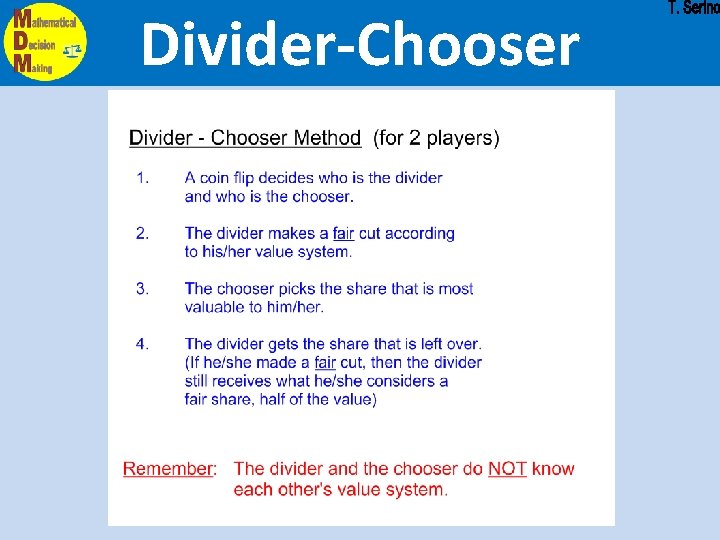
Divider-Chooser The Divider-Chooser method is, by far, the most popular fair division scheme. Without modification, this method only works for two players. Informally, it is referred to as the, you cut – I choose method. Given any continuous set S, the divider cuts S into two pieces, the chooser picks the piece he/she prefers, and the divider is left with the remaining piece.
Divider-Chooser
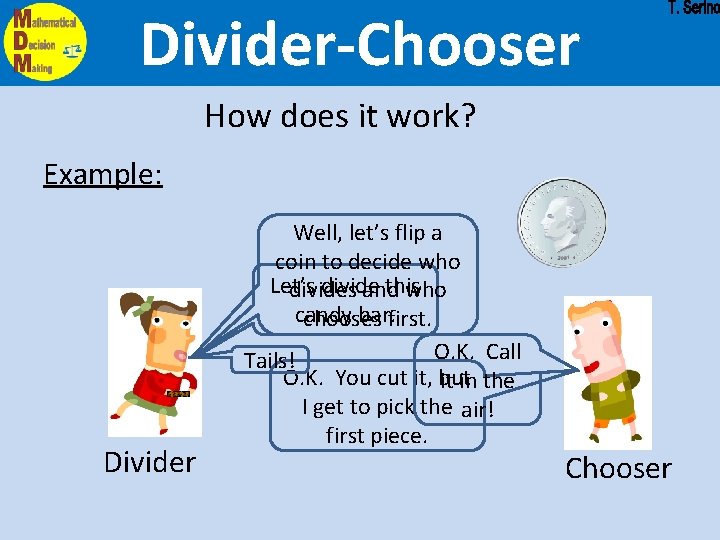
Divider-Chooser How does it work? Example: Divider Well, let’s flip a coin to decide who Let’s divide this divides and who candy bar. chooses first. O. K. Call Tails! O. K. You cut it, but it in the I get to pick the air! first piece. Chooser
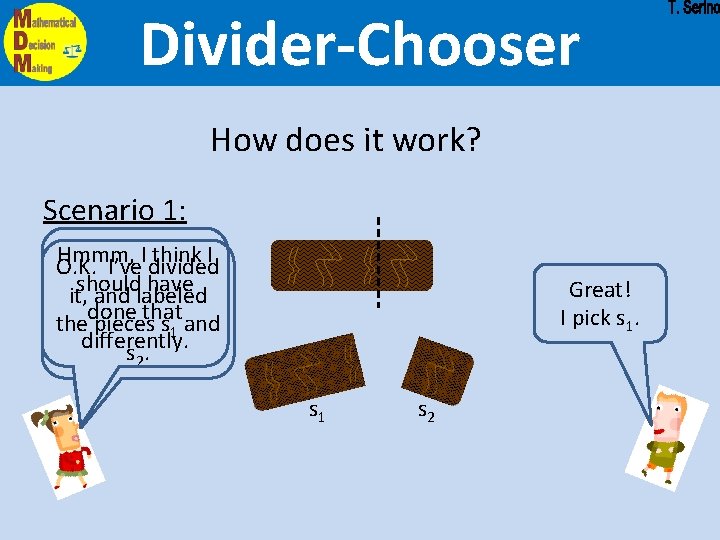
Divider-Chooser How does it work? Scenario 1: Hmmm, I think I O. K. I’ve divided should have it, and labeled done that and the pieces s 1 differently. s 2. Great! I pick s 1 s 2
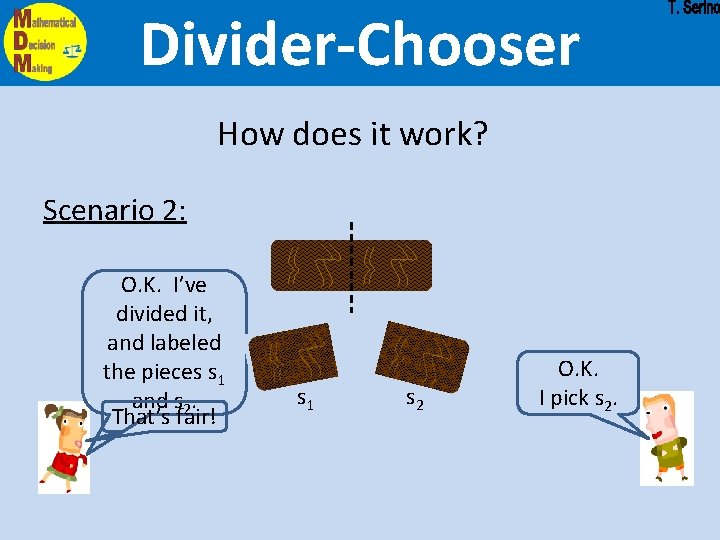
Divider-Chooser How does it work? Scenario 2: O. K. I’ve divided it, and labeled the pieces s 1 and s 2. That’s fair! s 1 s 2 O. K. I pick s 2.
Divider-Chooser Scenario 1 didn’t seem fair at a glance, because the divider didn’t make a fair cut. (The divider was given the opportunity to make a fair cut. This means that it was a fair division, but it was poorly played by the divider. ) Scenario 2 left both players with a fair share of the candy bar. The key to making this method work is that the divider must make a fair cut.
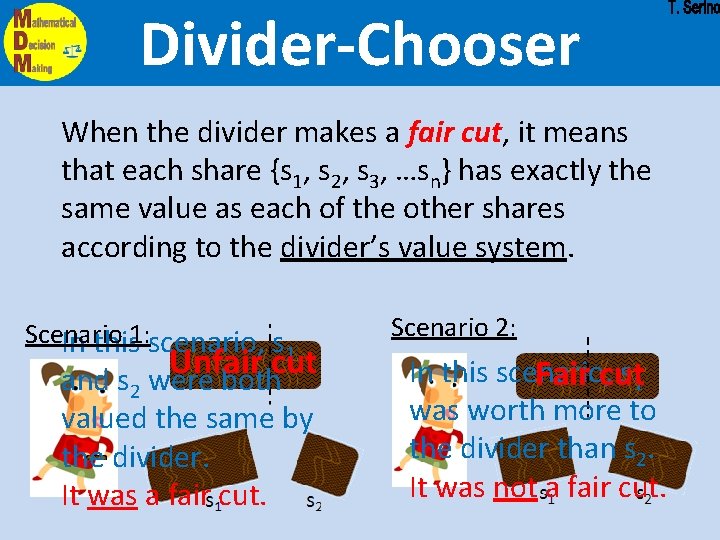
Divider-Chooser When the divider makes a fair cut, it means that each share {s 1, s 2, s 3, …sn} has exactly the same value as each of the other shares according to the divider’s value system. Scenario 1: In this scenario, s 1 Unfair cut and s were both 2 valued the same by the divider. It was a fair cut. Scenario 2: In this scenario, s Fair cut 1 was worth more to the divider than s 2. It was not a fair cut.
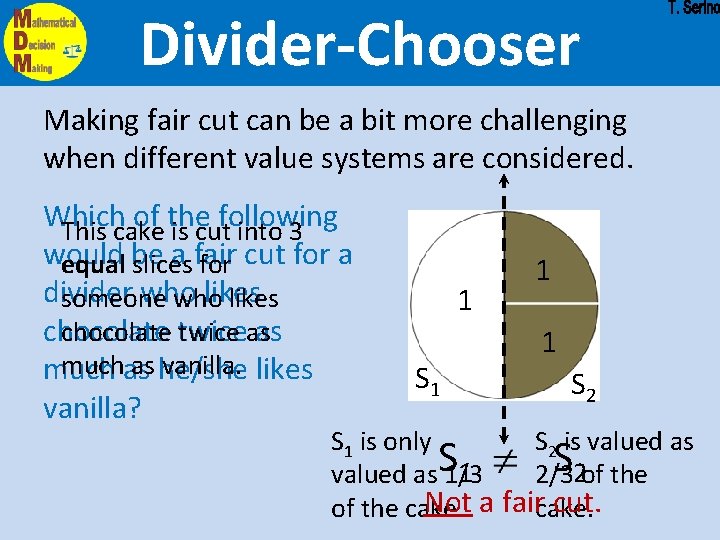
Divider-Chooser Making fair cut can be a bit more challenging when different value systems are considered. Which of the following This cake is cut into 3 would be a fair cut for a equal slices for divider who likes someone who likes chocolate twice as much as vanilla. much as he/she likes vanilla? 1 S 1 1 1 S 2 S 1 is only S 2 is valued as S 1 S 2 valued as 1/3 2/3 of the Not a fair cut. of the cake.
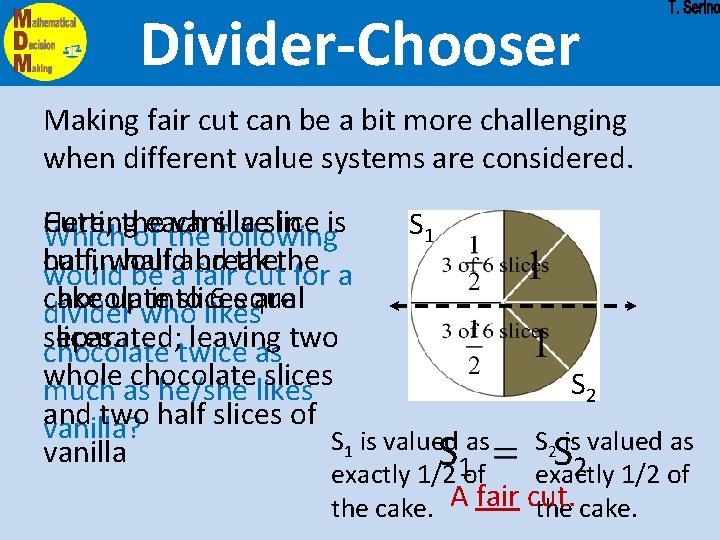
Divider-Chooser Making fair cut can be a bit more challenging when different value systems are considered. Cutting each slice in Here, the vanilla slice is S 1 Which of the following half, would break the cut in half and the would be a fair cut for a cake up into 6 equal chocolate slices are divider who likes slices. separated; leaving two chocolate twice as whole chocolate slices S 2 much as he/she likes and two half slices of vanilla? S 1 is valued as S 2 is valued as vanilla S S 1 2 exactly 1/2 of the cake. A fair cut. the cake.
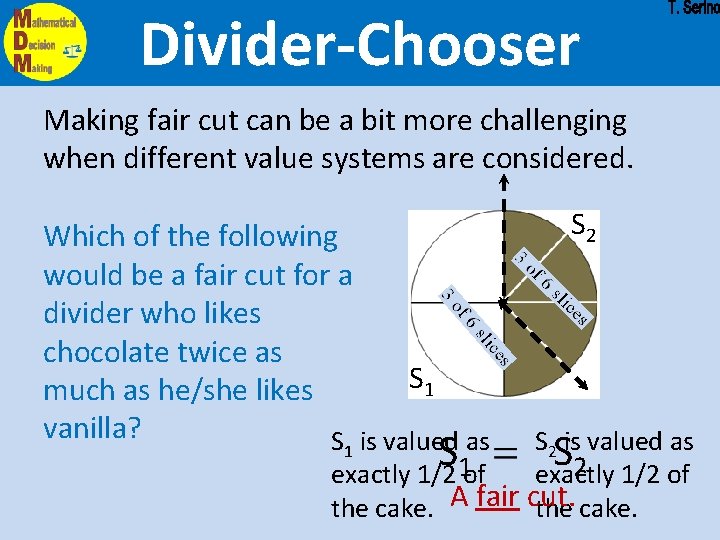
Divider-Chooser Making fair cut can be a bit more challenging when different value systems are considered. Which of the following would be a fair cut for a divider who likes chocolate twice as S 1 much as he/she likes vanilla? S is valued as S 2 is valued as S S 1 2 exactly 1/2 of the cake. A fair cut. the cake. 1
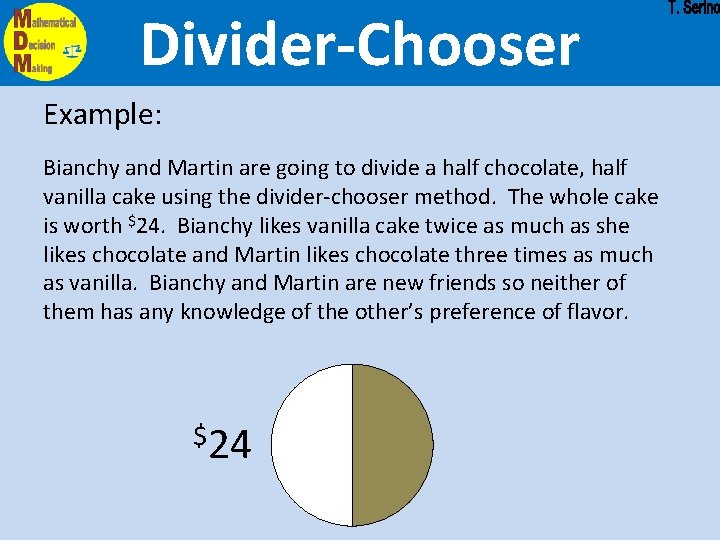
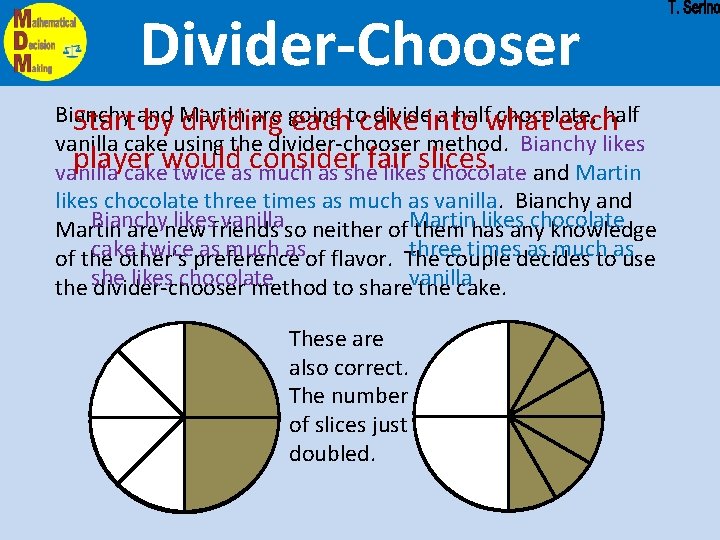
Divider-Chooser Example: Bianchy and Martin are going to divide a half chocolate, half vanilla cake using the divider-chooser method. The whole cake is worth $24. Bianchy likes vanilla cake twice as much as she likes chocolate and Martin likes chocolate three times as much as vanilla. Bianchy and Martin are new friends so neither of them has any knowledge of the other’s preference of flavor. $24
Divider-Chooser Bianchy and Martin are going to divide a half chocolate, half Start by dividing each cake into what each vanilla cake using the divider-chooser method. Bianchy likes player would consider fair slices. vanilla cake twice as much as she likes chocolate and Martin likes chocolate three times as much as vanilla. Bianchy and Bianchy likes vanilla Martin likes chocolate Martin are new friends so neither of them has any knowledge cake twice as much as three times as much as of the other’s preference of flavor. The couple decides to use she likes chocolate vanilla the divider-chooser method to share the cake. These are also correct. The number of slices just doubled.
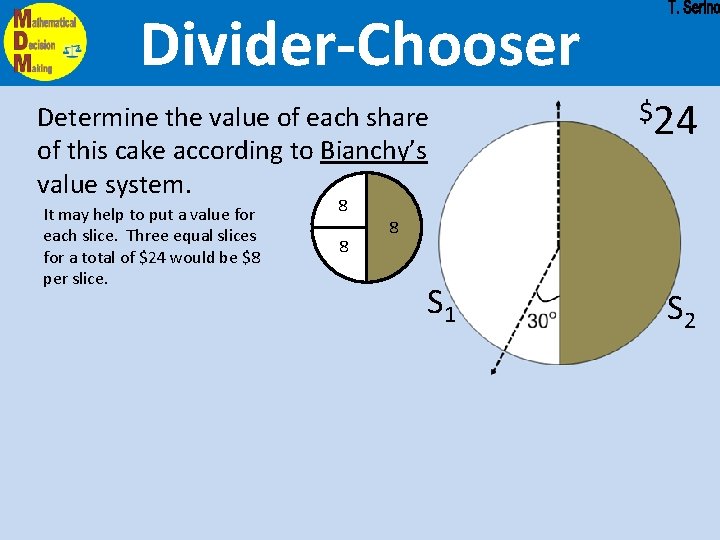
Divider-Chooser Determine the value of each share of this cake according to Bianchy’s value system. It may help to put a value for each slice. Three equal slices for a total of $24 would be $8 per slice. $24 8 8 8 S 1 S 2
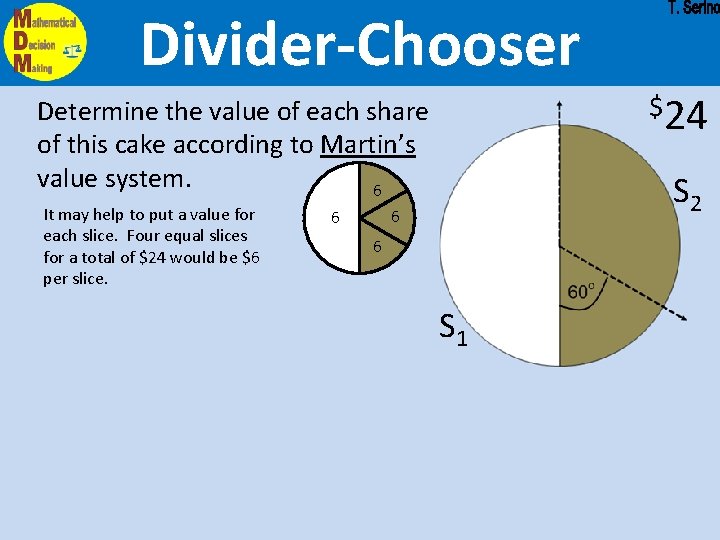
Divider-Chooser $24 Determine the value of each share of this cake according to Martin’s value system. 6 It may help to put a value for each slice. Four equal slices for a total of $24 would be $6 per slice. S 2 6 6 6 S 1
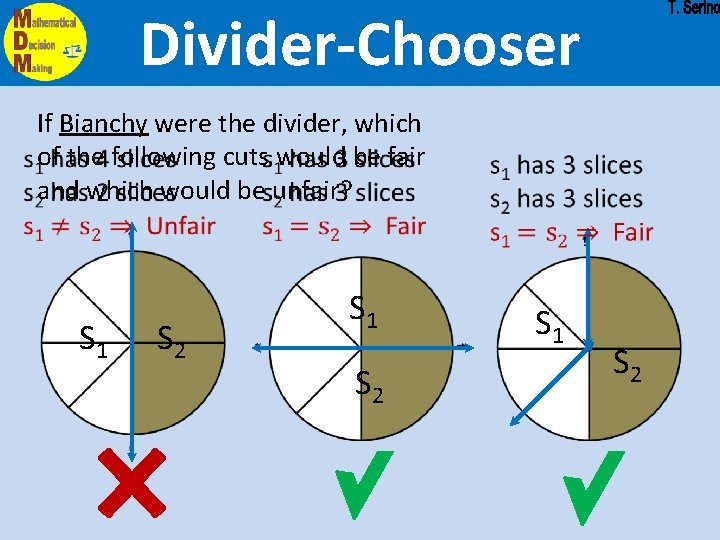
Divider-Chooser If Bianchy were the divider, which of the following cuts would be fair and which would be unfair? S 1 S 2
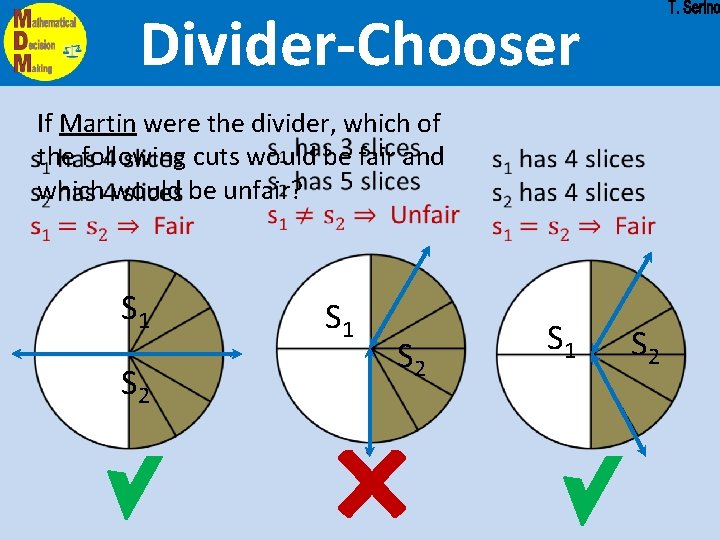
Divider-Chooser If Martin were the divider, which of the following cuts would be fair and which would be unfair? S 1 S 2
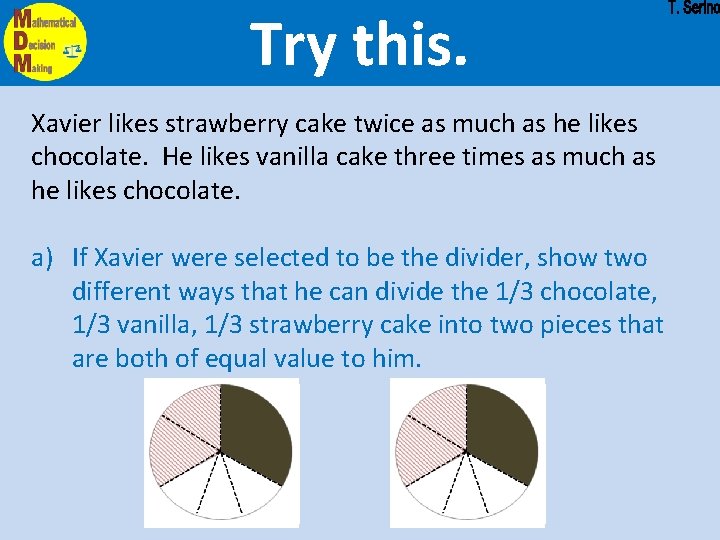
Try this. Xavier likes strawberry cake twice as much as he likes chocolate. He likes vanilla cake three times as much as he likes chocolate. a) If Xavier were selected to be the divider, show two different ways that he can divide the 1/3 chocolate, 1/3 vanilla, 1/3 strawberry cake into two pieces that are both of equal value to him.
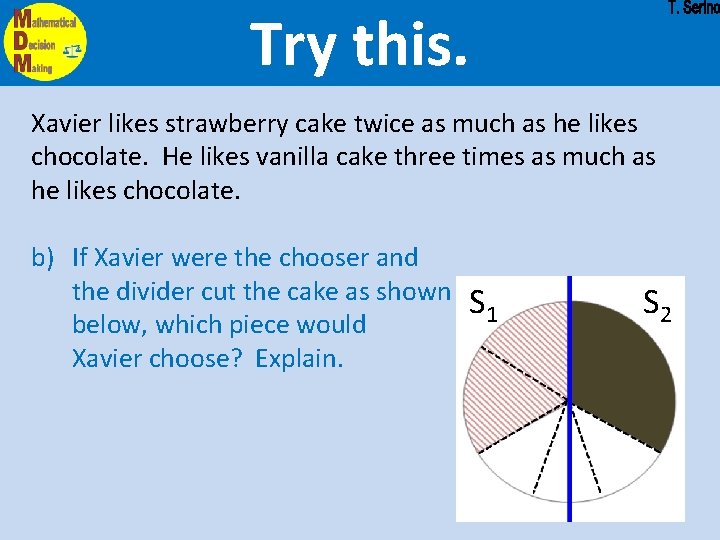
Try this. Xavier likes strawberry cake twice as much as he likes chocolate. He likes vanilla cake three times as much as he likes chocolate. b) If Xavier were the chooser and the divider cut the cake as shown S S 2 1 below, which piece would Xavier choose? Explain.
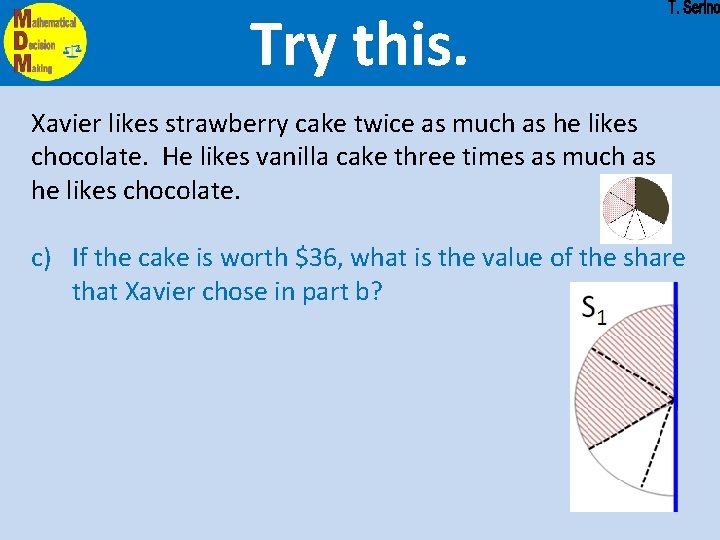
Try this. Xavier likes strawberry cake twice as much as he likes chocolate. He likes vanilla cake three times as much as he likes chocolate. c) If the cake is worth $36, what is the value of the share that Xavier chose in part b?