
Fair Cloud Sharing the Network in Cloud Computing
![Per Source (e. g. , Seawall [NSDI’ 11]) Min Guarantee Network Proportionality High Utilization](https://slidetodoc.com/presentation_image/40d72d759b68af4ec1bb302c3cad41a8/image-43.jpg "Per Source (e. g. , Seawall [NSDI’ 11]) Min Guarantee Network Proportionality High Utilization")
![Static Reservation (e. g. , Oktopus [Sigcomm’ 11]) Min Guarantee Network Proportionality High Utilization](https://slidetodoc.com/presentation_image/40d72d759b68af4ec1bb302c3cad41a8/image-44.jpg "Static Reservation (e. g. , Oktopus [Sigcomm’ 11]) Min Guarantee Network Proportionality High Utilization")
- Slides: 66
Fair. Cloud: Sharing the Network in Cloud Computing Presenter: Wei Sun Lucian Popa (HP Labs) Arvind Krishnamurthy (Univ Washington) Gautam Kumar (UC Berkeley) Sylvia Ratnasamy (UC Berkeley) Mosharaf Chowdhury (UC Berkeley) Ion Stoica (UC Berkeley)
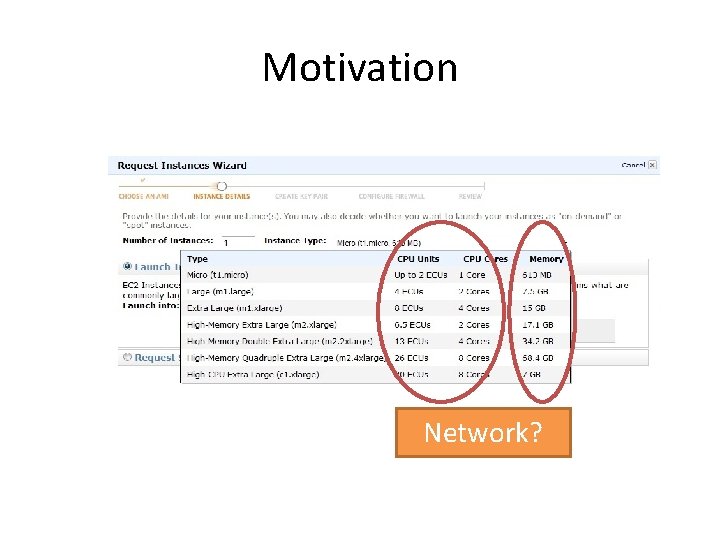
Motivation Network?
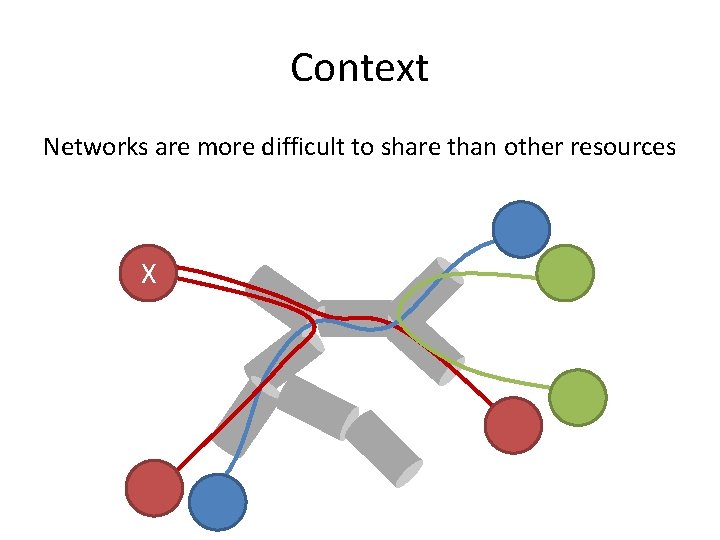
Context Networks are more difficult to share than other resources X
Context • Several proposals that share network differently, e. g. : – proportional to # source VMs (Seawall [NSDI 11]) – statically reserve bandwidth (Oktopus [Sigcomm 12]) –… • Provide specific types of sharing policies • Characterize solution space and relate policies to each other?
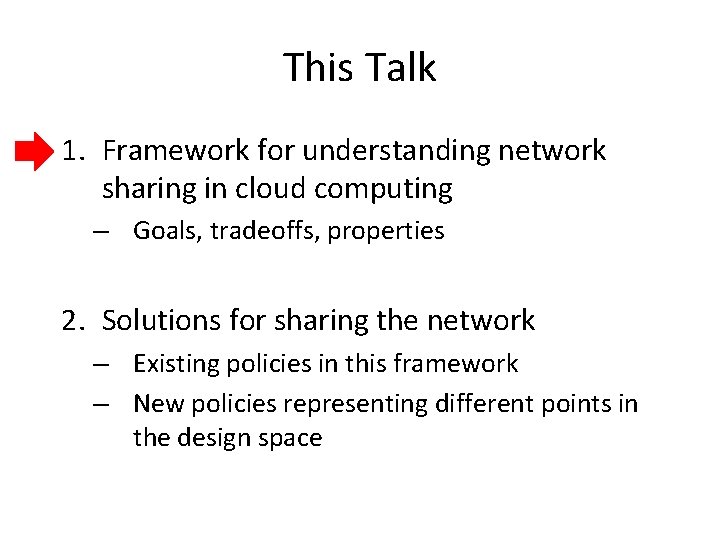
This Talk 1. Framework for understanding network sharing in cloud computing – Goals, tradeoffs, properties 2. Solutions for sharing the network – Existing policies in this framework – New policies representing different points in the design space
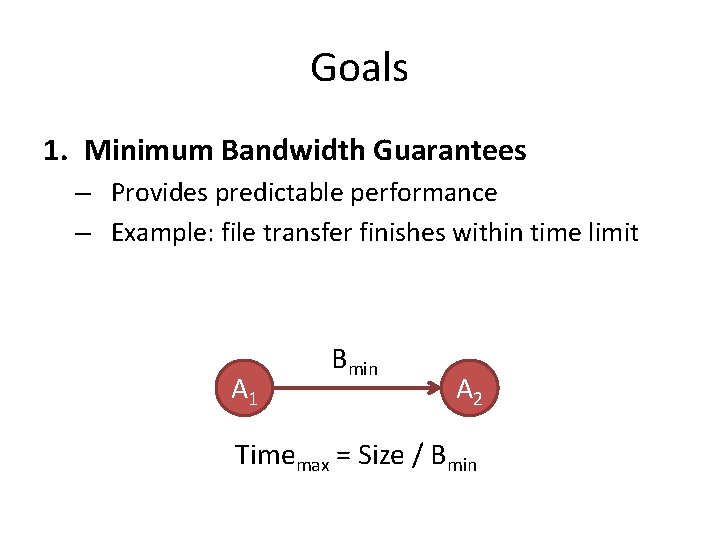
Goals 1. Minimum Bandwidth Guarantees – Provides predictable performance – Example: file transfer finishes within time limit A 1 Bmin A 2 Timemax = Size / Bmin
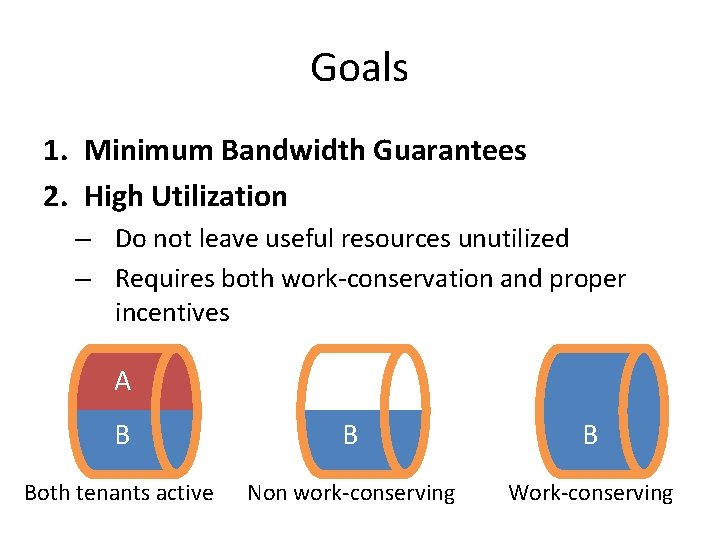
Goals 1. Minimum Bandwidth Guarantees 2. High Utilization – Do not leave useful resources unutilized – Requires both work-conservation and proper incentives A B Both tenants active Non work-conserving Work-conserving
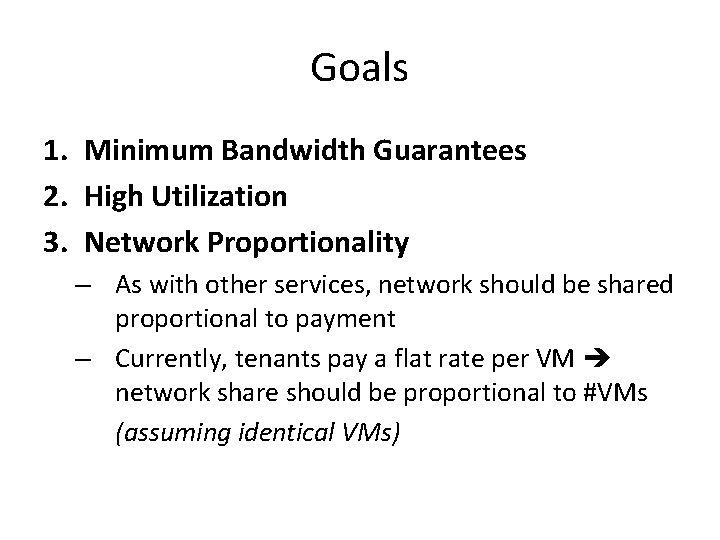
Goals 1. Minimum Bandwidth Guarantees 2. High Utilization 3. Network Proportionality – As with other services, network should be shared proportional to payment – Currently, tenants pay a flat rate per VM network share should be proportional to #VMs (assuming identical VMs)
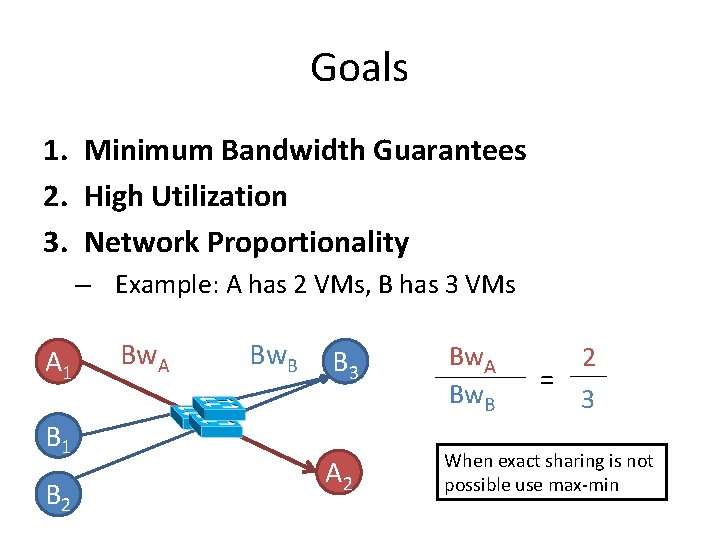
Goals 1. Minimum Bandwidth Guarantees 2. High Utilization 3. Network Proportionality – Example: A has 2 VMs, B has 3 VMs A 1 B 2 Bw. A Bw. B B 3 A 2 Bw. A Bw. B = 2 3 When exact sharing is not possible use max-min
Goals 1. Minimum Bandwidth Guarantees 2. High Utilization 3. Network Proportionality Not all goals are achievable simultaneously!
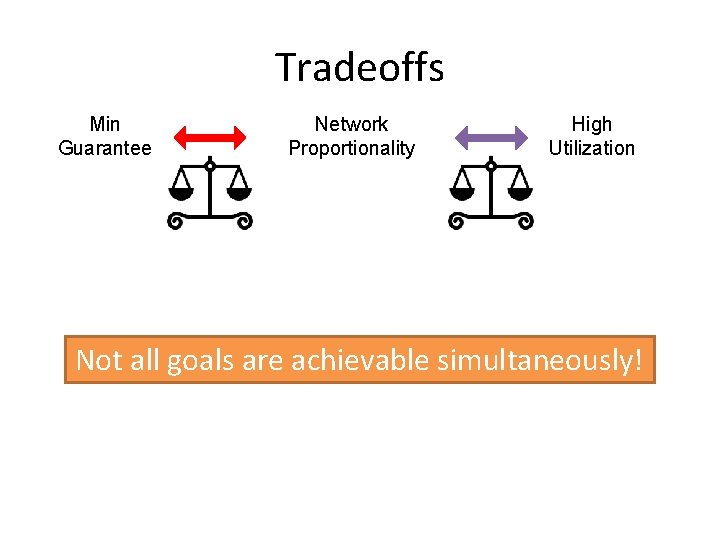
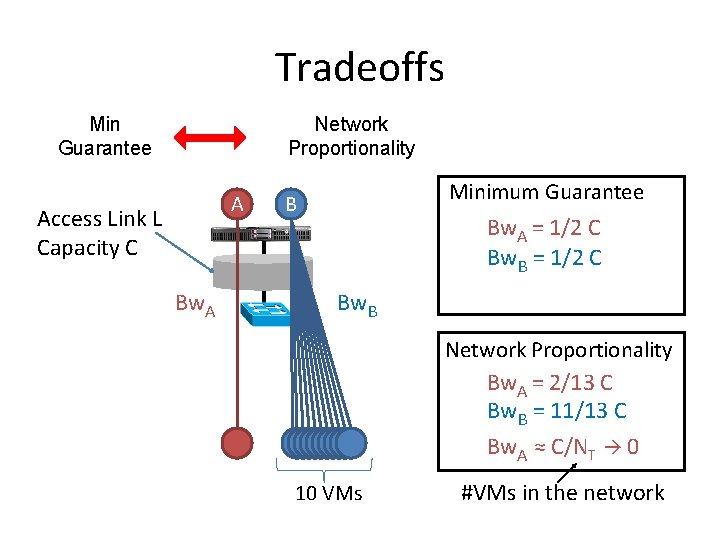
Tradeoffs Min Guarantee Network Proportionality High Utilization Not all goals are achievable simultaneously!
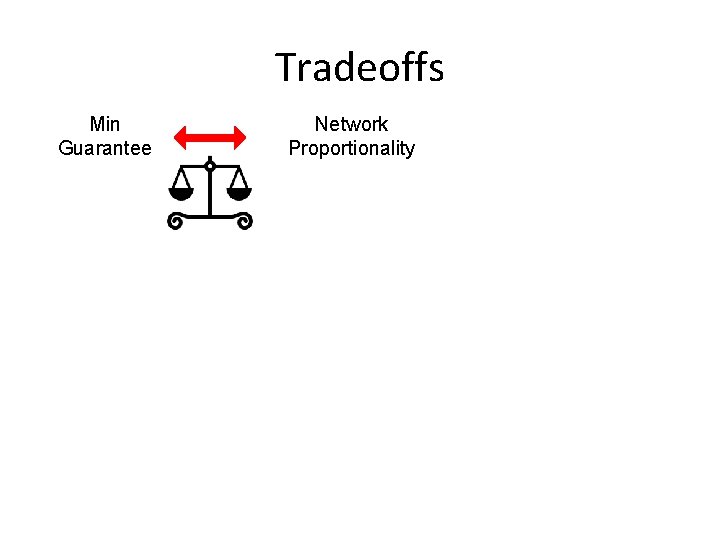
Tradeoffs Min Guarantee Network Proportionality
Tradeoffs Min Guarantee Network Proportionality A Access Link L Capacity C Bw. A Minimum Guarantee B Bw. A = 1/2 C Bw. B Network Proportionality Bw. A = 2/13 C Bw. B = 11/13 C Bw. A ≈ C/NT 0 10 VMs #VMs in the network
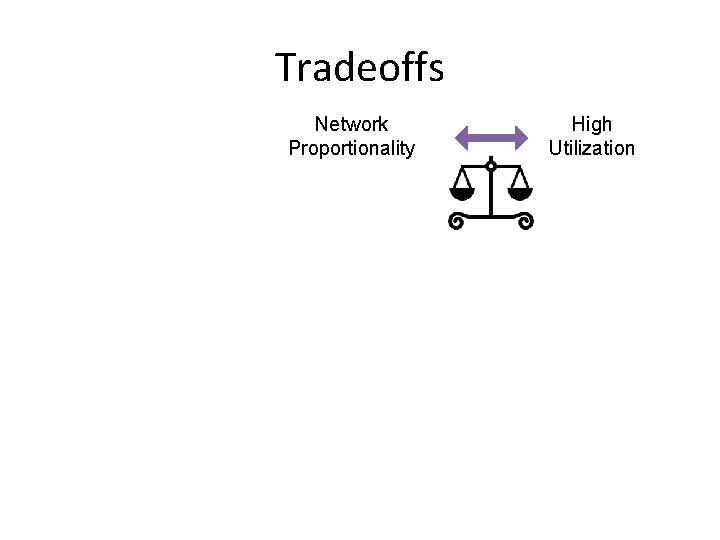
Tradeoffs Network Proportionality High Utilization
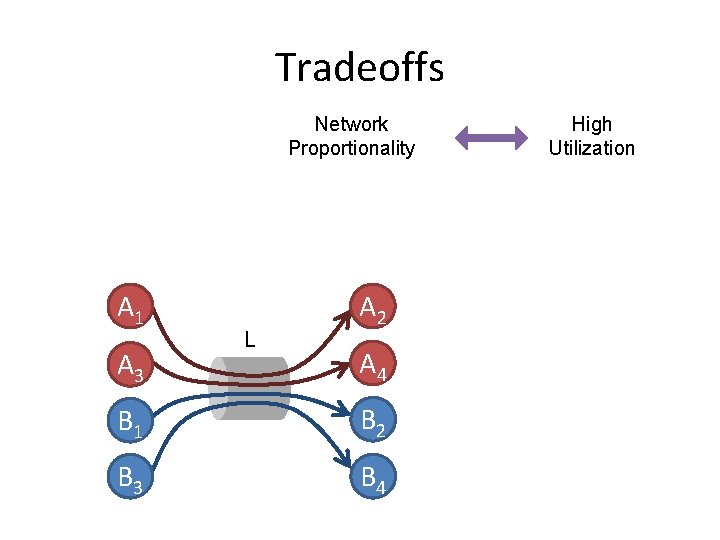
Tradeoffs Network Proportionality A 1 A 3 L A 2 A 4 B 1 B 2 B 3 B 4 High Utilization
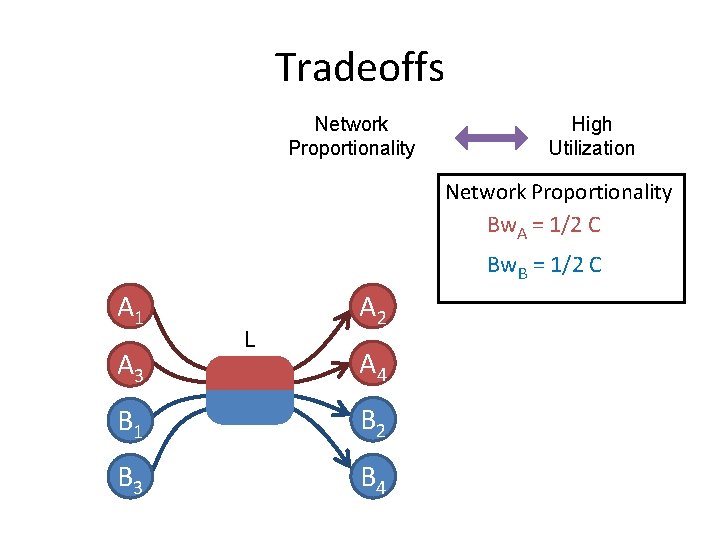
Tradeoffs Network Proportionality High Utilization Network Proportionality Bw. A = 1/2 C Bw. B = 1/2 C A 1 A 3 L A 2 A 4 B 1 B 2 B 3 B 4
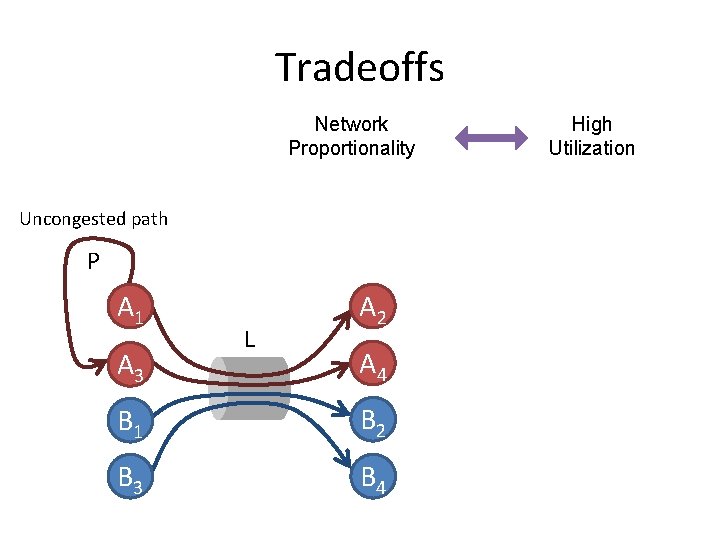
Tradeoffs Network Proportionality Uncongested path P A 1 A 3 L A 2 A 4 B 1 B 2 B 3 B 4 High Utilization
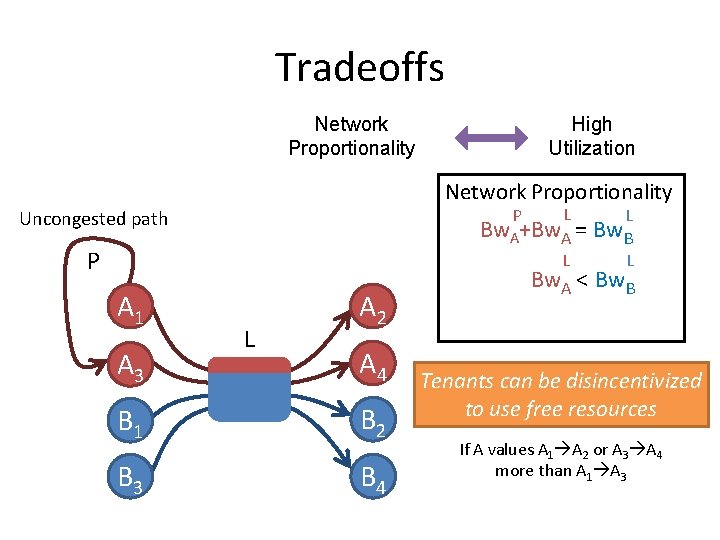
Tradeoffs High Utilization Network Proportionality L L Bw. A+Bw. A = Bw. B L L P Uncongested path P A 1 A 3 L A 2 A 4 B 1 B 2 B 3 B 4 Bw. A < Bw. B Tenants can be disincentivized to use free resources If A values A 1 A 2 or A 3 A 4 more than A 1 A 3
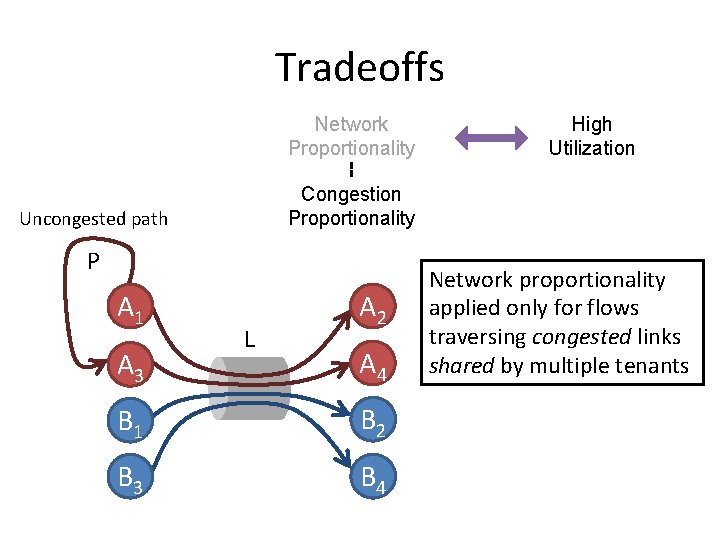
Tradeoffs Network Proportionality Congestion Proportionality Uncongested path P A 1 A 3 High Utilization L A 2 A 4 B 1 B 2 B 3 B 4 Network proportionality applied only for flows traversing congested links shared by multiple tenants
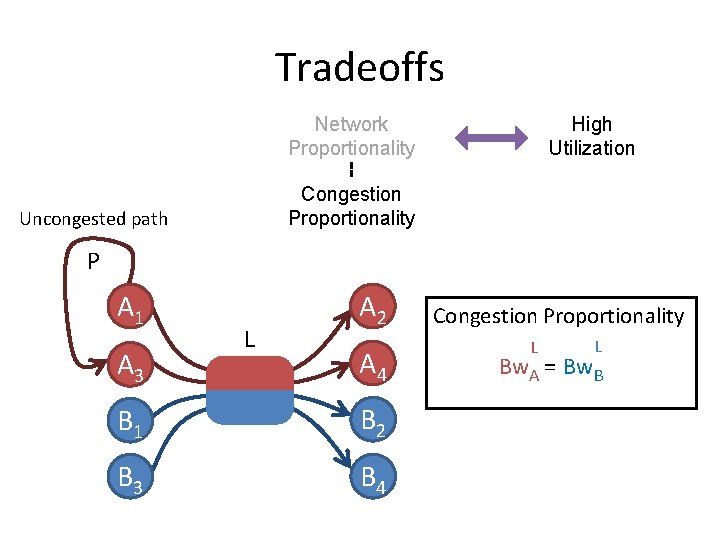
Tradeoffs High Utilization Network Proportionality Congestion Proportionality Uncongested path P A 1 A 3 L A 2 A 4 B 1 B 2 B 3 B 4 Congestion Proportionality L L Bw. A = Bw. B
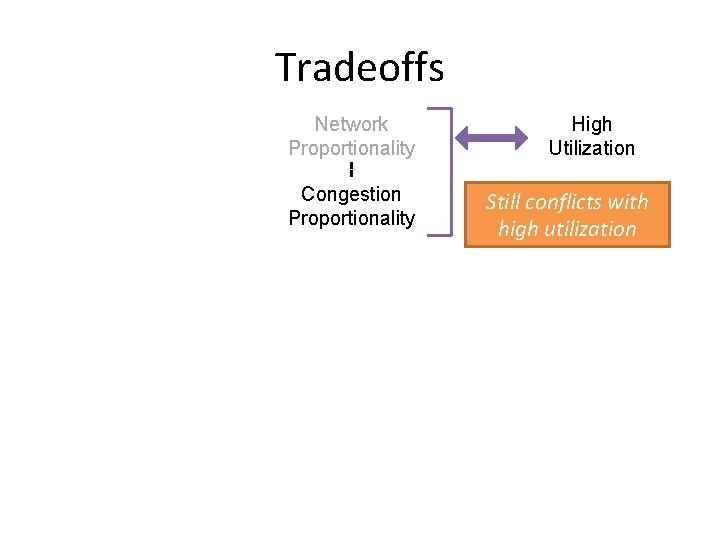
Tradeoffs Network Proportionality Congestion Proportionality High Utilization Still conflicts with high utilization
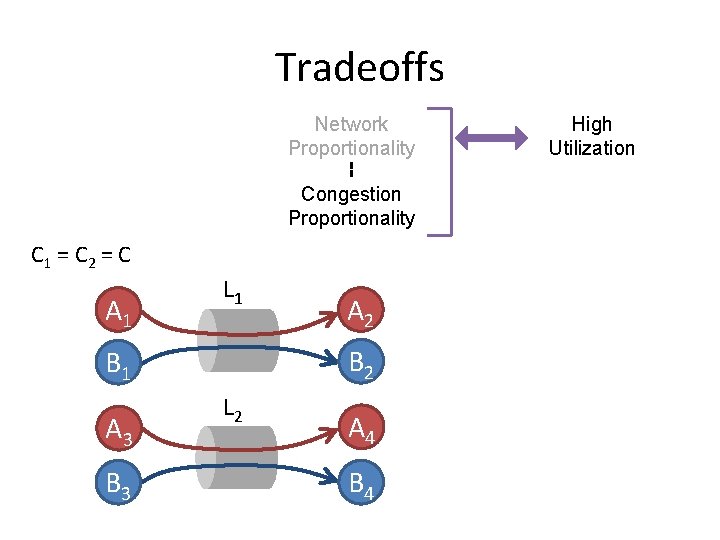
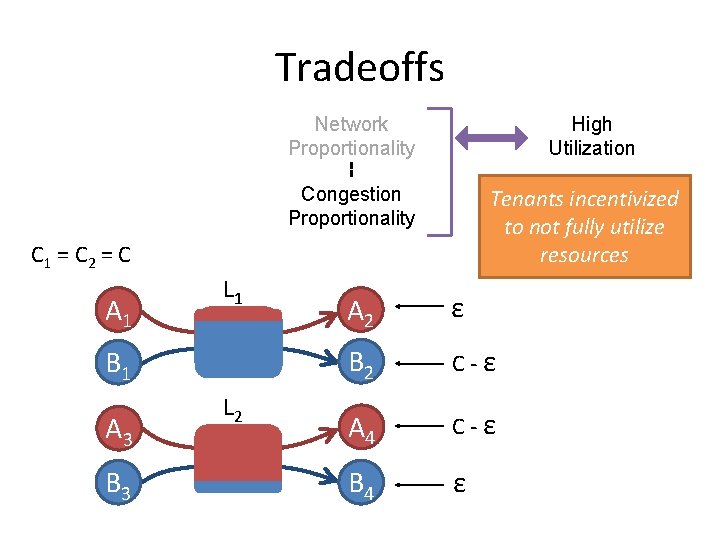
Tradeoffs Network Proportionality Congestion Proportionality C 1 = C 2 = C A 1 L 1 B 2 B 1 A 3 B 3 A 2 L 2 A 4 B 4 High Utilization
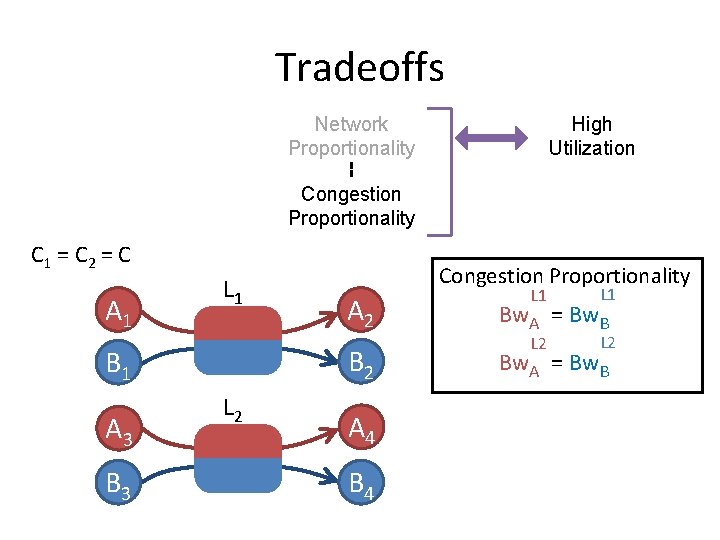
Tradeoffs High Utilization Network Proportionality Congestion Proportionality C 1 = C 2 = C A 1 L 1 B 1 A 3 B 3 L 2 Congestion Proportionality L 1 L 2 A 2 Bw. A = Bw. B B 2 Bw. A = Bw. B A 4 B 4
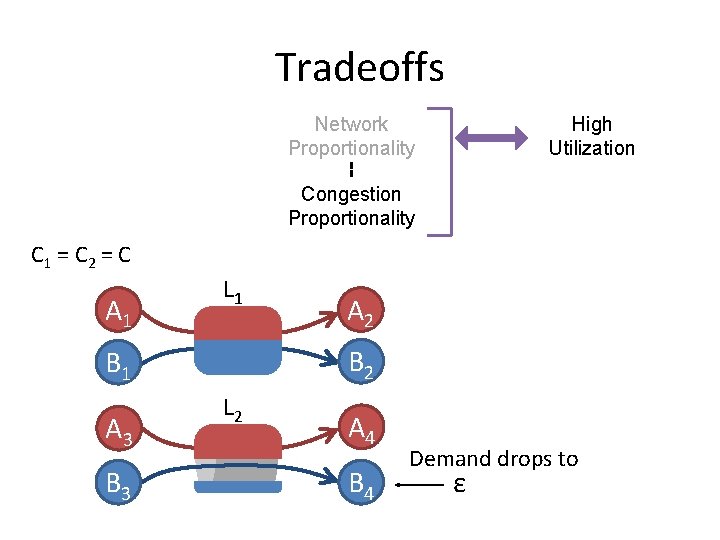
Tradeoffs High Utilization Network Proportionality Congestion Proportionality C 1 = C 2 = C A 1 L 1 B 2 B 1 A 3 B 3 A 2 L 2 A 4 B 4 Demand drops to ε
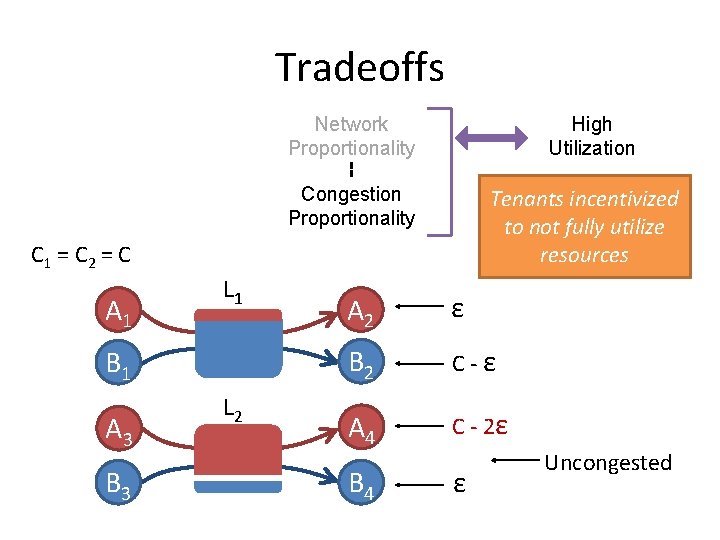
Tradeoffs High Utilization Network Proportionality Congestion Proportionality Tenants incentivized to not fully utilize resources C 1 = C 2 = C A 1 L 1 B 1 A 3 B 3 L 2 A 2 ε B 2 C-ε A 4 C-ε B 4 ε
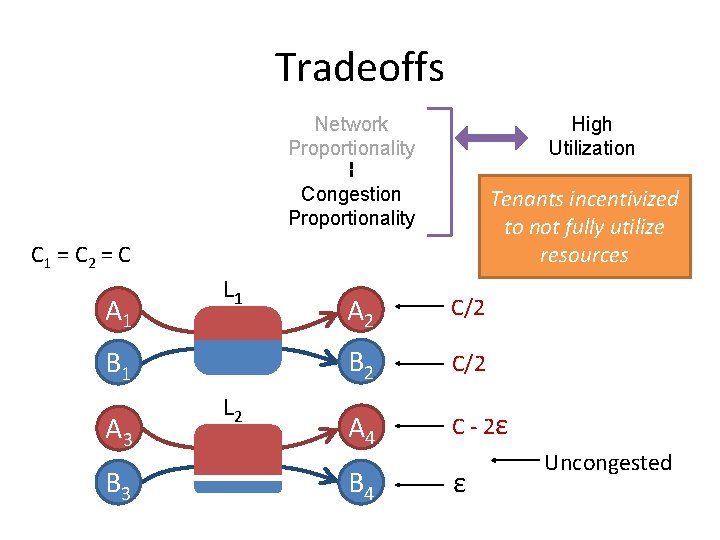
Tradeoffs High Utilization Network Proportionality Congestion Proportionality Tenants incentivized to not fully utilize resources C 1 = C 2 = C A 1 L 1 B 1 A 3 B 3 L 2 A 2 ε B 2 C-ε A 4 C - 2ε B 4 ε Uncongested
Tradeoffs High Utilization Network Proportionality Congestion Proportionality Tenants incentivized to not fully utilize resources C 1 = C 2 = C A 1 L 1 B 1 A 3 B 3 L 2 A 2 C/2 B 2 C/2 A 4 C - 2ε B 4 ε Uncongested
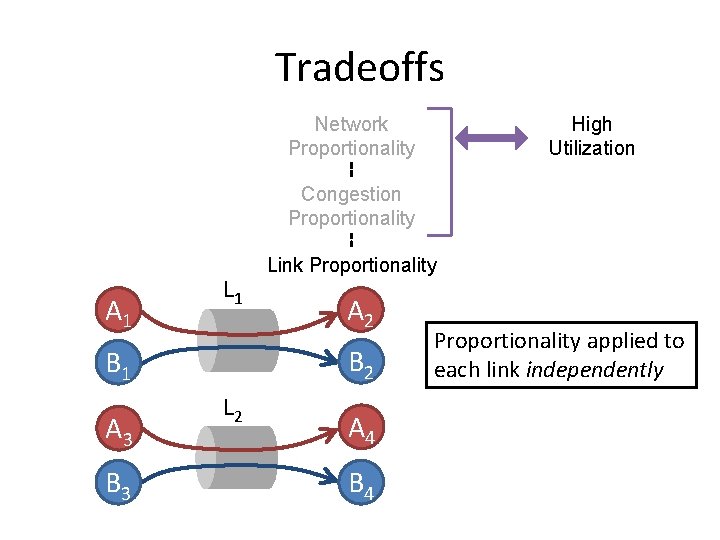
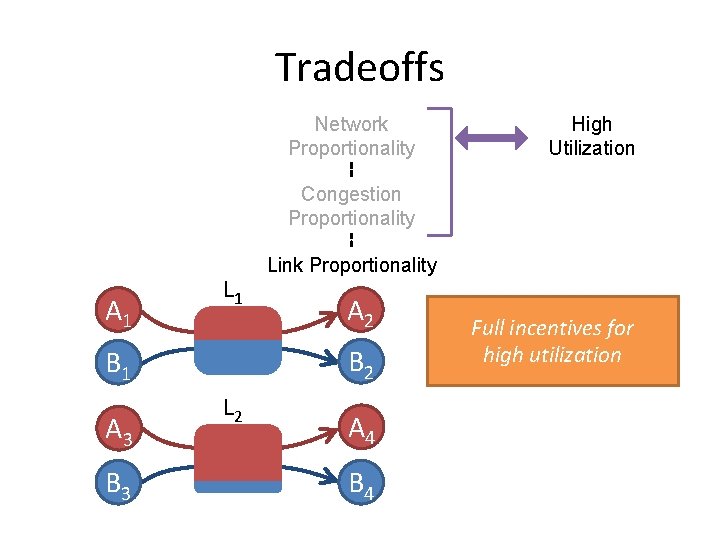
Tradeoffs High Utilization Network Proportionality Congestion Proportionality A 1 L 1 B 3 A 2 B 1 A 3 Link Proportionality L 2 A 4 B 4 Proportionality applied to each link independently
Tradeoffs Network Proportionality High Utilization Congestion Proportionality A 1 L 1 B 3 A 2 B 1 A 3 Link Proportionality L 2 A 4 B 4 Full incentives for high utilization
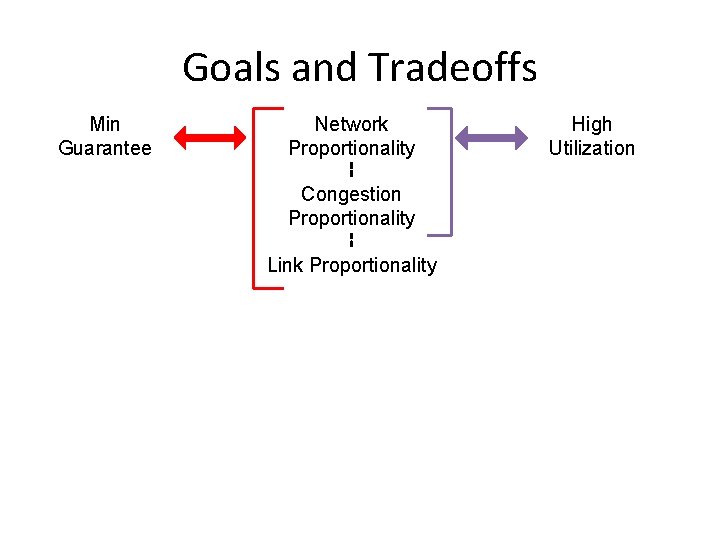
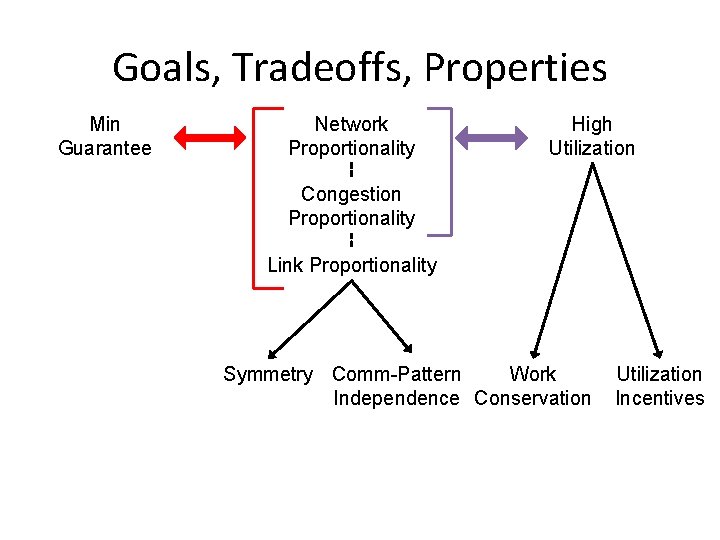
Goals and Tradeoffs Min Guarantee Network Proportionality Congestion Proportionality Link Proportionality High Utilization
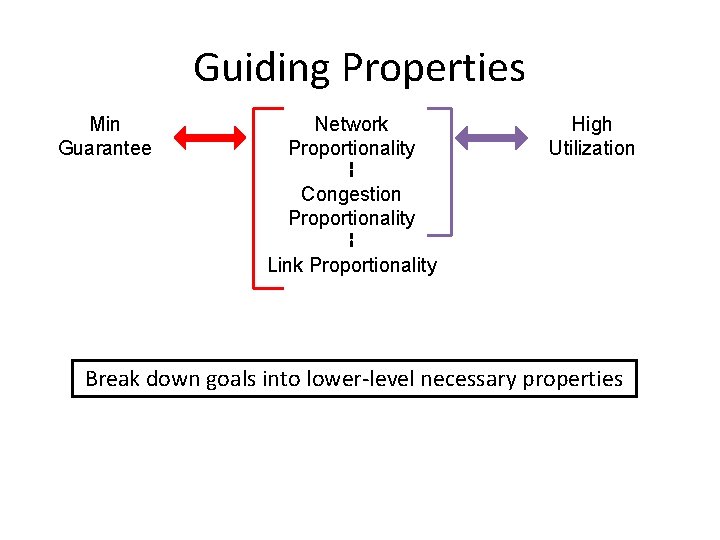
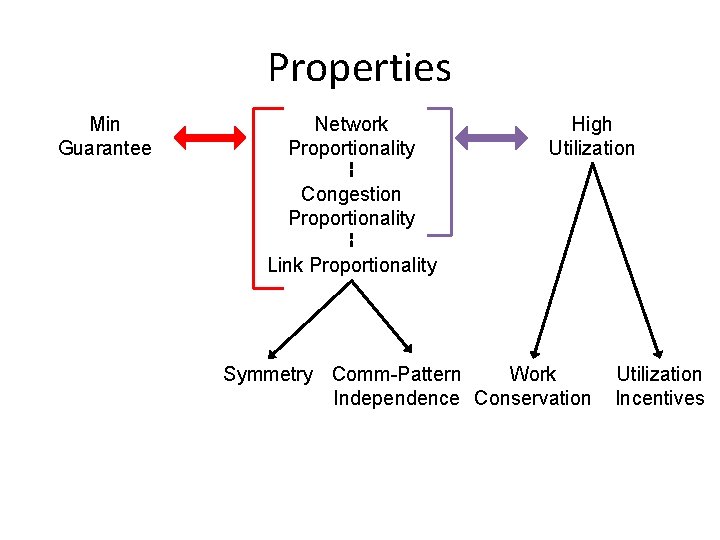
Guiding Properties Min Guarantee Network Proportionality High Utilization Congestion Proportionality Link Proportionality Break down goals into lower-level necessary properties
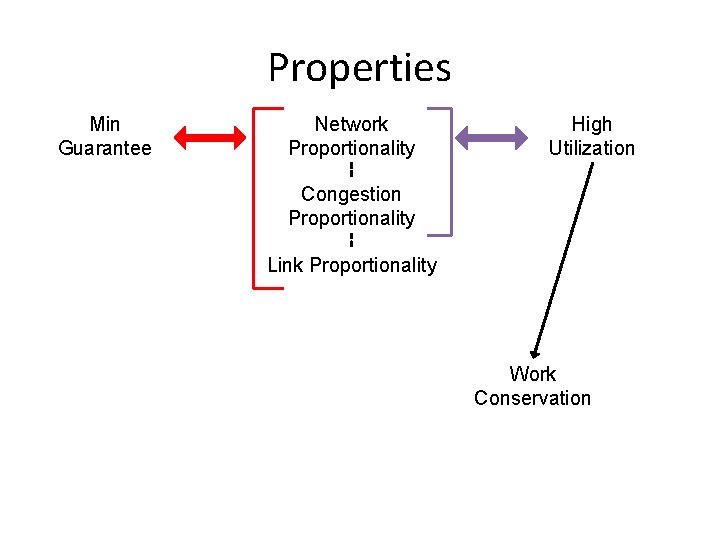
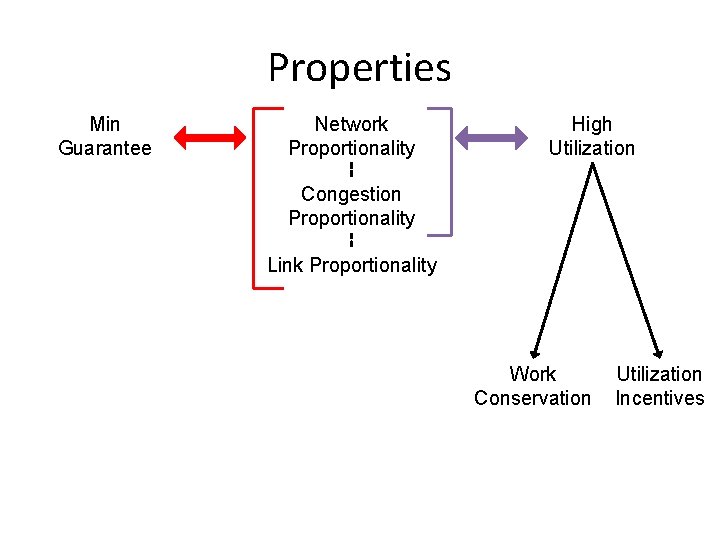
Properties Min Guarantee Network Proportionality High Utilization Congestion Proportionality Link Proportionality Work Conservation
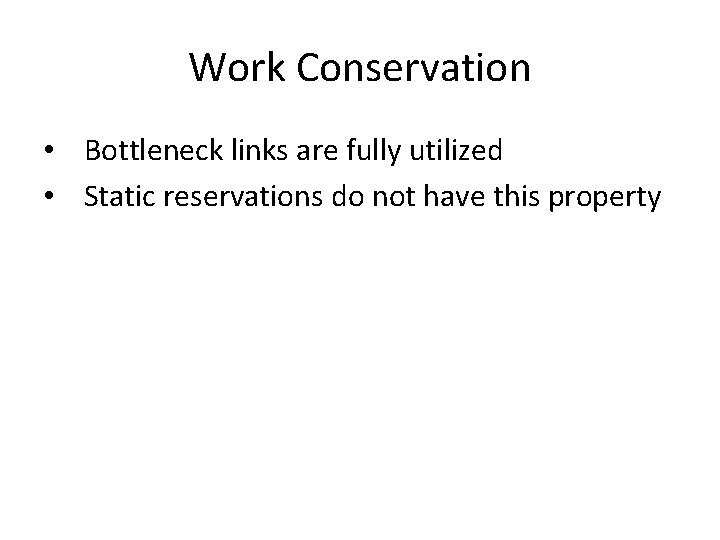
Work Conservation • Bottleneck links are fully utilized • Static reservations do not have this property
Properties Min Guarantee Network Proportionality High Utilization Congestion Proportionality Link Proportionality Work Conservation Utilization Incentives
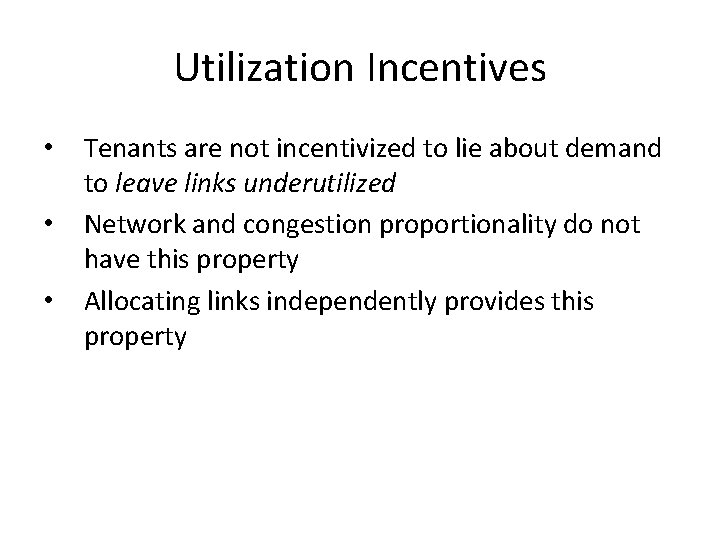
Utilization Incentives • • • Tenants are not incentivized to lie about demand to leave links underutilized Network and congestion proportionality do not have this property Allocating links independently provides this property
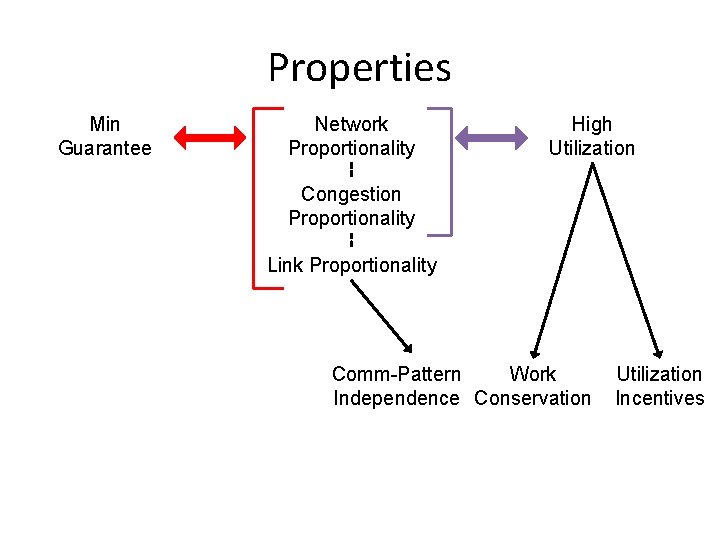
Properties Min Guarantee Network Proportionality High Utilization Congestion Proportionality Link Proportionality Comm-Pattern Work Independence Conservation Utilization Incentives
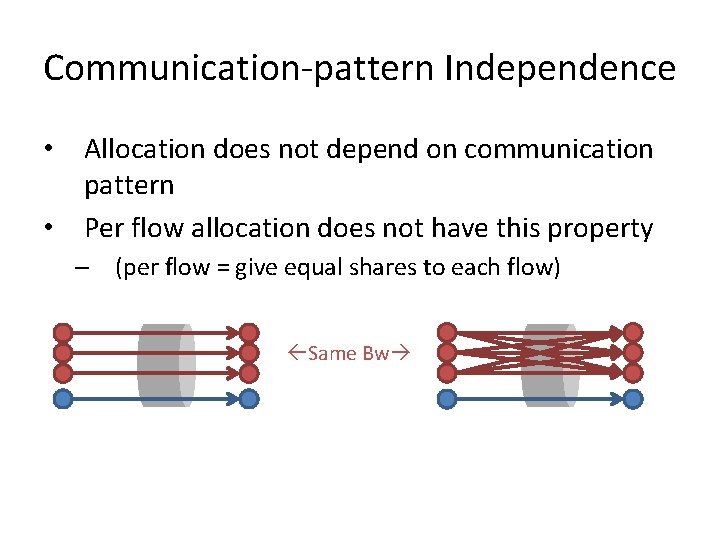
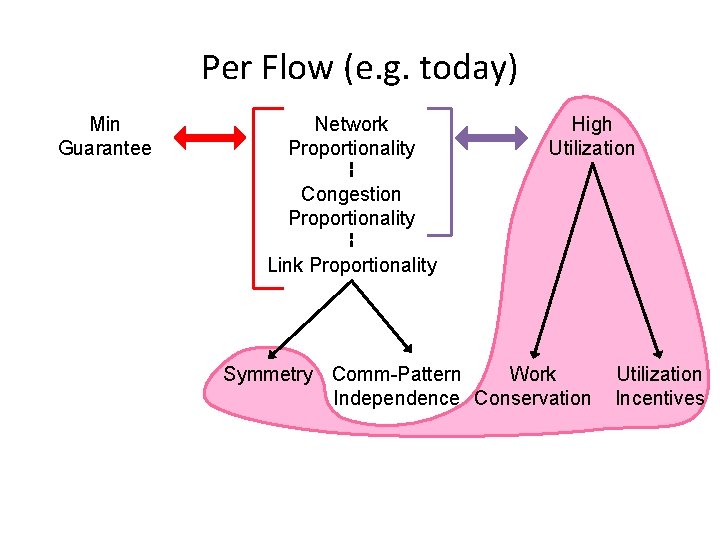
Communication-pattern Independence • Allocation does not depend on communication pattern • Per flow allocation does not have this property – (per flow = give equal shares to each flow) Same Bw
Properties Min Guarantee Network Proportionality High Utilization Congestion Proportionality Link Proportionality Symmetry Comm-Pattern Work Independence Conservation Utilization Incentives
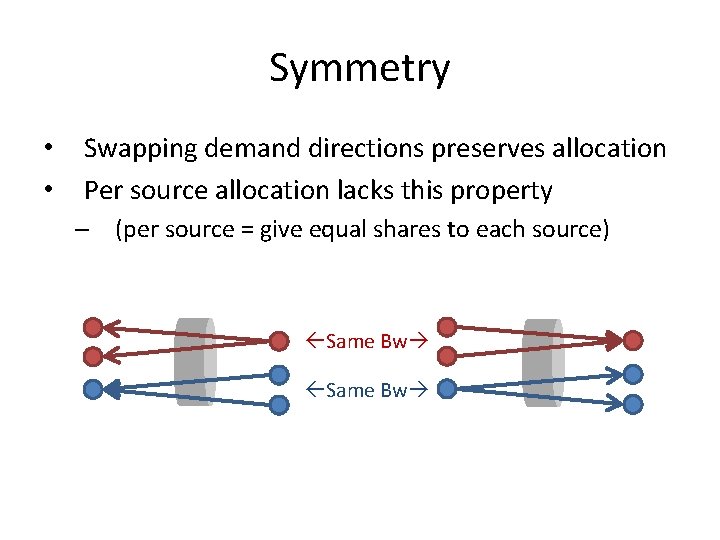
Symmetry • • Swapping demand directions preserves allocation Per source allocation lacks this property – (per source = give equal shares to each source) Same Bw
Goals, Tradeoffs, Properties Min Guarantee Network Proportionality High Utilization Congestion Proportionality Link Proportionality Symmetry Comm-Pattern Work Independence Conservation Utilization Incentives
Outline 1. Framework for understanding network sharing in cloud computing – Goals, tradeoffs, properties 2. Solutions for sharing the network – Existing policies in this framework – New policies representing different points in the design space
Per Flow (e. g. today) Min Guarantee Network Proportionality High Utilization Congestion Proportionality Link Proportionality Symmetry Comm-Pattern Work Independence Conservation Utilization Incentives
Per Source (e. g. , Seawall [NSDI’ 11]) Min Guarantee Network Proportionality High Utilization Congestion Proportionality Link Proportionality Symmetry Comm-Pattern Work Independence Conservation Utilization Incentives
Static Reservation (e. g. , Oktopus [Sigcomm’ 11]) Min Guarantee Network Proportionality High Utilization Congestion Proportionality Link Proportionality Symmetry Comm-Pattern Work Independence Conservation Utilization Incentives
New Allocation Policies 3 new allocation policies that take different stands on tradeoffs
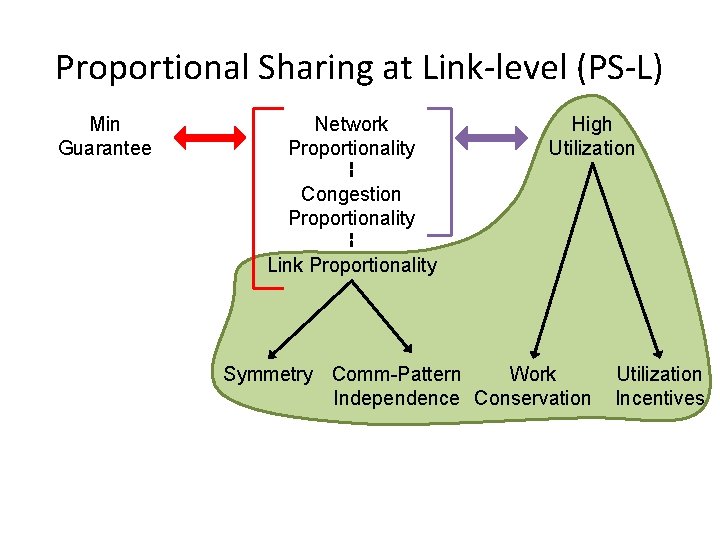
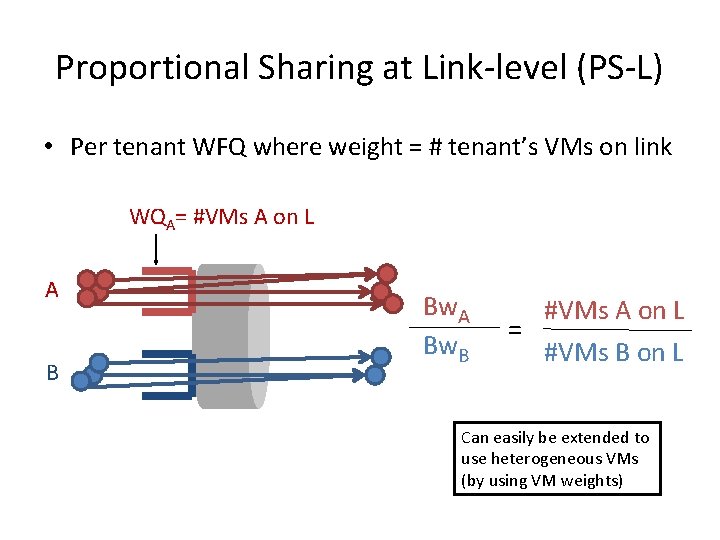
Proportional Sharing at Link-level (PS-L) Min Guarantee Network Proportionality High Utilization Congestion Proportionality Link Proportionality Symmetry Comm-Pattern Work Independence Conservation Utilization Incentives
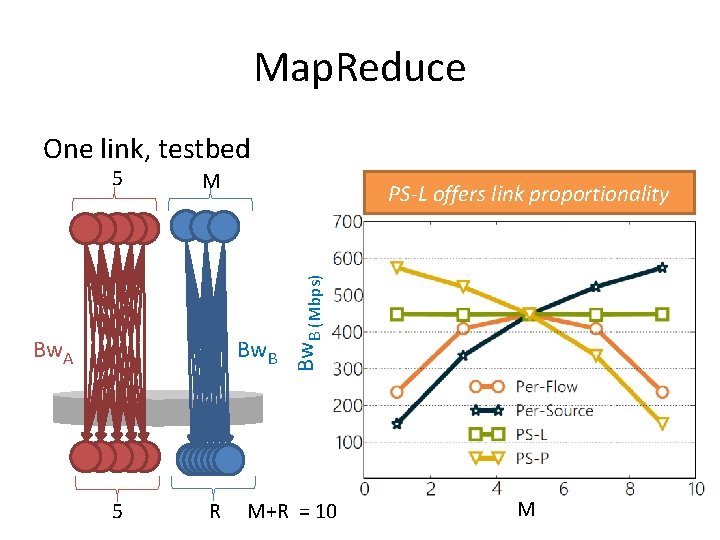
Proportional Sharing at Link-level (PS-L) • Per tenant WFQ where weight = # tenant’s VMs on link WQA= #VMs A on L A B Bw. A Bw. B #VMs A on L = #VMs B on L Can easily be extended to use heterogeneous VMs (by using VM weights)
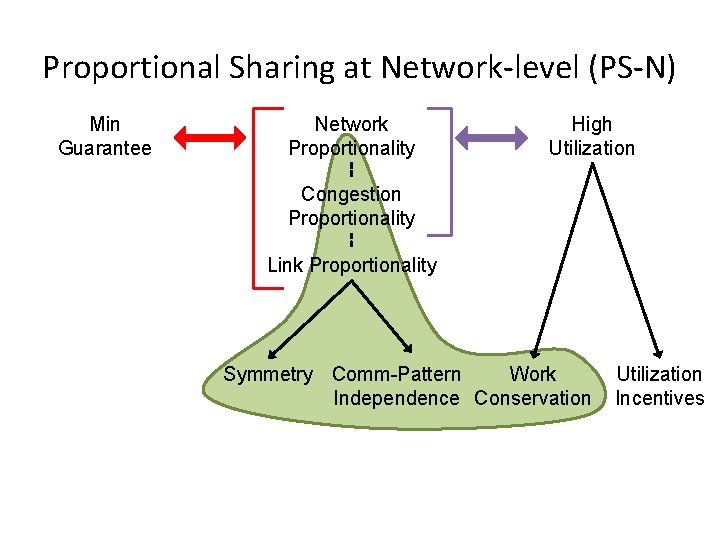
Proportional Sharing at Network-level (PS-N) Min Guarantee Network Proportionality High Utilization Congestion Proportionality Link Proportionality Symmetry Comm-Pattern Work Independence Conservation Utilization Incentives
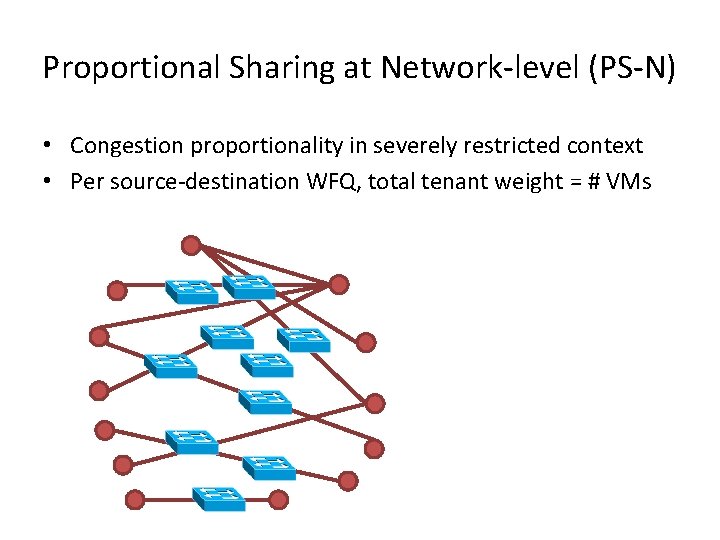
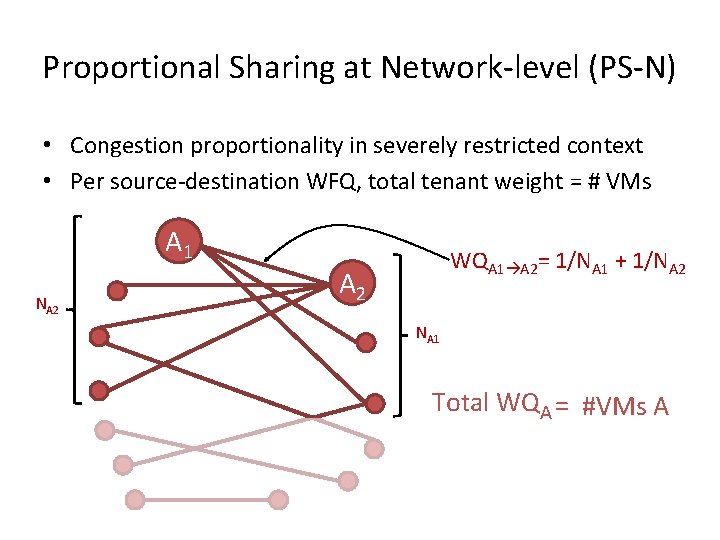
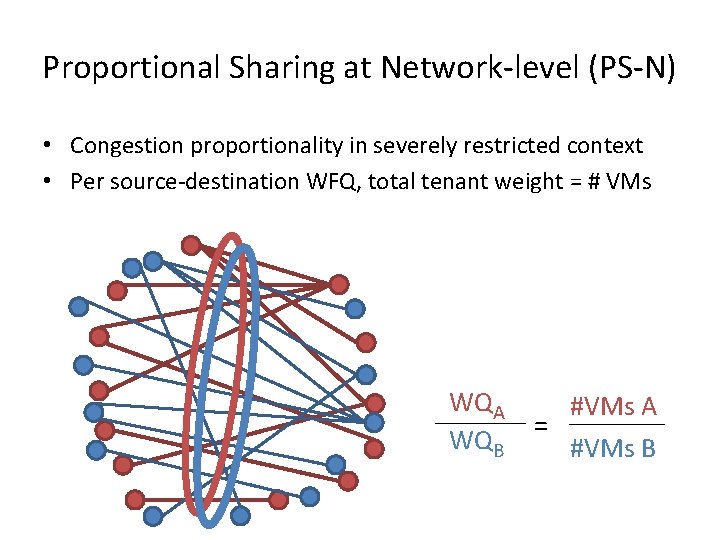
Proportional Sharing at Network-level (PS-N) • Congestion proportionality in severely restricted context • Per source-destination WFQ, total tenant weight = # VMs
Proportional Sharing at Network-level (PS-N) • Congestion proportionality in severely restricted context • Per source-destination WFQ, total tenant weight = # VMs A 1 NA 2 WQA 1 A 2= 1/NA 1 + 1/NA 2 NA 1 Total WQA = #VMs A
Proportional Sharing at Network-level (PS-N) • Congestion proportionality in severely restricted context • Per source-destination WFQ, total tenant weight = # VMs WQA WQB #VMs A = #VMs B
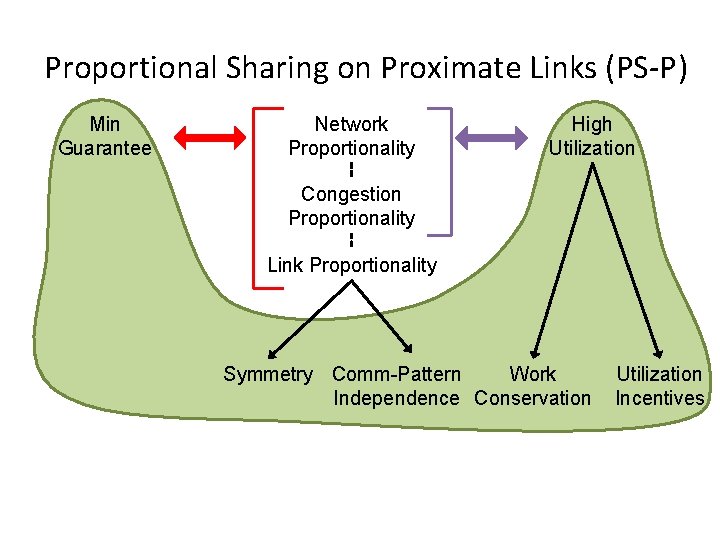
Proportional Sharing on Proximate Links (PS-P) Min Guarantee Network Proportionality High Utilization Congestion Proportionality Link Proportionality Symmetry Comm-Pattern Work Independence Conservation Utilization Incentives
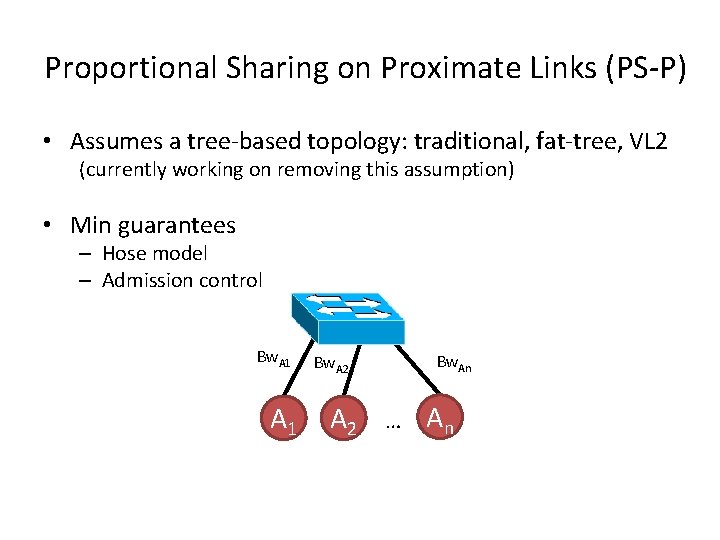
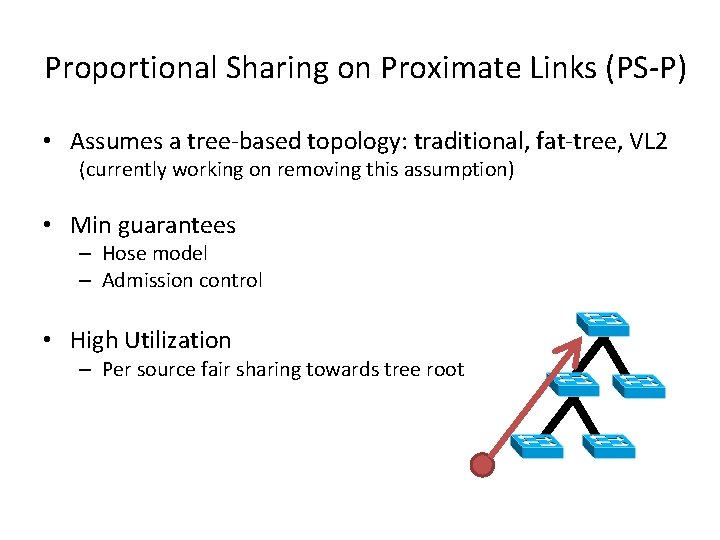
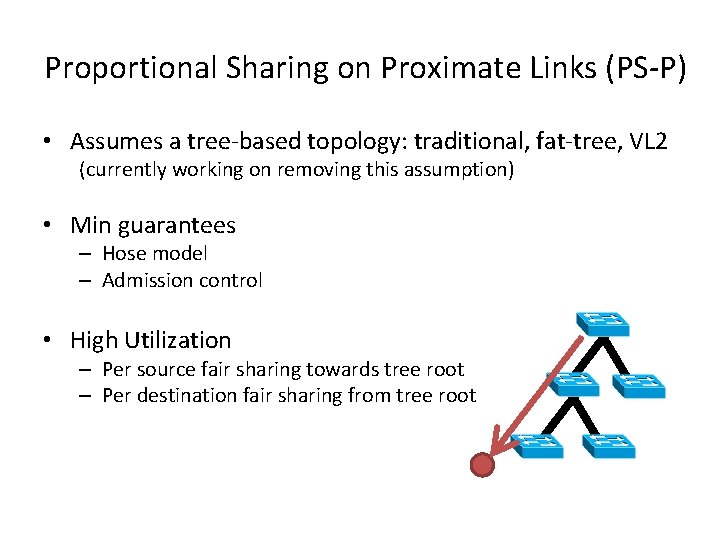
Proportional Sharing on Proximate Links (PS-P) • Assumes a tree-based topology: traditional, fat-tree, VL 2 (currently working on removing this assumption)
Proportional Sharing on Proximate Links (PS-P) • Assumes a tree-based topology: traditional, fat-tree, VL 2 (currently working on removing this assumption) • Min guarantees – Hose model – Admission control Bw. A 1 Bw. An Bw. A 2 … An
Proportional Sharing on Proximate Links (PS-P) • Assumes a tree-based topology: traditional, fat-tree, VL 2 (currently working on removing this assumption) • Min guarantees – Hose model – Admission control • High Utilization – Per source fair sharing towards tree root
Proportional Sharing on Proximate Links (PS-P) • Assumes a tree-based topology: traditional, fat-tree, VL 2 (currently working on removing this assumption) • Min guarantees – Hose model – Admission control • High Utilization – Per source fair sharing towards tree root – Per destination fair sharing from tree root
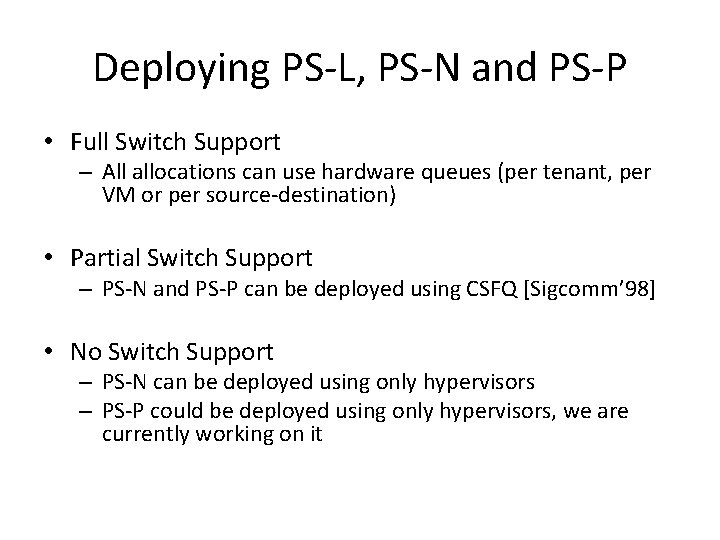
Deploying PS-L, PS-N and PS-P • Full Switch Support – All allocations can use hardware queues (per tenant, per VM or per source-destination) • Partial Switch Support – PS-N and PS-P can be deployed using CSFQ [Sigcomm’ 98] • No Switch Support – PS-N can be deployed using only hypervisors – PS-P could be deployed using only hypervisors, we are currently working on it
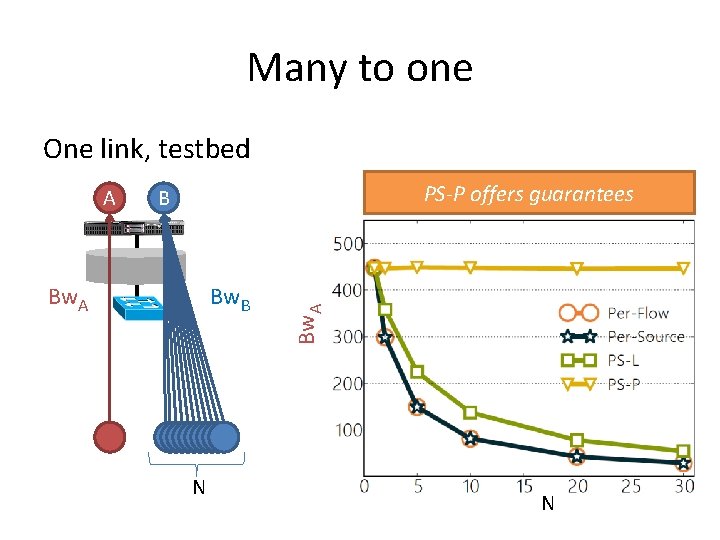
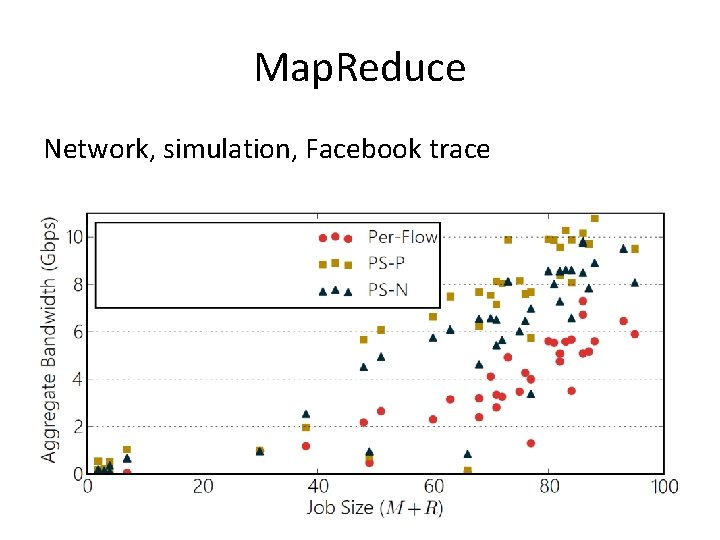
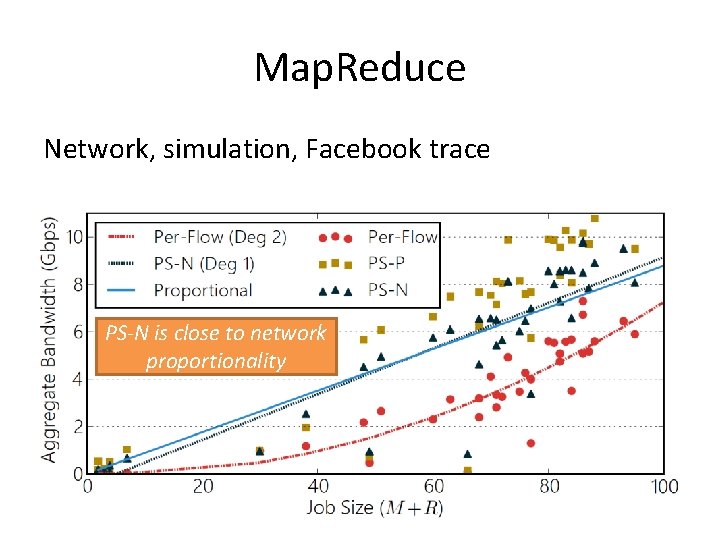
Evaluation • Small Testbed + Click Modular Router – 15 servers, 1 Gbps links • Simulation + Real Traces – 3200 nodes, flow level simulator, Facebook Map. Reduce traces
Many to one One link, testbed PS-P offers guarantees B Bw. A Bw. B N Bw. A A N
Map. Reduce One link, testbed M Bw. A PS-L offers link proportionality Bw. B 5 R Bw. B (Mbps) 5 M+R = 10 M
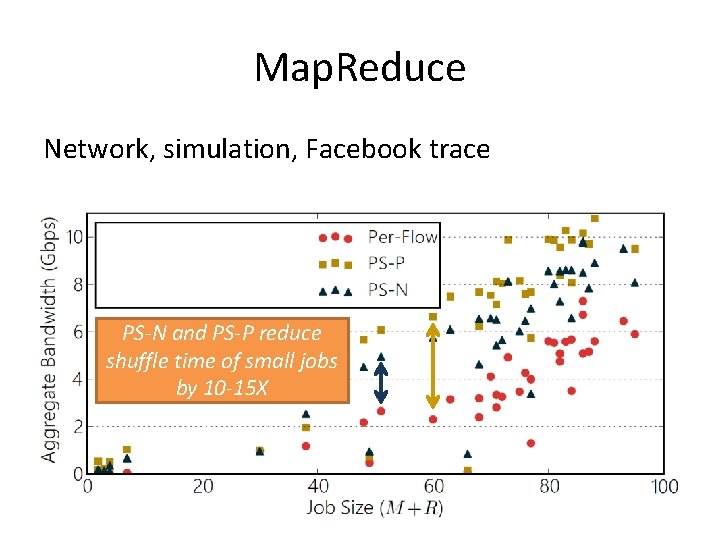
Map. Reduce Network, simulation, Facebook trace
Map. Reduce Network, simulation, Facebook trace PS-N is close to network proportionality
Map. Reduce Network, simulation, Facebook trace PS-N and PS-P reduce shuffle time of small jobs by 10 -15 X
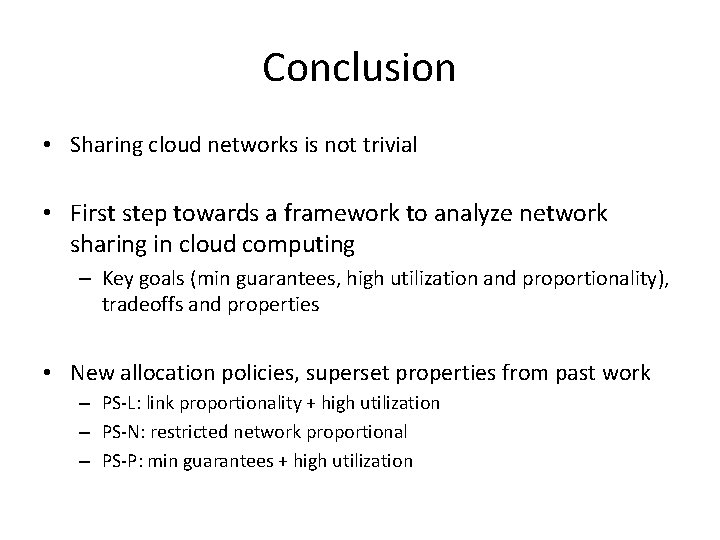
Conclusion • Sharing cloud networks is not trivial • First step towards a framework to analyze network sharing in cloud computing – Key goals (min guarantees, high utilization and proportionality), tradeoffs and properties • New allocation policies, superset properties from past work – PS-L: link proportionality + high utilization – PS-N: restricted network proportional – PS-P: min guarantees + high utilization
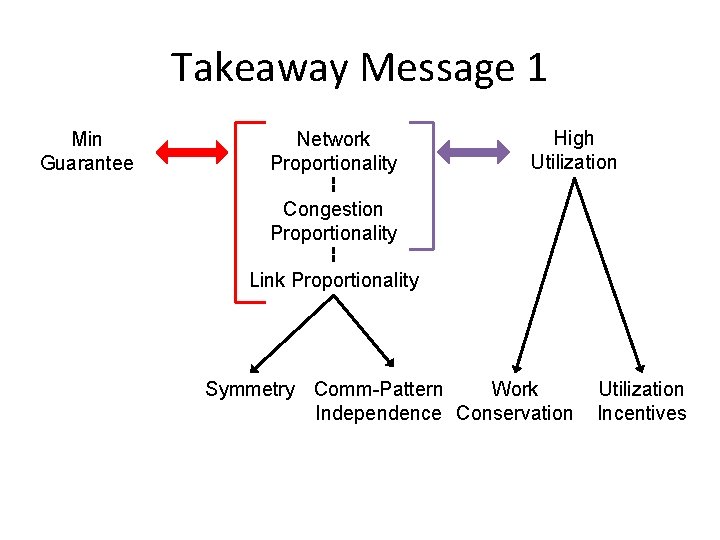
Takeaway Message 1 Min Guarantee Network Proportionality High Utilization Congestion Proportionality Link Proportionality Symmetry Comm-Pattern Work Independence Conservation Utilization Incentives
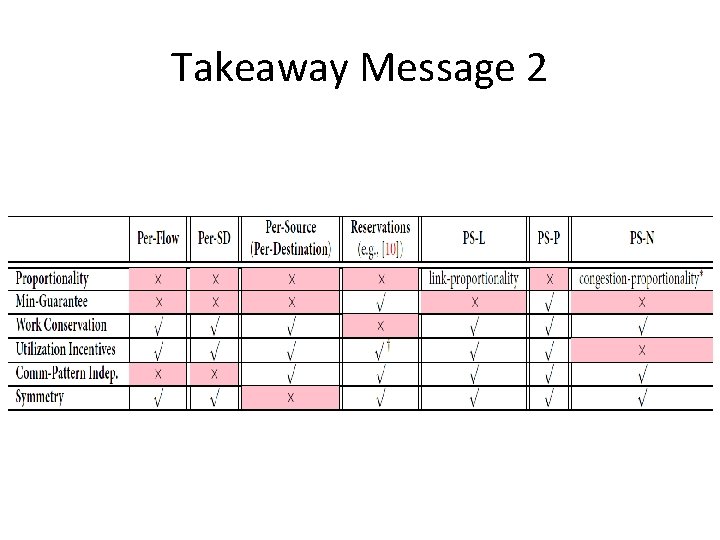
Takeaway Message 2