
Fair Assessment Maggie Bradford Jessie Dutcher Essential Questions
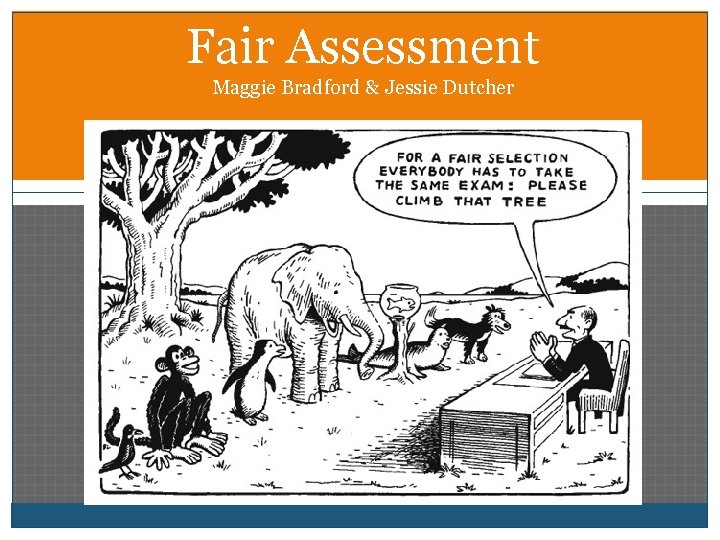
Fair Assessment Maggie Bradford & Jessie Dutcher

Essential Questions What is fair assessment? What factors affect fair assessment? How do I design and maintain fair assessment? How does bias exist in assessment? How do I create unbiased assessments?
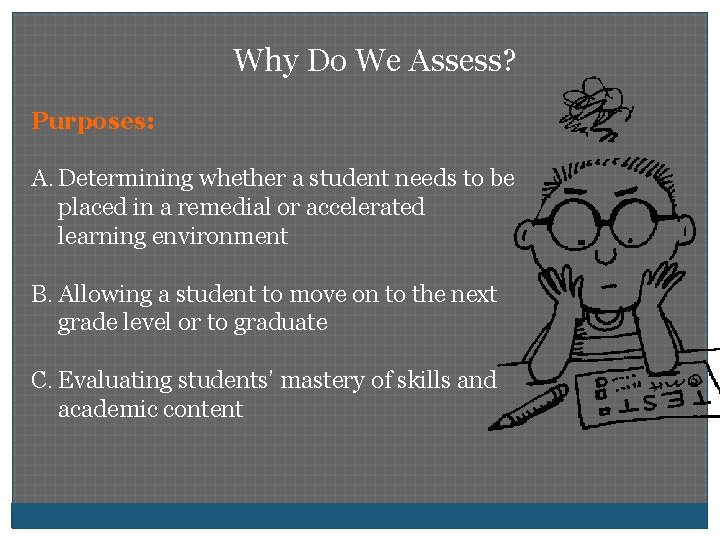
Why Do We Assess? Purposes: A. Determining whether a student needs to be placed in a remedial or accelerated learning environment B. Allowing a student to move on to the next grade level or to graduate C. Evaluating students’ mastery of skills and academic content
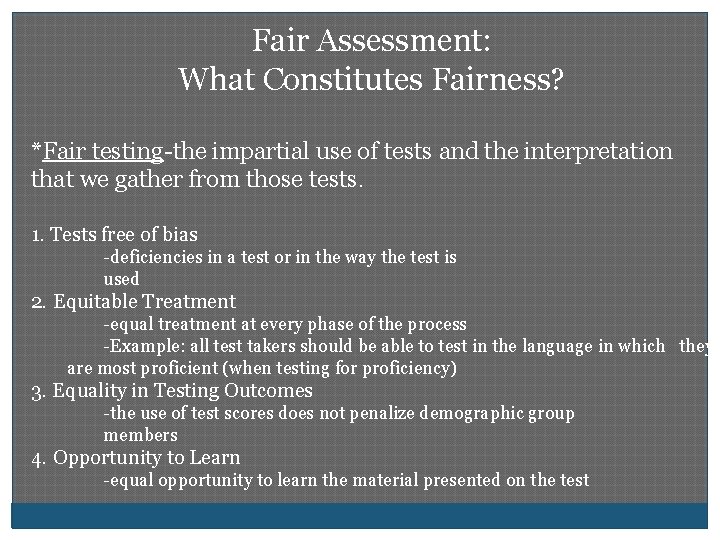
Fair Assessment: What Constitutes Fairness? *Fair testing-the impartial use of tests and the interpretation that we gather from those tests. 1. Tests free of bias -deficiencies in a test or in the way the test is used 2. Equitable Treatment -equal treatment at every phase of the process -Example: all test takers should be able to test in the language in which they are most proficient (when testing for proficiency) 3. Equality in Testing Outcomes -the use of test scores does not penalize demographic group members 4. Opportunity to Learn -equal opportunity to learn the material presented on the test
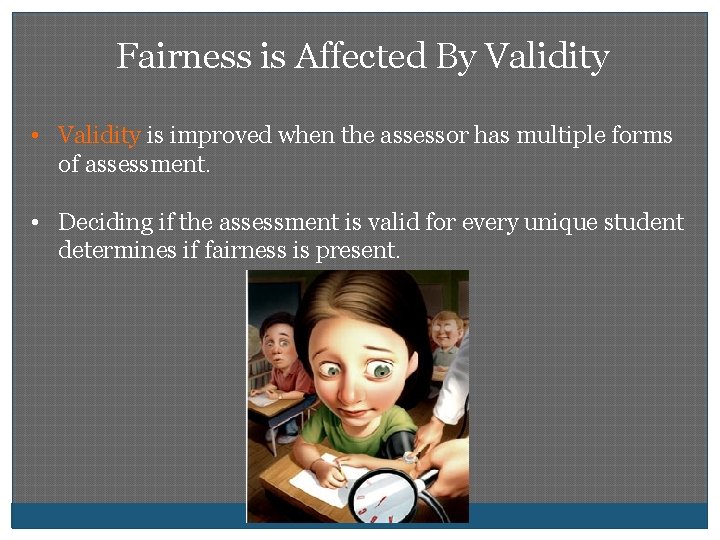
Fairness is Affected By Validity • Validity is improved when the assessor has multiple forms of assessment. • Deciding if the assessment is valid for every unique student determines if fairness is present.
Try This! A plant's fruit always contains seeds. Choose the item below that's not a fruit. a) Orange b) Pumpkin c) Apple d) Celery
“Accommodations are often an afterthe-fact consideration, when really the test should be designed to be accessible to all students from the start. ” -Bob Dolan, senior research scientist with the Center for Applied Special Technology (CAST) (Dillon, 2006)
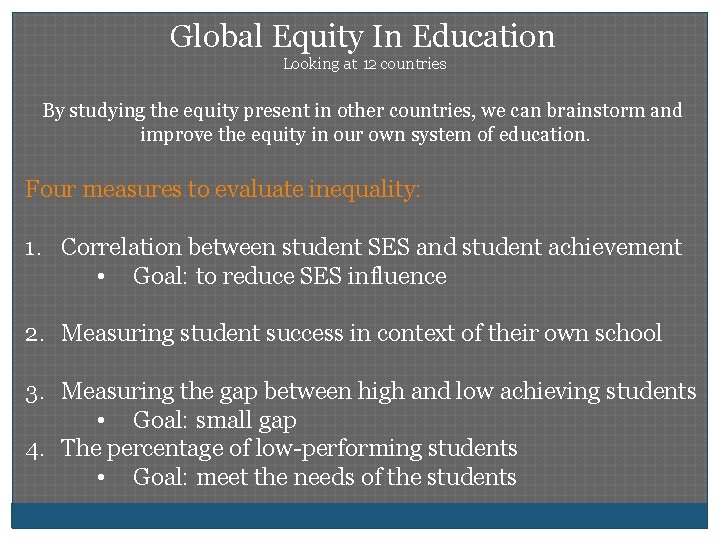
Global Equity In Education Looking at 12 countries By studying the equity present in other countries, we can brainstorm and improve the equity in our own system of education. Four measures to evaluate inequality: 1. Correlation between student SES and student achievement • Goal: to reduce SES influence 2. Measuring student success in context of their own school 3. Measuring the gap between high and low achieving students • Goal: small gap 4. The percentage of low-performing students • Goal: meet the needs of the students
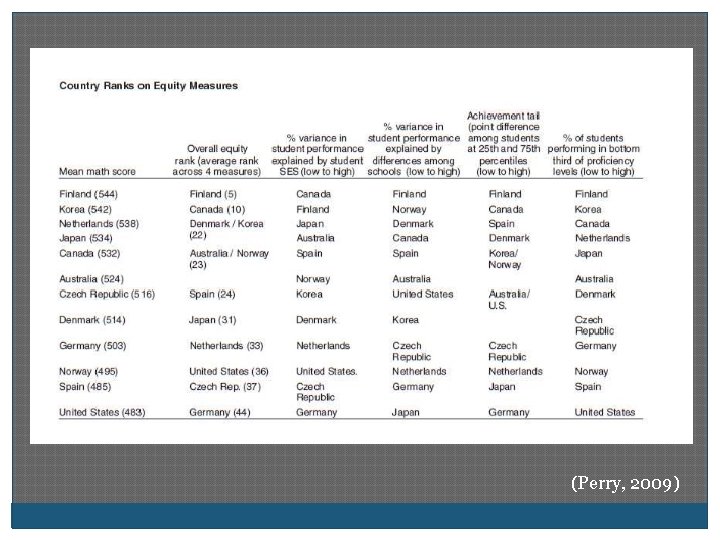
(Perry, 2009)
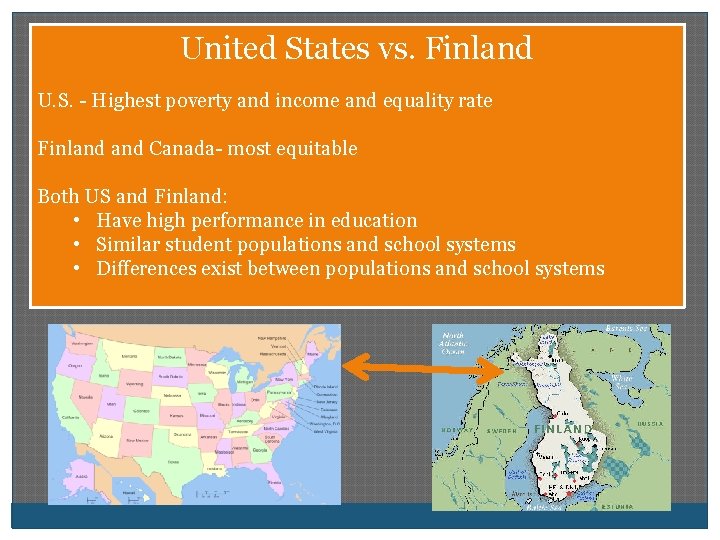
United States vs. Finland U. S. - Highest poverty and income and equality rate Finland Canada- most equitable Both US and Finland: • Have high performance in education • Similar student populations and school systems • Differences exist between populations and school systems
“There is no superior ‘Finland model’…Schools in all countries are facing the same challenge; to motivate their students to believe in themselves and to work harder. ” (Liang, 2003)
What types of bias do you believe might exist in assessment?
Bias: Students With Disabilities Case Study- Scott is a legally blind student who spent time in a school for the blind as well as a public school for his final senior year. The school for the blind did not provide rigorous academic instruction and he felt that “mainstream” schooling did not fit his needs in the public school setting. • Problems: • Most large-scale assessments are heavily text and language based. • The test format itself can be distracting. Providing accommodations for various disabilities is limited. • Universal design is to look at the student and create an assessment, not to fit the student to the assessment.
Bias: Language And Ethnicity Case Study-Tia is an 8 th grade student who has learning disabilities and difficulties with reading fluency. The statewide test covers the areas of language arts, mathematics, social studies and science. Each of these requires a significant amount of reading. Tia’s reading difficulties may prevent her from doing well in all of the subject matter areas. • Cultural differences in language, ESOL learners, variance in word meaning and expression • DELV Diagnostic Evaluation of Language Variation • Test for speech and language disorders of children from different language and cultural backgrounds • MAE Mainstream American English (MAE) and African American English (AAE)
Bias: Socioeconomic Status (SES) Case Study- Sarah’s school lacks many of the newer resources that can be used to help students better prepare for assessments. As a result, Sarah’s test scores might not accurately reflect her academic and intellectual capacity compared to schools and families that do have these resources. “Many standardized tests are unfair because the questions require a set of knowledge and skills more likely to be possessed by children from privileged backgrounds. ” -Alfie Kohn
Bias: Gender Case Study- Rosa, a Hispanic female, is given a writing assessment in which she must write a letter from the perspective of Huck Finn from The Adventures of Huckleberry Finn. Would this assessment prove equally as fair for Rosa as it would be for her classmate Timmy, a Caucasian male? “For most students, particularly girls and minorities, the present curriculum provides many windows and few mirrors. ” -Emily Style, author of Curriculum as Window and Mirror (Vandell, 1992)
Try This! If someone really wants to conserve resources, one good way to do so is to: a) Leave lights on even if they are not needed. b) Wash small loads instead of large loads in a clothes-washing machine. c) Write on both sides of a piece of paper. d) Place used newspapers in the garbage.
Fair Assessment: The SAT
The SAT: Where It Has Been, Where It Is Going • The Scholastic Aptitude Test (SAT) was created by Harvard’s former president James Bryant Conant and the Educational Testing Service (ETS). • It was formed in an effort to “provide greater educational access for academically gifted and accomplished students. ” Students now had to prove their intellectual worth, rather than their social pedigree. • The University of California adopted the exam in 1968 and schools around the country quickly followed suit.
The SAT: Is It Fair? • 1999 - The Big Test: The Secret History of the American Meritocracy, by Nicholas Lemann • Sparked the SAT-optional movement • The exam no longer served public good and was distorting • Educational priorities • Case Studies: Bates College/Providence College • SAT scores not indicative of GPAs • Bias? • Favors the wealthy • Studying to the test • Women and students of color “Nobody is going to spend their money that way. ” • Gaston Caperton, president of the College Board, when expressing how expensive it is to create standardized tests with fair questions and exam security.
Looking Toward The Future • SAT-optional Movement • Lemann advocates: • a national curriculum or • a national achievement exam for students exiting high school • Dual Interpretation Model • compare students from diverse backgrounds by examining test performance relative to other students in their own community, under similar learning conditions (in context with their own peers)
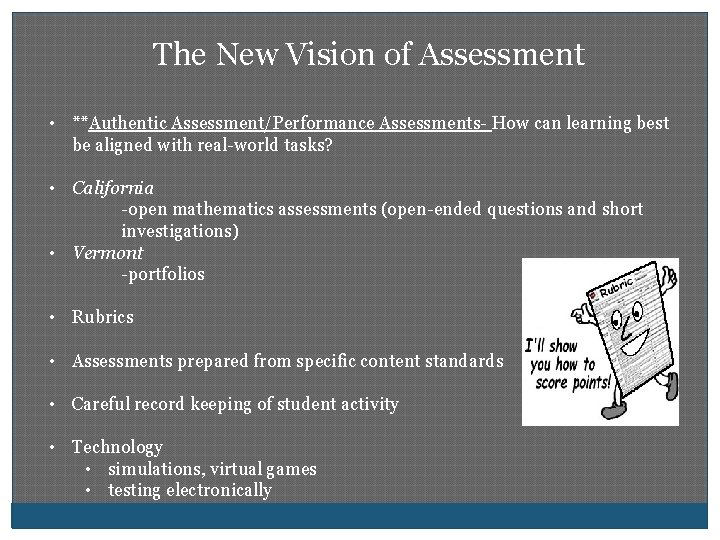
The New Vision of Assessment • **Authentic Assessment/Performance Assessments- How can learning best be aligned with real-world tasks? • California -open mathematics assessments (open-ended questions and short investigations) • Vermont -portfolios • Rubrics • Assessments prepared from specific content standards • Careful record keeping of student activity • Technology • simulations, virtual games • testing electronically
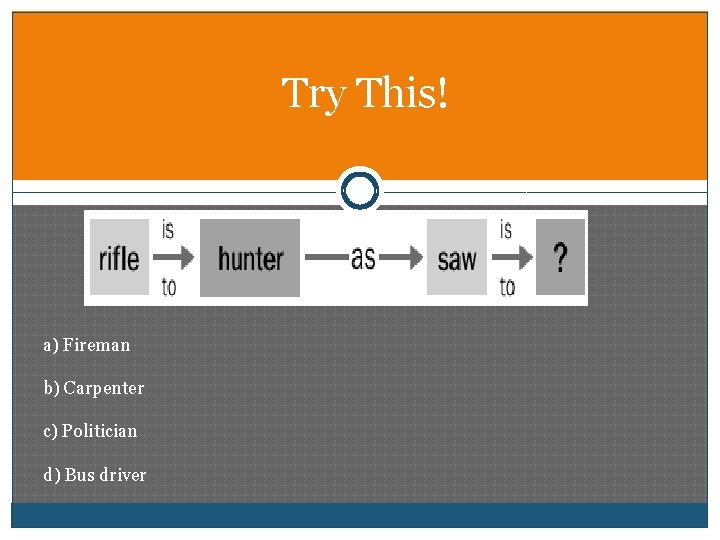
Try This! a) Fireman b) Carpenter c) Politician d) Bus driver
“Ideally, Nelson-Barber says, deep cultural awareness would inform test creation, dissemination, and evaluation. Such a comprehensive approach might move closer to eliminating cultural bias in testing and the need for accommodations for some groups of students. ” (Culture and Assessment, 2011)

For more information… Visit www. fairtest. org The National Center for Fair and Open Testing
Bibliography Assessment Tool Offers Culturally Fair Evaluation. (2002). ASHA Leader, 7(23), 17. Culture and Assessment: Discovering What Students Really Know. (2011). Dillon, N. (2006). Multiple Choice. American School Board Journal, 193(1), 22 -25. Education Digest: Essential Readings Condensed for Quick Review , 76 (8), 43 -46. Epstein, J. P. (2009). Behind the SAT-Optional Movement: Context and Controversy. Journal of College Admission (204), 8 -19. Graf, E. (2002). Different Assessments Suit Different Needs: Considering the Roles of Assessments in Gender Fairness and Educational Opportunity (Comments on Halpern’s Fair Assessments for Girls and Boys Paper). Issues In Education 8(1), 49. Helms, J. E. (2003). Fair and Valid Use of Educational Testing in Grades K-12.
Bibliography Keyser, S. , & Howell, S. L. (2008). The State of Authentic Assessment. Descriptive, Brigham Young University. Liang, X. (2010). Assessment Use, Self-Efficacy and Mathematics Achievement: Comparative Analysis of PISA 2003 Data of Finland, Canada and the USA. Evaluation & Research In Education, 23(3), 213 -229. Perry, L. (2009). Characteristics of Equitable Systems of Education: A Cross-National Analysis. European Education, 41(1), 79 -100. doi: 10. 2753/EUE 1056 -4934410104. Reddell, S. (2010). High Stakes Testing: Our Children at Risk. ERIC. Standardized Test Bias. (2000 -2012). (I. Pearson Education, Producer) Retrieved May 31, 2012, from Family Education: http: //quizzes. familyeducation. com/testing/standardized-tests/standardized-testbias. html#ixzz 1 w. VTCFzt. I. Vandell, K. , Dempsey, S. B. , & American Association of Univ. Women, W. C. (1992). Creating a Gender-Fair Multicultural Curriculum.
- Slides: 27