
Failure Resilient Routing Simple Failure Recovery with Load


- Slides: 34
Failure Resilient Routing Simple Failure Recovery with Load Balancing Martin Suchara in collaboration with: D. Xu, R. Doverspike, D. Johnson and J. Rexford
Failure Recovery and Traffic Engineering in IP Networks o Uninterrupted data delivery when links or routers fail o Failure recovery essential for n Backbone network operators n Large datacenters n Local enterprise networks o Major goal: re-balance the network load after failure 2
Overview I. Failure recovery: the challenges II. Architecture: goals and proposed design III. Optimizations: of routing and load balancing IV. Evaluation: using synthetic and realistic topologies V. Conclusion 3
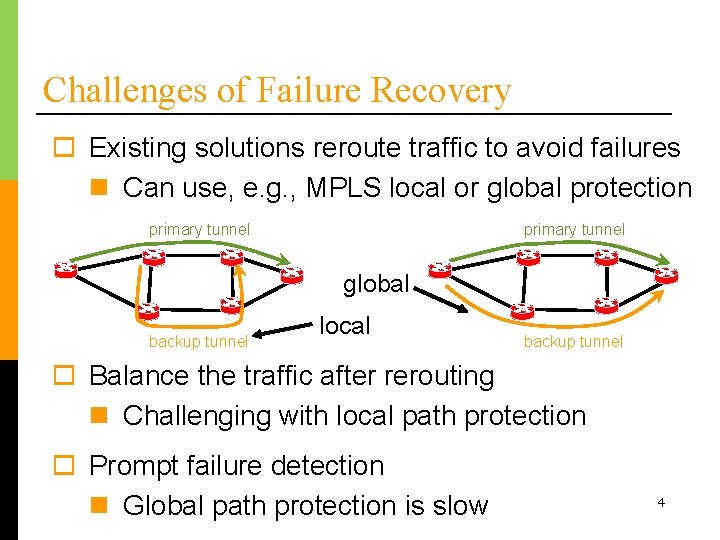
Challenges of Failure Recovery o Existing solutions reroute traffic to avoid failures n Can use, e. g. , MPLS local or global protection primary tunnel global backup tunnel local backup tunnel o Balance the traffic after rerouting n Challenging with local path protection o Prompt failure detection n Global path protection is slow 4
Overview I. Failure recovery: the challenges II. Architecture: goals and proposed design III. Optimizations: of routing and load balancing IV. Evaluation: using synthetic and realistic topologies V. Conclusion 5
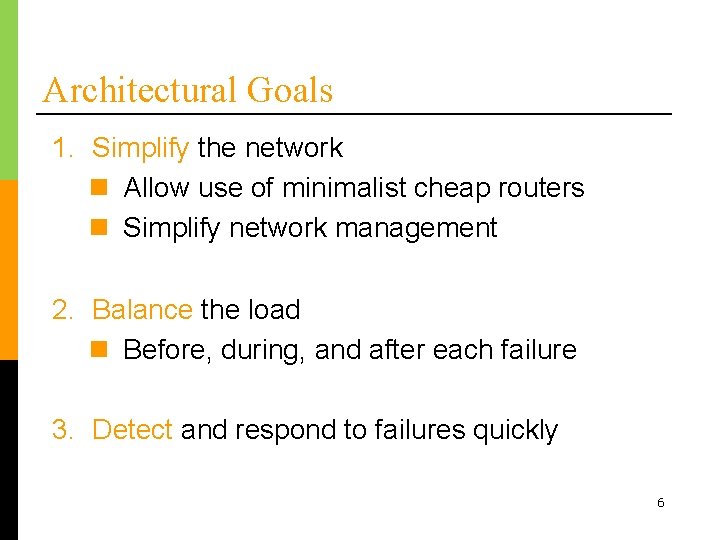
Architectural Goals 1. Simplify the network n Allow use of minimalist cheap routers n Simplify network management 2. Balance the load n Before, during, and after each failure 3. Detect and respond to failures quickly 6
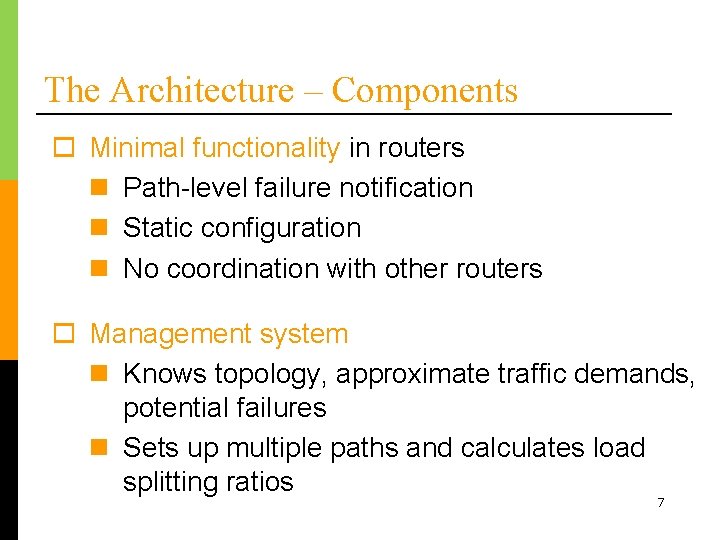
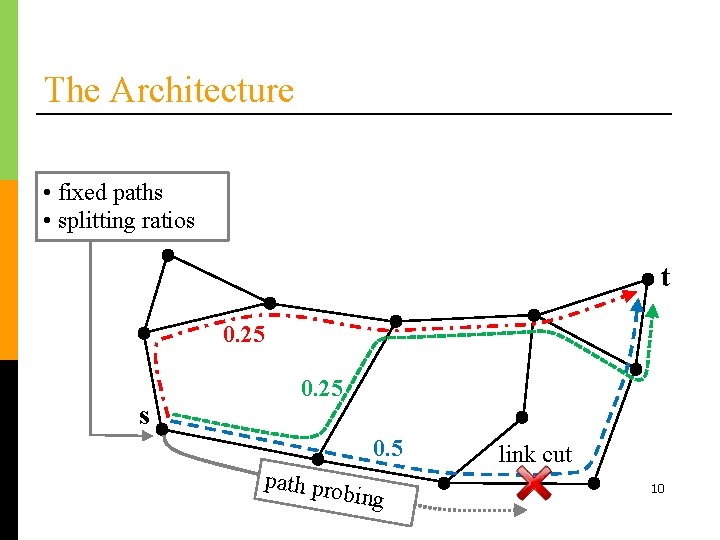
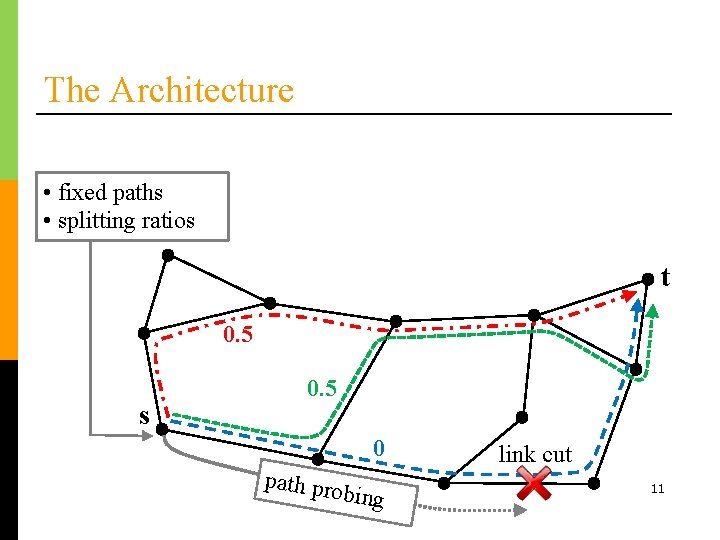
The Architecture – Components o Minimal functionality in routers n Path-level failure notification n Static configuration n No coordination with other routers o Management system n Knows topology, approximate traffic demands, potential failures n Sets up multiple paths and calculates load splitting ratios 7
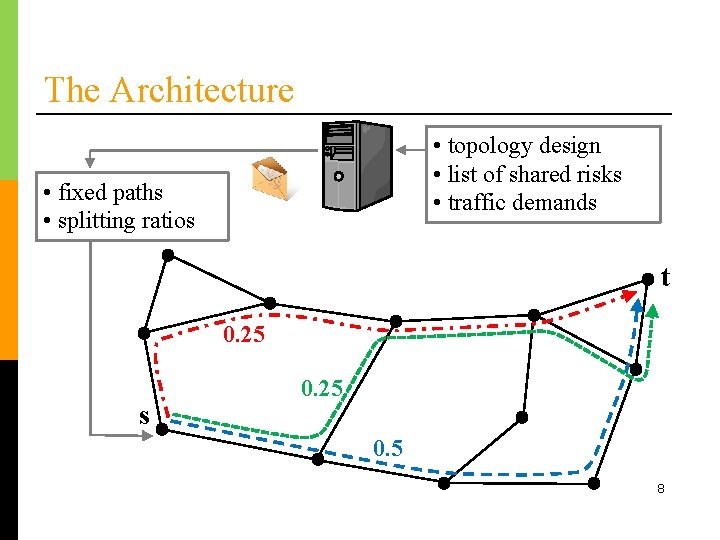
The Architecture • topology design • list of shared risks • traffic demands • fixed paths • splitting ratios t 0. 25 s 0. 25 0. 5 8
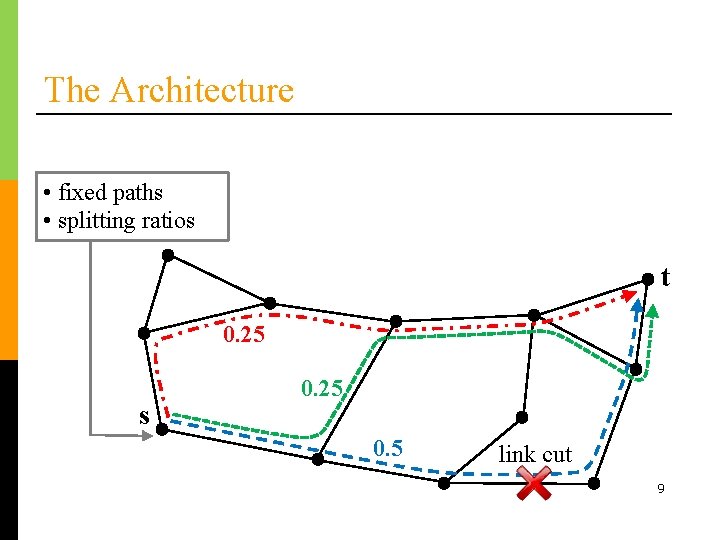
The Architecture • fixed paths • splitting ratios t 0. 25 s 0. 25 0. 5 link cut 9
The Architecture • fixed paths • splitting ratios t 0. 25 s 0. 25 0. 5 path pro bing link cut 10
The Architecture • fixed paths • splitting ratios t 0. 5 s 0. 5 0 path pro bing link cut 11
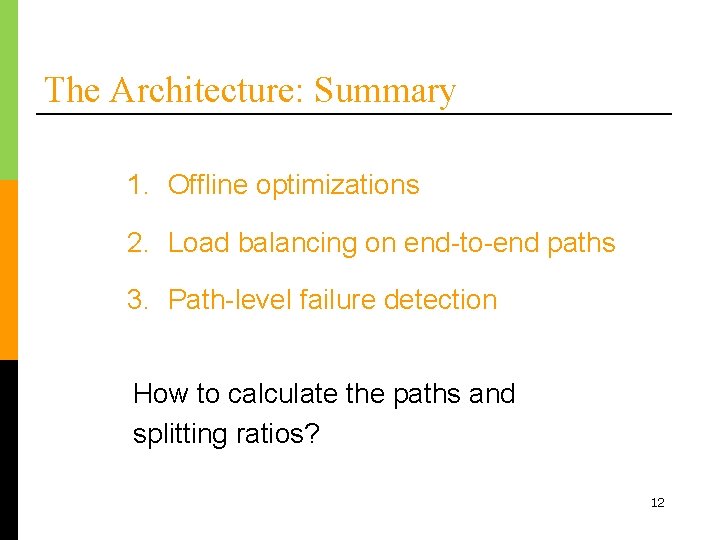
The Architecture: Summary 1. Offline optimizations 2. Load balancing on end-to-end paths 3. Path-level failure detection How to calculate the paths and splitting ratios? 12
Overview I. Failure recovery: the challenges II. Architecture: goals and proposed design III. Optimizations: of routing and load balancing IV. Evaluation: using synthetic and realistic topologies V. Conclusion 13
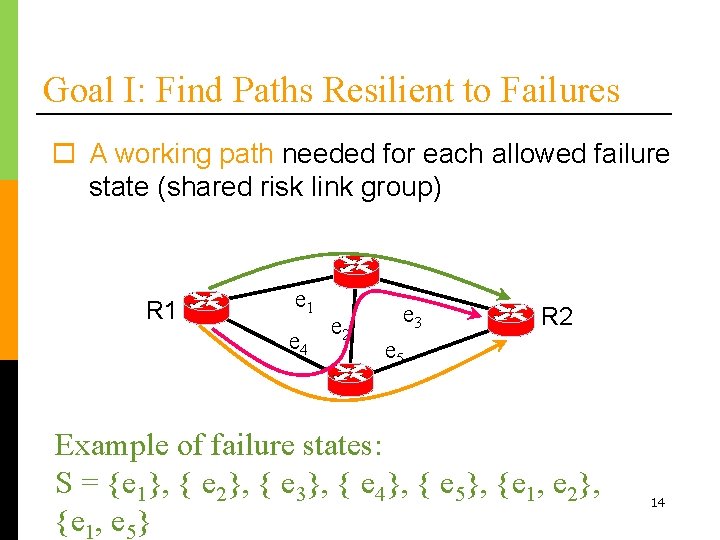
Goal I: Find Paths Resilient to Failures o A working path needed for each allowed failure state (shared risk link group) R 1 e 4 e 2 e 3 R 2 e 5 Example of failure states: S = {e 1}, { e 2}, { e 3}, { e 4}, { e 5}, {e 1, e 2}, {e 1, e 5} 14
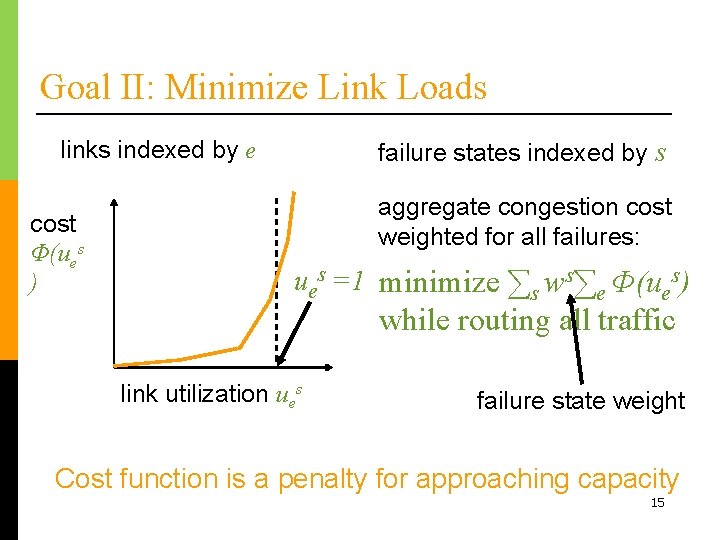
Goal II: Minimize Link Loads links indexed by e cost Φ(ues ) failure states indexed by s aggregate congestion cost weighted for all failures: ues =1 minimize ∑s ws∑e Φ(ues) while routing all traffic link utilization ues failure state weight Cost function is a penalty for approaching capacity 15
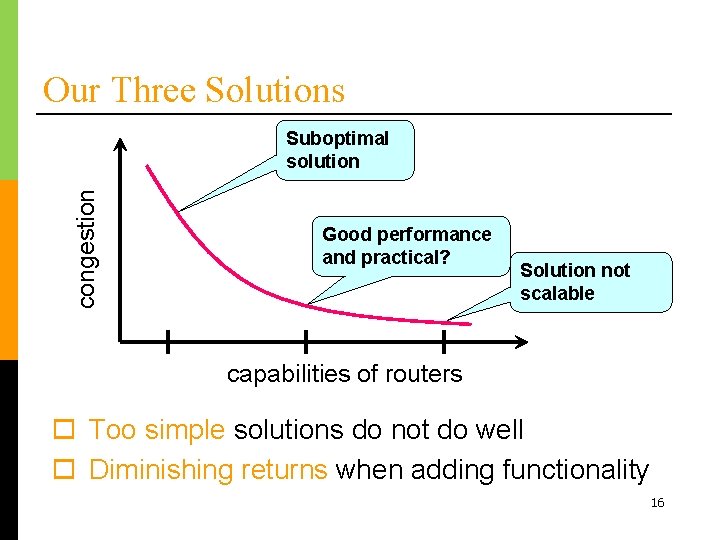
Our Three Solutions congestion Suboptimal solution Good performance and practical? Solution not scalable capabilities of routers o Too simple solutions do not do well o Diminishing returns when adding functionality 16
1. Optimal Solution: State Per Network Failure o Edge router must learn which links failed o Custom splitting ratios for each failure configuration: 0. 4 e 1 0. 4 e 3 e 5 0. 2 Failure Splitting Ratios - 0. 4, 0. 2 e 4 0. 7, 0, 0. 3 e 1 & e 2 … 0, 0. 6, 0. 4 e 2 one entry per failure … 0. 7 e 4 e 6 0. 3 17
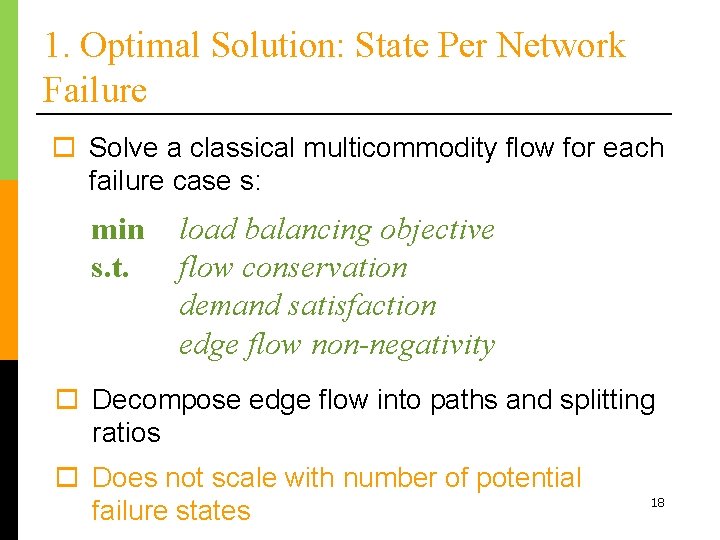
1. Optimal Solution: State Per Network Failure o Solve a classical multicommodity flow for each failure case s: min s. t. load balancing objective flow conservation demand satisfaction edge flow non-negativity o Decompose edge flow into paths and splitting ratios o Does not scale with number of potential failure states 18
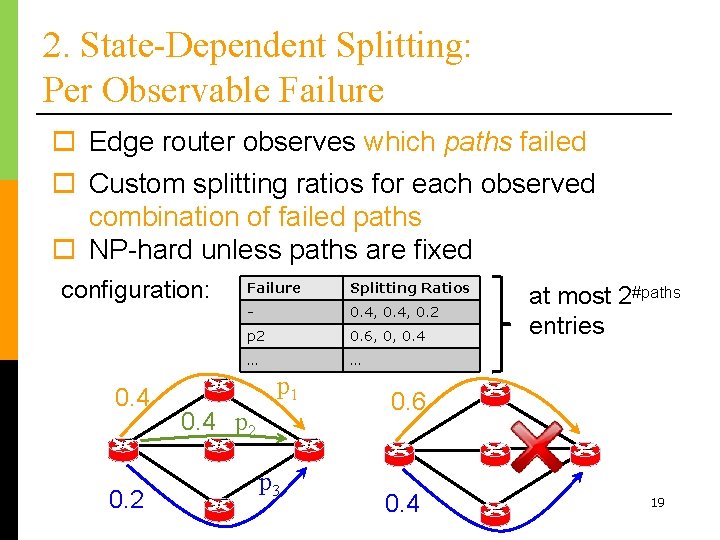
2. State-Dependent Splitting: Per Observable Failure o Edge router observes which paths failed o Custom splitting ratios for each observed combination of failed paths o NP-hard unless paths are fixed configuration: 0. 4 0. 2 Failure Splitting Ratios - 0. 4, 0. 2 p 2 0. 6, 0, 0. 4 … … p 1 0. 4 p 2 p 3 at most 2#paths entries 0. 6 0. 4 19
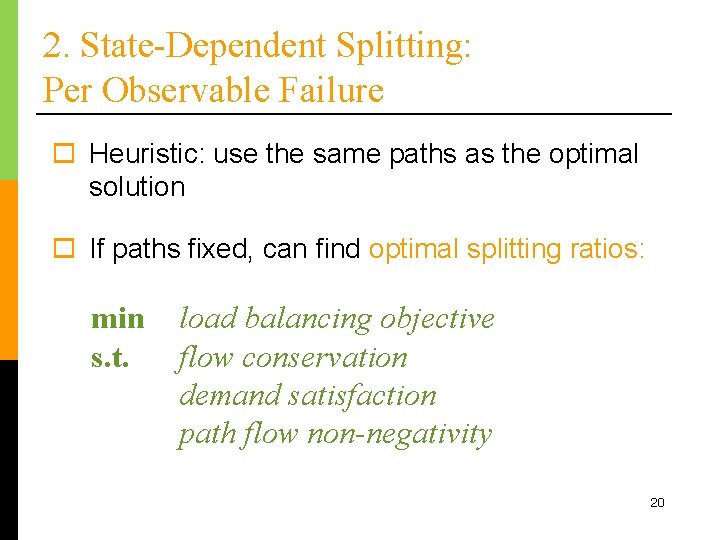
2. State-Dependent Splitting: Per Observable Failure o Heuristic: use the same paths as the optimal solution o If paths fixed, can find optimal splitting ratios: min s. t. load balancing objective flow conservation demand satisfaction path flow non-negativity 20
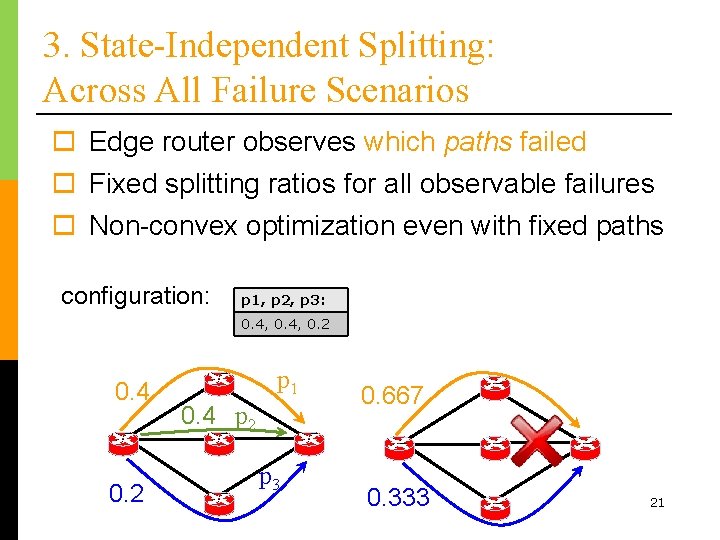
3. State-Independent Splitting: Across All Failure Scenarios o Edge router observes which paths failed o Fixed splitting ratios for all observable failures o Non-convex optimization even with fixed paths configuration: p 1, p 2, p 3: 0. 4, 0. 2 0. 4 0. 2 p 1 0. 4 p 2 p 3 0. 667 0. 333 21
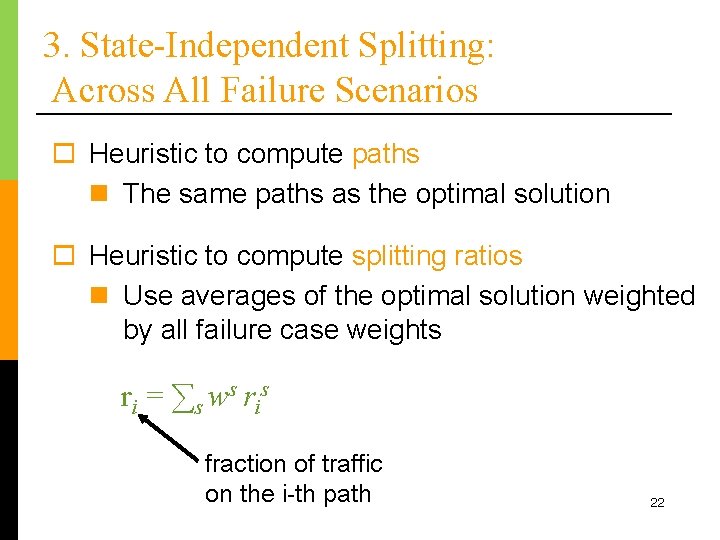
3. State-Independent Splitting: Across All Failure Scenarios o Heuristic to compute paths n The same paths as the optimal solution o Heuristic to compute splitting ratios n Use averages of the optimal solution weighted by all failure case weights ri = ∑ s w s r i s fraction of traffic on the i-th path 22
Our Three Solutions 1. Optimal solution 2. State-dependent splitting 3. State-independent splitting How well do they work in practice? 23
Overview I. Failure recovery: the challenges II. Architecture: goals and proposed design III. Optimizations: of routing and load balancing IV. Evaluation: using synthetic and realistic topologies V. Conclusion 24
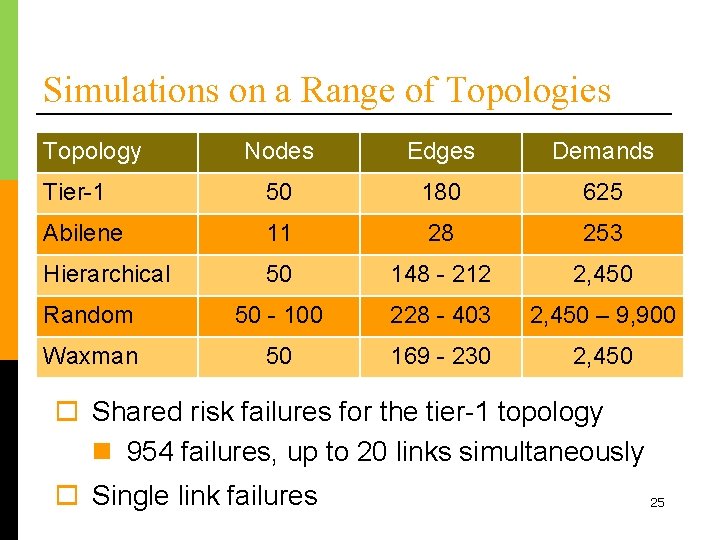
Simulations on a Range of Topologies Topology Nodes Edges Demands Tier-1 50 180 625 Abilene 11 28 253 Hierarchical 50 148 - 212 2, 450 Random 50 - 100 228 - 403 2, 450 – 9, 900 Waxman 50 169 - 230 2, 450 o Shared risk failures for the tier-1 topology n 954 failures, up to 20 links simultaneously o Single link failures 25
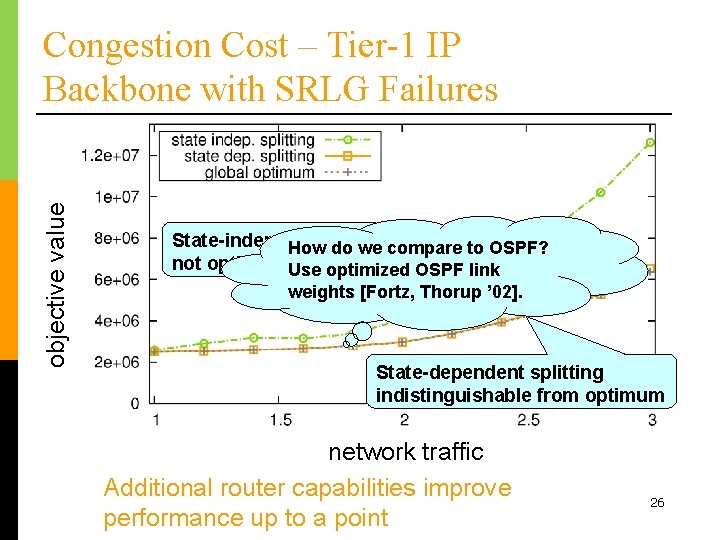
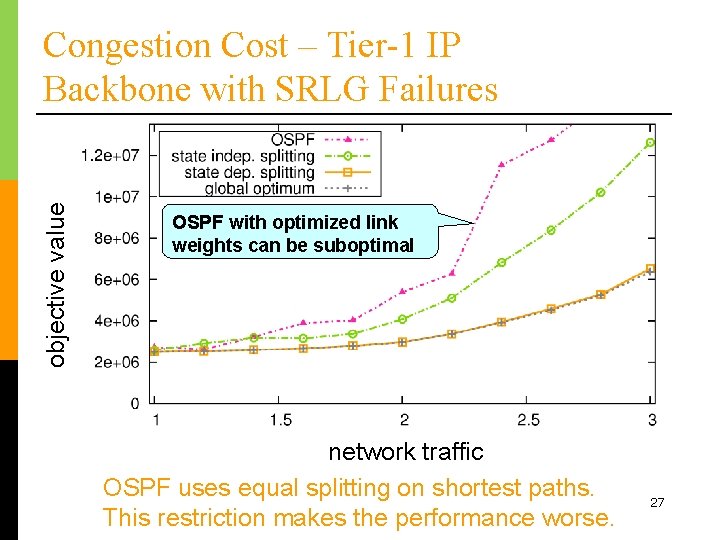
objective value Congestion Cost – Tier-1 IP Backbone with SRLG Failures State-independent splitting How do we compare to OSPF? not optimal but Usesimple optimized OSPF link weights [Fortz, Thorup ’ 02]. State-dependent splitting indistinguishable from optimum increasing load network traffic Additional router capabilities improve performance up to a point 26
objective value Congestion Cost – Tier-1 IP Backbone with SRLG Failures OSPF with optimized link weights can be suboptimal increasing load network traffic OSPF uses equal splitting on shortest paths. This restriction makes the performance worse. 27
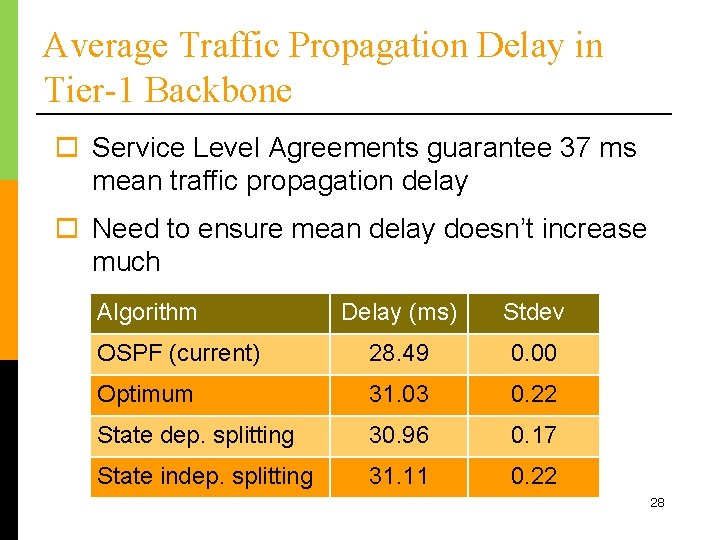
Average Traffic Propagation Delay in Tier-1 Backbone o Service Level Agreements guarantee 37 ms mean traffic propagation delay o Need to ensure mean delay doesn’t increase much Algorithm Delay (ms) Stdev OSPF (current) 28. 49 0. 00 Optimum 31. 03 0. 22 State dep. splitting 30. 96 0. 17 State indep. splitting 31. 11 0. 22 28
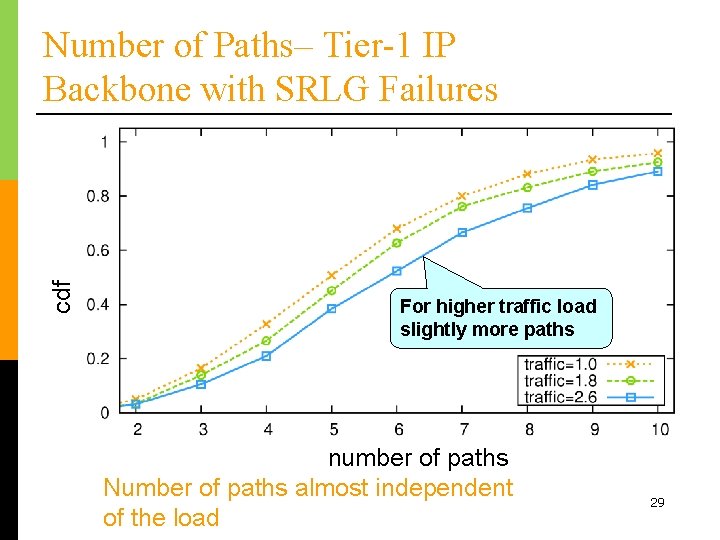
cdf Number of Paths– Tier-1 IP Backbone with SRLG Failures For higher traffic load slightly more paths numberofofpaths Number of paths almost independent of the load 29
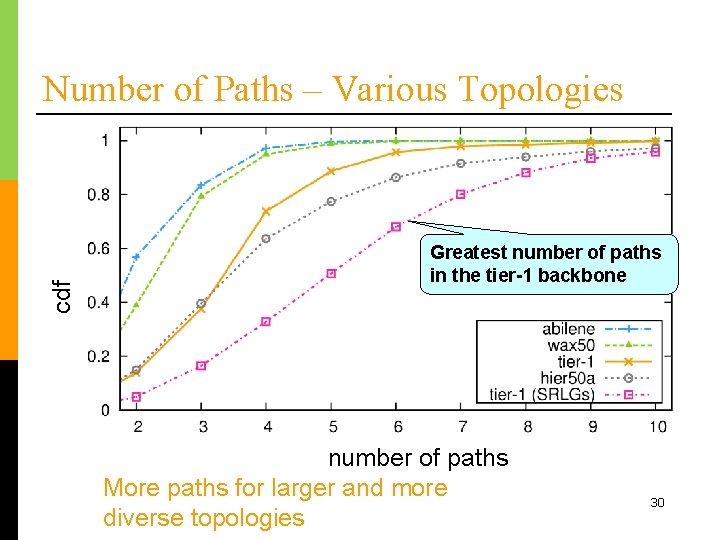
cdf Number of Paths – Various Topologies Greatest number of paths in the tier-1 backbone numberofofpaths More paths for larger and more diverse topologies 30
Overview I. Failure recovery: the challenges II. Architecture: goals and proposed design III. Optimizations: of routing and load balancing IV. Evaluation: using synthetic and realistic topologies V. Conclusion 31
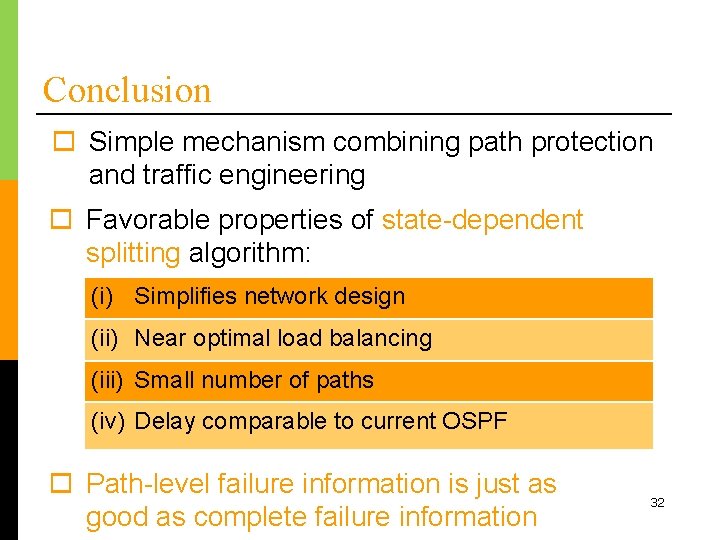
Conclusion o Simple mechanism combining path protection and traffic engineering o Favorable properties of state-dependent splitting algorithm: (i) Simplifies network design (ii) Near optimal load balancing (iii) Small number of paths (iv) Delay comparable to current OSPF o Path-level failure information is just as good as complete failure information 32
Acknowledgement Thanks to Olivier Bonaventure, Quynh Nguyen, Kostas Oikonomou, Rakesh Sinha, Kobus van der Merwe, and Jennifer Yates 33
Thank You! 34