
Failure Mode and Effects Analysis System FMEA Design

- Slides: 49
Failure Mode and Effects Analysis System FMEA Design FMEA Process FMEA
Purpose • FMEA is a process designed to identify potential identify failure modes and to rate the severity of their effects.
Problem Solving Process • Requires problem identification before we proceed to a possible solution • We need to prioritize the problems so our energy is directed • We want to attack the problem upstream-root cause • Our countermeasure and action plans must be implemented
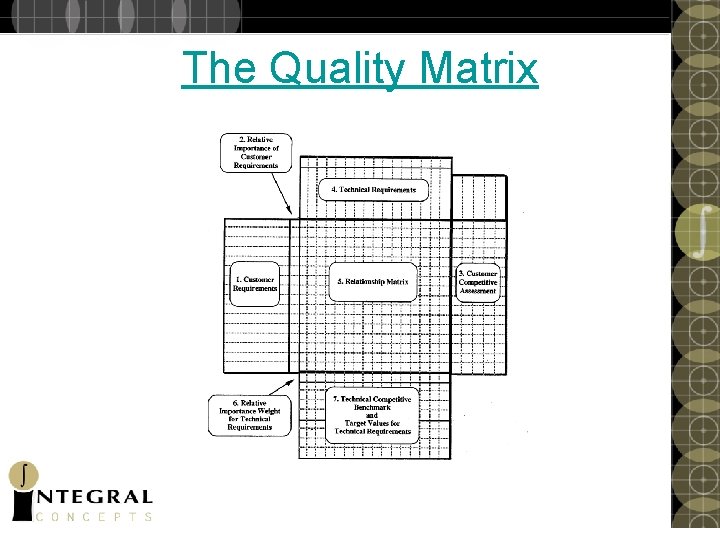
Recall: Quality Function Deployment • We begin at the end with a statement of needs and wants (standards etc. ) • We ask what do we do to achieve these outcomes. • We then continue to ask about the elements of each sub-function we design • We then ask about the process of manufacture.
The Quality Matrix
Begin with the ultimate customer • Identify how the thing you deliver will be used. • Ask the client about the use so as to help identify needs and wants. • What are the subsystems we would put in place to meet these needs/wants?
Move backwards from the ultimate customer • Ask what process is required to reach the customer. • This process step is served by another supplier • Continue backwards--each in-process customer has an in-process supplier.
The Problems are Too Great and the Day is Short • We need to work on what we can put our hands around --not everything • The idea is to use a mechanism to prioritize the work.
Pareto Principle • An essential element of this process involves the Pareto Principle • 80% of the occurrences of ill effects can be attributable to 20% of the causes • So, if we attack a few of the causes we can reduce the frequency of the problems in a substantial way.
Example • In the health care industry, over 80% ---I’m told 88%---of the charges come from under 20% of the carriers of insurance. • New advances in health care will likely use formats other than HMOs.
Pareto Chart Y-Axis • • The y-axis will be one of three quantities Severity: S (of the effect) Severity times Occurrence: S*O RPN: Severity*Occurrence*Detection (Risk Priority Number)
Pareto Chart X Axis • Failure Modes • Obtained by brainstorm and or data
System FMEA • Before we design the products, we want to analyze the failure modes that can occur between subsystems and processes that are needed.
System Functions • What are the building blocks for the proposed operation? • How do these blocks--processes and subsystems--relate to each other? • Example: To generate light in a car we need a variety of subsystems to work.
Output of System FMEA • The system failure mode prioritized by numbers • The specific functions that we need to monitor are identified. • A set of design actions to reduce the incidence of failures are put in place
What are the system functions here? • The battery operates the objects they are designed to power. • What do we need to do to make this happen? (specifically, we want to know the sub-systems needed to reach this point. ):
Design FMEA • Before a product is released to manufacturing we need to analyze the potential failure modes in the product due to design deficiency • What functions/products do we need? Will the design work? Is it verified? • Actions: Revise specifications, change design simulation
Output of Design FMEA • Product failure modes and numbers that reflect their rank order • Critical characteristics that we want to study • Product design actions to reduce the frequency of failures and or Robust Design to reduce the effect of causes of failures
Process FMEA • The failure modes in production and the administrative processes that can be caused by process deficiencies • Our goal here is to connect the process with the outcomes and work in an EFFECTIVE way to reduce the failures.
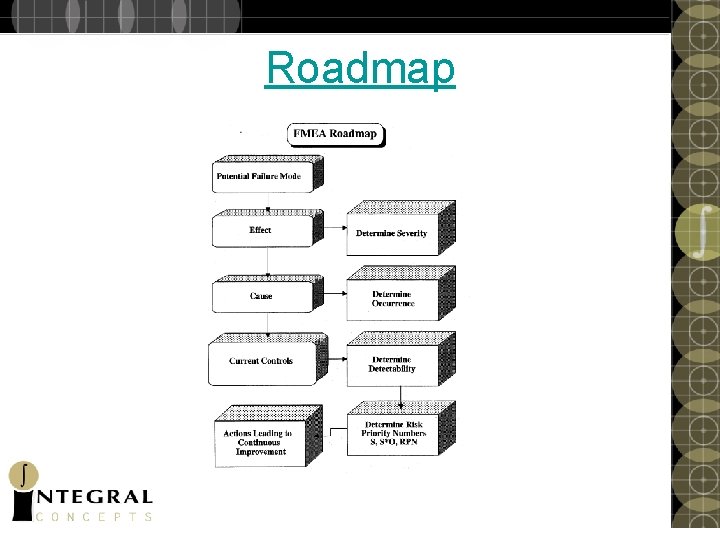
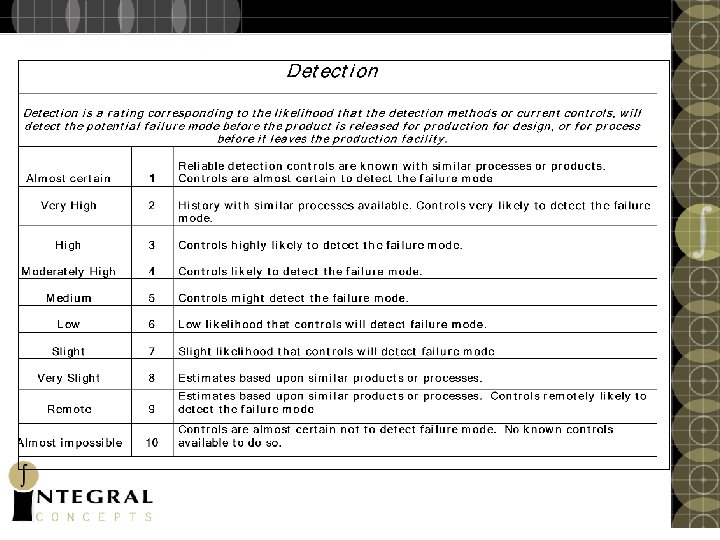
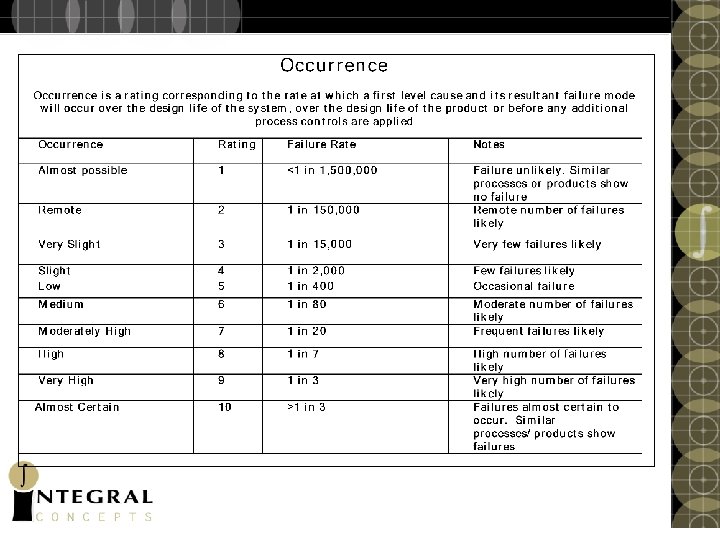
FMEA Roadmap • • • Potential failure mode -> Effect (Determine Severity)-> Cause (determine Occurrence)-> Current Controls (Determine Detectability) Determine Risk Numbers (S, O, RPN) Actions Leading to Improvement
Roadmap
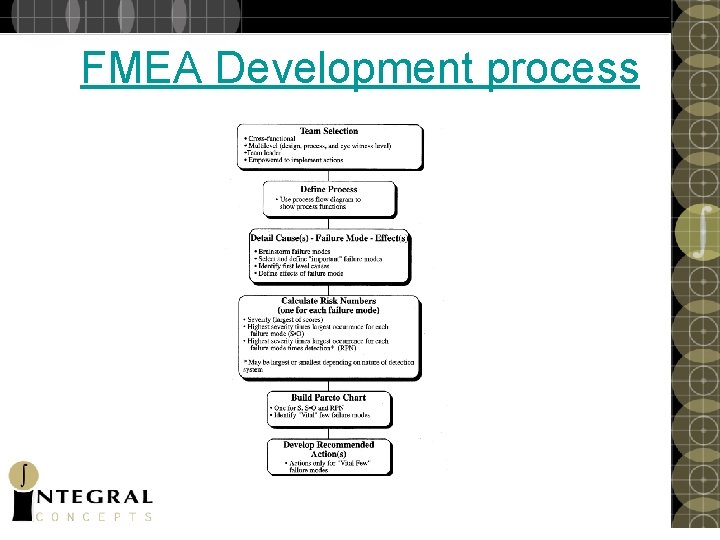
FMEA Development process
Process FMEA Template
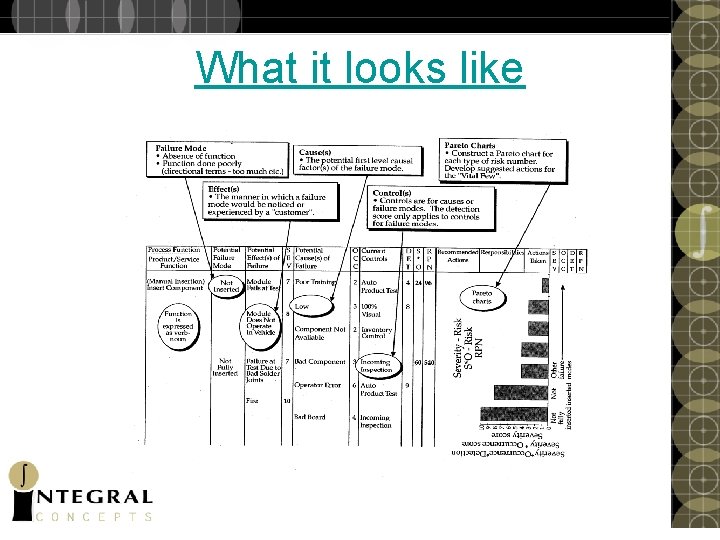
What it looks like
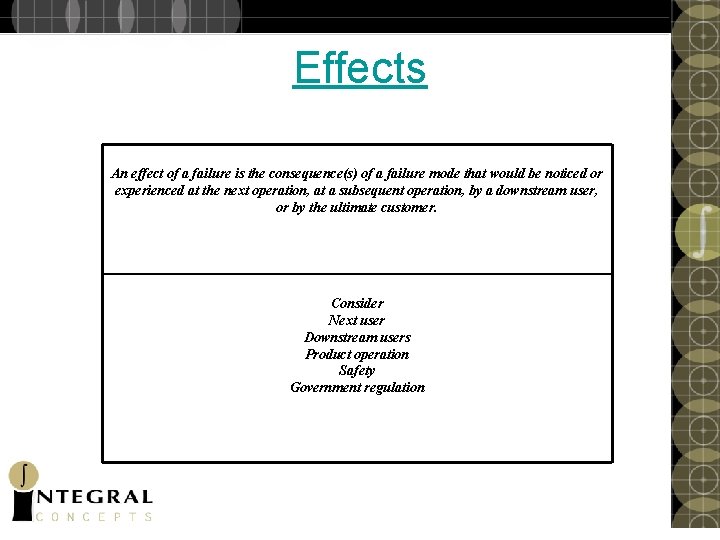
Effects An effect of a failure is the consequence(s) of a failure mode that would be noticed or experienced at the next operation, at a subsequent operation, by a downstream user, or by the ultimate customer. Consider Next user Downstream users Product operation Safety Government regulation
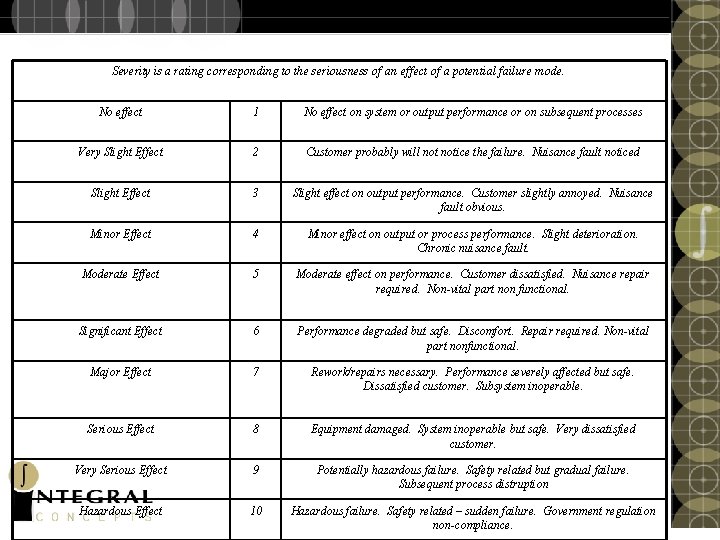
Severity is a rating corresponding to the seriousness of an effect of a potential failure mode. No effect 1 No effect on system or output performance or on subsequent processes Very Slight Effect 2 Customer probably will notice the failure. Nuisance fault noticed Slight Effect 3 Slight effect on output performance. Customer slightly annoyed. Nuisance fault obvious. Minor Effect 4 Minor effect on output or process performance. Slight deterioration. Chronic nuisance fault. Moderate Effect 5 Moderate effect on performance. Customer dissatisfied. Nuisance repair required. Non-vital part non functional. Significant Effect 6 Performance degraded but safe. Discomfort. Repair required. Non-vital part nonfunctional. Major Effect 7 Rework/repairs necessary. Performance severely affected but safe. Dissatisfied customer. Subsystem inoperable. Serious Effect 8 Equipment damaged. System inoperable but safe. Very dissatisfied customer. Very Serious Effect 9 Potentially hazardous failure. Safety related but gradual failure. Subsequent process distruption Hazardous Effect 10 Hazardous failure. Safety related – sudden failure. Government regulation non-compliance.
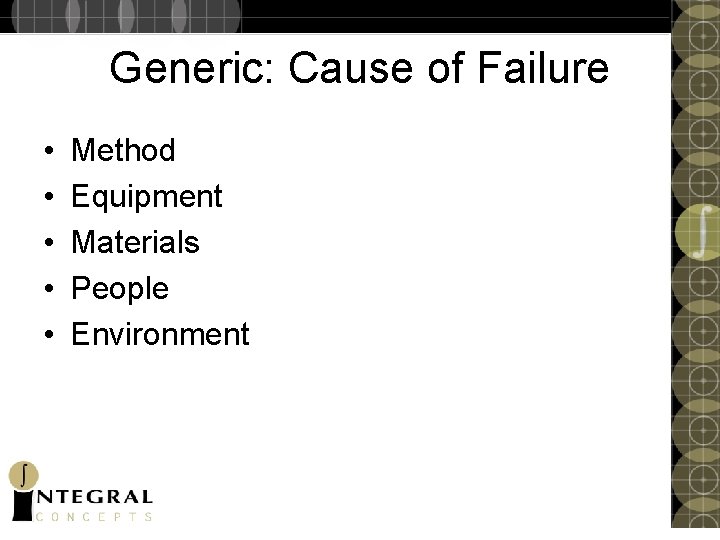
Generic: Cause of Failure • • • Method Equipment Materials People Environment
Examples • Failure Mode: Deposition too thick • Potential Cause: Air pressure peak too high
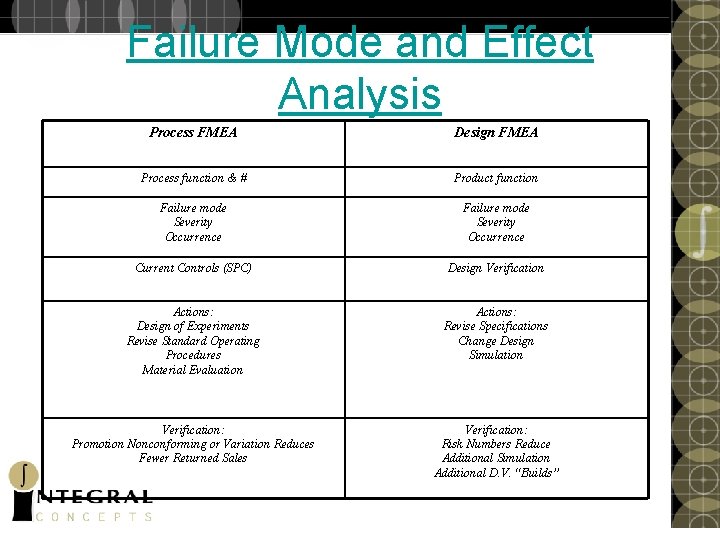
Failure Mode and Effect Analysis Process FMEA Design FMEA Process function & # Product function Failure mode Severity Occurrence Current Controls (SPC) Design Verification Actions: Design of Experiments Revise Standard Operating Procedures Material Evaluation Actions: Revise Specifications Change Design Simulation Verification: Promotion Nonconforming or Variation Reduces Fewer Returned Sales Verification: Risk Numbers Reduce Additional Simulation Additional D. V. “Builds”
Control Plans: Idea • The plan is a record of how you intend to control the process. • It changes as we learn: called a living document • It should eliminate processes that were not effective and introduce process steps that are effective • It is essential that broad (cross-functional) input be used to create the plan
Team • Include all major process leaders-crossfunctional • Bring people from all levels • Make sure everyone is empowered
System Thinking Issues • Eliminate barriers between units, people and or departments-between design and manufacture, between purchasing and users etc. • Eliminate numerical goals, M. B. O. , etc that cause people to tamper or use methods that take us away from our purpose • Institute a leadership that has us focused on the goal.
And also…. • Drive out fear • Engage people in learning how to improve the system • and act on ideas. . .
Control Plan Includes: • A plan to control each process step: Connect to the flow chart • We only want to control “important” failure modes • The control plan should identify actions • We want actions for only the vital few failure modes
Categories of Measurements • Significant characteristics-dimensions of final product etc. • Critical Characteristics-features of the process that affect the SC values • The critical characteristics should be predictors of the significant characteristics
Key Measurement Features in Control Plan • For each step of the process we have the Significant Characteristics (SC) – Determined by the next in process customer • We have the Critical Characteristics (CC) – Determined by the process that gives rise to the SC
How are the SC and CC related? • Design of experiments is the tool we use to help us identify the connections between process parameters and significant characteristics • It is essential that we NOT look at features one-at-a-time with all else held constant. • Without a several factor study we can’t learn about interactions
First Step: Stability • Unless the characteristics we want to control exhibit stability, it is difficult to make improvement. • Operational definitions of stability should be described in the control plan. • The implementation of these rules with respect to the key features are described in the control plan too.
Connections • The Control Plan identifies failure modes with product characteristics (SC) • The Control Plan identifies causes with process parameters (CC) • The strength of the relationship is estimated by the team and portrayed in an input-output matrix
Input <-> Output Matrix • List the causes--particular process parameters CC-- as rows of the table • List the failure modes as SC-significant characteristics as columns of the matrix. • Have the team identify the strength of the relationship as the matrix entry
One way to identify the few CC or SC for focus • For each SC we can determine the strength of the relationship with each CC (a 5 or ten point scale say. ) Team creates a number. • We would add the strength measures for each CC across all SC to establish a priority rating for the Critical Characteristics. • We can do the same in the other direction to help focus on a few SC
Data Validation • The relationship between particular SC and CC --process parameters--must be validated. • The strength of the relationship and potentially complicated interactions needs to be studied. • Scatter diagrams are always preferred to correlation measures
Summary • For each process step identify the key SC and CC. • Record results in the Control Plan • Obtain customer approval • Always look upstream for more effective control
Control Plan Categories • Pre launch – Process capability study – Prototype Control plan – Machine control plan • Ongoing – A living document to capture the current state of the plan--and history
Proactive Ideas • Change design for elimination of the failure mode • Create a robust design so as to eliminate effect • The new design would be directed at the high severity and occurrence items in our Pareto Analysis
Reactive Plan • Add controls and inspection to improve our ability to detect the failure mode
General Strategy • Change design and or the process to prevent or reduce the frequency of occurrence of a few causes • Start with a reactive plan and continue the process of improvement by moving upstream in the process. Find process parameters that are excellent predictors of final significant characteristics--and control these.