
Failure Investigation Principles for Combustion Turbines Combining Science
Failure Investigation Principles for Combustion Turbines- Combining Science and Art Presented by Ron Munson, P. E. & Dr. Swaminathan Principal Engineers Mechanical & Material Engineering, LLC Westinghouse 501 F/G Users Meeting San Diego, CA January 30, 2007
Introduction n What is a failure? – Inability of a turbine to perform its function with reasonable safety n Examples – – – Unscheduled disassembly of a turbine? Fractured Turbine Blade? Cracked Turbine Blade? Plugged Fuel Nozzle? Dirt Air Filter?
Introduction n n The definition of “Failure” will vary greatly and is debatable. Financial definition: – – – n Repair cost beyond planned maintenance budget Extends downtime beyond schedule Exceeds Insurance deductible No clear cut definition, but when you have one you will know it!
Levels of Failure Analysis Level 1 - determine Mechanism of damage n Level 2 - determine Mechanism and Cause for the damage n Level 3 - determine the Root Cause for the damage n
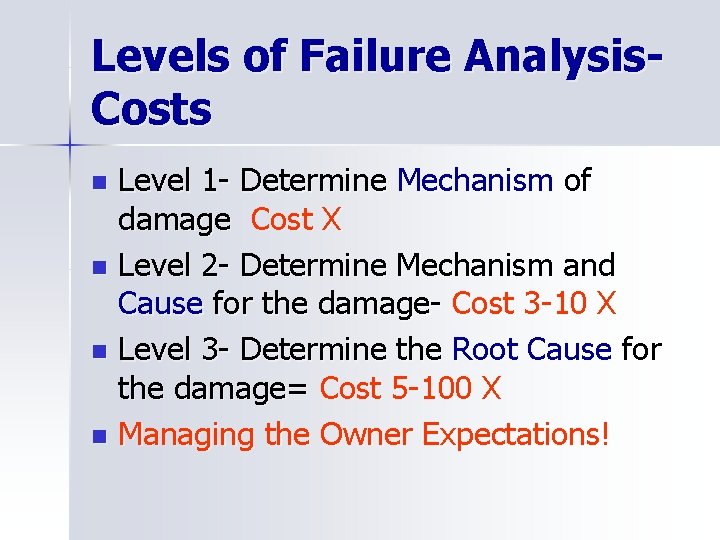
Levels of Failure Analysis. Costs Level 1 - Determine Mechanism of damage Cost X n Level 2 - Determine Mechanism and Cause for the damage- Cost 3 -10 X n Level 3 - Determine the Root Cause for the damage= Cost 5 -100 X n Managing the Owner Expectations! n
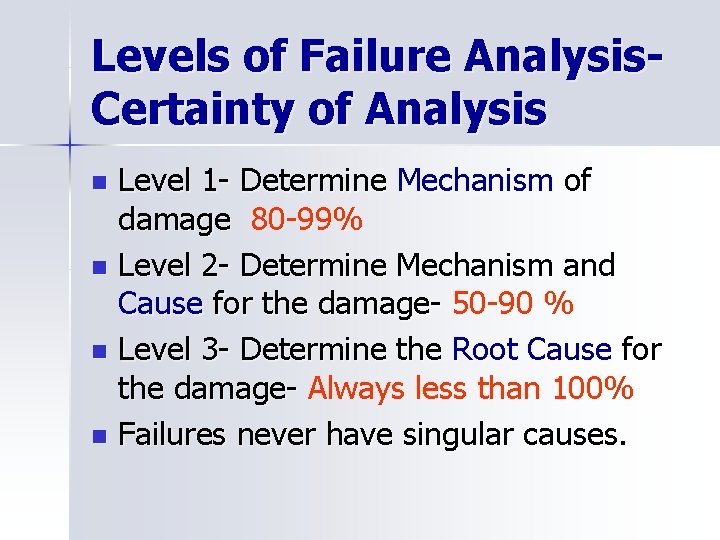
Levels of Failure Analysis. Certainty of Analysis Level 1 - Determine Mechanism of damage 80 -99% n Level 2 - Determine Mechanism and Cause for the damage- 50 -90 % n Level 3 - Determine the Root Cause for the damage- Always less than 100% n Failures never have singular causes. n

Basic Steps in Failure Investigation Secure Equipment n Document n Preserve n Document n Assemble RCA Team n Plan and delegate n Begin Dismantle n
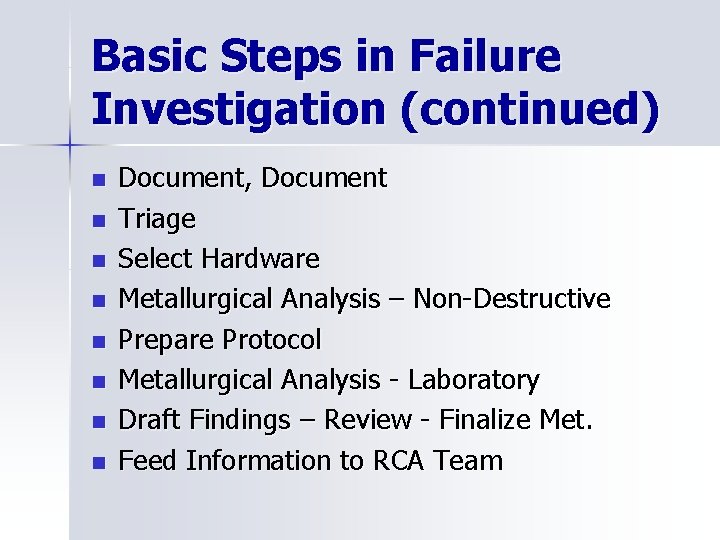
Basic Steps in Failure Investigation (continued) n n n n Document, Document Triage Select Hardware Metallurgical Analysis – Non-Destructive Prepare Protocol Metallurgical Analysis - Laboratory Draft Findings – Review - Finalize Met. Feed Information to RCA Team
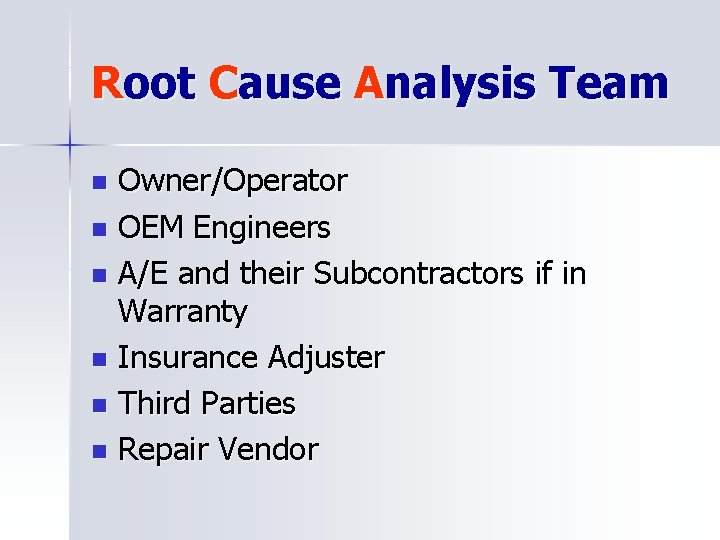
Root Cause Analysis Team Owner/Operator n OEM Engineers n A/E and their Subcontractors if in Warranty n Insurance Adjuster n Third Parties n Repair Vendor n
Root Cause Analysis Team - Cautions If RCA team is entirely OEM Personnel. STOP! n If there is an Long Term Service Agreement in Place - Beware n Generally, there will never be a single root cause—best effort is a weighted list of contributory causes. n
Combustion Turbines n n Combustion Turbines are particularly susceptible to the occurrence of undocumented failure mechanisms. CTs contain many very highly alloyed, state-of-theart materials. – These materials are usually introduced with short testing cycles 10, 000 to 24, 000 hours but asked to perform for times approaching 100, 000 hours – Alloys are complex and each alloy additive can react with its neighbors to produce unexpected consequences
Munson’s Axiom - The more sophisticated the alloy the more insidious and unpredictable the damage mechanism!
Strengthening Mechanisms Superalloys are strengthened by several mechanisms – Solid solution strengthening – Carbide or boride precipitation – Gamma Prime ( `) or gamma double prime ( ``) coherent precipitation – Dispersion strengthened
Degradation Mechanisms n Superalloys are degraded in service by many different mechanisms – – – Solutioning of ` or `` Over-aging of ` or ` ` Formation of TCP (topographically close- packed phases- Alpha Chrome ( - Cr) , Delta Phase ( ) Dissociation and reformation of carbides Growth or “ripening” of carbides Environmental deterioration such as Gas Phase Embrittlement, Corrosion by Combustion By. Products
Degradation Mechanisms n Superalloys are also very sensitive to fabrication or processing factors “The complete story of a superalloys manufacture and service can be read from its microstructure” JF Radavich – Casting segregation: freckles, ` -eutectic, eta, script carbides – Cooling rate/processing n Not all manufacturers are created equal
Physics Cannot be Ignored n n n Hot metal expands Gas flows from high pressure to lower pressure Rotating parts do not like debris Compressed air gets hot 99. 7 % filtration is still 0. 3 % contamination Metal heated above 2600°F melts without cooling

The Metal Does Not Lie Believe the metal !!
Summary Be sure you understand the level of failure analysis you really need n The metallurgist has a role, but only provides a piece of the puzzle n If the data is contradictory to your theory n – Wrong theory – Data is wrong
Case Studies WARNING IMAGES THAT FOLLOW MAY BE UPSETTING TO COMBUSTION TURBINE OWNERS
Gas Phase Embrittlement of Inconel 718 and 706
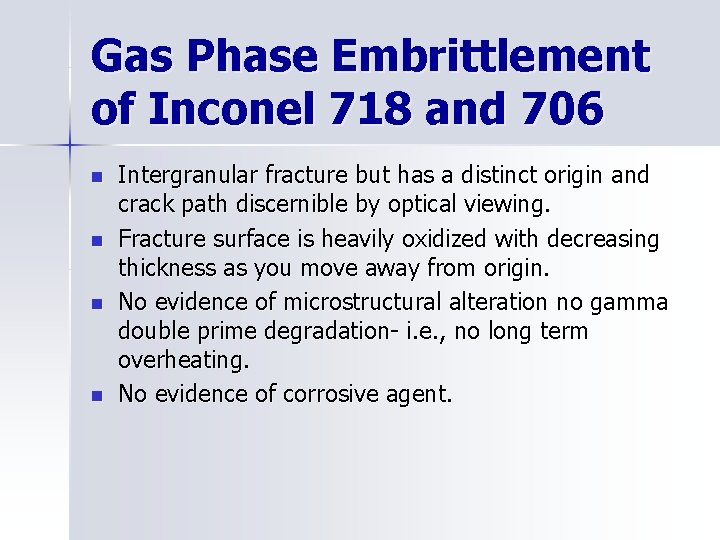
Gas Phase Embrittlement of Inconel 718 and 706 n n Intergranular fracture but has a distinct origin and crack path discernible by optical viewing. Fracture surface is heavily oxidized with decreasing thickness as you move away from origin. No evidence of microstructural alteration no gamma double prime degradation- i. e. , no long term overheating. No evidence of corrosive agent.
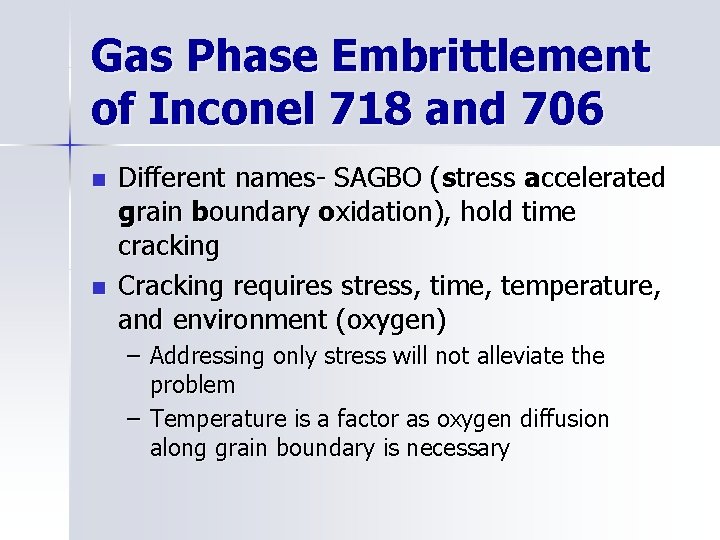
Gas Phase Embrittlement of Inconel 718 and 706 n n Different names- SAGBO (stress accelerated grain boundary oxidation), hold time cracking Cracking requires stress, time, temperature, and environment (oxygen) – Addressing only stress will not alleviate the problem – Temperature is a factor as oxygen diffusion along grain boundary is necessary
Alpha Chromium Formation in Inconel 718
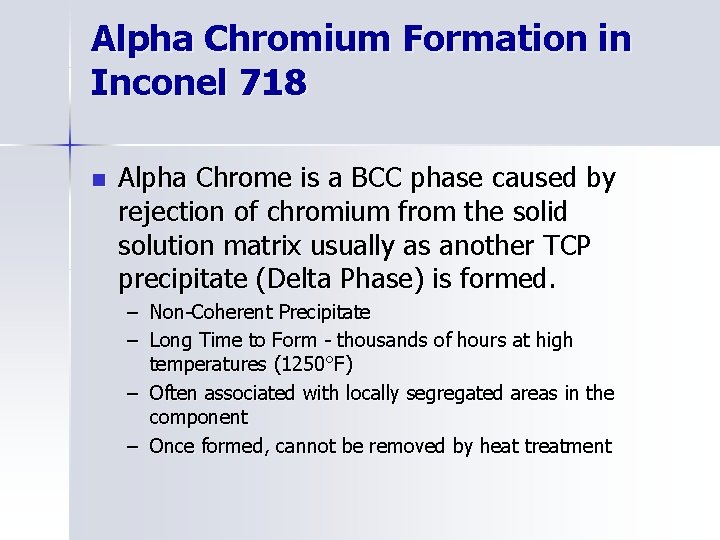
Alpha Chromium Formation in Inconel 718 n Alpha Chrome is a BCC phase caused by rejection of chromium from the solid solution matrix usually as another TCP precipitate (Delta Phase) is formed. – Non-Coherent Precipitate – Long Time to Form - thousands of hours at high temperatures (1250°F) – Often associated with locally segregated areas in the component – Once formed, cannot be removed by heat treatment
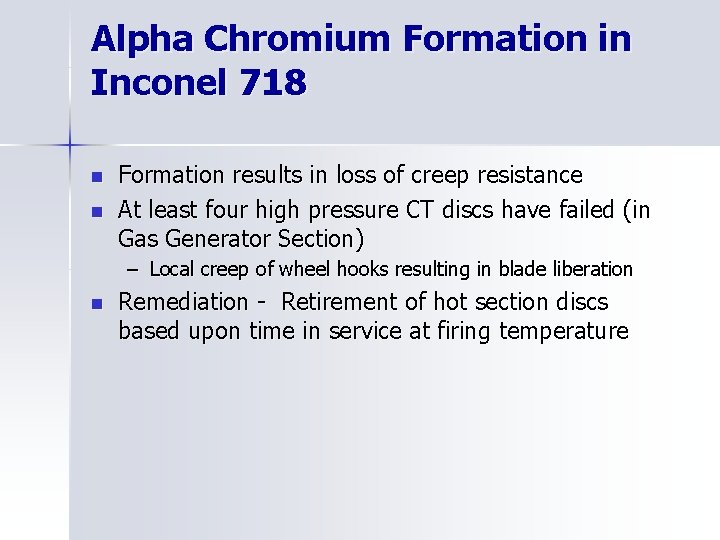
Alpha Chromium Formation in Inconel 718 n n Formation results in loss of creep resistance At least four high pressure CT discs have failed (in Gas Generator Section) – Local creep of wheel hooks resulting in blade liberation n Remediation - Retirement of hot section discs based upon time in service at firing temperature
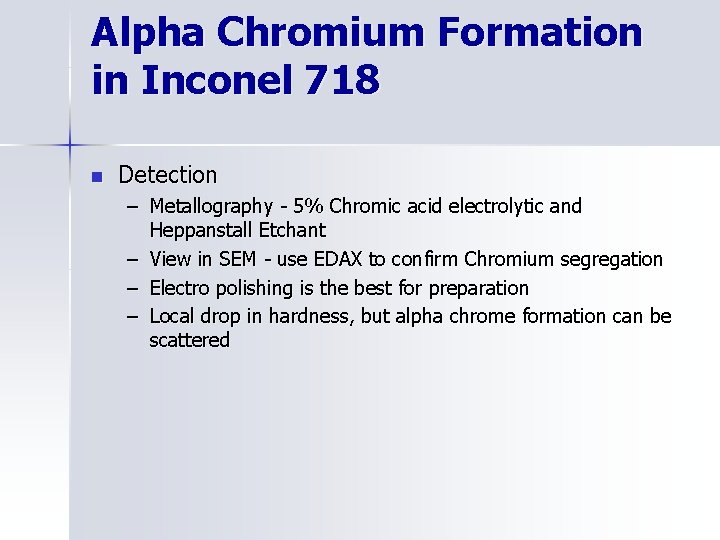
Alpha Chromium Formation in Inconel 718 n Detection – Metallography - 5% Chromic acid electrolytic and Heppanstall Etchant – View in SEM - use EDAX to confirm Chromium segregation – Electro polishing is the best for preparation – Local drop in hardness, but alpha chrome formation can be scattered
Corrosion Fatigue Cracking of Precipitation Hardened Stainless Steels (17 -4 PH)
Corrosion Fatigue Cracking of PH Hardened stainless Steel n To enhance compressor efficiency, manufacturers are using high strength stainless steels instead of the more traditional low hardness martensitic stainless steels. – Lower cross-sectional area - less inertial damping n The fatigue strength of high strength precipitation hardened stainless steel is very sensitive to corrosion damage and environment when compared to more typical martensitic steels. – Corrosion pitting causes dramatic loss in crack initiation resistance – Pitting is likely in a compressor – Corrosive environment may increase crack propagation rate
Corrosion Fatigue Cracking of PH Hardened stainless Steel n n CT compressors have both stator and rotating blades made of these steels (17 -4 p. H, 15 -5 p. H, Jethete [steam]). On CT compressors corrosive deposits are concentrated at the evaporation zone – Moist air with deposits (small particles that pass through filters and volatile species) enter front of compressor – Air is heated and moisture dries out leaving deposits – Load cycles and changes in ambient conditions intermittently wet and dry deposits setting up corrosion cells – Pitting corrosion results n Stator airfoils most susceptible as rotating blades shed deposits by centrifugal loading
- Slides: 29