
Faecal Immunochemistry Test q FIT Dr Rob Palmer
Faecal Immunochemistry Test q. FIT Dr Rob Palmer GPw. SI Gastro CCG Cancer and Gastro lead
Colorectal Cancer (CRC)- Epidemiology • 4 th most common malignancy in the UK • 2 nd commonest cause of cancer death • >20% of new cases in London are in people under 60 years old (i. e. below the screening age)
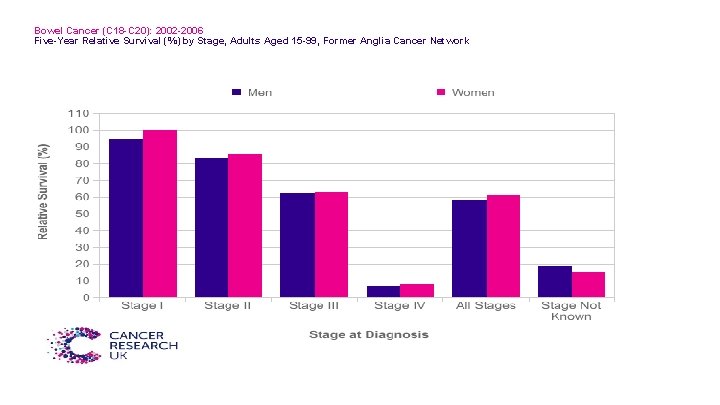
Bowel Cancer (C 18 -C 20): 2002 -2006 Five-Year Relative Survival (%) by Stage, Adults Aged 15 -99, Former Anglia Cancer Network
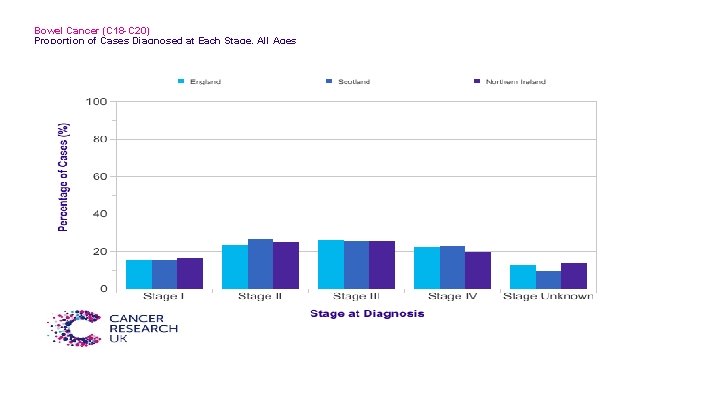
Bowel Cancer (C 18 -C 20) Proportion of Cases Diagnosed at Each Stage, All Ages
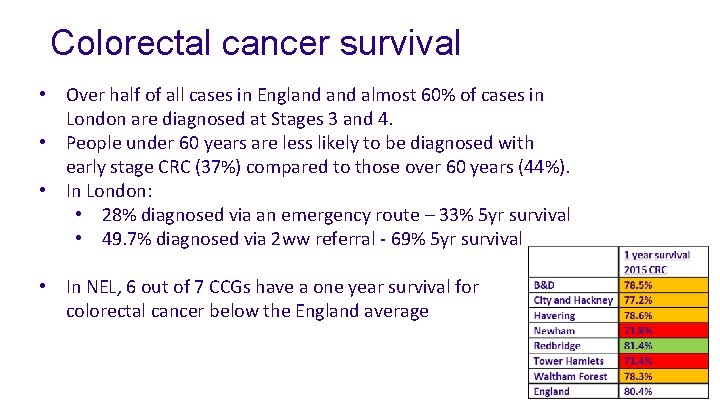
Colorectal cancer survival • Over half of all cases in England almost 60% of cases in London are diagnosed at Stages 3 and 4. • People under 60 years are less likely to be diagnosed with early stage CRC (37%) compared to those over 60 years (44%). • In London: • 28% diagnosed via an emergency route – 33% 5 yr survival • 49. 7% diagnosed via 2 ww referral - 69% 5 yr survival • In NEL, 6 out of 7 CCGs have a one year survival for colorectal cancer below the England average
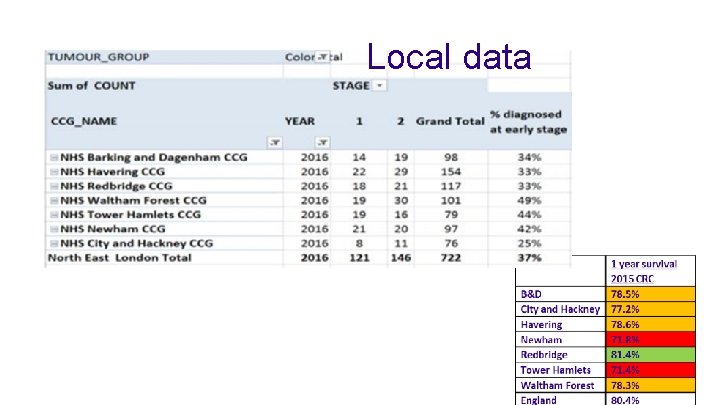
Local data
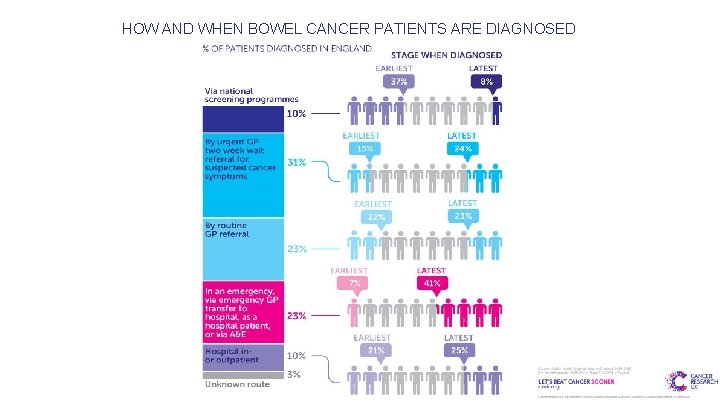
HOW AND WHEN BOWEL CANCER PATIENTS ARE DIAGNOSED
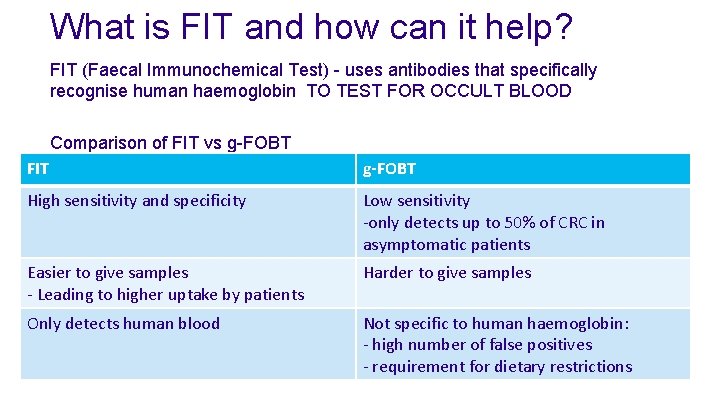
What is FIT and how can it help? FIT (Faecal Immunochemical Test) - uses antibodies that specifically recognise human haemoglobin TO TEST FOR OCCULT BLOOD Comparison of FIT vs g-FOBT FIT g-FOBT High sensitivity and specificity Low sensitivity -only detects up to 50% of CRC in asymptomatic patients Easier to give samples - Leading to higher uptake by patients Harder to give samples Only detects human blood Not specific to human haemoglobin: - high number of false positives - requirement for dietary restrictions
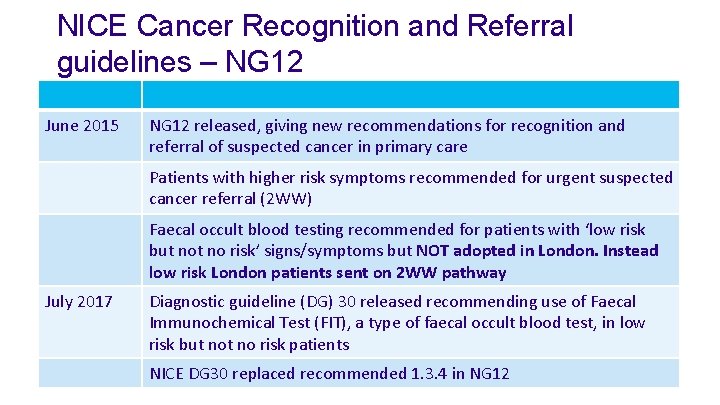
NICE Cancer Recognition and Referral guidelines – NG 12 June 2015 NG 12 released, giving new recommendations for recognition and referral of suspected cancer in primary care Patients with higher risk symptoms recommended for urgent suspected cancer referral (2 WW) Faecal occult blood testing recommended for patients with ‘low risk but no risk’ signs/symptoms but NOT adopted in London. Instead low risk London patients sent on 2 WW pathway July 2017 Diagnostic guideline (DG) 30 released recommending use of Faecal Immunochemical Test (FIT), a type of faecal occult blood test, in low risk but no risk patients NICE DG 30 replaced recommended 1. 3. 4 in NG 12
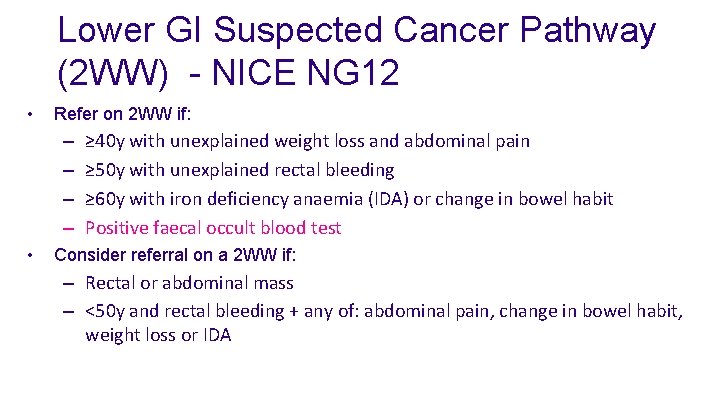
Lower GI Suspected Cancer Pathway (2 WW) - NICE NG 12 • Refer on 2 WW if: – – • ≥ 40 y with unexplained weight loss and abdominal pain ≥ 50 y with unexplained rectal bleeding ≥ 60 y with iron deficiency anaemia (IDA) or change in bowel habit Positive faecal occult blood test Consider referral on a 2 WW if: – Rectal or abdominal mass – <50 y and rectal bleeding + any of: abdominal pain, change in bowel habit, weight loss or IDA
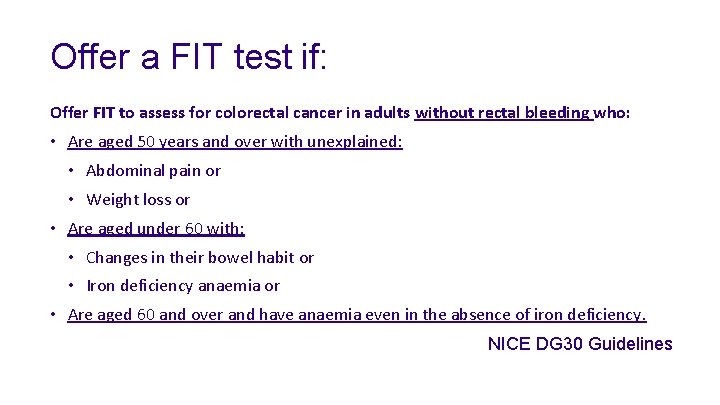
Offer a FIT test if: Offer FIT to assess for colorectal cancer in adults without rectal bleeding who: • Are aged 50 years and over with unexplained: • Abdominal pain or • Weight loss or • Are aged under 60 with: • Changes in their bowel habit or • Iron deficiency anaemia or • Are aged 60 and over and have anaemia even in the absence of iron deficiency. NICE DG 30 Guidelines
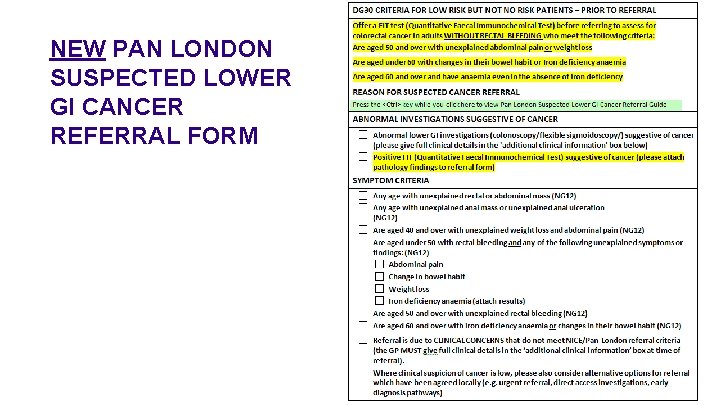
NEW PAN LONDON SUSPECTED LOWER GI CANCER REFERRAL FORM
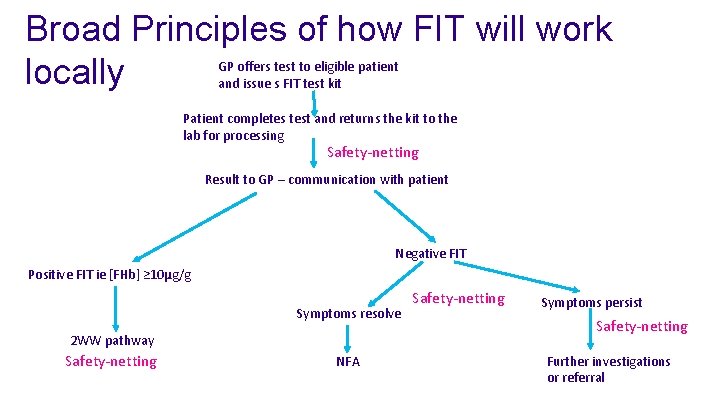
Broad Principles of how FIT will work locally GP offers test to eligible patient and issue s FIT test kit Patient completes test and returns the kit to the lab for processing Safety-netting Result to GP – communication with patient Negative FIT Positive FIT ie [FHb] ≥ 10µg/g Symptoms resolve 2 WW pathway Safety-netting NFA Safety-netting Symptoms persist Safety-netting Further investigations or referral
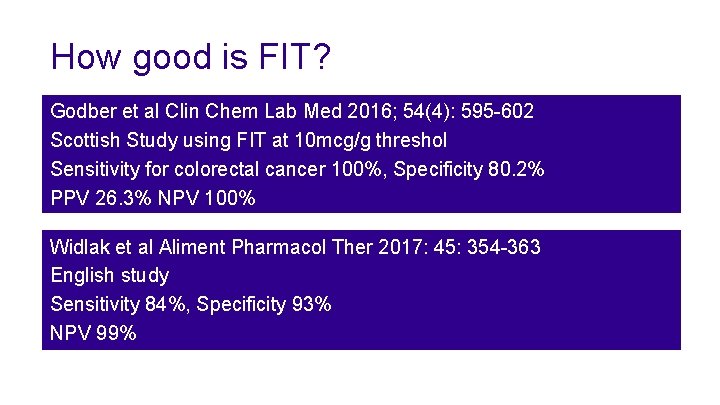
How good is FIT? Godber et al Clin Chem Lab Med 2016; 54(4): 595 -602 Scottish Study using FIT at 10 mcg/g threshol Sensitivity for colorectal cancer 100%, Specificity 80. 2% PPV 26. 3% NPV 100% Widlak et al Aliment Pharmacol Ther 2017: 45: 354 -363 English study Sensitivity 84%, Specificity 93% NPV 99%
If FIT result negative… • The risk of cancer would be very low… but not zero and it doesn’t rule out other non-cancer diagnoses • If ongoing clinical concerns refer
What is the difference between FIT and calprotectin? • FIT: measures human haemoglobin; i. e. bleeding • Calprotectin: released from neutrophils & macrophages at sites of inflammation • Recommend to use FIT when suspect cancer and F. calp when suspect IBD. In younger patients, it may be appropriate to request both.
Projected benefits of implementation of FIT • Proportion of CRC diagnosed at Stage 1 -2 to increase from 39. 9% (2015) to 43. 1% (NEL STPs) • Proportion of CRC diagnosed through emergency A&E visit to drop from 28. 4% to 20% • Reduction in the need for colonoscopy in 75 -80% of cases • Overall reduction of colonoscopy/CTC by 15% • Significant savings to NHS (middle projection figure £ 6. 5 million for London) • Cost of test = £ 15 -20 (kit + testing)
FIT in Bowel Cancer Screening Programme (BCSP) • Due to replace g-FOBT during 2019 • Improved sensitivity over FOBt • Higher thresholds for q. FIT used in screening programme (120 mcg/g vs 10 mcg/g for symptomatic patients) – i. e. patients who have a negative screening result may still have bowel cancer and should be offered a symptomatic FIT test if appropriate • Projected improved uptake by patients (approx 7%)
The Future … • Use in high-risk (2 ww) patients • Surveillance (previous polyps, strong FH CRC)
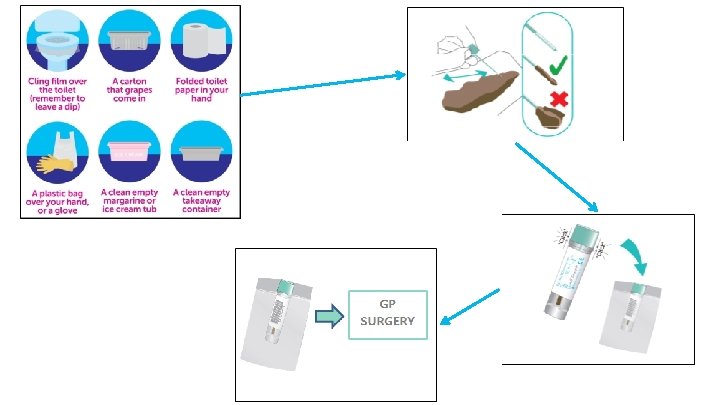
Patient resources What is FIT and how to deliver samples: • Leaflet • Video – https: //gps. cityandhackneyccg. nhs. uk/topic/cancer
- Slides: 21