
Faculty of Science Geology Department Sedimentary Basins Lecture
Faculty of Science Geology Department Sedimentary Basins Lecture 2
Senso stricto basins • Basins are saucer-shaped area of sedimentary rocks, and it is sub-rounded (oval) in plan view. • The dip of strata and thicken centripetally towards the center of the basin. • In cross-section it draw as curvature of the earth, in the fact it is veneers of sediment on the earth surface.
Craton from Greek: kratos "strength") is an old and stable part of the continental lithosphere. v Cratons are generally found in the interiors of tectonic plates. They are characteristically composed of ancient crystalline basement rock, which may be covered by younger sedimentary rock. They have a thick crust and deep lithospheric roots that extend as much as several hundred kilometres into the Earth's mantle. v. The term craton is used to distinguish the stable portion of the continental crust from regions that are more geologically active and unstable. v. Cratons can be described as shields, in which the basement rock crops out at the surface, and platforms, in which the basement is overlaid by sediments and sedimentary rock. v. The word craton was first proposed by the Austrian geologist Leopold Kober in 1921 as Kratogen, referring to stable continental platforms, and orogen as a term for mountain or orogenic belts. Later authors shortened the former term to kraton and then to craton.
Senso stricto basins Types of Senso stricto basins There are two types of these basins: 1 - Intracratonic basins (More stable) 2 - Epicratonic basins (Less stable than intracratonic basins. )
Senso stricto basins 1 - Intracratonic basins: * It lie within the continental crust. * Intracratonic basins occur within continental interiors away from plate margins. * They are oval or subcircular in plan and saucer-shaped in cross section.
Senso stricto basins • Intracratonic basins are floored with continental crust, and in most instances, are also underlain by faild or fossil rifts. • Their evolution involves a combination and succession of basin-forming processes, which include continental extension, thermal subsidence over a wide area, and later isostatic readjustments.
Senso stricto basins * Intracratonic basins are clastic type of the sedimentary basin, sometime the water of sea cover the lower area to formed marine sediments „Evaporites“ as carbonate. * Intracratonic stratigrafic sequences: Within intracratonic basins and adjacent platforms, stratigraphic subdivision differs from international stratigraphic subdivisions. Intracratonic st. subdivisions follows the now well stablished concept of „Cratonic Sequences“ of Sloss 1963.
Senso stricto basins • Sloss (1963): recognized that the stratigraphy of the North American craton is subdivided into six cratonic sequences, which are bounded by major interregional (continent-wide) unconformities. • These cratonic sequence are (from oldest to youngest): 1 - Sauk (590 to 488 Ma). 2 - Tippecanoe (488 to 401 Ma). 3 - Kaskaskia (401 to 330 Ma). 4 - Absaroka (330 to 186 Ma). 5 - Zuni (186 to 60 Ma). 6 - Tejas (60 Ma to present).

Senso stricto basins • Examples of intracratonic basins: There are four major intracratonic basins from North America. A- Illinois. B- Michigan. C- Williston. D- Hudson Bay Basin.
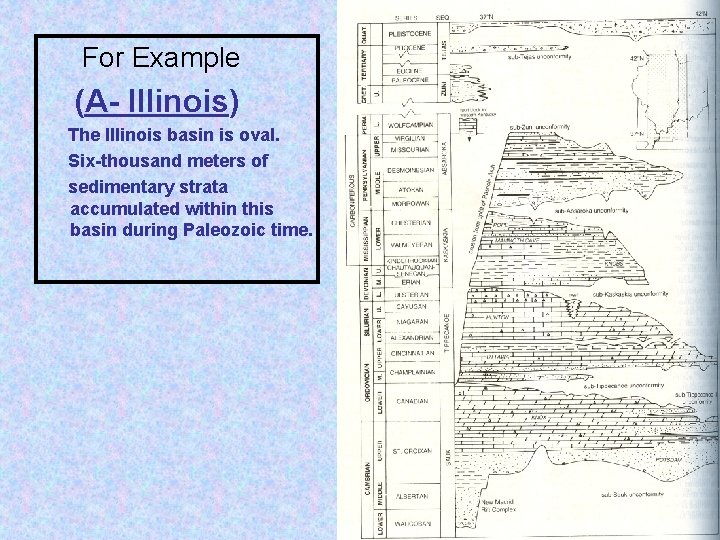
For Example (A- Illinois) The Illinois basin is oval. Six-thousand meters of sedimentary strata accumulated within this basin during Paleozoic time.
Mechanisms of Formation of Intracratonic Basins: Intracratonic basins formed by a sequence of processes. Theses processes are: 1 - lithospheric stretching. 2 - mechanical, fault-controlled subsidence. 3 - thermal subsidence and contraction. 4 - merging of slower thermal subsidence with reactivated subsidence due to isostatically uncompensated exess mass (e. g. Sleep et al. , 1980).
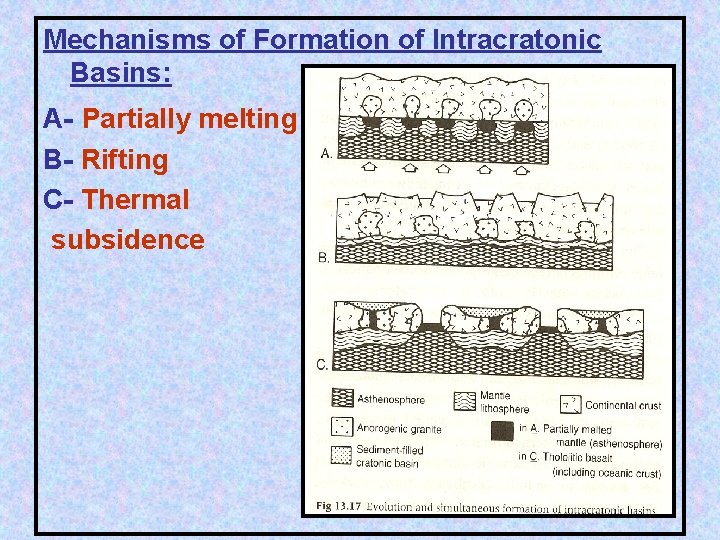
Mechanisms of Formation of Intracratonic Basins: A- Partially melting B- Rifting C- Thermal subsidence
Senso stricto basins 2 - Epicratonic basins: • It lie on continental crust but are partially open to ocean basin, that means, it lie on edge of continental crust. (between the coninental crust and marine areas „Oceans“). • The axis of the epicratonic basin may be plunge to the floor of the ocean or interrupted by Sill-like feature at the rim of the continental margin.
Senso stricto basins • Epicratonic basins are less stable than intracratonic basins, due to their situation at the continental margins. • At the floors of theses basins, there are subsidence leading to faulting on these floors and found some igneous activity.
Senso stricto basins Examples of epicratonic basins: Niger delta basin and Mississipian Gulf Coast. These basins are infilled by terrigenous „clastic“, and the final phase of epicratonic basins are infilled during the Oligocene and Miocene by terrigenous „clastics“ and carbonate sedimentation in both marine and continental environments.

Niger delta basin
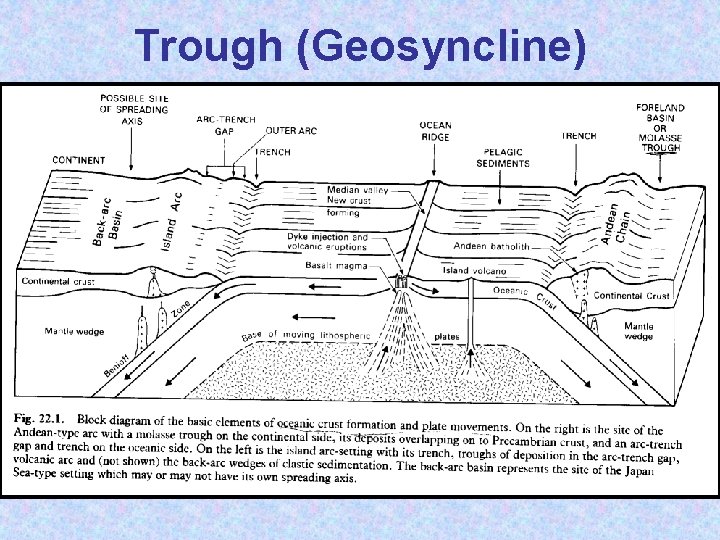
Trough • Trough, is elongated (linear) sedimentary basins and structurally closed. The most comon type of trough basins is Geosyncline. It is trough of highly tectonic sediment which forms mountain belts. Dimentions: several kilometers (depth) & hundres kilometers (long).
Trough • To understand the basins general and the geosyncline basins, this need necessary to know the larger scal morphology and mechanics of the earth. • Plate tectonic lead to reapparisal the concept of basins and basins analysis espiceal in case the tectonic linear troughs termed Geosynclines.
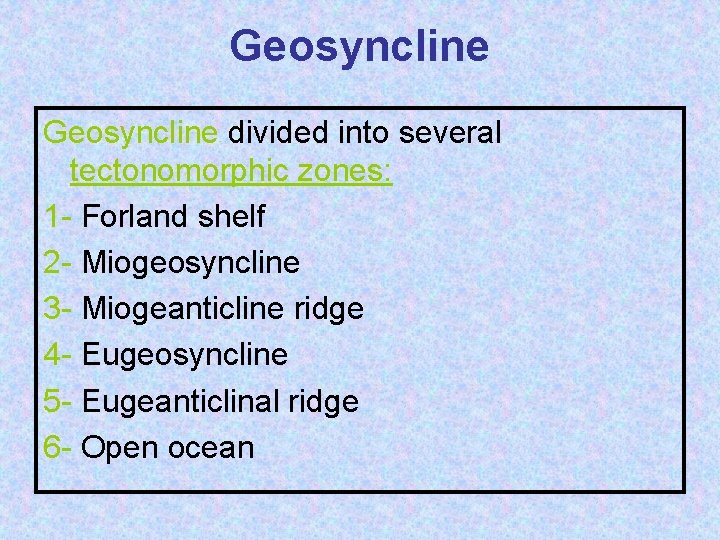
Geosyncline divided into several tectonomorphic zones: 1 - Forland shelf 2 - Miogeosyncline 3 - Miogeanticline ridge 4 - Eugeosyncline 5 - Eugeanticlinal ridge 6 - Open ocean
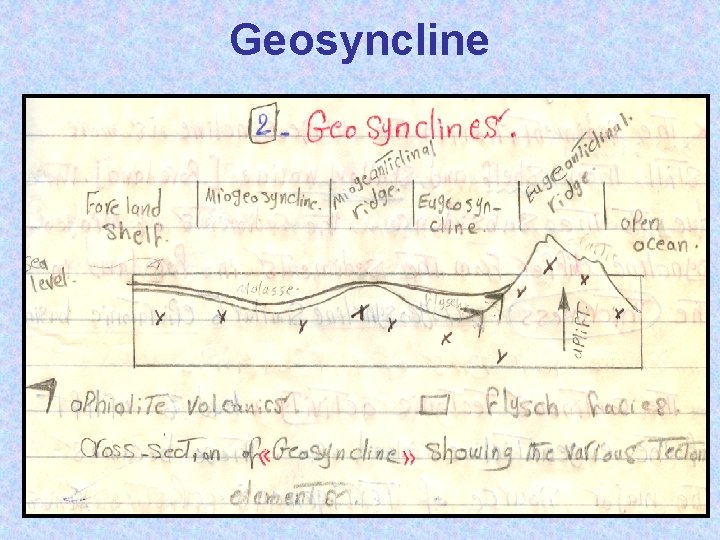
Geosyncline
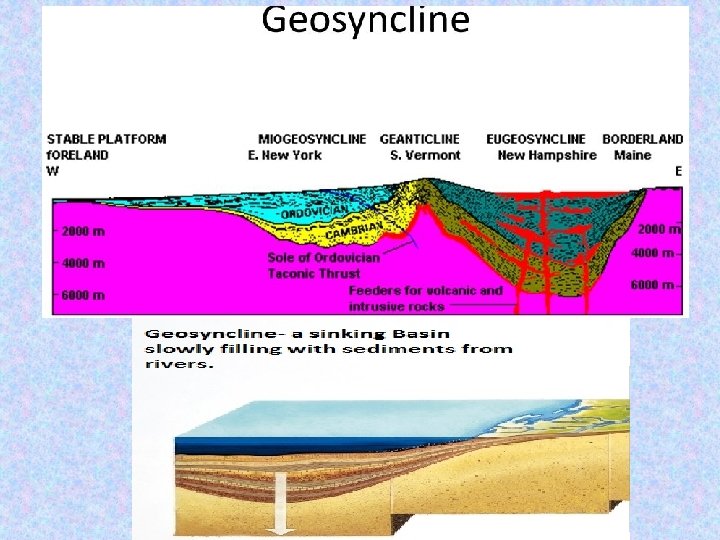
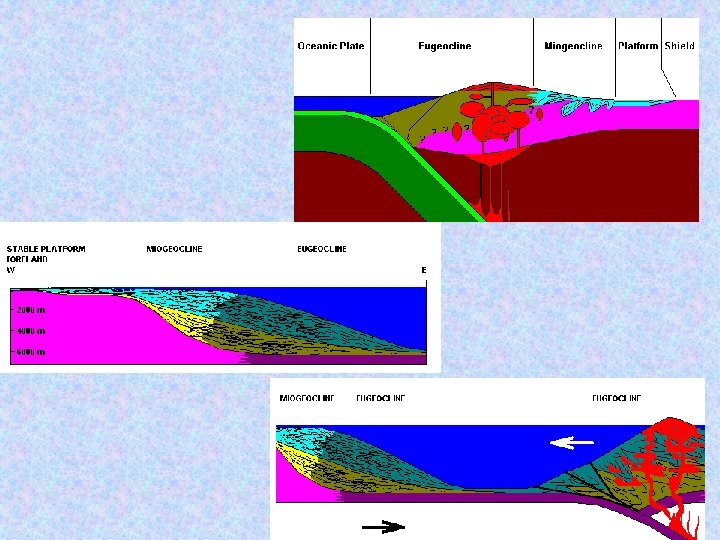
Trough (Geosyncline)
Geosyncline • Miogeosyncline: is less active and more stable trough. • Eugeosyncline: is more active and unstable trough. • Eugeosyncline is separated from the open ocean by the eugeanticline (island arc of rising volcanic). • Miogeosyncline separated from the eugeosyncline by the miogeanticline.
Geosyncline • The sedimentation in the Miogeosyncline is more still than shelf and shallow marine (Foreland), this due to the subsidence. • The sediments of moigeosyncline differ from the sediments in foreland in the thickness. • Miogeosyncline similar to epicratonic basins.
Geosyncline • The continous tectonic activity lead to uplift of the eugeanticline (island arc), this becomes the major source of terrigenous (clastic) sediments. • These deposits are lead down within the eugeosyncline as turbidities to form the flysh facies.
Geosyncline • By continous of tectonic activity, the deposits migrated from eugeosyncline to miogeosyncline, during this migration the deposits change from the flysh to the Molasse facies. • Molasse facies are largely coarse terrigenous clastic with abundant with conglomerate. • By continous of the tectonic activity, the Molasse are laid down into non-marine fluvial and fanglomerate environmentes.
- Slides: 27