
Faculty of Science Geology Department Sedimentary Basins Lecture
Faculty of Science Geology Department Sedimentary Basins Lecture 4
Rift-related basins • Active extension or stretching of continental lithospheric plates causes surface deformation, volcanism and high heat flow due to the effects of normal faulting and changes in crustal and mantle thickness, structure and state. • The elongate rift basins and marginal uplifts that result from theses processes are prominent tectonic features of the continental surface. • The major areas undergoing active extension and rifting are shown in the following fig.

Rift-related basins
Rift-related basins 1 - Rift basins are long fault-bounded trough which occur in various tectonic setting and show corresponding diverisity (difference of sediment fill). • Geological Origin: The down-dropped basin formed during rifting because of stretching and thinning of the continental crust • They have economic importance as sources of hydrocarbons, evaporites and metals.
Rift basins Mechanism: 1 - Rift initiated by updoming of the crust. 2 - Updoming lead to forme the fructure system (triradiate rift system) as (triple rift junction). 3 - In initially, the rift lie above sea level, so, they are infilled with terrgenous clastics sediments (fluvial and lacustrine sediments). 4 - When, the rift subsides below the sea level (the frist subsidence), the rift floods by water of sea, so, the favours evaporites will formed. (at shallow depth).
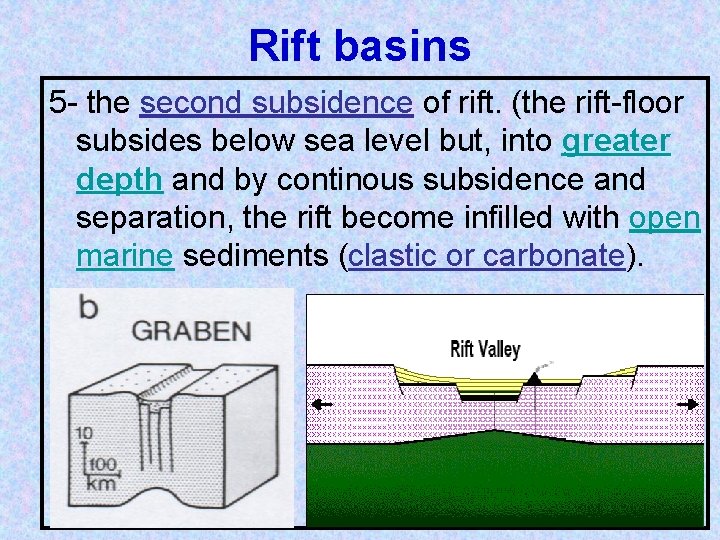
Rift basins 5 - the second subsidence of rift. (the rift-floor subsides below sea level but, into greater depth and by continous subsidence and separation, the rift become infilled with open marine sediments (clastic or carbonate).
Rift basins • There are two types of the rift basins: 1 - Intracontinental rift basins 2 - Intracratonic rifts.
1 - intracontinental rift basins • It is the frist phase of rift development within cratonic area of continental crust. • Where, the fractures of triradial rift valley systems commonly diverge from the culmination of the dome. • The rift become infilled with continental fluviolacustrine deposits, often, associated with volcanics (igneous activity).
1 - intracontinental rift basins • The best examples of this type are: (Baikal in Siberia, Rhine Valley in Germany, and East Africa).
2 - intracratonic rifts • It is intracontinental rift, but, the floor of it depressed below sea level, so, the sea water floods the rift basin from time to time (the rift subsidence below sea level). • The continental clastic facies (Fluvial & Lacustrine) are overlain by evaporites. • Example: The suez graben (pre-rift basement rocks are overlain by 4 km of miocene sediments „clastic sediments“ which formed by updoming. This clastic sediments are overlain by the evaporites group (dolomites and algal limestone, gypsiumanhydrite, marls, rock salts)
2 - intracratonic rifts • The suez gulf opens out southwards into the Red-Sea. This is intercratonic rift basin. It formed by the crustal rifting of Arabo. Nubian Pre-Cambrian craton. • By continous the subsidence and separation, the Red-Sea will convert Ocean. It is termed the incipient ocean.

2 - intracratonic rifts
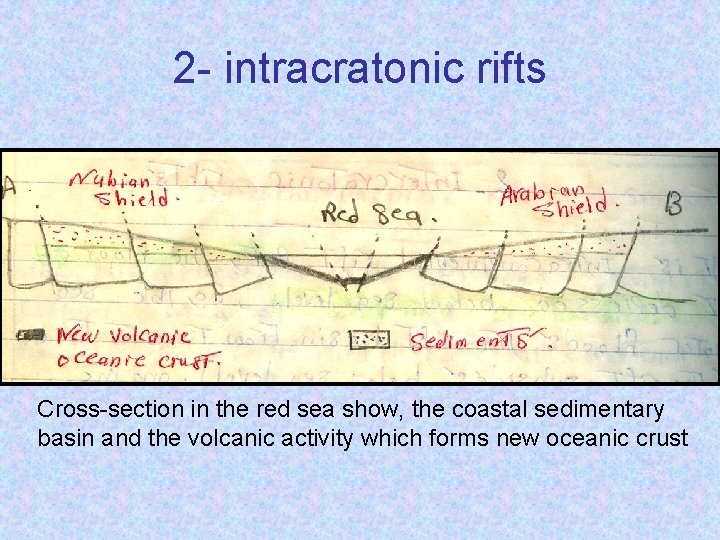
2 - intracratonic rifts Cross-section in the red sea show, the coastal sedimentary basin and the volcanic activity which forms new oceanic crust
2. AULACOGENE BASINS Doming of continental areas (due to stretching) lead to three rift vallyes meeting at a 120° triple Junction. Two rift vallyes combine to form a divergent plate leading to (through graben) ocean spreading, but the third arm closed by subduction causing deformation of sediments and volcanics. Continental margin collides with subduction zone forming orogenic belt and the faild arm called aulacogen.
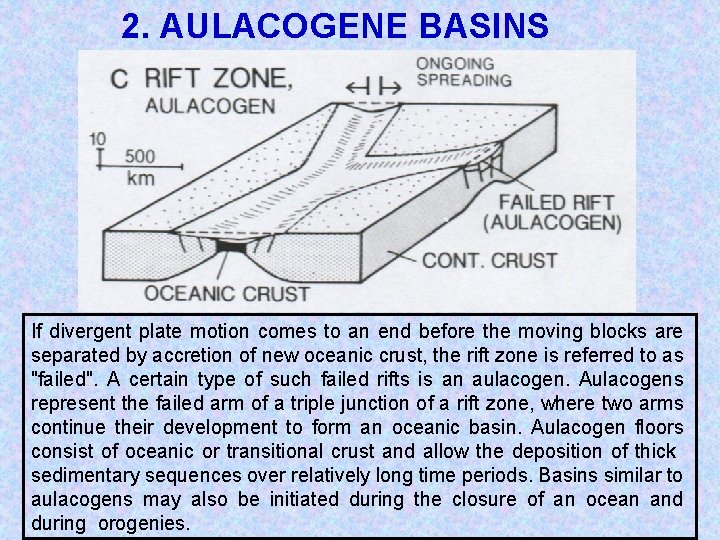
2. AULACOGENE BASINS If divergent plate motion comes to an end before the moving blocks are separated by accretion of new oceanic crust, the rift zone is referred to as "failed". A certain type of such failed rifts is an aulacogen. Aulacogens represent the failed arm of a triple junction of a rift zone, where two arms continue their development to form an oceanic basin. Aulacogen floors consist of oceanic or transitional crust and allow the deposition of thick sedimentary sequences over relatively long time periods. Basins similar to aulacogens may also be initiated during the closure of an ocean and during orogenies.
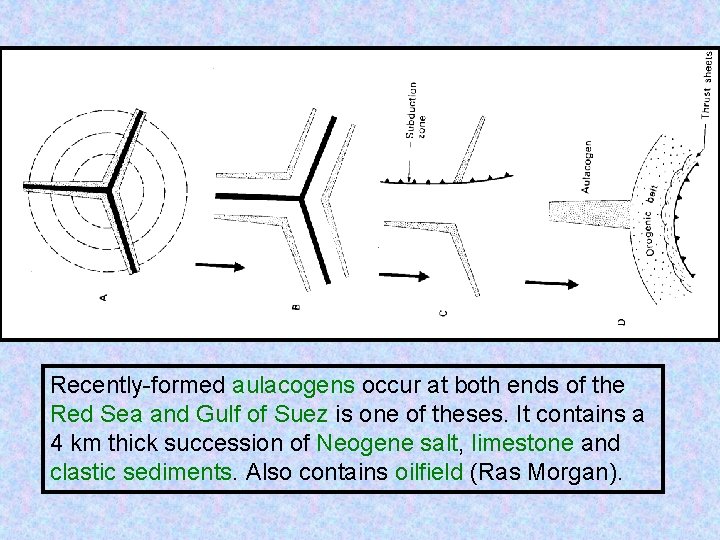
Recently-formed aulacogens occur at both ends of the Red Sea and Gulf of Suez is one of theses. It contains a 4 km thick succession of Neogene salt, limestone and clastic sediments. Also contains oilfield (Ras Morgan).
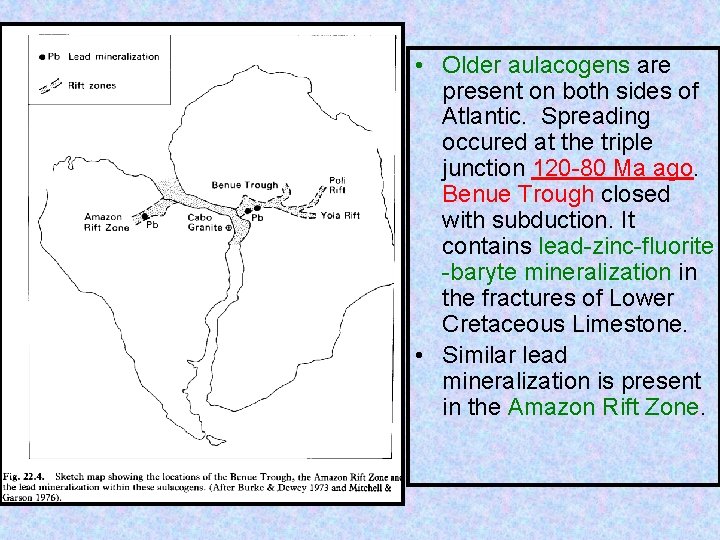
• Older aulacogens are present on both sides of Atlantic. Spreading occured at the triple junction 120 -80 Ma ago. Benue Trough closed with subduction. It contains lead-zinc-fluorite -baryte mineralization in the fractures of Lower Cretaceous Limestone. • Similar lead mineralization is present in the Amazon Rift Zone.
SUMMARY AULACOGENE BASINS • Narrow continental rifts which do not evolve into spreading ridge oceanic basins. • Dominated by initial alluvial fan, fluvial, lake facies; up to 4 km thick. • May extend enough – crustal subsidence & extension – marine transgression; no oceanic crust – coastal plain rivers, coal swamp shoreline, shelf & slope environment • Provenance – continental, mixed – plutonic, metasedimentary, metavolcanic, contemporaneous volcanic – ± marine carbonates
- Slides: 18