
Faculty of Law TAX MORALE RISK AND ABUSE
Faculty of Law TAX MORALE, RISK, AND ABUSE Diego Quiñones Cruz, Esq. LLM, APCLB Partner, Quiñones Cruz Abogados Dphil in Law Candidate and Tutor in Law Harris Manchester College, University of Oxford February, 2018 IFA Serbia Belgrade, Serbia
Faculty of Law Why is “abuse” a critical element for contemporary tax compliance? • Tax compliance was traditionally assessed as a function of outcomes, both in relation to fulfilling “formal” tax obligations (e. g. filing tax returns at the right time and supplying requested information) and to paying tax as –literally- demanded in legislation. • However, there has been a clear global trend over the past two to three decades to evaluate compliance by asking whether the substantive tax outcome –the tax contribution- matches what applicable law “intended”, regardless of whether it was formally aligned with the letter of the law.
Faculty of Law Why is “abuse” a critical element for contemporary tax compliance? • This trend of associating compliance with the primacy of substance over form, which was initiated via judicial precedent in countries like the US and the UK (purposive approach and Ramsay doctrine), was gradually extended and codified in multiple jurisdictions. • The increasing public visibility and political interest on corporate and HNWI tax affairs seen over the past decade has created a “snowball” effect, whereby these considerations, which were previously reserved for borderline cases, have become central criteria for evaluating compliance. This is particularly clear in the international tax context post-BEPS, but is also applicable domestically.
Faculty of Law UK GAAR “Arrangements are “tax arrangements” if, having regard to all the circumstances, it would be reasonable to conclude that the obtaining of a tax advantage was the main purpose, or one of the main purposes, of the arrangements. (2)Tax arrangements are “abusive” if they are arrangements the entering into or carrying out of which cannot reasonably be regarded as a reasonable course of action in relation to the relevant tax provisions, having regard to all the circumstances including— (a)whether the substantive results of the arrangements are consistent with any principles on which those provisions are based (whether express or implied) and the policy objectives of those provisions, (b)whether the means of achieving those results involves one or more contrived or abnormal steps, and (c)whether the arrangements are intended to exploit any shortcomings in those provisions. ”
Faculty of Law GAAR in the EU Anti-Tax Avoidance Directive “…a Member State shall ignore an arrangement or a series of arrangements which, having been put into place for the main purpose or one of the main purposes of obtaining a tax advantage that defeats the object or purpose of the applicable tax law, are not genuine having regard to all relevant facts and circumstances… …an arrangement or a series thereof shall be regarded as non-genuine to the extent that they are not put into place for valid commercial reasons which reflect economic reality. ”
Faculty of Law The Principal Purpose Test (PPT) in the OECD MLI “…a benefit under the Covered Tax Agreement shall not be granted…if it is reasonable to conclude, having regard to all relevant facts and circumstances, that obtaining that benefit was one of the principal purposes of any arrangement or transaction that resulted directly or indirectly in that benefit, unless it is established that granting that benefit in these circumstances would be in accordance with the object and purpose of the relevant provisions of the Covered Tax Agreement. ”

Faculty of Law Serbian “Substance over Form” rule “Tax facts will be interpreted in accordance with its economic substance. Any simulated transaction Will be disregarded and the nonsimulated transaction will be taken into account” (trans. Dejan Mrakovic)
Faculty of Law What’s problematic about provisions based on “tax abuse”? • The main problem: Pretending to determine whether a taxpayer’s interpretation of tax law is “acceptable” according to a series of allegedly-objective parameters when, in reality, many tax rules are open textured, and therefore are naturally prone to be understood differently by each interpreter. • Additionally, there tends to be a confusion between legal and moral/ethical judgment.
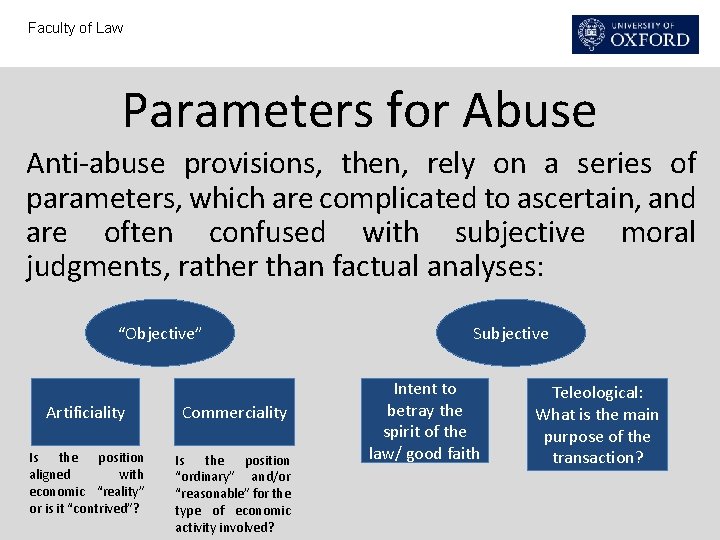
Faculty of Law Parameters for Abuse Anti-abuse provisions, then, rely on a series of parameters, which are complicated to ascertain, and are often confused with subjective moral judgments, rather than factual analyses: “Objective” Artificiality Commerciality Is the position aligned with economic “reality” or is it “contrived”? Is the position “ordinary” and/or “reasonable” for the type of economic activity involved? Subjective Intent to betray the spirit of the law/ good faith Teleological: What is the main purpose of the transaction?
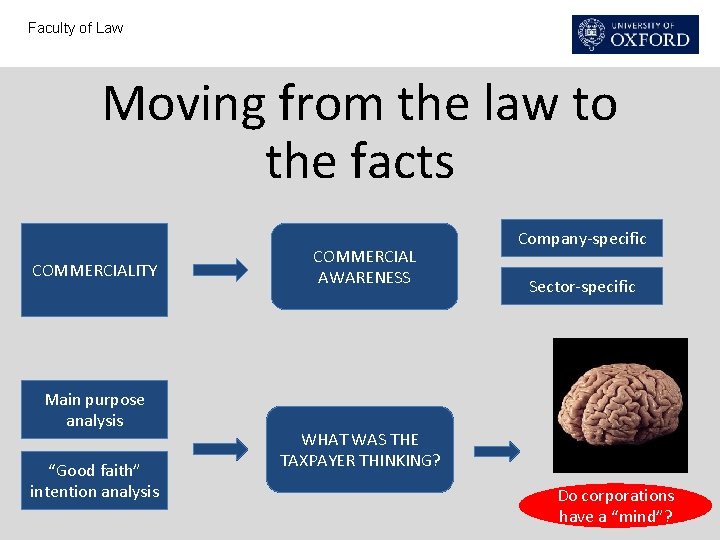
Faculty of Law Moving from the law to the facts COMMERCIALITY Main purpose analysis “Good faith” intention analysis COMMERCIAL AWARENESS Company-specific Sector-specific WHAT WAS THE TAXPAYER THINKING? Do corporations have a “mind”?
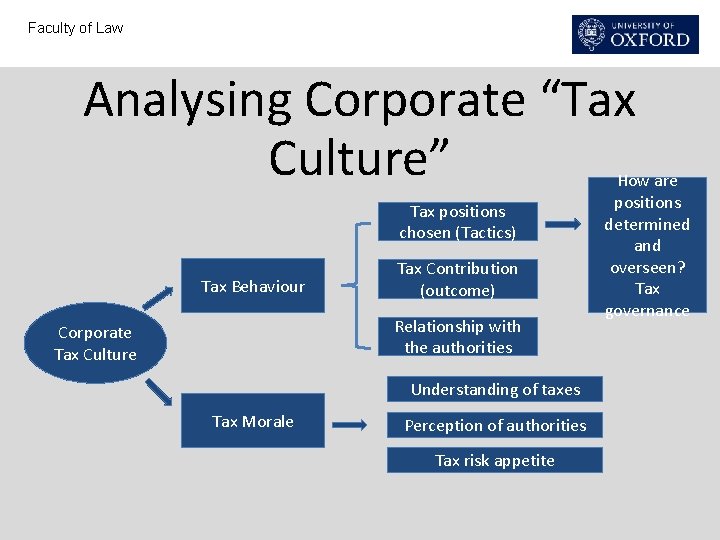
Faculty of Law Analysing Corporate “Tax Culture” Tax positions chosen (Tactics) Tax Behaviour Tax Contribution (outcome) Relationship with the authorities Corporate Tax Culture Understanding of taxes Tax Morale Perception of authorities Tax risk appetite How are positions determined and overseen? Tax governance
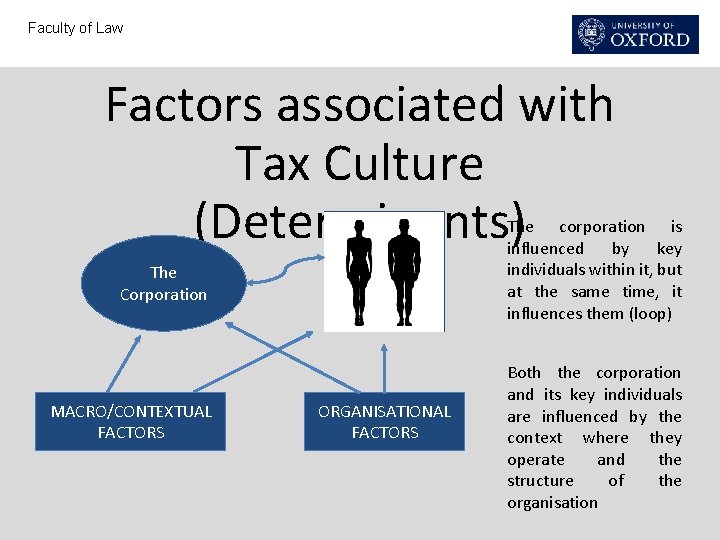
Faculty of Law Factors associated with Tax Culture (Determinants) The corporation is influenced by key individuals within it, but at the same time, it influences them (loop) The Corporation MACRO/CONTEXTUAL FACTORS ORGANISATIONAL FACTORS Both the corporation and its key individuals are influenced by the context where they operate and the structure of the organisation
Faculty of Law Tax Culture “On the Field” The following slides analyse factors closely associated to corporate tax risk, as seen in empirical research conducted in 2016 -2017 with large corporations (multiple economic sectors, all MNCs, different ownership structures) and corporate tax directors in the UK and in Colombia. Comparative research: Emerging market vs. a developed economy, fairly similar corporate income tax systems (with the exception of the UK’s semi-territorial system), but different compliance paradigms (UK co-operative compliance; COL traditional command control compliance).

Faculty of Law Individual Factors: Tax executive personal objectives in relation to work Risk Aversion and Compliance are tied with key individuals’ professional objectives in relation to tax UK COL Risk mitigators: ‘My main objective is that what happens today does not turn into a living hell tomorrow and that whatever bad No surprises: ‘My key objective is giving some reliable guidance. happened today will be managed. We know that there’s risk so We are a publicly listed company and the analysts and we try to normalize and prevent future risk by control. ’ (P 24 COL) shareholders want to know the numbers, so I want to avoid surprises, make sure that everything is robust and can be supported, no nasty surprises and audits. ’ (P 20 UK) Compliance: ‘My main objective is to ensure that we tax effect every transaction in an appropriate way, that we don’t miss anything, that we are accurate in our compliance and report completely and accurately to external stakeholders. . . ’ (P 4 UK) Tax Minimisers: ‘…I feel very satisfied when I know that my tax strategy and planning were efficient…it’s about saving money. ’ (P 11 COL) Multi-taskers: ‘We cannot afford the luxury of non-compliance, so we try to have an adequate tax planning, trying to support positions which do not place the corporation under risk …We do try to optimise, but we are framing that within the context of what the taxation of a corporation such as this one “should be”. ’ (P 14 COL)
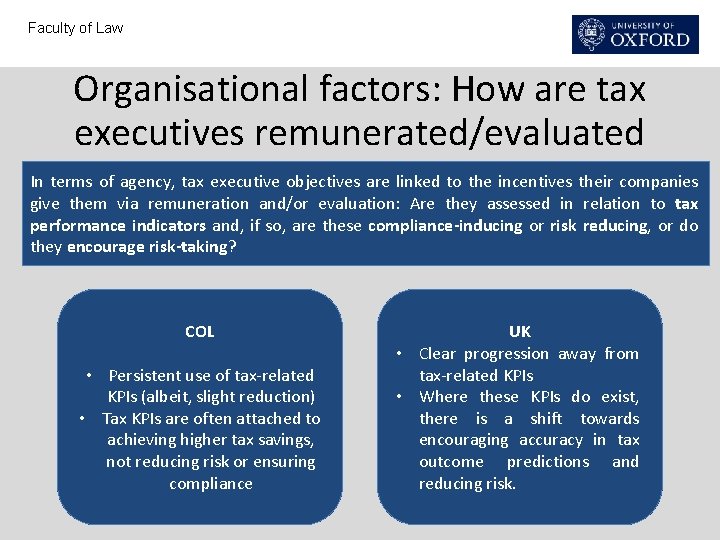
Faculty of Law Organisational factors: How are tax executives remunerated/evaluated In terms of agency, tax executive objectives are linked to the incentives their companies give them via remuneration and/or evaluation: Are they assessed in relation to tax performance indicators and, if so, are these compliance-inducing or risk reducing, or do they encourage risk-taking? COL • Persistent use of tax-related KPIs (albeit, slight reduction) • Tax KPIs are often attached to achieving higher tax savings, not reducing risk or ensuring compliance UK • Clear progression away from tax-related KPIs • Where these KPIs do exist, there is a shift towards encouraging accuracy in tax outcome predictions and reducing risk.
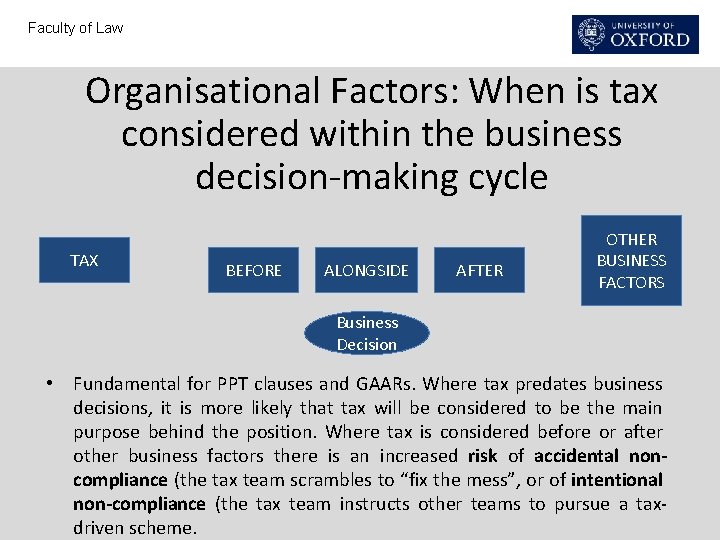
Faculty of Law Organisational Factors: When is tax considered within the business decision-making cycle TAX BEFORE ALONGSIDE AFTER OTHER BUSINESS FACTORS Business Decision • Fundamental for PPT clauses and GAARs. Where tax predates business decisions, it is more likely that tax will be considered to be the main purpose behind the position. Where tax is considered before or after other business factors there is an increased risk of accidental noncompliance (the tax team scrambles to “fix the mess”, or of intentional non-compliance (the tax team instructs other teams to pursue a taxdriven scheme.
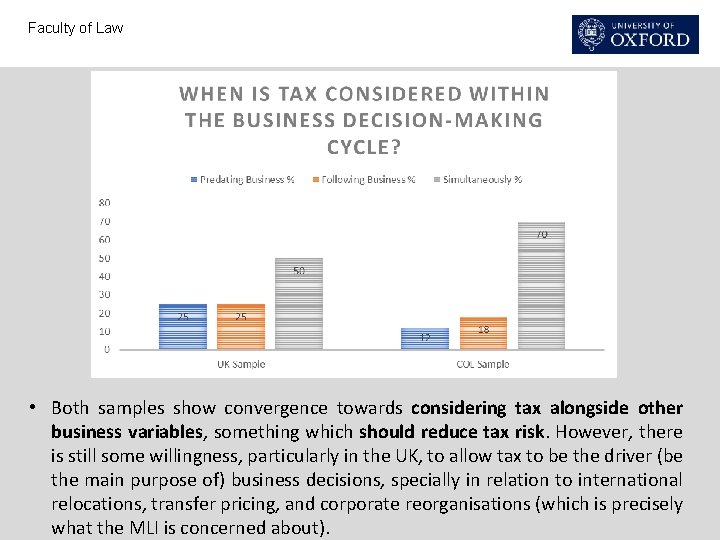
Faculty of Law • Both samples show convergence towards considering tax alongside other business variables, something which should reduce tax risk. However, there is still some willingness, particularly in the UK, to allow tax to be the driver (be the main purpose of) business decisions, specially in relation to international relocations, transfer pricing, and corporate reorganisations (which is precisely what the MLI is concerned about).
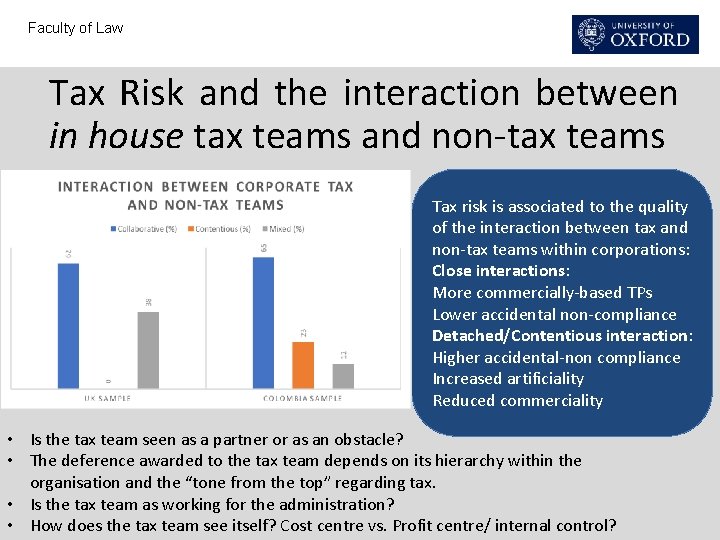
Faculty of Law Tax Risk and the interaction between in house tax teams and non-tax teams Tax risk is associated to the quality of the interaction between tax and non-tax teams within corporations: Close interactions: More commercially-based TPs Lower accidental non-compliance Detached/Contentious interaction: Higher accidental-non compliance Increased artificiality Reduced commerciality • Is the tax team seen as a partner or as an obstacle? • The deference awarded to the tax team depends on its hierarchy within the organisation and the “tone from the top” regarding tax. • Is the tax team as working for the administration? • How does the tax team see itself? Cost centre vs. Profit centre/ internal control?
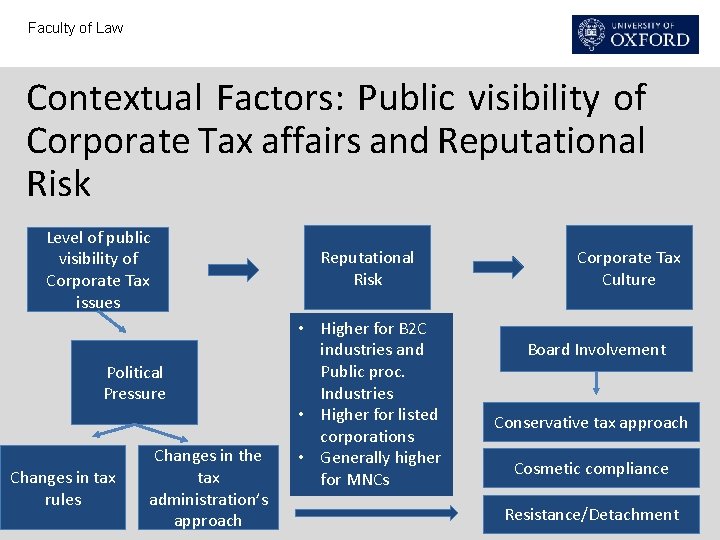
Faculty of Law Contextual Factors: Public visibility of Corporate Tax affairs and Reputational Risk Level of public visibility of Corporate Tax issues Political Pressure Changes in tax rules Changes in the tax administration’s approach Reputational Risk • Higher for B 2 C industries and Public proc. Industries • Higher for listed corporations • Generally higher for MNCs Corporate Tax Culture Board Involvement Conservative tax approach Cosmetic compliance Resistance/Detachment
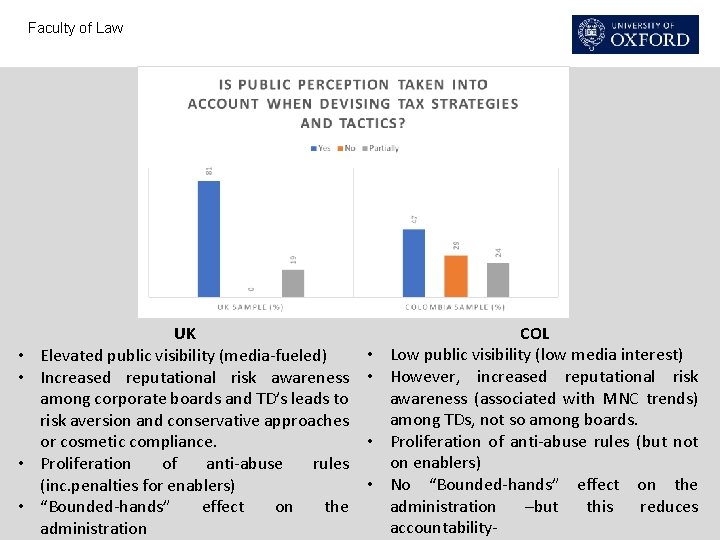
Faculty of Law • • UK Elevated public visibility (media-fueled) Increased reputational risk awareness among corporate boards and TD’s leads to risk aversion and conservative approaches or cosmetic compliance. Proliferation of anti-abuse rules (inc. penalties for enablers) “Bounded-hands” effect on the administration • • COL Low public visibility (low media interest) However, increased reputational risk awareness (associated with MNC trends) among TDs, not so among boards. Proliferation of anti-abuse rules (but not on enablers) No “Bounded-hands” effect on the administration –but this reduces accountability-
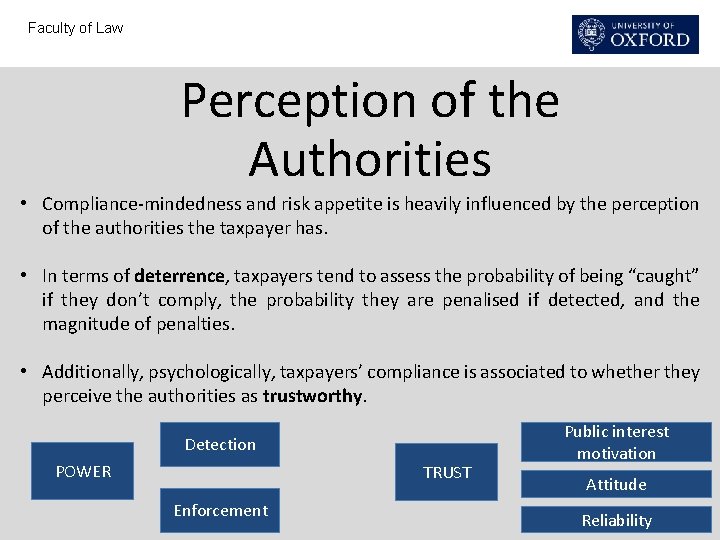
Faculty of Law Perception of the Authorities • Compliance-mindedness and risk appetite is heavily influenced by the perception of the authorities the taxpayer has. • In terms of deterrence, taxpayers tend to assess the probability of being “caught” if they don’t comply, the probability they are penalised if detected, and the magnitude of penalties. • Additionally, psychologically, taxpayers’ compliance is associated to whether they perceive the authorities as trustworthy. Detection POWER TRUST Enforcement Public interest motivation Attitude Reliability
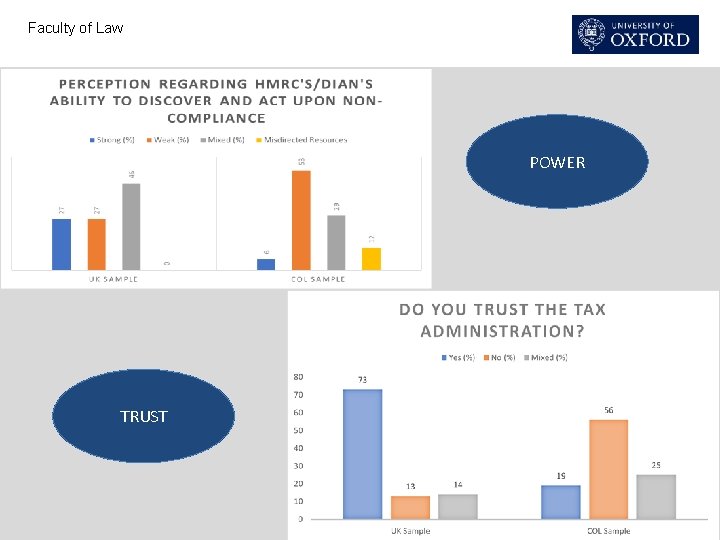
Faculty of Law POWER TRUST
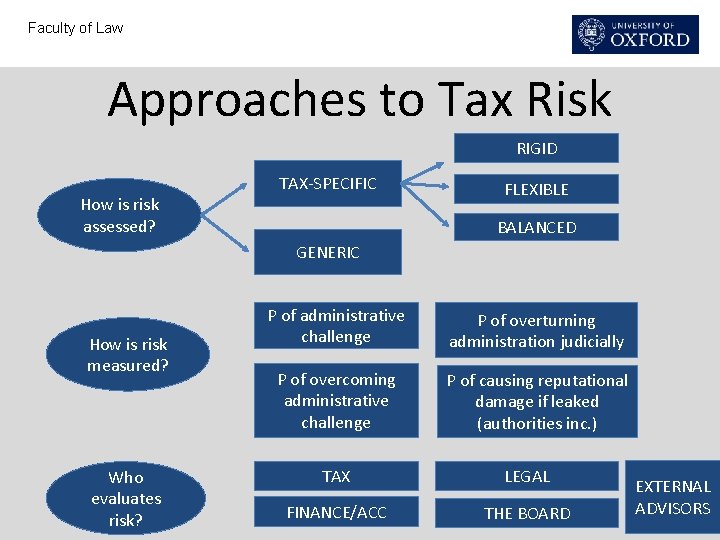
Faculty of Law Approaches to Tax Risk RIGID How is risk assessed? TAX-SPECIFIC FLEXIBLE BALANCED GENERIC How is risk measured? Who evaluates risk? P of administrative challenge P of overturning administration judicially P of overcoming administrative challenge P of causing reputational damage if leaked (authorities inc. ) TAX LEGAL FINANCE/ACC THE BOARD EXTERNAL ADVISORS
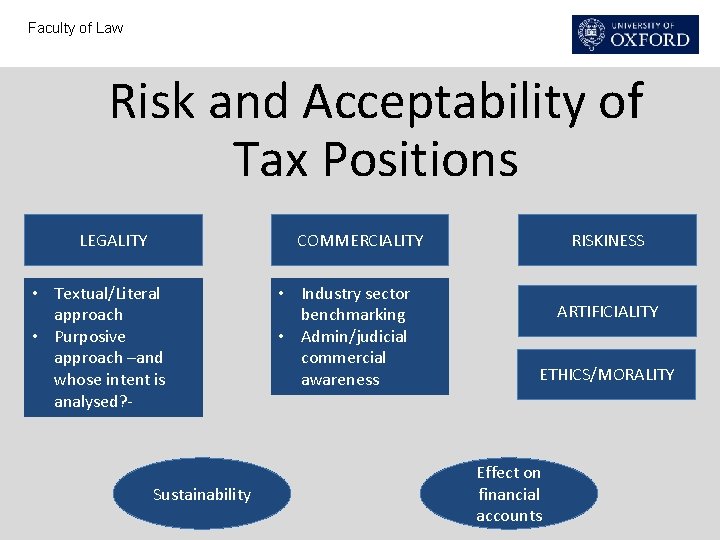
Faculty of Law Risk and Acceptability of Tax Positions LEGALITY COMMERCIALITY • Textual/Literal approach • Purposive approach –and whose intent is analysed? - Sustainability • Industry sector benchmarking • Admin/judicial commercial awareness RISKINESS ARTIFICIALITY ETHICS/MORALITY Effect on financial accounts
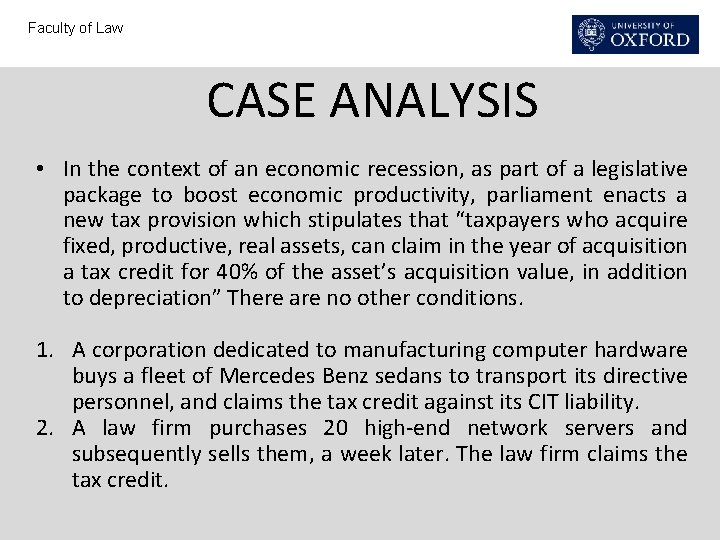
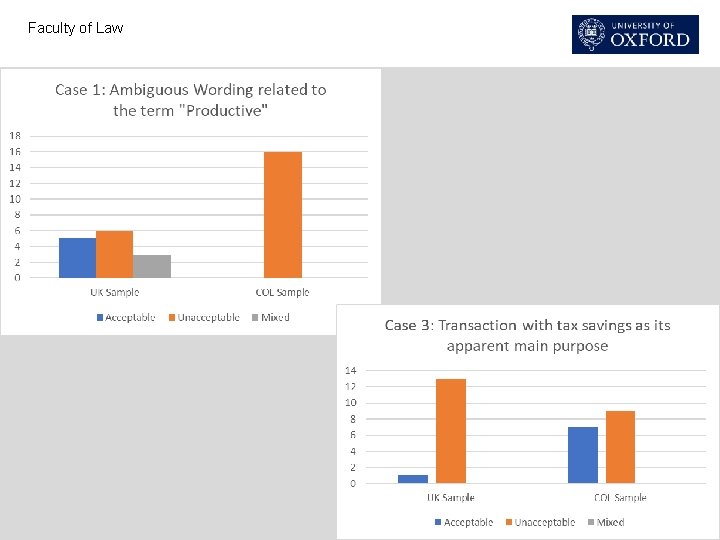
Faculty of Law CASE ANALYSIS • In the context of an economic recession, as part of a legislative package to boost economic productivity, parliament enacts a new tax provision which stipulates that “taxpayers who acquire fixed, productive, real assets, can claim in the year of acquisition a tax credit for 40% of the asset’s acquisition value, in addition to depreciation” There are no other conditions. 1. A corporation dedicated to manufacturing computer hardware buys a fleet of Mercedes Benz sedans to transport its directive personnel, and claims the tax credit against its CIT liability. 2. A law firm purchases 20 high-end network servers and subsequently sells them, a week later. The law firm claims the tax credit.
Faculty of Law

Faculty of Law Thank you!
- Slides: 27