
Faculty of Law Obiter Stylistic Guidelines AbbreviationsAcronyms no
Faculty of Law Obiter Stylistic Guidelines
Abbreviations/Acronyms • no abbreviations used in the text • abbreviations used in footnotes only • acronyms can be used in text The Labour Relations Act (LRA) was promulgated … • abbreviations and acronyms are without punctuation • use of abbreviations/acronyms must be consistent • accepted abbreviations in footnotes: § § for for a section – s 138(5)(b) [in text – section 138(5)(b)] sections – ss 138 -139 [in text – sections 138 -139] paragraph – par [31] chapter – ch
Punctuation • where words appear in brackets, punctuation marks (full stops, commas, colons etc) must always be placed after the final bracket • but if a complete sentence within a paragraph appears in brackets, full stop must be placed in front of the last bracket • all footnotes end with a full stop • references to footnote numbers should appear after punctuation and quotation marks § for example ”¹ , ² ? ³ § and not ¹” ², ³?
Quotations and quotation marks • direct quotations should be used sparingly and be as brief as possible • must correspond exactly with the original text • when complete sentence quoted, the quotation must appear as a separate paragraph with a 1 cm indent on either side, in smaller font, and single spacing • changes or additions to quotations placed in square brackets [ ] • should not start with ellipses (…), but may end with (…) • not typed in italics • double quotation marks and single quotation marks for quotes within a quotation
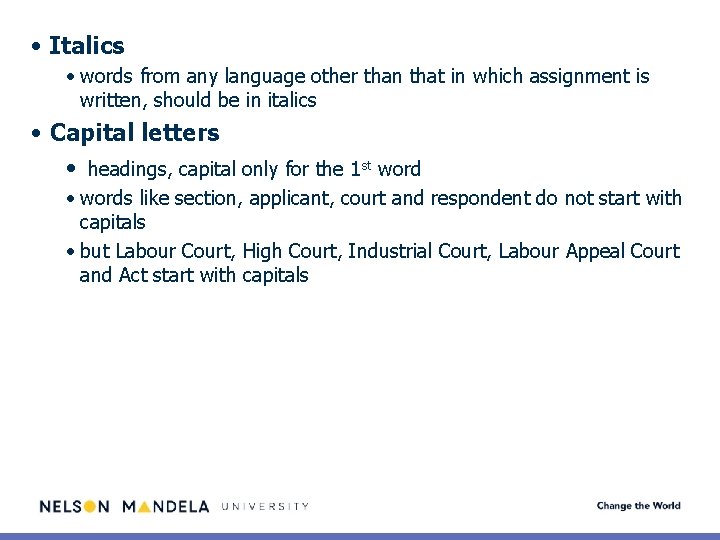
• Italics • words from any language other than that in which assignment is written, should be in italics • Capital letters • headings, capital only for the 1 st word • words like section, applicant, court and respondent do not start with capitals • but Labour Court, High Court, Industrial Court, Labour Appeal Court and Act start with capitals
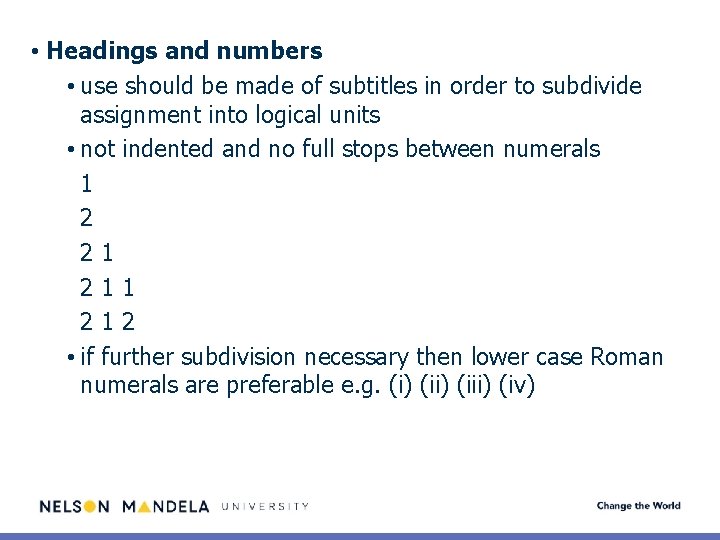
• Headings and numbers • use should be made of subtitles in order to subdivide assignment into logical units • not indented and no full stops between numerals 1 2 21 212 • if further subdivision necessary then lower case Roman numerals are preferable e. g. (i) (iii) (iv)
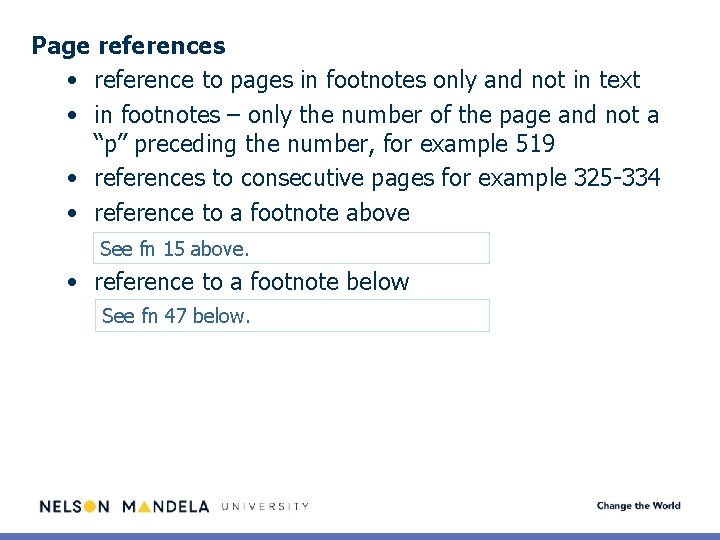
Page references • reference to pages in footnotes only and not in text • in footnotes – only the number of the page and not a “p” preceding the number, for example 519 • references to consecutive pages for example 325 -334 • reference to a footnote above See fn 15 above. • reference to a footnote below See fn 47 below.
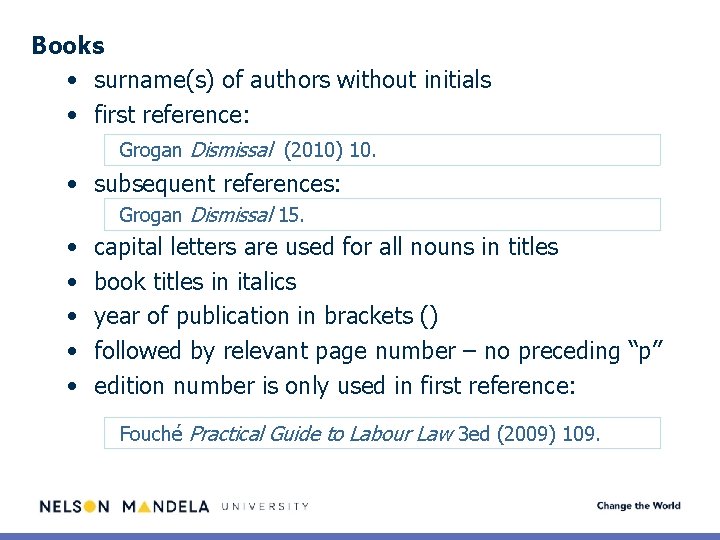
Books • surname(s) of authors without initials • first reference: Grogan Dismissal (2010) 10. • subsequent references: Grogan Dismissal 15. • • • capital letters are used for all nouns in titles book titles in italics year of publication in brackets () followed by relevant page number – no preceding “p” edition number is only used in first reference: Fouché Practical Guide to Labour Law 3 ed (2009) 109.
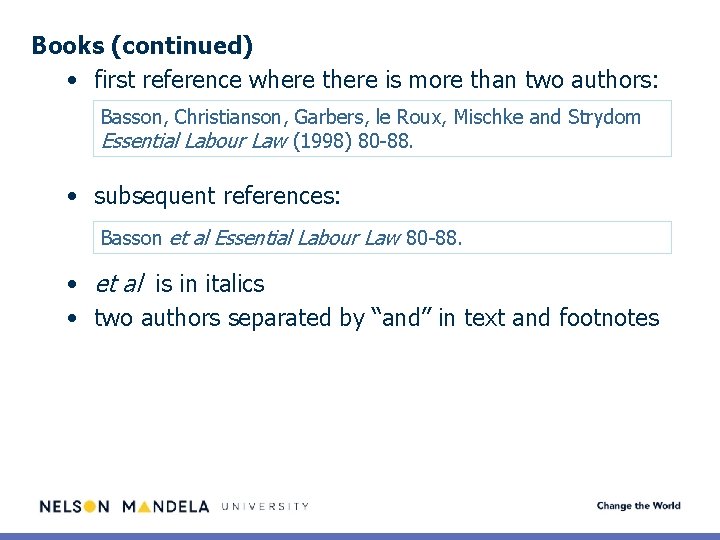
Books (continued) • first reference where there is more than two authors: Basson, Christianson, Garbers, le Roux, Mischke and Strydom Essential Labour Law (1998) 80 -88. • subsequent references: Basson et al Essential Labour Law 80 -88. • et al is in italics • two authors separated by “and” in text and footnotes
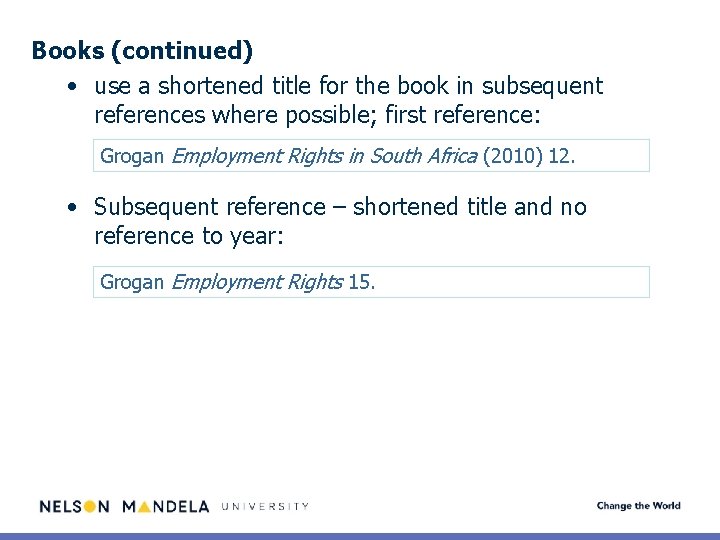
Books (continued) • use a shortened title for the book in subsequent references where possible; first reference: Grogan Employment Rights in South Africa (2010) 12. • Subsequent reference – shortened title and no reference to year: Grogan Employment Rights 15.
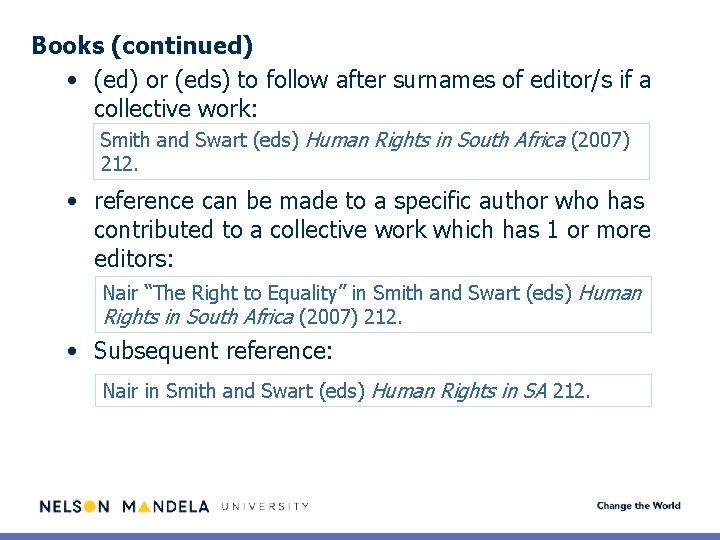
Books (continued) • (ed) or (eds) to follow after surnames of editor/s if a collective work: Smith and Swart (eds) Human Rights in South Africa (2007) 212. • reference can be made to a specific author who has contributed to a collective work which has 1 or more editors: Nair “The Right to Equality” in Smith and Swart (eds) Human Rights in South Africa (2007) 212. • Subsequent reference: Nair in Smith and Swart (eds) Human Rights in SA 212.
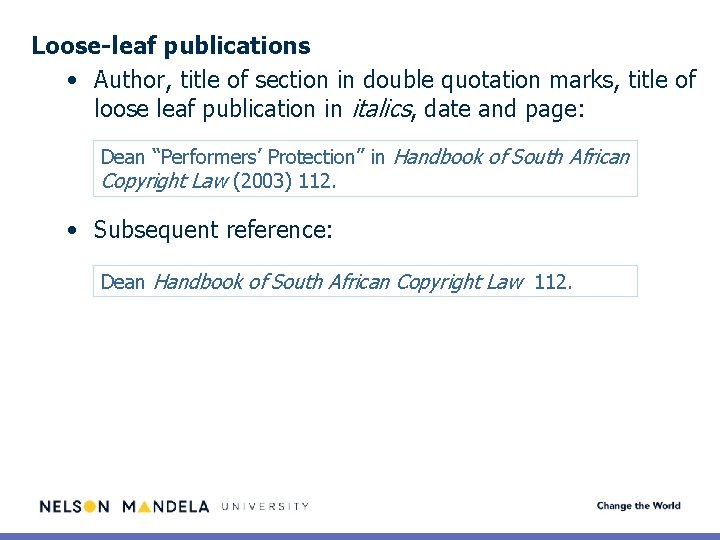
Loose-leaf publications • Author, title of section in double quotation marks, title of loose leaf publication in italics, date and page: Dean “Performers’ Protection” in Handbook of South African Copyright Law (2003) 112. • Subsequent reference: Dean Handbook of South African Copyright Law 112.
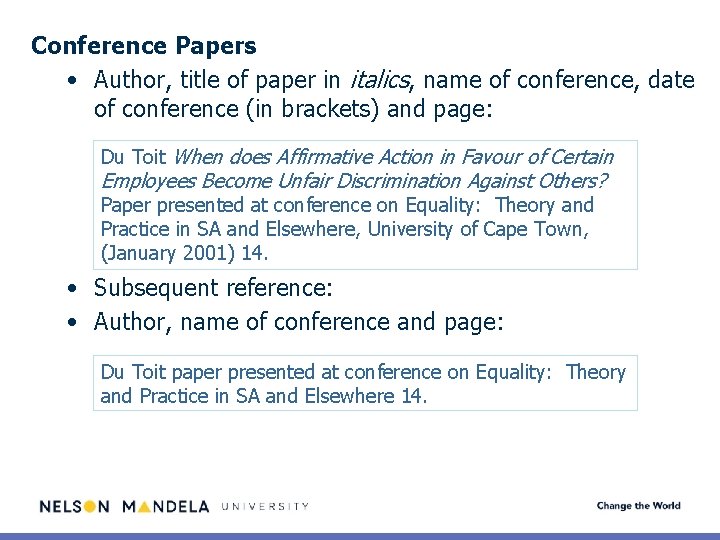
Conference Papers • Author, title of paper in italics, name of conference, date of conference (in brackets) and page: Du Toit When does Affirmative Action in Favour of Certain Employees Become Unfair Discrimination Against Others? Paper presented at conference on Equality: Theory and Practice in SA and Elsewhere, University of Cape Town, (January 2001) 14. • Subsequent reference: • Author, name of conference and page: Du Toit paper presented at conference on Equality: Theory and Practice in SA and Elsewhere 14.

Dissertation, thesis, treatise • Author, title of thesis in italics, type and institution (in brackets), year, and page: Buchan Franchisor Failure: An Assessment of the Adequacy of Regulatory Response (doctoral thesis, Queensland University of Technology) 2010 23. • Subsequent reference: • Author, shortened title, and page: Buchan Franchisor Failure 23.
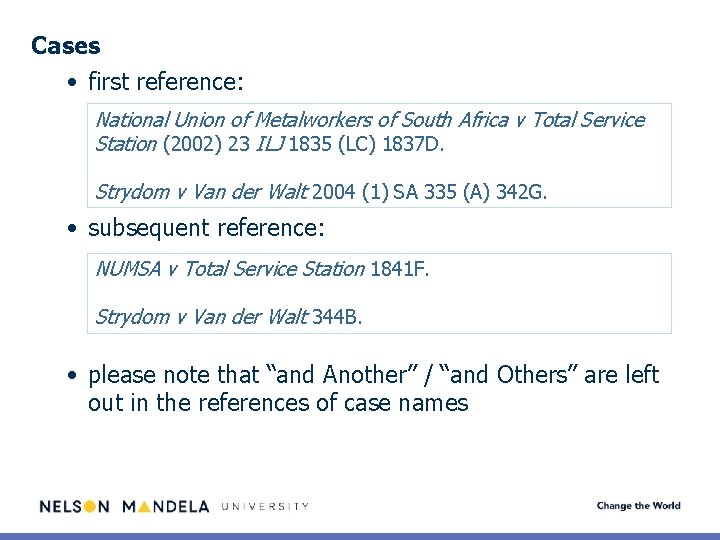
Cases • first reference: National Union of Metalworkers of South Africa v Total Service Station (2002) 23 ILJ 1835 (LC) 1837 D. Strydom v Van der Walt 2004 (1) SA 335 (A) 342 G. • subsequent reference: NUMSA v Total Service Station 1841 F. Strydom v Van der Walt 344 B. • please note that “and Another” / “and Others” are left out in the references of case names
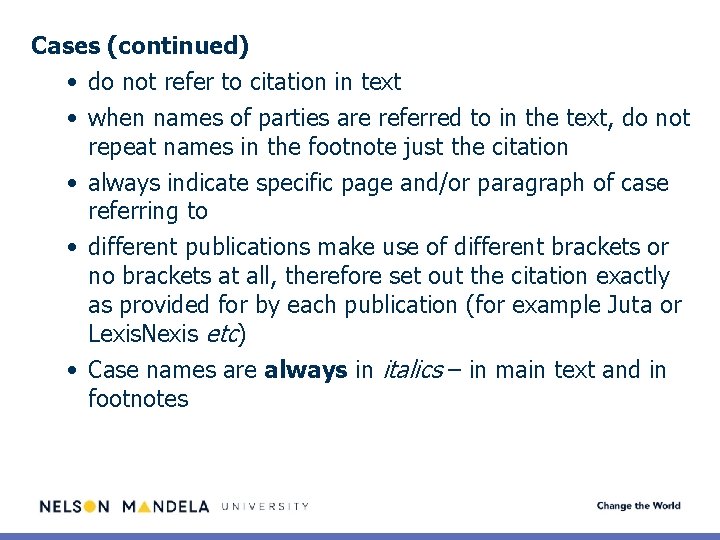
Cases (continued) • do not refer to citation in text • when names of parties are referred to in the text, do not repeat names in the footnote just the citation • always indicate specific page and/or paragraph of case referring to • different publications make use of different brackets or no brackets at all, therefore set out the citation exactly as provided for by each publication (for example Juta or Lexis. Nexis etc) • Case names are always in italics – in main text and in footnotes
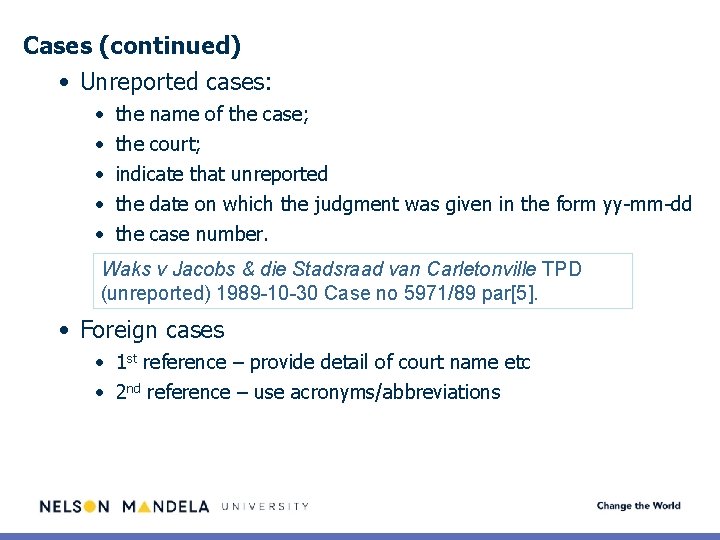
Cases (continued) • Unreported cases: • • • the name of the case; the court; indicate that unreported the date on which the judgment was given in the form yy-mm-dd the case number. Waks v Jacobs & die Stadsraad van Carletonville TPD (unreported) 1989 -10 -30 Case no 5971/89 par[5]. • Foreign cases • 1 st reference – provide detail of court name etc • 2 nd reference – use acronyms/abbreviations
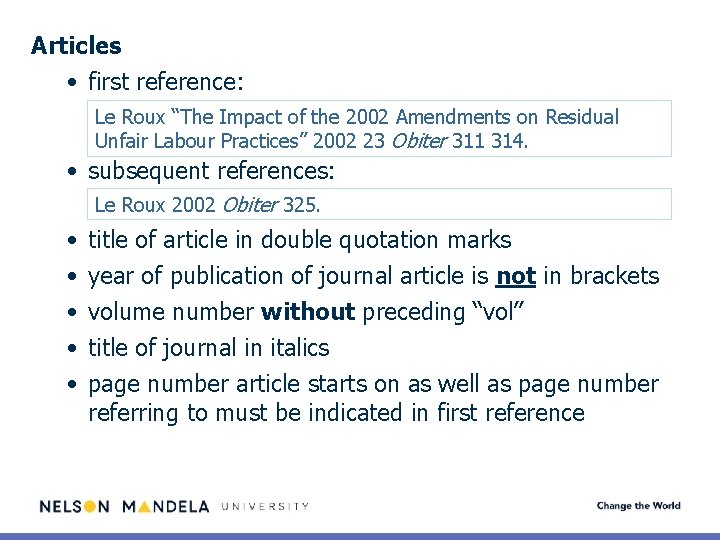
Articles • first reference: Le Roux “The Impact of the 2002 Amendments on Residual Unfair Labour Practices” 2002 23 Obiter 311 314. • subsequent references: Le Roux 2002 Obiter 325. • • • title of article in double quotation marks year of publication of journal article is not in brackets volume number without preceding “vol” title of journal in italics page number article starts on as well as page number referring to must be indicated in first reference
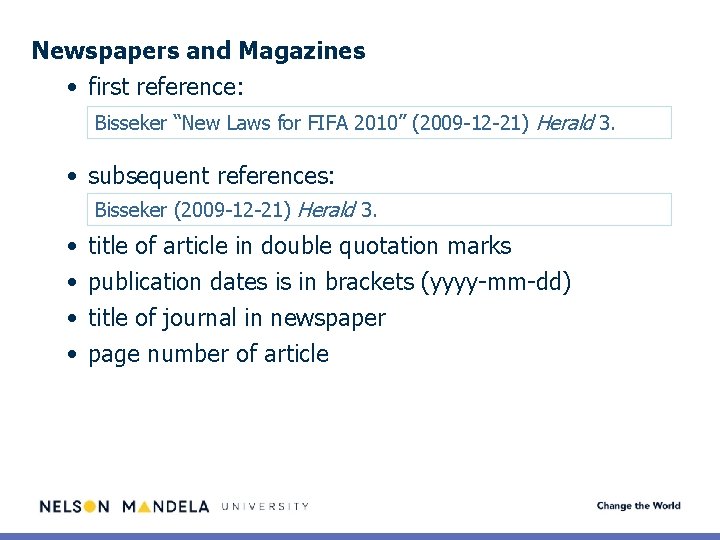
Newspapers and Magazines • first reference: Bisseker “New Laws for FIFA 2010” (2009 -12 -21) Herald 3. • subsequent references: Bisseker (2009 -12 -21) Herald 3. • • title of article in double quotation marks publication dates is in brackets (yyyy-mm-dd) title of journal in newspaper page number of article
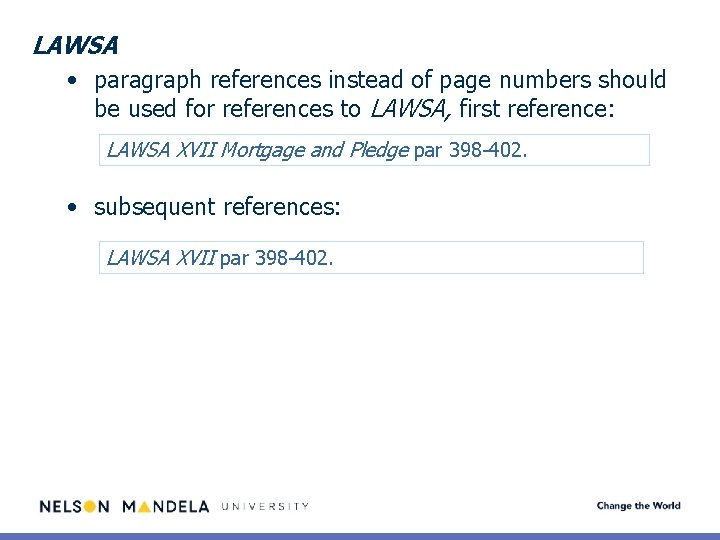
LAWSA • paragraph references instead of page numbers should be used for references to LAWSA, first reference: LAWSA XVII Mortgage and Pledge par 398 -402. • subsequent references: LAWSA XVII par 398 -402.
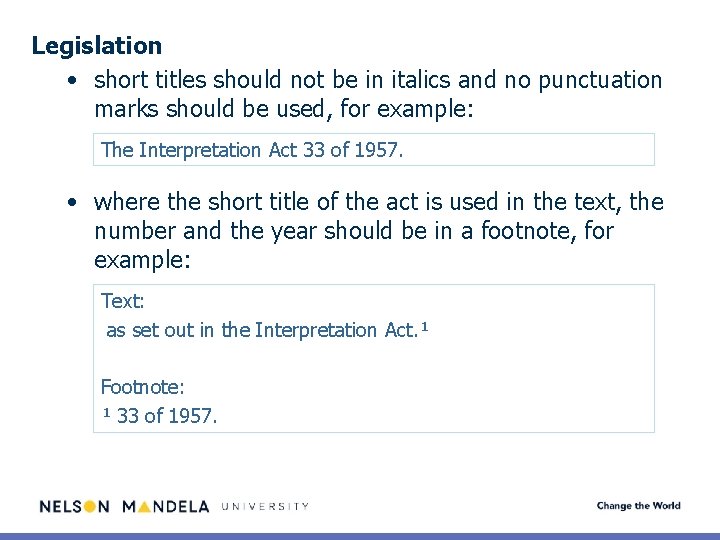
Legislation • short titles should not be in italics and no punctuation marks should be used, for example: The Interpretation Act 33 of 1957. • where the short title of the act is used in the text, the number and the year should be in a footnote, for example: Text: as set out in the Interpretation Act. ¹ Footnote: ¹ 33 of 1957.
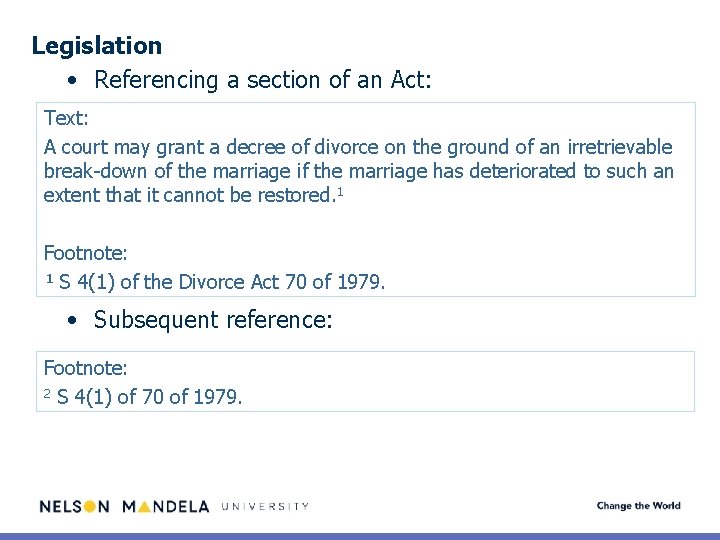
Legislation • Referencing a section of an Act: Text: A court may grant a decree of divorce on the ground of an irretrievable break-down of the marriage if the marriage has deteriorated to such an extent that it cannot be restored. 1 Footnote: ¹ S 4(1) of the Divorce Act 70 of 1979. • Subsequent reference: Footnote: 2 S 4(1) of 70 of 1979.
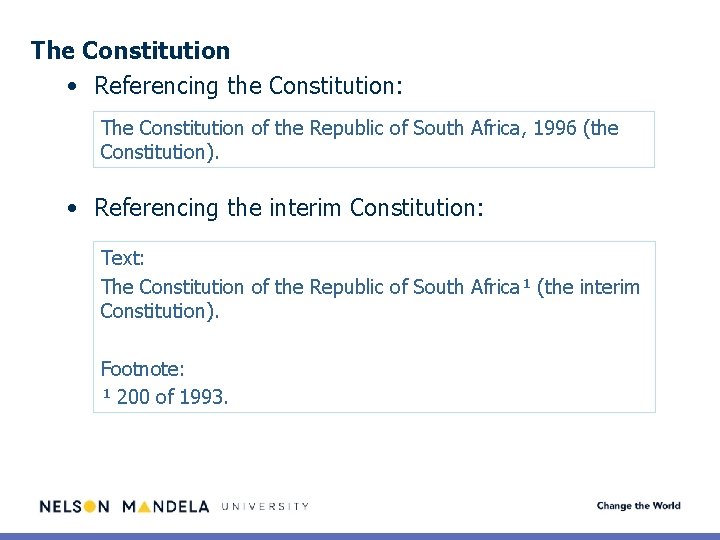
The Constitution • Referencing the Constitution: The Constitution of the Republic of South Africa, 1996 (the Constitution). • Referencing the interim Constitution: Text: The Constitution of the Republic of South Africa¹ (the interim Constitution). Footnote: ¹ 200 of 1993.
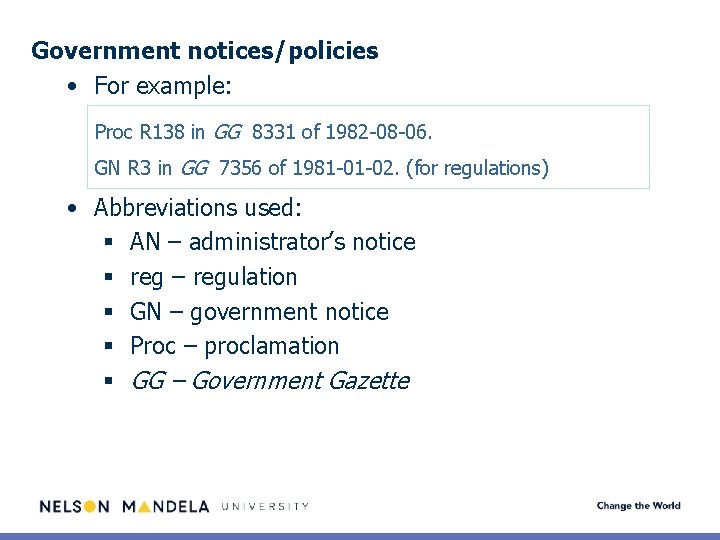
Government notices/policies • For example: Proc R 138 in GG 8331 of 1982 -08 -06. GN R 3 in GG 7356 of 1981 -01 -02. (for regulations) • Abbreviations used: § AN – administrator’s notice § reg – regulation § GN – government notice § Proc – proclamation § GG – Government Gazette
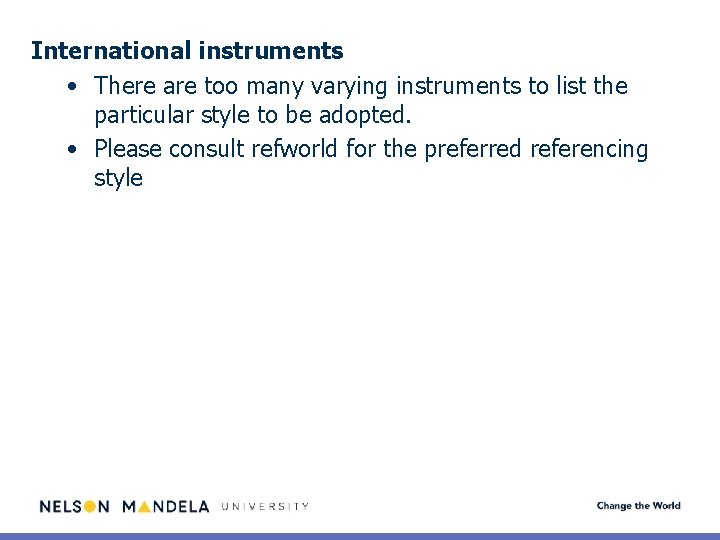
International instruments • There are too many varying instruments to list the particular style to be adopted. • Please consult refworld for the preferred referencing style
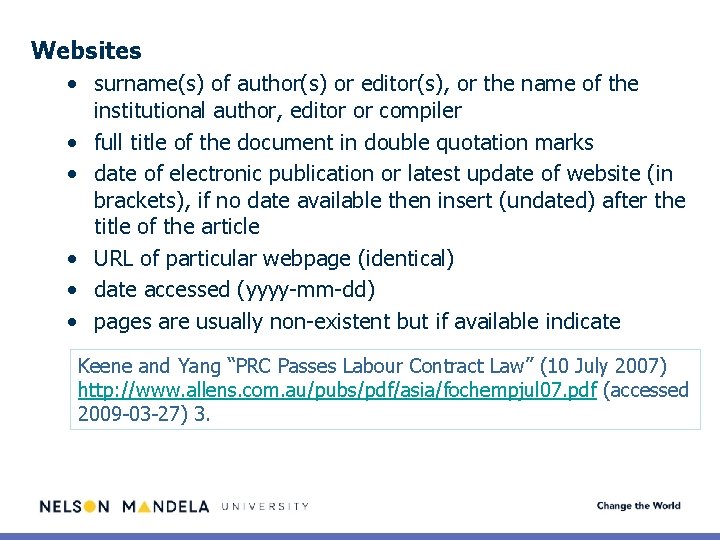
Websites • surname(s) of author(s) or editor(s), or the name of the institutional author, editor or compiler • full title of the document in double quotation marks • date of electronic publication or latest update of website (in brackets), if no date available then insert (undated) after the title of the article • URL of particular webpage (identical) • date accessed (yyyy-mm-dd) • pages are usually non-existent but if available indicate Keene and Yang “PRC Passes Labour Contract Law” (10 July 2007) http: //www. allens. com. au/pubs/pdf/asia/fochempjul 07. pdf (accessed 2009 -03 -27) 3.
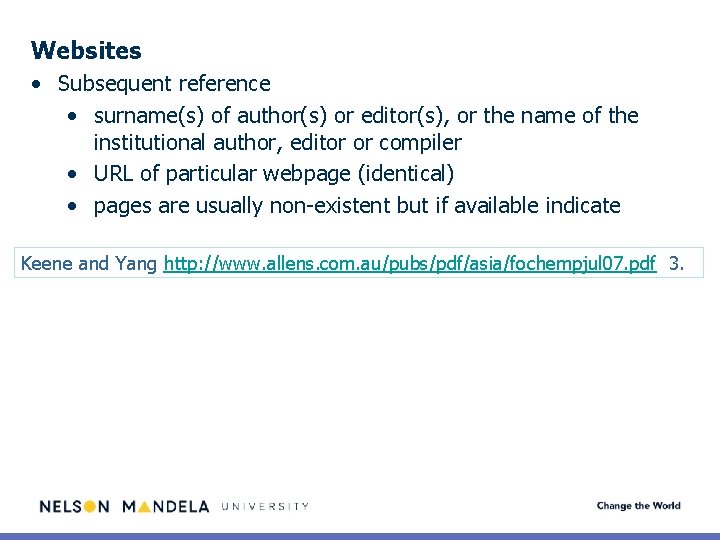
Websites • Subsequent reference • surname(s) of author(s) or editor(s), or the name of the institutional author, editor or compiler • URL of particular webpage (identical) • pages are usually non-existent but if available indicate Keene and Yang http: //www. allens. com. au/pubs/pdf/asia/fochempjul 07. pdf 3.
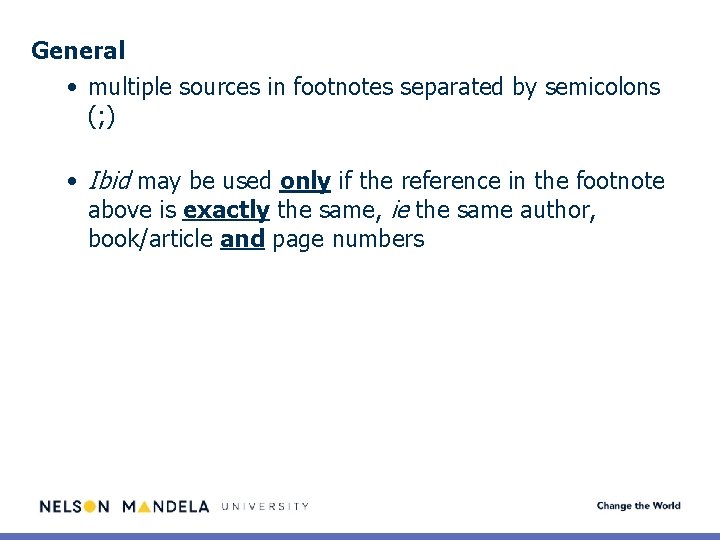
General • multiple sources in footnotes separated by semicolons (; ) • Ibid may be used only if the reference in the footnote above is exactly the same, ie the same author, book/article and page numbers
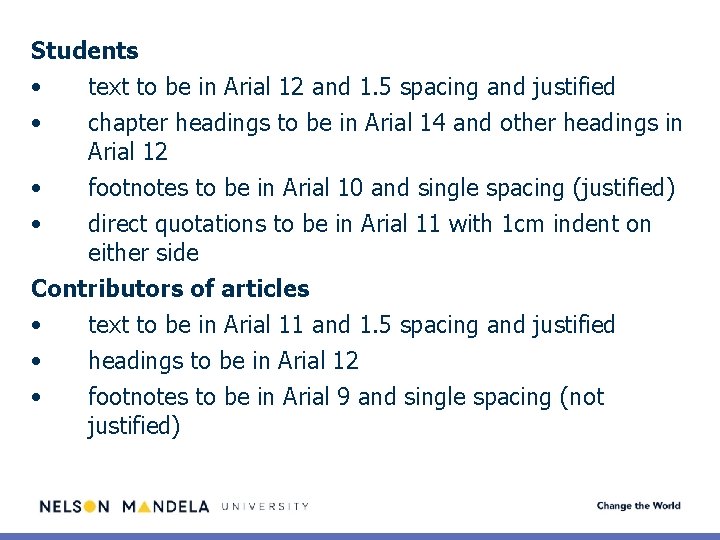
Students • text to be in Arial 12 and 1. 5 spacing and justified • chapter headings to be in Arial 14 and other headings in Arial 12 • footnotes to be in Arial 10 and single spacing (justified) • direct quotations to be in Arial 11 with 1 cm indent on either side Contributors of articles • • • text to be in Arial 11 and 1. 5 spacing and justified headings to be in Arial 12 footnotes to be in Arial 9 and single spacing (not justified)
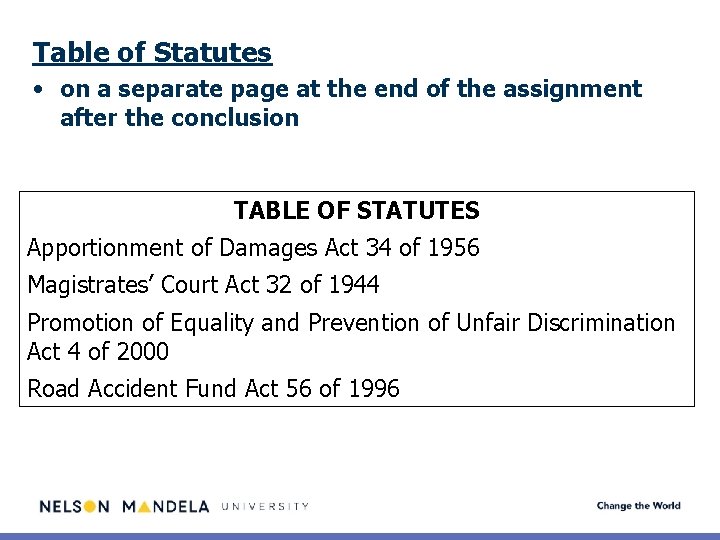
Table of Statutes • on a separate page at the end of the assignment after the conclusion TABLE OF STATUTES Apportionment of Damages Act 34 of 1956 Magistrates’ Court Act 32 of 1944 Promotion of Equality and Prevention of Unfair Discrimination Act 4 of 2000 Road Accident Fund Act 56 of 1996
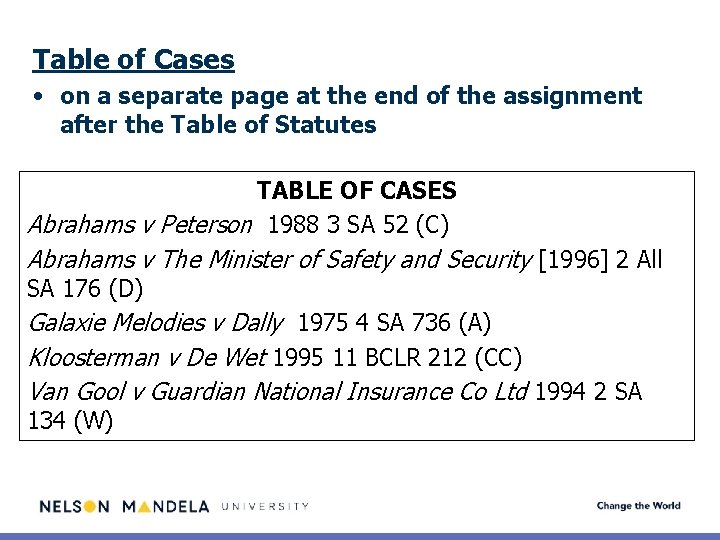
Table of Cases • on a separate page at the end of the assignment after the Table of Statutes TABLE OF CASES Abrahams v Peterson 1988 3 SA 52 (C) Abrahams v The Minister of Safety and Security [1996] 2 All SA 176 (D) Galaxie Melodies v Dally 1975 4 SA 736 (A) Kloosterman v De Wet 1995 11 BCLR 212 (CC) Van Gool v Guardian National Insurance Co Ltd 1994 2 SA 134 (W)
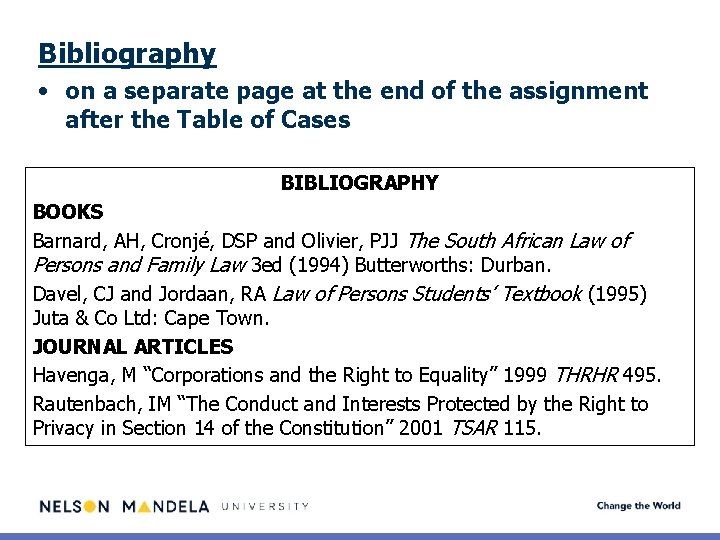
Bibliography • on a separate page at the end of the assignment after the Table of Cases BIBLIOGRAPHY BOOKS Barnard, AH, Cronjé, DSP and Olivier, PJJ The South African Law of Persons and Family Law 3 ed (1994) Butterworths: Durban. Davel, CJ and Jordaan, RA Law of Persons Students’ Textbook (1995) Juta & Co Ltd: Cape Town. JOURNAL ARTICLES Havenga, M “Corporations and the Right to Equality” 1999 THRHR 495. Rautenbach, IM “The Conduct and Interests Protected by the Right to Privacy in Section 14 of the Constitution” 2001 TSAR 115.
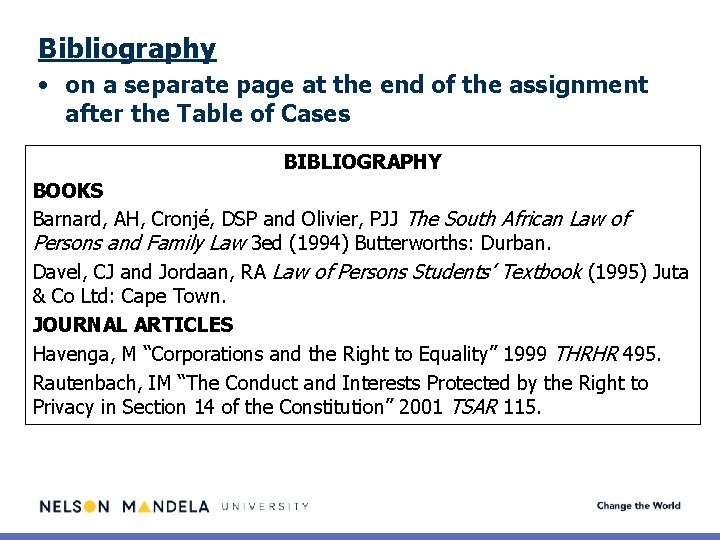
Bibliography • on a separate page at the end of the assignment after the Table of Cases BIBLIOGRAPHY BOOKS Barnard, AH, Cronjé, DSP and Olivier, PJJ The South African Law of Persons and Family Law 3 ed (1994) Butterworths: Durban. Davel, CJ and Jordaan, RA Law of Persons Students’ Textbook (1995) Juta & Co Ltd: Cape Town. JOURNAL ARTICLES Havenga, M “Corporations and the Right to Equality” 1999 THRHR 495. Rautenbach, IM “The Conduct and Interests Protected by the Right to Privacy in Section 14 of the Constitution” 2001 TSAR 115.
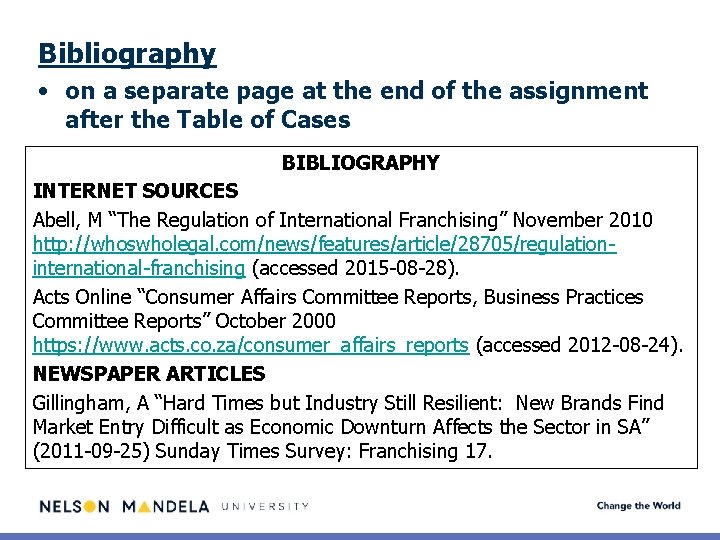
Bibliography • on a separate page at the end of the assignment after the Table of Cases BIBLIOGRAPHY INTERNET SOURCES Abell, M “The Regulation of International Franchising” November 2010 http: //whoswholegal. com/news/features/article/28705/regulationinternational-franchising (accessed 2015 -08 -28). Acts Online “Consumer Affairs Committee Reports, Business Practices Committee Reports” October 2000 https: //www. acts. co. za/consumer_affairs_reports (accessed 2012 -08 -24). NEWSPAPER ARTICLES Gillingham, A “Hard Times but Industry Still Resilient: New Brands Find Market Entry Difficult as Economic Downturn Affects the Sector in SA” (2011 -09 -25) Sunday Times Survey: Franchising 17.
- Slides: 34