
Faculty of Engineering Department of Mechanical Engineering Fluid

- Slides: 47
Faculty of Engineering Department of Mechanical Engineering Fluid Mechanics MEE 290 – Sections CA (42695) & EA (42697) Pressure and Fluid Statics Dr. Mamoun Janajrah Ph. D, UK Spring 2017
Chapter 3 • • Pressure, The manometer, The barometer and atmospheric pressure, Introduction to fluid statics, Hydrostatics forces on submerged plane surfaces, Hydrostatics forces on curved surfaces, Buoyancy & stability. 2
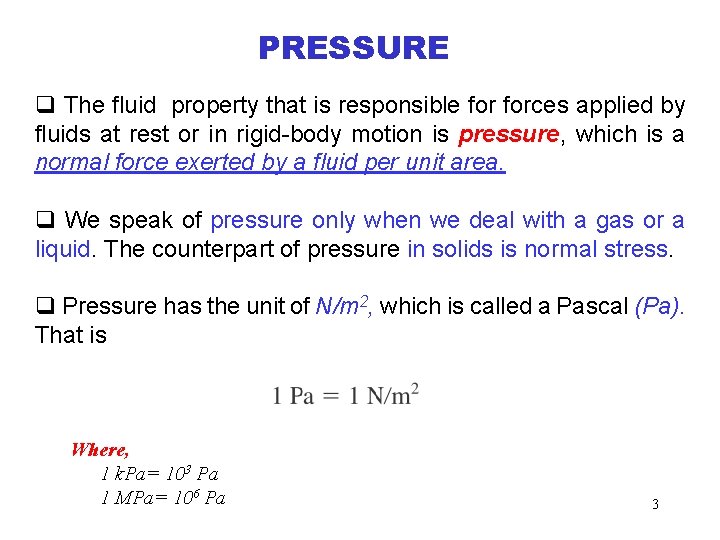
PRESSURE q The fluid property that is responsible forces applied by fluids at rest or in rigid-body motion is pressure, which is a normal force exerted by a fluid per unit area. q We speak of pressure only when we deal with a gas or a liquid. The counterpart of pressure in solids is normal stress. q Pressure has the unit of N/m 2, which is called a Pascal (Pa). That is Where, 1 k. Pa= 103 Pa 1 MPa= 106 Pa 3
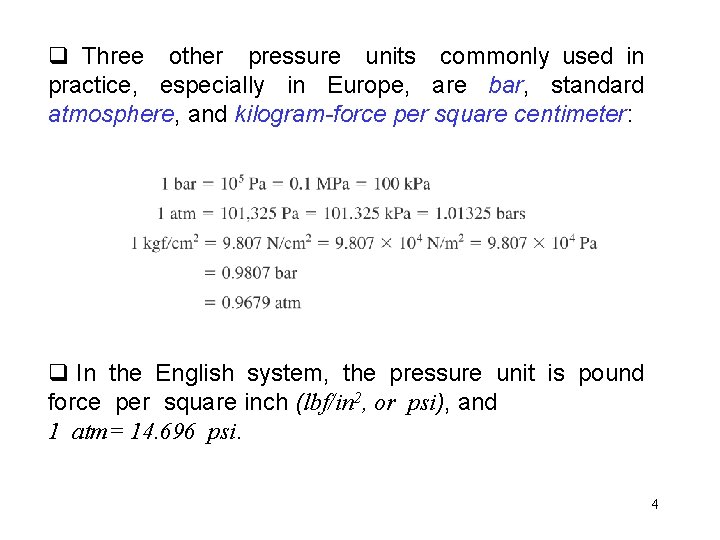
q Three other pressure units commonly used in practice, especially in Europe, are bar, standard atmosphere, and kilogram-force per square centimeter: q In the English system, the pressure unit is pound force per square inch (lbf/in 2, or psi), and 1 atm= 14. 696 psi. 4
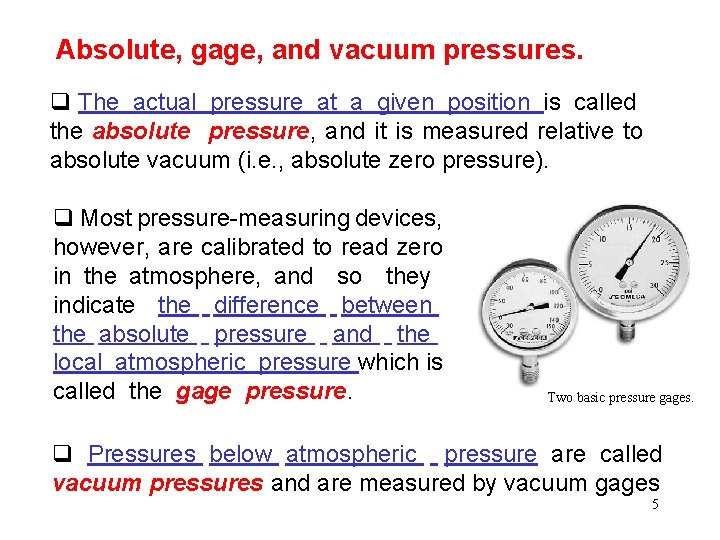
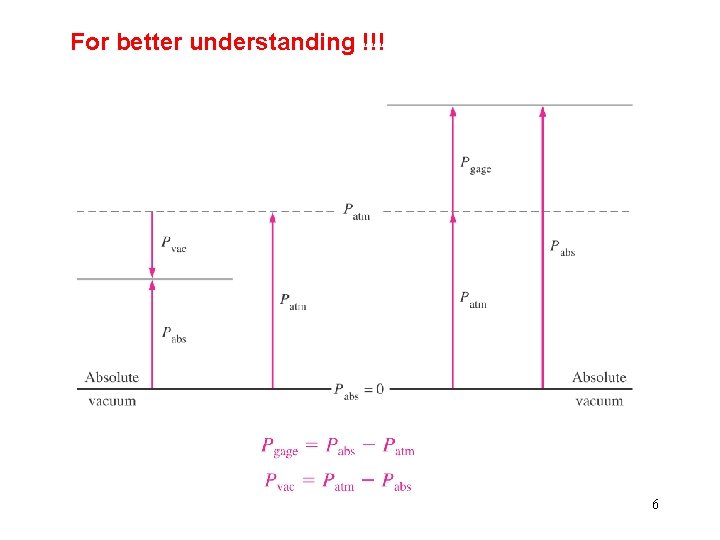
Absolute, gage, and vacuum pressures. q The actual pressure at a given position is called the absolute pressure, and it is measured relative to absolute vacuum (i. e. , absolute zero pressure). q Most pressure-measuring devices, however, are calibrated to read zero in the atmosphere, and so they indicate the difference between the absolute pressure and the local atmospheric pressure which is called the gage pressure. Two basic pressure gages. q Pressures below atmospheric pressure are called vacuum pressures and are measured by vacuum gages 5
For better understanding !!! 6
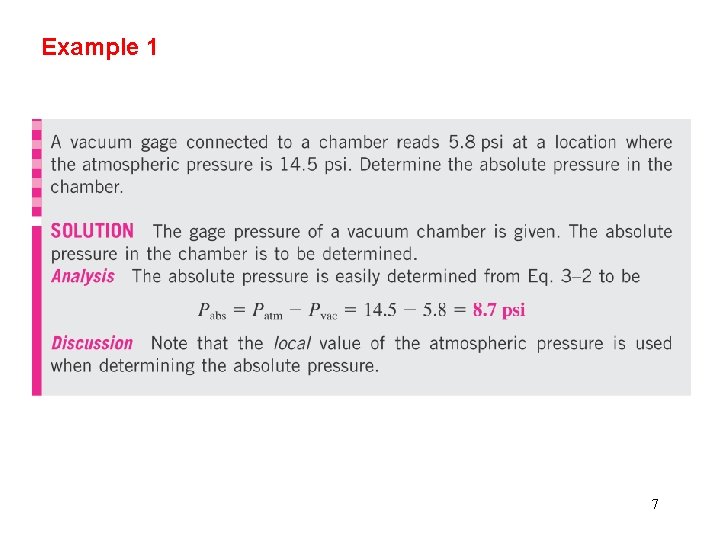
Example 1 7
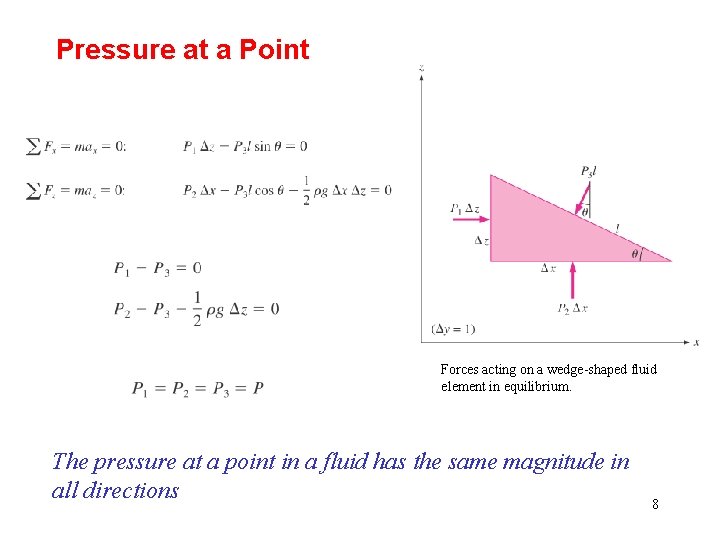
Pressure at a Point Forces acting on a wedge-shaped fluid element in equilibrium. The pressure at a point in a fluid has the same magnitude in all directions 8
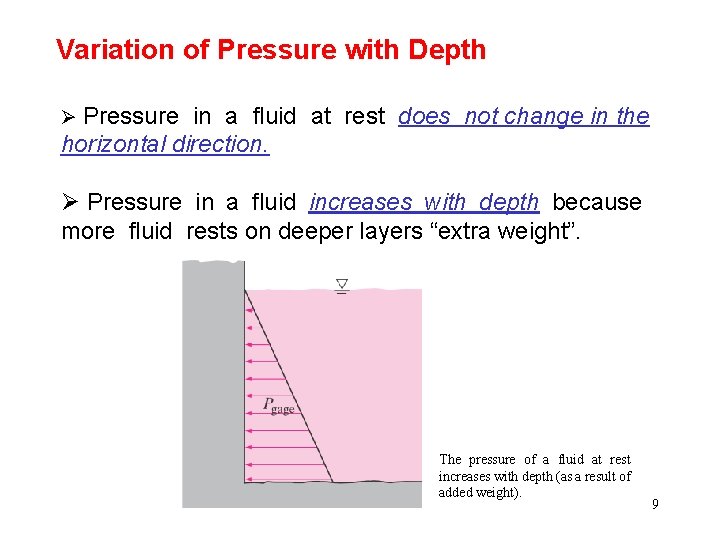
Variation of Pressure with Depth Ø Pressure in a fluid at rest does not change in the horizontal direction. Ø Pressure in a fluid increases with depth because more fluid rests on deeper layers “extra weight”. The pressure of a fluid at rest increases with depth (as a result of added weight). 9
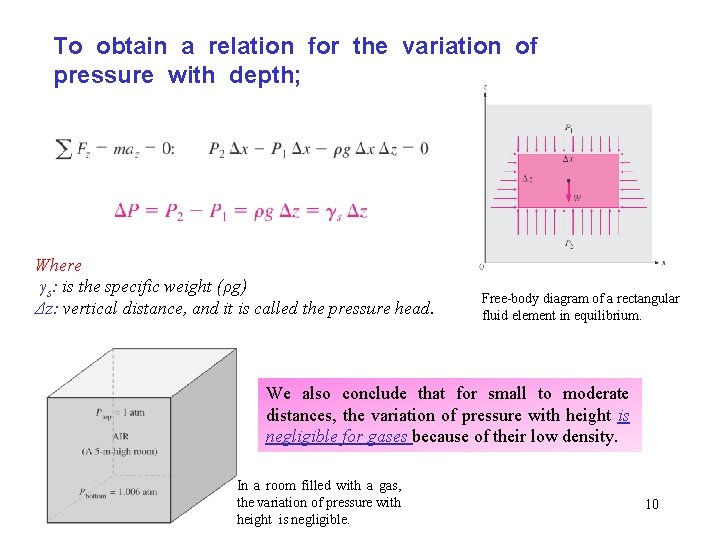
To obtain a relation for the variation of pressure with depth; Where γs: is the specific weight (ρg) Δz: vertical distance, and it is called the pressure head. Free-body diagram of a rectangular fluid element in equilibrium. We also conclude that for small to moderate distances, the variation of pressure with height is negligible for gases because of their low density. In a room filled with a gas, the variation of pressure with height is negligible. 10
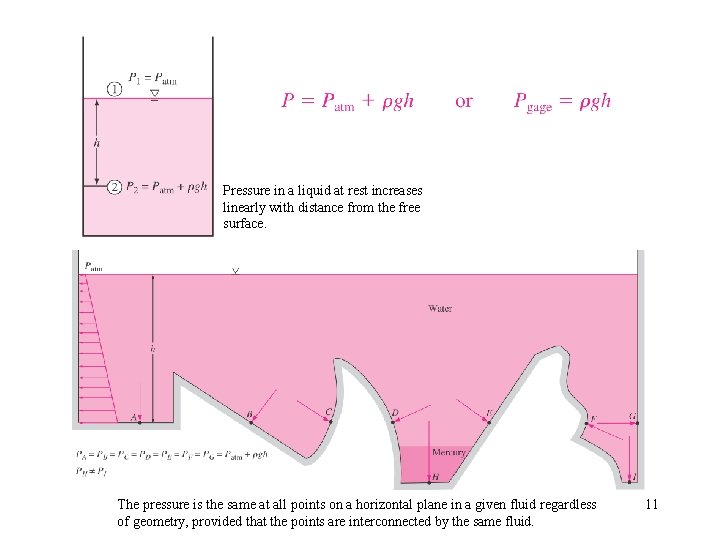
Pressure in a liquid at rest increases linearly with distance from the free surface. The pressure is the same at all points on a horizontal plane in a given fluid regardless of geometry, provided that the points are interconnected by the same fluid. 11
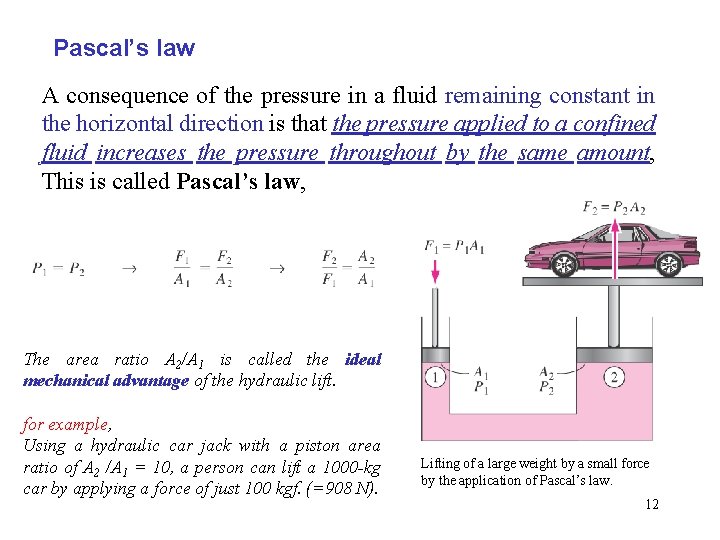
Pascal’s law A consequence of the pressure in a fluid remaining constant in the horizontal direction is that the pressure applied to a confined fluid increases the pressure throughout by the same amount, This is called Pascal’s law, The area ratio A 2/A 1 is called the ideal mechanical advantage of the hydraulic lift. for example, Using a hydraulic car jack with a piston area ratio of A 2 /A 1 = 10, a person can lift a 1000 -kg car by applying a force of just 100 kgf. (=908 N). Lifting of a large weight by a small force by the application of Pascal’s law. 12
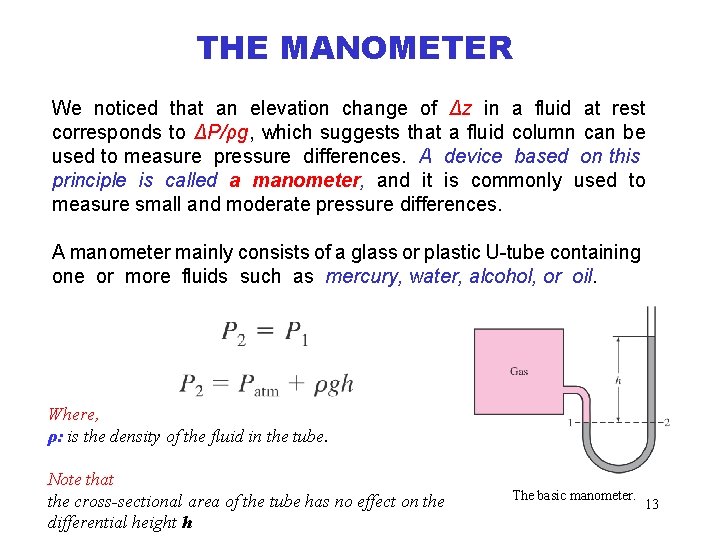
THE MANOMETER We noticed that an elevation change of Δz in a fluid at rest corresponds to ΔP/ρg, which suggests that a fluid column can be used to measure pressure differences. A device based on this principle is called a manometer, and it is commonly used to measure small and moderate pressure differences. A manometer mainly consists of a glass or plastic U-tube containing one or more fluids such as mercury, water, alcohol, or oil. Where, ρ: is the density of the fluid in the tube. Note that the cross-sectional area of the tube has no effect on the differential height h The basic manometer. 13
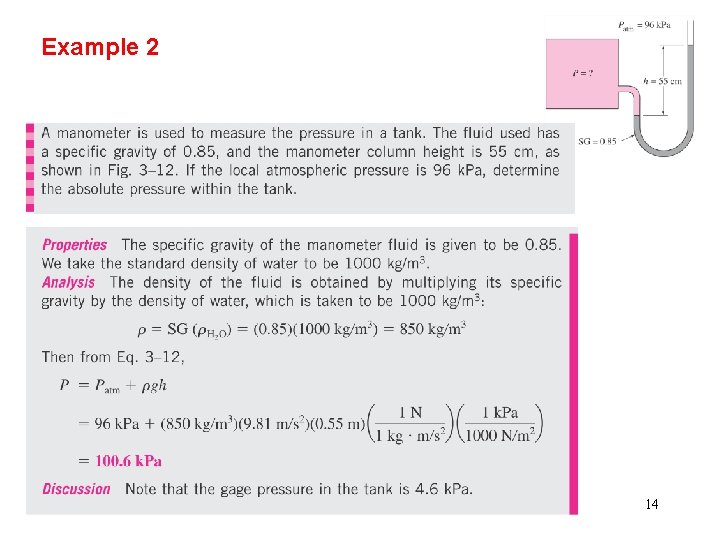
Example 2 14
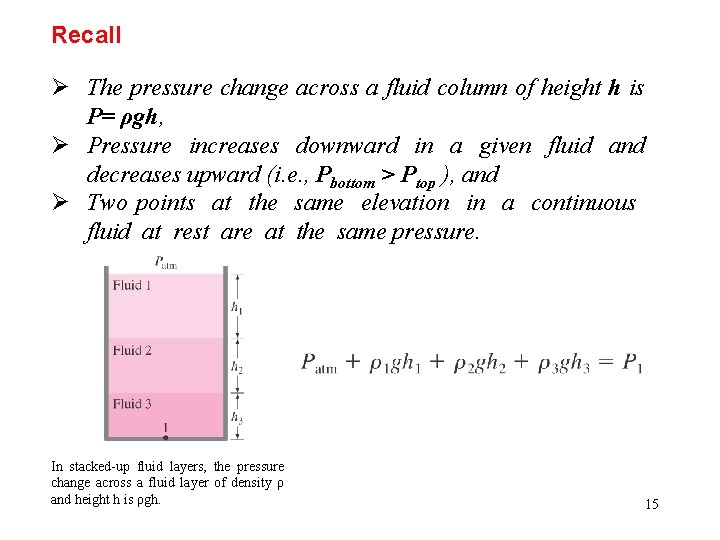
Recall Ø The pressure change across a fluid column of height h is P= ρgh, Ø Pressure increases downward in a given fluid and decreases upward (i. e. , Pbottom ˃ Ptop ), and Ø Two points at the same elevation in a continuous fluid at rest are at the same pressure. In stacked-up fluid layers, the pressure change across a fluid layer of density ρ and height h is ρgh. 15
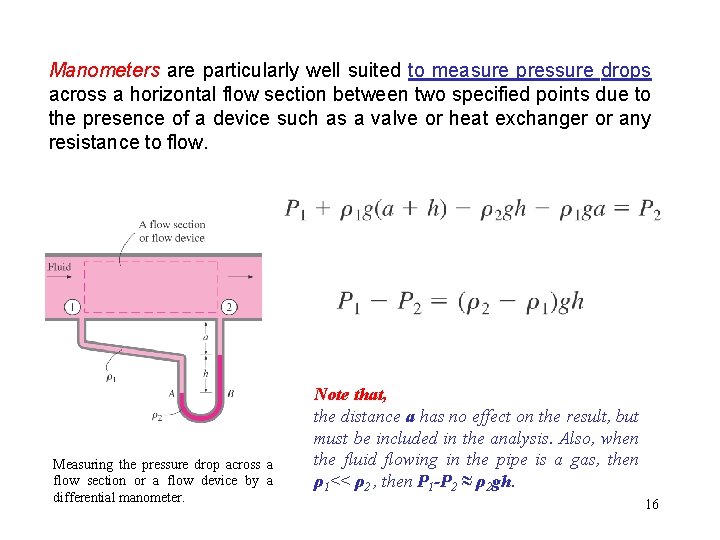
Manometers are particularly well suited to measure pressure drops across a horizontal flow section between two specified points due to the presence of a device such as a valve or heat exchanger or any resistance to flow. Measuring the pressure drop across a flow section or a flow device by a differential manometer. Note that, the distance a has no effect on the result, but must be included in the analysis. Also, when the fluid flowing in the pipe is a gas, then ρ1˂˂ ρ2 , then P 1 -P 2 ≈ ρ2 gh. 16
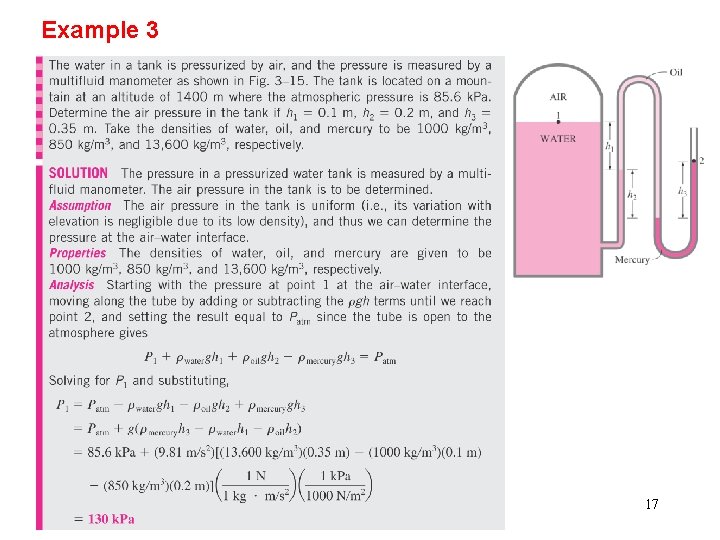
Example 3 17
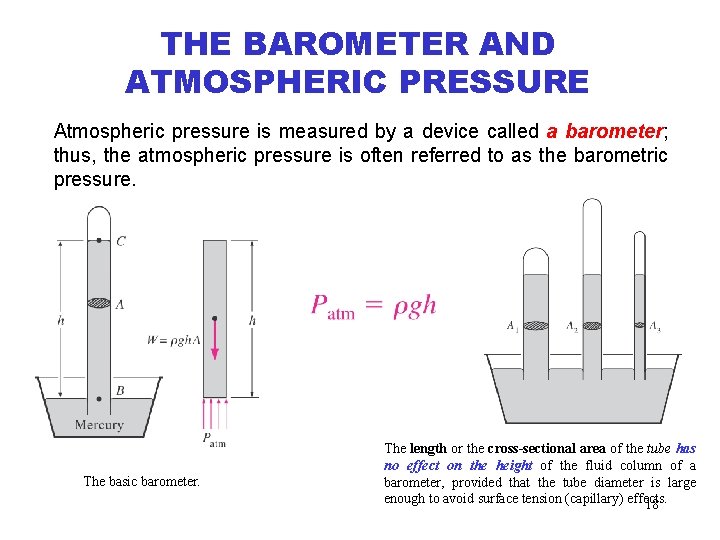
THE BAROMETER AND ATMOSPHERIC PRESSURE Atmospheric pressure is measured by a device called a barometer; thus, the atmospheric pressure is often referred to as the barometric pressure. The basic barometer. The length or the cross-sectional area of the tube has no effect on the height of the fluid column of a barometer, provided that the tube diameter is large enough to avoid surface tension (capillary) effects. 18
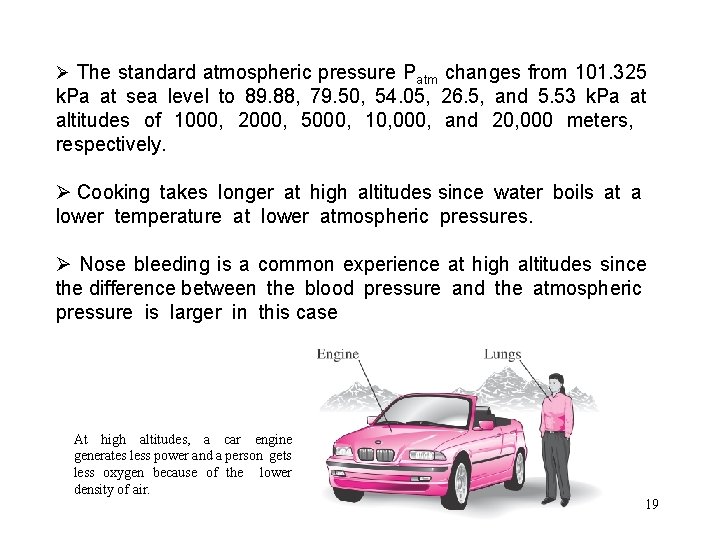
Ø The standard atmospheric pressure Patm changes from 101. 325 k. Pa at sea level to 89. 88, 79. 50, 54. 05, 26. 5, and 5. 53 k. Pa at altitudes of 1000, 2000, 5000, 10, 000, and 20, 000 meters, respectively. Ø Cooking takes longer at high altitudes since water boils at a lower temperature at lower atmospheric pressures. Ø Nose bleeding is a common experience at high altitudes since the difference between the blood pressure and the atmospheric pressure is larger in this case At high altitudes, a car engine generates less power and a person gets less oxygen because of the lower density of air. 19
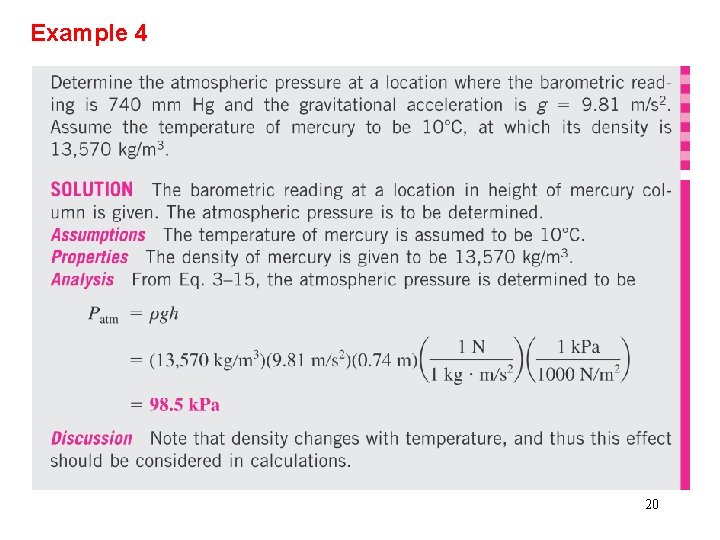
Example 4 20
INTRODUCTION TO FLUID STATICS Ø Fluid statics deals with problems associated with fluids at rest. The fluid can be either gaseous or liquid. Ø Fluid statics is generally referred to as hydrostatics when the fluid is a liquid and as aerostatics when the fluid is a gas. Ø Fluid statics is used to determine the forces acting on floating or submerged bodies and the forces developed by devices like hydraulic presses and car jacks. Ø The design of many engineering systems such as water dams and liquid storage tanks requires the determination of the forces acting on the surfaces using fluid statics. 21
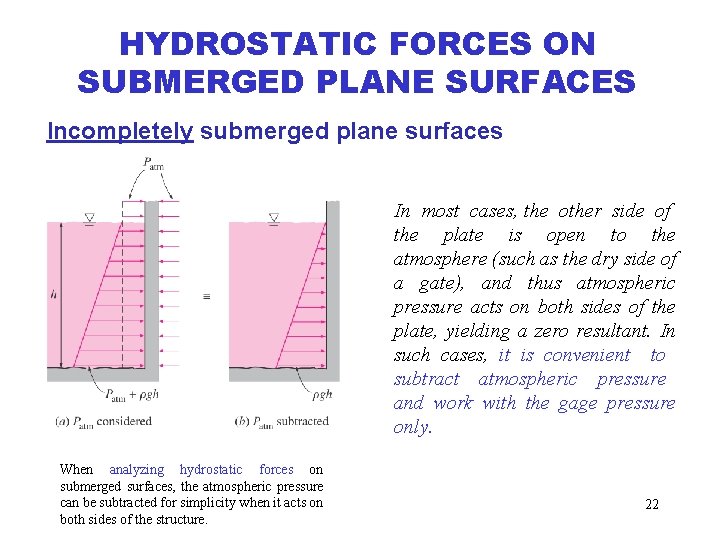
HYDROSTATIC FORCES ON SUBMERGED PLANE SURFACES Incompletely submerged plane surfaces In most cases, the other side of the plate is open to the atmosphere (such as the dry side of a gate), and thus atmospheric pressure acts on both sides of the plate, yielding a zero resultant. In such cases, it is convenient to subtract atmospheric pressure and work with the gage pressure only. When analyzing hydrostatic forces on submerged surfaces, the atmospheric pressure can be subtracted for simplicity when it acts on both sides of the structure. 22
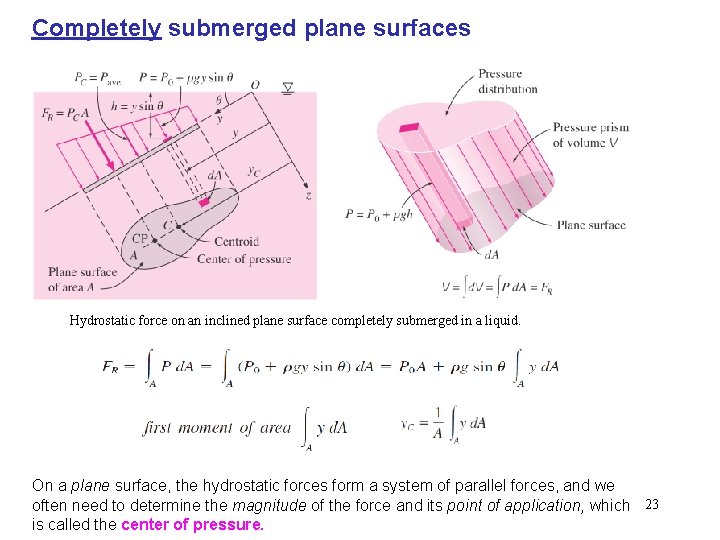
Completely submerged plane surfaces Hydrostatic force on an inclined plane surface completely submerged in a liquid. On a plane surface, the hydrostatic forces form a system of parallel forces, and we often need to determine the magnitude of the force and its point of application, which 23 is called the center of pressure.
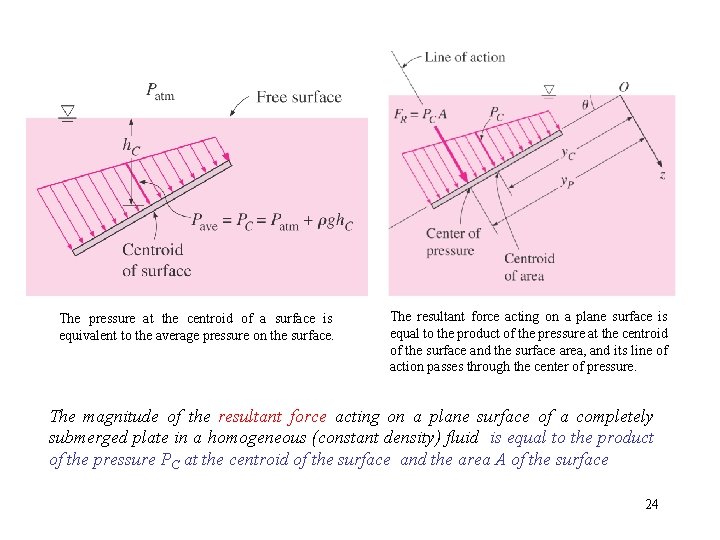
The pressure at the centroid of a surface is equivalent to the average pressure on the surface. The resultant force acting on a plane surface is equal to the product of the pressure at the centroid of the surface and the surface area, and its line of action passes through the center of pressure. The magnitude of the resultant force acting on a plane surface of a completely submerged plate in a homogeneous (constant density) fluid is equal to the product of the pressure PC at the centroid of the surface and the area A of the surface 24
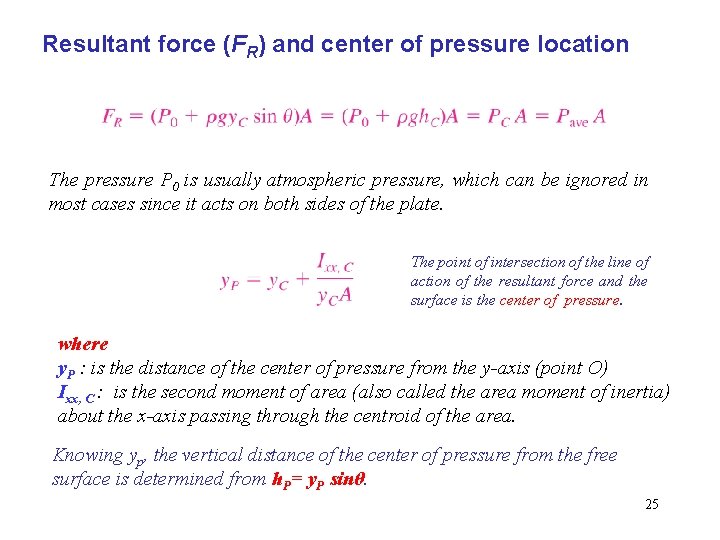
Resultant force (FR) and center of pressure location The pressure P 0 is usually atmospheric pressure, which can be ignored in most cases since it acts on both sides of the plate. The point of intersection of the line of action of the resultant force and the surface is the center of pressure. where y. P : is the distance of the center of pressure from the y-axis (point O) Ixx, C : is the second moment of area (also called the area moment of inertia) about the x-axis passing through the centroid of the area. Knowing yp, the vertical distance of the center of pressure from the free surface is determined from h. P= y. P sinθ. 25
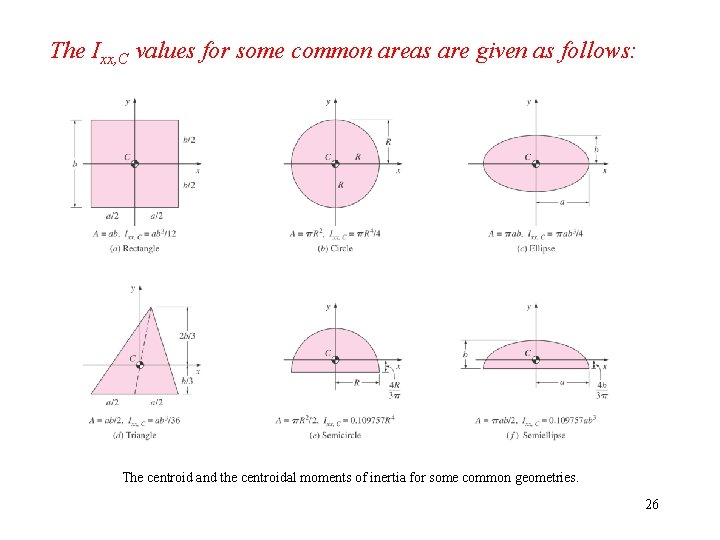
The Ixx, C values for some common areas are given as follows: The centroid and the centroidal moments of inertia for some common geometries. 26
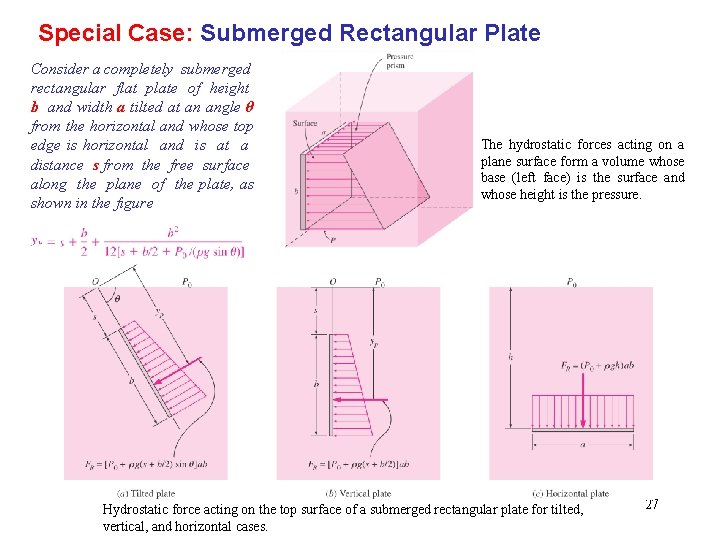
Special Case: Submerged Rectangular Plate Consider a completely submerged rectangular flat plate of height b and width a tilted at an angle θ from the horizontal and whose top edge is horizontal and is at a distance s from the free surface along the plane of the plate, as shown in the figure The hydrostatic forces acting on a plane surface form a volume whose base (left face) is the surface and whose height is the pressure. Hydrostatic force acting on the top surface of a submerged rectangular plate for tilted, vertical, and horizontal cases. 27
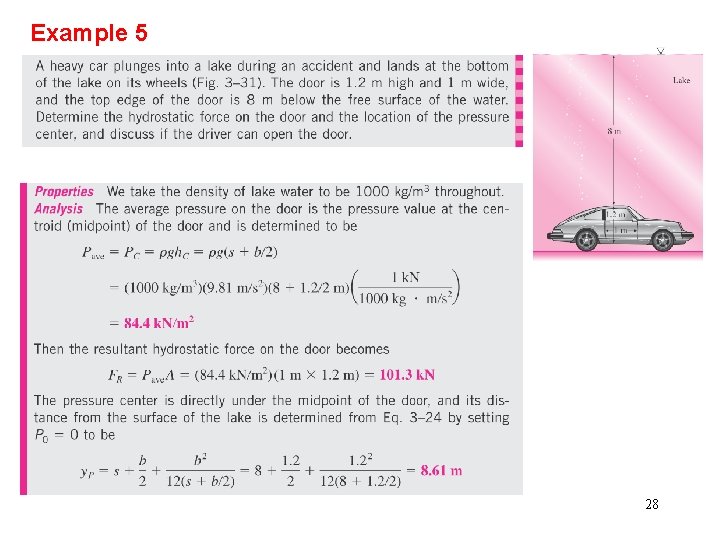
Example 5 28
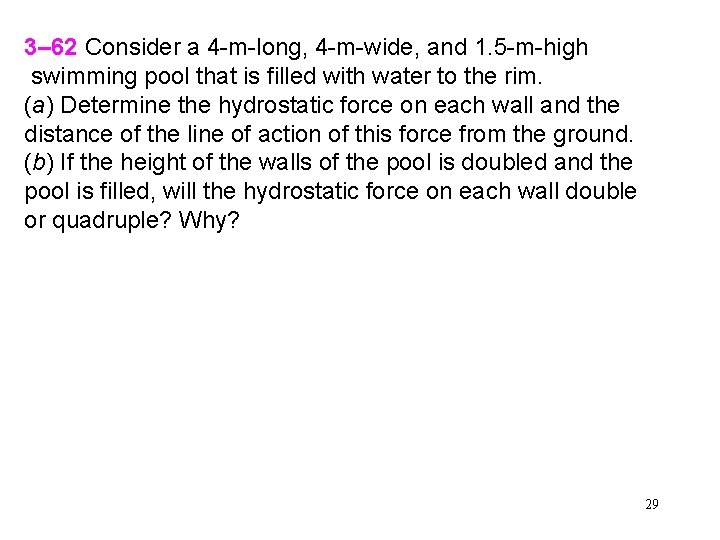
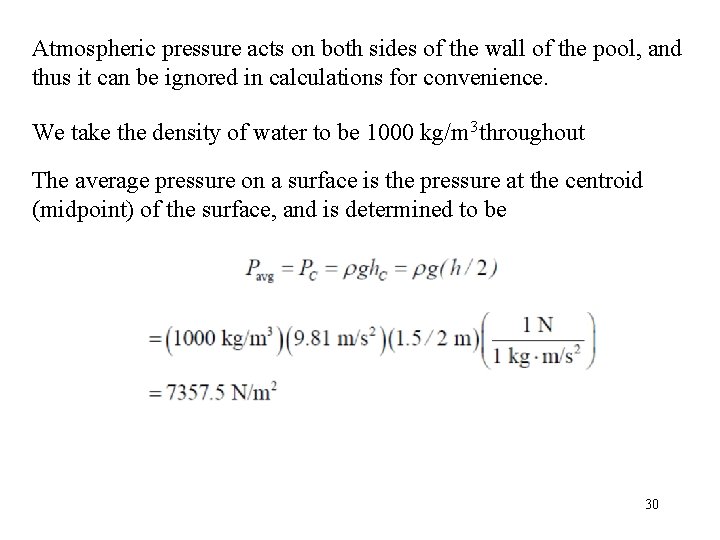
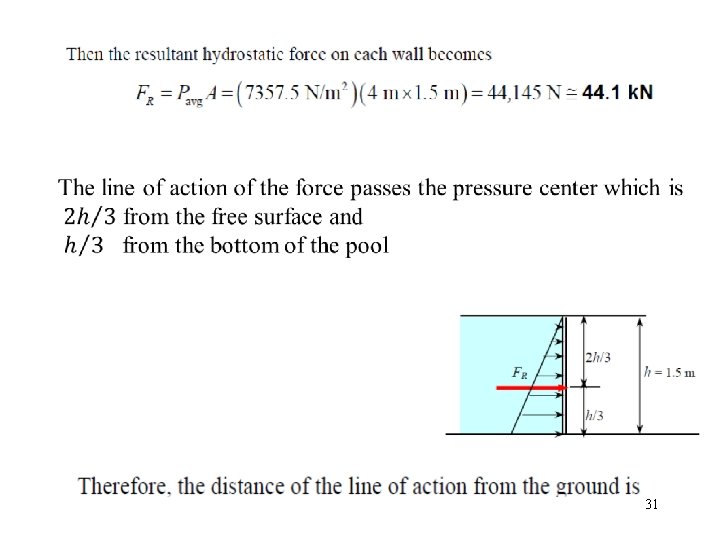
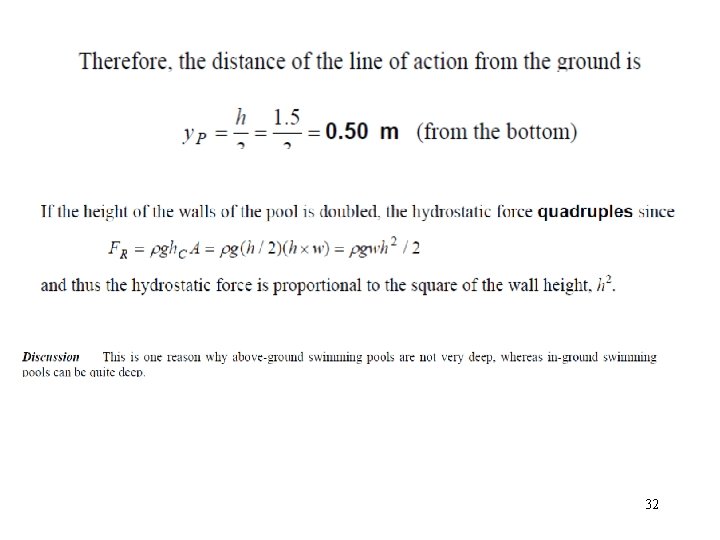
3– 62 Consider a 4 -m-long, 4 -m-wide, and 1. 5 -m-high swimming pool that is filled with water to the rim. (a) Determine the hydrostatic force on each wall and the distance of the line of action of this force from the ground. (b) If the height of the walls of the pool is doubled and the pool is filled, will the hydrostatic force on each wall double or quadruple? Why? 29
Atmospheric pressure acts on both sides of the wall of the pool, and thus it can be ignored in calculations for convenience. We take the density of water to be 1000 kg/m 3 throughout The average pressure on a surface is the pressure at the centroid (midpoint) of the surface, and is determined to be 30
31
32
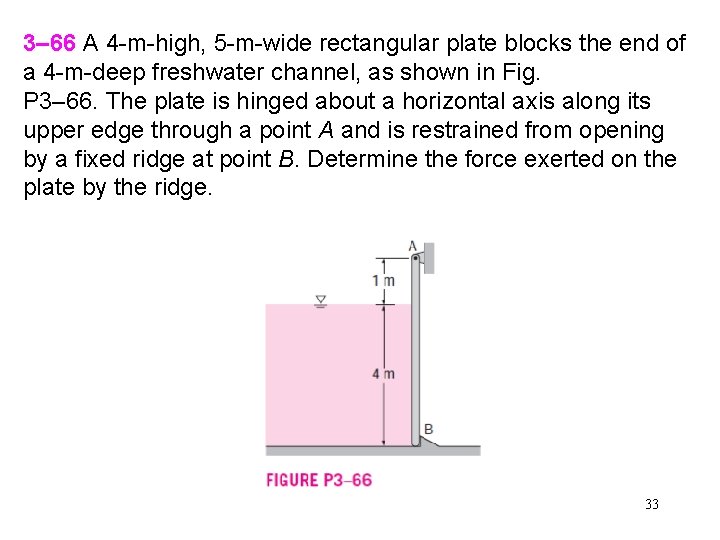
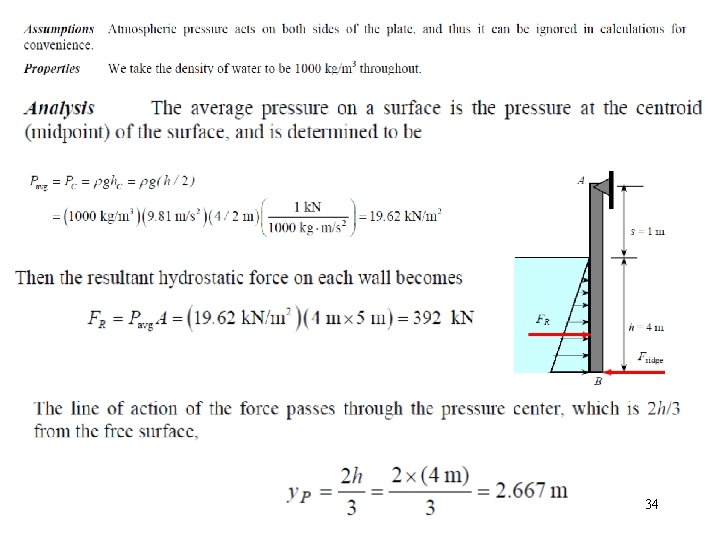
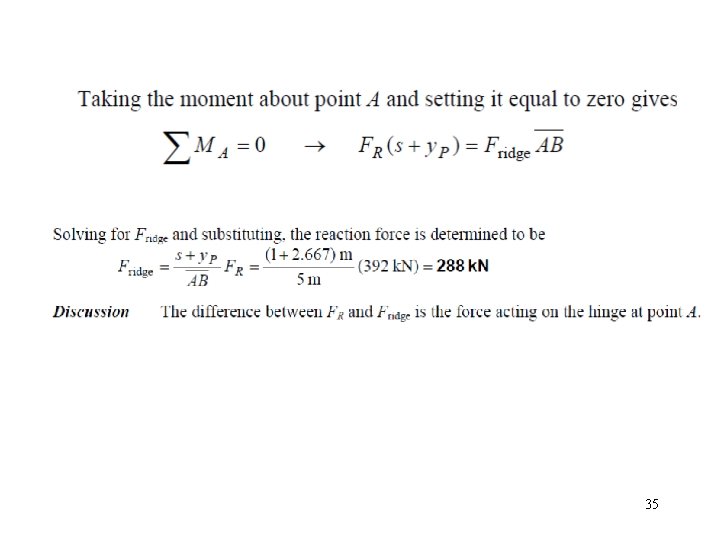
3– 66 A 4 -m-high, 5 -m-wide rectangular plate blocks the end of a 4 -m-deep freshwater channel, as shown in Fig. P 3– 66. The plate is hinged about a horizontal axis along its upper edge through a point A and is restrained from opening by a fixed ridge at point B. Determine the force exerted on the plate by the ridge. 33
34
35
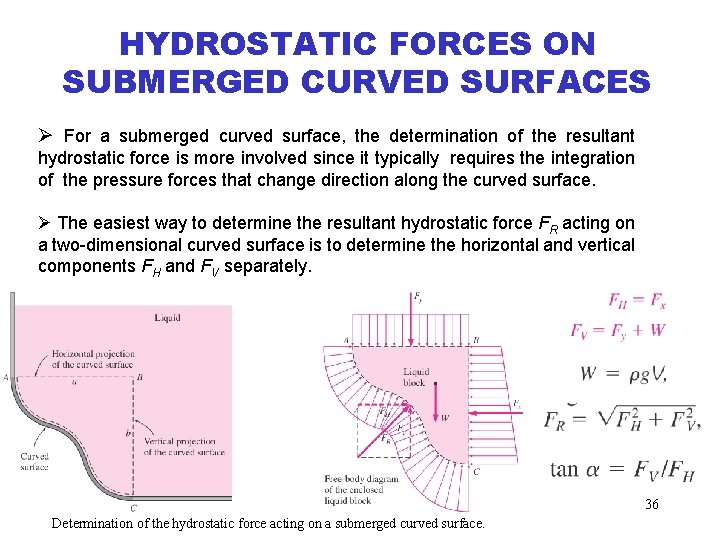
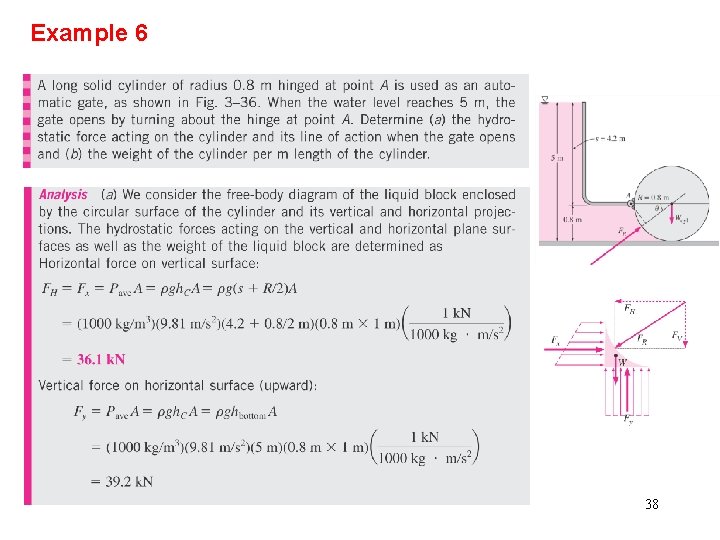
HYDROSTATIC FORCES ON SUBMERGED CURVED SURFACES Ø For a submerged curved surface, the determination of the resultant hydrostatic force is more involved since it typically requires the integration of the pressure forces that change direction along the curved surface. Ø The easiest way to determine the resultant hydrostatic force FR acting on a two-dimensional curved surface is to determine the horizontal and vertical components FH and FV separately. 36 Determination of the hydrostatic force acting on a submerged curved surface.
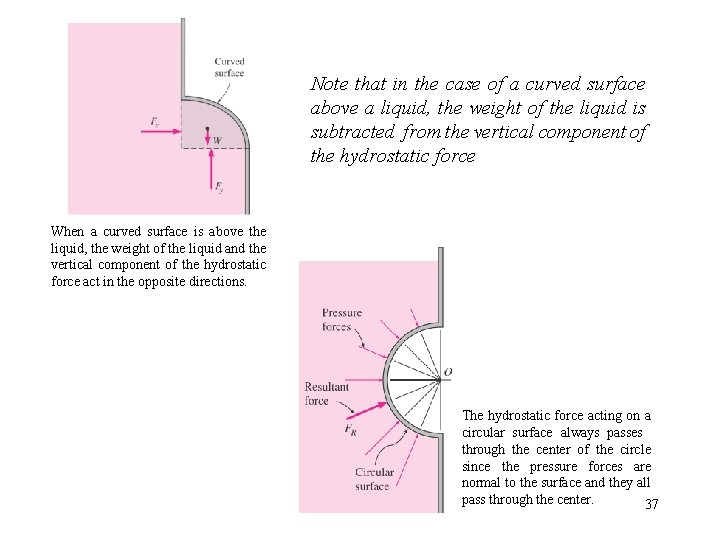
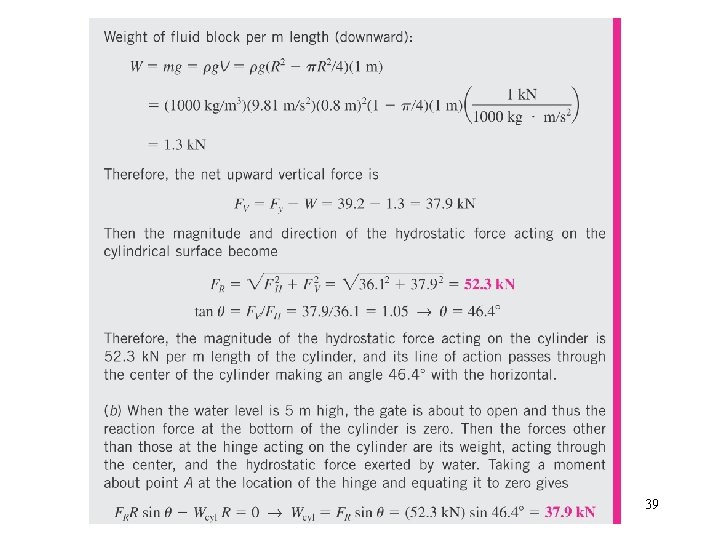
Note that in the case of a curved surface above a liquid, the weight of the liquid is subtracted from the vertical component of the hydrostatic force When a curved surface is above the liquid, the weight of the liquid and the vertical component of the hydrostatic force act in the opposite directions. The hydrostatic force acting on a circular surface always passes through the center of the circle since the pressure forces are normal to the surface and they all pass through the center. 37
Example 6 38
39
BUOYANCY AND STABILITY Ø It is a common experience that an object feels lighter and weights less in a liquid than it does in air. This can be demonstrated easily by weighing a heavy object in water by a waterproof spring scale. Ø Also, objects made of wood or other light materials float on water. Ø These and other observations suggest that a fluid exerts an upward force on a body immersed in it. This force that tends to lift the body is called the buoyant force and is denoted by FB. 40
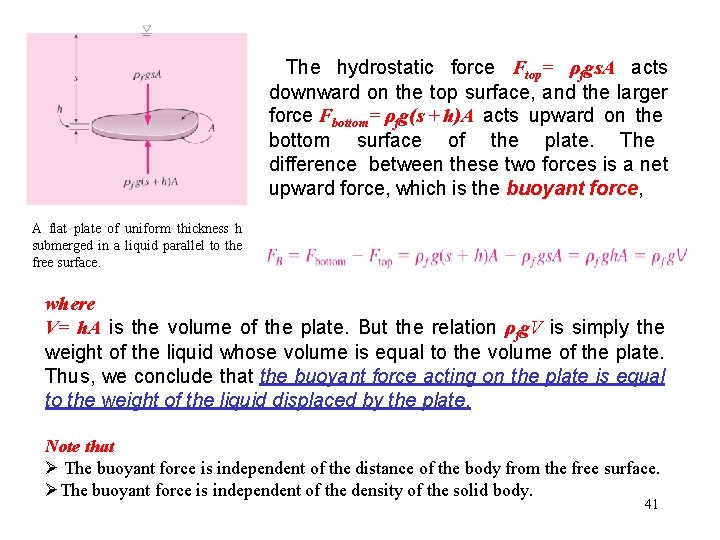
The hydrostatic force Ftop= ρfgs. A acts downward on the top surface, and the larger force Fbottom= ρfg(s + h)A acts upward on the bottom surface of the plate. The difference between these two forces is a net upward force, which is the buoyant force, A flat plate of uniform thickness h submerged in a liquid parallel to the free surface. where V= h. A is the volume of the plate. But the relation ρfg. V is simply the weight of the liquid whose volume is equal to the volume of the plate. Thus, we conclude that the buoyant force acting on the plate is equal to the weight of the liquid displaced by the plate. Note that Ø The buoyant force is independent of the distance of the body from the free surface. ØThe buoyant force is independent of the density of the solid body. 41
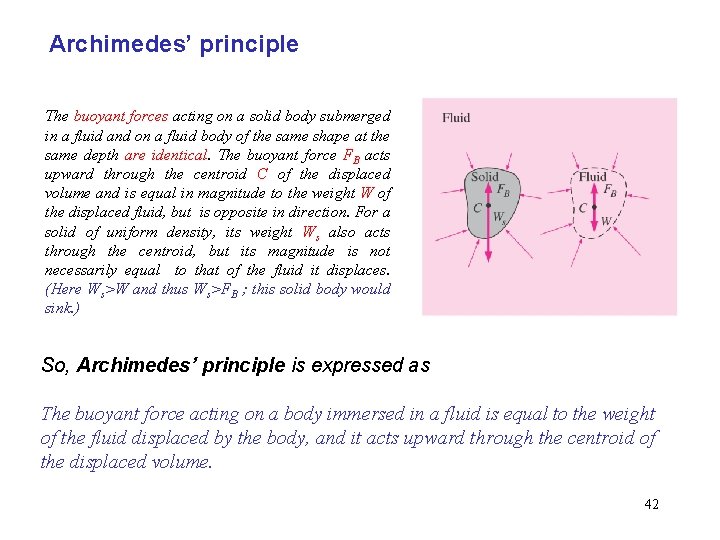
Archimedes’ principle The buoyant forces acting on a solid body submerged in a fluid and on a fluid body of the same shape at the same depth are identical. The buoyant force FB acts upward through the centroid C of the displaced volume and is equal in magnitude to the weight W of the displaced fluid, but is opposite in direction. For a solid of uniform density, its weight Ws also acts through the centroid, but its magnitude is not necessarily equal to that of the fluid it displaces. (Here Ws˃W and thus Ws˃FB ; this solid body would sink. ) So, Archimedes’ principle is expressed as The buoyant force acting on a body immersed in a fluid is equal to the weight of the fluid displaced by the body, and it acts upward through the centroid of the displaced volume. 42
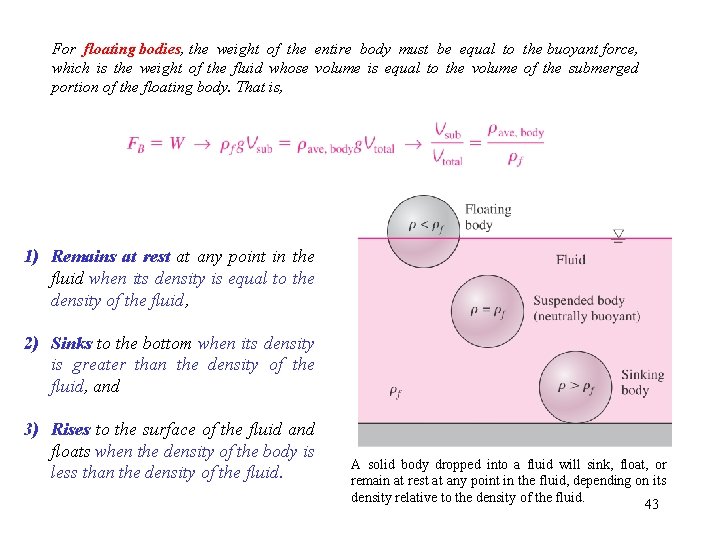
For floating bodies, the weight of the entire body must be equal to the buoyant force, which is the weight of the fluid whose volume is equal to the volume of the submerged portion of the floating body. That is, 1) Remains at rest at any point in the fluid when its density is equal to the density of the fluid, 2) Sinks to the bottom when its density is greater than the density of the fluid, and 3) Rises to the surface of the fluid and floats when the density of the body is less than the density of the fluid. A solid body dropped into a fluid will sink, float, or remain at rest at any point in the fluid, depending on its density relative to the density of the fluid. 43
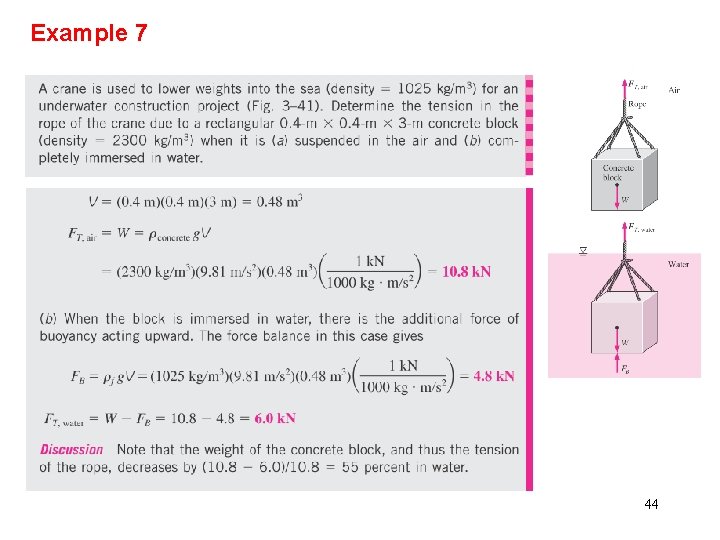
Example 7 44
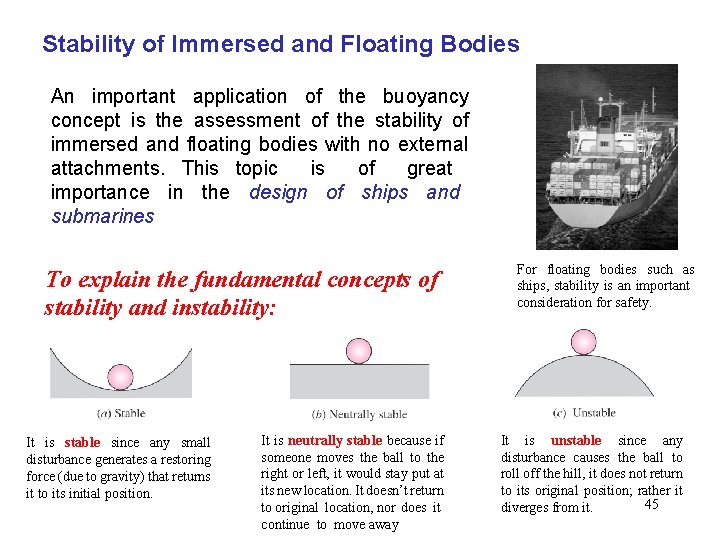
Stability of Immersed and Floating Bodies An important application of the buoyancy concept is the assessment of the stability of immersed and floating bodies with no external attachments. This topic is of great importance in the design of ships and submarines To explain the fundamental concepts of stability and instability: It is stable since any small disturbance generates a restoring force (due to gravity) that returns it to its initial position. It is neutrally stable because if someone moves the ball to the right or left, it would stay put at its new location. It doesn’t return to original location, nor does it continue to move away For floating bodies such as ships, stability is an important consideration for safety. It is unstable since any disturbance causes the ball to roll off the hill, it does not return to its original position; rather it 45 diverges from it.
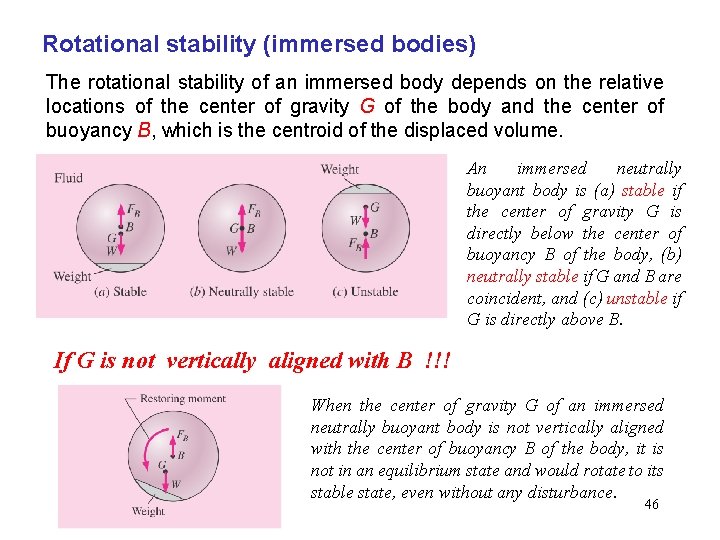
Rotational stability (immersed bodies) The rotational stability of an immersed body depends on the relative locations of the center of gravity G of the body and the center of buoyancy B, which is the centroid of the displaced volume. An immersed neutrally buoyant body is (a) stable if the center of gravity G is directly below the center of buoyancy B of the body, (b) neutrally stable if G and B are coincident, and (c) unstable if G is directly above B. If G is not vertically aligned with B !!! When the center of gravity G of an immersed neutrally buoyant body is not vertically aligned with the center of buoyancy B of the body, it is not in an equilibrium state and would rotate to its stable state, even without any disturbance. 46
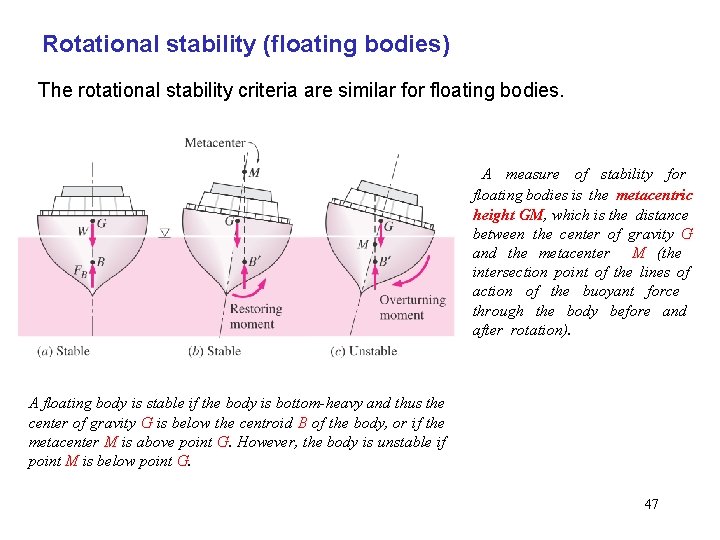
Rotational stability (floating bodies) The rotational stability criteria are similar for floating bodies. A measure of stability for floating bodies is the metacentric height GM, which is the distance between the center of gravity G and the metacenter M (the intersection point of the lines of action of the buoyant force through the body before and after rotation). A floating body is stable if the body is bottom-heavy and thus the center of gravity G is below the centroid B of the body, or if the metacenter M is above point G. However, the body is unstable if point M is below point G. 47