
Faculty Early Career Development Program CAREER Joanne Tornow
- Slides: 15
Faculty Early Career Development Program (CAREER) Joanne Tornow BIO/MCB Chair, CAREER Coordinating Committee
CAREER Program Goals n n n Provide stable funds to support the early career-development activities of outstanding teacher-scholars in the context of the mission of their organization Build a firm foundation to sustain integrated research and educational activities beyond the life of the initial award Increase participation of those traditionally underrepresented in science and engineering
CAREER: NSF’s Most Prestigious Award for Junior Faculty n Size and duration of CAREER awards are commensurate with the award’s prestige n n n Five year duration $400, 000 minimum ($500, 000 in BIO) Source of NSF’s PECASE awardees (Presidential Early Career Award for Scientists and Engineers)
PECASE n n n Presidential award recognizing 60 outstanding junior scientists and engineers annually who have exceptional potential for leadership at the frontiers of knowledge Participating agencies: NSF, NIH, NIST, USDA, DOE, DOD, NASA, NOAA, and VA NSF’s awardees are chosen from among the newest group of CAREER awardees
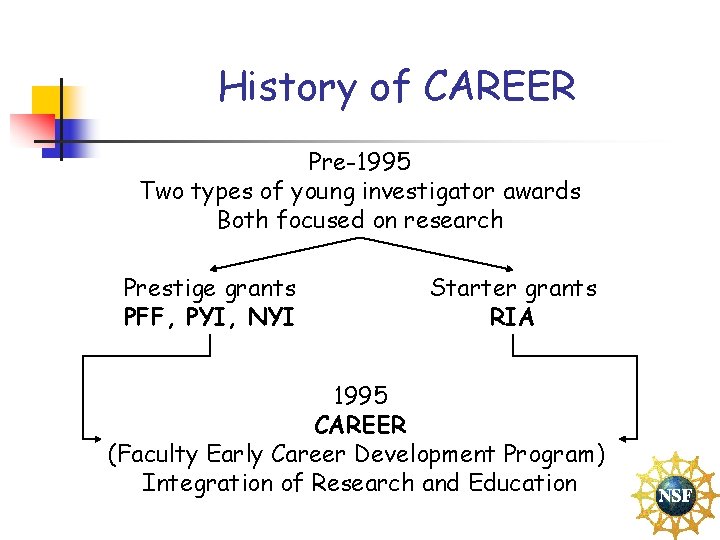
History of CAREER Pre-1995 Two types of young investigator awards Both focused on research Prestige grants PFF, PYI, NYI Starter grants RIA 1995 CAREER (Faculty Early Career Development Program) Integration of Research and Education
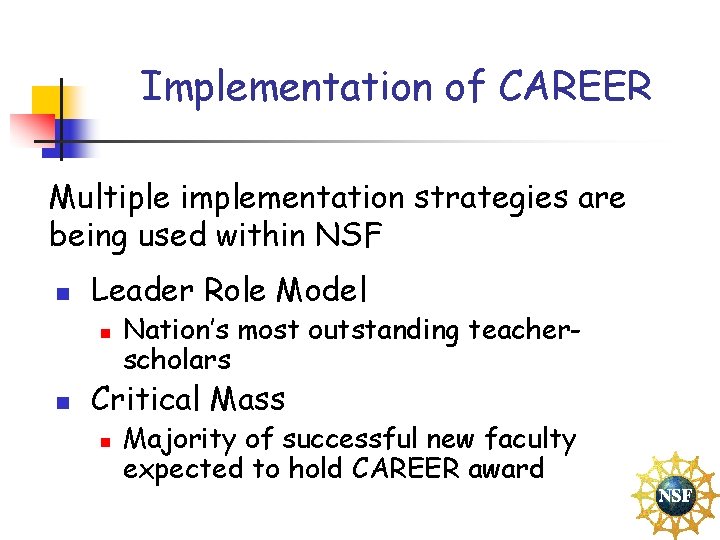
Implementation of CAREER Multiple implementation strategies are being used within NSF n Leader Role Model n n Nation’s most outstanding teacherscholars Critical Mass n Majority of successful new faculty expected to hold CAREER award
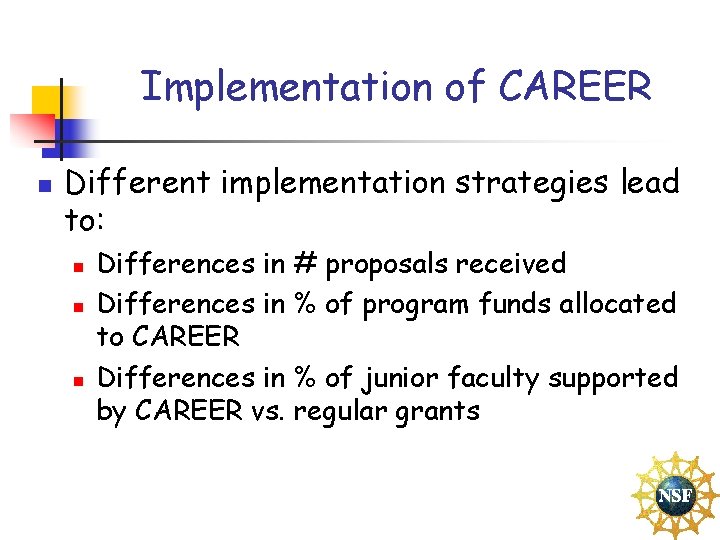
Implementation of CAREER n Different implementation strategies lead to: n n n Differences in # proposals received Differences in % of program funds allocated to CAREER Differences in % of junior faculty supported by CAREER vs. regular grants
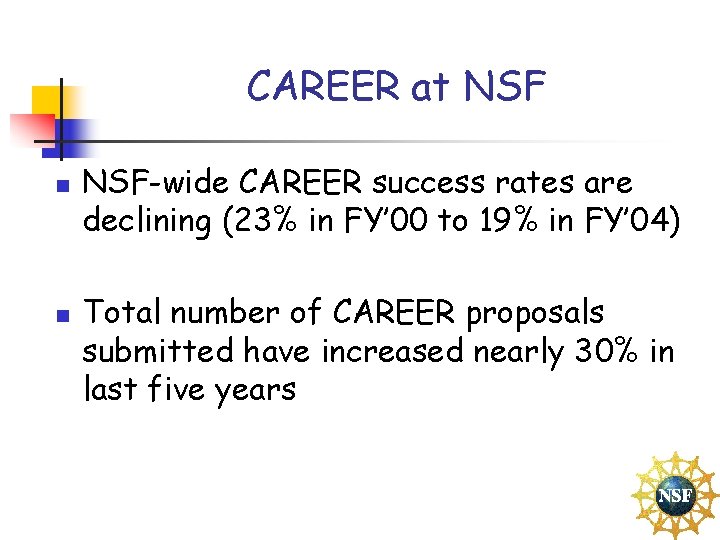
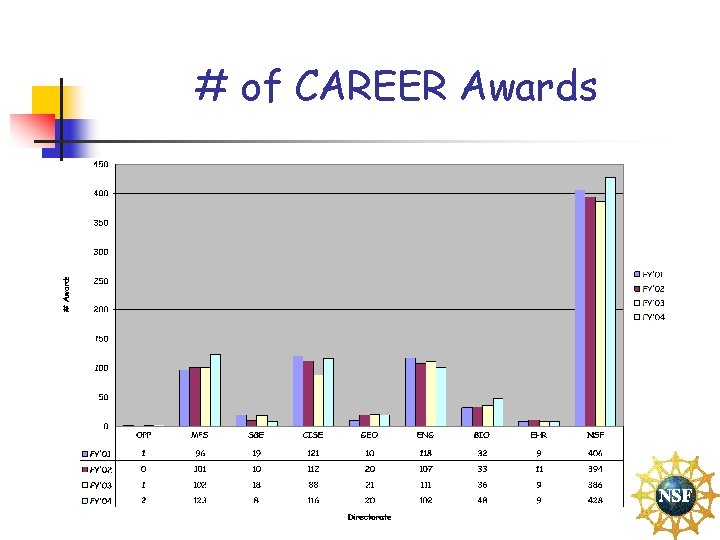
CAREER at NSF n n NSF-wide CAREER success rates are declining (23% in FY’ 00 to 19% in FY’ 04) Total number of CAREER proposals submitted have increased nearly 30% in last five years
# of CAREER Awards
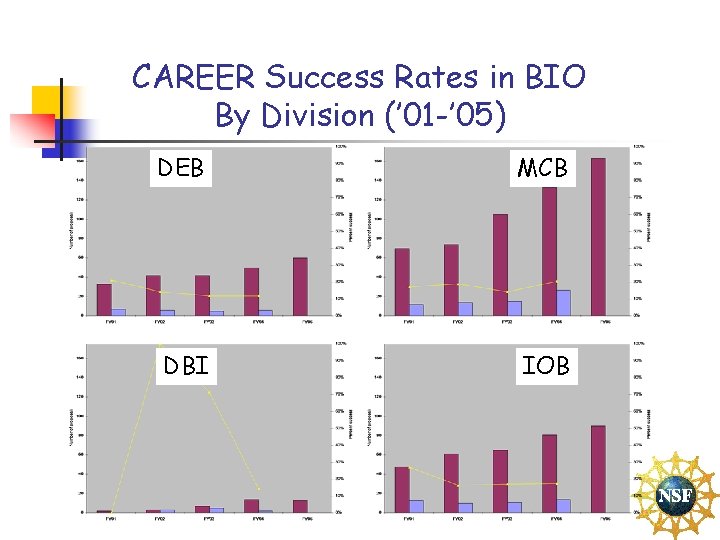
CAREER Success Rates in BIO By Division (’ 01 -’ 05) DEB MCB DBI IOB
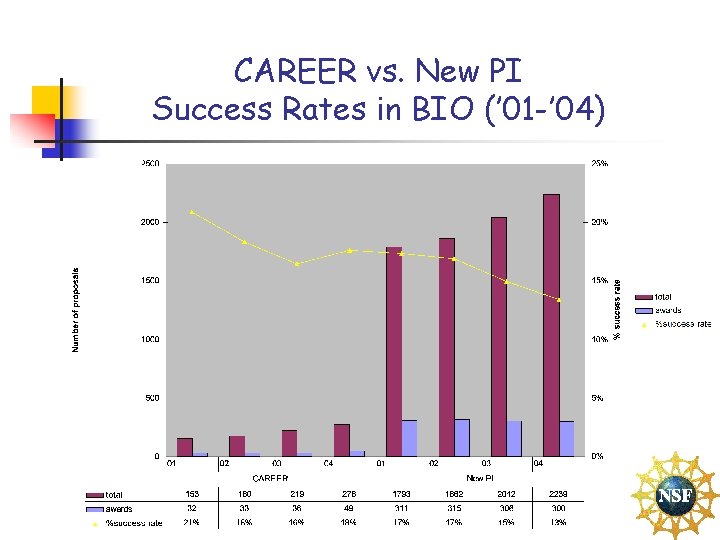
CAREER vs. New PI Success Rates in BIO (’ 01 -’ 04)
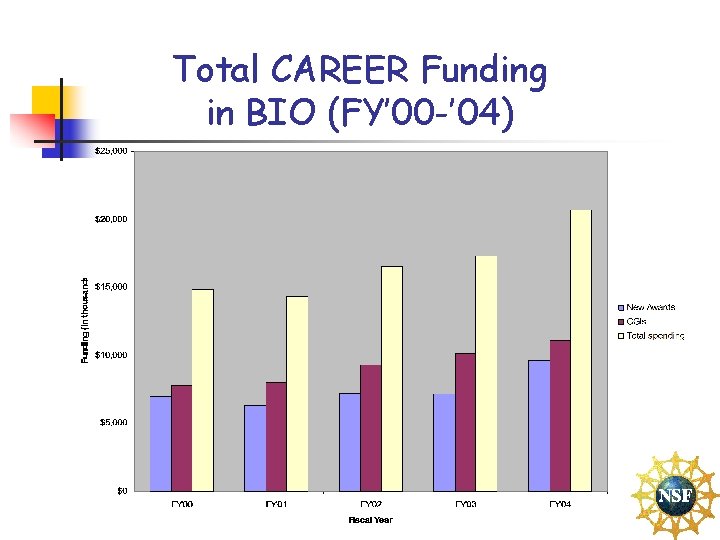
Total CAREER Funding in BIO (FY’ 00 -’ 04)
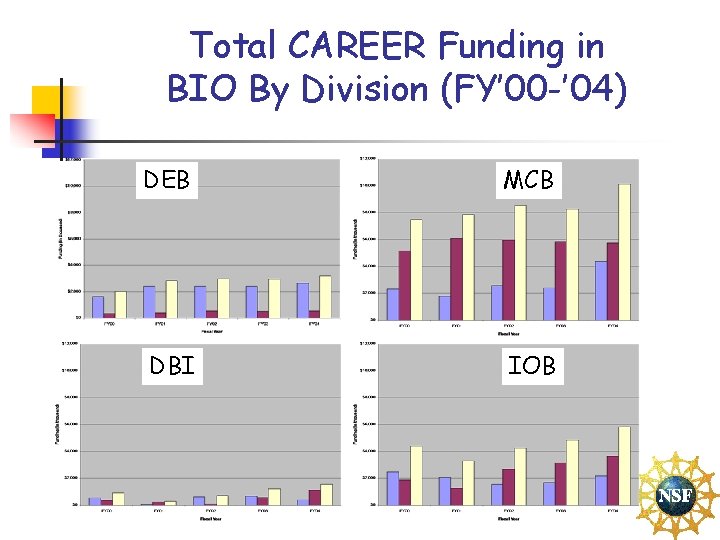
Total CAREER Funding in BIO By Division (FY’ 00 -’ 04) DEB MCB DBI IOB
CAREER Demographics (NSF-wide) n n Participation by female PIs increasing slightly (21% in FY’ 00 to 25% in FY’ 05) Participation by minority PIs increasing (7. 3% in FY’ 00 to 10% in FY’ 05) ~ 16% of proposals were submitted by institutions in EPSCo. R states ~ 4% of proposals were submitted by minority-serving institutions
In Conclusion n n The CAREER program is a major activity at NSF (over 3700 CAREER awards made to date, 160 PECASE awards), and is continuing to grow Future Activities: n n n COV review of CAREER External evaluation of the impact of CAREER PECASE awardee colloquium