
Faculty Development EDUCATIONAL SUPERVISORS TOOL KIT ONE www


- Slides: 48
Faculty Development EDUCATIONAL SUPERVISORS TOOL KIT ONE www. londondeanery. ac. uk
INTRODUCTIONS • Your name • Your role • Who you educationally supervise • What you want to get out of the session?
EDUCATIONAL SUPERVISION • Definition of ES? - roles - knowledge and skills required • What trainees want in ES? • Difficulties with ES role?
CS vs. ES CS – day to day line management of trainee in context of providing safe clinical care (here & now) ES – broader role involving discussion of all aspects of training and professional development (retrospective and prospective)
EDUCATIONAL SUPERVISION “ process (largely involving regular appraisal interviews) whereby a more senior doctor helps a trainee to maximise the benefit that the trainee gets from a training position in order to fulfil his/her long term career aims ” BW Lloyd & D Becker 2007
EDUCATIONAL SUPERVISION Educational supervisors are responsible for overseeing training to ensure that trainees are making the necessary clinical and educational progress. Where possible, it is desirable for trainees to have the same educational supervisor for the whole of their training programme or for stages of training (e. g. the early years or more advanced years of training) Paragraph 4. 22 from: A Guide to Postgraduate Specialty Training in the UK (the “Gold Guide”).
CLINICAL SUPERVISOR A trainer who is selected and appropriately trained to be responsible for overseeing a specified trainee's clinical work and for providing constructive feedback during a training placement. Taken from, ‘Operational Guide for the PMETB Quality Framework’ (Version 4. 2), February 2009. http: //www. pmetb. org. uk
EDUCATIONAL SUPERVISION Roles: • Feedback on performance • Career Advice • Objective Setting • Pastoral Support • Non clinical advice
EDUCATIONAL SUPERVISION Knowledge & Skills: • Knowledge of syllabus & training programme • Listening skills • Encouragement • Regular protected time to meet
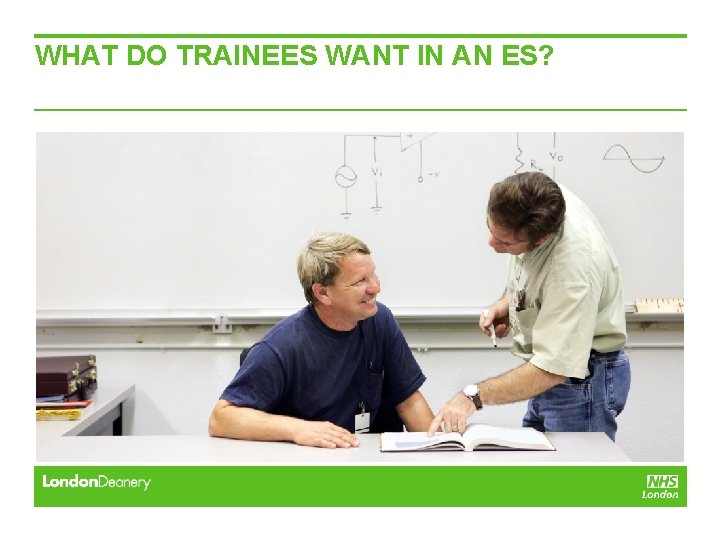
WHAT DO TRAINEES WANT IN AN ES?
DIFFICULTIES WITH ES ROLE?
ES SUGGESTED JOB DESCRIPTION http: //www. faculty. londondeanery. ac. uk/professional-development-framework-forsupervisors/prof_dev_frame_jan 10. pdf
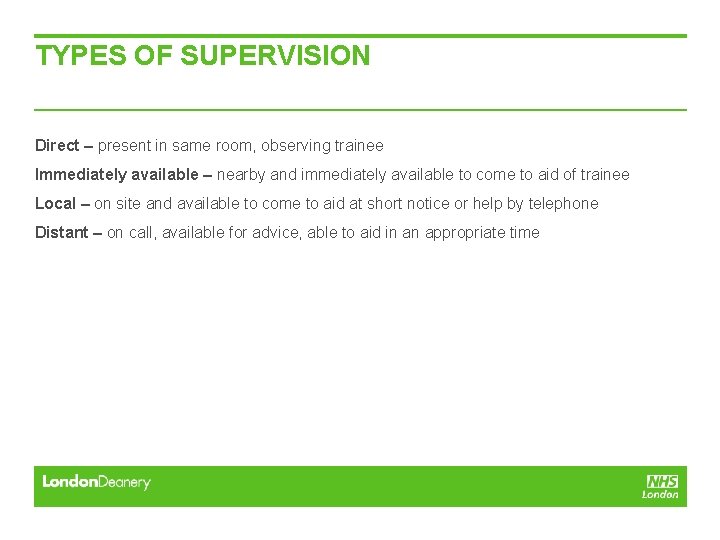
TYPES OF SUPERVISION Direct – present in same room, observing trainee Immediately available – nearby and immediately available to come to aid of trainee Local – on site and available to come to aid at short notice or help by telephone Distant – on call, available for advice, able to aid in an appropriate time
CONFLICT? Supervision should ensure patient/client safety and promote professional development. Kilminster et al 2007
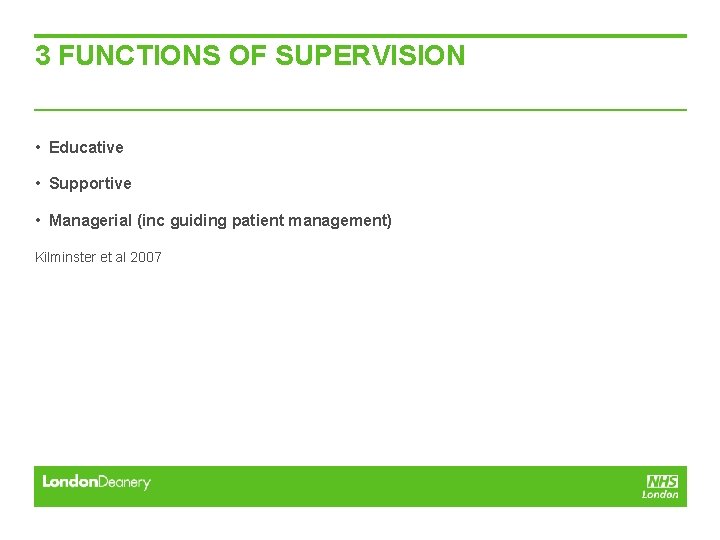
3 FUNCTIONS OF SUPERVISION • Educative • Supportive • Managerial (inc guiding patient management) Kilminster et al 2007
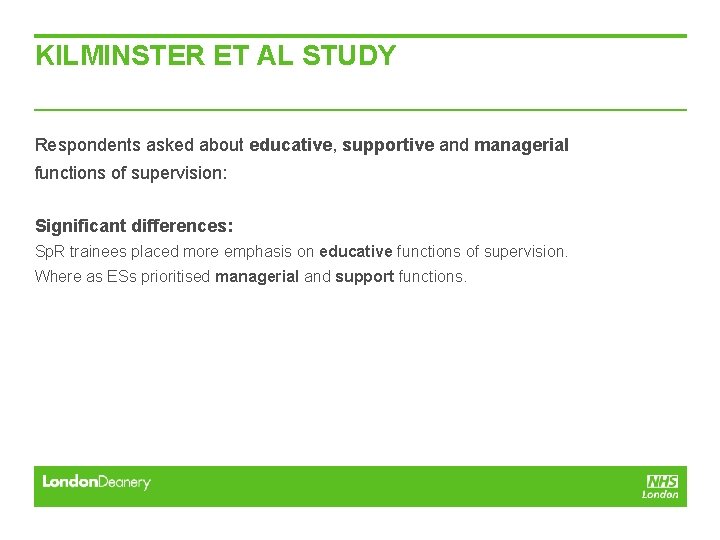
KILMINSTER ET AL STUDY Respondents asked about educative, supportive and managerial functions of supervision: Significant differences: Sp. R trainees placed more emphasis on educative functions of supervision. Where as ESs prioritised managerial and support functions.
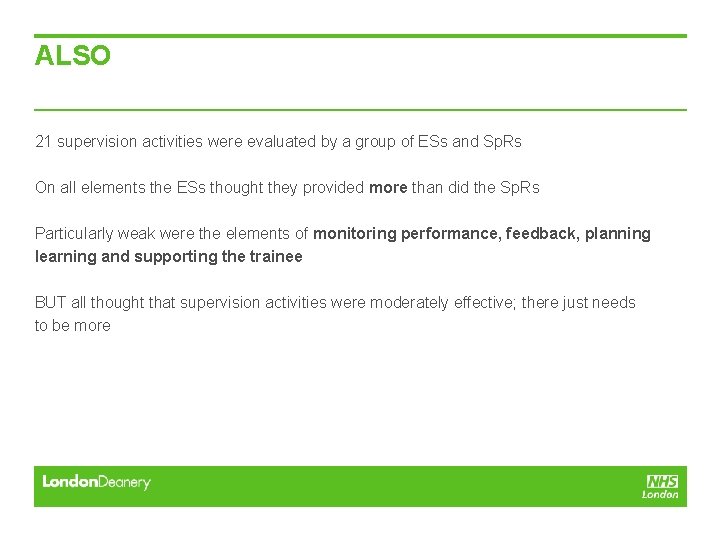
ALSO 21 supervision activities were evaluated by a group of ESs and Sp. Rs On all elements the ESs thought they provided more than did the Sp. Rs Particularly weak were the elements of monitoring performance, feedback, planning learning and supporting the trainee BUT all thought that supervision activities were moderately effective; there just needs to be more
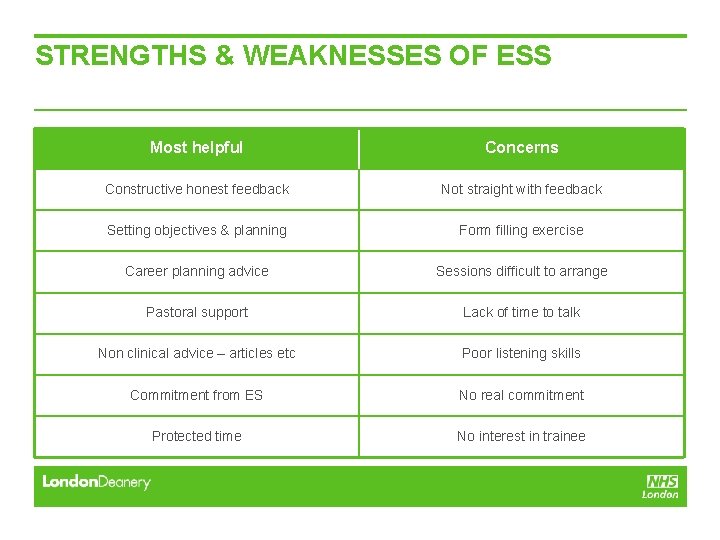
STRENGTHS & WEAKNESSES OF ESS Most helpful Concerns Constructive honest feedback Not straight with feedback Setting objectives & planning Form filling exercise Career planning advice Sessions difficult to arrange Pastoral support Lack of time to talk Non clinical advice – articles etc Poor listening skills Commitment from ES No real commitment Protected time No interest in trainee
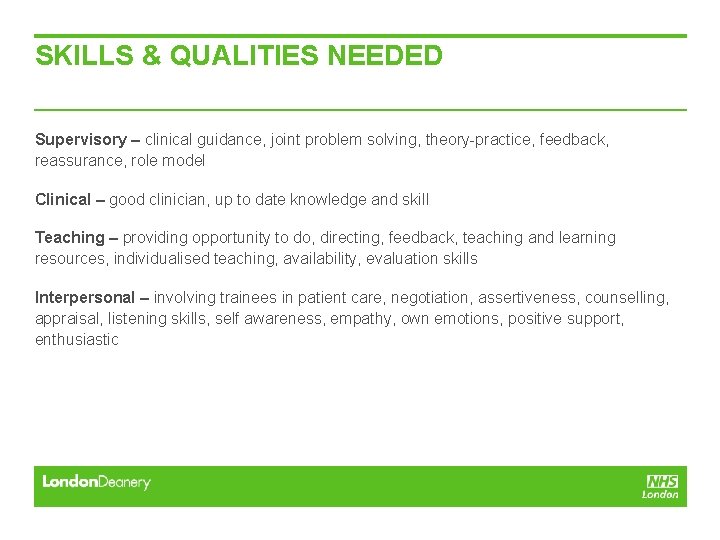
SKILLS & QUALITIES NEEDED Supervisory – clinical guidance, joint problem solving, theory-practice, feedback, reassurance, role model Clinical – good clinician, up to date knowledge and skill Teaching – providing opportunity to do, directing, feedback, teaching and learning resources, individualised teaching, availability, evaluation skills Interpersonal – involving trainees in patient care, negotiation, assertiveness, counselling, appraisal, listening skills, self awareness, empathy, own emotions, positive support, enthusiastic
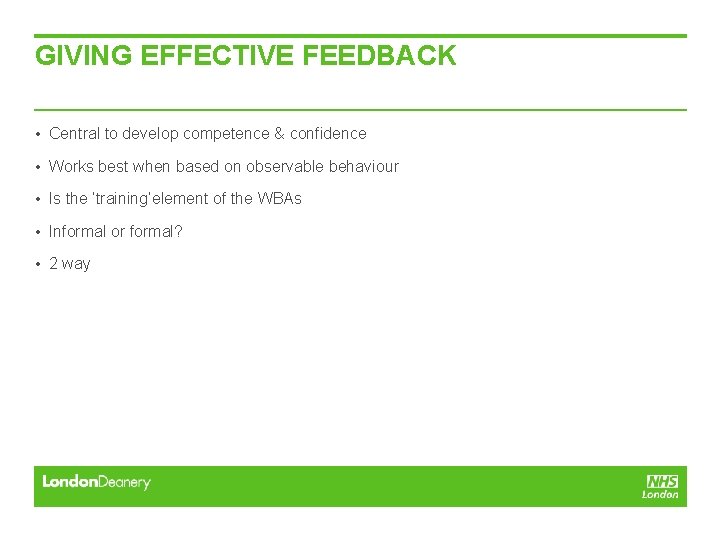
GIVING EFFECTIVE FEEDBACK • Central to develop competence & confidence • Works best when based on observable behaviour • Is the ‘training’element of the WBAs • Informal or formal? • 2 way
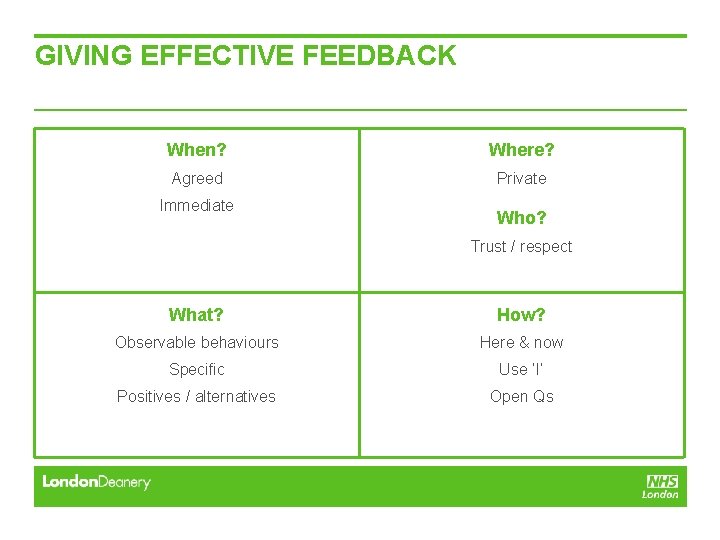
GIVING EFFECTIVE FEEDBACK When? Where? Agreed Private Immediate Who? Trust / respect What? How? Observable behaviours Here & now Specific Use ‘I’ Positives / alternatives Open Qs
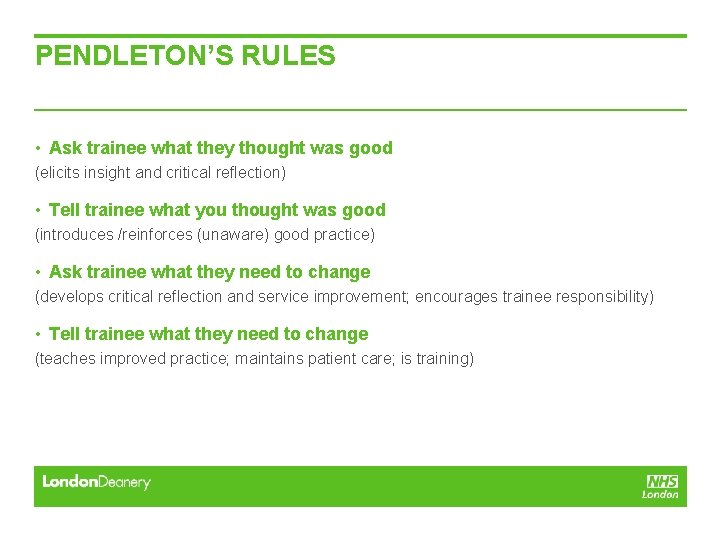
PENDLETON’S RULES • Ask trainee what they thought was good (elicits insight and critical reflection) • Tell trainee what you thought was good (introduces /reinforces (unaware) good practice) • Ask trainee what they need to change (develops critical reflection and service improvement; encourages trainee responsibility) • Tell trainee what they need to change (teaches improved practice; maintains patient care; is training)
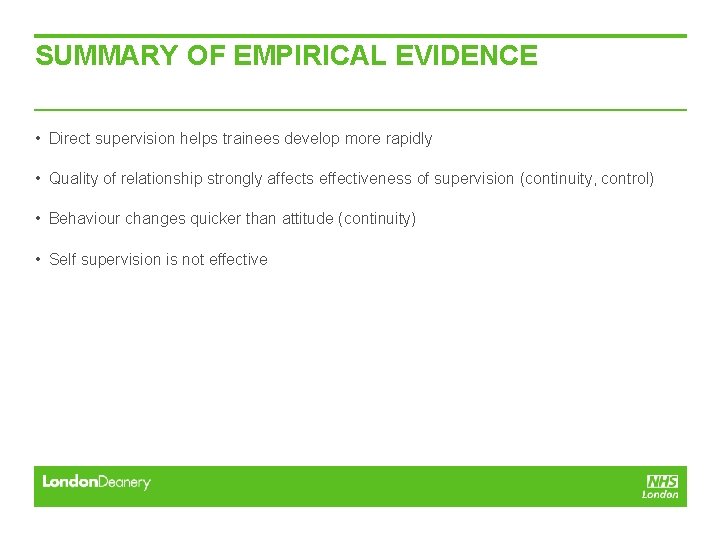
SUMMARY OF EMPIRICAL EVIDENCE • Direct supervision helps trainees develop more rapidly • Quality of relationship strongly affects effectiveness of supervision (continuity, control) • Behaviour changes quicker than attitude (continuity) • Self supervision is not effective
STRUCTURING AN EDUCATIONAL SUPERVISION SESSION Initial practicalities: • Frequency? • Time allocation? • Number of trainees to supervise? • Pre meeting preparation?
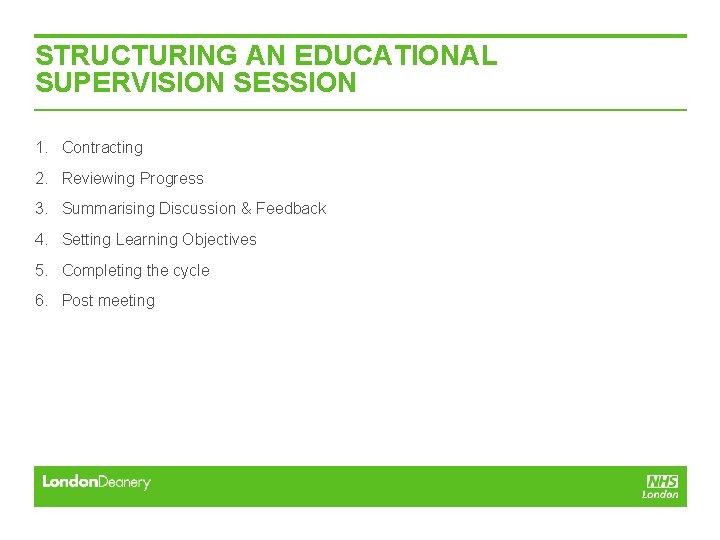
STRUCTURING AN EDUCATIONAL SUPERVISION SESSION 1. Contracting 2. Reviewing Progress 3. Summarising Discussion & Feedback 4. Setting Learning Objectives 5. Completing the cycle 6. Post meeting
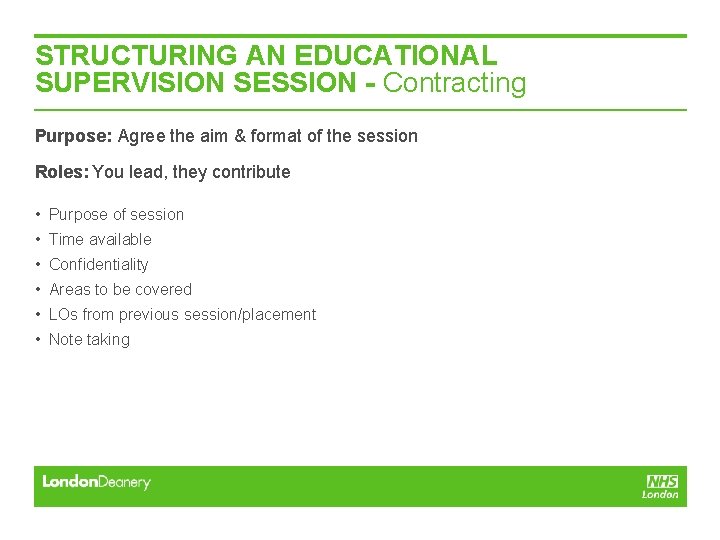
STRUCTURING AN EDUCATIONAL SUPERVISION SESSION - Contracting Purpose: Agree the aim & format of the session Roles: You lead, they contribute • Purpose of session • Time available • Confidentiality • Areas to be covered • LOs from previous session/placement • Note taking
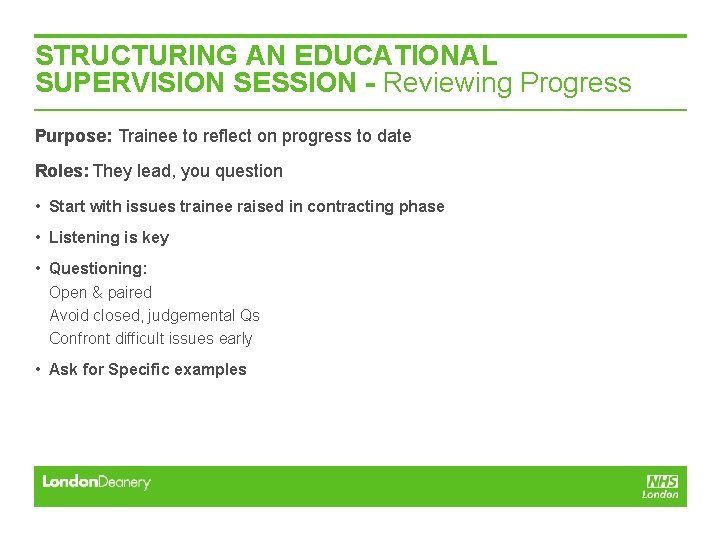
STRUCTURING AN EDUCATIONAL SUPERVISION SESSION - Reviewing Progress Purpose: Trainee to reflect on progress to date Roles: They lead, you question • Start with issues trainee raised in contracting phase • Listening is key • Questioning: Open & paired Avoid closed, judgemental Qs Confront difficult issues early • Ask for Specific examples
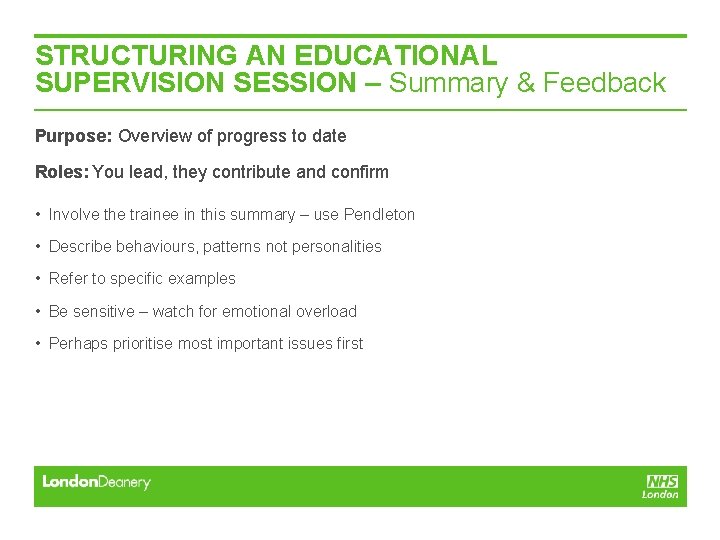
STRUCTURING AN EDUCATIONAL SUPERVISION SESSION – Summary & Feedback Purpose: Overview of progress to date Roles: You lead, they contribute and confirm • Involve the trainee in this summary – use Pendleton • Describe behaviours, patterns not personalities • Refer to specific examples • Be sensitive – watch for emotional overload • Perhaps prioritise most important issues first
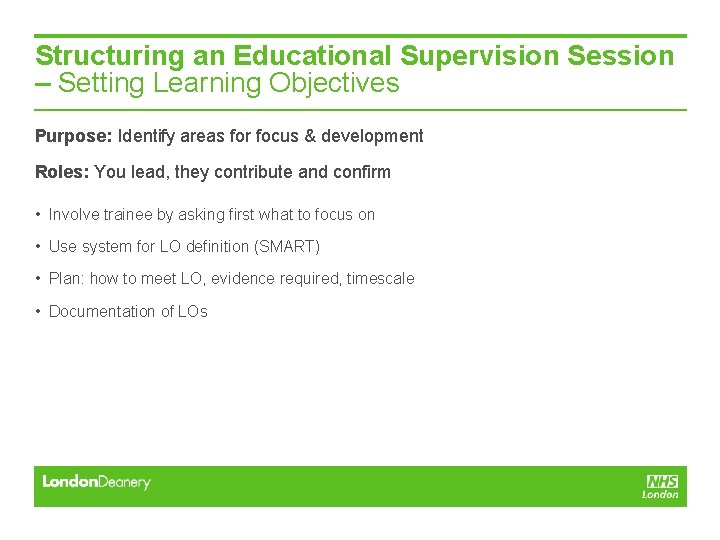
Structuring an Educational Supervision Session – Setting Learning Objectives Purpose: Identify areas for focus & development Roles: You lead, they contribute and confirm • Involve trainee by asking first what to focus on • Use system for LO definition (SMART) • Plan: how to meet LO, evidence required, timescale • Documentation of LOs
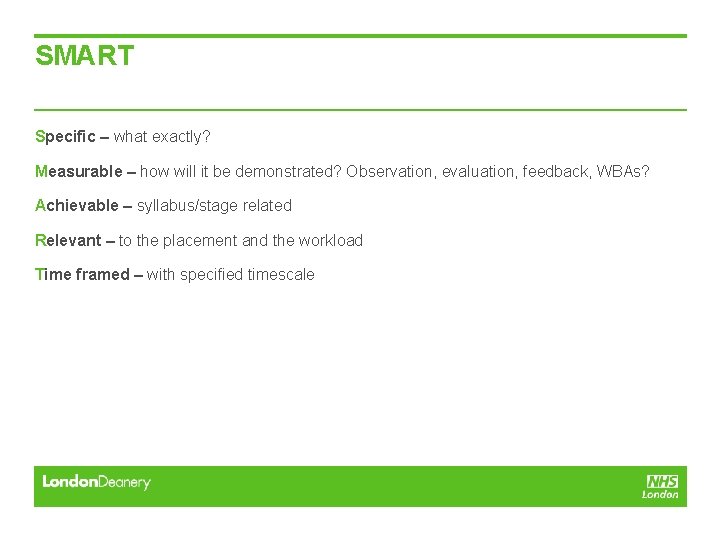
SMART Specific – what exactly? Measurable – how will it be demonstrated? Observation, evaluation, feedback, WBAs? Achievable – syllabus/stage related Relevant – to the placement and the workload Time framed – with specified timescale
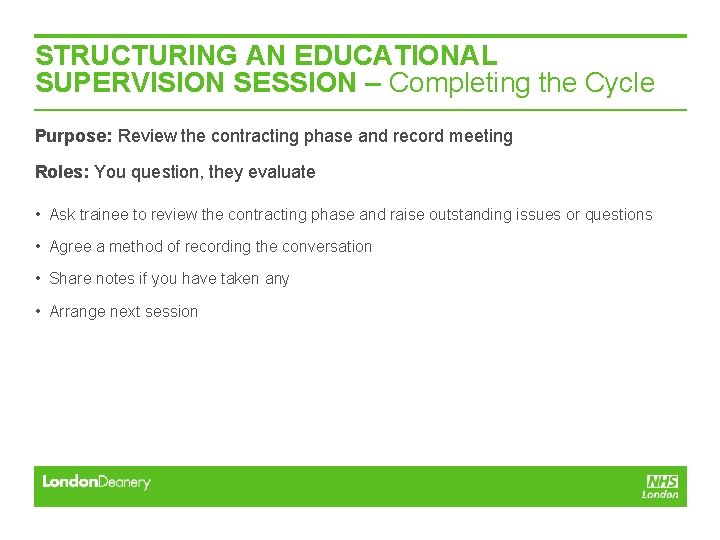
STRUCTURING AN EDUCATIONAL SUPERVISION SESSION – Completing the Cycle Purpose: Review the contracting phase and record meeting Roles: You question, they evaluate • Ask trainee to review the contracting phase and raise outstanding issues or questions • Agree a method of recording the conversation • Share notes if you have taken any • Arrange next session
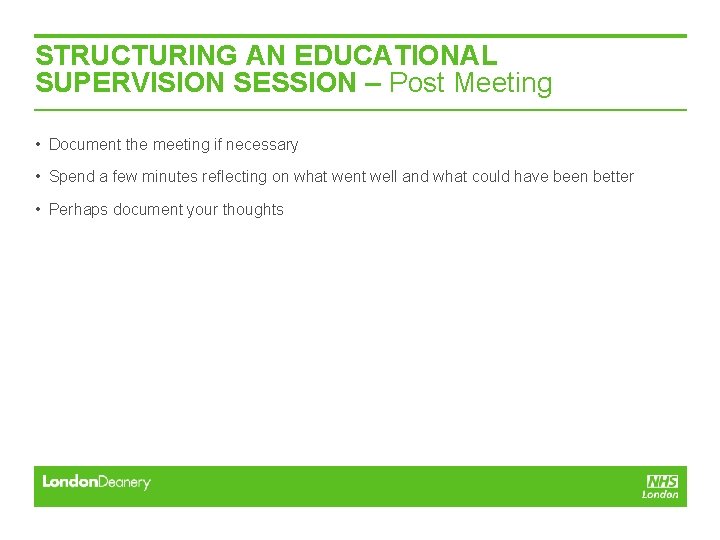
STRUCTURING AN EDUCATIONAL SUPERVISION SESSION – Post Meeting • Document the meeting if necessary • Spend a few minutes reflecting on what went well and what could have been better • Perhaps document your thoughts
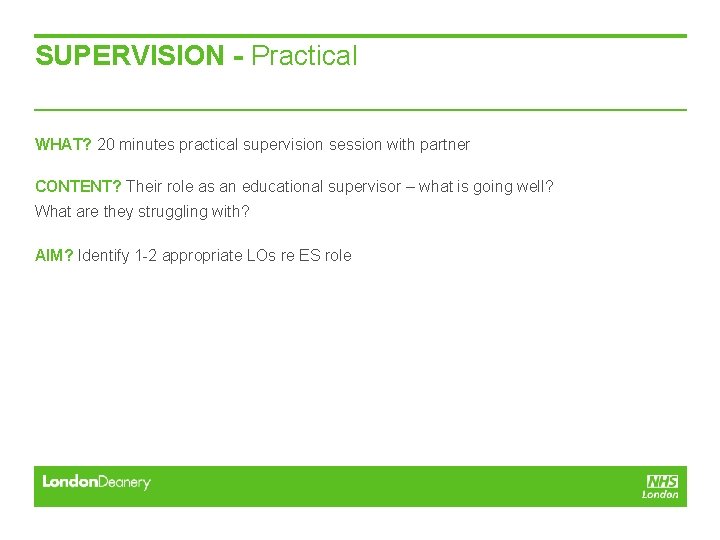
SUPERVISION - Practical WHAT? 20 minutes practical supervision session with partner CONTENT? Their role as an educational supervisor – what is going well? What are they struggling with? AIM? Identify 1 -2 appropriate LOs re ES role
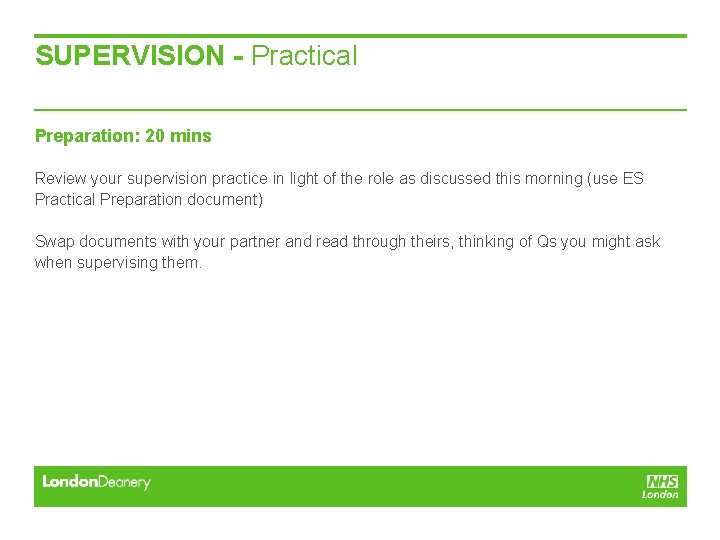
SUPERVISION - Practical Preparation: 20 mins Review your supervision practice in light of the role as discussed this morning (use ES Practical Preparation document) Swap documents with your partner and read through theirs, thinking of Qs you might ask when supervising them.
SUPERVISION - Practical 1: 20 mins Discuss with your partner their role as ES, using: 1. Structure given in previous session (contracting etc) 2. Information they give in Practical Preparation document.
SUPERVISION - Practical Feedback: 10 mins Person who has been supervised should give feedback to the supervisor: • What did they find useful? • What did they take away from the session? • What was less useful? • How did the supervisor conduct the session?
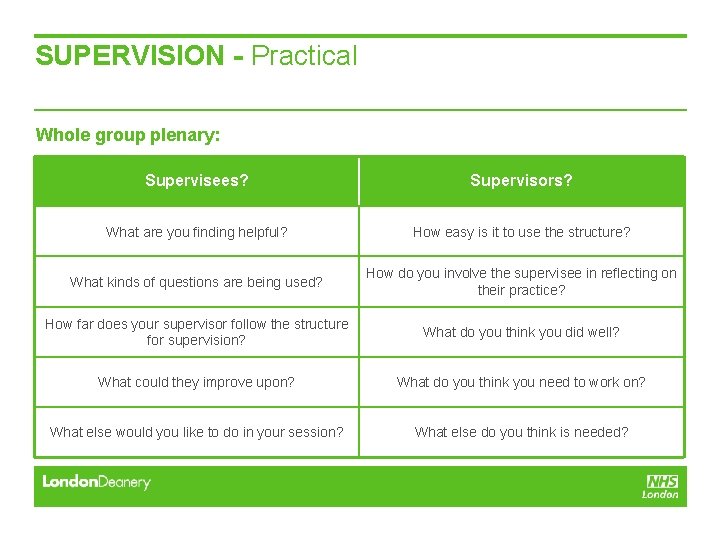
SUPERVISION - Practical Whole group plenary: Supervisees? Supervisors? What are you finding helpful? How easy is it to use the structure? What kinds of questions are being used? How do you involve the supervisee in reflecting on their practice? How far does your supervisor follow the structure for supervision? What do you think you did well? What could they improve upon? What do you think you need to work on? What else would you like to do in your session? What else do you think is needed?
SUPERVISION - Practical 2: 20 mins Discuss with your partner their role as ES, using: 1. Structure given in previous session (contracting etc) 2. Information they give in Practical Preparation document.
SUPERVISION - Practical Feedback: 10 mins Person who has been supervised should give feedback to the supervisor: • What did they find useful? • What did they take away from the session? • What was less useful? • How did the supervisor conduct the session?
SUPERVISION - Practical Whole group plenary: • What can you transfer to your ES role with trainees? • What may not work so well with trainees? • What might you do differently when having such sessions with trainees? • Have you identified skills you need to develop? • Did you identify any objectives for your PDP? Example? • What stopped you from identifying objectives?
Case Study FPTD What are the Issues here? What were the solutions? Any other thoughts?
Case Study FPTD Issues: • Trainee – communication, availability, confidence • CS & ES relationship – indistinct, conflicting advice Solutions: • Change ES (not always possible) • Communication support offered • Monthly meetings with CS reports • Preparation for next placement • Special placement in GP • A&E visit
STRUGGLING TRAINEE – Early Warning Signs? Think about a trainee (or trainees) you have known who have struggled with their training. What were some of the early warning signs (even if you did not recognise them at the time) that they were in difficulty?
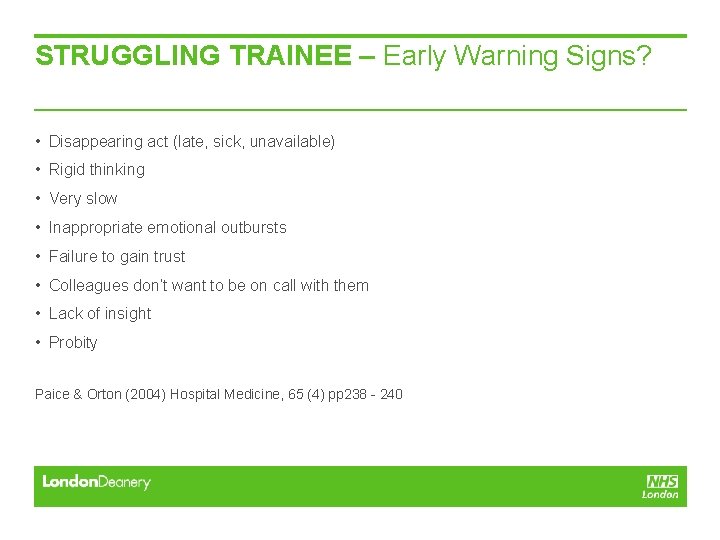
STRUGGLING TRAINEE – Early Warning Signs? • Disappearing act (late, sick, unavailable) • Rigid thinking • Very slow • Inappropriate emotional outbursts • Failure to gain trust • Colleagues don’t want to be on call with them • Lack of insight • Probity Paice & Orton (2004) Hospital Medicine, 65 (4) pp 238 - 240
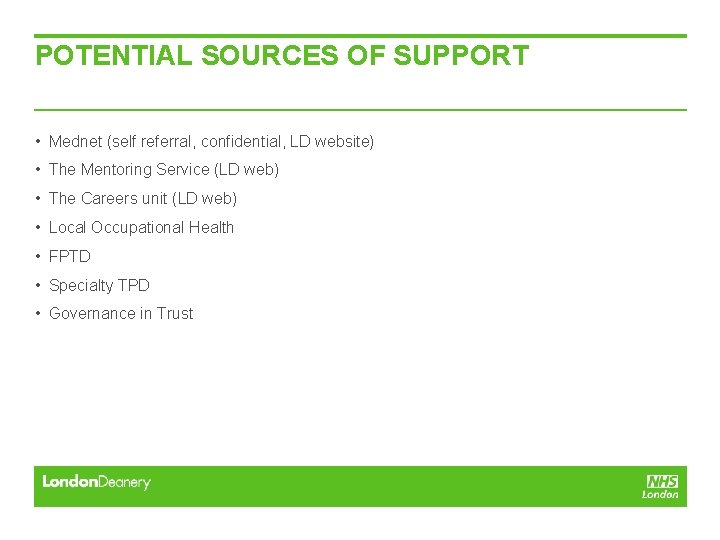
POTENTIAL SOURCES OF SUPPORT • Mednet (self referral, confidential, LD website) • The Mentoring Service (LD web) • The Careers unit (LD web) • Local Occupational Health • FPTD • Specialty TPD • Governance in Trust
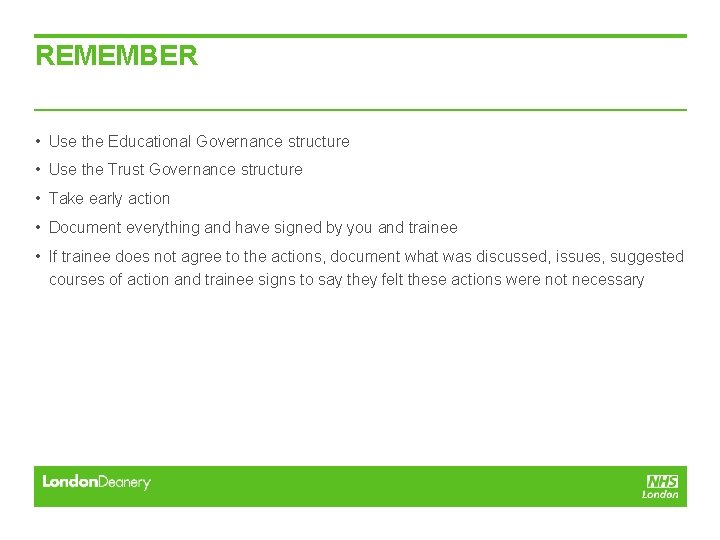
REMEMBER • Use the Educational Governance structure • Use the Trust Governance structure • Take early action • Document everything and have signed by you and trainee • If trainee does not agree to the actions, document what was discussed, issues, suggested courses of action and trainee signs to say they felt these actions were not necessary
REMEMBER • Most trainees are not in difficulty • All trainees can benefit from good supervision • With struggling trainees good supervision can benefit hugely.
FINALLY What one thing will you do as a result of attending this session, in your ES role?