
Faculty Academic Advisor Training Fall 2019 Dr Barbara

Faculty Academic Advisor Training Fall 2019 Dr. Barbara Cobb Coordinator of Academic Advising Professor, English Coordinator, Liberal Arts (multidisciplinary) Major bcobb@murraystate. edu msu. advising@murraystate. edu
Murray State University Academic Advising provides: • academic advisor training, both “live” and online • the Academic Advising website, with resources and training for students and academic advisors • academic advising support for students and advisors
Advising Model at Murray State “Blended Decentralized” o faculty advising, discipline-specific o JCSET specific programs – staff advising o BCOB AACSB programs – CUBA o undergraduate advising center until fully admitted o faculty advising once fully admitted o Center for Student Engagement and Success o referrals o at-risk students o Starfish my. Gate Teaching/Advising tab o Flags, Kudos, Referrals, Student “Raise Your Hand”
3 Major Advising Seasons o Fall: Before Advanced Scheduling mid-October - early November o Spring: Before Advanced Scheduling after spring break – early April o Summer: Summer Orientation – May-July trainings Apr & June
Advanced Scheduling Student Information my. Gate Academics tab Calendars/Deadlines (right side) Timetable for Advanced Scheduling Registration date/time on my. Gate Academics tab Registration Tools Registration Status (add/drop classes located there as well)
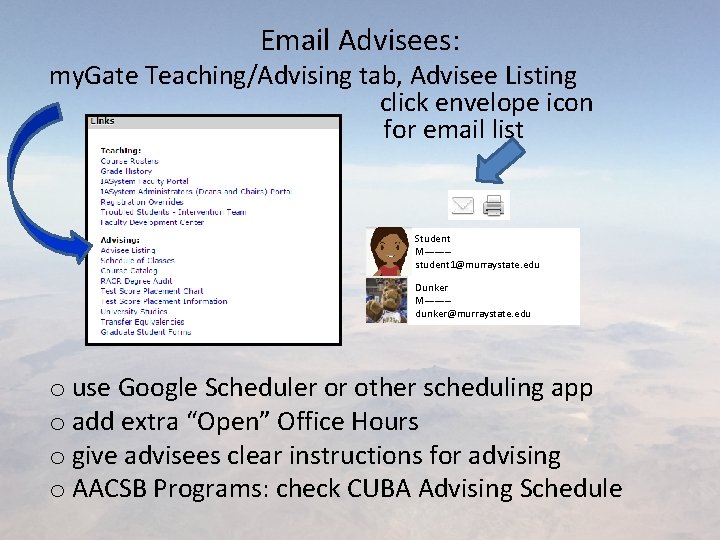
Email Advisees: my. Gate Teaching/Advising tab, Advisee Listing click envelope icon for email list Student M-------student 1@murraystate. edu Dunker M-------dunker@murraystate. edu o use Google Scheduler or other scheduling app o add extra “Open” Office Hours o give advisees clear instructions for advising o AACSB Programs: check CUBA Advising Schedule
To: Advisees From: Dr. Murray Advisor Advanced Scheduling begins November 4 th. Please use this scheduler to sign up for an academic advising appointment. Go to www. murraystate. edu/advising and use the Your Advisor, Your Responsibilities tab to prepare for your advising session. We will review your RACR, discuss classes for summer and fall term, and plan for future terms. Also, we will cover study abroad and internship options, as well as career and professional plans. You must be advised before your Advisor Hold is lifted so that you can register for winter and spring term.
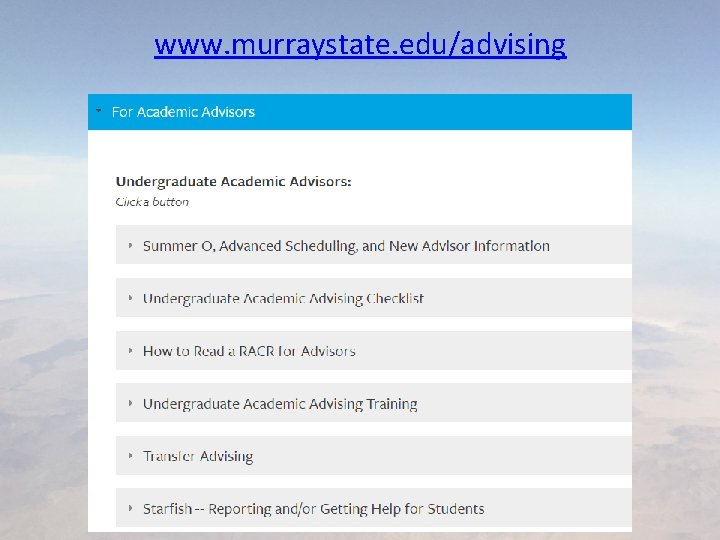
www. murraystate. edu/advising
How to Read a RACR (10 minute training) • RACR, Racer Academic Completion Report: degree audit used to determine progress to graduation and status • Review RACR every semester • Make sure all credit is included on RACR • Student is responsible for accuracy of RACR • Academic Advisor makes changes with appropriate approvals • my. Gate Teaching/Advising Registrar Forms
RACR Basics • 120 credit hours minimum to degree • 42 credit hours at 300+ level required (39 for BIS) • Degree Requirements • University Studies / Honors Sequence • Area, Major, Minor • Electives (at bottom) – evaluate for substitution in area/major/minor • Click-through to course descriptions • Course Exception Form (Registrar Forms)
RACR – Area, Major, Minor Match with the Bulletin – Prerequisites, co-requisites – Univ Studies required courses – Tracks – Advisor Approved Electives (AAPR): use Course Exception Form to approve (Registrar Forms) • Check for Unrestricted Electives in your Area or Major: make sure students meet 120 credit hours to degree and 42 at upper level (top of RACR). •
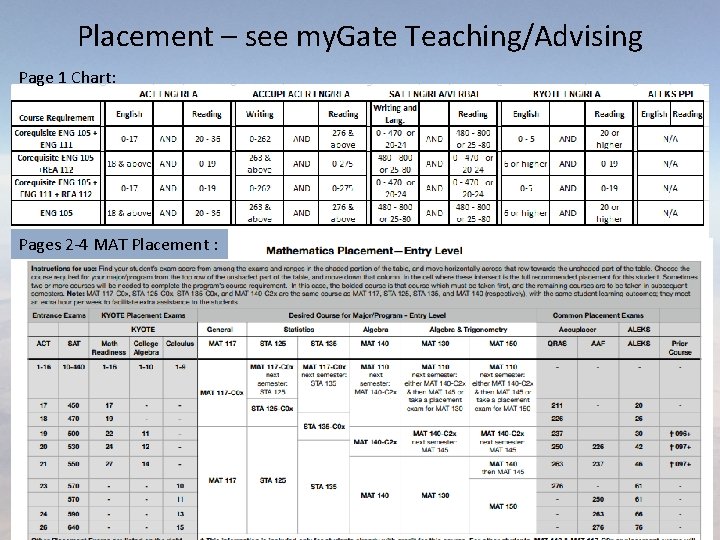
Placement – see my. Gate Teaching/Advising Page 1 Chart: Pages 2 -4 MAT Placement :
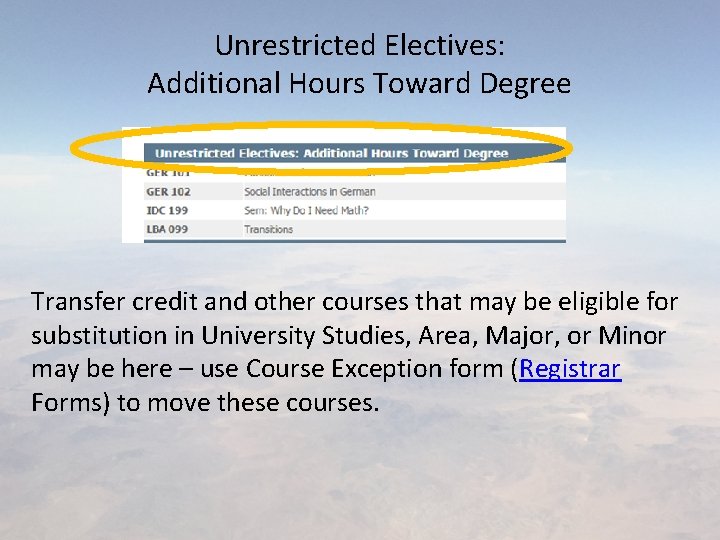
Unrestricted Electives: Additional Hours Toward Degree Transfer credit and other courses that may be eligible for substitution in University Studies, Area, Major, or Minor may be here – use Course Exception form (Registrar Forms) to move these courses.
Advising Honors College Students • Honors Sequence REPLACES University Studies • Use RACR • Honors College students must enroll in at least ONE Honors Sequence course every semester until Honors Sequence is complete • Honors College students register with Special Populations on first day of advanced scheduling • Holds MAY be released by the Honors College advisors (make sure that they are advised by you too) If Honors Sequence disappears from RACR, student should contact Honors College office immediately.
Transfer Advising • Transfer Center • Common transfer course prefixes: • TRN, CLL, SCL, HLP, MLL, SOS, ESC, GAC, GED: Evaluate these courses for equivalency or substitution • Transfer Equivalencies see Transfer Center/Transferring Classes to pre-evaluate courses -if course is not listed, student should contact Transfer Center. (Use this tool to find classes that transfer in from other colleges. )
Transfer Course Equivalencies • If course should be equivalent, contact the Transfer Center: course will be evaluated and added to equivalency for ALL FUTURE evaluations • If course should be substituted for University Studies for THIS STUDENT ONLY, use the University Studies Course Substitution form • If the course should be substituted for a course in your program, use the Registrar Course Exception form Note: if a 200 -level course from another institution is substituted for a 300+ course at MSU, the course will NOT count toward upper division hours for graduation.
Declaring Area, Major, Minor • 45 Credit Hours: Student MUST have Area or Major declared before Advanced Scheduling • 60 Credit Hours: Hours Student with a Major MUST have MINOR or second Major declared before Advanced Scheduling • Change of Area/Major: use this FORM (Registrar Forms) • Change of Minor may be done on same form; student MAY change Minor without advisor signature at Registrar’s Office
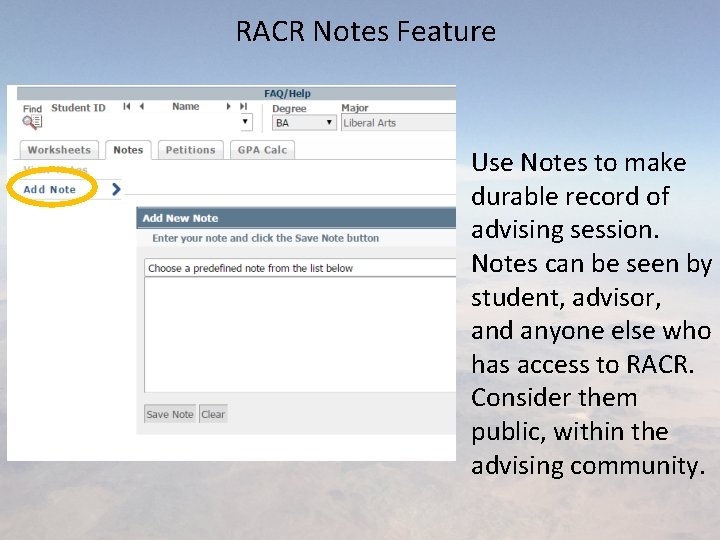
RACR Notes Feature Use Notes to make durable record of advising session. Notes can be seen by student, advisor, and anyone else who has access to RACR. Consider them public, within the advising community.
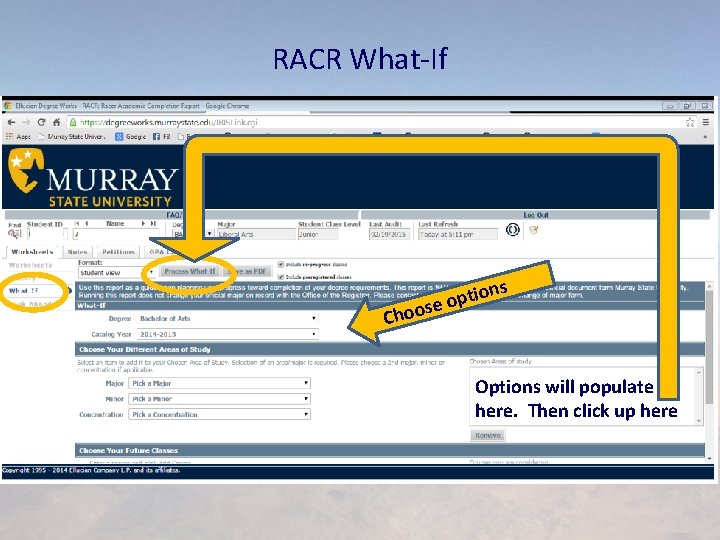
RACR What-If ns o i t p se o Choo Options will populate here. Then click up here
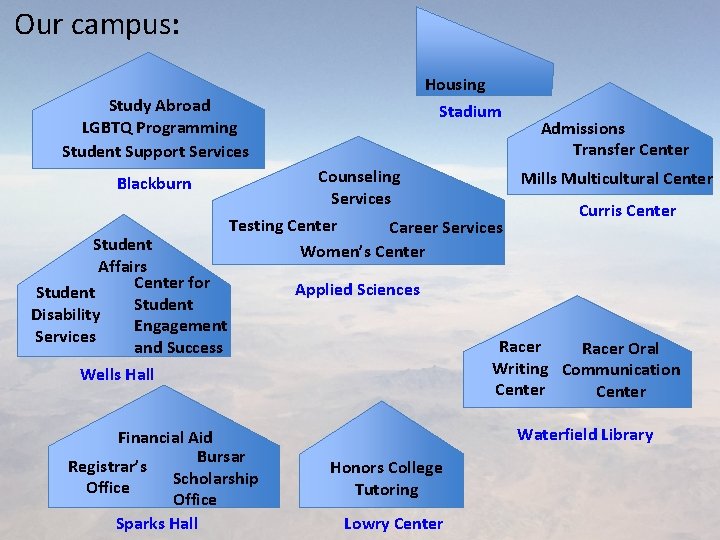
Our campus: Housing Stadium Study Abroad LGBTQ Programming Student Support Services Blackburn Student Affairs Center for Student Disability Engagement Services and Success Counseling Services Testing Center Career Services Women’s Center Mills Multicultural Center Curris Center Applied Sciences Racer Oral Writing Communication Center Wells Hall Financial Aid Bursar Registrar’s Scholarship Office Sparks Hall Admissions Transfer Center Waterfield Library Honors College Tutoring Lowry Center
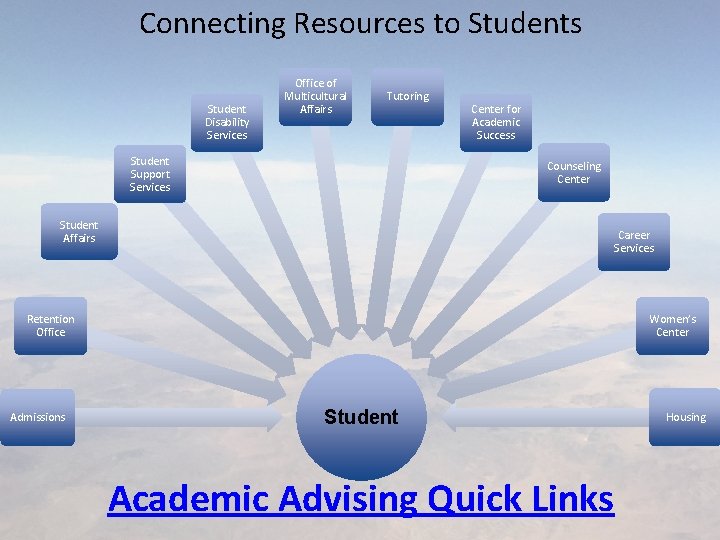
Connecting Resources to Students Student Disability Services Office of Multicultural Affairs Tutoring Student Support Services Center for Academic Success Counseling Center Student Affairs Career Services Retention Office Admissions Women’s Center Student Academic Advising Quick Links Housing
Before Meeting Advisee: Schedule of Classes • Schedule of Classes is available approx. one month before advanced scheduling: check for availability of classes for students in your program • Schedule of Classes can be found on – my. Gate Teaching/Advising (instructor/advisor) – my. Gate Academics (student) – Racer. Net Registration 101 for Students / for Academic Advisors: see Academic Advising website
Advising Session – Advisor Checklist • Meet with every student • Use RACR and the Bulletin to help student choose classes • Know prerequisites and advise accordingly • Make sure student is making progress; discuss plans for future semesters • Discuss strengths, weaknesses, successes, challenges • Discuss plans for future (career/professional)
RACR: Do the Math! • Top of RACR: 120 is the minimum credit hours required for a degree. • Your advisee MAY need more than 120 credit hours to complete all requirements. • Your program MAY require fewer than 120 credit hours; your advisee may need electives to reach 120 credit hours. • Check GPA; advisee may need to retake courses to meet GPA requirements. • Advisee may need more than 15 credit hour/semester – extra tuition.
Full-Time Status • Student should contact ALL offices with questions: • Bursar: Full-Time = 12 credit hours NON-WEB • Housing: Full-Time = average 12 hours per semester, Fall / Winter / Spring • Scholarship: rules vary; be sure that student knows how to stay in good standing • International: rules vary; be sure that student knows requirements • Veterans: Full-Time = 12 credit hours; no WEB remedial/developmental allowed
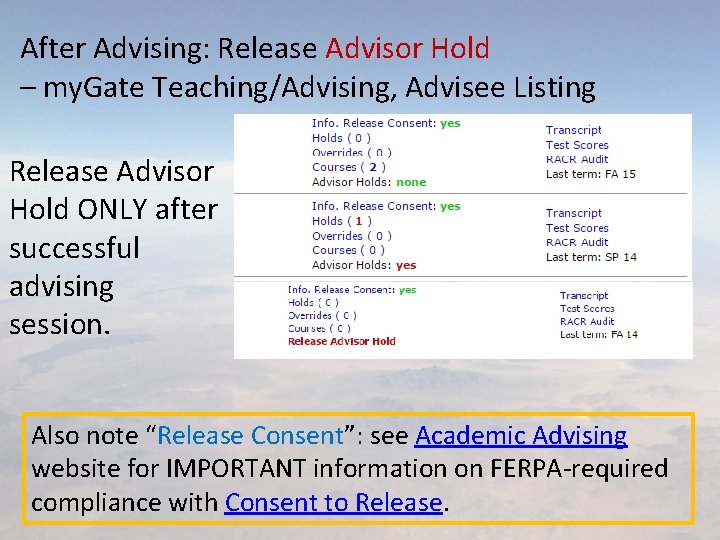
After Advising: Release Advisor Hold – my. Gate Teaching/Advising, Advisee Listing Release Advisor Hold ONLY after successful advising session. Also note “Release Consent”: see Academic Advising website for IMPORTANT information on FERPA-required compliance with Consent to Release.
Contacts – email addresses Registrar: msu. registrar@murraystate. edu RACR: Ashley Rogers msu. racr@murraystate. edu Transfer: Maria Rosa msu. transfercenter@murraystate. edu International: Bill Mc. Kibben bmckibben@murraystate. edu CSES/Retention: Peggy Whaley pwhaley@murraystate. edu Academic Advising: Barbara Cobb msu. advising@murraystate. edu www. murraystate. edu/advising
- Slides: 27