
FACULTATIVE REINSURANCE Things mean what they mean A

- Slides: 21
FACULTATIVE REINSURANCE
Things mean what they mean? • A wife asks her husband, "Could you please go shopping for me and buy one carton of milk, and if they have eggs, get 6. “ • A short time later the husband comes back with 6 cartons of milk. The wife asks him, "Why did you buy 6 cartons of milk? “ He replied, "They had eggs. " Think about it! 25. 10. 2020 2
Law applicable to Reinsurance Contracts § Reinsurance is a distinct and separate contract from the original insurance § Reinsurance need not cover the reinsured’s entire obligations § The reinsurance contract must cover the same risk as the original insurance § The insurance and reinsurance contracts must exist at the same time § A reinsurance contract is one of ‘Utmost Good Faith’?
Types of Reinsurance 1. Facultative Reinsurance transacted on an individual risk basis. The ceding company has the option to offer an individual risk to the reinsurer and the reinsurer retains the right to accept or reject the risk. 2. Treaty Reinsurance A transaction encompassing a block of the ceding company’s book of business. The reinsurer must accept all business included within the terms of the reinsurance contract.
FACULTATIVE REINSURANCE
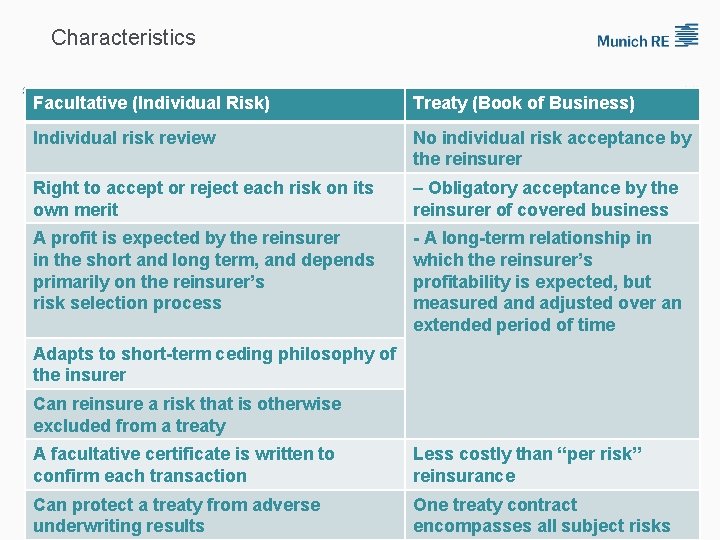
Characteristics Facultative (Individual Risk) Treaty (Book of Business) Individual risk review No individual risk acceptance by the reinsurer Right to accept or reject each risk on its own merit – Obligatory acceptance by the reinsurer of covered business A profit is expected by the reinsurer in the short and long term, and depends primarily on the reinsurer’s risk selection process - A long-term relationship in which the reinsurer’s profitability is expected, but measured and adjusted over an extended period of time Adapts to short-term ceding philosophy of the insurer Can reinsure a risk that is otherwise excluded from a treaty A facultative certificate is written to confirm each transaction Less costly than “per risk” reinsurance Can protect a treaty from adverse underwriting results One treaty contract encompasses all subject risks
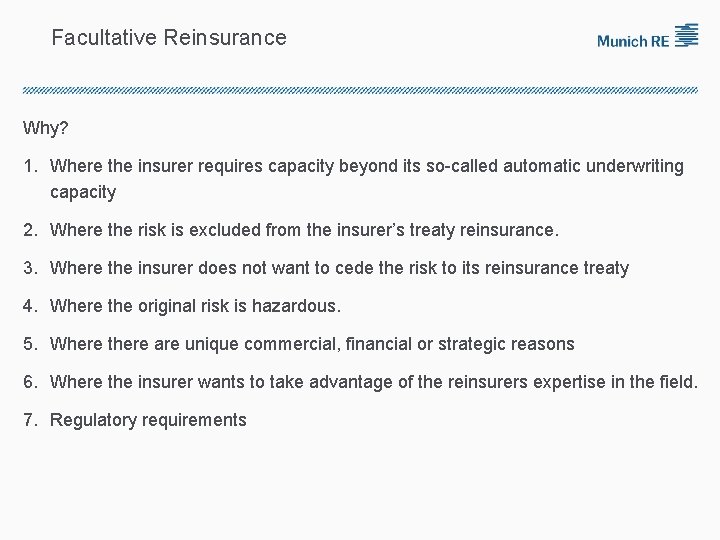
Facultative Reinsurance Why? 1. Where the insurer requires capacity beyond its so-called automatic underwriting capacity 2. Where the risk is excluded from the insurer’s treaty reinsurance. 3. Where the insurer does not want to cede the risk to its reinsurance treaty 4. Where the original risk is hazardous. 5. Where there are unique commercial, financial or strategic reasons 6. Where the insurer wants to take advantage of the reinsurers expertise in the field. 7. Regulatory requirements
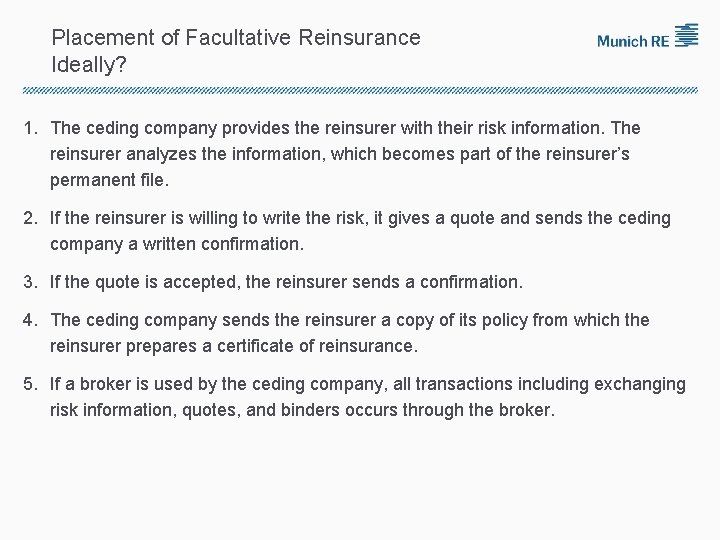
Placement of Facultative Reinsurance Ideally? 1. The ceding company provides the reinsurer with their risk information. The reinsurer analyzes the information, which becomes part of the reinsurer’s permanent file. 2. If the reinsurer is willing to write the risk, it gives a quote and sends the ceding company a written confirmation. 3. If the quote is accepted, the reinsurer sends a confirmation. 4. The ceding company sends the reinsurer a copy of its policy from which the reinsurer prepares a certificate of reinsurance. 5. If a broker is used by the ceding company, all transactions including exchanging risk information, quotes, and binders occurs through the broker.
THE SLIP
The Slip 1. The basic information is recorded on a slip § A placing slip § Signing slip 2. The underwriters will on placement of the risk, insert his scratch or initials, once done they are bound to this percentage of the risk. 3. The underwriter can be signed down (a smaller amount than originally signed for) 4. In the London Market – contract certainty has been introduced where the slip contains details of the specific clauses that will be included in the policy.
Inconsistencies between the slip and the policy § If the wording contradicts the slip, it will be taken that the wording was intended to amend the slip; see Youell v. Bland Welch (The Superhulls case) (1992). § Whether the wording completely supercedes the slip is still a matter open for debate although more recent cases such as HIH v. Chase Manhattan have suggested that this depends on the intention of the parties. Standard Life Assurance Limited v Oak Dedicated Limited and others [2008] EWHC 222 (COMM
The status of the slip § General Re v Fennia Patria (1982) – bound to the risk as soon as the underwriter signs. § The Zephyr (1983) – underwriters bound the line that is written and not the final expected signed line. § Touche Ross Ltd v Baker – each underwriter is a separate and independent contract.
SO WHAT CAN GO WRONG?
Same Terms as Original “This Reinsurance is subject to the same terms, provisions, exclusions and conditions (except as regards premium and except as provided herein and subject always to the Limits Reinsured hereon) as are contained within the following Policy. . . ” Policy Number : XXXX. Insurer : ABC Insurance Company. ”
Incorporating Original Terms 1. The terms should be relevant to the reinsurance 2. It should make sense in the context of reinsurance 3. it should be consistent with the terms of reinsurance 4. It is suitable for the inclusion in the reinsurance HIH v New Hampshire [2001] 2 Lloyd’s Rep. 161 Pine Top Insurance Co. v Unione Italiana Co. Ltd [1987] 1 Lloyd’s Rep. 476
Same Terms as Original 1. Has the underwriter had sight of the original? § Policy reference doesn't mean existence of a policy § Better a reference to a standard policy (ABI All Risks policy – where terms are already known) § Language of the original policy? 2. Original Documentation § The way in which the terms are worded § The intention of the reinsurance § Whether reinsurance terms occur within the insurance policy? Paul Toomey v Banco Vitalicio De Espana Sa De Seguros Y Reaseguros (2004)
Interpretation 1. English law looks at solely at the contract wording itself and rarely (unless there is a clear mistake) will take evidence outside of this – four corners principle 2. Other jurisdictions – negotiations between parties and surrounding circumstances play an important role. 3. A contract must not include any terms which are unspecific or create ambiguities, for example any “TBA”s (To Be Agreed / Advised). LMG (London Market Group) § Unfortunately many of the terms are not printed in total and only refer to abbreviated terms e. g. NMA 464, LMA 5062 § It is necessary therefore to ensure a full wording is produced with all the terms.
Conflict of Law In Forsikringsaktieselskapet Vesta -v- Butcher (1986), • the original risk was insured in Norway by a Norwegian insurer • reinsured at Lloyd’s by a policy which warranted the same gross terms and conditions as original. • although the words were not sufficient to render the entire contract to be governed by Norwegian law and that English law remained the proper law, the construction of parts of the contract was to be carried out in accordance with Norwegian law to maintain consistency between the underlining insurance and reinsurance
Practical Points to Avoid Contract Uncertainty § In a commercial insurance context, the Court will generally look to interpret the contract in light of its commercial purpose. § However, it is important to ensure that the language used is clear - the Court will not rewrite the contract to make a better deal for the parties § Do not leave your agreed intention unsaid – spell it out, be literal, as the Court may not always assist you. § Make sure the other party has received the message you want to give (this is especially significant when negotiating through intermediaries) § Be aware of grammar and how it can affect the meaning of a clause. § Use standard wordings but be careful that the clause operates as you intend. § Read the policy as a whole and check each clause makes sense with your overarching intention. § Understand the differences between the underlying and the reinsurance law 25/10/2020
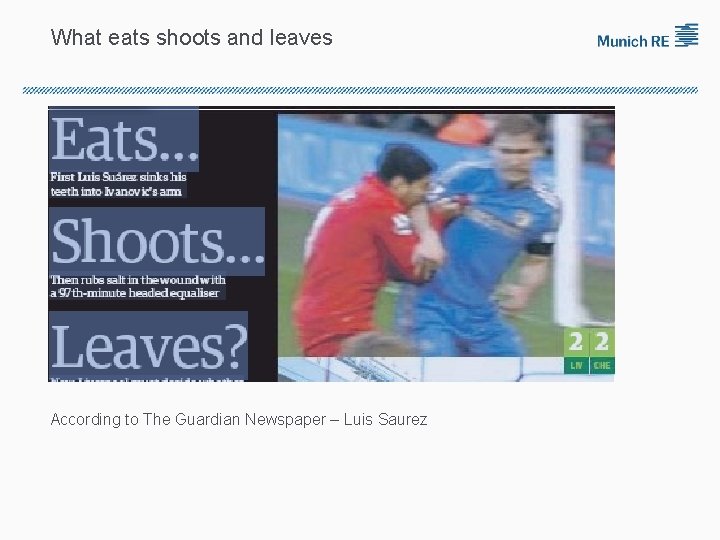
What eats shoots and leaves According to The Guardian Newspaper – Luis Saurez
THANK YOU FOR YOUR ATTENTION ANY QUESTIONS