
Factors that control Population 1 Competition 2 Predation
- Slides: 44
Factors that control Population 1. Competition 2. Predation 3. Parasitism 4. Symbiosis These factors help maintain population numbers and bring about a ‘balance of nature’ 1
Population A group of individuals of the same species living together in a habitat. They live in populations for the following reasons: n Their habitat provides food and shelter n Individuals are safer in a group n The availability of a mate for breeding purposes 2
Competition When `2 or more organisms seek a resource that is in short supply in the habitat. Intra-specific competition: Between members of the same species i. e. within a species Inter-specific competition: Between members of different species 3
Competition for resources Plants compete for light, water, minerals and space Animals compete for food, water, shelter, territory and mates 4
Learning check What is meant by a population? A group of individuals of the same species living together in a habitat Explain what is meant by competition. When organisms of the same or different species ‘fight’ for necessary resources that are in short supply. 5
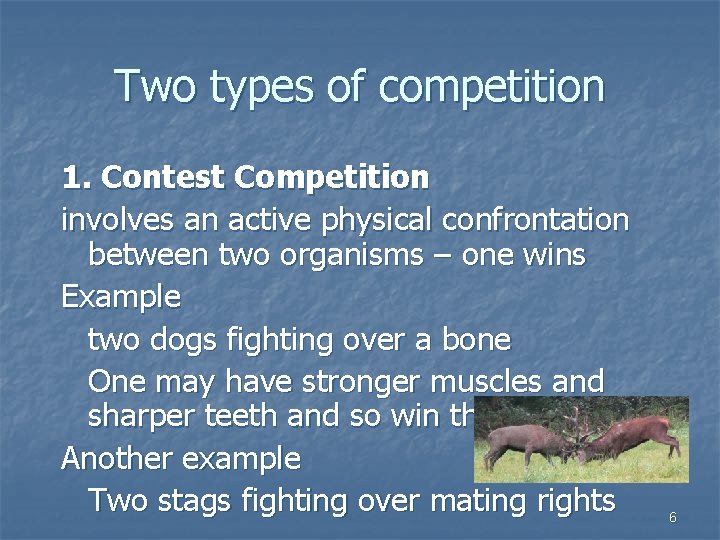
Two types of competition 1. Contest Competition involves an active physical confrontation between two organisms – one wins Example two dogs fighting over a bone One may have stronger muscles and sharper teeth and so win the bone Another example Two stags fighting over mating rights 6
Two types of competition 2. Scramble Competition This is where each organism tries to acquire as much of the resource as possible e. g. an ivy plant and a hawthorn tree may compete for light. The ivy uses adventitious roots to grip the hawthorn and climb higher. 7
adventitious roots adventitious root: root that does not develop from the radicle e. g. (a) climbing roots of ivy, (b) roots of cuttings that arise from a node. 8
Competition & Population Size n n n Restricts population size Only successful competitors will survive and reproduce Is a driving force behind evolution i. e. adaptive techniques (sharp teeth of carnivores or climbing abilities in ivy) develop in response to the need to survive competition 9
How do animals survive competition? They adapt to their environment by: n Changing their feeding habits n Moving away from over-populated areas (migrating) n Reproductive strategies e. g. Kangaroo can carry up to three offspring 1. 2. 3. Joey New born baby (2. 5 cm long) Fertilized Egg sitting in tubes to go to womb 10
How do plants survive competition? e. g. weeds These compete with other plants for water, minerals and light and will survive because: n They produce large numbers of seeds n Seeds germinate quickly n Plants thrive even in poorer soil conditions 11
Adaptive Techniques Adaptive techniques are adaptations which have evolved (developed) in response to the need to survive competition e. g. 1 big antlers on stags, muscular strength e. g. 2 climbing abilities in ivy 12
Predation predation: when animals (predators) kill and eat other animals for food. predator: animal that hunts, captures and kills other animals (prey) for food. Predators have evolved adaptive techniques to survive, e. g. wolf has keen hearing and eyesight, strong muscles, sharp teeth, camouflage and hunts in packs. 13
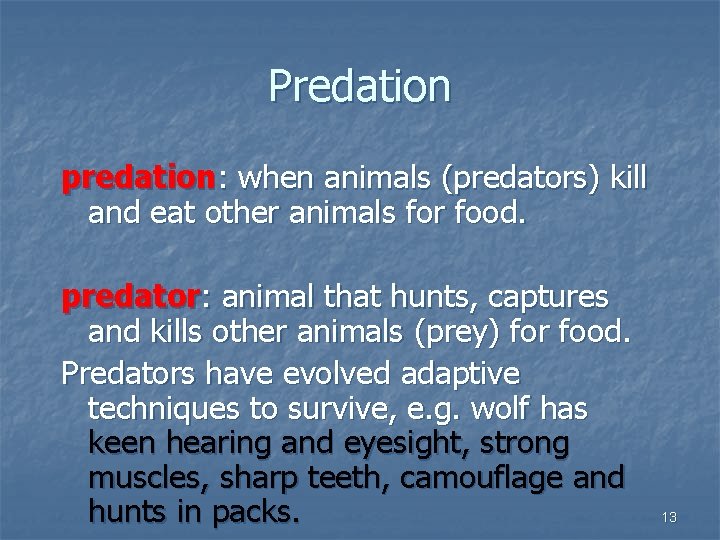
Positive Effects of Predation 1. 2. 3. Predation stabilises the community Predators control the number of herbivores and so prevent overgrazing Predators eliminate the less well adapted (weaker) prey 14
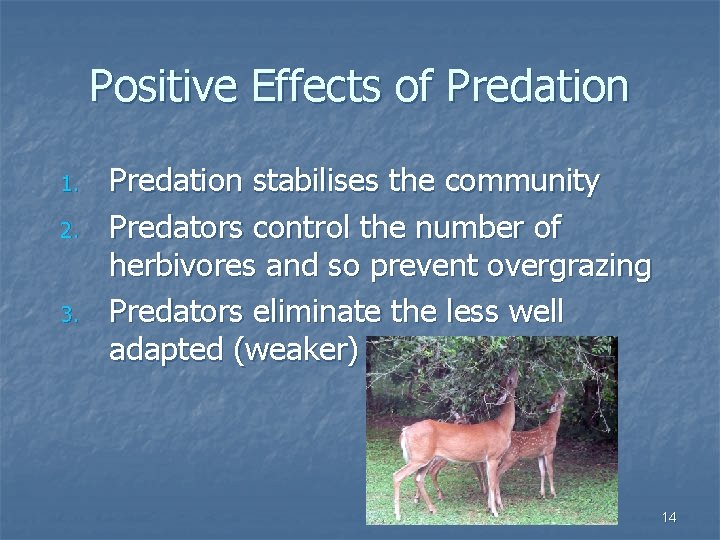
Adaptations of Predators n n n Keen senses and sharp teeth Catch easiest prey – old and sick (less energy used) Change diet to suit prey available e. g. foxes Live and hunt in packs Migrate to where prey is plentiful Camouflage 15
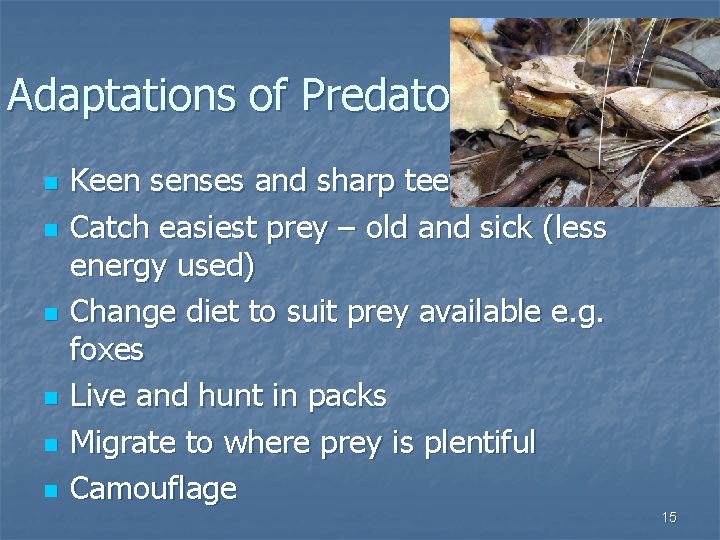
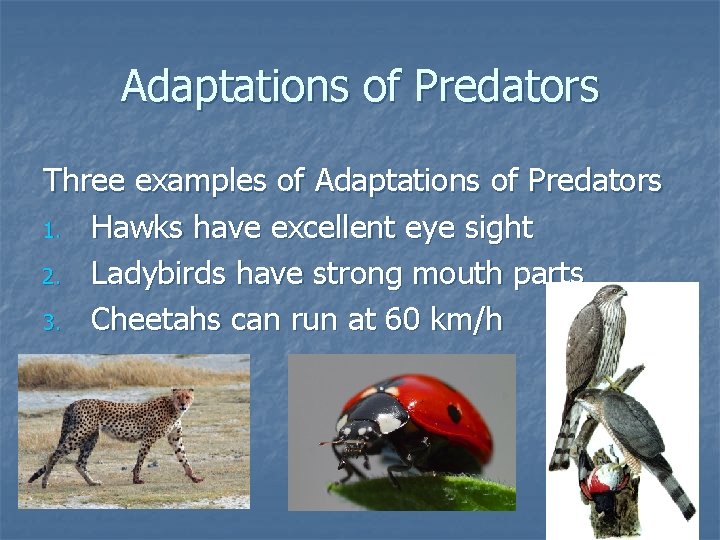
Adaptations of Predators Three examples of Adaptations of Predators 1. Hawks have excellent eye sight 2. Ladybirds have strong mouth parts 3. Cheetahs can run at 60 km/h 16
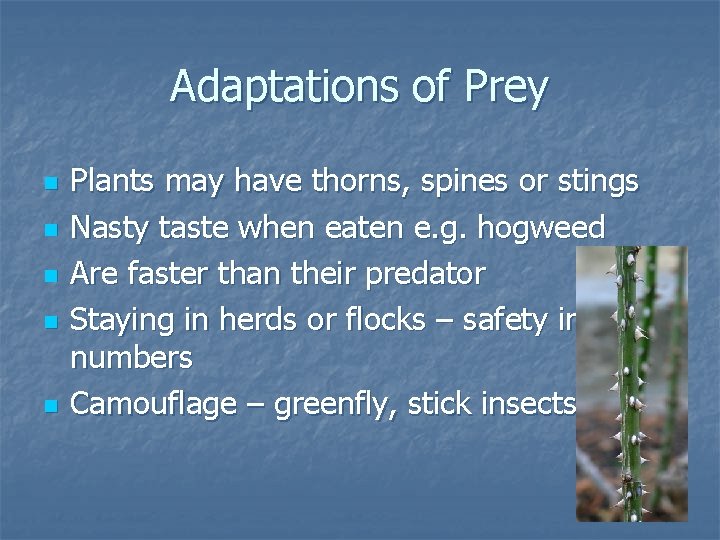
Adaptations of Prey n n n Plants may have thorns, spines or stings Nasty taste when eaten e. g. hogweed Are faster than their predator Staying in herds or flocks – safety in numbers Camouflage – greenfly, stick insects 17
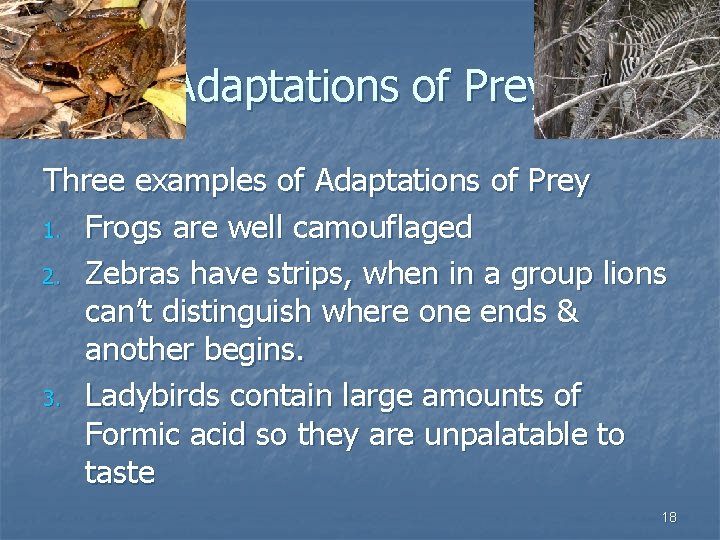
Adaptations of Prey Three examples of Adaptations of Prey 1. Frogs are well camouflaged 2. Zebras have strips, when in a group lions can’t distinguish where one ends & another begins. 3. Ladybirds contain large amounts of Formic acid so they are unpalatable to taste 18
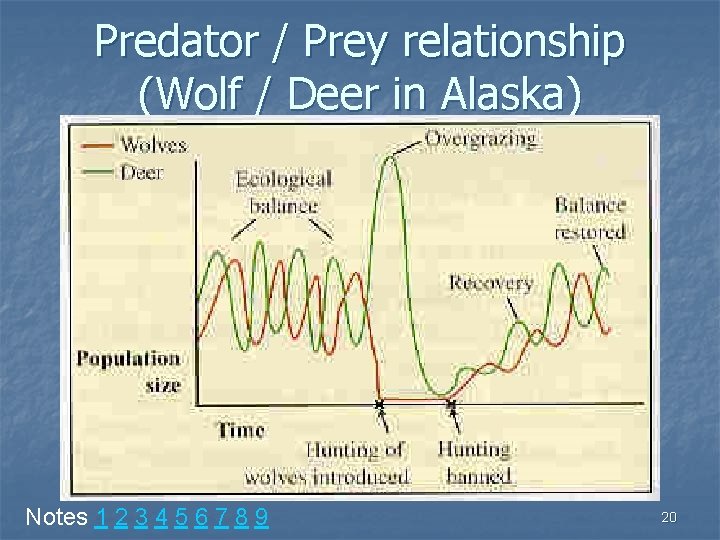
Predator / Prey relationship The populations of wolves and deer are interconnected. Both have evolved adaptive techniques to survive e. g. wolves – keen hearing and eyesight, strong muscles, sharp teeth, camouflage and hunt in packs. deer – keen hearing and eyesight, quick to turn and run and camouflage to evade the wolves. 19
Predator / Prey relationship (Wolf / Deer in Alaska) Notes 1 2 3 4 5 6 7 8 9 20
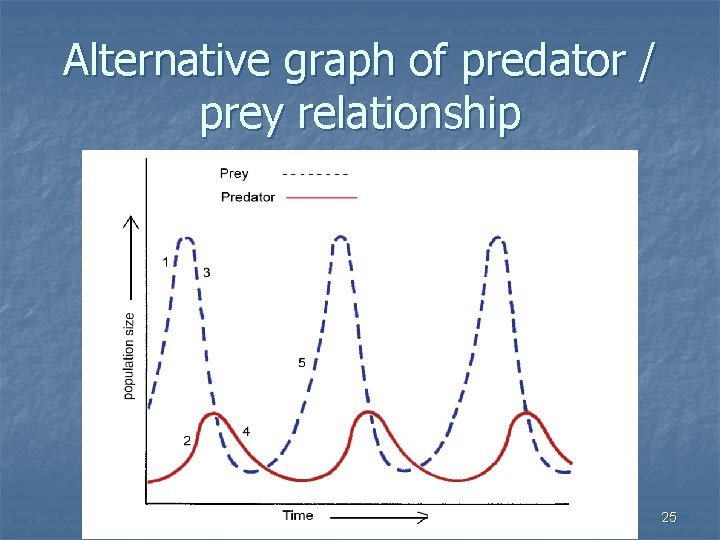
Notes on graph 1. 2. 3. 4. When the rabbit population increased, the fox population had more food and increased too. graph As the fox population increased, the number of rabbits being killed increased – graph resulting in a decline in the rabbit population When the rabbit population declined, there was less food for the foxes and they declined in numbers too. graph This led to an increase in the deer population. graph 21
Notes on graph 5. 6. 7. This cycle continued over years and had obviously found a natural balance to do with availability of food for both populations. graph When the fox population was drastically reduced due to hunting, the resulting explosion of the rabbit population led to overgrazing of the vegetation. graph This produced huge mortality and emigration in the deer population with a collapse of the relationship. graph 22
Notes on graph After the banning of hunting, a balance was slowly re-established in the two populations. graph The populations are controlled by negative feedback, where a drop in numbers is generally self-correcting. Over a long period of time, the rabbits evolve structures and behaviours to survive predation better, e. g. quicker reactions, etc. The foxes also evolve better predation techniques to cope with the evolving prey. 23 8.
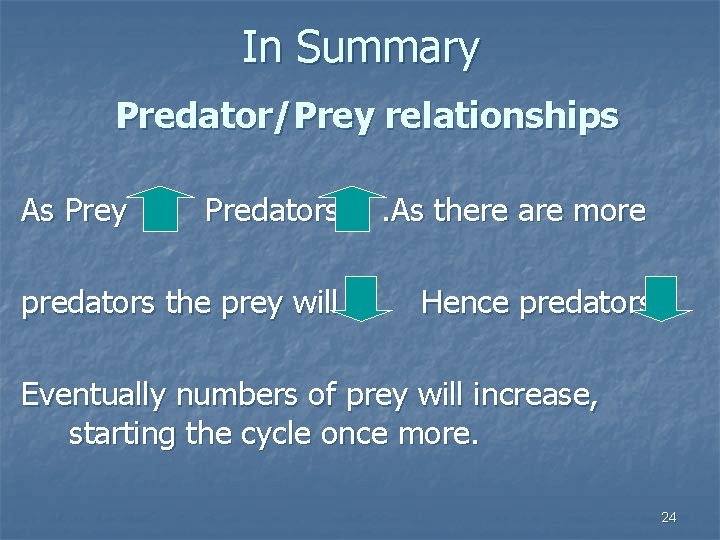
In Summary Predator/Prey relationships As Prey Predators . As there are more predators the prey will Hence predators Eventually numbers of prey will increase, starting the cycle once more. 24
Alternative graph of predator / prey relationship 25
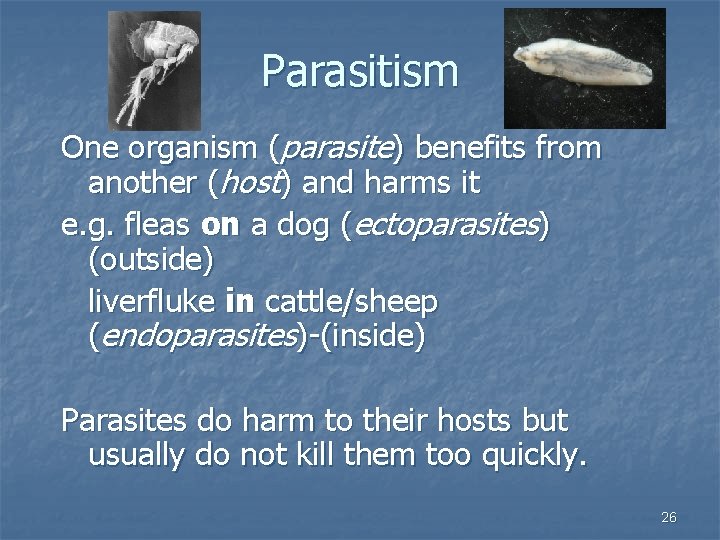
Parasitism One organism (parasite) benefits from another (host) and harms it e. g. fleas on a dog (ectoparasites) (outside) liverfluke in cattle/sheep (endoparasites)-(inside) Parasites do harm to their hosts but usually do not kill them too quickly. 26
Symbiosis– where two diff speies organisms have close, relationship where at least one of them benefits. Parasitism is a form of symbiosis 27
Examples of Symbiosis n n n A lichen is composed of an alga and a fungus i. The alga obtains mineral supply from the fungus; the fungus obtains food from the alga. Nitrogen-fixing bacteria in the nodules of leguminous plants (legumes): The bacteria make nitrogen compounds needed by the plant and the plant makes carbohydrates and other food material needed by the bacteria Bacteria living in the colon produce vitamin B 2 and vitamin K. The body absorbs these vitamins. 28
Population Dynamics
Factors that contribute to Predator-Prey relationships 1. The availability and abundance of food Large number of deer will increase the number of wolves. This will decrease the number of deer and then wolves. When wolves decrease deer will increase again. 30
Factors that contribute to Predator-Prey relationships 2. 3. Concealment When there is less prey they can hide better, this allows population of prey to survive and increase. Movement of Prey & Predators If there is not enough food the prey will move to a more abundant location; predator moves to area with more prey. 31
Population Dynamics A population is a group of organisms of the one species. Population density is a measurement of the numbers of a species over a stated area. Population increases are due to increases in the birth rate and immigration. Population decreases are due to increases in the mortality rate and emigration. 32
Population Dynamics Most population numbers tend to fluctuate in the short term, but find an overall balance in the long term where births and immigrations are equal to deaths and emigrations. Mortality rates are high in nature – many organisms die before they can reproduce. 33
Population Dynamics Deaths are usually due to predation, parasites and lack of food rather than old age. A high mortality rate is important to populations – why? It protects the stock of food and eliminates the less well-adapted organisms. 34
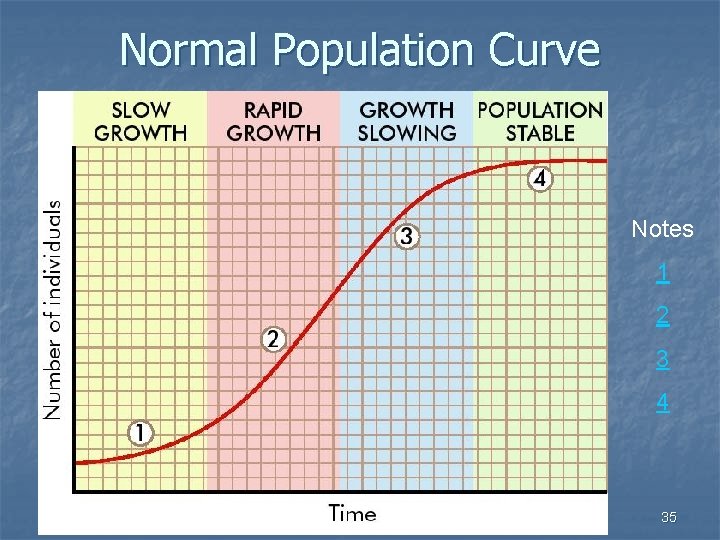
Normal Population Curve Notes 1 2 3 4 35
Notes on graph 1. 2. 3. 4. Organisms arrive and then adapt to their new environment graph Growth takes place rapidly due to newly -available food graph Growth constraints are felt – predation, overcrowding, available food, etc. graph Growth settles at a level that the environment can support. 36
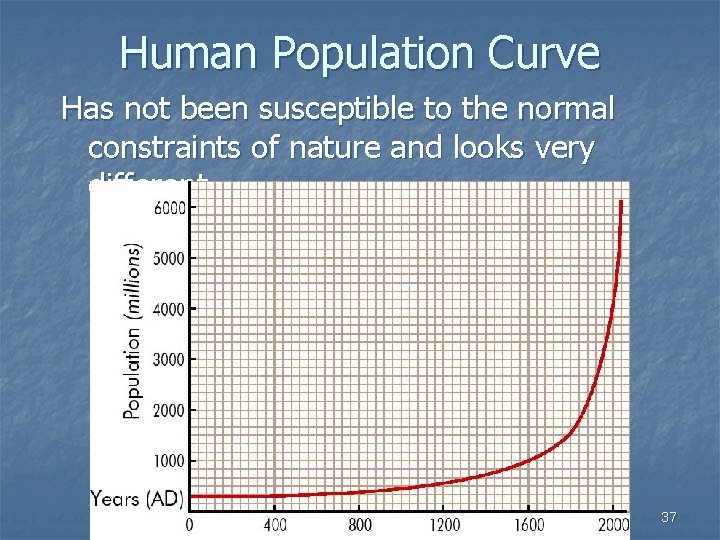
Human Population Curve Has not been susceptible to the normal constraints of nature and looks very different 37
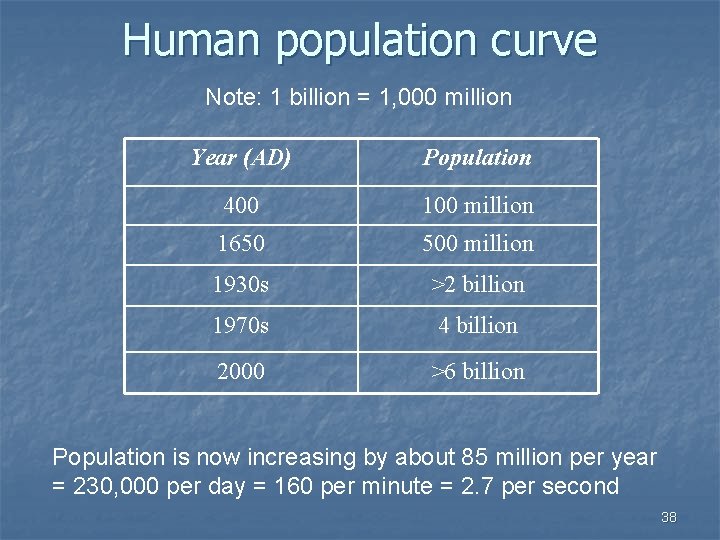
Human population curve Note: 1 billion = 1, 000 million Year (AD) Population 400 100 million 1650 500 million 1930 s >2 billion 1970 s 4 billion 2000 >6 billion Population is now increasing by about 85 million per year = 230, 000 per day = 160 per minute = 2. 7 per second 38
Human population curve 66% of world population live in Asia. Birth rates are declining in developed countries. The increase in the human population is not due to an increase in birth rates, but is caused by reduced death rates. 39
Factors affecting Human Population Numbers n n Famine n War n Contraception Disease 40
Famine A lack of food leads to malnutrition and death due to disease or starvation e. g. Great Irish Famine of 1845 – 47, about one million people died. Some countries still suffer from famine, but it is often a problem of food distribution rather than food shortages. Advances in agricultural techniques have so far allowed food supplies to match population growth. 41
Disease Vaccines – reduce the incidence of diphtheria, whooping cough, tetanus, polio, meningitis, TB, etc. Sanitation + insecticides – have controlled malaria, yellow fever and sleeping sickness. Anaesthetics have improved surgical methods & new drugs have saved many lives. Antibiotics have prevented deaths that would have been caused by bacteria. 42
War Reduces the human population. Effects can be temporary. Increased birth rates (baby booms) often follow wars. 43
Contraception Increased availability has reduced birth rates since the 1960 s. Evident in developed countries e. g. in Western Europe and USA the average family size = 2. 1. This is close to the level needed to ensure the pop remains constant. The fertility rate in developing countries has fallen from 6. 1 in 1970 to 3. 5 today, due to contraception. 44