
FACTORS MULTIPLES LEARNING OBJECTIVES After learning the chapter

FACTORS & MULTIPLES
LEARNING OBJECTIVES; � After learning the chapter , students will be able to: � (a) learn more about factors and multiples. � (b) find out HCF and LCM of given numbers by using different methods. � (c) solve various word problems based on HCF and LCM. � (d) analyse different relations between HCF and LCM. � (e) understand the properties of HCF and LCM. � (f) create questions of their own based on daily life situations related to HCF and LCM and use them in higher studies and day-to-day life.
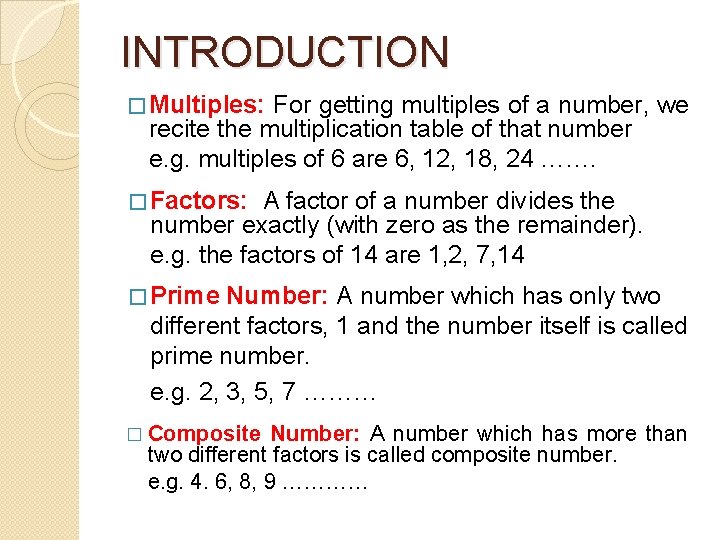
INTRODUCTION � Multiples: For getting multiples of a number, we recite the multiplication table of that number e. g. multiples of 6 are 6, 12, 18, 24 ……. � Factors: A factor of a number divides the number exactly (with zero as the remainder). e. g. the factors of 14 are 1, 2, 7, 14 � Prime Number: A number which has only two different factors, 1 and the number itself is called prime number. e. g. 2, 3, 5, 7 ……… � Composite Number: A number which has more than two different factors is called composite number. e. g. 4. 6, 8, 9 …………

MORE ABOUT FACTORS �One (1) is factor of every number. �Every number is a factor of itself. �Two prime numbers whose difference is 2 are called Twin Prime Numbers. e. g. 5 and 7; 17 and 19. �Two number are said to be Co-prime when they have only 1 as common factor. e. g. 5 and 6; 12 and 13
Questions for Self Evaluation: � 1. Is 35 a prime number? State its factors. � 2. Is 26 a composite number? State its factors? � 3. Write the first 5 multiples of 21. � 4. Write all the even factors of 20. � 5. Write the first 5 prime numbers. � 6. Name any 5 two-digit composite numbers.
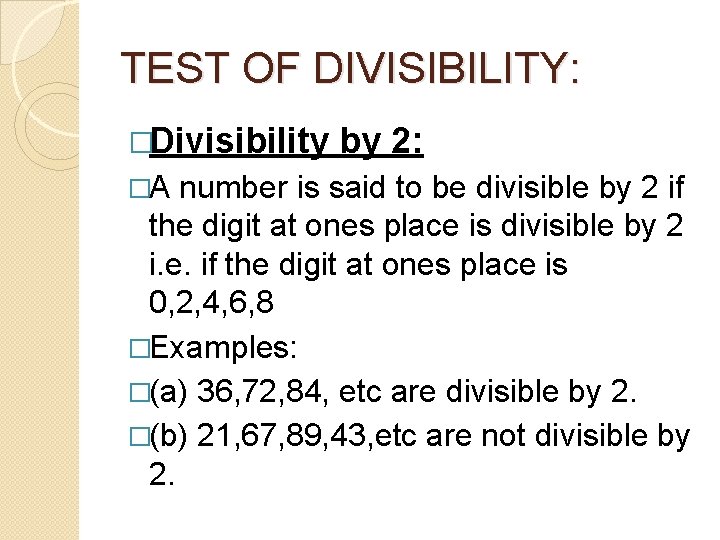
TEST OF DIVISIBILITY: �Divisibility �A by 2: number is said to be divisible by 2 if the digit at ones place is divisible by 2 i. e. if the digit at ones place is 0, 2, 4, 6, 8 �Examples: �(a) 36, 72, 84, etc are divisible by 2. �(b) 21, 67, 89, 43, etc are not divisible by 2.
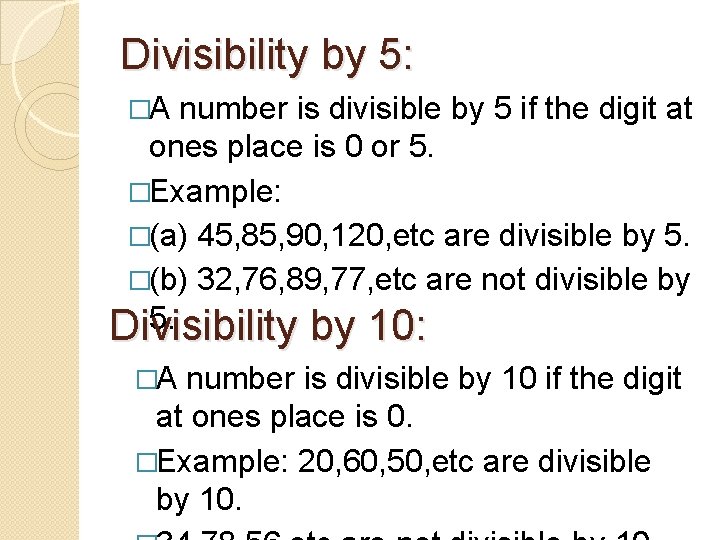
Divisibility by 5: �A number is divisible by 5 if the digit at ones place is 0 or 5. �Example: �(a) 45, 85, 90, 120, etc are divisible by 5. �(b) 32, 76, 89, 77, etc are not divisible by 5. Divisibility by 10: �A number is divisible by 10 if the digit at ones place is 0. �Example: 20, 60, 50, etc are divisible by 10.
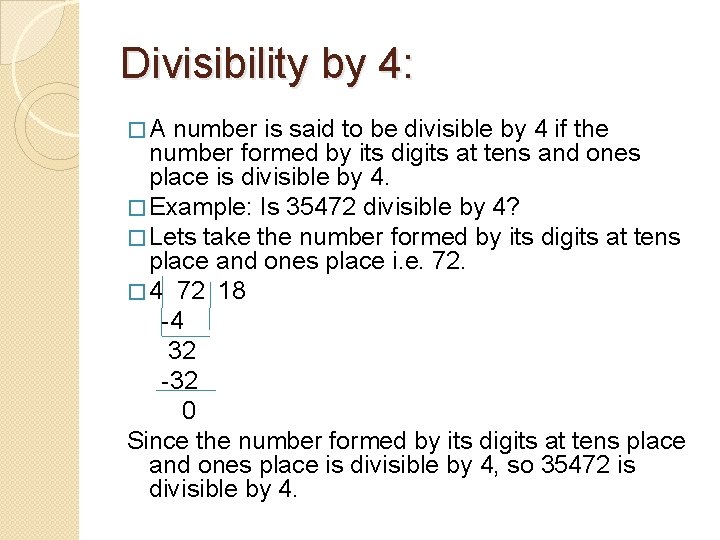
Divisibility by 4: �A number is said to be divisible by 4 if the number formed by its digits at tens and ones place is divisible by 4. � Example: Is 35472 divisible by 4? � Lets take the number formed by its digits at tens place and ones place i. e. 72. � 4 72 18 -4 32 -32 0 Since the number formed by its digits at tens place and ones place is divisible by 4, so 35472 is divisible by 4.
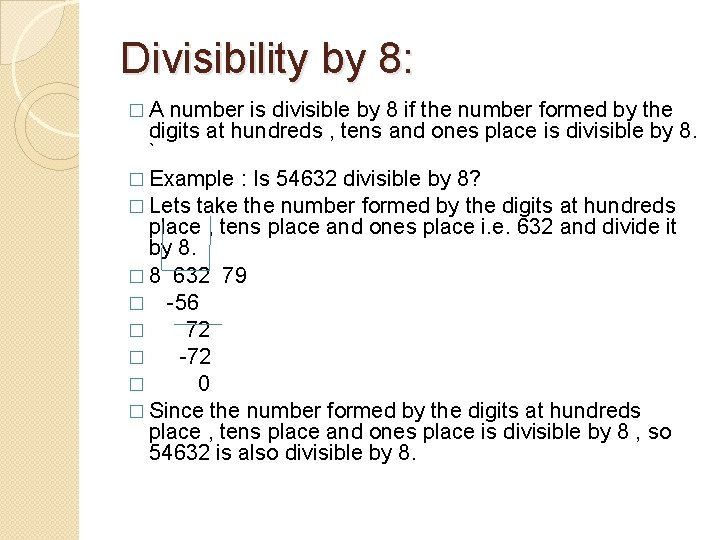
Divisibility by 8: �A number is divisible by 8 if the number formed by the digits at hundreds , tens and ones place is divisible by 8. ` � Example : Is 54632 divisible by 8? � Lets take the number formed by the digits at hundreds place , tens place and ones place i. e. 632 and divide it by 8. � 8 632 79 � -56 � 72 � -72 � 0 � Since the number formed by the digits at hundreds place , tens place and ones place is divisible by 8 , so 54632 is also divisible by 8.
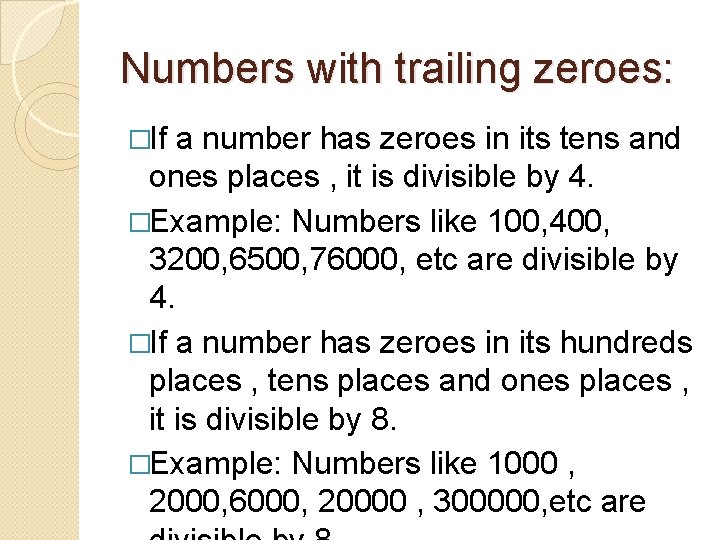
Numbers with trailing zeroes: �If a number has zeroes in its tens and ones places , it is divisible by 4. �Example: Numbers like 100, 400, 3200, 6500, 76000, etc are divisible by 4. �If a number has zeroes in its hundreds places , tens places and ones places , it is divisible by 8. �Example: Numbers like 1000 , 2000, 6000, 20000 , 300000, etc are
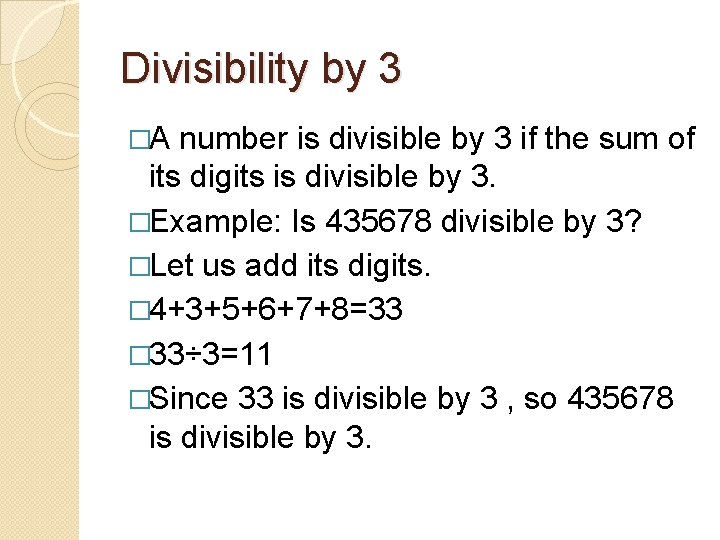
Divisibility by 3 �A number is divisible by 3 if the sum of its digits is divisible by 3. �Example: Is 435678 divisible by 3? �Let us add its digits. � 4+3+5+6+7+8=33 � 33÷ 3=11 �Since 33 is divisible by 3 , so 435678 is divisible by 3.
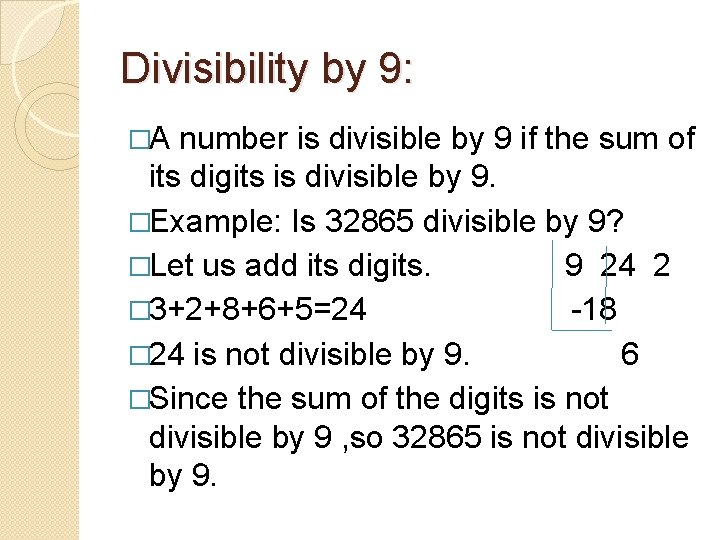
Divisibility by 9: �A number is divisible by 9 if the sum of its digits is divisible by 9. �Example: Is 32865 divisible by 9? �Let us add its digits. 9 24 2 � 3+2+8+6+5=24 -18 � 24 is not divisible by 9. 6 �Since the sum of the digits is not divisible by 9 , so 32865 is not divisible by 9.

Divisibility by 11: �A number is divisible by 11 if the difference between the sum of the digits at even places and sum of the digits at odd places is either 0 or a multiple of 11, then the number is divisible by 11. �Example: Is 428934 divisible by 11? �E E E � 4 2 8 9 3 4 � O O O �Sum of digits at odd places=4+9+2=15 �Sum of digits at even places=3+8+4=15 �Differences of two sums=15 -15=0 �So , 428934 is divisible by 11.
More on divisibility tests: �Point-A: A number is divisible by 6 if it is divisible by co-prime factors of 6. �Example: 54 is divisible by 2 and 3. So, 54 is divisible by 2 x 3=6. �Similarly, a number is divisible by 12 if it is divisible by 4 and 3. �Point –B: If a number is divisible by another number , then it is divisible by each factor of that number. �Example: 20 is divisible by 10. Factors of 10 are 1, 2, 5, 10. So, 20 is also divisible by 1, 2, 5, 10.
More on divisibility tests: �Point-C: If a number is divisible by two coprime numbers , then it is divisible by their product. �Example: 6 and 7 are two co-prime numbers. 84 is divisible by 6 as well as 7. So, 84 is also divisible by 6 x 7=42. �Point-D: If two numbers are divisible by a number, then their sum is also divisible by that number. �Example: 16 and 20 are divisible by 4. So, 20+16=36 is also divisible by 4. �Point-E: If two given numbers are divisible by a number , then their difference is also divisible by that number. �Example: 28 and 63 are divisible by 7. So, 63 -28=35. 35 is also divisible by 7.
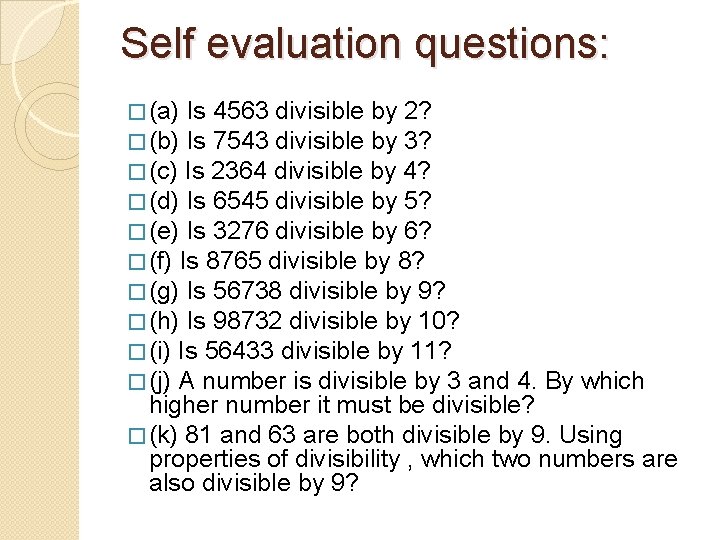
Self evaluation questions: � (a) Is 4563 divisible by 2? � (b) Is 7543 divisible by 3? � (c) Is 2364 divisible by 4? � (d) Is 6545 divisible by 5? � (e) Is 3276 divisible by 6? � (f) Is 8765 divisible by 8? � (g) Is 56738 divisible by 9? � (h) Is 98732 divisible by 10? � (i) Is 56433 divisible by 11? � (j) A number is divisible by 3 and 4. By which higher number it must be divisible? � (k) 81 and 63 are both divisible by 9. Using properties of divisibility , which two numbers are also divisible by 9?
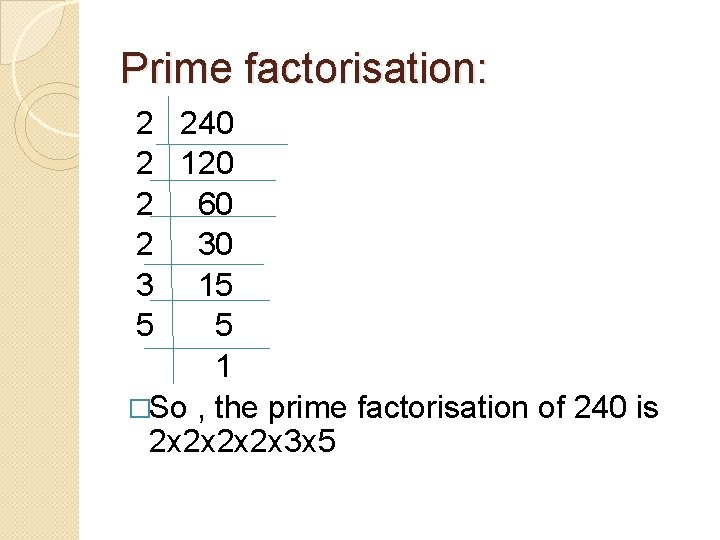
Prime factorisation: 2 240 2 120 2 60 2 30 3 15 5 5 1 �So , the prime factorisation of 240 is 2 x 2 x 3 x 5
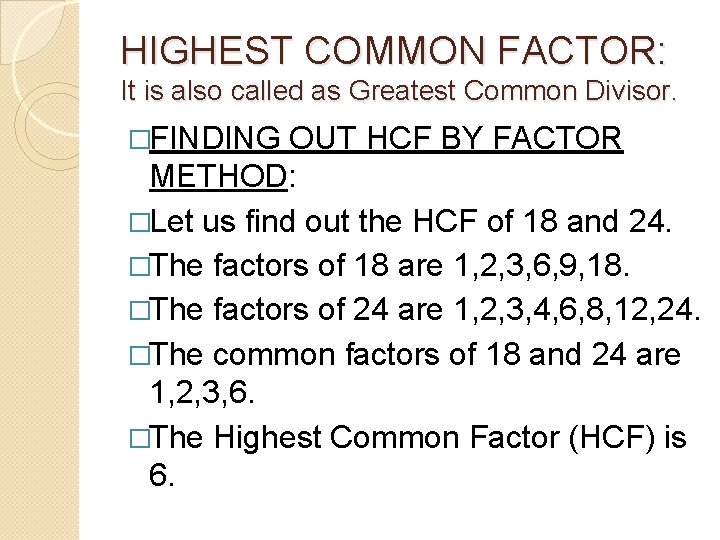
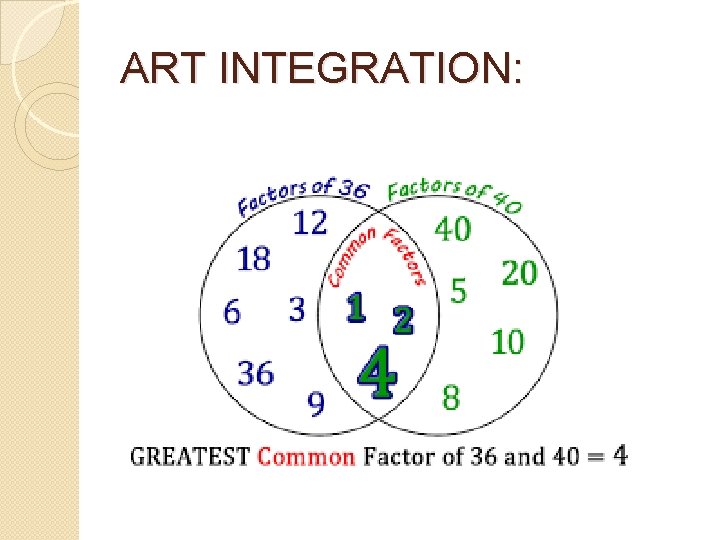
HIGHEST COMMON FACTOR: It is also called as Greatest Common Divisor. �FINDING OUT HCF BY FACTOR METHOD: �Let us find out the HCF of 18 and 24. �The factors of 18 are 1, 2, 3, 6, 9, 18. �The factors of 24 are 1, 2, 3, 4, 6, 8, 12, 24. �The common factors of 18 and 24 are 1, 2, 3, 6. �The Highest Common Factor (HCF) is 6.

�FINDING HCF BY PRIME FACTORISATION METHOD: �Let us find out the HCF of 36 and 48. 2 36 2 48 2 18 2 24 3 9 2 12 3 3 2 6 1 3 3 1 36= 2 x 2 x 3 x 3 48= 2 x 2 x 3 Common factors of 36 and 48 are 2, 2, 3 So , HCF of 36 and 48 = 2 x 2 x 3=12
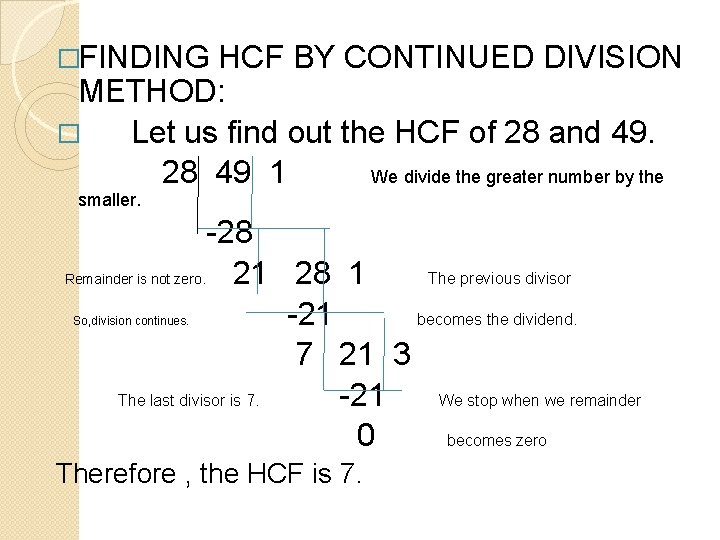
�FINDING HCF BY CONTINUED DIVISION METHOD: � Let us find out the HCF of 28 and 49. 28 49 1 We divide the greater number by the smaller. -28 Remainder is not zero. 21 28 1 The previous divisor -21 becomes the dividend. 7 21 3 The last divisor is 7. -21 We stop when we remainder 0 becomes zero So, division continues. Therefore , the HCF is 7.
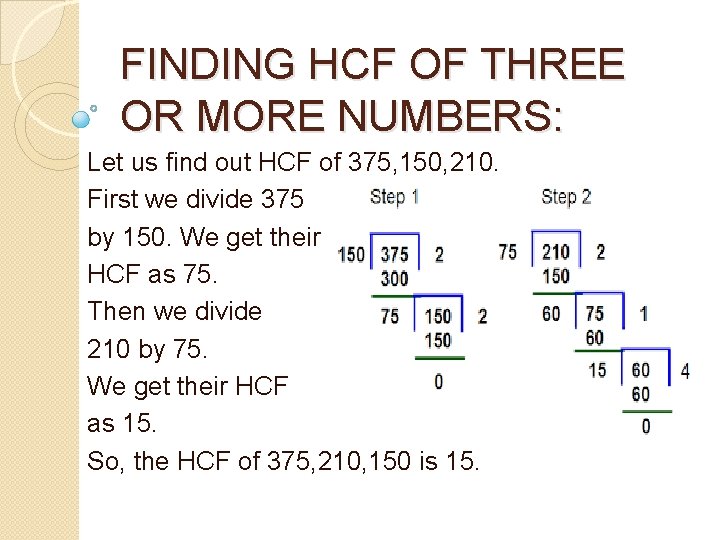
FINDING HCF OF THREE OR MORE NUMBERS: Let us find out HCF of 375, 150, 210. First we divide 375 by 150. We get their HCF as 75. Then we divide 210 by 75. We get their HCF as 15. So, the HCF of 375, 210, 150 is 15.
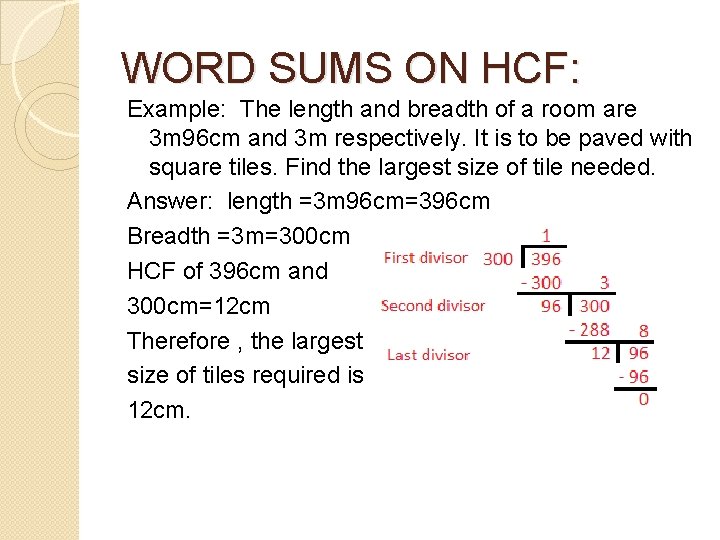
WORD SUMS ON HCF: Example: The length and breadth of a room are 3 m 96 cm and 3 m respectively. It is to be paved with square tiles. Find the largest size of tile needed. Answer: length =3 m 96 cm=396 cm Breadth =3 m=300 cm HCF of 396 cm and 300 cm=12 cm Therefore , the largest size of tiles required is 12 cm.
LEAST COMMON MULTIPLE: �FINDING LCM BY LISTING MULTIPLES: �Lets find out the LCM of 12 and 16. �The multiples of 12 are 12, 24, 36, 48, 60. . . �The multiples of 16 are 16, 32, 48, 64, . . . . �The common multiples are 48, 96, . . . �The Lowest Common Multiple is 48.
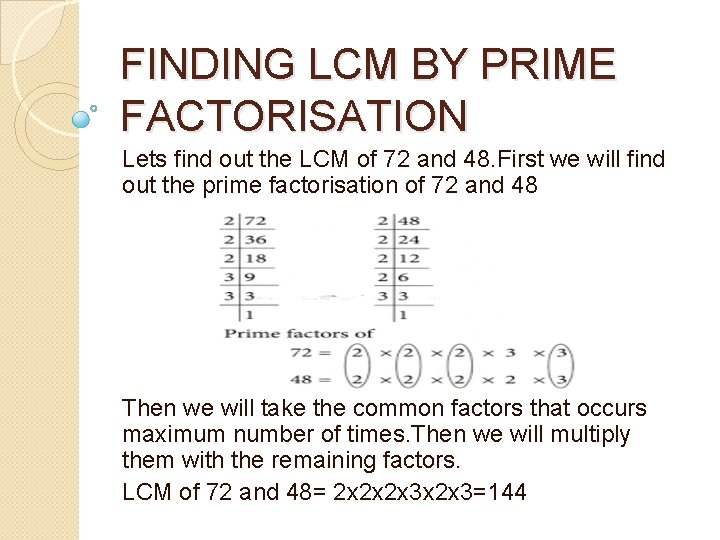
FINDING LCM BY PRIME FACTORISATION Lets find out the LCM of 72 and 48. First we will find out the prime factorisation of 72 and 48 Then we will take the common factors that occurs maximum number of times. Then we will multiply them with the remaining factors. LCM of 72 and 48= 2 x 2 x 2 x 3=144
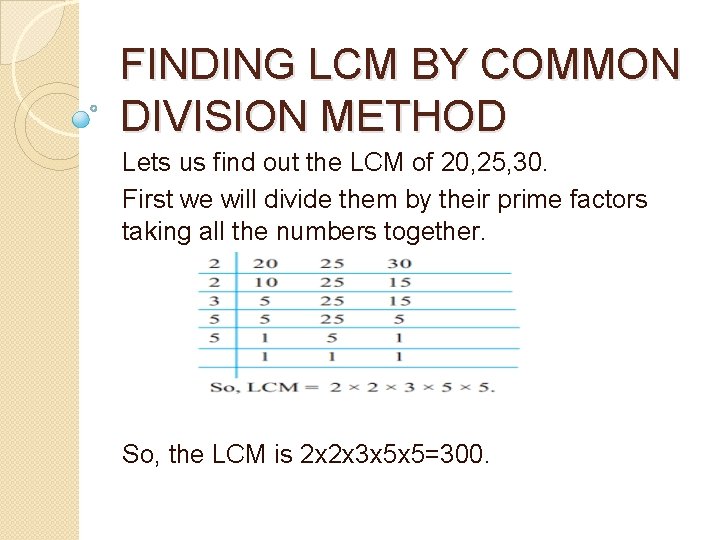
FINDING LCM BY COMMON DIVISION METHOD Lets us find out the LCM of 20, 25, 30. First we will divide them by their prime factors taking all the numbers together. So, the LCM is 2 x 2 x 3 x 5 x 5=300.
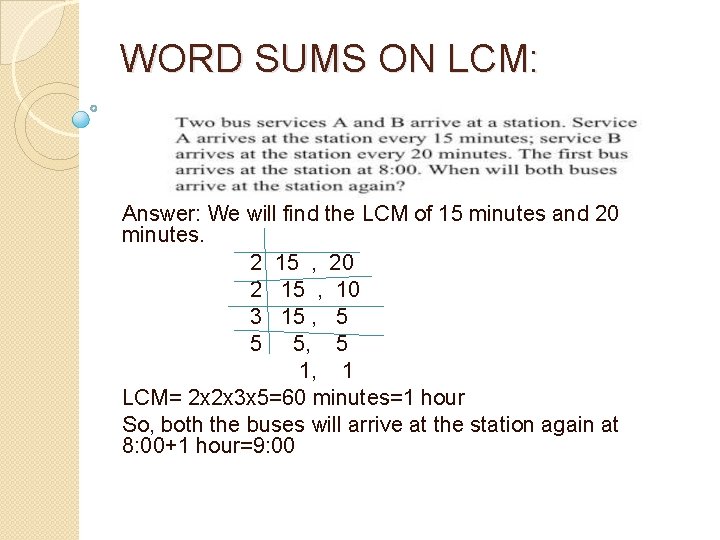
WORD SUMS ON LCM: Answer: We will find the LCM of 15 minutes and 20 minutes. 2 15 , 20 2 15 , 10 3 15 , 5 5 5, 5 1, 1 LCM= 2 x 2 x 3 x 5=60 minutes=1 hour So, both the buses will arrive at the station again at 8: 00+1 hour=9: 00
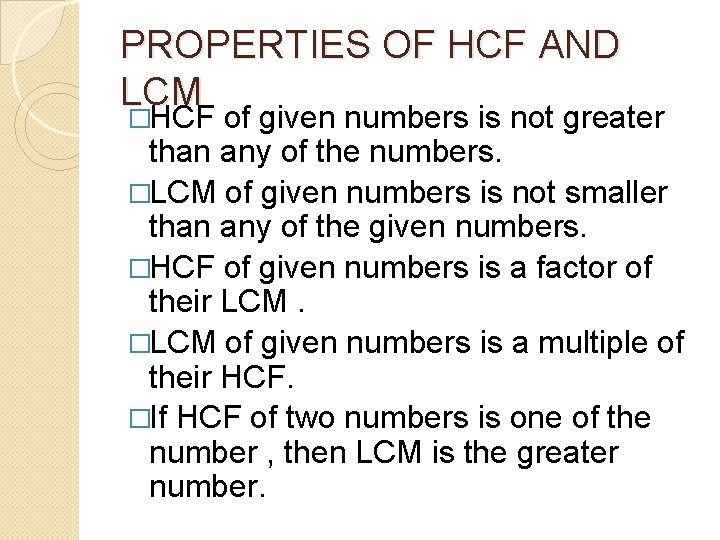
PROPERTIES OF HCF AND LCM �HCF of given numbers is not greater than any of the numbers. �LCM of given numbers is not smaller than any of the given numbers. �HCF of given numbers is a factor of their LCM. �LCM of given numbers is a multiple of their HCF. �If HCF of two numbers is one of the number , then LCM is the greater number.
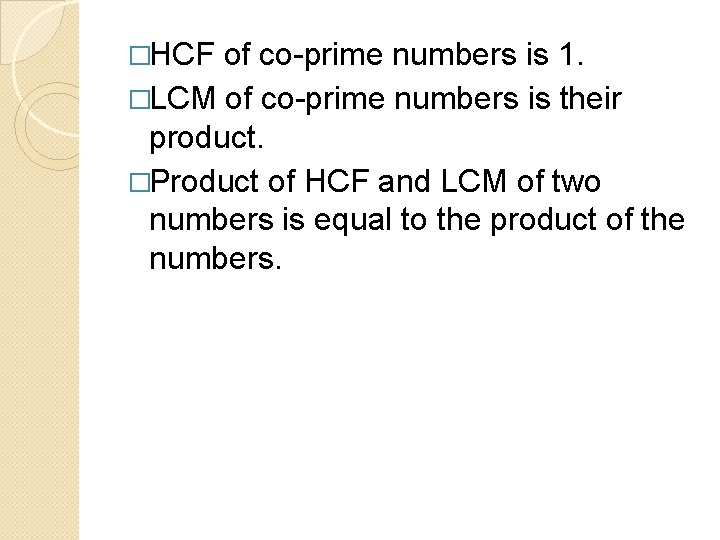
�HCF of co-prime numbers is 1. �LCM of co-prime numbers is their product. �Product of HCF and LCM of two numbers is equal to the product of the numbers.
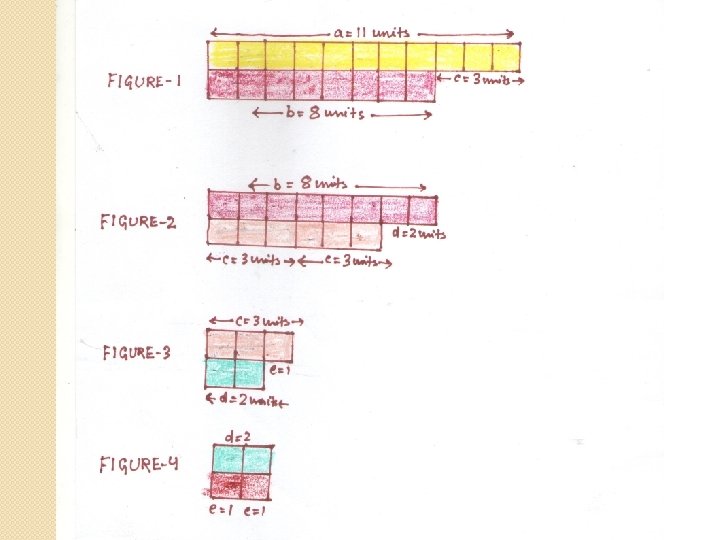
ACTIVITY: � � � � � � By paper cutting method find out the HCF of two numbers. Aim To find the HCF of two numbers experimentally based on Euclid's division lemma. Material Required Square sheet and maths kit. Procedure 1. Cut one strip of length “a” units (a=11 cm) and one strip of length “b” units (b=8 cm) of width 1 cm each (a>b). 2. Paste the strips of length “a” units above the strip of length “b” units aligning them from length as shown in fig 1. The remaining length is say c cm (c=3 cm, b>c). 3. Cut another strip of length b units and 2 strips of c units. Paste the strip of b units above the strips of c unit aligning them from left ad shown in fig 2. The remaining length is say d cm. (d=2 cm, d<c) 4. Repeat the process till the length proceeding strips covered completely and second strip which covers the proceeding strips is the HCF of given number (fig 4). Observation By Euclid's division lemma a=bq+r, 0≤r<b Fig 1. Shows a=b× 1+c (q=1, r=c) Fig 2. shows b=c× 2+d (q=2, r=d) Fig 3. shows c=d× 1+e (q=1, r=e) Fig 4. shows d=e× 2+0 (q=2, r=0) H. C. F. of a and b is e. Here, a=11 cm, b=8 cm, c=3 cm, d=2 cm and e=1 cm H. C. F of 11 and 8 is 1. Conclusion Euclid's division lemma can be used for finding the HCF of two or more numbers.
PROJECT: �List 10 examples of daily life situations in your surroundings where you have to apply the concepts of HCF and LCM. �Find out more about Abundant numbers.
ART INTEGRATION:
ART INTEGRATION:
SUMMARISATION OF THE CHAPTER: � Two prime numbers whose difference is 2 are called as twin prime numbers. � Two numbers are said to be co-prime when they have only 1 as common factor. � Every number has infinite number of multiples and finite number of factors. � A number is divisible by another number if it is divisible by its co-prime factors. � If a number is divisible by two co-prime numbers , then it is divisible by by their product. � If two given numbers are divisible by a number , then their sum is divisible by that number. � If two given numbers are divisible by a number , then their difference is also divisible by that number. � Prime factorisation of a number is the factorisation in which every factor is a prime number.
�HCF is also known as Greatest Common Divisor. �Product of HCF and LCM of two numbers is equal to product of the numbers. �HCF of given numbers is not greater than any of the numbers. �LCM of given numbers is not smaller than any of the numbers.
LEARNING OUTCOMES: After learning this chapter , students are able to : (a) Know more about factors and multiples. (b) Find out HCF and LCM using different methods. (c) Solve various word sums based on HCF and LCM. (d) Know more about the properties of HCF and LCM and the relation between them. (e) Create innovative ideas related to HCF and LCM. (f) Apply the skills of HCF and LCM in their daily life situations and higher studies.
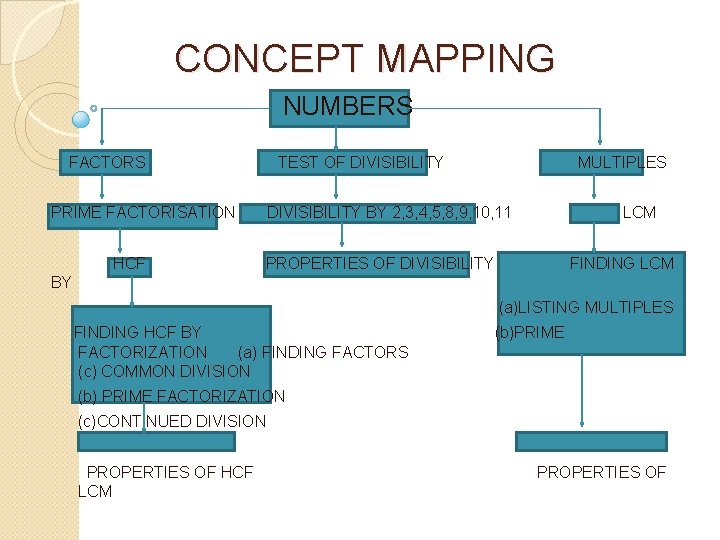
CONCEPT MAPPING NUMBERS FACTORS TEST OF DIVISIBILITY PRIME FACTORISATION HCF MULTIPLES DIVISIBILITY BY 2, 3, 4, 5, 8, 9, 10, 11 LCM PROPERTIES OF DIVISIBILITY FINDING LCM BY (a)LISTING MULTIPLES FINDING HCF BY FACTORIZATION (a) FINDING FACTORS (c) COMMON DIVISION (b)PRIME (b) PRIME FACTORIZATION (c)CONTINUED DIVISION PROPERTIES OF HCF LCM PROPERTIES OF

- Slides: 38