
FACTORS INFLUENCING MALAYSIAN STUDENTS INTENTION TO STUDY AT


- Slides: 25
FACTORS INFLUENCING MALAYSIAN STUDENTS’ INTENTION TO STUDY AT A HIGHER EDUCATIONAL INSTITUTION 1 Presented By: Prof Dr Karl Wagner Pooyan Yousefi Fard
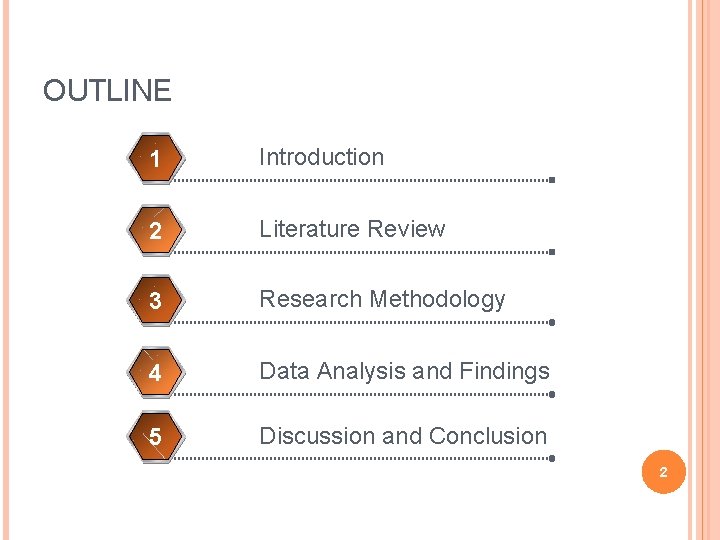
OUTLINE 1 Introduction 2 Literature Review 3 Research Methodology 4 Data Analysis and Findings 5 Discussion and Conclusion 2
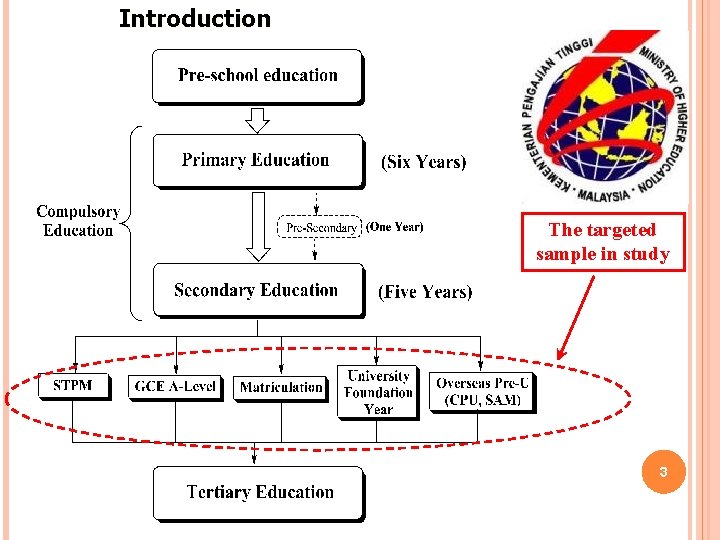
Introduction The targeted sample in study 3
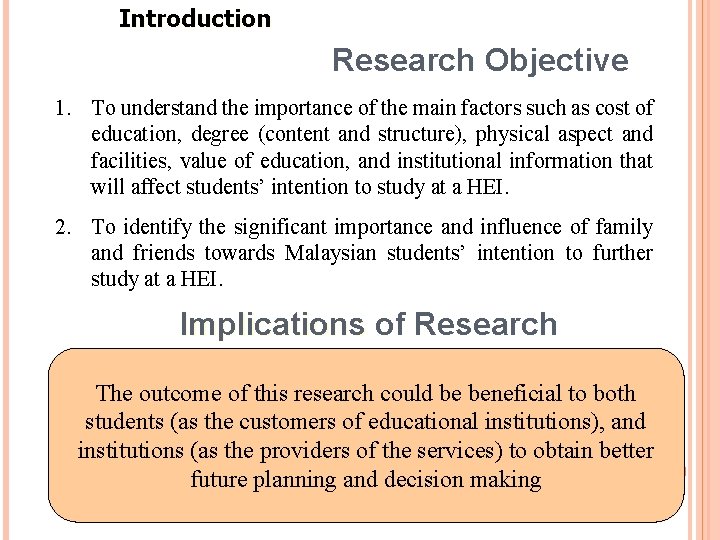
Introduction Research Objective 1. To understand the importance of the main factors such as cost of education, degree (content and structure), physical aspect and facilities, value of education, and institutional information that will affect students’ intention to study at a HEI. 2. To identify the significant importance and influence of family and friends towards Malaysian students’ intention to further study at a HEI. Implications of Research The outcome of this research could be beneficial to both students (as the customers of educational institutions), and institutions (as the providers of the services) to obtain better 4 future planning and decision making
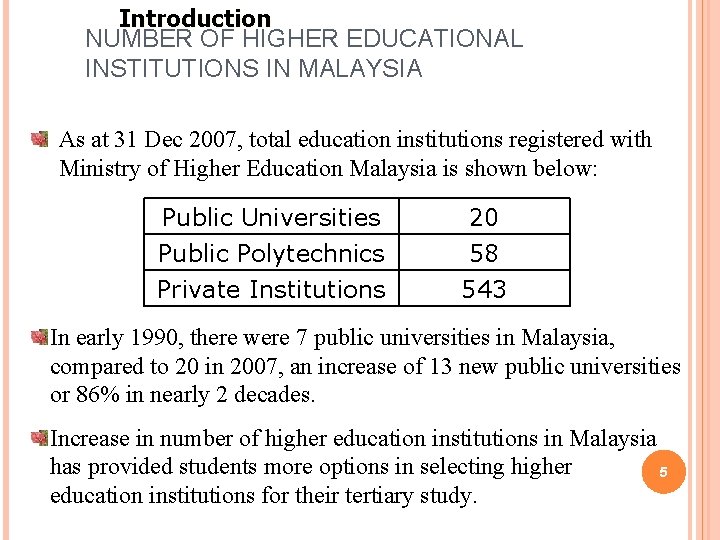
Introduction NUMBER OF HIGHER EDUCATIONAL INSTITUTIONS IN MALAYSIA As at 31 Dec 2007, total education institutions registered with Ministry of Higher Education Malaysia is shown below: Public Universities Public Polytechnics Private Institutions 20 58 543 In early 1990, there were 7 public universities in Malaysia, compared to 20 in 2007, an increase of 13 new public universities or 86% in nearly 2 decades. Increase in number of higher education institutions in Malaysia has provided students more options in selecting higher 5 education institutions for their tertiary study.
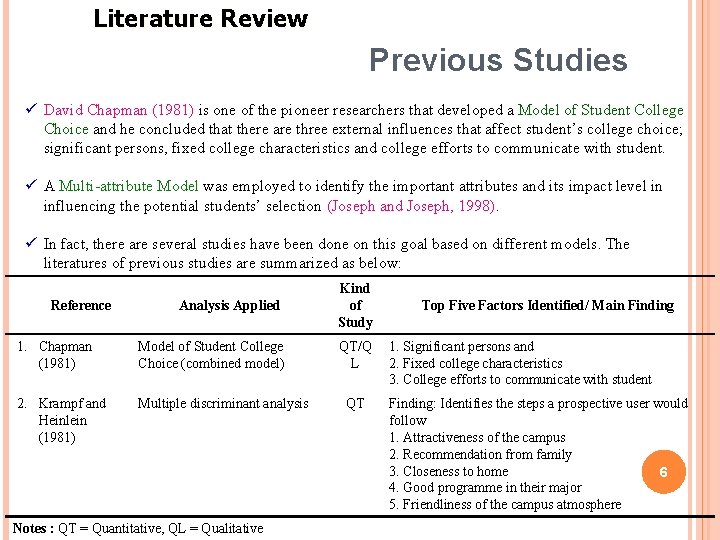
Literature Review Previous Studies ü David Chapman (1981) is one of the pioneer researchers that developed a Model of Student College Choice and he concluded that there are three external influences that affect student’s college choice; significant persons, fixed college characteristics and college efforts to communicate with student. ü A Multi-attribute Model was employed to identify the important attributes and its impact level in influencing the potential students’ selection (Joseph and Joseph, 1998). ü In fact, there are several studies have been done on this goal based on different models. The literatures of previous studies are summarized as below: Analysis Applied Kind of Study 1. Chapman (1981) Model of Student College Choice (combined model) QT/Q L 2. Krampf and Heinlein (1981) Multiple discriminant analysis Reference Notes : QT = Quantitative, QL = Qualitative QT Top Five Factors Identified/ Main Finding 1. Significant persons and 2. Fixed college characteristics 3. College efforts to communicate with student Finding: Identifies the steps a prospective user would follow 1. Attractiveness of the campus 2. Recommendation from family 3. Closeness to home 6 4. Good programme in their major 5. Friendliness of the campus atmosphere
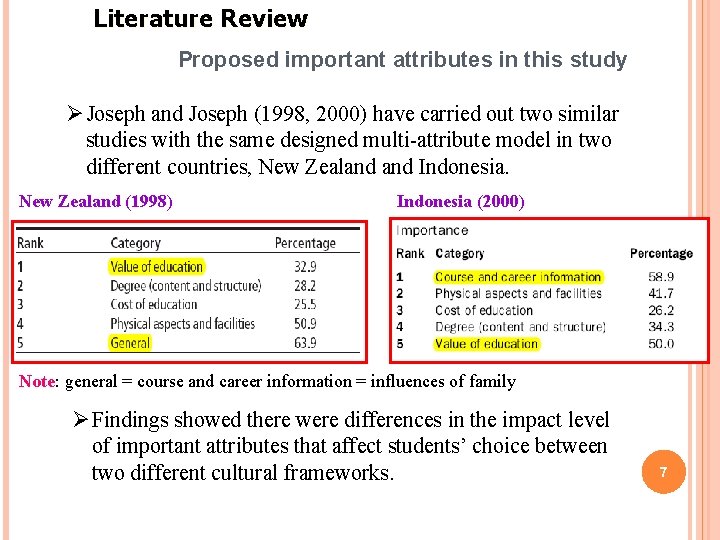
Literature Review Proposed important attributes in this study ØJoseph and Joseph (1998, 2000) have carried out two similar studies with the same designed multi-attribute model in two different countries, New Zealand Indonesia. New Zealand (1998) Indonesia (2000) Note: general = course and career information = influences of family ØFindings showed there were differences in the impact level of important attributes that affect students’ choice between two different cultural frameworks. 7
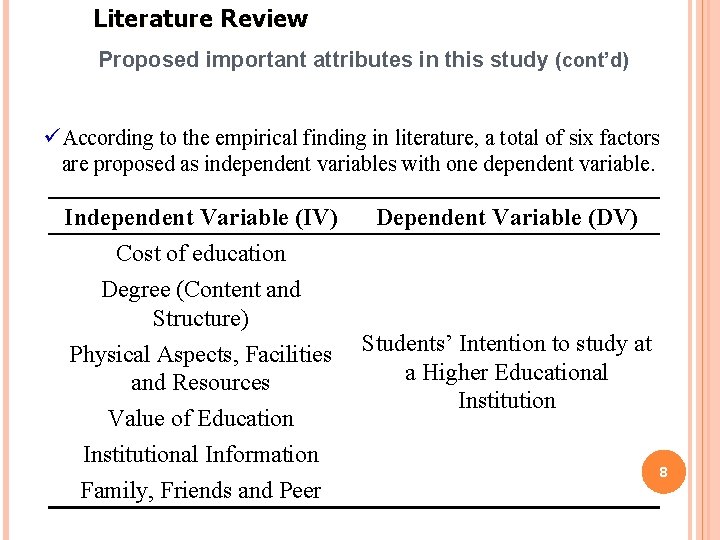
Literature Review Proposed important attributes in this study (cont’d) ü According to the empirical finding in literature, a total of six factors are proposed as independent variables with one dependent variable. Independent Variable (IV) Cost of education Degree (Content and Structure) Physical Aspects, Facilities and Resources Value of Education Institutional Information Family, Friends and Peer Dependent Variable (DV) Students’ Intention to study at a Higher Educational Institution 8
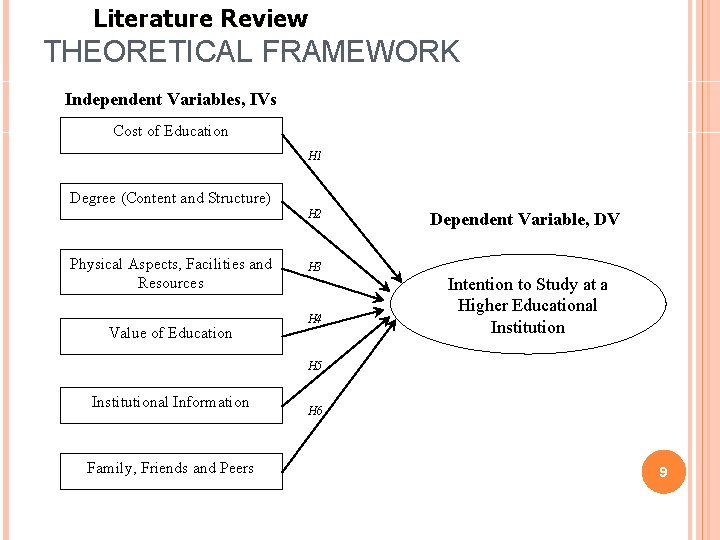
Literature Review THEORETICAL FRAMEWORK Independent Variables, IVs Cost of Education H 1 Degree (Content and Structure) H 2 Physical Aspects, Facilities and Resources Value of Education Dependent Variable, DV H 3 H 4 Intention to Study at a Higher Educational Institution H 5 Institutional Information Family, Friends and Peers H 6 9
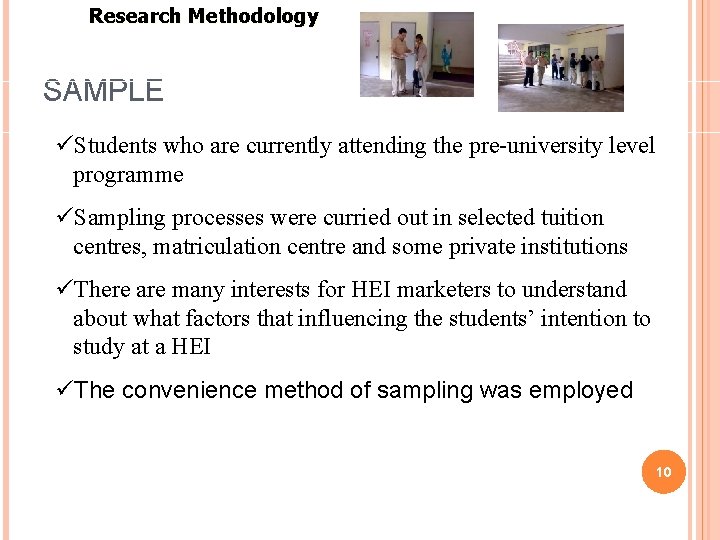
Research Methodology SAMPLE üStudents who are currently attending the pre-university level programme üSampling processes were curried out in selected tuition centres, matriculation centre and some private institutions üThere are many interests for HEI marketers to understand about what factors that influencing the students’ intention to study at a HEI üThe convenience method of sampling was employed 10
Research Methodology Instrument Design The instrument to gain primary data is a self-administered questionnaire containing three sections: I. The importance of factors influencing respondents’ intention to study at a HEI (six IVs) and respondents’ intention to study one potential Dependent Variable). Responses to the items were measured on a five-point Likert scale where 1 meant “Strongly Disagree” and 5 meant “Strongly Agree”. II. The ranking of most important attributes. III. Demographics. Completed by face to face interviews and self-administered questionnaire survey. 11
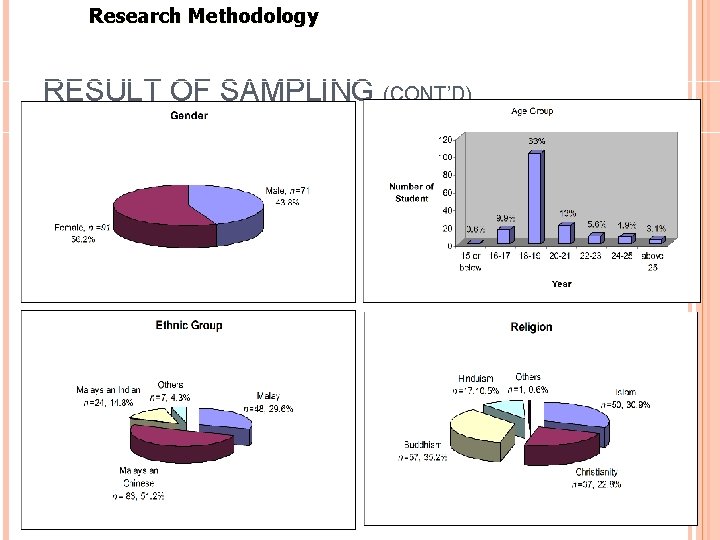
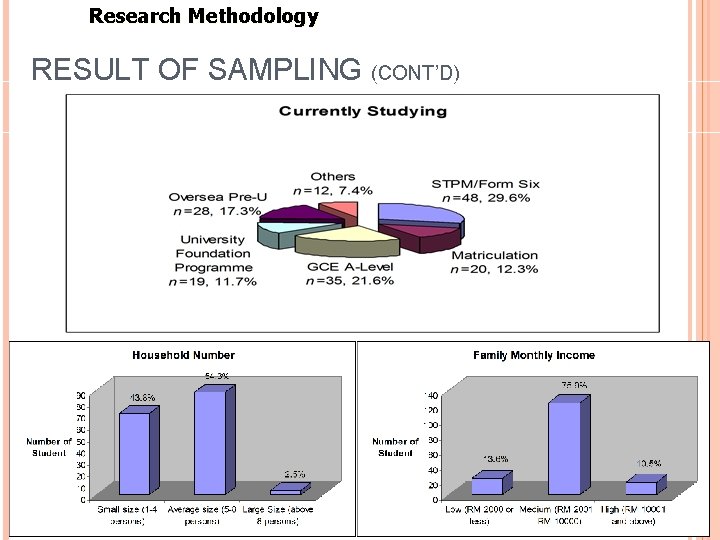
Research Methodology RESULT OF SAMPLING (CONT’D) 12
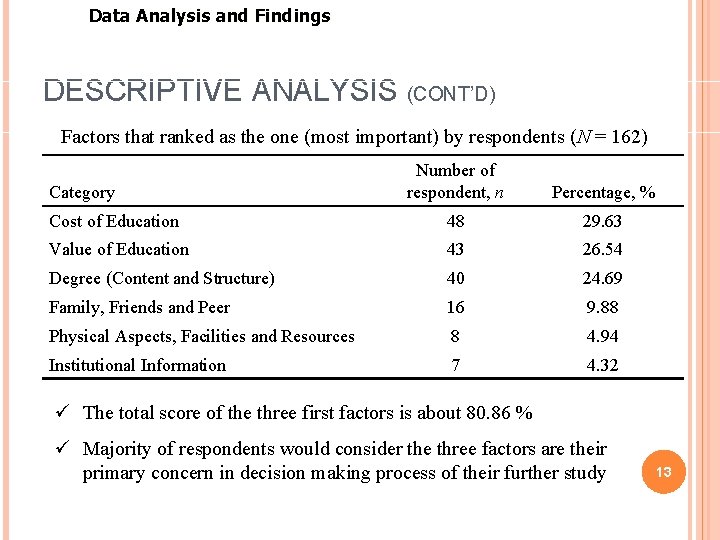
Data Analysis and Findings DESCRIPTIVE ANALYSIS (CONT’D) Factors that ranked as the one (most important) by respondents (N = 162) Number of respondent, n Percentage, % Cost of Education 48 29. 63 Value of Education 43 26. 54 Degree (Content and Structure) 40 24. 69 Family, Friends and Peer 16 9. 88 Physical Aspects, Facilities and Resources 8 4. 94 Institutional Information 7 4. 32 Category ü The total score of the three first factors is about 80. 86 % ü Majority of respondents would consider the three factors are their primary concern in decision making process of their further study 13
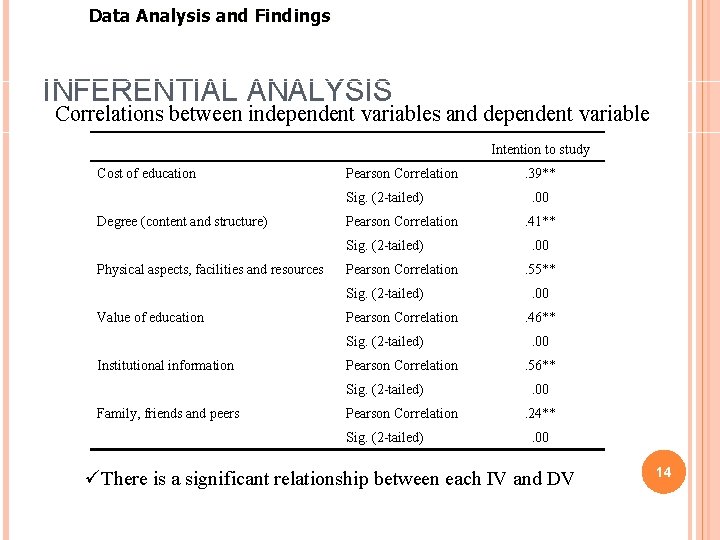
Data Analysis and Findings INFERENTIAL ANALYSIS Correlations between independent variables and dependent variable Intention to study Cost of education Pearson Correlation Sig. (2 -tailed) Degree (content and structure) Pearson Correlation Sig. (2 -tailed) Physical aspects, facilities and resources Pearson Correlation Sig. (2 -tailed) Value of education Pearson Correlation Sig. (2 -tailed) Institutional information Pearson Correlation Sig. (2 -tailed) Family, friends and peers Pearson Correlation Sig. (2 -tailed) . 39**. 00. 41**. 00. 55**. 00. 46**. 00. 56**. 00. 24**. 00 üThere is a significant relationship between each IV and DV 14
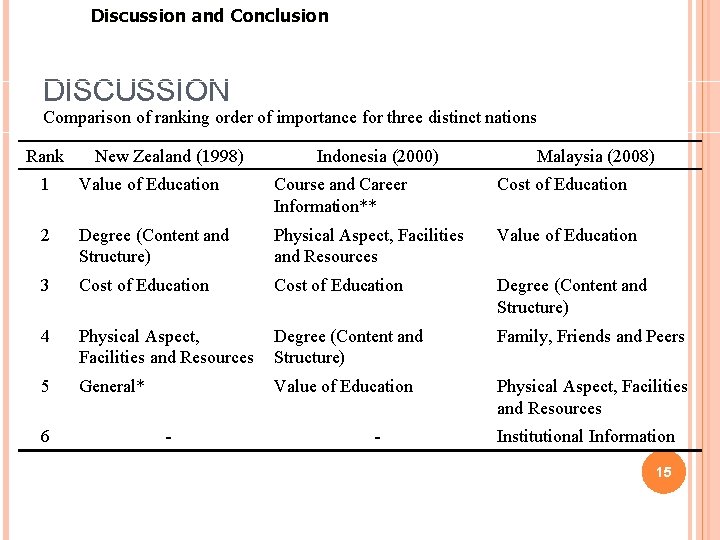
Discussion and Conclusion DISCUSSION Comparison of ranking order of importance for three distinct nations Rank New Zealand (1998) Indonesia (2000) Malaysia (2008) 1 Value of Education Course and Career Information** Cost of Education 2 Degree (Content and Structure) Physical Aspect, Facilities and Resources Value of Education 3 Cost of Education Degree (Content and Structure) 4 Physical Aspect, Facilities and Resources Degree (Content and Structure) Family, Friends and Peers 5 General* Value of Education Physical Aspect, Facilities and Resources 6 - - Institutional Information 15
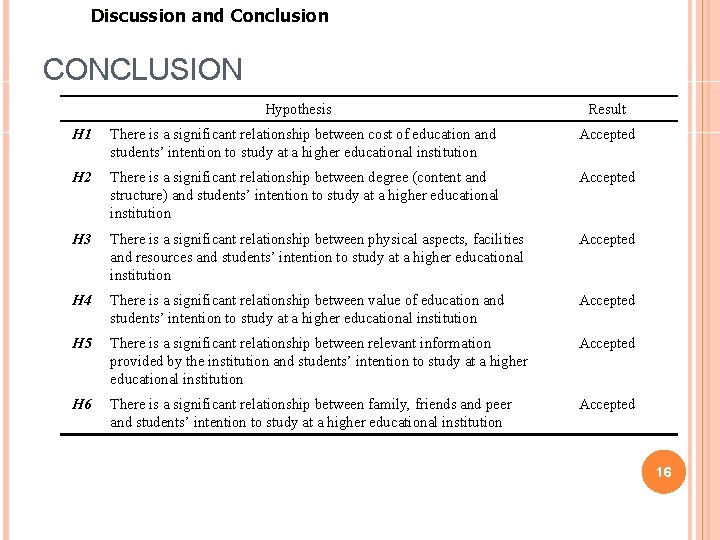
Discussion and Conclusion CONCLUSION Hypothesis Result H 1 There is a significant relationship between cost of education and students’ intention to study at a higher educational institution Accepted H 2 There is a significant relationship between degree (content and structure) and students’ intention to study at a higher educational institution Accepted H 3 There is a significant relationship between physical aspects, facilities and resources and students’ intention to study at a higher educational institution Accepted H 4 There is a significant relationship between value of education and students’ intention to study at a higher educational institution Accepted H 5 There is a significant relationship between relevant information provided by the institution and students’ intention to study at a higher educational institution Accepted H 6 There is a significant relationship between family, friends and peer and students’ intention to study at a higher educational institution Accepted 16
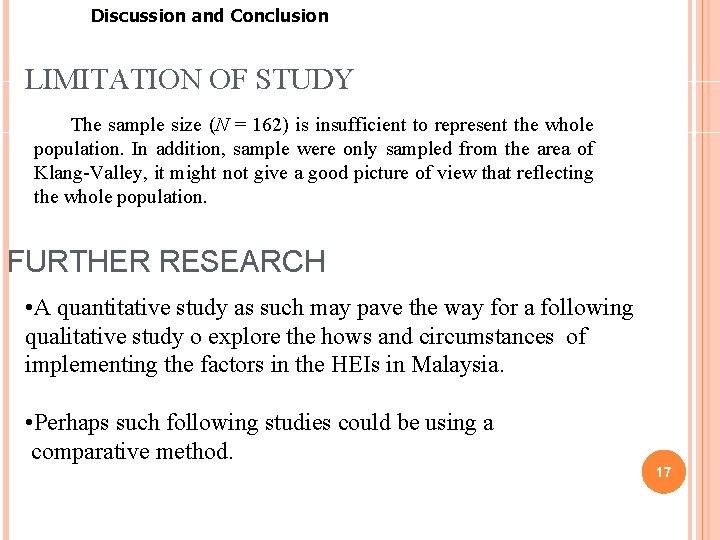
Discussion and Conclusion LIMITATION OF STUDY The sample size (N = 162) is insufficient to represent the whole population. In addition, sample were only sampled from the area of Klang-Valley, it might not give a good picture of view that reflecting the whole population. FURTHER RESEARCH • A quantitative study as such may pave the way for a following qualitative study o explore the hows and circumstances of implementing the factors in the HEIs in Malaysia. • Perhaps such following studies could be using a comparative method. 17
18
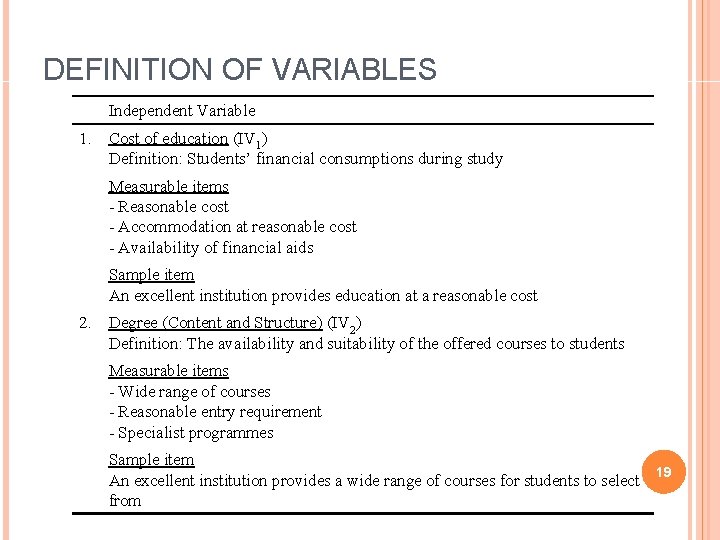
DEFINITION OF VARIABLES Independent Variable 1. Cost of education (IV 1) Definition: Students’ financial consumptions during study Measurable items - Reasonable cost - Accommodation at reasonable cost - Availability of financial aids Sample item An excellent institution provides education at a reasonable cost 2. Degree (Content and Structure) (IV 2) Definition: The availability and suitability of the offered courses to students Measurable items - Wide range of courses - Reasonable entry requirement - Specialist programmes Sample item An excellent institution provides a wide range of courses for students to select 19 from
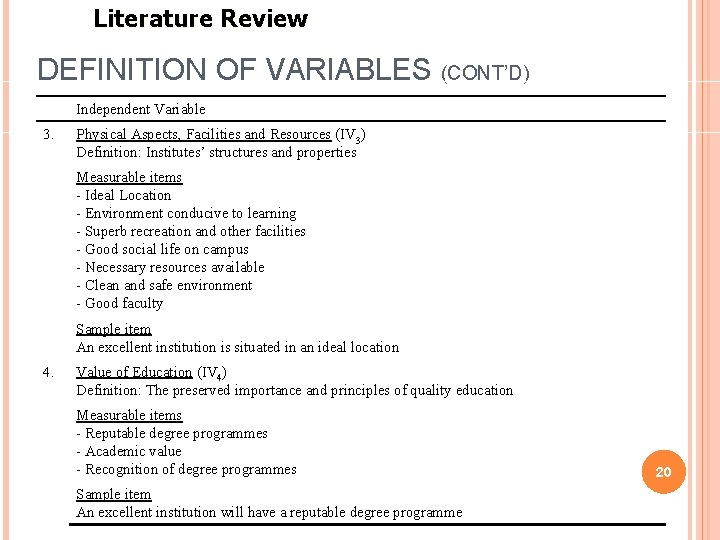
Literature Review DEFINITION OF VARIABLES (CONT’D) Independent Variable 3. Physical Aspects, Facilities and Resources (IV 3) Definition: Institutes’ structures and properties Measurable items - Ideal Location - Environment conducive to learning - Superb recreation and other facilities - Good social life on campus - Necessary resources available - Clean and safe environment - Good faculty Sample item An excellent institution is situated in an ideal location 4. Value of Education (IV 4) Definition: The preserved importance and principles of quality education Measurable items - Reputable degree programmes - Academic value - Recognition of degree programmes Sample item An excellent institution will have a reputable degree programme 20
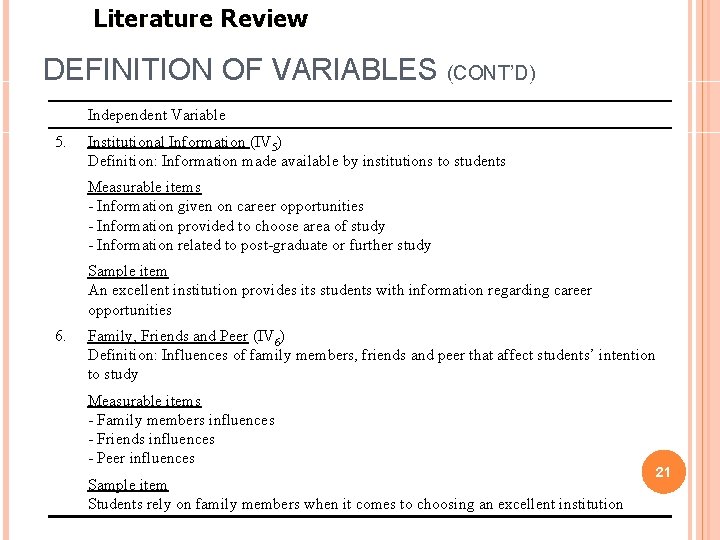
Literature Review DEFINITION OF VARIABLES (CONT’D) Independent Variable 5. Institutional Information (IV 5) Definition: Information made available by institutions to students Measurable items - Information given on career opportunities - Information provided to choose area of study - Information related to post-graduate or further study Sample item An excellent institution provides its students with information regarding career opportunities 6. Family, Friends and Peer (IV 6) Definition: Influences of family members, friends and peer that affect students’ intention to study Measurable items - Family members influences - Friends influences - Peer influences Sample item Students rely on family members when it comes to choosing an excellent institution 21
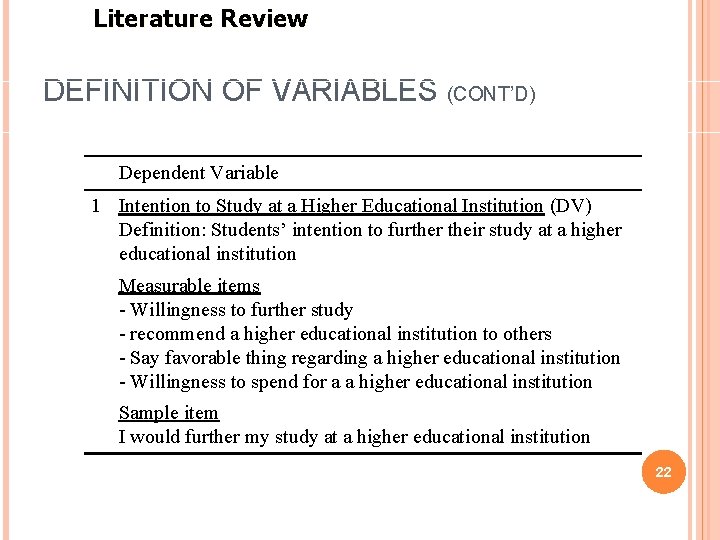
Literature Review DEFINITION OF VARIABLES (CONT’D) Dependent Variable 1 Intention to Study at a Higher Educational Institution (DV) Definition: Students’ intention to further their study at a higher educational institution Measurable items - Willingness to further study - recommend a higher educational institution to others - Say favorable thing regarding a higher educational institution - Willingness to spend for a a higher educational institution Sample item I would further my study at a higher educational institution 22
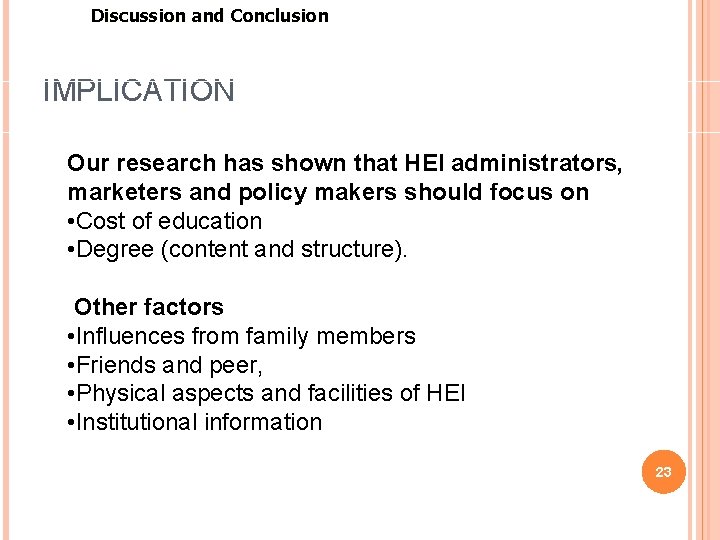
Discussion and Conclusion IMPLICATION Our research has shown that HEI administrators, marketers and policy makers should focus on • Cost of education • Degree (content and structure). Other factors • Influences from family members • Friends and peer, • Physical aspects and facilities of HEI • Institutional information 23
Research Methodology RESULT OF SAMPLING (CONT’D) 24
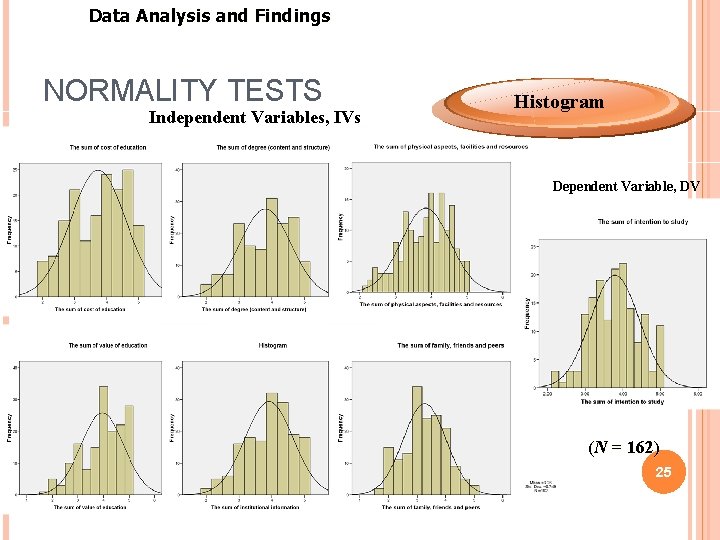
Data Analysis and Findings NORMALITY TESTS Independent Variables, IVs Histogram Dependent Variable, DV (N = 162) 25