
Factors are whole numbers not including 0 that

Factors: are whole numbers (not including 0) that are multiplied together to give a product - divides into another whole number evenly with no remainder (= NO DECIMALS!) Sometimes represented by F(x) or F(X) 5 x 2 = 10 Factors Product: is the answer to a multiplication question
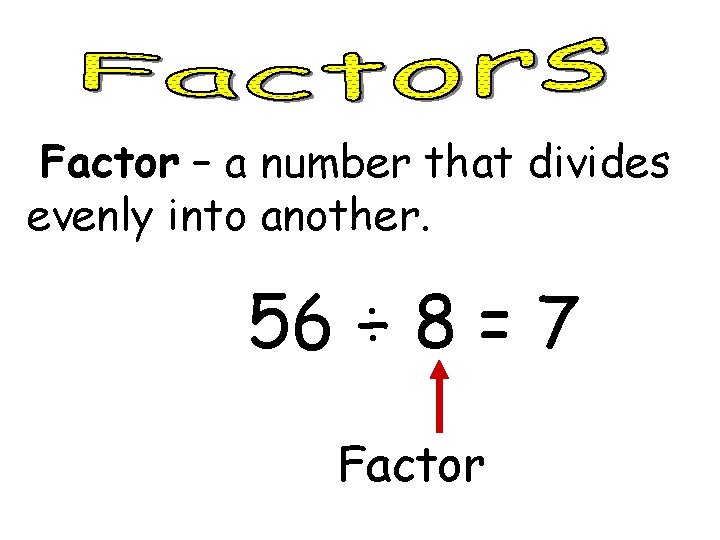
Factor – a number that divides evenly into another. 56 ÷ 8 = 7 Factor
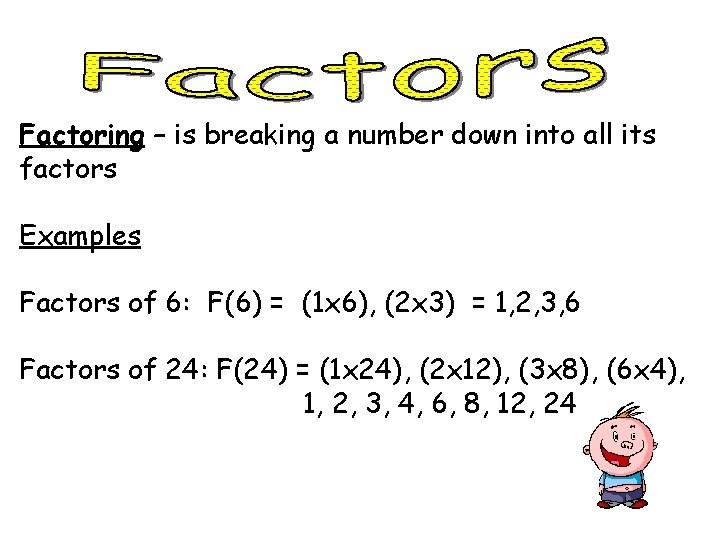
Factoring – is breaking a number down into all its factors Examples Factors of 6: F(6) = (1 x 6), (2 x 3) = 1, 2, 3, 6 Factors of 24: F(24) = (1 x 24), (2 x 12), (3 x 8), (6 x 4), 1, 2, 3, 4, 6, 8, 12, 24
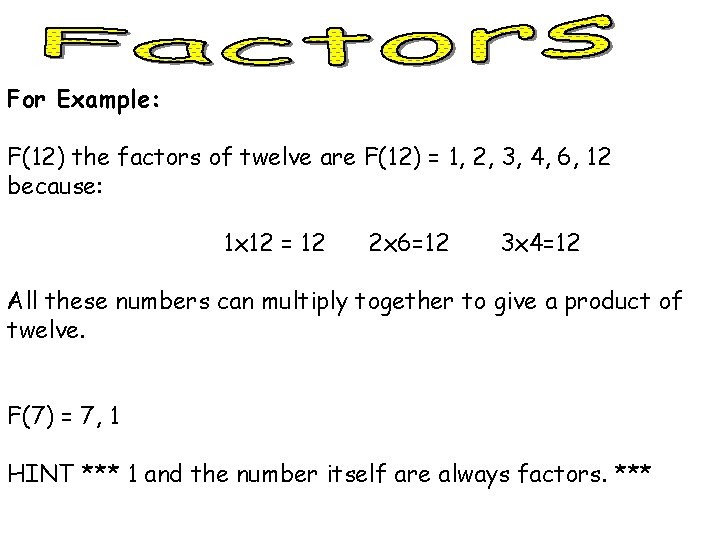
For Example: F(12) the factors of twelve are F(12) = 1, 2, 3, 4, 6, 12 because: 1 x 12 = 12 2 x 6=12 3 x 4=12 All these numbers can multiply together to give a product of twelve. F(7) = 7, 1 HINT *** 1 and the number itself are always factors. ***
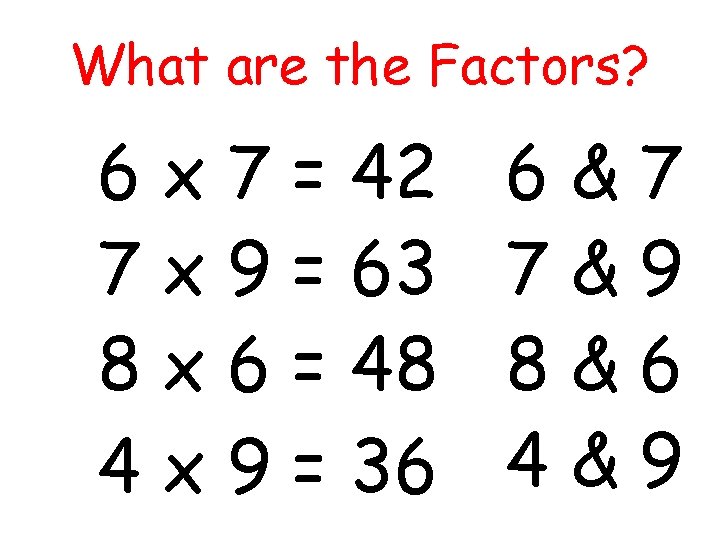
What are the Factors? 6 x 7 = 42 7 x 9 = 63 8 x 6 = 48 4 x 9 = 36 6&7 7&9 8&6 4&9
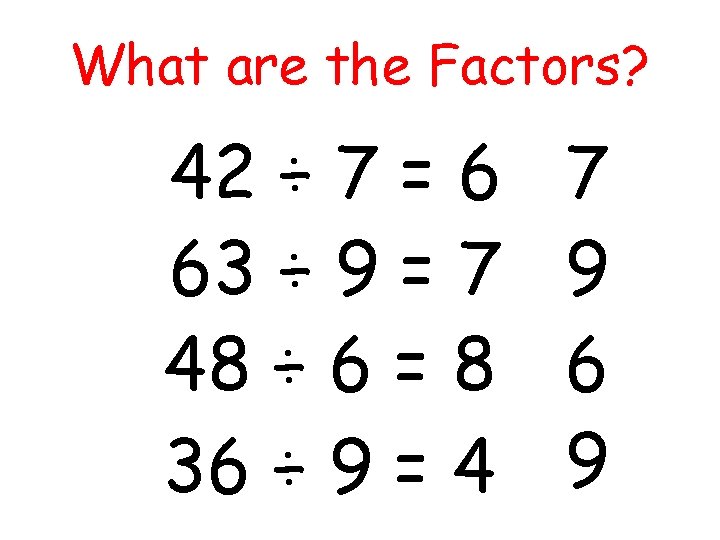
What are the Factors? 42 ÷ 7 = 6 63 ÷ 9 = 7 48 ÷ 6 = 8 36 ÷ 9 = 4 7 9 6 9
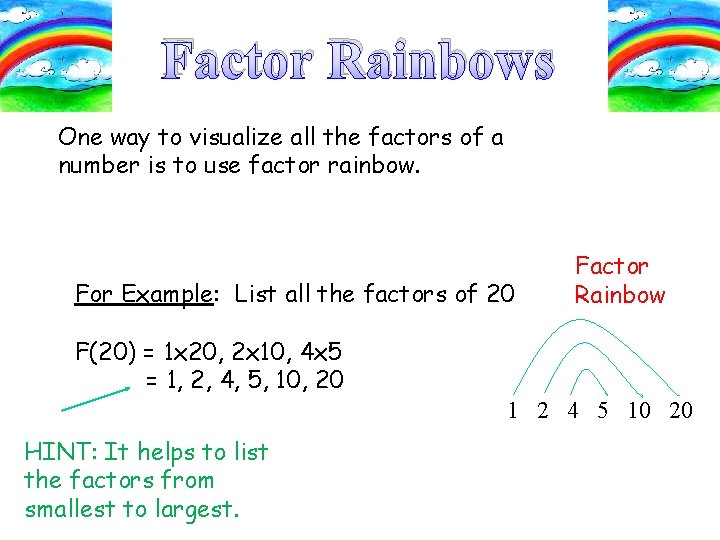
Factor Rainbows One way to visualize all the factors of a number is to use factor rainbow. For Example: List all the factors of 20 Factor Rainbow F(20) = 1 x 20, 2 x 10, 4 x 5 = 1, 2, 4, 5, 10, 20 1 2 4 5 10 20 HINT: It helps to list the factors from smallest to largest.
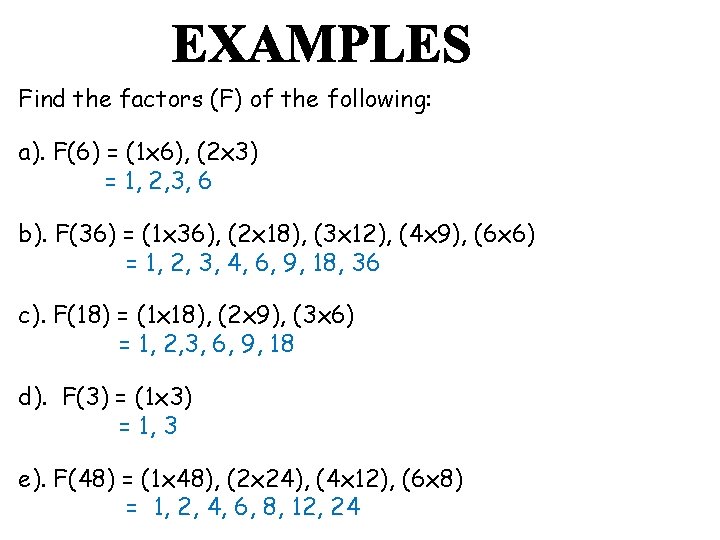
Find the factors (F) of the following: a). F(6) = (1 x 6), (2 x 3) = 1, 2, 3, 6 b). F(36) = (1 x 36), (2 x 18), (3 x 12), (4 x 9), (6 x 6) = 1, 2, 3, 4, 6, 9, 18, 36 c). F(18) = (1 x 18), (2 x 9), (3 x 6) = 1, 2, 3, 6, 9, 18 d). F(3) = (1 x 3) = 1, 3 e). F(48) = (1 x 48), (2 x 24), (4 x 12), (6 x 8) = 1, 2, 4, 6, 8, 12, 24
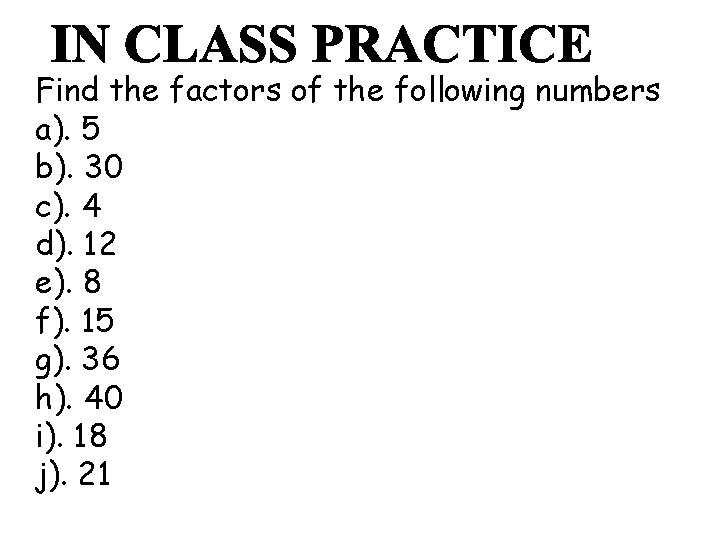
Find the factors of the following numbers a). 5 b). 30 c). 4 d). 12 e). 8 f). 15 g). 36 h). 40 i). 18 j). 21
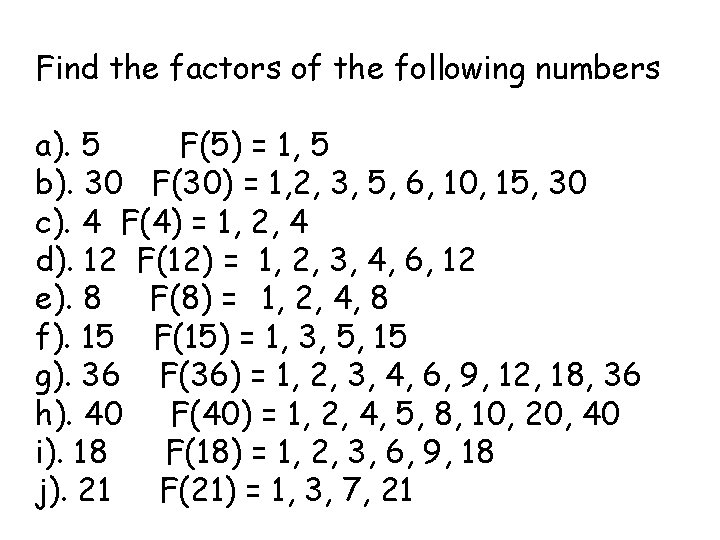
Find the factors of the following numbers a). 5 F(5) = 1, 5 b). 30 F(30) = 1, 2, 3, 5, 6, 10, 15, 30 c). 4 F(4) = 1, 2, 4 d). 12 F(12) = 1, 2, 3, 4, 6, 12 e). 8 F(8) = 1, 2, 4, 8 f). 15 F(15) = 1, 3, 5, 15 g). 36 F(36) = 1, 2, 3, 4, 6, 9, 12, 18, 36 h). 40 F(40) = 1, 2, 4, 5, 8, 10, 20, 40 i). 18 F(18) = 1, 2, 3, 6, 9, 18 j). 21 F(21) = 1, 3, 7, 21
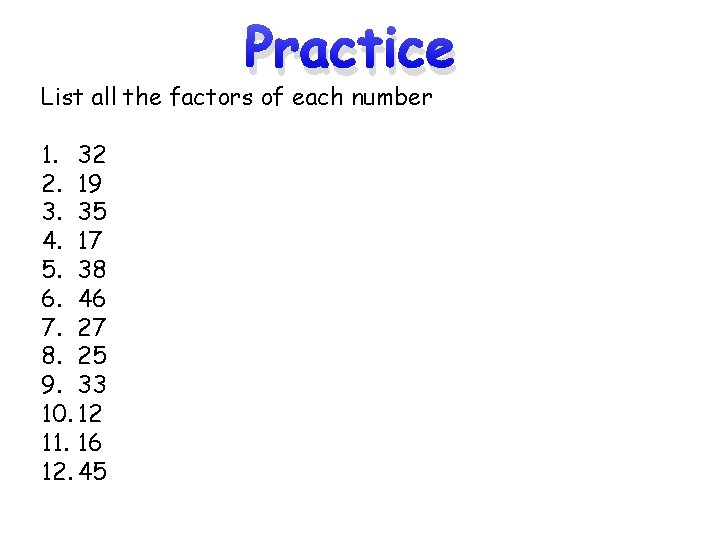
Practice List all the factors of each number 1. 32 2. 19 3. 35 4. 17 5. 38 6. 46 7. 27 8. 25 9. 33 10. 12 11. 16 12. 45
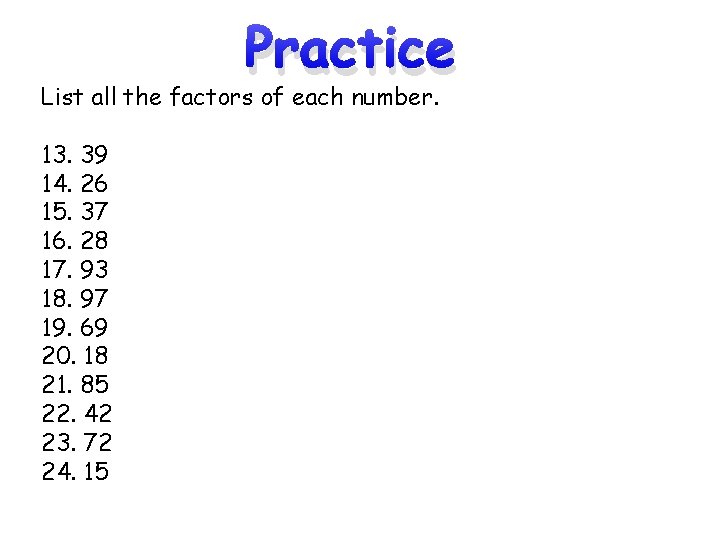
Practice List all the factors of each number. 13. 39 14. 26 15. 37 16. 28 17. 93 18. 97 19. 69 20. 18 21. 85 22. 42 23. 72 24. 15
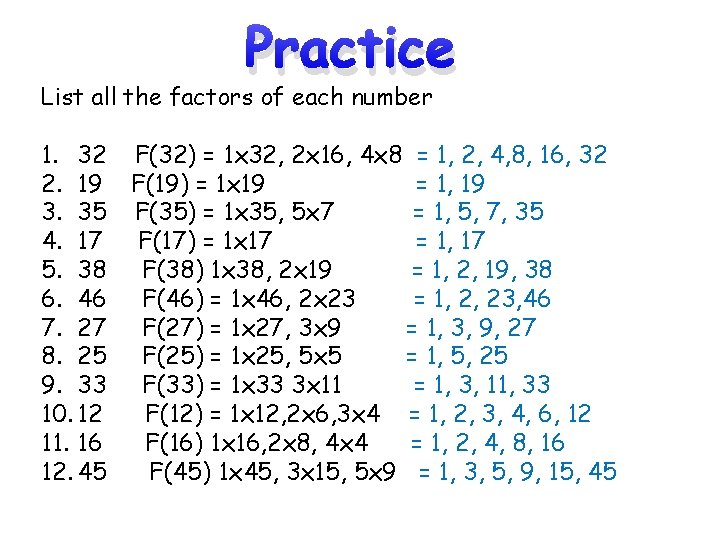
Practice List all the factors of each number 1. 32 2. 19 3. 35 4. 17 5. 38 6. 46 7. 27 8. 25 9. 33 10. 12 11. 16 12. 45 F(32) = 1 x 32, 2 x 16, 4 x 8 = 1, 2, 4, 8, 16, 32 F(19) = 1 x 19 = 1, 19 F(35) = 1 x 35, 5 x 7 = 1, 5, 7, 35 F(17) = 1 x 17 = 1, 17 F(38) 1 x 38, 2 x 19 = 1, 2, 19, 38 F(46) = 1 x 46, 2 x 23 = 1, 2, 23, 46 F(27) = 1 x 27, 3 x 9 = 1, 3, 9, 27 F(25) = 1 x 25, 5 x 5 = 1, 5, 25 F(33) = 1 x 33 3 x 11 = 1, 3, 11, 33 F(12) = 1 x 12, 2 x 6, 3 x 4 = 1, 2, 3, 4, 6, 12 F(16) 1 x 16, 2 x 8, 4 x 4 = 1, 2, 4, 8, 16 F(45) 1 x 45, 3 x 15, 5 x 9 = 1, 3, 5, 9, 15, 45
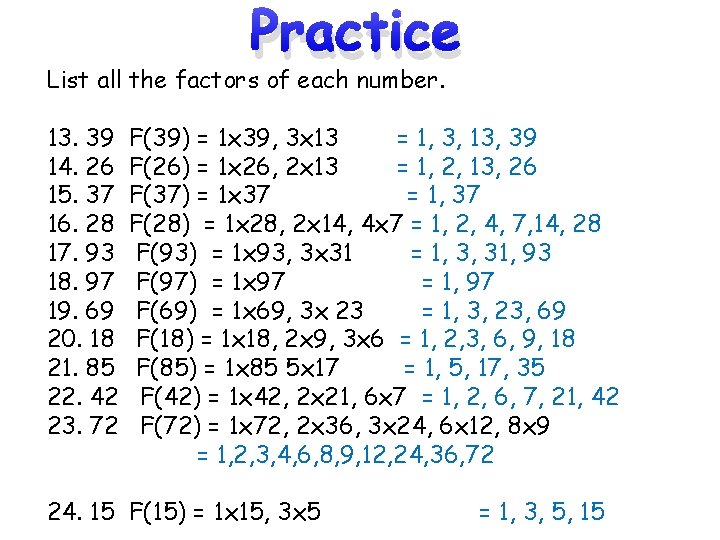
Practice List all the factors of each number. 13. 39 14. 26 15. 37 16. 28 17. 93 18. 97 19. 69 20. 18 21. 85 22. 42 23. 72 F(39) = 1 x 39, 3 x 13 = 1, 3, 13, 39 F(26) = 1 x 26, 2 x 13 = 1, 2, 13, 26 F(37) = 1 x 37 = 1, 37 F(28) = 1 x 28, 2 x 14, 4 x 7 = 1, 2, 4, 7, 14, 28 F(93) = 1 x 93, 3 x 31 = 1, 3, 31, 93 F(97) = 1 x 97 = 1, 97 F(69) = 1 x 69, 3 x 23 = 1, 3, 23, 69 F(18) = 1 x 18, 2 x 9, 3 x 6 = 1, 2, 3, 6, 9, 18 F(85) = 1 x 85 5 x 17 = 1, 5, 17, 35 F(42) = 1 x 42, 2 x 21, 6 x 7 = 1, 2, 6, 7, 21, 42 F(72) = 1 x 72, 2 x 36, 3 x 24, 6 x 12, 8 x 9 = 1, 2, 3, 4, 6, 8, 9, 12, 24, 36, 72 24. 15 F(15) = 1 x 15, 3 x 5 = 1, 3, 5, 15
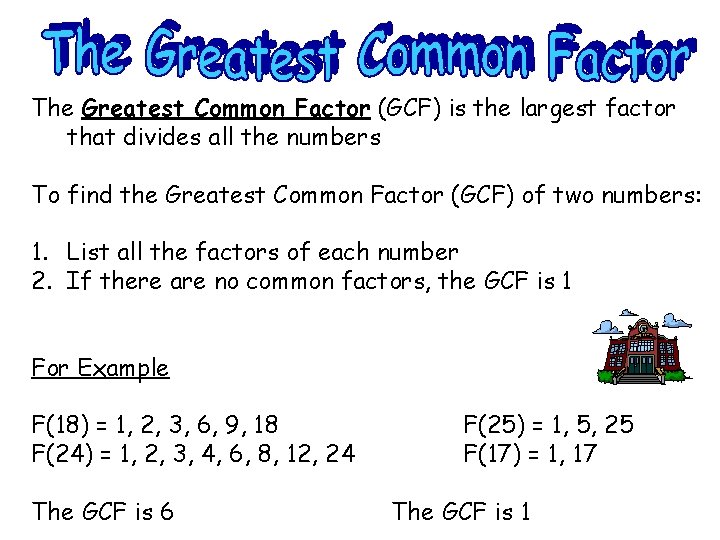
The Greatest Common Factor (GCF) is the largest factor that divides all the numbers To find the Greatest Common Factor (GCF) of two numbers: 1. List all the factors of each number 2. If there are no common factors, the GCF is 1 For Example F(18) = 1, 2, 3, 6, 9, 18 F(24) = 1, 2, 3, 4, 6, 8, 12, 24 The GCF is 6 F(25) = 1, 5, 25 F(17) = 1, 17 The GCF is 1

Class Practice Find the Greatest Common Factor of each set. 1. 12 & 15 2. 4 & 9 3. 16 & 24 4. 30 & 18 2. 12, 30 & 9 F(12) = 1, 2, 3, 4, 6, 12 The GCF = 3 F(15) = 1, 3, 5, 15
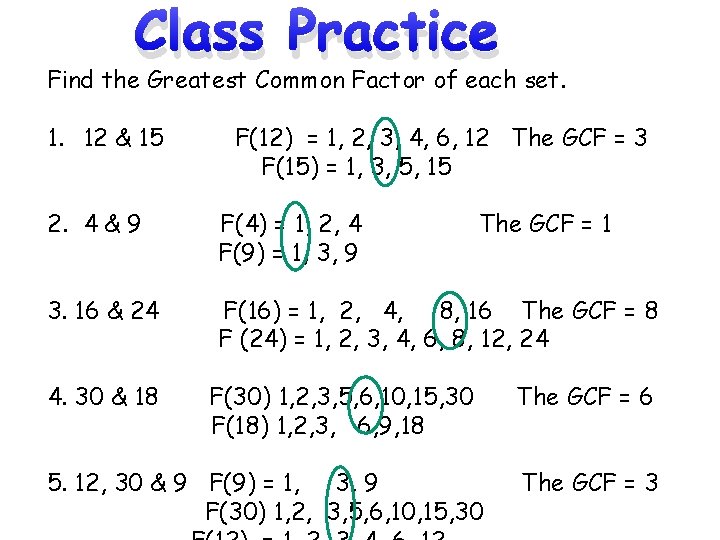
Class Practice Find the Greatest Common Factor of each set. 1. 12 & 15 F(12) = 1, 2, 3, 4, 6, 12 The GCF = 3 F(15) = 1, 3, 5, 15 2. 4 & 9 F(4) = 1, 2, 4 F(9) = 1, 3, 9 3. 16 & 24 F(16) = 1, 2, 4, 8, 16 The GCF = 8 F (24) = 1, 2, 3, 4, 6, 8, 12, 24 4. 30 & 18 The GCF = 1 F(30) 1, 2, 3, 5, 6, 10, 15, 30 F(18) 1, 2, 3, 6, 9, 18 5. 12, 30 & 9 F(9) = 1, 3, 9 F(30) 1, 2, 3, 5, 6, 10, 15, 30 The GCF = 6 The GCF = 3
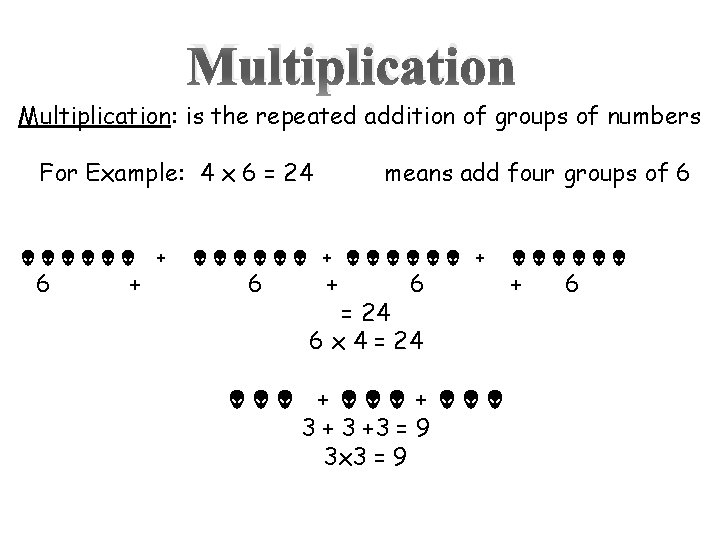
Multiplication: is the repeated addition of groups of numbers For Example: 4 x 6 = 24 + 6 + means add four groups of 6 + + 6 = 24 6 x 4 = 24 + + 3 +3 = 9 3 x 3 = 9 + 6
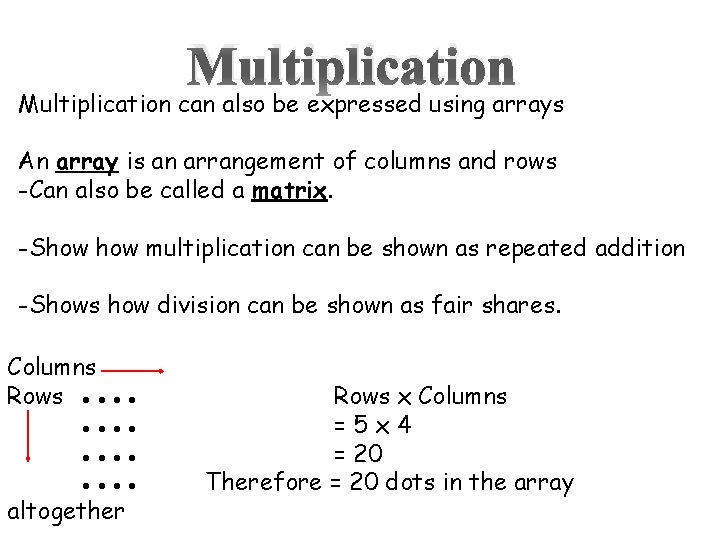
Multiplication can also be expressed using arrays An array is an arrangement of columns and rows -Can also be called a matrix. -Show multiplication can be shown as repeated addition -Shows how division can be shown as fair shares. Columns Rows ●●●● altogether Rows x Columns =5 x 4 = 20 Therefore = 20 dots in the array
Rectangles Question Find all the possible whole number lengths and widths of rectangles with each area (A=Length x Width) given below. a) 12 cm 2 b) 20 cm 2 c) 17 cm 2 d) 24 cm 2 How could you show your work?
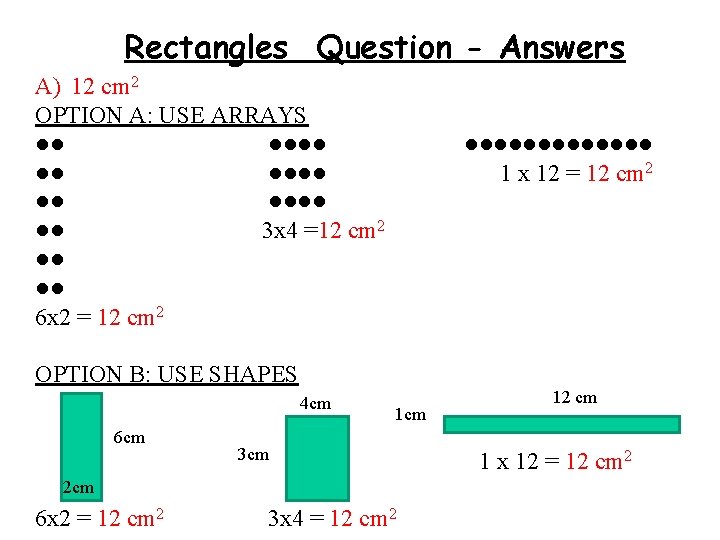
Rectangles Question - Answers A) 12 cm 2 OPTION A: USE ARRAYS ●● ●●●● ●● ●● 3 x 4 =12 cm 2 ●● ●● 6 x 2 = 12 cm 2 ●●●●●●● 1 x 12 = 12 cm 2 OPTION B: USE SHAPES 4 cm 6 cm 1 cm 3 cm 2 cm 6 x 2 = 12 cm 2 3 x 4 = 12 cm 2 12 cm 1 x 12 = 12 cm 2
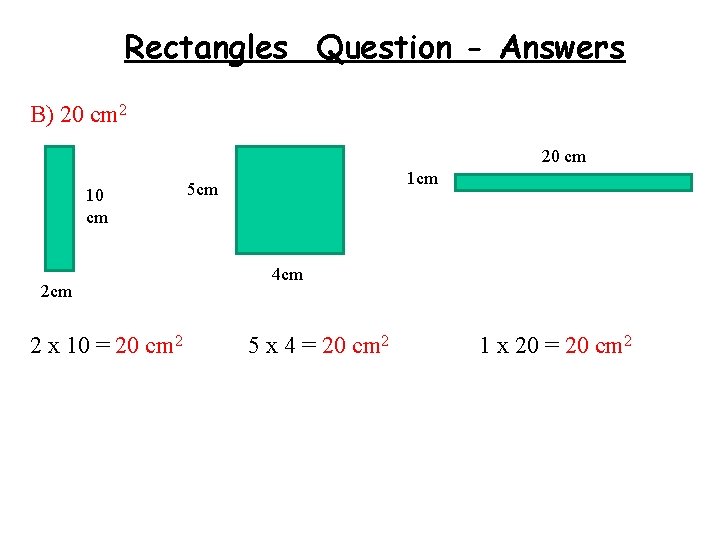
Rectangles Question - Answers B) 20 cm 2 20 cm 10 cm 2 x 10 = 20 cm 2 1 cm 5 cm 4 cm 5 x 4 = 20 cm 2 1 x 20 = 20 cm 2
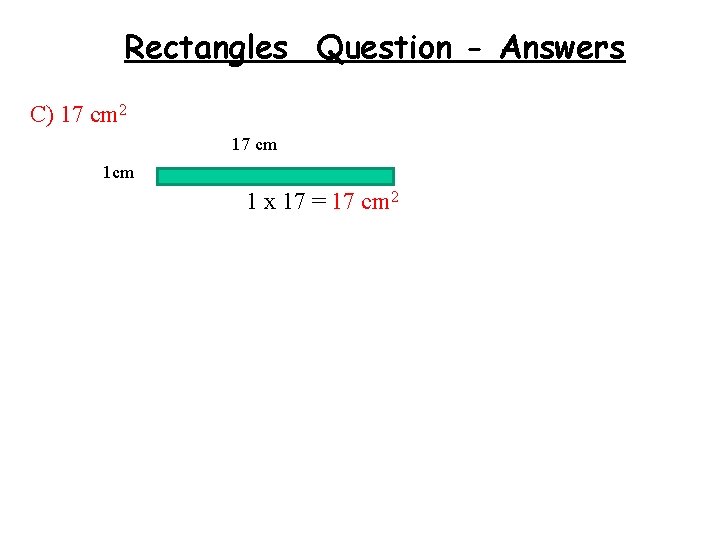
Rectangles Question - Answers C) 17 cm 2 17 cm 1 x 17 = 17 cm 2
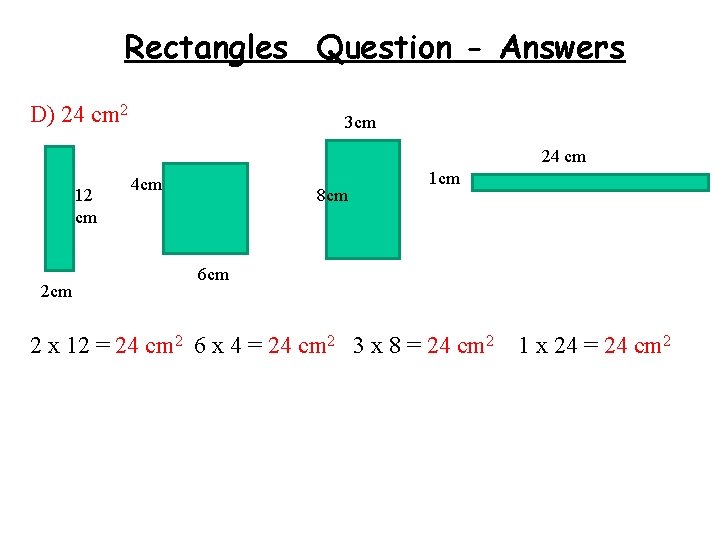
Rectangles Question - Answers D) 24 cm 2 3 cm 24 cm 12 cm 2 cm 4 cm 8 cm 1 cm 6 cm 2 x 12 = 24 cm 2 6 x 4 = 24 cm 2 3 x 8 = 24 cm 2 1 x 24 = 24 cm 2
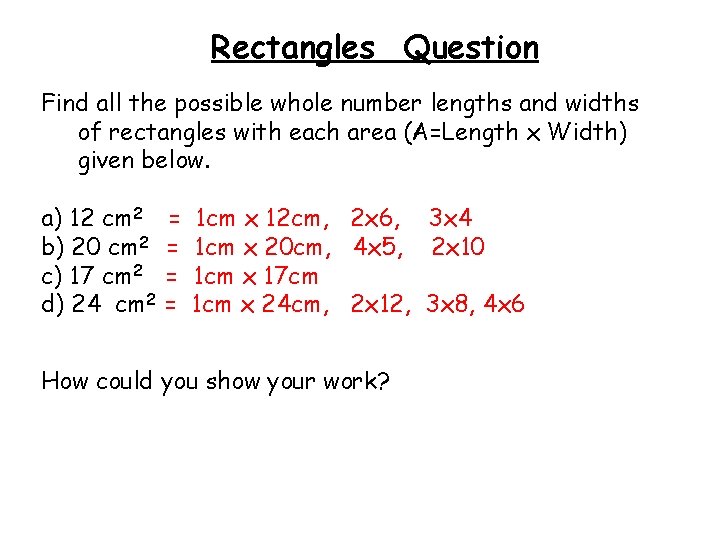
Rectangles Question Find all the possible whole number lengths and widths of rectangles with each area (A=Length x Width) given below. a) 12 cm 2 b) 20 cm 2 c) 17 cm 2 d) 24 cm 2 = = 1 cm x 12 cm, 2 x 6, 3 x 4 1 cm x 20 cm, 4 x 5, 2 x 10 1 cm x 17 cm 1 cm x 24 cm, 2 x 12, 3 x 8, 4 x 6 How could you show your work?
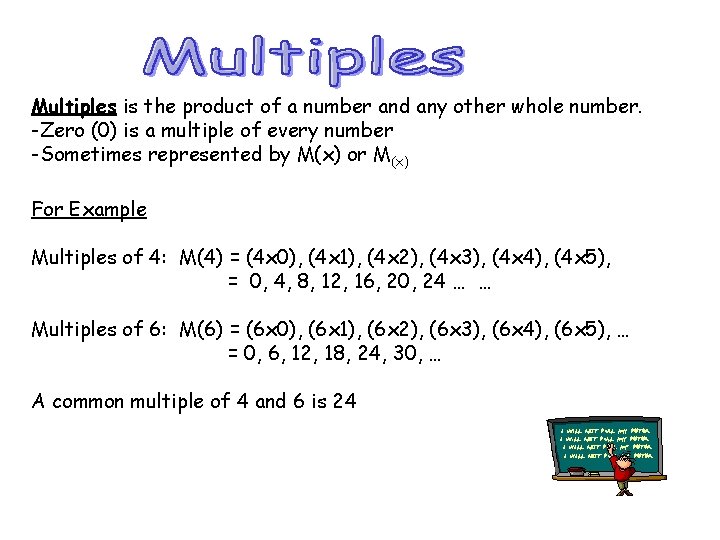
Multiples is the product of a number and any other whole number. -Zero (0) is a multiple of every number -Sometimes represented by M(x) or M(x) For Example Multiples of 4: M(4) = (4 x 0), (4 x 1), (4 x 2), (4 x 3), (4 x 4), (4 x 5), = 0, 4, 8, 12, 16, 20, 24 … … Multiples of 6: M(6) = (6 x 0), (6 x 1), (6 x 2), (6 x 3), (6 x 4), (6 x 5), … = 0, 6, 12, 18, 24, 30, … A common multiple of 4 and 6 is 24
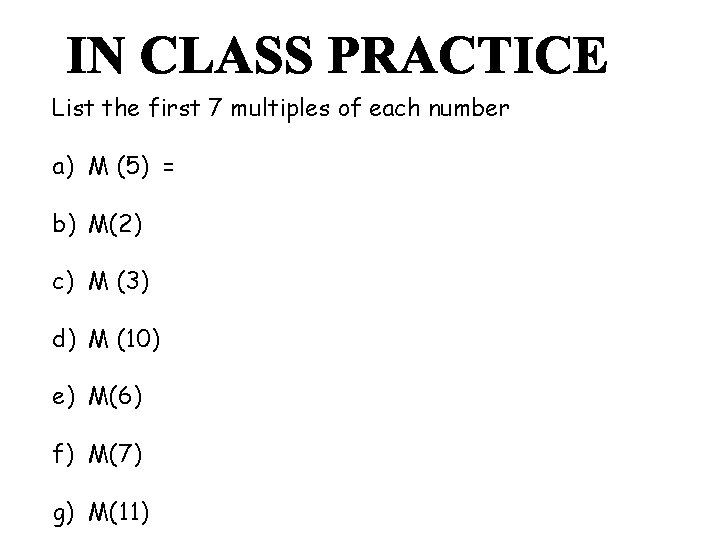
List the first 7 multiples of each number a) M (5) = b) M(2) c) M (3) d) M (10) e) M(6) f) M(7) g) M(11)
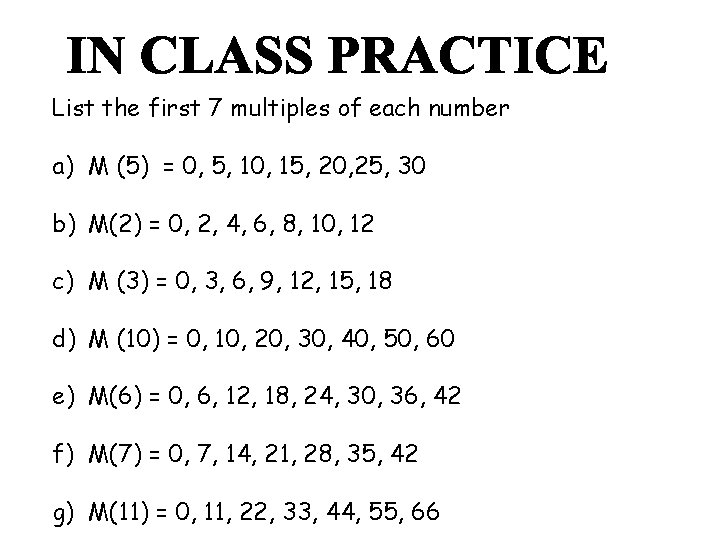
List the first 7 multiples of each number a) M (5) = 0, 5, 10, 15, 20, 25, 30 b) M(2) = 0, 2, 4, 6, 8, 10, 12 c) M (3) = 0, 3, 6, 9, 12, 15, 18 d) M (10) = 0, 10, 20, 30, 40, 50, 60 e) M(6) = 0, 6, 12, 18, 24, 30, 36, 42 f) M(7) = 0, 7, 14, 21, 28, 35, 42 g) M(11) = 0, 11, 22, 33, 44, 55, 66
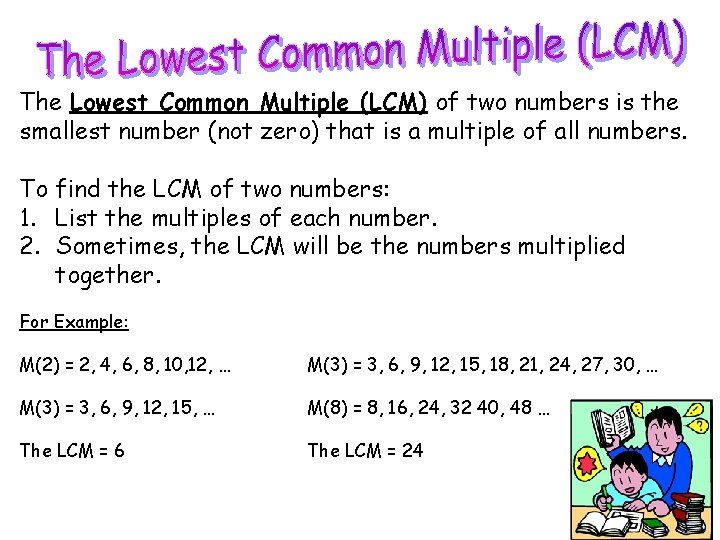
The Lowest Common Multiple (LCM) of two numbers is the smallest number (not zero) that is a multiple of all numbers. To find the LCM of two numbers: 1. List the multiples of each number. 2. Sometimes, the LCM will be the numbers multiplied together. For Example: M(2) = 2, 4, 6, 8, 10, 12, … M(3) = 3, 6, 9, 12, 15, 18, 21, 24, 27, 30, … M(3) = 3, 6, 9, 12, 15, … M(8) = 8, 16, 24, 32 40, 48 … The LCM = 6 The LCM = 24
CLASS PRACTICE Find the Lowest Common Multiple (LCM) for each pair. a) 6 and 8 b) 13 and 2 c) 15 and 9
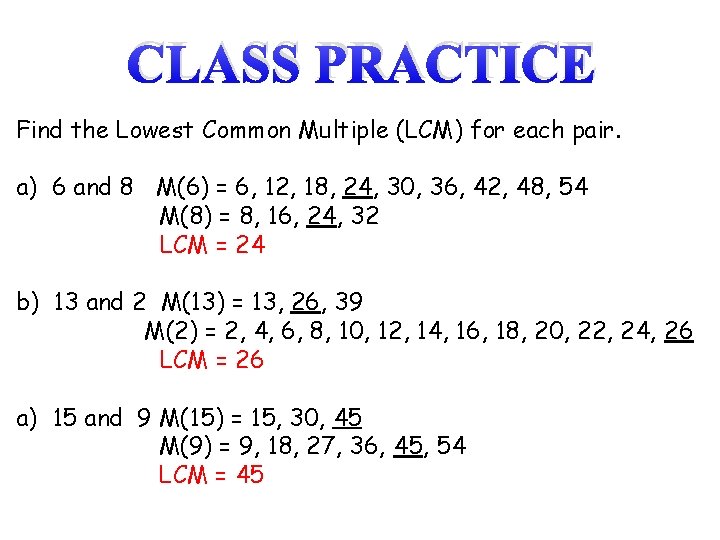
CLASS PRACTICE Find the Lowest Common Multiple (LCM) for each pair. a) 6 and 8 M(6) = 6, 12, 18, 24, 30, 36, 42, 48, 54 M(8) = 8, 16, 24, 32 LCM = 24 b) 13 and 2 M(13) = 13, 26, 39 M(2) = 2, 4, 6, 8, 10, 12, 14, 16, 18, 20, 22, 24, 26 LCM = 26 a) 15 and 9 M(15) = 15, 30, 45 M(9) = 9, 18, 27, 36, 45, 54 LCM = 45
GCF and LCM Problem Solving How can you tell if a word problem requires you to use Greatest Common Factor or Least Common Multiple to solve?
If it is a GCF Problem • What is the question asking us? • Do we have to split things into smaller sections? • Are we trying to figure out how many people we can invite? • Are we trying to arrange something into rows or groups?
GCF Problem - Example Samantha has two pieces of cloth. One piece is 72 cm wide and the other piece is 90 cm wide. She wants to cut both pieces into strips of equal width that are as wide as possible. How wide should she cut the strips?
Key Information The pieces of cloth are 72 and 90 cm wide. How wide should she cut the strips so that they are the largest possible equal lengths?
Key Information This problem can be solved using Greatest Common Factor because we are cutting or “dividing” the strips of cloth into smaller pieces (factor) of 72 and 90. • Find the GCF of 72 and 90
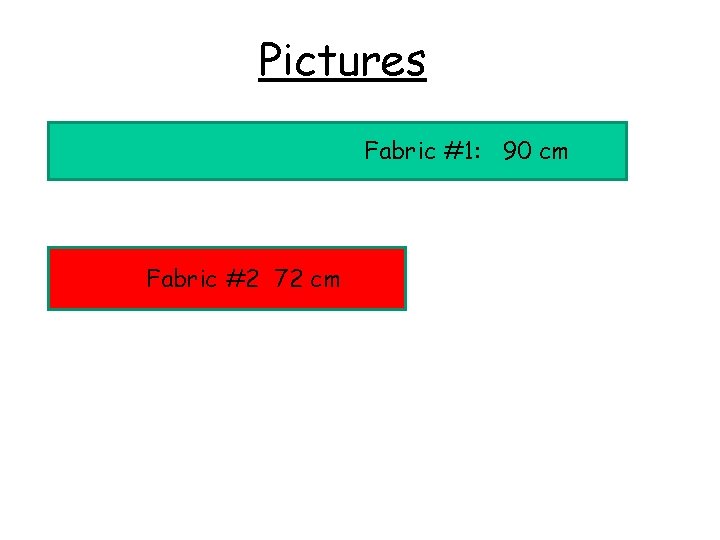
Pictures Fabric #1: 90 cm Fabric #2 72 cm
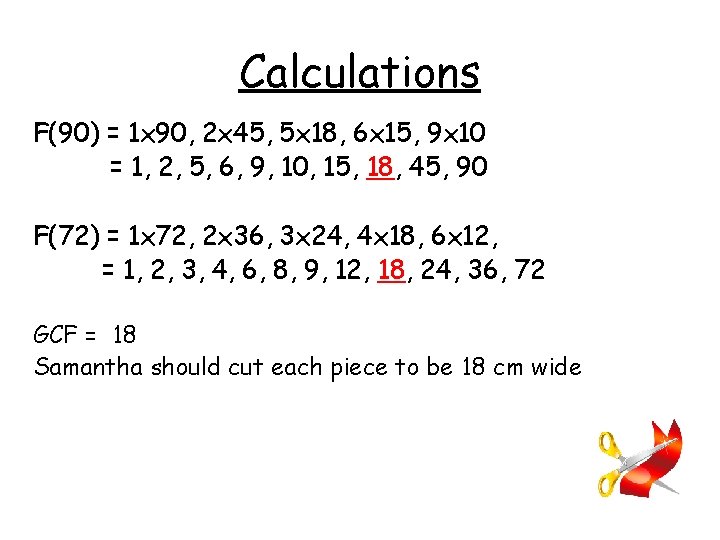
Calculations F(90) = 1 x 90, 2 x 45, 5 x 18, 6 x 15, 9 x 10 = 1, 2, 5, 6, 9, 10, 15, 18, 45, 90 F(72) = 1 x 72, 2 x 36, 3 x 24, 4 x 18, 6 x 12, = 1, 2, 3, 4, 6, 8, 9, 12, 18, 24, 36, 72 GCF = 18 Samantha should cut each piece to be 18 cm wide
Concluding Sentence Samantha should cut each piece to be 18 cm wide
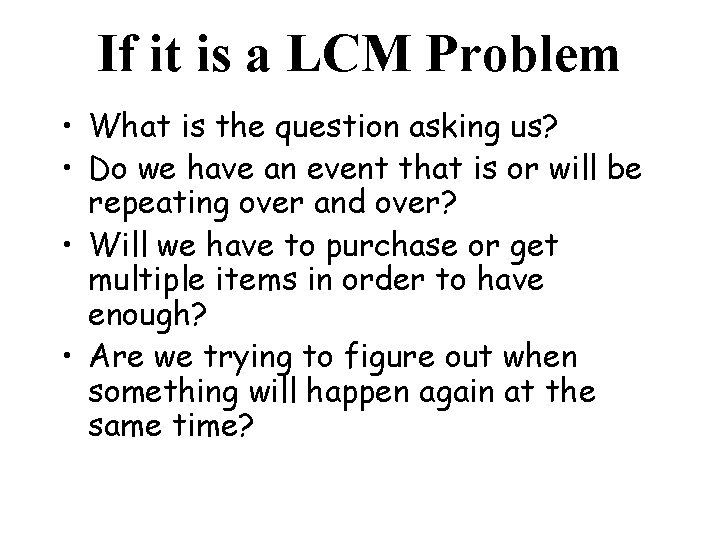
If it is a LCM Problem • What is the question asking us? • Do we have an event that is or will be repeating over and over? • Will we have to purchase or get multiple items in order to have enough? • Are we trying to figure out when something will happen again at the same time?
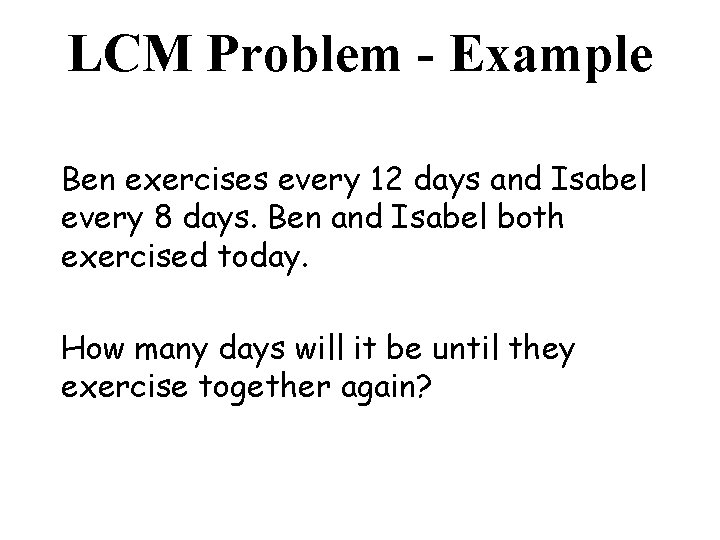
LCM Problem - Example Ben exercises every 12 days and Isabel every 8 days. Ben and Isabel both exercised today. How many days will it be until they exercise together again?
Key Information Ben exercises every 12 days and Isabel every 8 days and they both exercised today. How many days is it until they will both exercise on the same day again.
Key Information This problem can be solved using Least Common Multiple. We are trying to figure out when will be the next time they are exercising together. Find the LCM of 12 and 8.
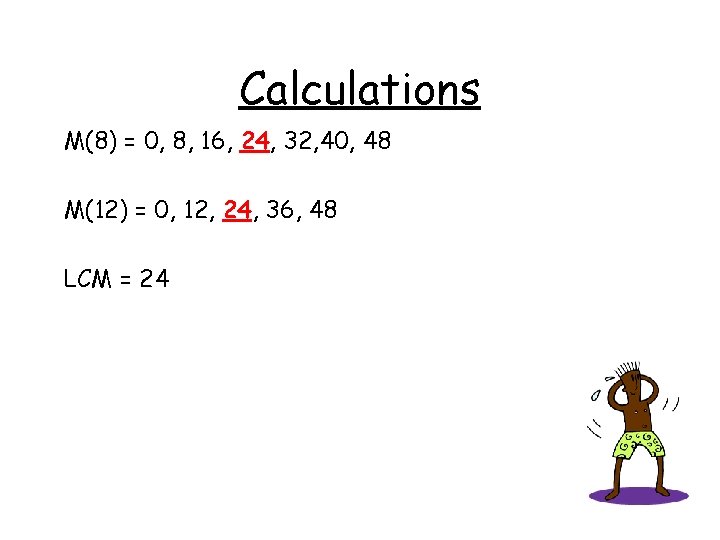
Calculations M(8) = 0, 8, 16, 24, 32, 40, 48 M(12) = 0, 12, 24, 36, 48 LCM = 24
Concluding Sentence Ben and Isabel would exercise on the same day every 24 days.
QUIZ!!!!!! On a sheet of notebook paper, tell whether the following word problems could be solved using GCF or LCM… Then solve each problem.
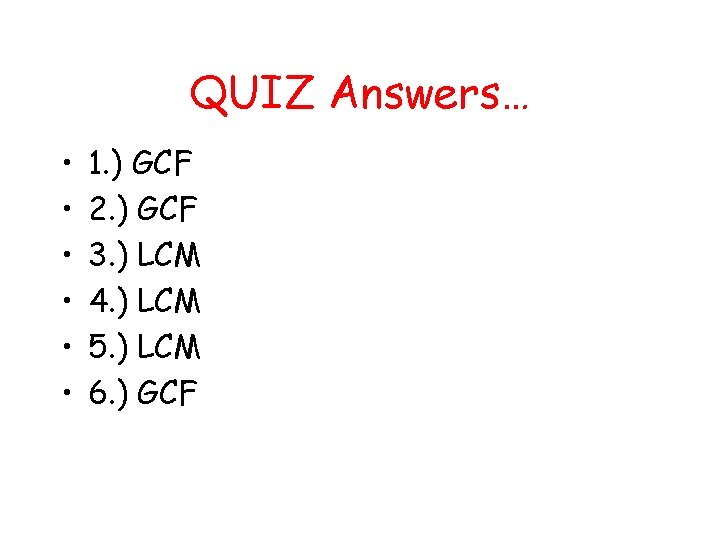
QUIZ Answers… • • • 1. ) GCF 2. ) GCF 3. ) LCM 4. ) LCM 5. ) LCM 6. ) GCF
Question #1 Mrs. Evans has 120 crayons and 30 pieces of paper to give to her students. What is the largest # of students she can have in her class so that each student gets equal # of crayons and equal # of paper.
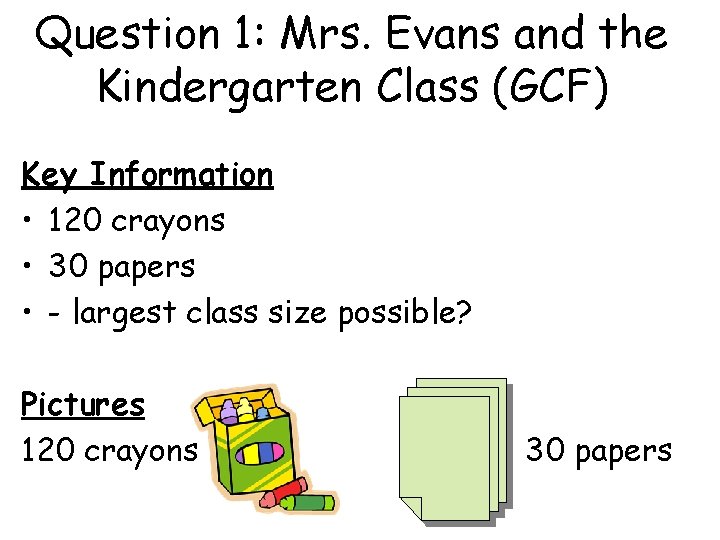
Question 1: Mrs. Evans and the Kindergarten Class (GCF) Key Information • 120 crayons • 30 papers • - largest class size possible? Pictures 120 crayons 30 papers
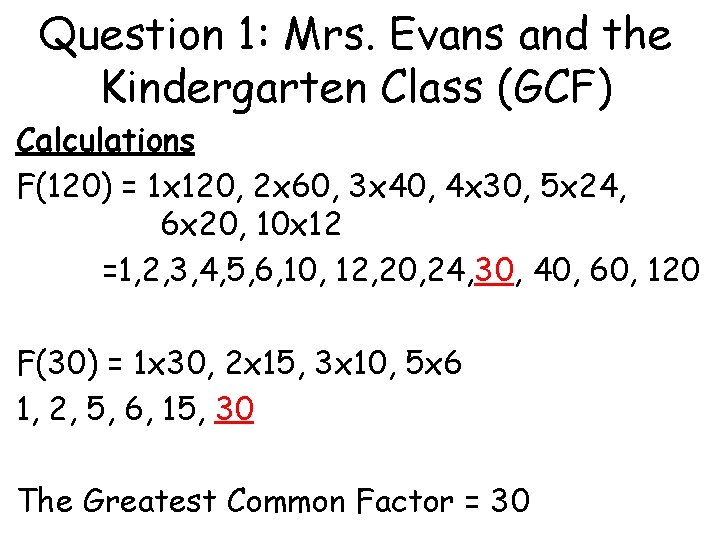
Question 1: Mrs. Evans and the Kindergarten Class (GCF) Calculations F(120) = 1 x 120, 2 x 60, 3 x 40, 4 x 30, 5 x 24, 6 x 20, 10 x 12 =1, 2, 3, 4, 5, 6, 10, 12, 20, 24, 30, 40, 60, 120 F(30) = 1 x 30, 2 x 15, 3 x 10, 5 x 6 1, 2, 5, 6, 15, 30 The Greatest Common Factor = 30
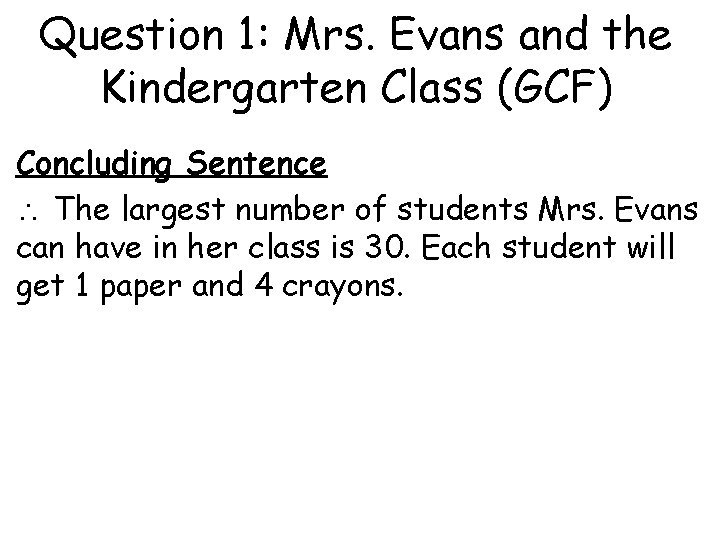
Question 1: Mrs. Evans and the Kindergarten Class (GCF) Concluding Sentence The largest number of students Mrs. Evans can have in her class is 30. Each student will get 1 paper and 4 crayons.
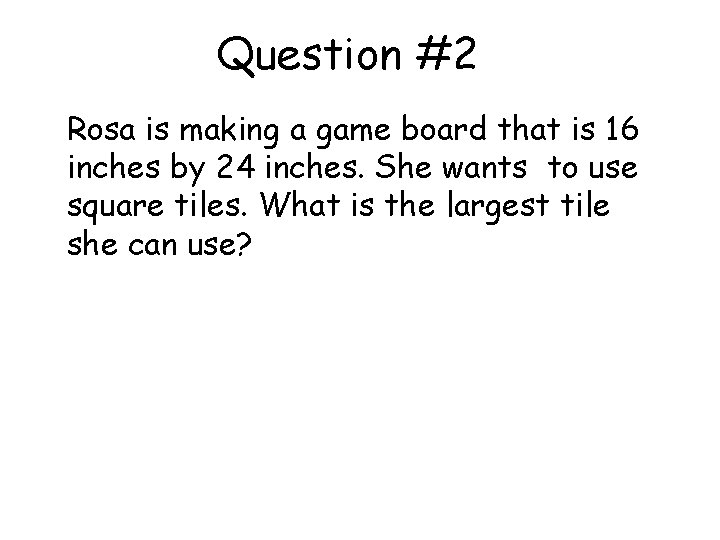
Question #2 Rosa is making a game board that is 16 inches by 24 inches. She wants to use square tiles. What is the largest tile she can use?
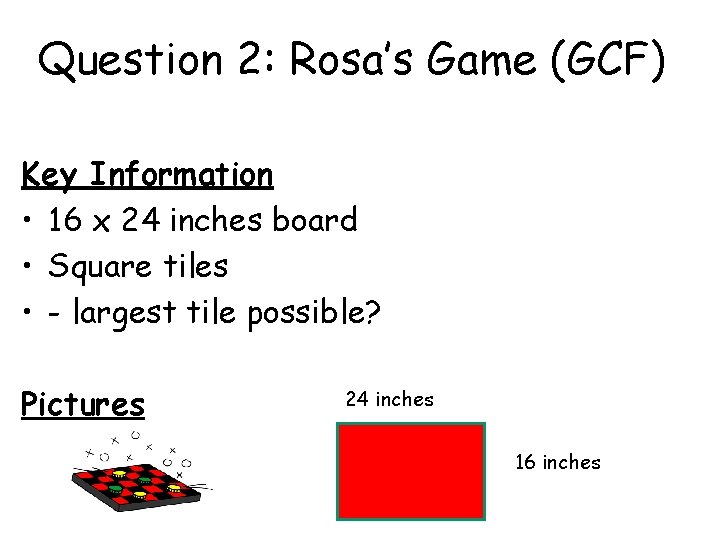
Question 2: Rosa’s Game (GCF) Key Information • 16 x 24 inches board • Square tiles • - largest tile possible? Pictures 24 inches 16 inches
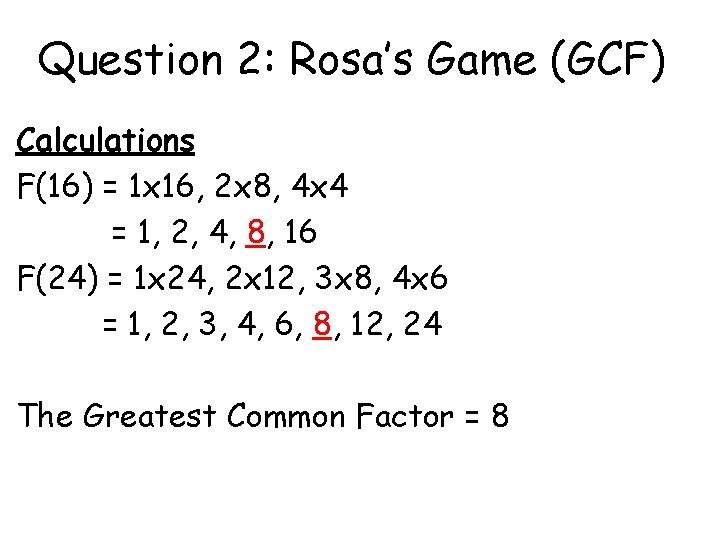
Question 2: Rosa’s Game (GCF) Calculations F(16) = 1 x 16, 2 x 8, 4 x 4 = 1, 2, 4, 8, 16 F(24) = 1 x 24, 2 x 12, 3 x 8, 4 x 6 = 1, 2, 3, 4, 6, 8, 12, 24 The Greatest Common Factor = 8
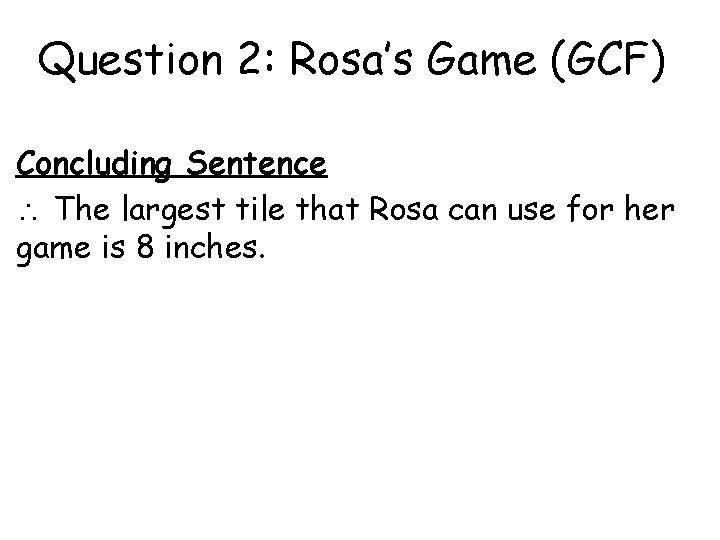
Question 2: Rosa’s Game (GCF) Concluding Sentence The largest tile that Rosa can use for her game is 8 inches.
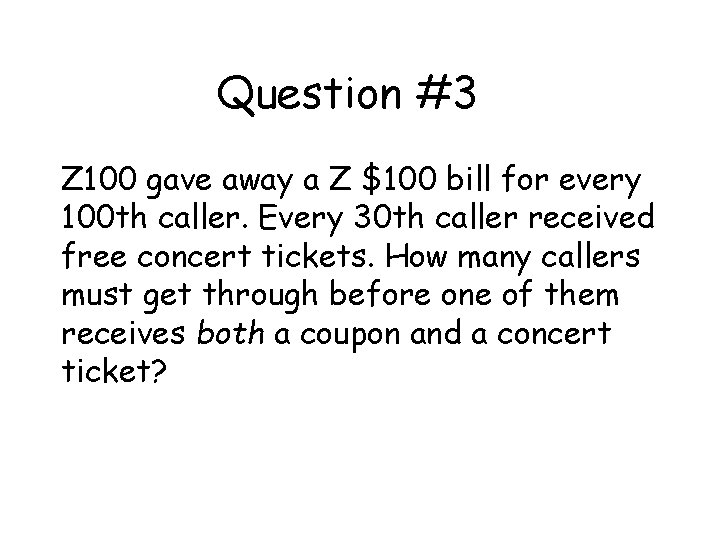
Question #3 Z 100 gave away a Z $100 bill for every 100 th caller. Every 30 th caller received free concert tickets. How many callers must get through before one of them receives both a coupon and a concert ticket?
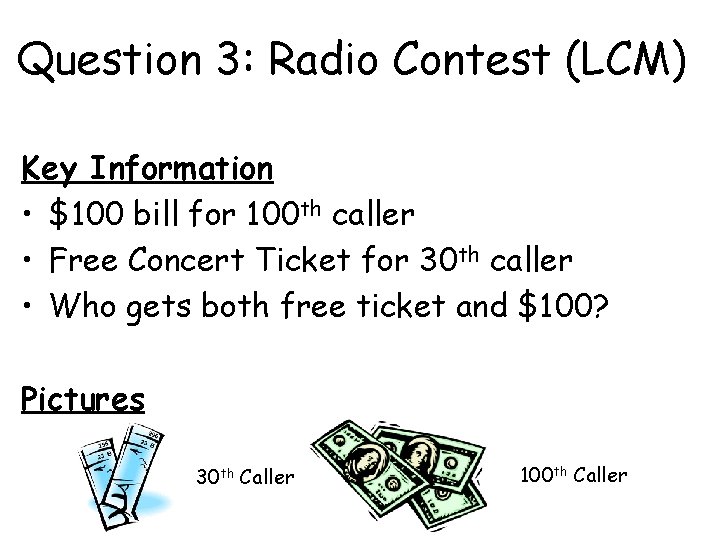
Question 3: Radio Contest (LCM) Key Information • $100 bill for 100 th caller • Free Concert Ticket for 30 th caller • Who gets both free ticket and $100? Pictures 30 th Caller 100 th Caller
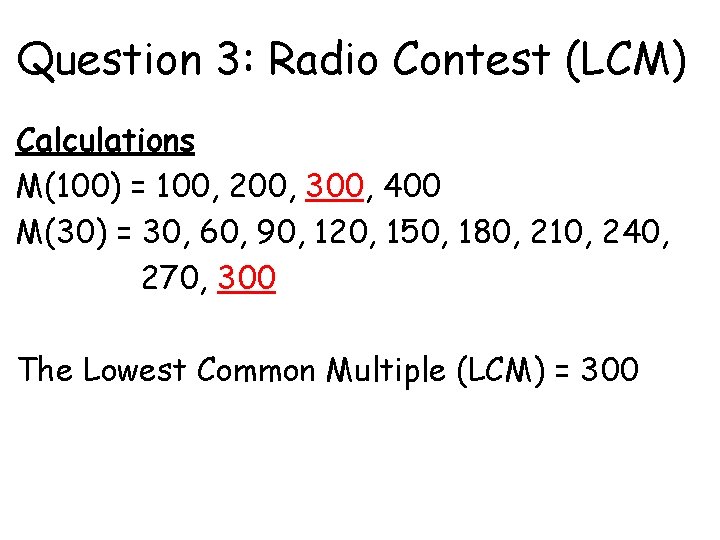
Question 3: Radio Contest (LCM) Calculations M(100) = 100, 200, 300, 400 M(30) = 30, 60, 90, 120, 150, 180, 210, 240, 270, 300 The Lowest Common Multiple (LCM) = 300
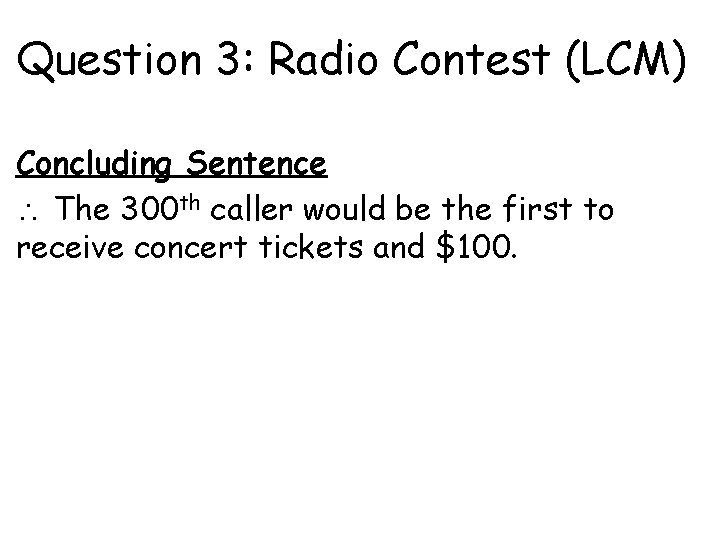
Question 3: Radio Contest (LCM) Concluding Sentence The 300 th caller would be the first to receive concert tickets and $100.
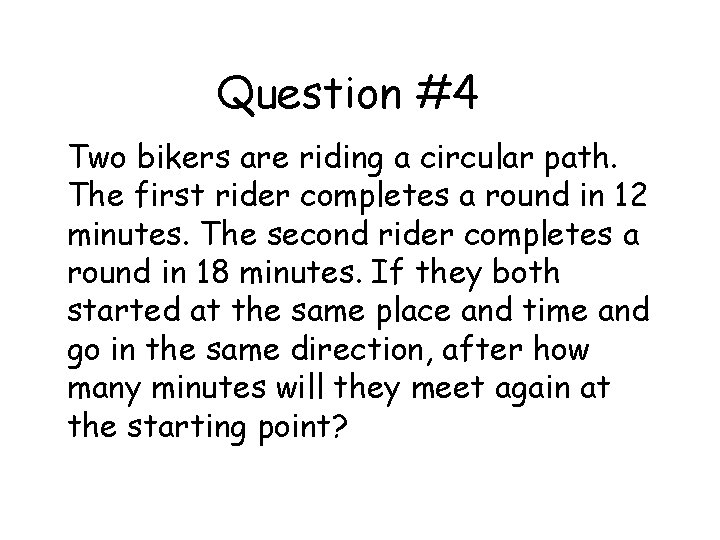
Question #4 Two bikers are riding a circular path. The first rider completes a round in 12 minutes. The second rider completes a round in 18 minutes. If they both started at the same place and time and go in the same direction, after how many minutes will they meet again at the starting point?
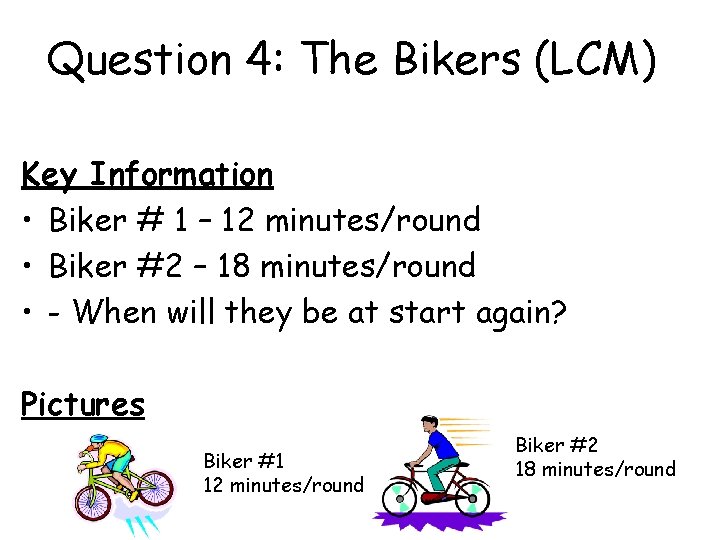
Question 4: The Bikers (LCM) Key Information • Biker # 1 – 12 minutes/round • Biker #2 – 18 minutes/round • - When will they be at start again? Pictures Biker #1 12 minutes/round Biker #2 18 minutes/round
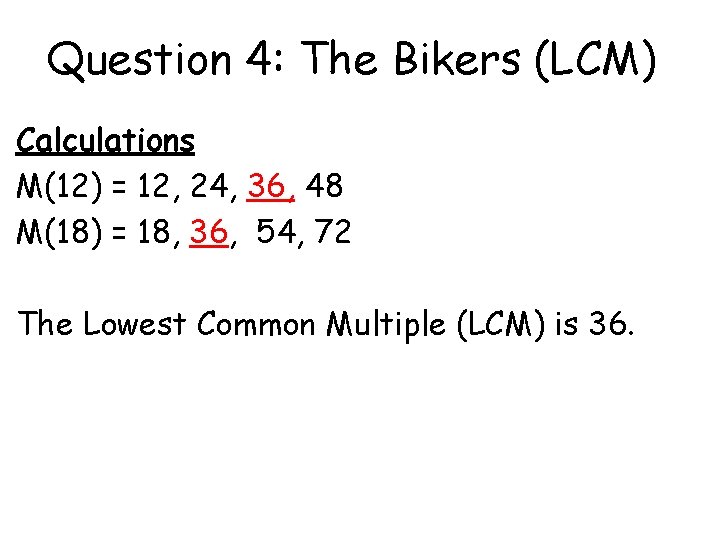
Question 4: The Bikers (LCM) Calculations M(12) = 12, 24, 36, 48 M(18) = 18, 36, 54, 72 The Lowest Common Multiple (LCM) is 36.
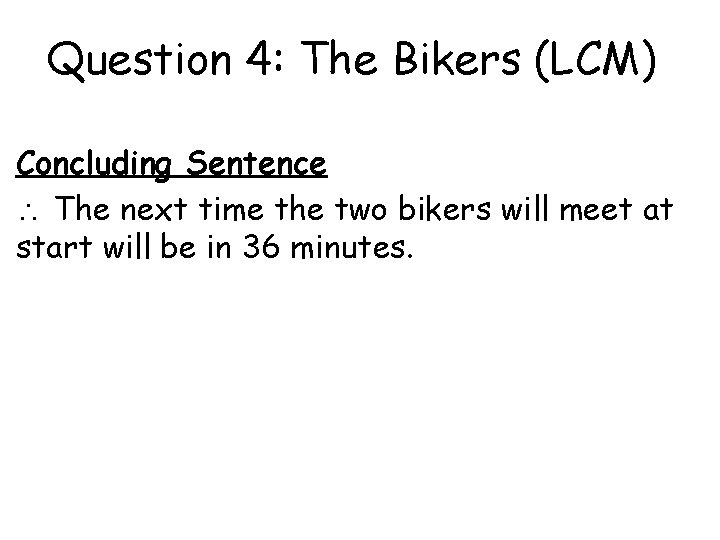
Question 4: The Bikers (LCM) Concluding Sentence The next time the two bikers will meet at start will be in 36 minutes.
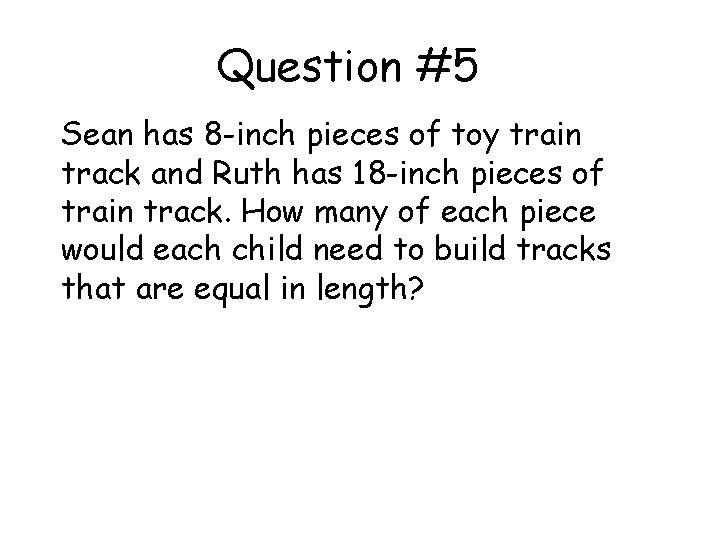
Question #5 Sean has 8 -inch pieces of toy train track and Ruth has 18 -inch pieces of train track. How many of each piece would each child need to build tracks that are equal in length?
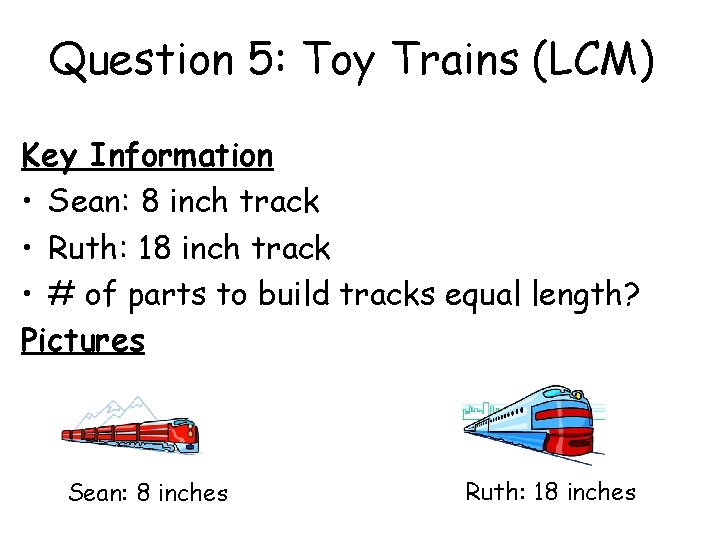
Question 5: Toy Trains (LCM) Key Information • Sean: 8 inch track • Ruth: 18 inch track • # of parts to build tracks equal length? Pictures Sean: 8 inches Ruth: 18 inches
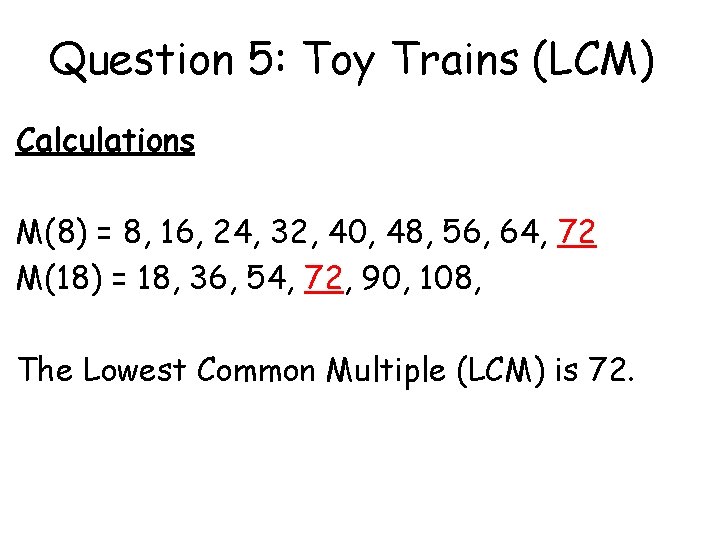
Question 5: Toy Trains (LCM) Calculations M(8) = 8, 16, 24, 32, 40, 48, 56, 64, 72 M(18) = 18, 36, 54, 72, 90, 108, The Lowest Common Multiple (LCM) is 72.
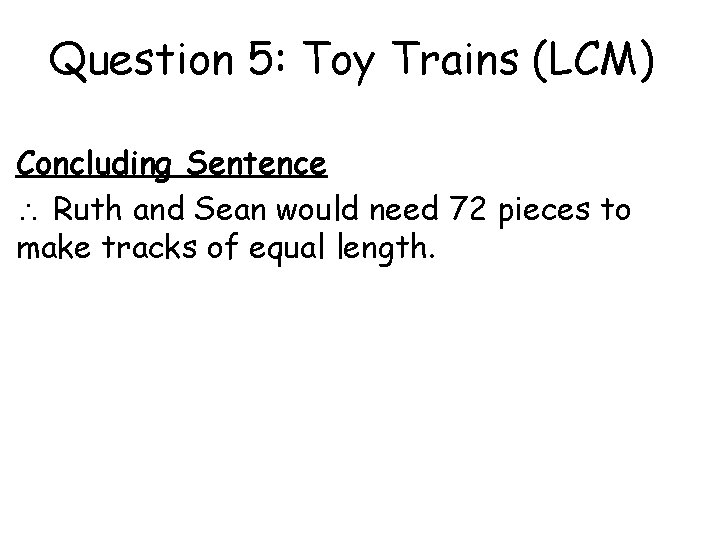
Question 5: Toy Trains (LCM) Concluding Sentence Ruth and Sean would need 72 pieces to make tracks of equal length.
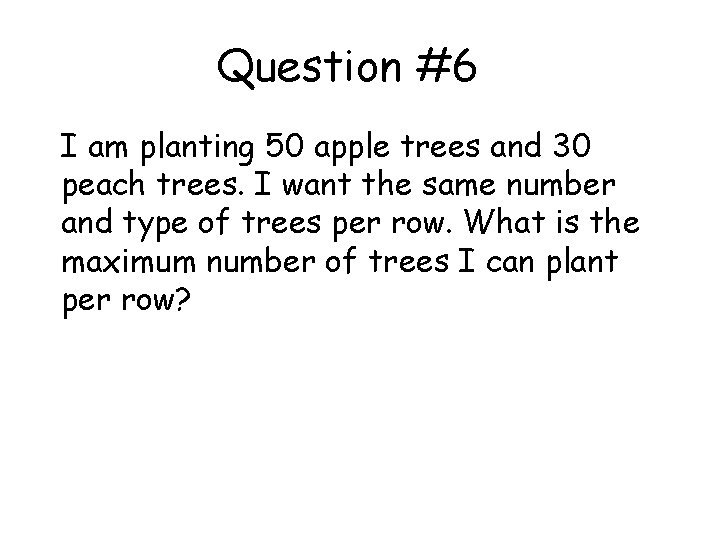
Question #6 I am planting 50 apple trees and 30 peach trees. I want the same number and type of trees per row. What is the maximum number of trees I can plant per row?
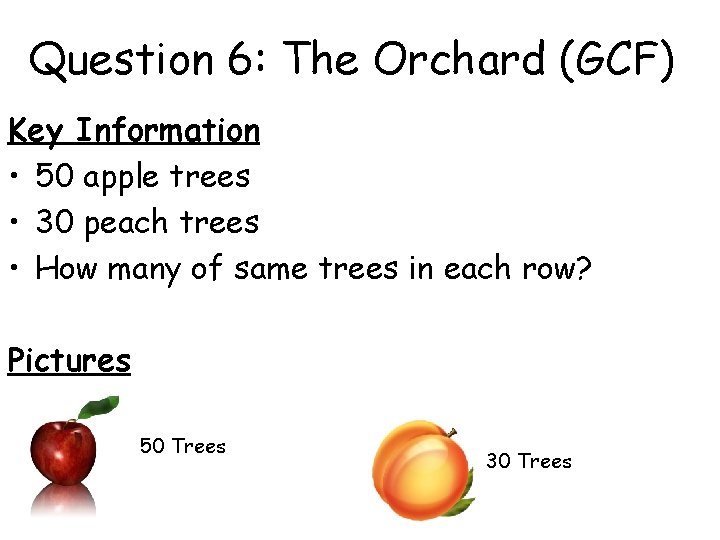
Question 6: The Orchard (GCF) Key Information • 50 apple trees • 30 peach trees • How many of same trees in each row? Pictures 50 Trees 30 Trees
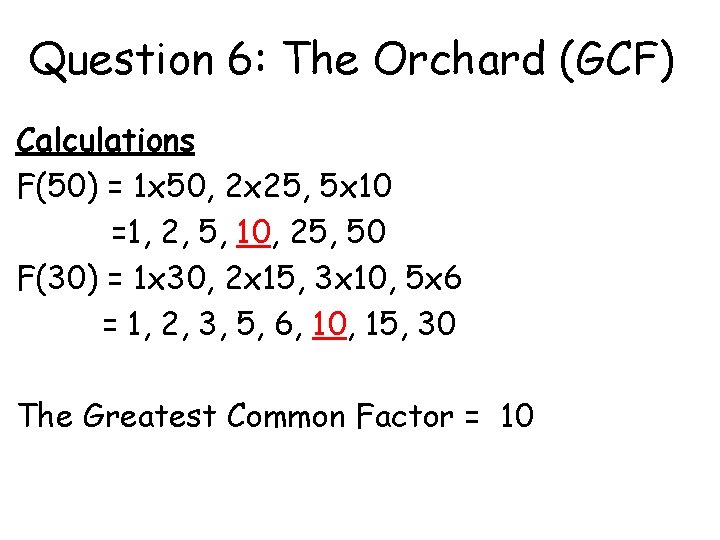
Question 6: The Orchard (GCF) Calculations F(50) = 1 x 50, 2 x 25, 5 x 10 =1, 2, 5, 10, 25, 50 F(30) = 1 x 30, 2 x 15, 3 x 10, 5 x 6 = 1, 2, 3, 5, 6, 10, 15, 30 The Greatest Common Factor = 10
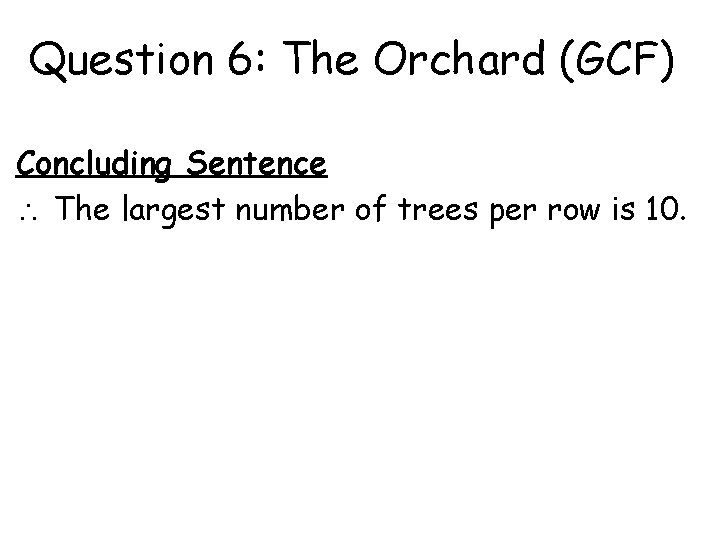
Question 6: The Orchard (GCF) Concluding Sentence The largest number of trees per row is 10.
- Slides: 72