
Factors are numbers you can multiply together to
• Factors are numbers you can multiply together to get another number. • Multiples are numbers that can be divided by another number without a remainder. Its also the product from multiplying a number by another number. • A prime number is a whole number greater than one, that has only two whole-number factors that are one and itself. • Composite number is a number that has three or more factors.
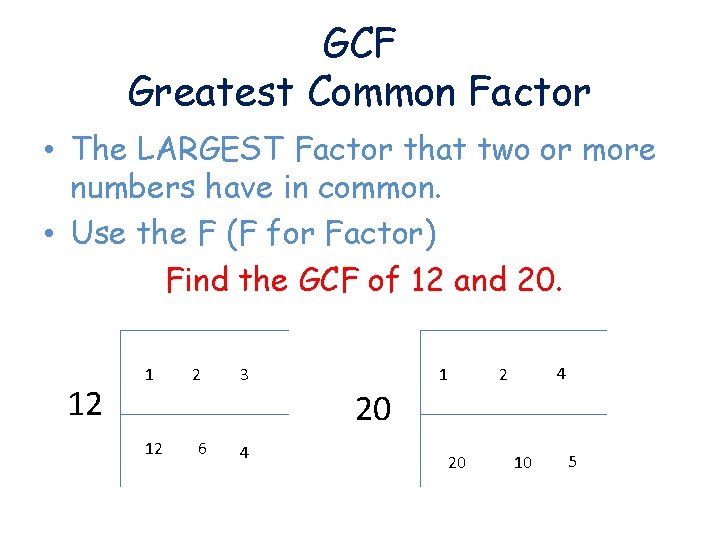
GCF Greatest Common Factor • The LARGEST Factor that two or more numbers have in common. • Use the F (F for Factor) Find the GCF of 12 and 20. 12 1 2 3 1 4 2 20 12 6 4 20 10 5
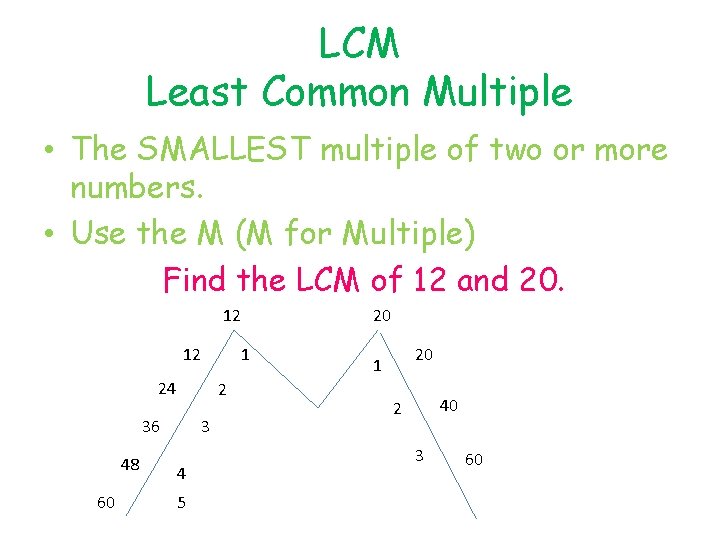
LCM Least Common Multiple • The SMALLEST multiple of two or more numbers. • Use the M (M for Multiple) Find the LCM of 12 and 20. 12 12 24 2 36 48 60 1 3 4 5 20 20 1 40 2 3 60

Prime Factorization • "Prime Factorization" is finding which prime numbers multiply together to make the original number • To find Prime Factorization: use a Factor Tree
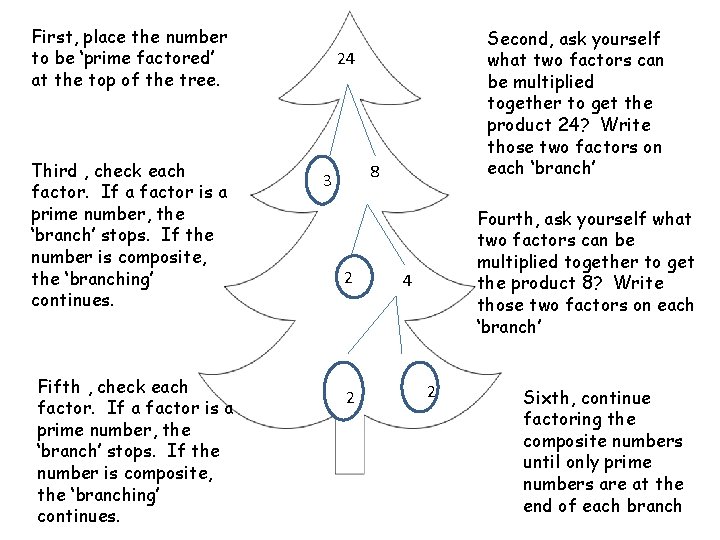
First, place the number to be ‘prime factored’ at the top of the tree. Third , check each factor. If a factor is a prime number, the ‘branch’ stops. If the number is composite, the ‘branching’ continues. Fifth , check each factor. If a factor is a prime number, the ‘branch’ stops. If the number is composite, the ‘branching’ continues. Second, ask yourself what two factors can be multiplied together to get the product 24? Write those two factors on each ‘branch’ 24 3 8 3 22 22 Fourth, ask yourself what two factors can be multiplied together to get the product 8? Write those two factors on each ‘branch’ 4 2 2 Sixth, continue factoring the composite numbers until only prime numbers are at the end of each branch
- Slides: 5