
Factors and Multiples Prime and Composite Numbers Factors
Factors and Multiples Prime and Composite Numbers
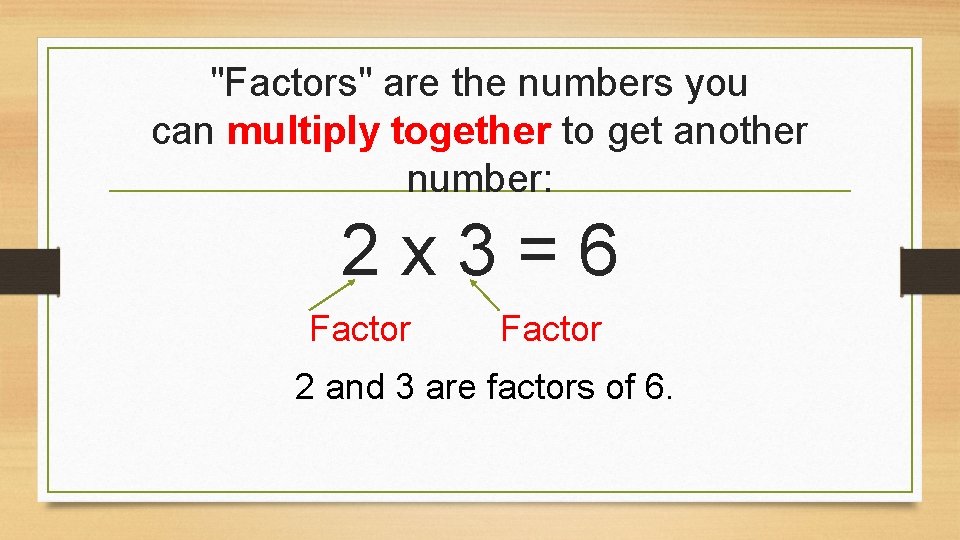
"Factors" are the numbers you can multiply together to get another number: 2 x 3=6 Factor 2 and 3 are factors of 6.
“Factors” are the numbers multiplied together to give a product. Example: 3 and 4 are factors of 12, because 3× 4=12 Also 2× 6=12 so 2 and 6 are also factors of 12, And 1× 12=12 so 1 and 12 are factors of 12 as well. Therefore the factors of 12 are;
List some factors of the following; (Remember to use your times tables knowledge) • • • 15 20 54 120 63 48
Find the Product of each set of Factors; 1. 2. 3. 4. 5. 6. 7 and 4 9 and 7 7 and 5 7 and 10 3 and 7 7. 7 and 8 8. 8 and 4 9. 2 and 8 10. 0 and 8 11. 8 and 8 12. 8 and 10

Prime Numbers • • • Prime Numbers are those numbers that only have 2 factors. 2 3 5 7 31

Composite Numbers • Composite Numbers are all the numbers that have more than 2 factors. • • • 4 6 8 9 35
Multiples and our Times Tables 8, 16, 24, 32, 40 are all multiples of 8. We can think of it as the answers to the 8 times tables. 1. What are the multiples of 7, starting from 7? 2. What are the multiples of 6, starting from 6? 3. This list of numbers {33, 36, 39, 42, 45, 48, 51, 54, 57, 60} are the multiples of which number? 4. Can you identify a pattern to recognise all of the factors of 5? {5, 10, 15, 20, 25, 30, 35, 40, 45, 50, 55, 60, 65, 70 …. . }
Multiplication Grid • Fill in the 12 x 12 grid with the answers to all of the Times Tables. • When completed with your shoulder partner colour in all of the Prime numbers BLUE. • All of the numbers left over should be Composite. • Give on get one!
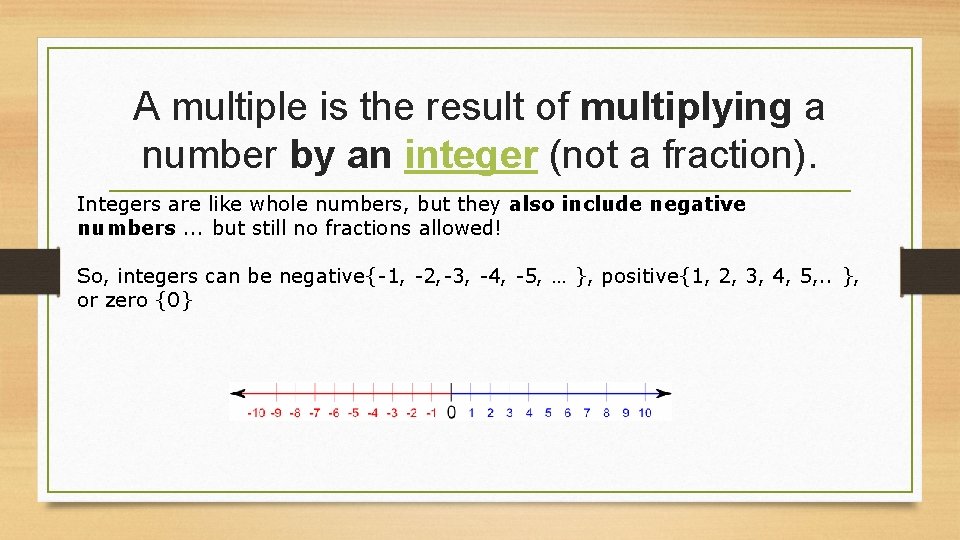
A multiple is the result of multiplying a number by an integer (not a fraction). Integers are like whole numbers, but they also include negative numbers. . . but still no fractions allowed! So, integers can be negative{-1, -2, -3, -4, -5, … }, positive{1, 2, 3, 4, 5, . . }, or zero {0}
- Slides: 10