
FACTORS AFFECTING VARIATION IN LIGHT AND TEMPERATURE TEMPERATURE
- Slides: 37
FACTORS AFFECTING VARIATION IN LIGHT AND TEMPERATURE
TEMPERATURE • Temperature is one of the most important ecological factor. • It regulates many physiological processes of plants. • Metabolic processes are low at a certain minimum temperature. It increases at particular temperature called optimum temperature. • The plant grows best at optimum temperature.
continue • Metabolism again decreases at maximum temperature. • The plants can not survive above this temperature. • Both extremely low and high temperatures have adverse effects on plant growth.
Factors affecting Temperature • Following factors affect variation in temperature. 1. Altitude 2. Latitude 3. Ocean currents 4. Prevailing winds 5. Slope features 6. Land water
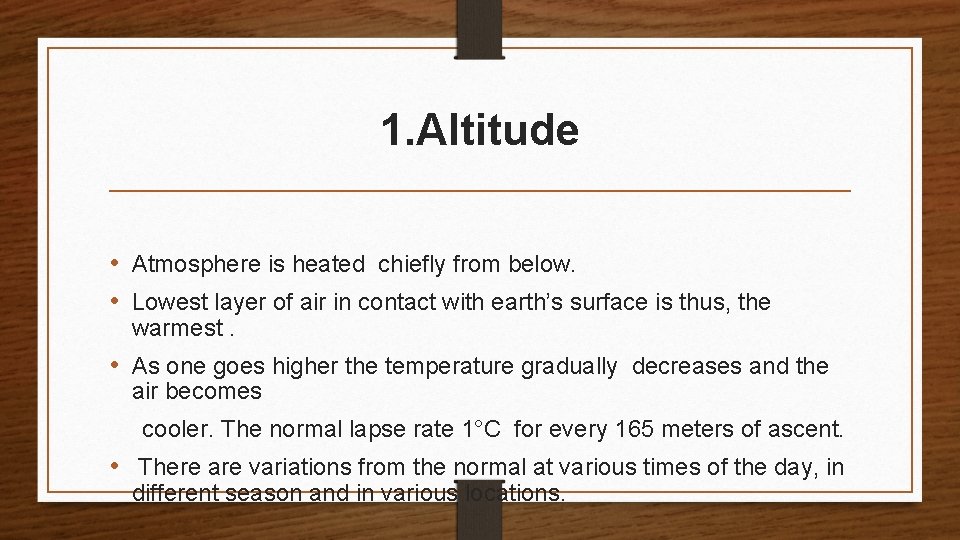
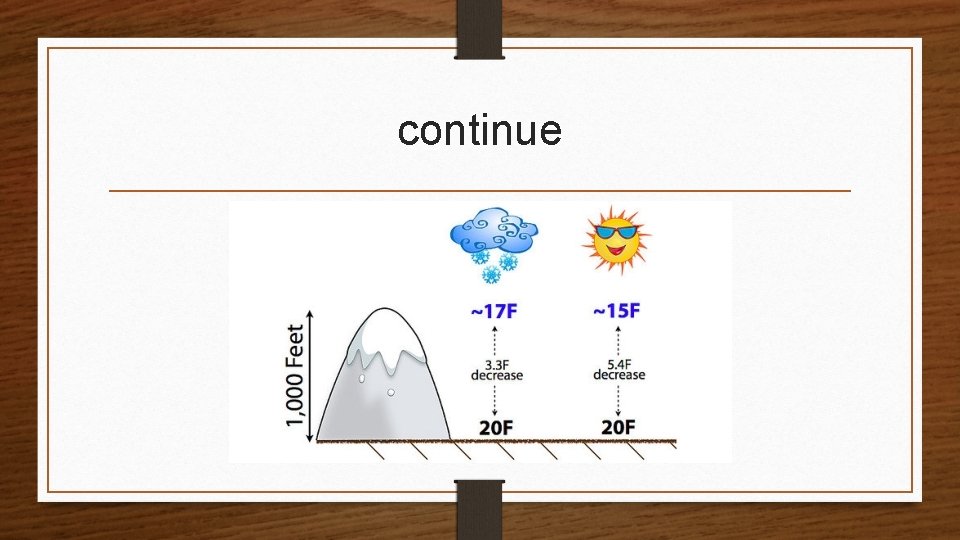
1. Altitude • Atmosphere is heated chiefly from below. • Lowest layer of air in contact with earth’s surface is thus, the warmest. • As one goes higher the temperature gradually decreases and the air becomes cooler. The normal lapse rate 1°C for every 165 meters of ascent. • There are variations from the normal at various times of the day, in different season and in various locations.
continue
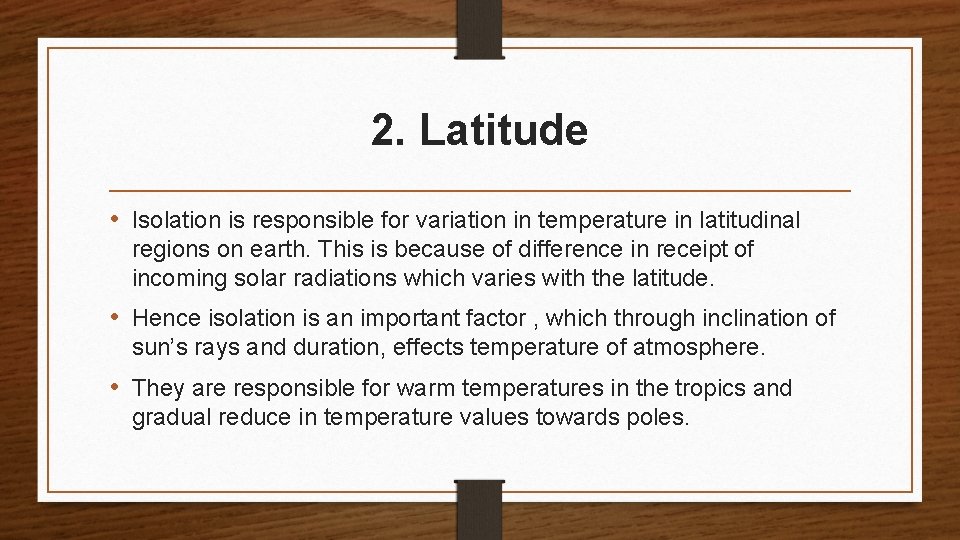
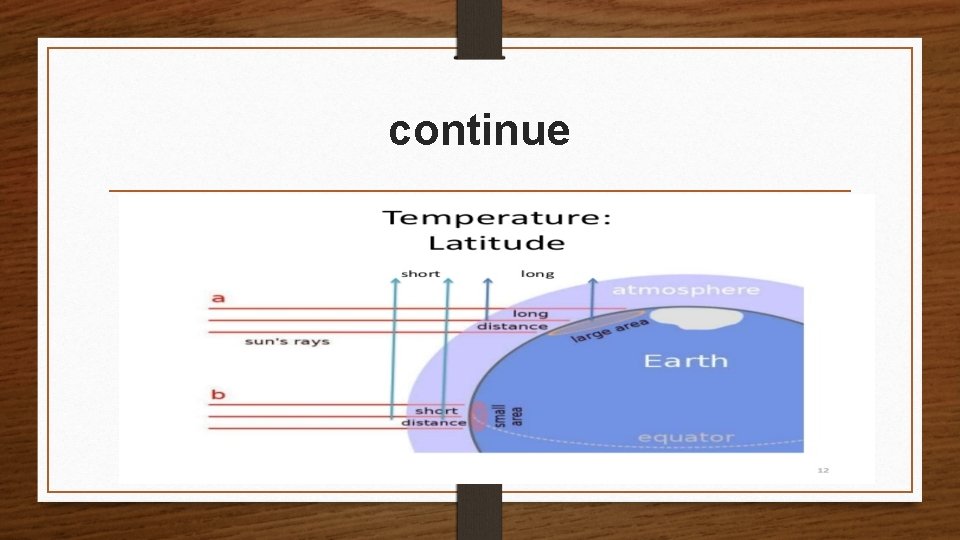
2. Latitude • Isolation is responsible for variation in temperature in latitudinal regions on earth. This is because of difference in receipt of incoming solar radiations which varies with the latitude. • Hence isolation is an important factor , which through inclination of sun’s rays and duration, effects temperature of atmosphere. • They are responsible for warm temperatures in the tropics and gradual reduce in temperature values towards poles.
continue
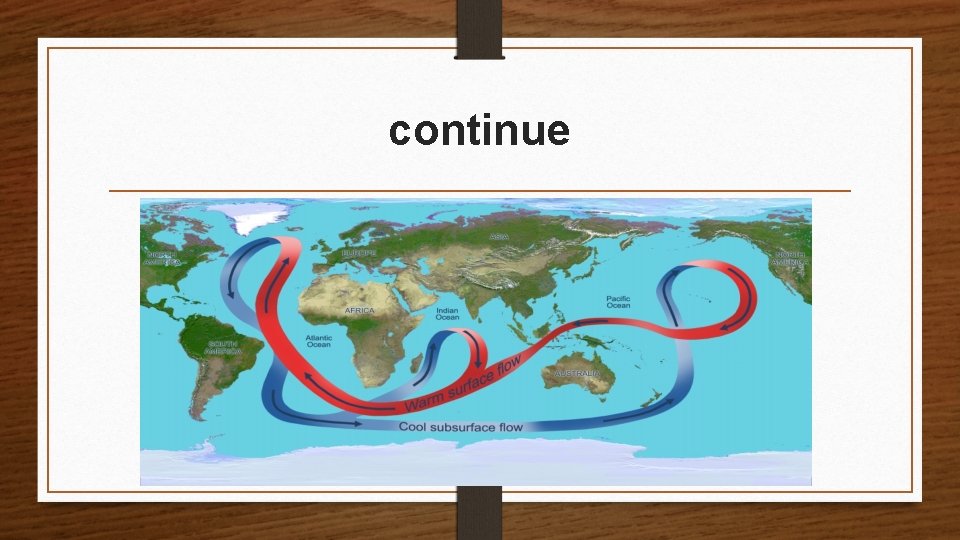
3. Ocean currents • Ocean currents effect the temperature of adjacent land regions. • Warm current increase the temperature of coastal areas, whereas cooler current lower them. • Wind directions prevailing in the area carry in a particular direction the moderating influence of oceanic current. • In higher latitudes eastern coasts are cooler than western coasts at same latitude. • The effect of cold currents is most pronounced in the tropics during summer months in mid –latitudes.
continue
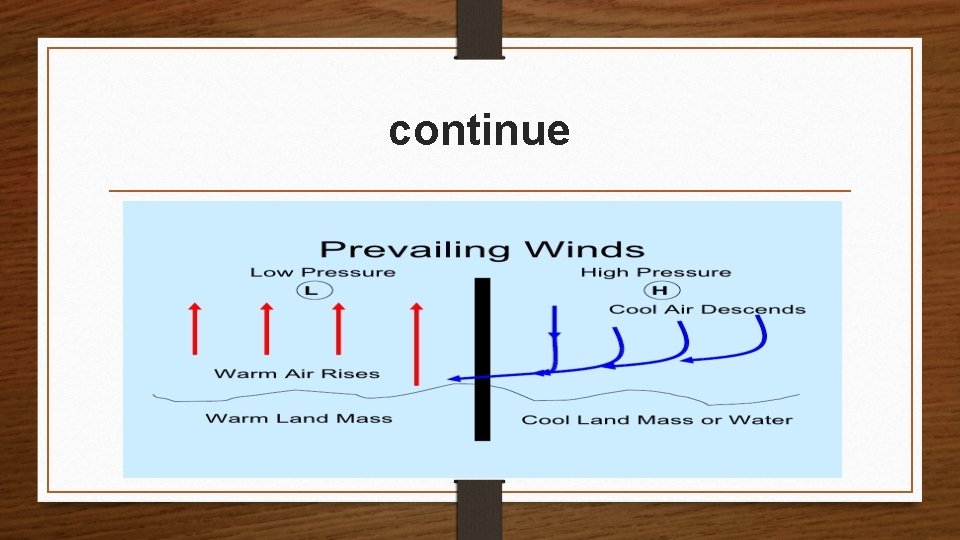
4. Prevailing winds • A windward coastal location will experience the full moderating effect of oceans cool summer and mild winters. • An inland station in other word on the same latitude or leeward coastal location will have a more continental temperature regions since the winds do not bring oceanic influence to it.
continue • Wind blows because Ø air over warm land rise ØCooler air moves in from surrounding areas to replace rising air ØThe cool air is heated and process repeats
continue
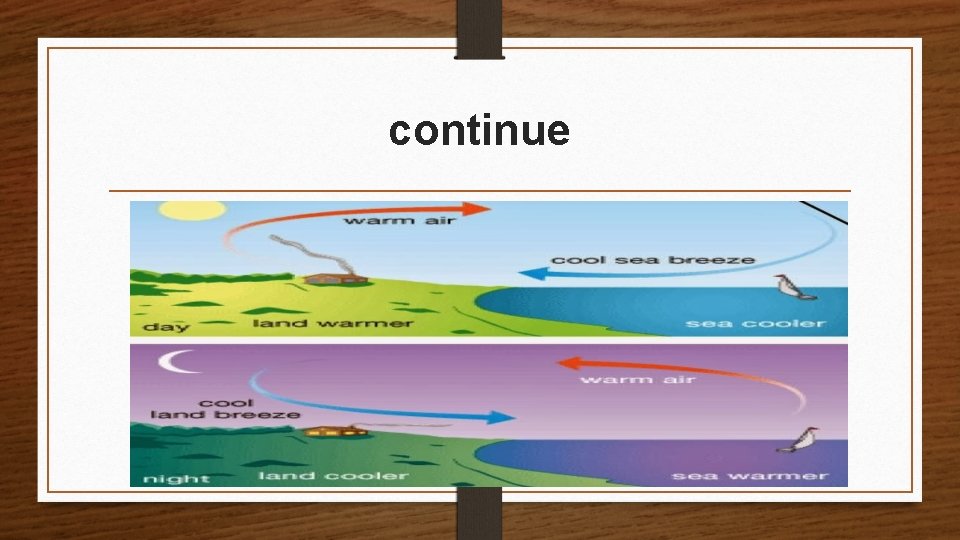
5. Land Water • Because air is heated by terrestrial radiation, differential heating of land water surfaces cause variations in the temperature of the air above. • Land mass is heated and cooled more rapidly to a greater degree than water. • Therefore , temperature of air over land differs markedly from that of the air on expense of water in the same latitude. • More extremes of temperature felt over land than over the oceans.
continue • • • Water moderates temperature: Absorbs heat from air that is warmer Hydrogen bonds break Releases heat to air that is cooler Hydrogen bond breaks
continue • High specific heat: • This absorption and release of heat from water only slightly changes its own temperature. • Coastal areas generally have milder climates
continue
6. Slope features • Direction of slop and its angle control the amount of solar radiation received at a place. • Slopes exposed more to sun receive more radiation than those away from the direct rays of sun. • In several valleys settlement and cultivation are hence , concentrated on southern slopes whereas northern slopes remain forested. In India this is true in Himalayan region.
continue • Because of these factors distribution of temperature over earth is not uniformed. • It varies horizontally as well as vertically. • Horizontal distribution of temperature exist across the latitude. • An isotherm in an imaginary line joining places having equal temperatures reduced to sea level to remove effects of altitude. • In vertical distribution temperature reduces with increasing hight.
continue • Since atmosphere is heated mainly by the terrestrial radiation atmospheric layer overlying immediately on earth’s surface receives maximum heat, and therefore, the warmest. • As we go higher and higher temperature gradually decrease and air becomes cooler. • There also diurnal and seasonal variation in temperature. • The daily cycle of temperature shows a gradual enhance from sun rise to about 3. oo pm.
Continue • Temperature decrease in evening and night and reach a minimum before sunrise. • The difference in temperature between maximum in a day and minimum Junaid during the night is known as diurnal range of temperature. • Seasonal differences in temperature are because of differences in the angle of incidence of sun rays and duration of sunlight.
Factors affecting light • Following factors affects light: 1. Atmosphere, consists of gases, suspended and solid particles etc 2. Water layers 3. Layers of vegetation, as in forests 4. Topographic factors as direction and slope of the land surfaces
1 -Effect of Atmosphere • Earth’s atmosphere reflects or absorb some sunlight, but allows most of the visible light to pass through to earth’s surface. • A cloudy day is darker because clouds reflect and absorb much of the sunlight, so less light passes through to the ground. • The atmosphere can affect light in fout ways. it can absorb light, reflect It or let it pass through. • Air can also emit or give off, light. Although air does not emit much visible light certain gases absorb and emit radiation that is similar to visible light.
Continue • Just as there are sounds humans cannot hear, there are forms of radiation that humans cannot see. Sounds can be too high to hear. • In a similar way, waves of ultraviolet have more energy than the light we can see. Ultraviolet radiation causee sunburn and other types of damage. Sounds can also be too low for humans to hear. In a similar way, waves of infrared radiation have less energy than visible light. • Infrared radiatio usually warms the materials that absorb it. Different gases in the atmosphere absorb these two different types of radiations.
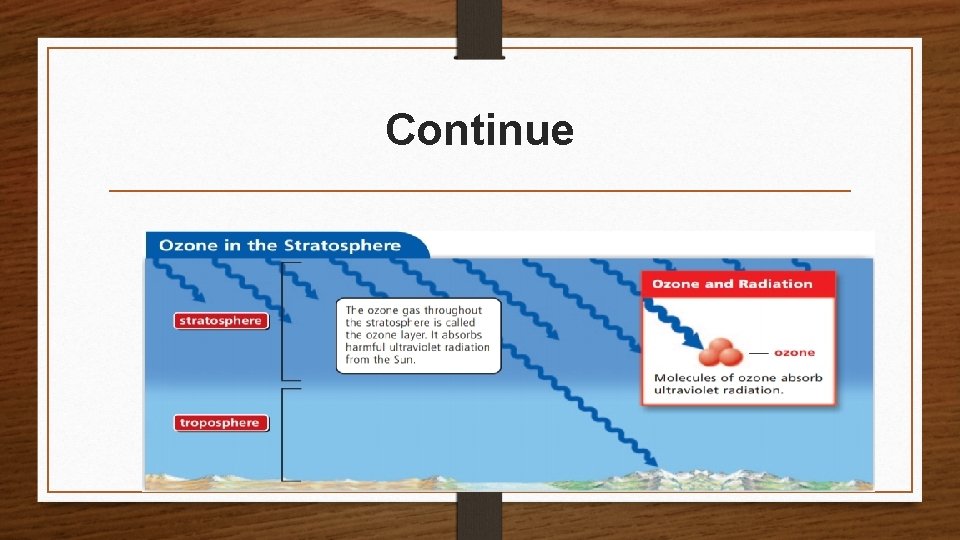
Continue • The Ozone layer protects life from harmful radiatio: • Ozone gas forms in stratosphere. An Ozone molecule is made up of 3 atoms of element oxygen. Our body uses regular Oxygen gas which has two atoms of oxygen. • In the stratosphere, Ozone and regular oxygen gases break apart and form again in a compact cycle. • The reactions that destroy and form Ozone normally balance each other, so the cycle can repeat endlessly. • Even though Ozone is mixed with nitrogen and other gases, the Ozone in stratosphere is called the ozone layer.
Continue • The Ozone layer protects life on earth by absorbing harmful ultraviolet radiation from the sun. Too much ultraviolet radiation cause sunburn, skin cancer, and damaged eyesight. • Ultraviolet radiation can harm crops a material suggest plastic or paint. Ozone absorbs ultraviolet radiation but lets other types of radiation such as visible light pass through.
Continue
Continue • The green house effect keeps the Earth warm: • A jacket helps keep us warm on a cool day by slowing the movementof heat energy away from our body. In a similar way, certain gases in the atmosphere slow the movement of energy away from Earth’s surface. • The gases absorb and emit infrared radiation, which keeps energy in Earth’s system for a while. • This process was named the because it reminded scientists of the way glass traps warmth inside a greenhouse carbon dioxide, methane, watervapour, nitrogen oxide, and other gases that absorb and give of infrared radiation are known as greenhouse gases.
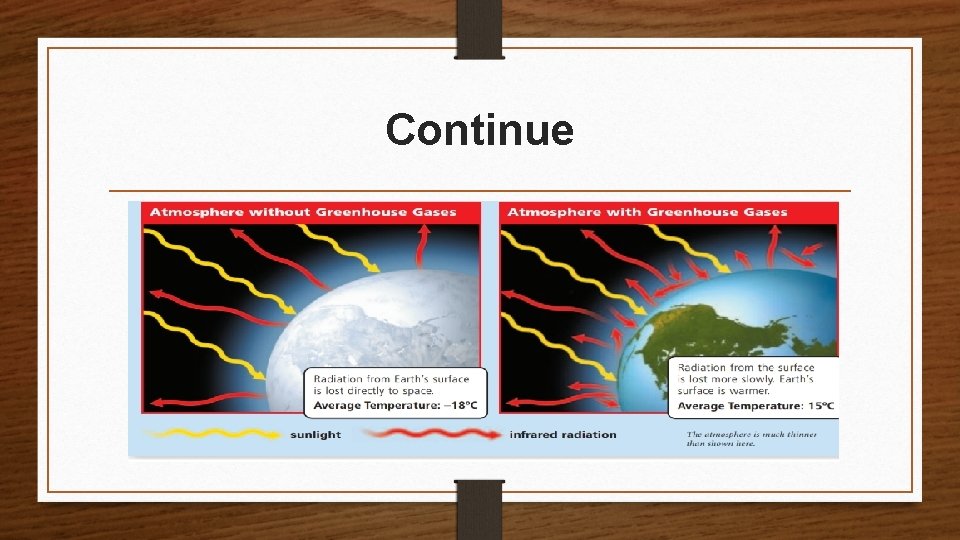
Continue • Unlike the glass roof and walls of a greenhouse the greenhouse gases do not form a single layer. They are mixed together with nitrogen, Oxygen, and other gases in the air. • The atmosphere is denset in troposphere- the lowest layer-so most of the greenhouse gas molecules are also in troposphere. • Radiation from sun, including visible light, warm earth’s surface, which then emits infrared radiation. If the atmosphere had no greenhouse gases, the infrared radiation would go straight through the atmosphere into outer space.
Continue • Earth’s average surface temperature would be only about Zero Fahrenheit. • Water would freeze, and it would be too cold for most forms of life on Earth to survive. • Green house effect: • Greenhouse gas molecules absorb and emit infrared radiation. • Earth’s atmosphere does have greenhouse gases. These gases absorb some of the infrared radiation emitted by Earth surface. • The greenhouse gases can then give off this energy as infrared radiation.
Continue • Some of the energy is absorbed again by the surface, while some of the energy goes out into space. • The greenhouse effect keeps earth’s average surface temperature around 15 degree celcius or 59 Fahrenheit. • The energy stays in a system longer with greenhouse gases than without them. In time, all the energy ends up back in outer space. If it did not, Earth would grow warmer and warmer as it absorbs more and more solar radiation.
Continue
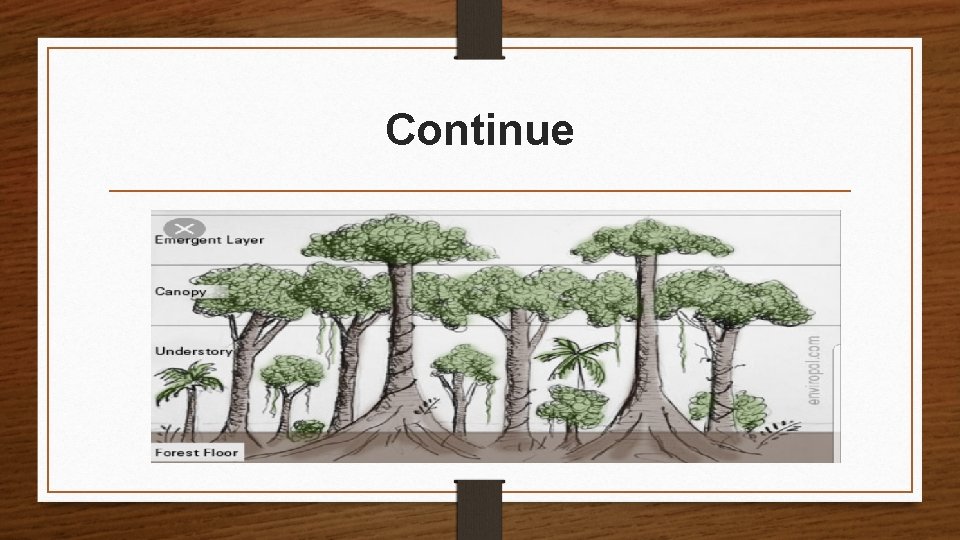
2. Effect of layers of vegetation • The layers of vegetation bring about variations in light intensity is reaching at different heights of mountain. • In forests a major portion of light intensity is absorbed by tree vegetation and the light reaching to the lower part of the ground vegetation is considerably decreased by 90 -98 precent of that in exposed areas. • The amount of light reaching the forest floor depends upon the height of canopy, age of tree, crown development of trees and phenological characteristics of constituent species.
Continue • Hence, in a forest, the mature tallest tree receives full insolation undershrubs receive subdued illumination and herbs and especially epigenous cryptogams grow in weaker light conditions. • When leaves of a tree are fully expanded, its canopy can decrease light to less than 1% of full solar radiation.
Continue
Effect of layers of water • The layers of water have pronounced influence on light intensities. • In aquatic bodies life forms are found growing in distinct zones, although such a zonation is not always due to different light intensity at different depths. • Submerged plants receive weaker illumination the exposed plants, as some of the light is reflected at the water surface and of the remainder, much is observed by the upper layers of water. • Like penetration in water depends upon the turbidity, motion, solute content and planktonic growth of the water.
Continue • The intensity of light decreases successively with increasing depth. • Usually at dawn, sunset, and in water, light intensities are weaker. • At equator daylight prevails for about 12 hours out of every 24, in both summer and winter. • Towards the poles, in summer day length becomes larger than 12 hours.