
Factors affecting use of climate change science decision
- Slides: 29
Factors affecting use of climate change science & decision support tools forest management in Vermont Clare Ginger, University of Vermont William Valliere, University of Vermont James Duncan, Forest Ecosystem Monitoring Cooperative, University of Vermont 2017 Forest Ecosystem Monitoring Cooperative Conference, December 15
Where to Today… • Context ▫ Forests & climate change ▫ Forest research project at University of Vermont • Questions for today’s presentation • Approach • Findings • Next steps
Global Change & Forest Health • Changing climate, different growing conditions, changing forest structure & function ▫ ▫ Temperature & precipitation changes Weather disturbances Changes in tree species Changes in invasive species • Institutional Responses ▫ Adaptation (&/or mitigation)
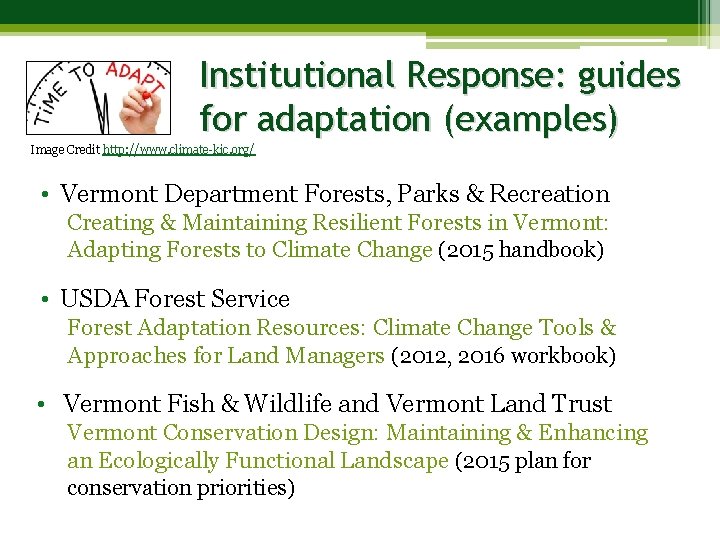
Institutional Response: guides for adaptation (examples) Image Credit http: //www. climate-kic. org/ • Vermont Department Forests, Parks & Recreation Creating & Maintaining Resilient Forests in Vermont: Adapting Forests to Climate Change (2015 handbook) • USDA Forest Service Forest Adaptation Resources: Climate Change Tools & Approaches for Land Managers (2012, 2016 workbook) • Vermont Fish & Wildlife and Vermont Land Trust Vermont Conservation Design: Maintaining & Enhancing an Ecologically Functional Landscape (2015 plan for conservation priorities)
Some Barriers to Adaptation • Uncertainty about climate change impacts • Mismatch in spatial scale of data & modeling as compared to management decisions • Mismatch in temporal scale of impacts as compared to planning/decision making time horizons
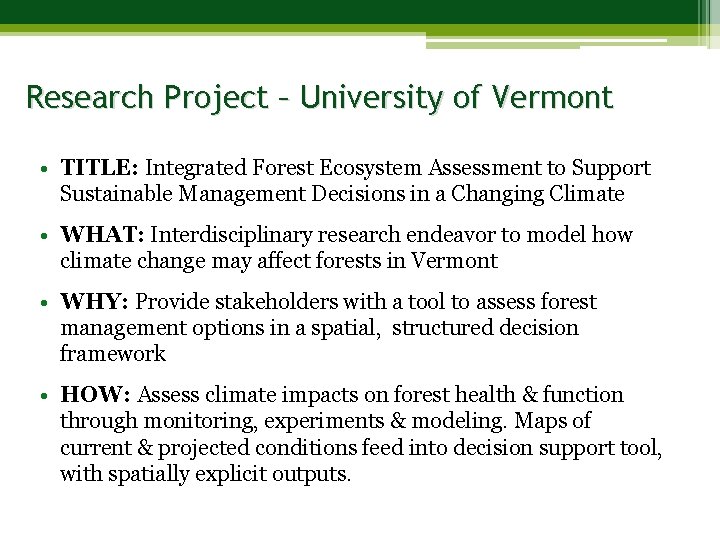
Research Project – University of Vermont • TITLE: Integrated Forest Ecosystem Assessment to Support Sustainable Management Decisions in a Changing Climate • WHAT: Interdisciplinary research endeavor to model how climate change may affect forests in Vermont • WHY: Provide stakeholders with a tool to assess forest management options in a spatial, structured decision framework • HOW: Assess climate impacts on forest health & function through monitoring, experiments & modeling. Maps of current & projected conditions feed into decision support tool, with spatially explicit outputs.
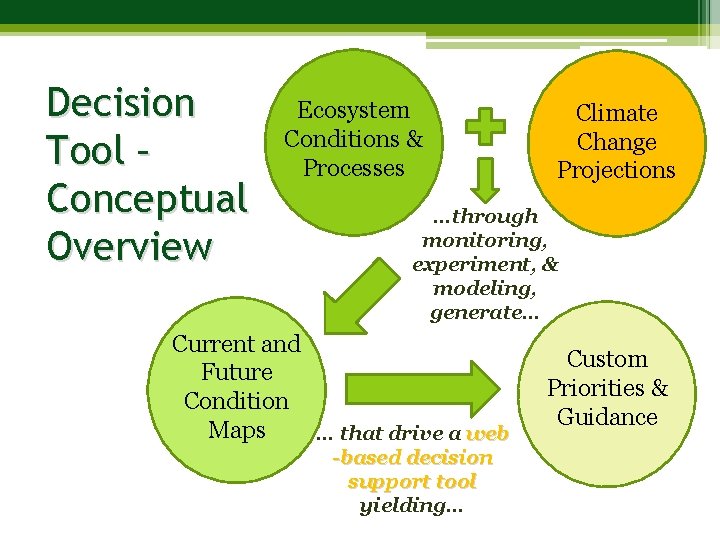
Decision Tool – Conceptual Overview Ecosystem Conditions & Processes Climate Change Projections …through monitoring, experiment, & modeling, generate… Current and Future Condition Maps … that drive a web -based decision support tool yielding… Custom Priorities & Guidance
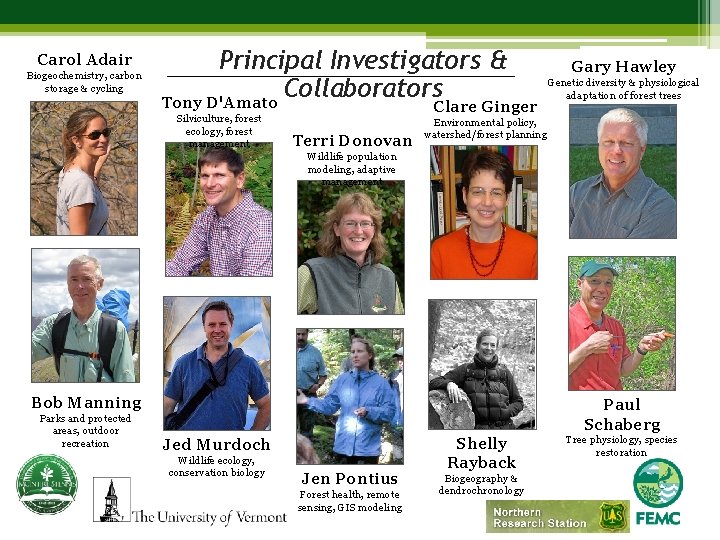
Carol Adair Biogeochemistry, carbon storage & cycling Principal Investigators & Collaborators Tony D'Amato Silviculture, forest ecology, forest management Clare Ginger Terri Donovan Gary Hawley Genetic diversity & physiological adaptation of forest trees Environmental policy, watershed/forest planning Wildlife population modeling, adaptive management Bob Manning Parks and protected areas, outdoor recreation Paul Schaberg Jed Murdoch Wildlife ecology, conservation biology Jen Pontius Forest health, remote sensing, GIS modeling Shelly Rayback Biogeography & dendrochronology Tree physiology, species restoration
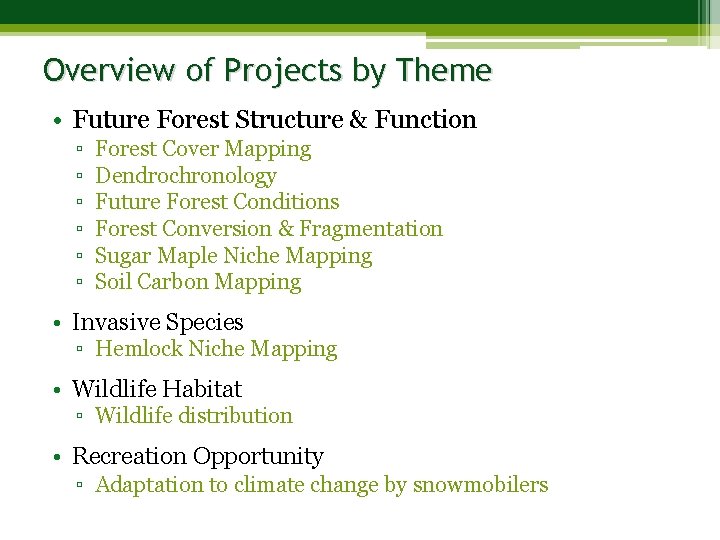
Overview of Projects by Theme • Future Forest Structure & Function ▫ ▫ ▫ Forest Cover Mapping Dendrochronology Future Forest Conditions Forest Conversion & Fragmentation Sugar Maple Niche Mapping Soil Carbon Mapping • Invasive Species ▫ Hemlock Niche Mapping • Wildlife Habitat ▫ Wildlife distribution • Recreation Opportunity ▫ Adaptation to climate change by snowmobilers
Project Addressing Barriers to Adaptation • Reduce uncertainty about climate change impacts • Reduce mismatch in spatial scale of data & modeling as compared to management decisions • Mismatch in temporal scale of impacts as compared to planning/decision making time horizons
Underlying assumptions/issues RELEVANCE, CREDIBILITY, USABILITY • Data & outputs will be relevant to decisions/management situations • Monitoring, experimental & modeling results will be credible to potential users • Forest managers/decision makers/analysts/ planners have capacity & time to use tool, data &/or outputs generated by the project
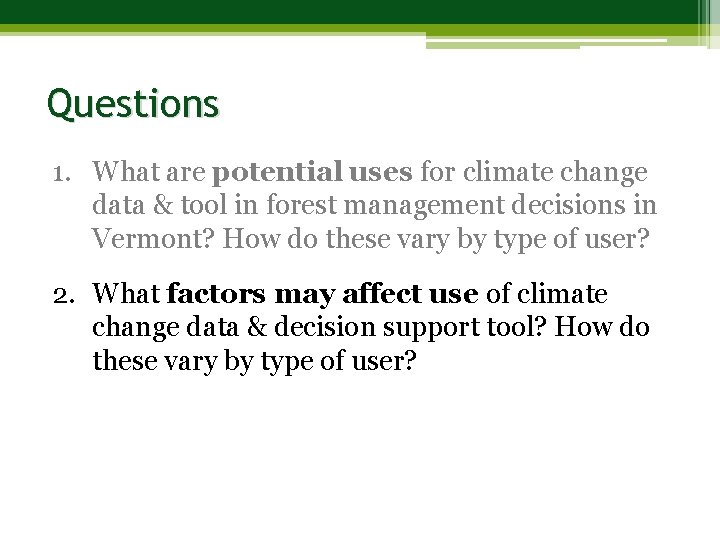
Questions 1. What are potential uses for climate change data & tool in forest management decisions in Vermont? How do these vary by type of user?
Questions 1. What are potential uses for climate change data & tool in forest management decisions in Vermont? How do these vary by type of user? 2. What factors may affect use of climate change data & decision support tool? How do these vary by type of user?
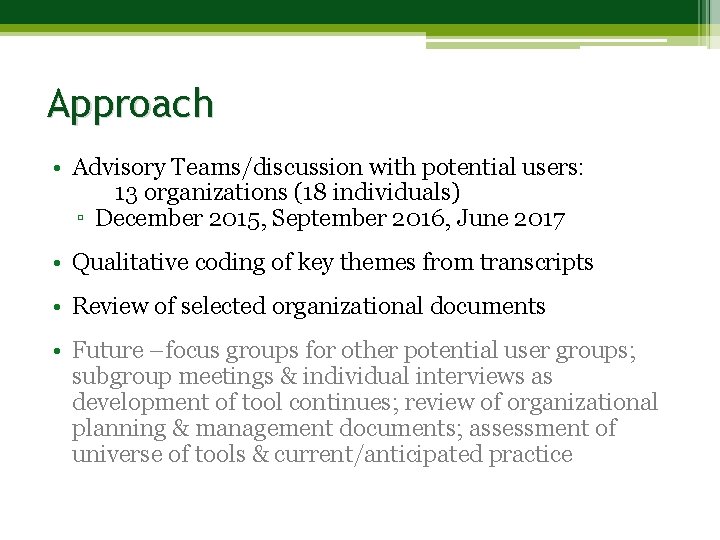
Approach • Advisory Teams/discussion with potential users: 13 organizations (18 individuals) ▫ December 2015, September 2016, June 2017 • Qualitative coding of key themes from transcripts • Review of selected organizational documents • Future –focus groups for other potential user groups; subgroup meetings & individual interviews as development of tool continues; review of organizational planning & management documents; assessment of universe of tools & current/anticipated practice
Potential User Groups Federal Agencies State Agencies
Potential User Groups Non-Profits/Non-Governmental Organizations Conservation Groups Recreation Groups To be added: Consulting Foresters & Regional Planning Commissions Other
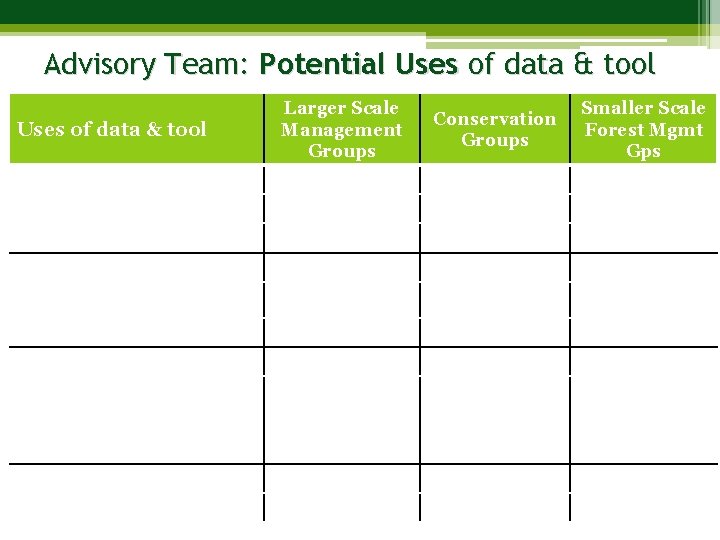
Advisory Team: Potential Uses of data & tool Larger Scale Management Groups Conservation Groups Smaller Scale Forest Mgmt Gps
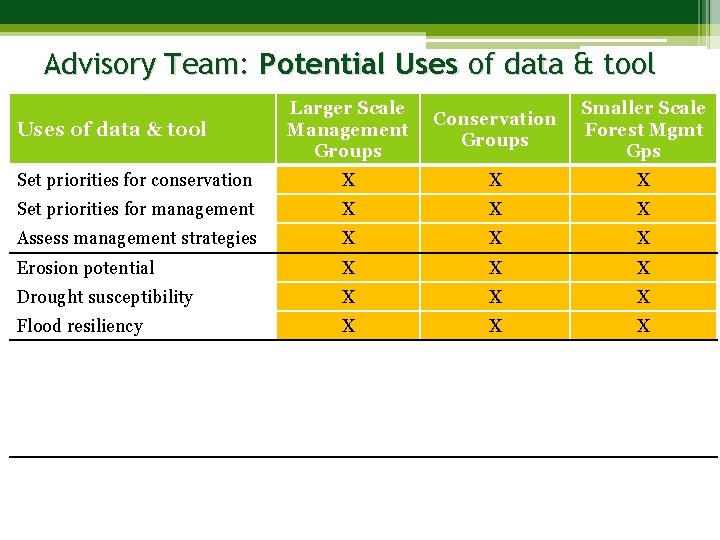
Advisory Team: Potential Uses of data & tool Larger Scale Management Groups Conservation Groups Smaller Scale Forest Mgmt Gps Set priorities for conservation X X X Set priorities for management X X X Assess management strategies X X X Erosion potential X X X Drought susceptibility X X X Flood resiliency X X X Uses of data & tool
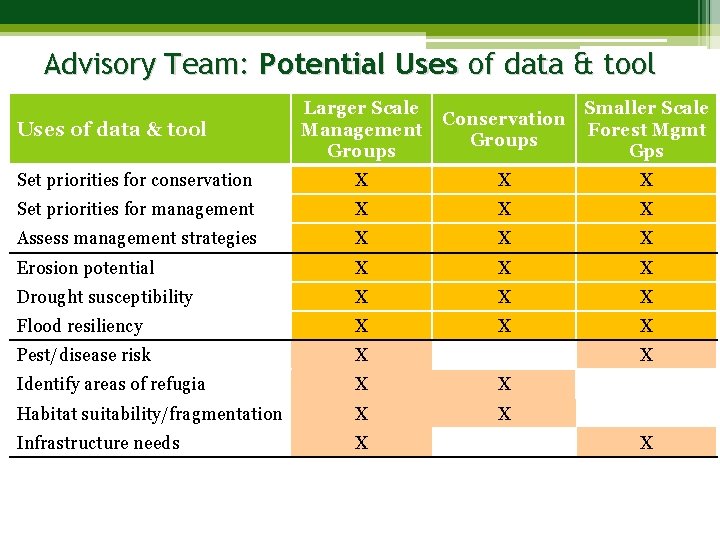
Advisory Team: Potential Uses of data & tool Larger Scale Management Groups Conservation Groups Smaller Scale Forest Mgmt Gps Set priorities for conservation X X X Set priorities for management X X X Assess management strategies X X X Erosion potential X X X Drought susceptibility X X X Flood resiliency X X X Pest/disease risk X Identify areas of refugia X X Habitat suitability/fragmentation X X Infrastructure needs X Uses of data & tool X X
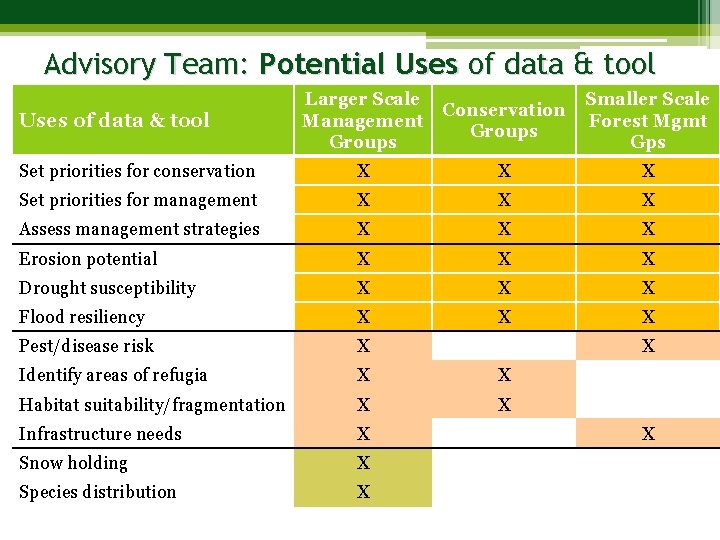
Advisory Team: Potential Uses of data & tool Larger Scale Management Groups Conservation Groups Smaller Scale Forest Mgmt Gps Set priorities for conservation X X X Set priorities for management X X X Assess management strategies X X X Erosion potential X X X Drought susceptibility X X X Flood resiliency X X X Pest/disease risk X Identify areas of refugia X X Habitat suitability/fragmentation X X Infrastructure needs X Snow holding X Species distribution X Uses of data & tool X X
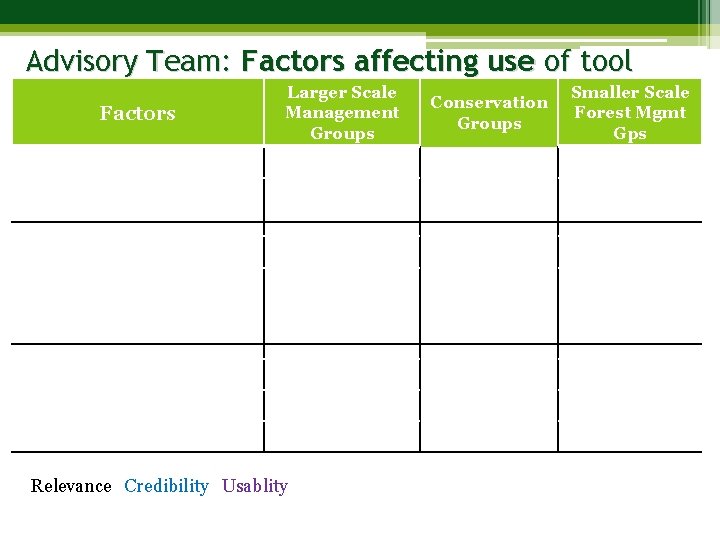
Advisory Team: Factors affecting use of tool Factors Larger Scale Management Groups Relevance Credibility Usablity Conservation Groups Smaller Scale Forest Mgmt Gps
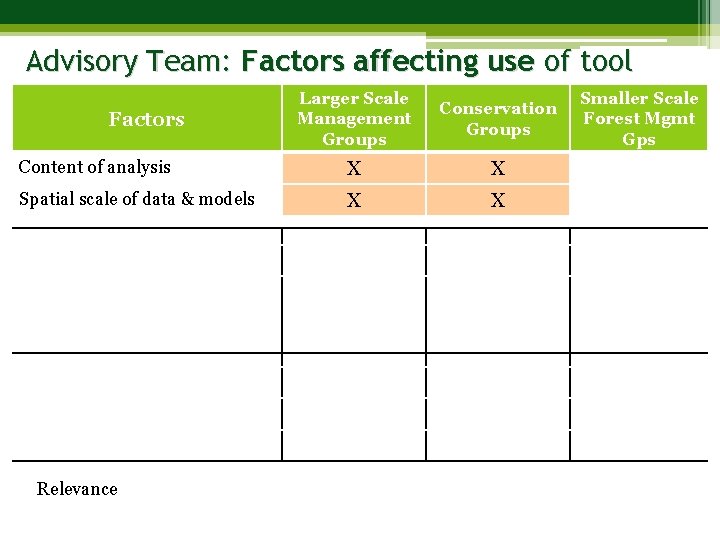
Advisory Team: Factors affecting use of tool Larger Scale Management Groups Conservation Groups Content of analysis X X Spatial scale of data & models X X Factors Relevance Smaller Scale Forest Mgmt Gps
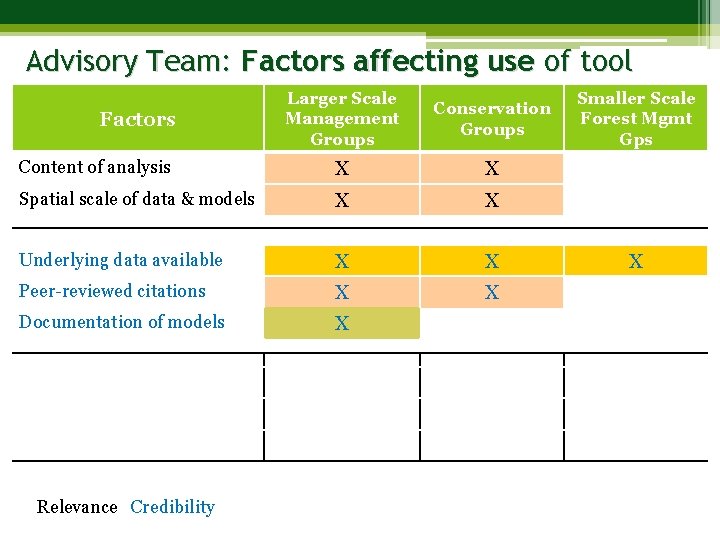
Advisory Team: Factors affecting use of tool Larger Scale Management Groups Conservation Groups Content of analysis X X Spatial scale of data & models X X Underlying data available X X Peer-reviewed citations X X Documentation of models X Factors Relevance Credibility Smaller Scale Forest Mgmt Gps X
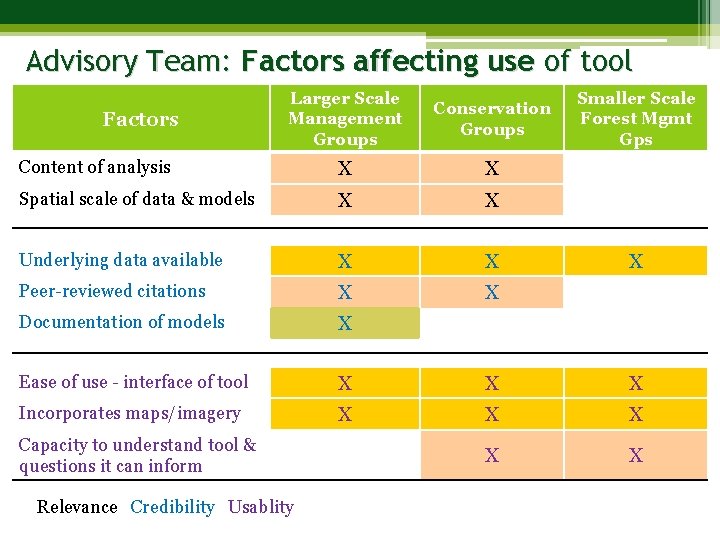
Advisory Team: Factors affecting use of tool Larger Scale Management Groups Conservation Groups Content of analysis X X Spatial scale of data & models X X Underlying data available X X Peer-reviewed citations X X Documentation of models X Ease of use - interface of tool X X X Incorporates maps/imagery X X X Factors Capacity to understand tool & questions it can inform Relevance Credibility Usablity Smaller Scale Forest Mgmt Gps X
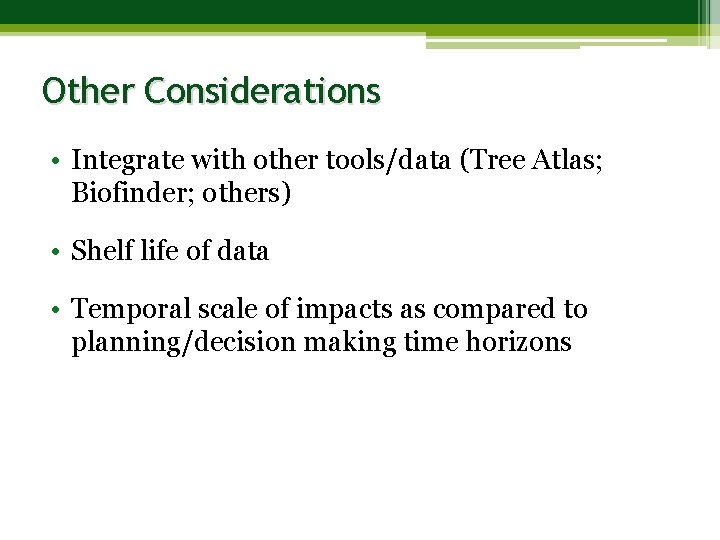
Other Considerations • Integrate with other tools/data (Tree Atlas; Biofinder; others) • Shelf life of data • Temporal scale of impacts as compared to planning/decision making time horizons
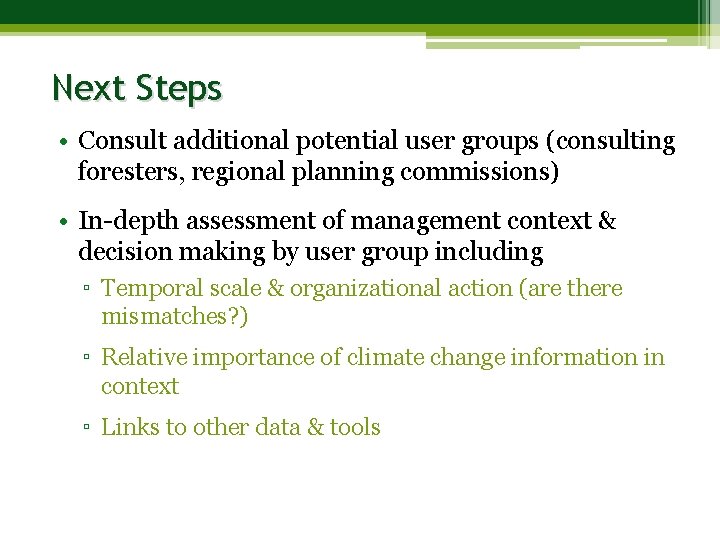
Next Steps • Consult additional potential user groups (consulting foresters, regional planning commissions) • In-depth assessment of management context & decision making by user group including ▫ Temporal scale & organizational action (are there mismatches? ) ▫ Relative importance of climate change information in context ▫ Links to other data & tools
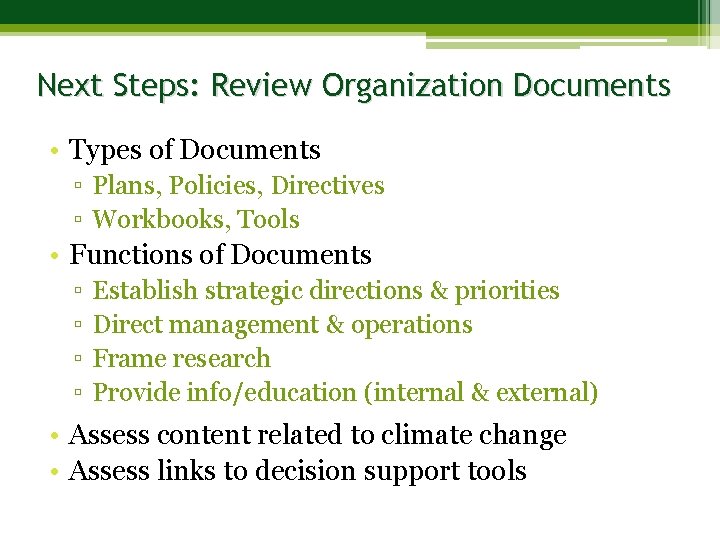
Next Steps: Review Organization Documents • Types of Documents ▫ Plans, Policies, Directives ▫ Workbooks, Tools • Functions of Documents ▫ ▫ Establish strategic directions & priorities Direct management & operations Frame research Provide info/education (internal & external) • Assess content related to climate change • Assess links to decision support tools
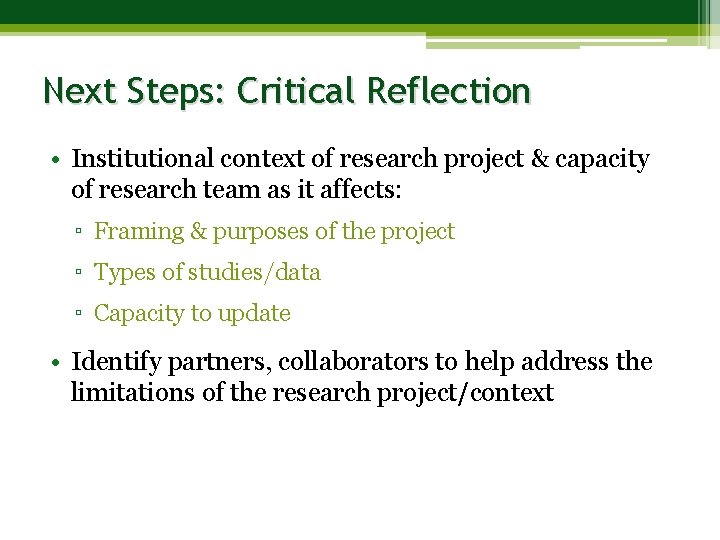
Next Steps: Critical Reflection • Institutional context of research project & capacity of research team as it affects: ▫ Framing & purposes of the project ▫ Types of studies/data ▫ Capacity to update • Identify partners, collaborators to help address the limitations of the research project/context
Acknowledgements • USDA Mc. Intire-Stennis Program for funding • Collaborators on this presentation (Bill Valliere, Jim Duncan) • Project Team