
Factors Affecting Transportation Systems Engineering Introduction Human factors

- Slides: 23
Factors Affecting Transportation Systems Engineering
Introduction • Human factors – Drivers, passengers, and pedestrians – Reaction time, visual acuity, walking speed etc. • Vehicle factors – Vehicle dimensions, weight, axle configuration, turning radius and turning path, acceleration and braking characteristics etc. • Road factors – Road surface, lighting, roughness, night visibility, geometric aspects 1/18/2022 Factors Affecting Transportation 2/11
Human factors • Most complex factor as the human performances varies from individual to individual – Traffic signal timed to permit an average pedestrian to cross the street safely may cause a severe hazard to an elderly person • Variability – Ability to react to a situation, vision and hearing, and other physical and psychological factors vary from person to person and depends on age, fatigue, nature of stimuli etc. 1/18/2022 Factors Affecting Transportation 3/11
Human factors • Reaction time – Perception • Perceiving the sensations received through the sense organs, nerves and brains. – Intellection • Identification and understanding of stimuli – Emotion • Judgment of the appropriate response to be made on the stimuli like to stop, pass, move laterally etc. – Volition • Execution of the decision which is the result of a physical actions of the driver 1/18/2022 Factors Affecting Transportation 4/11
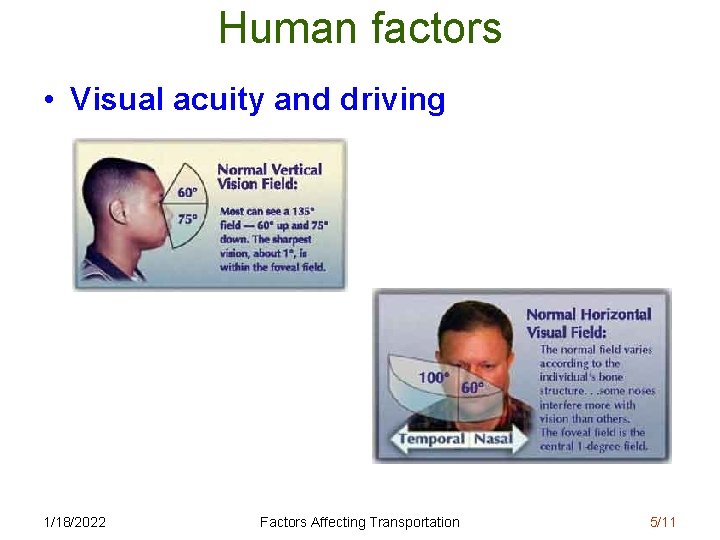
Human factors • Visual acuity and driving 1/18/2022 Factors Affecting Transportation 5/11
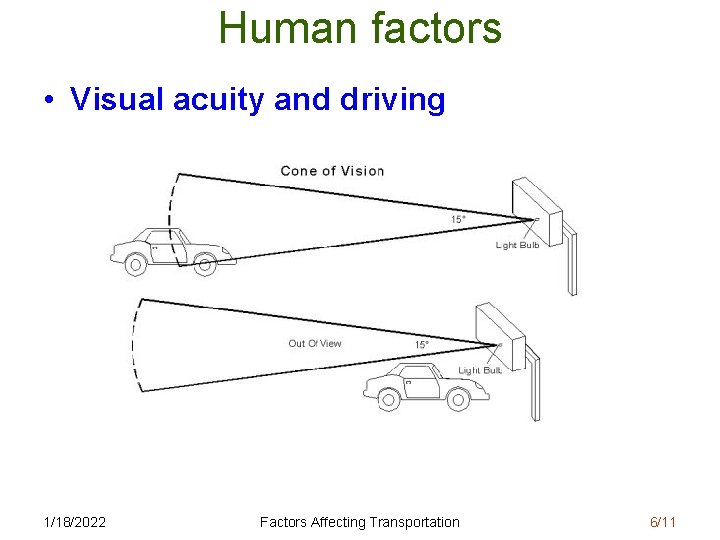
Human factors • Visual acuity and driving 1/18/2022 Factors Affecting Transportation 6/11
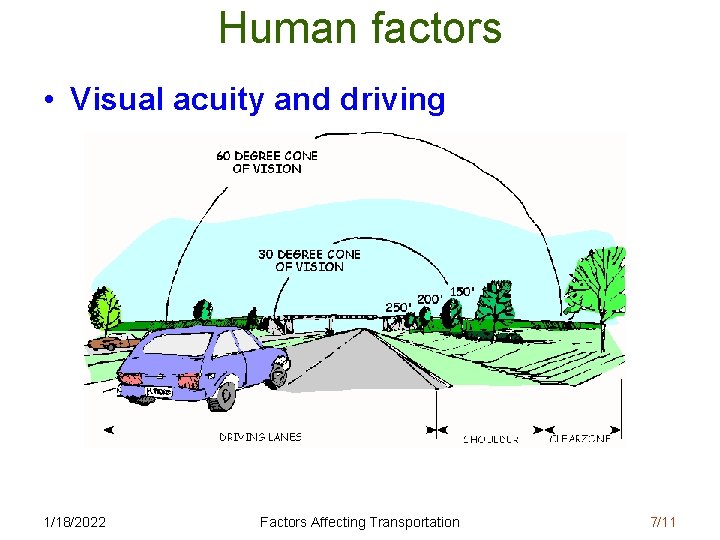
Human factors • Visual acuity and driving 1/18/2022 Factors Affecting Transportation 7/11
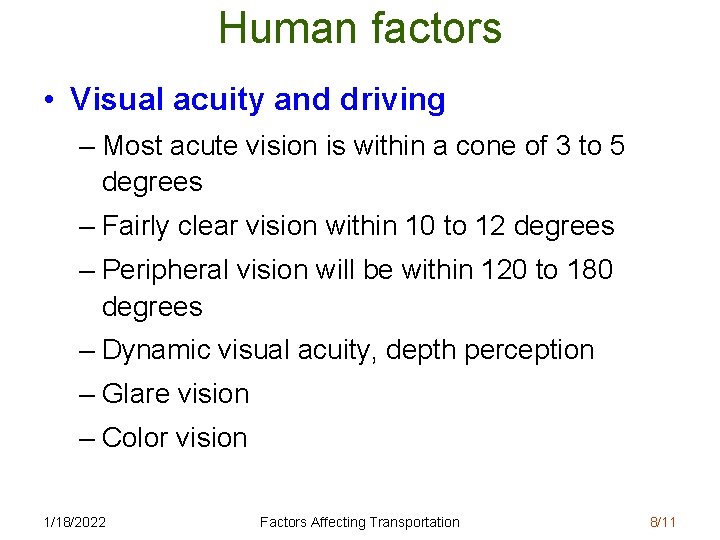
Human factors • Visual acuity and driving – Most acute vision is within a cone of 3 to 5 degrees – Fairly clear vision within 10 to 12 degrees – Peripheral vision will be within 120 to 180 degrees – Dynamic visual acuity, depth perception – Glare vision – Color vision 1/18/2022 Factors Affecting Transportation 8/11
Human factors • Walking – Pedestrian traffic along footpaths, sidewalks, crosswalks, safety zones, islands, and over and under passes – Average pedestrian walking speed 1. 5 to 2 m/sec. • Other Characteristics – Hearing acquity 1/18/2022 Factors Affecting Transportation 9/11
Vehicle factors • Design vehicles – To provide practical limits for road designers – Road space and geometry is available to normal vehicles – To implement traffic control effectively and efficiently – Take care of other road users also. 1/18/2022 Factors Affecting Transportation 10/11
Vehicle factors • Vehicles can be grouped into – Motorized two wheelers – Motorized three wheelers – Passenger car – Bus – Single axle trucks – Multi axle trucks – Truck trailer combinations – Slow non motorized vehicles 1/18/2022 Factors Affecting Transportation 11/11
Vehicle factors • Vehicle dimensions – Width, – Height, – Length, – Rear overhang, – Ground clearance. • Width of vehicle affects – Width of lanes – Shoulders – Parking facility • Capacity of the road decreases if the width exceeds the design values 1/18/2022 Factors Affecting Transportation 12/11
Vehicle factors • Height of vehicle affects – Clearance height of structures like over-bridges, under -bridges and electric and other service lines and also placing of signs and signals • Length of the vehicle affects – Extra width of pavement, – Minimum turning radius, – Safe overtaking distance, – Capacity – Parking facility 1/18/2022 Factors Affecting Transportation 13/11
Vehicle factors • Rear overhang control is important when vehicle takes a right/left turn from a stationary point • Ground clearance of vehicle affects designing ramps 1/18/2022 Factors Affecting Transportation 14/11
Vehicle factors • Weight and axle configuration – Weight of vehicle is transferred to pavement through axles – Design parameters are fixed on basis of number of axles – Power to weight ratio • Measure of ease with which a vehicle can move • More important for heavy vehicles • Determines length to which a positive gradient can be permitted taking into consideration case of heavy vehicles 1/18/2022 Factors Affecting Transportation 15/11
Vehicle factors • Turning radius and turning path – Dependent on the design and class of the vehicle – Effective width of vehicle is increased on a turning – Important at an intersection, round about, terminals, and parking areas 1/18/2022 Factors Affecting Transportation 16/11
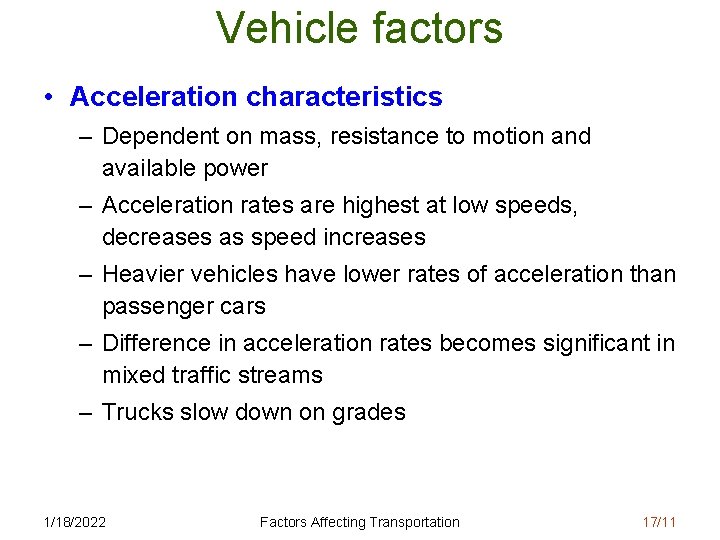
Vehicle factors • Acceleration characteristics – Dependent on mass, resistance to motion and available power – Acceleration rates are highest at low speeds, decreases as speed increases – Heavier vehicles have lower rates of acceleration than passenger cars – Difference in acceleration rates becomes significant in mixed traffic streams – Trucks slow down on grades 1/18/2022 Factors Affecting Transportation 17/11
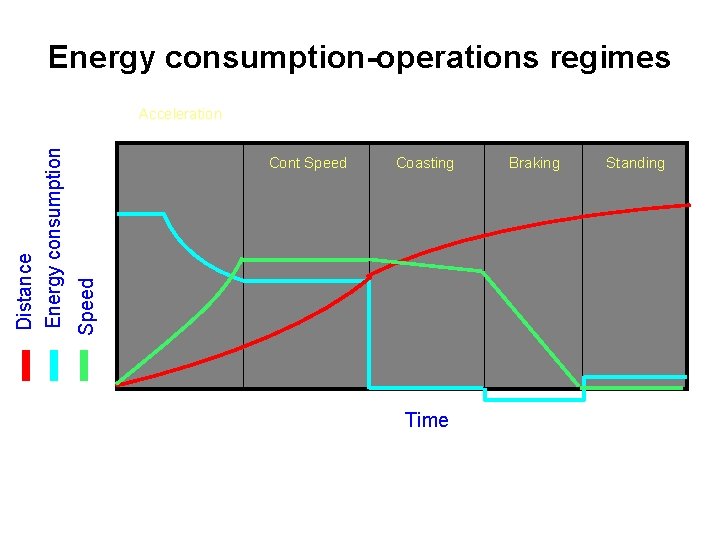
Energy consumption-operations regimes Cont Speed Coasting Speed Distance Energy consumption Acceleration Time Braking Standing
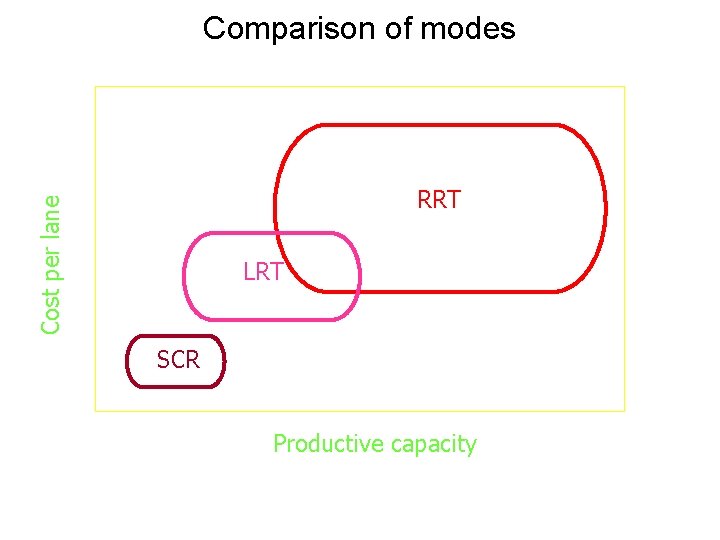
Comparison of modes Cost per lane RRT LRT SCR Productive capacity
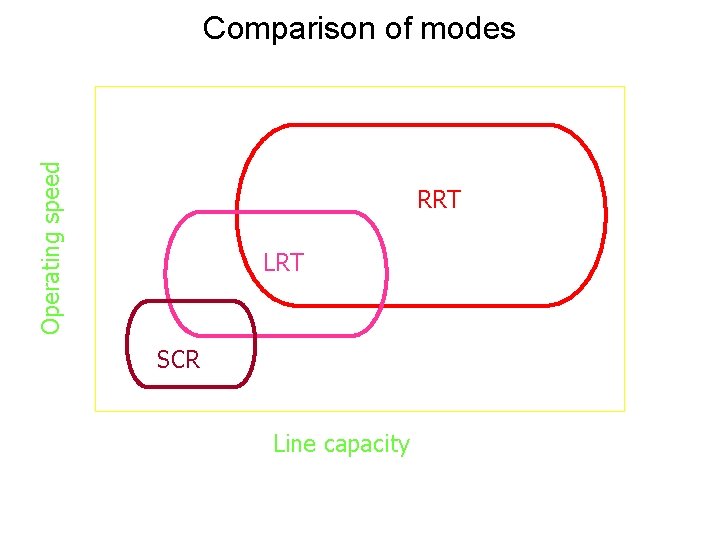
Operating speed Comparison of modes RRT LRT SCR Line capacity
Road factors • Road surface – Roughness, tire wear, tractive resistance, noise, light reflection, electrostatic properties • Lighting – Planned on basis of night vehicular traffic, pedestrian volumes and accident experience – Shoulders or even speed change lanes deliberately roughened as a means of delineation 1/18/2022 Factors Affecting Transportation
Road factors • Roughness • Texture of surface of inner-lane is rougher than that of the outside lane, • Shoulders or even speed change lanes deliberately roughened as a means of delineation • Pavement colors • Night visibility • Geometric aspects – Pavement slope – Gradient – Right of way 1/18/2022 Factors Affecting Transportation
Thank You tomvmathew@gmail. com