
FACTORS AFFECTING SECOND LANGUAGE ACQUISITION Motivation Age Personality

- Slides: 12
FACTORS AFFECTING SECOND LANGUAGE ACQUISITION
�Motivation �Age �Personality �Cognitive ability �Learner Perperence �Aptitude
Motivation � Motivating students in to lesson. � Varying the activities, tasks, and materials to increase students’ interest levels. � Using cooperative rather than competitive goals to increase students’ selfconfidence. � Creating supportive and non-threatening learning atmosphere.
Age � L 2 development in informal language learning environment where the TL is used primarily; Ø Children can eventually speak the L 2 with native- like fliency, but their parents and older learners are hard to achieve such high level of mastery of the spoken language, especially in pronunciation/accent. Ø Adults and adolescents can make more rapid progress toward mastery of an L 2 in contexts where they can make use the language on a daily basis in social, personal, professional, or academic interaction.
Personality � There are number of personality characteristics that are likely to affect L 2 learning, such as: q. Extroversion vs. introversion q. Inhibition vs. risk-taking q. Self-esteem (self-confidence) q. Anxiety q. Empathy
Cognitive ability students with greater cognitive abilities will make the faster progress. � Some linguists believe that there is a specific, innate language learning ability that is stronger in some students than in others. � Students who are learning a second language which is from the same language family as their first language have, in general, a much easier task than those who aren't. �
Learner Preferences � Perceptual learning styles; q Visual learner. q. Auditory (aural) learners. q. Haptic learners (a combination of the kinesthetic and tactile styles. ) q. Kinesthetic learners (body movement). q. Tactile learners (hands-on).
Aptitude � refers to potential for achievement. � Aptitude for second language learning is usually composed of four (4) abilities: q Identify and memorize the sounds q Understand the function of particular words in sentences q Figure out grammatical rules from language sample q Memorize new words
References: http: //www. ncca. ie/uploadedfiles/curriculum /inclusion/esl_primary. pdf � http: //math. arizona. edu/~cemela/english/co ntent/shortcourses/sla/2 nd%20 Language% 20 Acquisition. pdf � http: //www. transparent. com/about/secondlanguage. html � http: //www. sdkrashen. com/. � http: //www 2. nkfust. edu. tw/~emchen/SLA/in tro. com �
QUIZ
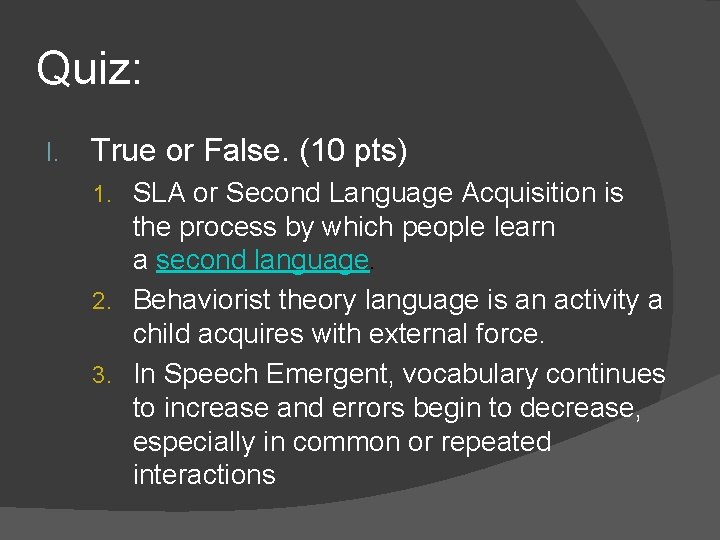
Quiz: I. True or False. (10 pts) 1. SLA or Second Language Acquisition is the process by which people learn a second language. 2. Behaviorist theory language is an activity a child acquires with external force. 3. In Speech Emergent, vocabulary continues to increase and errors begin to decrease, especially in common or repeated interactions
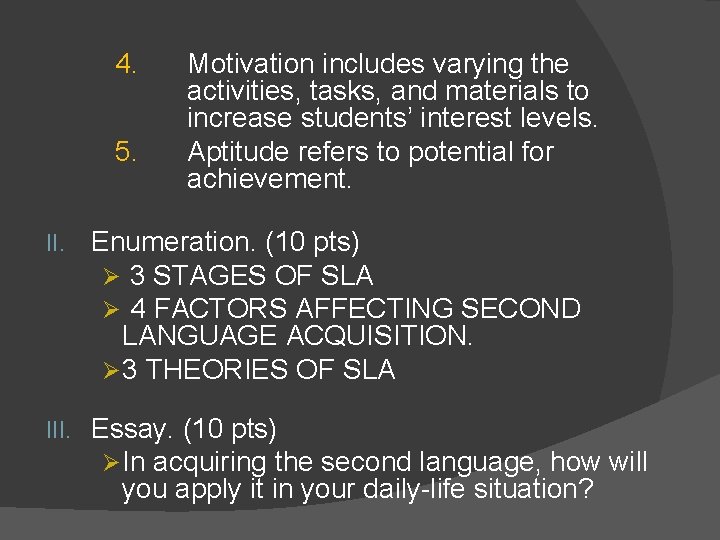
4. 5. Motivation includes varying the activities, tasks, and materials to increase students’ interest levels. Aptitude refers to potential for achievement. II. Enumeration. (10 pts) Ø 3 STAGES OF SLA Ø 4 FACTORS AFFECTING SECOND LANGUAGE ACQUISITION. Ø 3 THEORIES OF SLA III. Essay. (10 pts) Ø In acquiring the second language, how will you apply it in your daily-life situation?