
Factors Affecting Rate of Erosion Rainfall duration and
- Slides: 33
Factors Affecting Rate of Erosion • Rainfall (duration and intensity): – Anything that increases the amount of runoff relative to the infiltration rate will enhance erosion from rain. • Heavy, intense rains can quickly exceed the soil’s infiltration rate, adding to the erosiveness of the rainfall event. Soils that have been silted shut (crusting) reduces the infiltration rate as well. • Extend duration rains can saturate the surface soil profile reducing the infiltration rate and increase the erosion potential of the excess water.
Factors Affecting Rate of Erosion • Soil texture: – Influences water erosion by determining infiltration rate – Influences wind erosion by percentage of different soil separates • Slope length and percentage: : – Influences water erosion by the amount of water running off a slope and the velocity of the water movement which is primarily determined by slope.
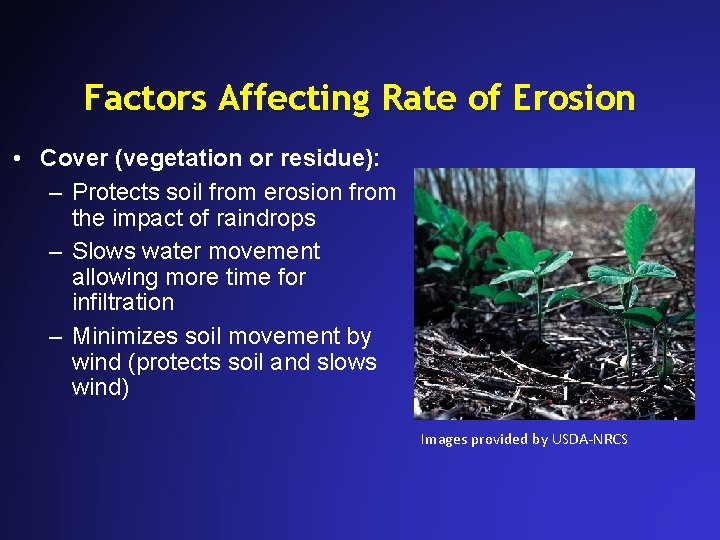
Factors Affecting Rate of Erosion • Cover (vegetation or residue): – Protects soil from erosion from the impact of raindrops – Slows water movement allowing more time for infiltration – Minimizes soil movement by wind (protects soil and slows wind) Images provided by USDA-NRCS
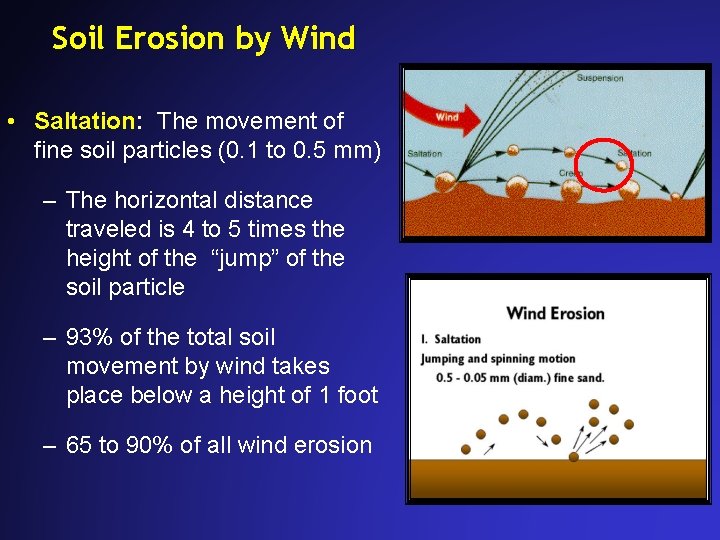
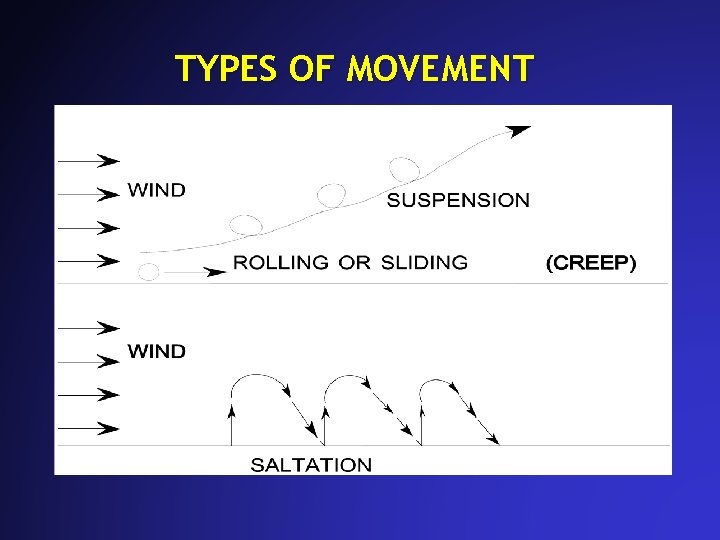
Soil Erosion • Wind Erosion: The breakdown of solid rock into smaller particles and its removal by wind. – It may occur on any soil whose surface is dry, unprotected by vegetation (to bind it at root level and shelter the surface) and consists of light particles. – The mechanisms include straightforward picking up of dust and soil particles by the airflow and the dislodging or abrasion of surface material by the impact of particles already airborne. • Types of wind erosion – Saltation – Suspension – Surface creep
Soil Erosion by Wind • Saltation: The movement of fine soil particles (0. 1 to 0. 5 mm) – The horizontal distance traveled is 4 to 5 times the height of the “jump” of the soil particle – 93% of the total soil movement by wind takes place below a height of 1 foot – 65 to 90% of all wind erosion
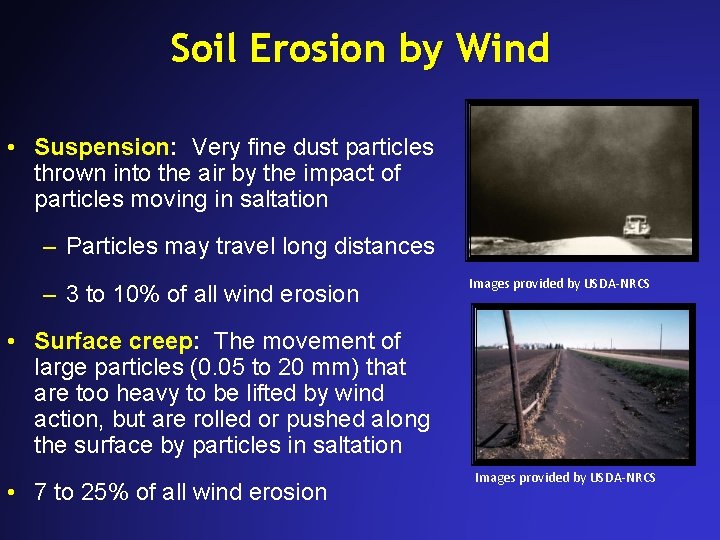
Soil Erosion by Wind • Suspension: Very fine dust particles thrown into the air by the impact of particles moving in saltation – Particles may travel long distances – 3 to 10% of all wind erosion Images provided by USDA-NRCS • Surface creep: The movement of large particles (0. 05 to 20 mm) that are too heavy to be lifted by wind action, but are rolled or pushed along the surface by particles in saltation • 7 to 25% of all wind erosion Images provided by USDA-NRCS
TYPES OF MOVEMENT
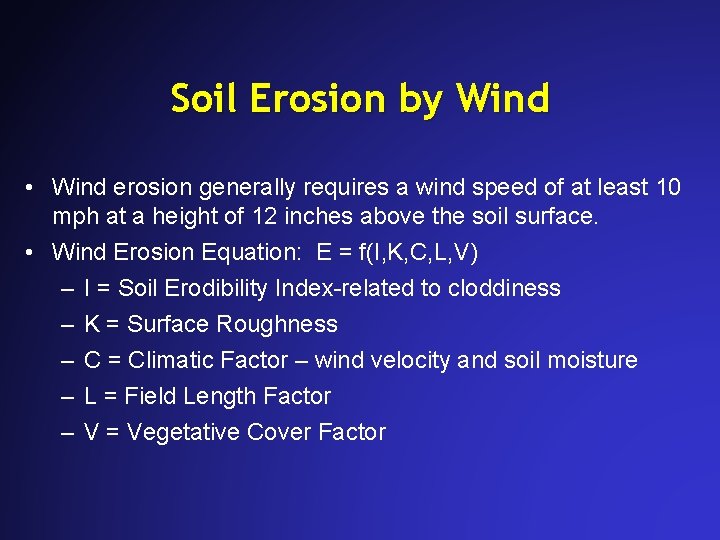
Soil Erosion by Wind • Wind erosion generally requires a wind speed of at least 10 mph at a height of 12 inches above the soil surface. • Wind Erosion Equation: E = f(I, K, C, L, V) – I = Soil Erodibility Index-related to cloddiness – K = Surface Roughness – C = Climatic Factor – wind velocity and soil moisture – L = Field Length Factor – V = Vegetative Cover Factor
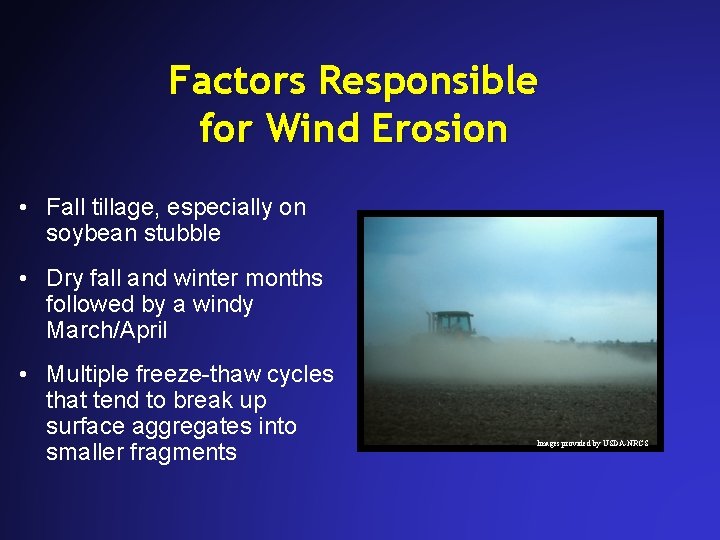
Factors Responsible for Wind Erosion • Fall tillage, especially on soybean stubble • Dry fall and winter months followed by a windy March/April • Multiple freeze-thaw cycles that tend to break up surface aggregates into smaller fragments Images provided by USDA-NRCS
Factors Affecting Wind Erosion • Soil surface roughness: – Smooth soil surfaces offer little resistance to wind – Roughness tends to break wind speed at the surface minimizing abrasion and breakdown of surface soil structure. – Excessive tillage creates small particles on a smooth soil surface, contributing to further soil structure breakdown by abrasion and increased erosion. • Climate – Speed and duration of the wind is directly related to the extent of soil erosion – Low soil moisture allows surface particles to be moved by wind – Freeze/dry cycles tend to break soil aggregates into smaller pieces creating more soil particles that can be move by wind
Factors Affecting Wind Erosion • Unsheltered distance: – Lack of windbreaks allows wind to move soil for greater distances. Knolls tend to be eroded the most with uninhibited winds. • Vegetative cover: – Loose, dry soil tends to be susceptible to wind erosion – Low levels of crop residue may not provide ample protection – Integrated approach using network of living windbreaks, combined with proper tillage, residue management, and crop selection.
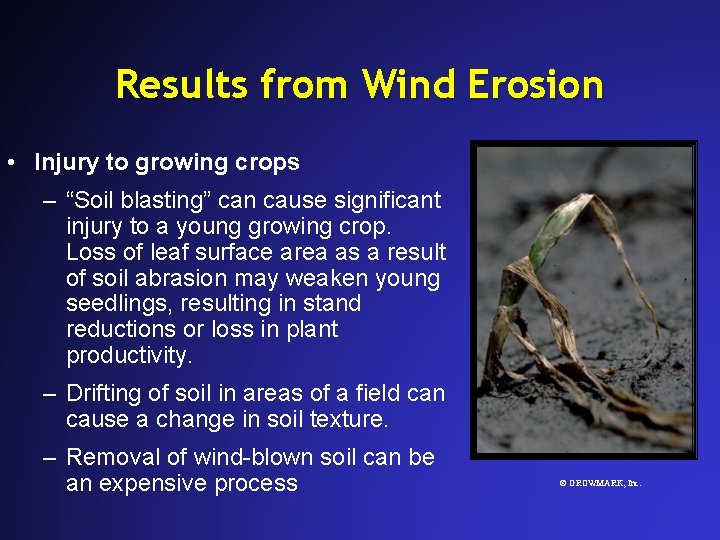
Results from Wind Erosion • Injury to growing crops – “Soil blasting” can cause significant injury to a young growing crop. Loss of leaf surface area as a result of soil abrasion may weaken young seedlings, resulting in stand reductions or loss in plant productivity. – Drifting of soil in areas of a field can cause a change in soil texture. – Removal of wind-blown soil can be an expensive process © GROWMARK, Inc.
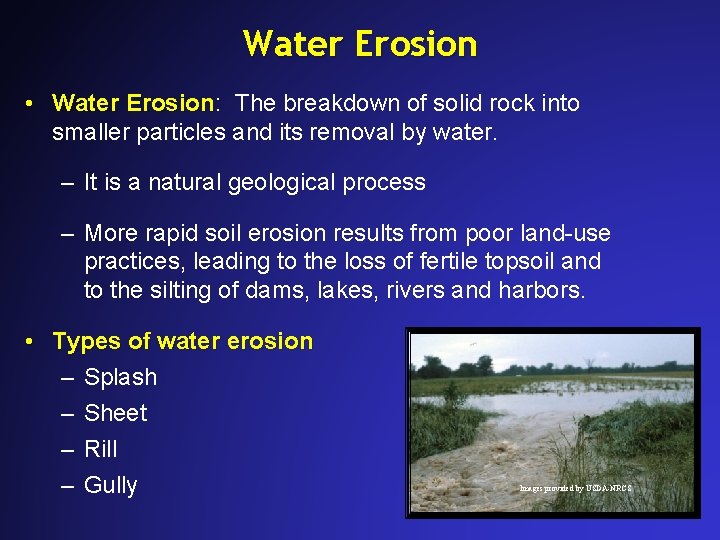
Water Erosion • Water Erosion: Erosion The breakdown of solid rock into smaller particles and its removal by water. – It is a natural geological process – More rapid soil erosion results from poor land-use practices, leading to the loss of fertile topsoil and to the silting of dams, lakes, rivers and harbors. • Types of water erosion – Splash – Sheet – Rill – Gully Images provided by USDA-NRCS
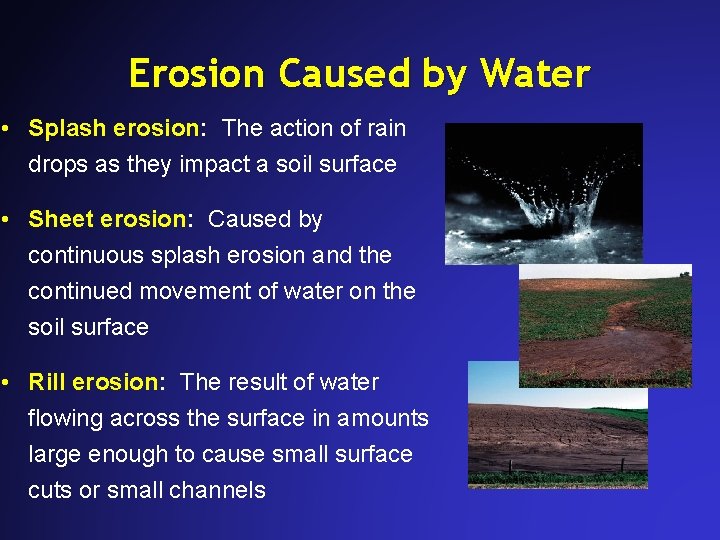
Erosion Caused by Water • Splash erosion: erosion The action of rain drops as they impact a soil surface • Sheet erosion: Caused by continuous splash erosion and the continued movement of water on the soil surface • Rill erosion: The result of water flowing across the surface in amounts large enough to cause small surface cuts or small channels
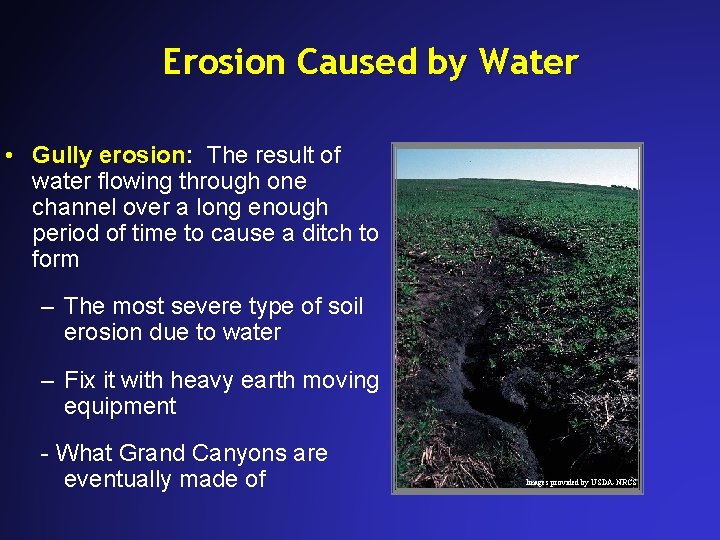
Erosion Caused by Water • Gully erosion: erosion The result of water flowing through one channel over a long enough period of time to cause a ditch to form – The most severe type of soil erosion due to water – Fix it with heavy earth moving equipment - What Grand Canyons are eventually made of Images provided by USDA-NRCS
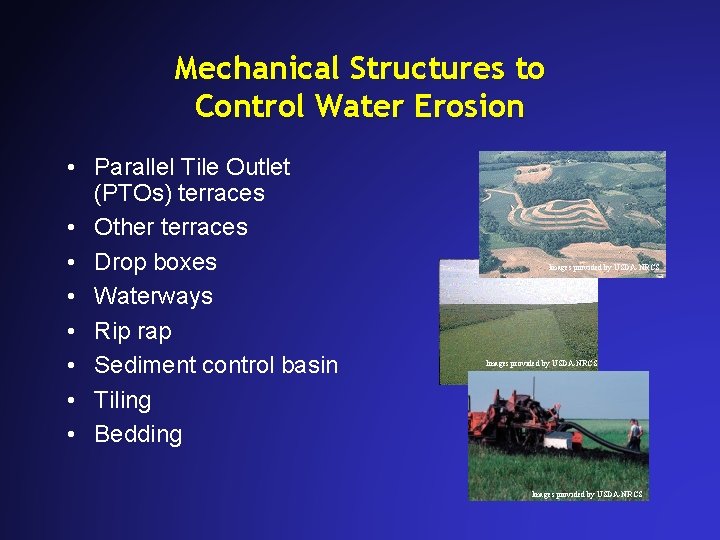
Mechanical Structures to Control Water Erosion • Parallel Tile Outlet (PTOs) terraces • Other terraces • Drop boxes • Waterways • Rip rap • Sediment control basin • Tiling • Bedding Images provided by USDA-NRCS
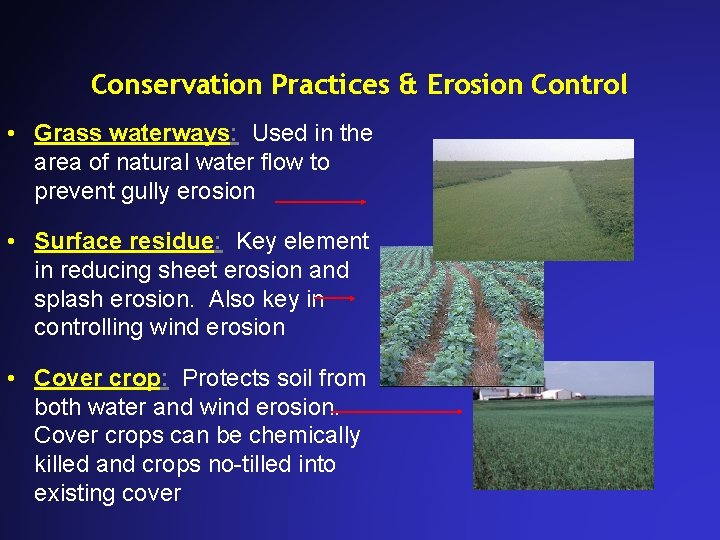
Conservation Practices & Erosion Control • Grass waterways: Used in the area of natural water flow to prevent gully erosion • Surface residue: Key element in reducing sheet erosion and splash erosion. Also key in controlling wind erosion • Cover crop: Protects soil from both water and wind erosion. Cover crops can be chemically killed and crops no-tilled into existing cover
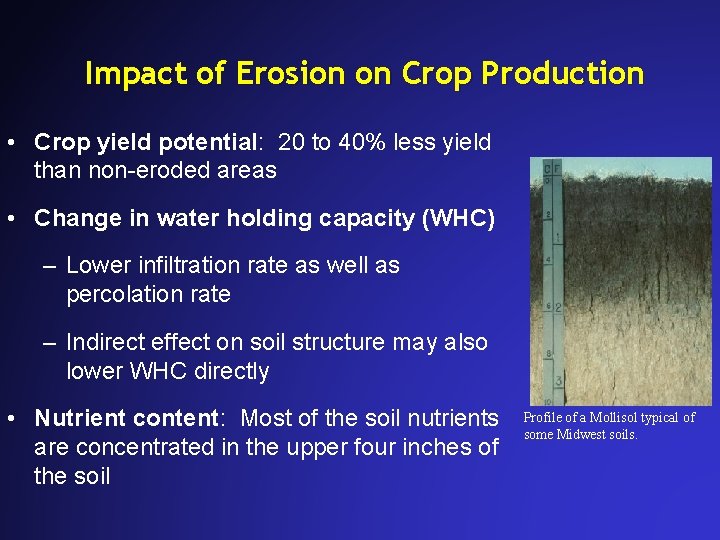
Impact of Erosion on Crop Production • Crop yield potential: 20 to 40% less yield than non-eroded areas • Change in water holding capacity (WHC) – Lower infiltration rate as well as percolation rate – Indirect effect on soil structure may also lower WHC directly • Nutrient content: Most of the soil nutrients are concentrated in the upper four inches of the soil Profile of a Mollisol typical of some Midwest soils.
Impact of Erosion on Crop Production • Organic Matter (OM) Content: Organic matter is primarily added to the surface of soils • As the surface is eroded, not only is OM lost directly but the ability to produce more OM is negatively impacted • Infiltration: When soil pores are sealed off at the surface water infiltration is reduced
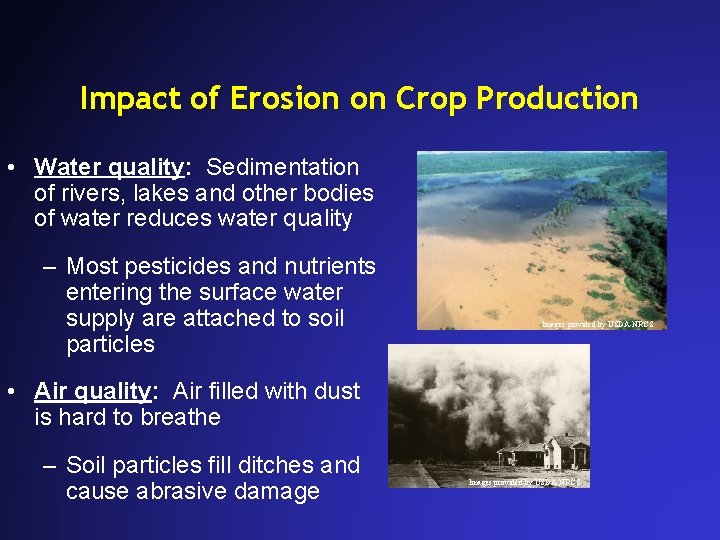
Impact of Erosion on Crop Production • Water quality: Sedimentation of rivers, lakes and other bodies of water reduces water quality – Most pesticides and nutrients entering the surface water supply are attached to soil particles Images provided by USDA-NRCS • Air quality: Air filled with dust is hard to breathe – Soil particles fill ditches and cause abrasive damage Images provided by USDA-NRCS
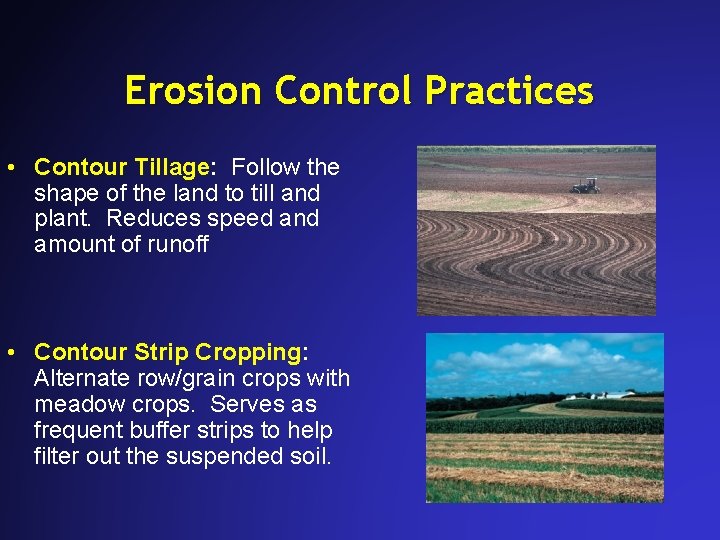
Erosion Control Practices • Contour Tillage: Follow the shape of the land to till and plant. Reduces speed and amount of runoff • Contour Strip Cropping: Alternate row/grain crops with meadow crops. Serves as frequent buffer strips to help filter out the suspended soil.
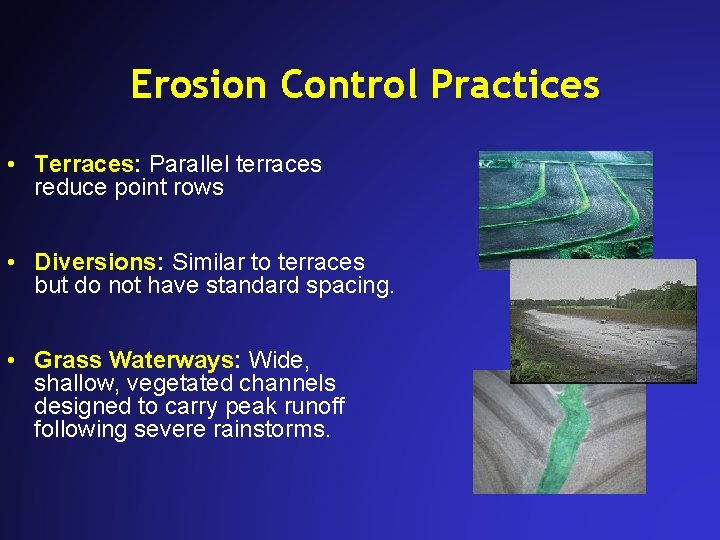
Erosion Control Practices • Terraces: Parallel terraces reduce point rows • Diversions: Similar to terraces but do not have standard spacing. • Grass Waterways: Wide, shallow, vegetated channels designed to carry peak runoff following severe rainstorms.
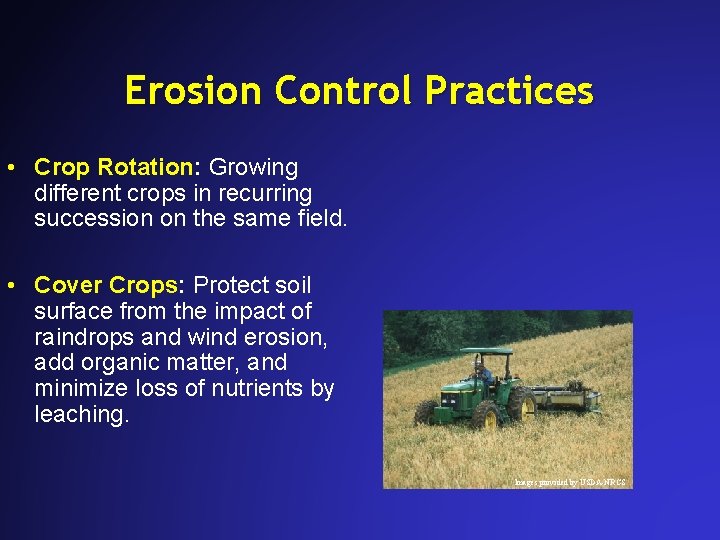
Erosion Control Practices • Crop Rotation: Growing different crops in recurring succession on the same field. • Cover Crops: Protect soil surface from the impact of raindrops and wind erosion, add organic matter, and minimize loss of nutrients by leaching. Images provided by USDA-NRCS
Characteristics of Effective Cover Crops • Add organic matter: Improves soil characteristics, such as texture, moisture-holding capacity, nutrient-holding capacity and tilth • Add nutrients: Legumes can fix N from the atmosphere and leave it for the following crop if timing is appropriate • Recover unused nutrients: Deep-rooted cover crops, such as rye, wheat, and barley, can recycle nutrients that remain in the soil for the following crop. They can capture unused nitrate -N and hold it in an unavailable organic form over the winter months.
Characteristics of Effective Cover Crops • Reduce weed growth: Prevents sunlight from reaching the soil surface, inhibiting the germination and/or early growth of weed species. • Buffer adverse growing conditions: Shade the soil during hot, dry conditions. Helps capture rain and snow. • Benefit wildlife: Provide wildlife with both food and habitat.
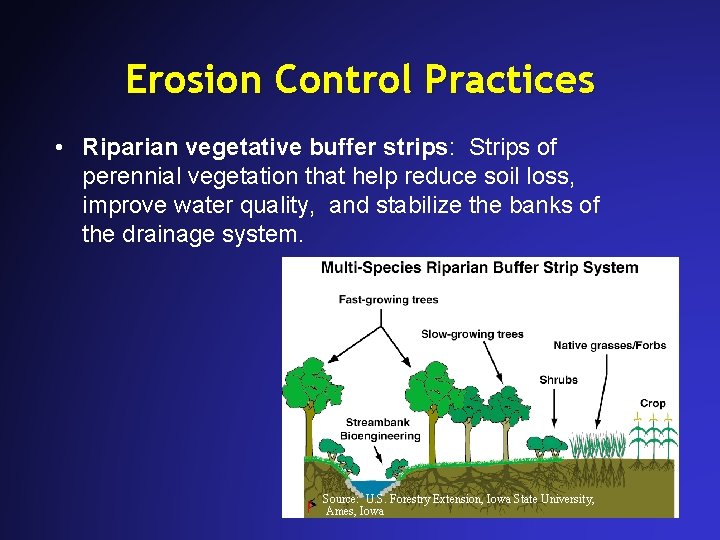
Erosion Control Practices • Riparian vegetative buffer strips: Strips of perennial vegetation that help reduce soil loss, improve water quality, and stabilize the banks of the drainage system. Source: U. S. Forestry Extension, Iowa State University, Ames, Iowa
Impact on Erosion • Surface residue – Protects soil surface from moving water, raindrop impact, and wind – Slows velocity of both wind and water • Row spacing – Narrow rows provide earlier vegetative cover offering protection from raindrop impact and wind – Slows velocity of both wind and water • Cover crops – Protects the soil surface from moving water, raindrop impact, and wind – Slows velocity of both wind and water
Impact on Erosion • Strip cropping: Slope length of rowed crop is reduced with broadcast crop (corn vs. alfalfa) • Contouring: Reduces water velocity so some sediment can settle out • Terraces: Reduces slope length and helps increase water infiltration • Grassed waterway: Main water channel protected from soil erosion. Sod reduces water velocity and erosion potential
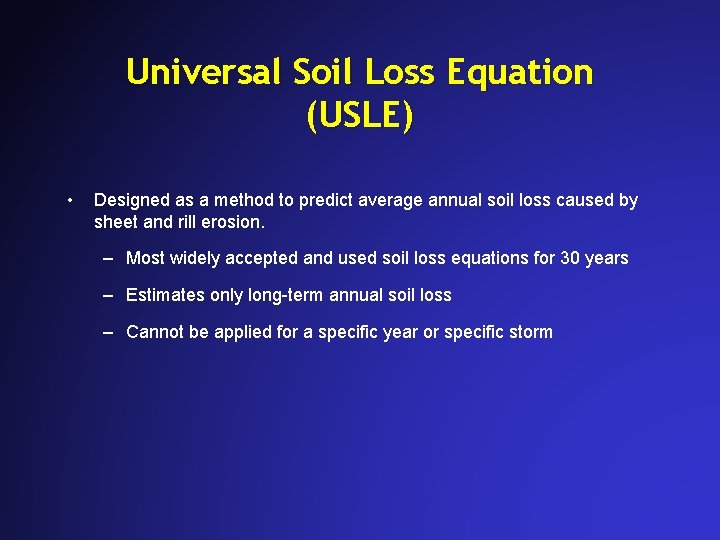
Universal Soil Loss Equation (USLE) • Designed as a method to predict average annual soil loss caused by sheet and rill erosion. – Most widely accepted and used soil loss equations for 30 years – Estimates only long-term annual soil loss – Cannot be applied for a specific year or specific storm
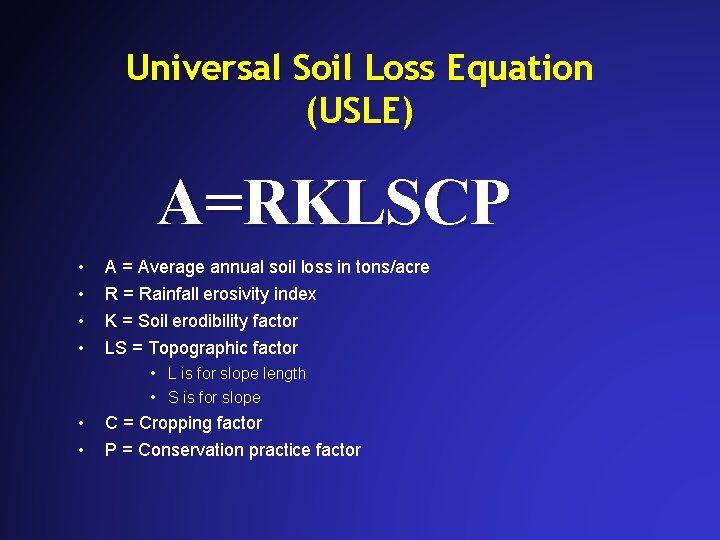
Universal Soil Loss Equation (USLE) A=RKLSCP • • A = Average annual soil loss in tons/acre R = Rainfall erosivity index K = Soil erodibility factor LS = Topographic factor • L is for slope length • S is for slope • • C = Cropping factor P = Conservation practice factor
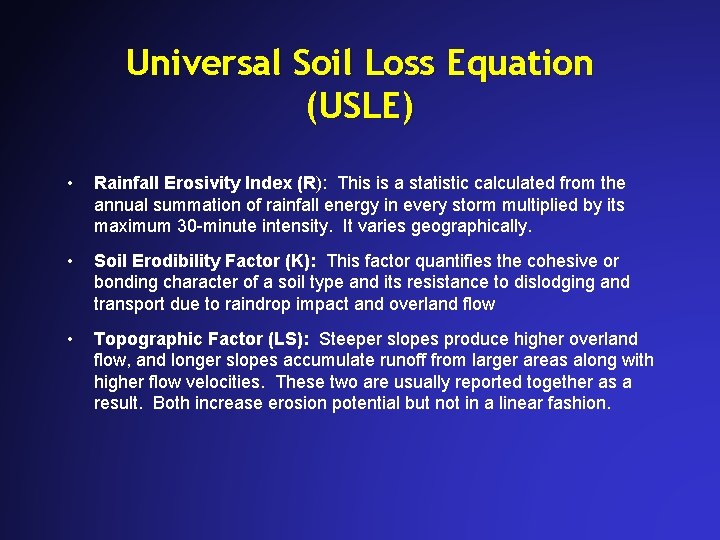
Universal Soil Loss Equation (USLE) • Rainfall Erosivity Index (R): This is a statistic calculated from the annual summation of rainfall energy in every storm multiplied by its maximum 30 -minute intensity. It varies geographically. • Soil Erodibility Factor (K): This factor quantifies the cohesive or bonding character of a soil type and its resistance to dislodging and transport due to raindrop impact and overland flow • Topographic Factor (LS): Steeper slopes produce higher overland flow, and longer slopes accumulate runoff from larger areas along with higher flow velocities. These two are usually reported together as a result. Both increase erosion potential but not in a linear fashion.
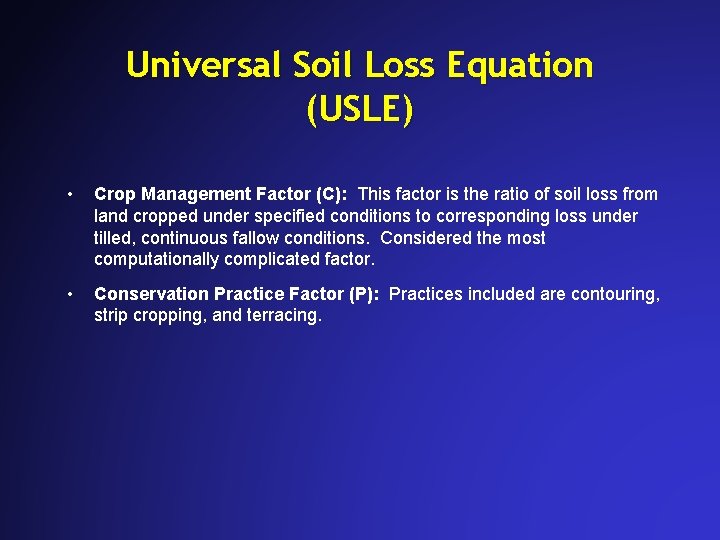
Universal Soil Loss Equation (USLE) • Crop Management Factor (C): This factor is the ratio of soil loss from land cropped under specified conditions to corresponding loss under tilled, continuous fallow conditions. Considered the most computationally complicated factor. • Conservation Practice Factor (P): Practices included are contouring, strip cropping, and terracing.
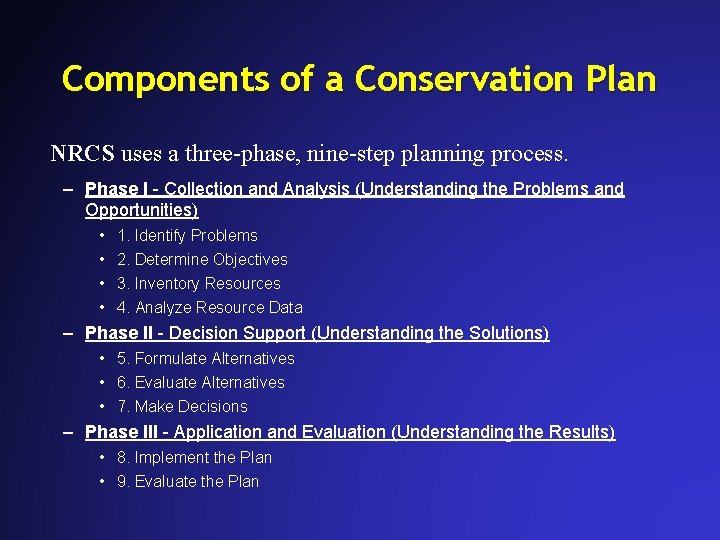
Components of a Conservation Plan NRCS uses a three-phase, nine-step planning process. – Phase I - Collection and Analysis (Understanding the Problems and Opportunities) • • 1. Identify Problems 2. Determine Objectives 3. Inventory Resources 4. Analyze Resource Data – Phase II - Decision Support (Understanding the Solutions) • 5. Formulate Alternatives • 6. Evaluate Alternatives • 7. Make Decisions – Phase III - Application and Evaluation (Understanding the Results) • 8. Implement the Plan • 9. Evaluate the Plan