
Factors affecting quality of compost produced from agricultural
- Slides: 15
“Factors affecting quality of compost produced from agricultural waste: assessment of risk” Kostas Komnitsas, Dimitra Zaharaki, Despina Vamvuka Dpt. Mineral Resources Engineering, Technical University Crete, Chania, Crete, Greece
Objectives Selected parameters such as optimal conditions for successful composting, application rates of compost on soil and limit values for concentrations of heavy metals in soil, are defined The risk for humans exposed to various recalcitrant compounds contained in treated or untreated agricultural waste (AW) can be assessed
AW production 1 The most important AW produced in the Mediterranean region include olive mill and winery wastewater, animal waste, rice and wheat straw, as well as wastes from fruit and vegetable processing AW are characterized by seasonal production and exhibit often a substantial contamination potential Uncontrolled disposal of untreated AW on soil or water bodies can cause various adverse effects such as decreased soil permeability, inhibition of crop growth, eutrophication of water bodies and contamination of drinking water sources
AW production 2 Olive mill wastewater (OMW) is characterized by high organic load (BOD 5: 20 -120 g/L; COD: 25 -240 g/L), high content of phenolic compounds (0. 5 -24 g/L) and rather low p. H (4 -6) Wine production generates large volumes of solid wastes (grape stalks, grape marc and wine lees) and wastewater (p. H 3. 5 -7, 4 -7 g/L BOD, up to 10 g/L COD, salinity 3 -4 m. S/cm, high content in sulphide compounds) Animal wastes include mainly manures, poultry and slaughterhouse waste Other AW include rice straw, garden, and agroindustrial wastes
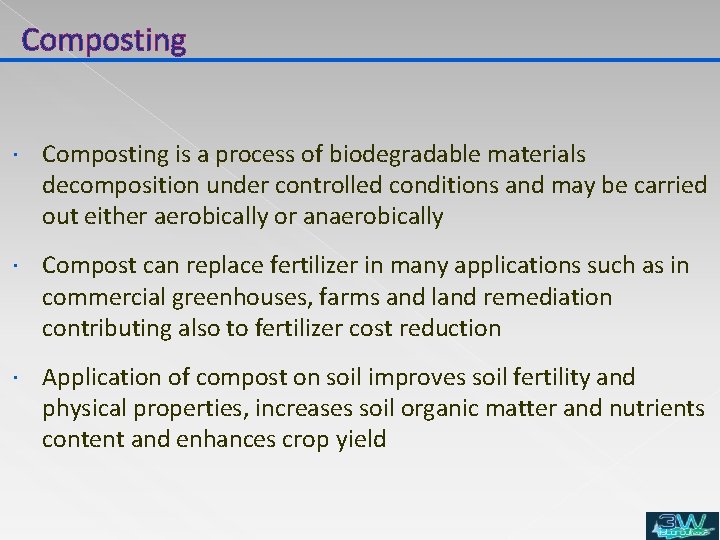
Composting is a process of biodegradable materials decomposition under controlled conditions and may be carried out either aerobically or anaerobically Compost can replace fertilizer in many applications such as in commercial greenhouses, farms and land remediation contributing also to fertilizer cost reduction Application of compost on soil improves soil fertility and physical properties, increases soil organic matter and nutrients content and enhances crop yield
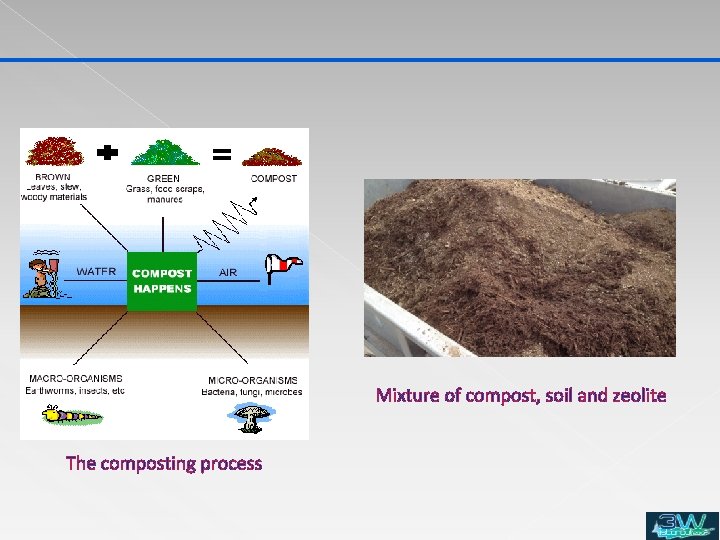
Mixture of compost, soil and zeolite The composting process
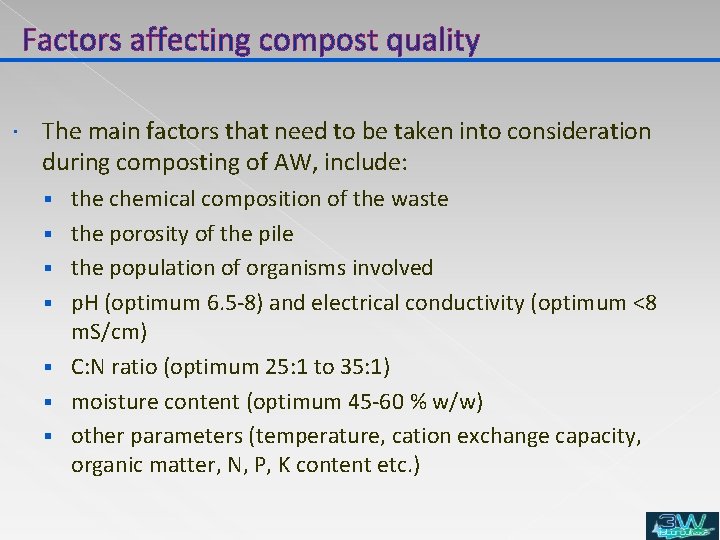
Factors affecting compost quality The main factors that need to be taken into consideration during composting of AW, include: § § § § the chemical composition of the waste the porosity of the pile the population of organisms involved p. H (optimum 6. 5 -8) and electrical conductivity (optimum <8 m. S/cm) C: N ratio (optimum 25: 1 to 35: 1) moisture content (optimum 45 -60 % w/w) other parameters (temperature, cation exchange capacity, organic matter, N, P, K content etc. )
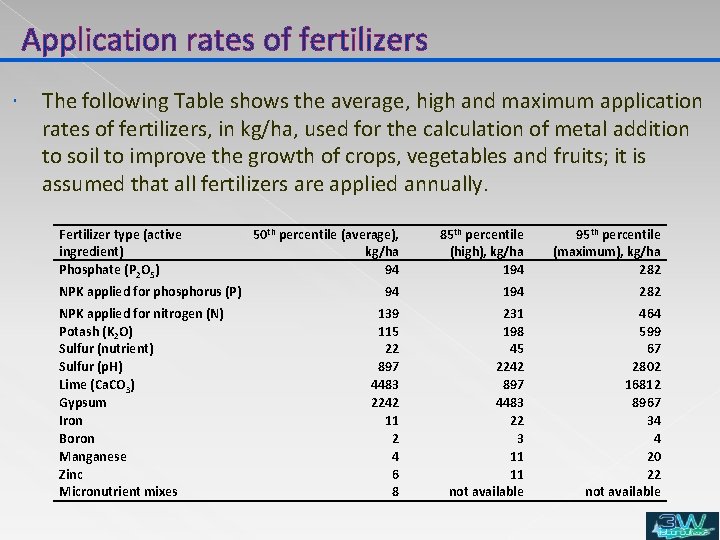
Application rates of fertilizers The following Table shows the average, high and maximum application rates of fertilizers, in kg/ha, used for the calculation of metal addition to soil to improve the growth of crops, vegetables and fruits; it is assumed that all fertilizers are applied annually. Fertilizer type (active ingredient) Phosphate (P 2 O 5) NPK applied for phosphorus (P) NPK applied for nitrogen (N) Potash (K 2 O) Sulfur (nutrient) Sulfur (p. H) Lime (Ca. CO 3) Gypsum Iron Boron Manganese Zinc Micronutrient mixes 50 th percentile (average), kg/ha 94 85 th percentile (high), kg/ha 194 95 th percentile (maximum), kg/ha 282 94 194 282 139 115 22 897 4483 2242 11 2 4 6 8 231 198 45 2242 897 4483 22 3 11 11 not available 464 599 67 2802 16812 8967 34 4 20 22 not available
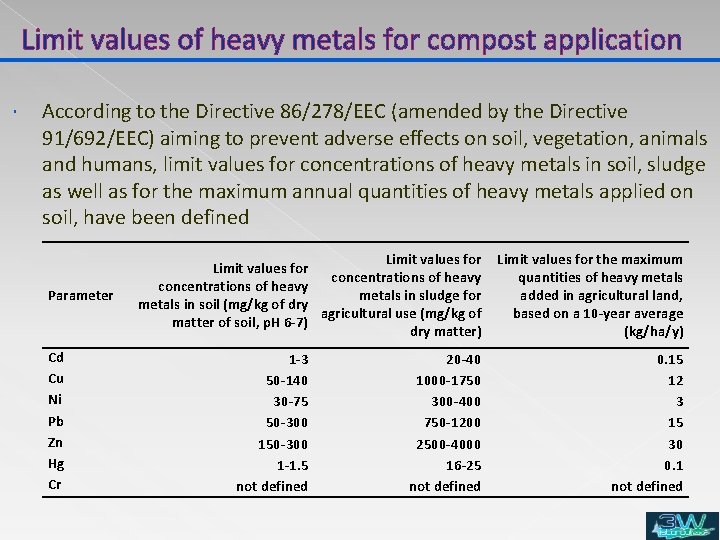
Limit values of heavy metals for compost application According to the Directive 86/278/EEC (amended by the Directive 91/692/EEC) aiming to prevent adverse effects on soil, vegetation, animals and humans, limit values for concentrations of heavy metals in soil, sludge as well as for the maximum annual quantities of heavy metals applied on soil, have been defined Parameter Cd Cu Ni Pb Zn Hg Cr Limit values for concentrations of heavy metals in sludge for metals in soil (mg/kg of dry agricultural use (mg/kg of matter of soil, p. H 6 -7) dry matter) 1 -3 50 -140 30 -75 50 -300 1 -1. 5 not defined 20 -40 1000 -1750 300 -400 750 -1200 2500 -4000 16 -25 not defined Limit values for the maximum quantities of heavy metals added in agricultural land, based on a 10 -year average (kg/ha/y) 0. 15 12 3 15 30 0. 1 not defined
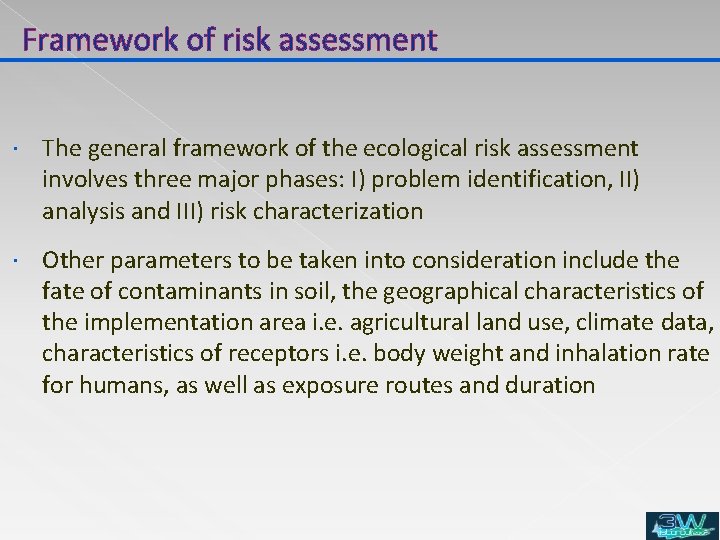
Framework of risk assessment The general framework of the ecological risk assessment involves three major phases: I) problem identification, II) analysis and III) risk characterization Other parameters to be taken into consideration include the fate of contaminants in soil, the geographical characteristics of the implementation area i. e. agricultural land use, climate data, characteristics of receptors i. e. body weight and inhalation rate for humans, as well as exposure routes and duration
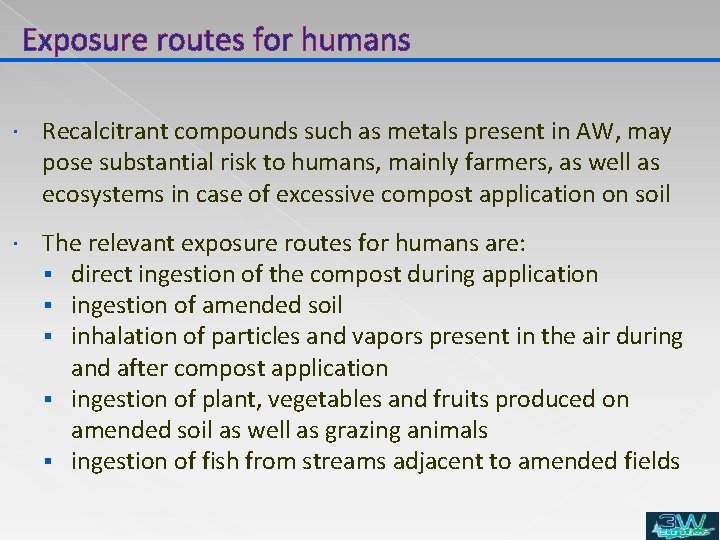
Exposure routes for humans Recalcitrant compounds such as metals present in AW, may pose substantial risk to humans, mainly farmers, as well as ecosystems in case of excessive compost application on soil The relevant exposure routes for humans are: § direct ingestion of the compost during application § ingestion of amended soil § inhalation of particles and vapors present in the air during and after compost application § ingestion of plant, vegetables and fruits produced on amended soil as well as grazing animals § ingestion of fish from streams adjacent to amended fields
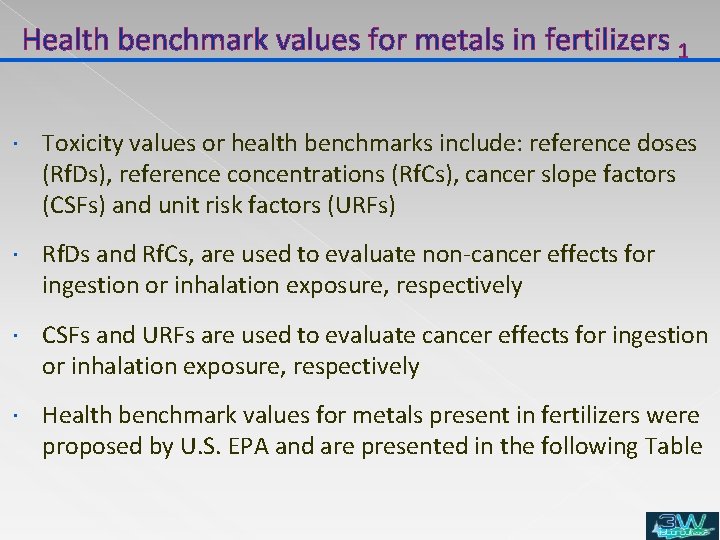
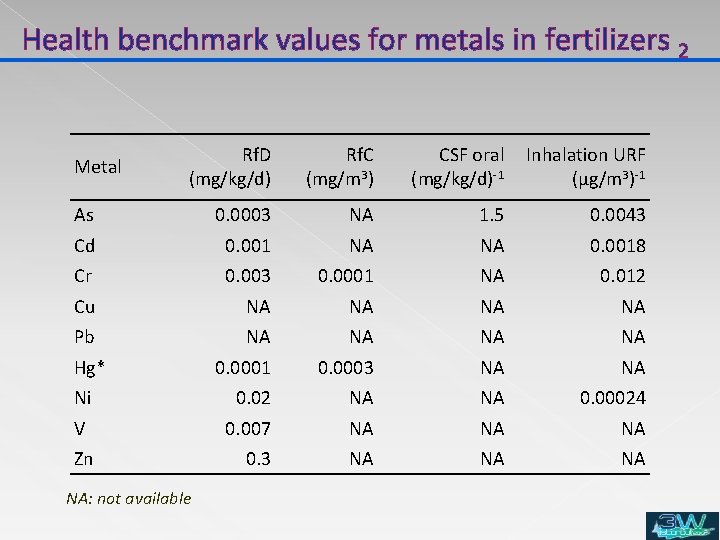
Health benchmark values for metals in fertilizers 1 Toxicity values or health benchmarks include: reference doses (Rf. Ds), reference concentrations (Rf. Cs), cancer slope factors (CSFs) and unit risk factors (URFs) Rf. Ds and Rf. Cs, are used to evaluate non-cancer effects for ingestion or inhalation exposure, respectively CSFs and URFs are used to evaluate cancer effects for ingestion or inhalation exposure, respectively Health benchmark values for metals present in fertilizers were proposed by U. S. EPA and are presented in the following Table
Health benchmark values for metals in fertilizers 2 Rf. D (mg/kg/d) Rf. C (mg/m 3) CSF oral (mg/kg/d)-1 Inhalation URF (μg/m 3)-1 As 0. 0003 NA 1. 5 0. 0043 Cd 0. 001 NA NA 0. 0018 Cr 0. 003 0. 0001 NA 0. 012 Cu NA NA Pb NA NA 0. 0001 0. 0003 NA NA Ni 0. 02 NA NA 0. 00024 V 0. 007 NA NA NA 0. 3 NA NA NA Metal Hg* Zn NA: not available
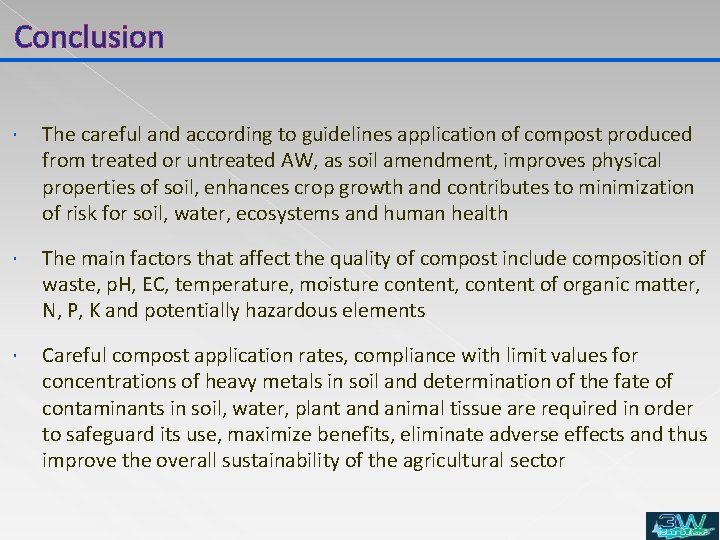
Conclusion The careful and according to guidelines application of compost produced from treated or untreated AW, as soil amendment, improves physical properties of soil, enhances crop growth and contributes to minimization of risk for soil, water, ecosystems and human health The main factors that affect the quality of compost include composition of waste, p. H, EC, temperature, moisture content, content of organic matter, N, P, K and potentially hazardous elements Careful compost application rates, compliance with limit values for concentrations of heavy metals in soil and determination of the fate of contaminants in soil, water, plant and animal tissue are required in order to safeguard its use, maximize benefits, eliminate adverse effects and thus improve the overall sustainability of the agricultural sector
Technical University of Crete Dpt Mineral Resources Engineering Research Unit “Management of mining/metallurgical wastes and rehabilitation of contaminated soils” www. mred. tuc. gr/p 013215_UK. htm Ackowledgement Financial support of LIFE+ Environment Policy and Governance in the framework of the LIFE 10 ENV/GR/594 Waste. Reuse project “Best practices for Agricultural Wastes (AW) treatment and reuse in the Mediterranean countries (Waste. Reuse)”, duration 01/09/11 - 31/08/15, www. wastereuse. eu