
Factors affecting Patterns of Health and Disease Medical
- Slides: 21
Factors affecting Patterns of Health and Disease Medical Geography
Introduction • Health has always been a fundamental social concern, but apprehension over health issues has escalated in recent years due to: • Extensive media coverage of disease outbreaks • Rapid spread of infectious diseases around the world • Growing evidence of the health impacts of exposure to the by-products of industrialization • Anxieties about the availability and affordability of health care and many more.
Contd. • Health is outcome of many things and there are certain determinants of Health • Geographical investigations of the spatial variation of diseases provide important insights into what contributes to disease outcomes and options for disease prevention. • When diseases occur in some places but not in others, or when disease rates vary from place to place, the characteristics that differentiate those places provide clues to etiology.
Contd. • When the number of cases of a disease changes across time periods, spatiotemporal analysis can reveal the direction and speed that the disease has spread. • Declining disease rates may indicate the effect of preventative actions or development of immunity. • Preventative actions include vaccinations, early detection and treatment, quarantine, reduction in exposure
Contd. • Each of these can also vary by location—thus having an impact on the local patterns of health or illness. • Diseases vary dramatically, so investigations of the causal factors that lead to them are likewise varied. • Broadly speaking, there are many factors which not affect the health of human populations but also play an important role in creating spatial variations in the distribution of disease over the globe.
Which Factors effect health and Diseases? • • Geographical and Environmental Factors Socio-Economic Factors Cultural Factors Political Factors
Geographical and Environmental Factors • Medically speaking, Man is the product of mostly his environment than of his genetic make up. • The health of human beings is determined not by heredity but by the conditions under which they live. • The natural environment is under constant interference by man who is constantly disrupting the ecological equilibrium through his rapidly developing scientific and technological knowledge. • Health and disease pattern is influenced by a number of geographical factors.
Some Notable Geographical and Environmental Factors • • • Altitude Absolute Location Relative Location Weather and Climate Natural Disasters Prevailing eco system and habitats
Contd. • Built environment • Pollution and Pollutants • Exposure to hazardous substances in the air, water, soil, and food • Technological disasters • Climate Change
Altitude • Altitude or Elevation has a great impact on the health and disease pattern. • With increasing elevation many vector borne diseases diminish such as Malaria is not a disease of Mountain tops because mosquitoes cannot breed at an elevation of 2000 meters above mean sea level • living at higher altitudes can induce hypoxia related events. (Hypoxia is the deficiency in the amount of oxygen reaching the tissues). Generalized hypoxia occurs in healthy people when they ascend to high altitude, where it causes altitude sickness leading to potentially fatal complications: high altitude pulmonary edema (HAPE) and high altitude cerebral edema (HACE) • Moreover, researches have shown that high altitudes, in excess of 6000 ft, are associated with a significant reduction in mortality risk. • A great association of Red blood cells with altitude is observed for example 4 -5 million red cells per ml of blood survival in human at sea level, and 8 million are required at about 4000 meters. At sealevel, such an access of red blood cells is detrimental and is manifested as a disease called erythrocythemia.
Absolute Location (Latitudinal Location) • The location and place also has a great influence on the pattern of disease. Since the temperature distribution and seasonal change is greatly associated with latitudinal position and therefore, areas closer to Equator experience longer and intense summers as compared to polar regions • Consequently, endemic diseases also vary in this way due to change in the natural environment and so on. • For instance, Equatorial and tropical regions possess hot and humid environment and most common diseases found there are vector-borne such as: • Dengue, Malaria, Chagas disease, Yellow fever, Leishmaniosis etc.
Relative Location • Relative location refers to the surroundings where human beings live and the presence of any water body, forest, industrial activity, transport activity or any such phenomenon near by human residences has a great effect on the health and disease pattern • Deteriorated environmental surroundings with poor air quality or high Noise levels or contaminated water supplies can result in certain infectious diseases and long term exposure to harmful substances released from nearby such activities may result in many non-communicable disease like cancer, hearing loss, stress and other psychological disorders and so on.
Weather & Climate • Weather and climate greatly affect the human health in many ways. • High temperatures of tropical climates can depress body functions, lower general vitality and predispose man to infectious diseases • High temperatures also affect metabolic rate as minimum metabolism is observed between 20 ° C to 25 °C and above 25 ° C there is a tendency to increased metabolic rate. • Extreme heat and cold i. e. excessive thermal stresses are definitely harmful as moderately hot conditions increase susceptibility to intestinal diseases and moderately cold conditions increase susceptibility to respiratory diseases. • Examples are asthma, bronchitis, rhinitis, rheumatic diseases, heart diseases ( particularly myocardial infarction and angina pectoris) stroke, certain eye diseases, and vascular disorders. • Injury produced by excessive heat includes fainting, sweat gland disorders( prickly heat), heat exhaustion and heat stroke, most in humid tropics. • Cold injury includes chilblains, frost-bite, and hypothermia.
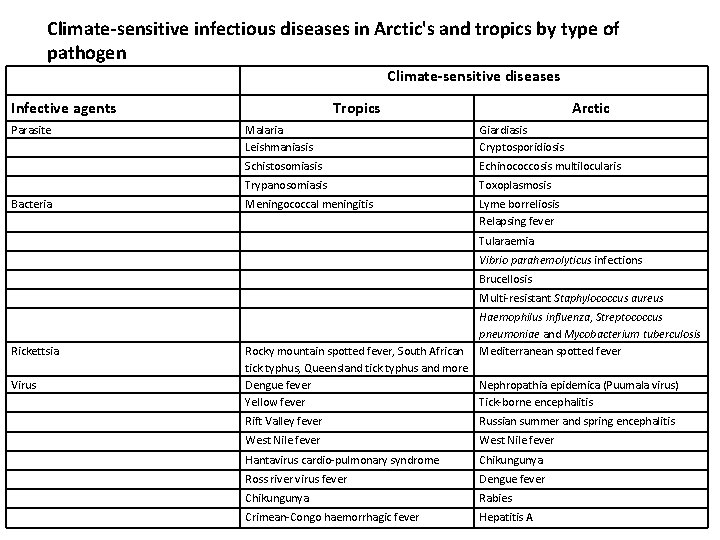
Climate-sensitive infectious diseases in Arctic's and tropics by type of pathogen Climate-sensitive diseases Infective agents Parasite Bacteria Tropics Arctic Malaria Leishmaniasis Giardiasis Cryptosporidiosis Schistosomiasis Echinococcosis multilocularis Trypanosomiasis Toxoplasmosis Meningococcal meningitis Lyme borreliosis Relapsing fever Tularaemia Vibrio parahemolyticus infections Brucellosis Multi-resistant Staphylococcus aureus Rickettsia Virus Haemophilus influenza, Streptococcus pneumoniae and Mycobacterium tuberculosis Mediterranean spotted fever Rocky mountain spotted fever, South African tick typhus, Queensland tick typhus and more Dengue fever Nephropathia epidemica (Puumala virus) Yellow fever Tick-borne encephalitis Rift Valley fever Russian summer and spring encephalitis West Nile fever Hantavirus cardio-pulmonary syndrome Chikungunya Ross river virus fever Dengue fever Chikungunya Rabies Crimean-Congo haemorrhagic fever Hepatitis A
Natural Disasters • Natural and man made disasters have the direct and indirect impact on the health of the population. • Each year, approximately 300 natural disasters occur world wide, exacting a human toll of nearly 250, 000 lives. • In the past 20 years, natural disasters have clamed the lives of about 3 million people and have negatively affect the life of nearly 800 million people. • Among these disasters, Earth quakes and Flooding (Tsunami, flash flooding) are most disastrous. • Natural disasters result in physical trauma, acute diseases and emotional trauma along with increase in the morbidity and mortality associated with chronic diseases. • Their impact usually is in the form of severe injuries, outbreak of epidemics, casualties (deaths), damage to health care facilities etc.
Prevailing Ecosystems and Habitats • Alteration of Eco system has resulted into many indirect and indirect health impacts upon human beings as increased deforestation lead to increased malaria exposure, loss of access to wild foods etc. • Habitat relates to man’s surroundings of air, land water. • The atmosphere at most places is polluted with particulate matter ( dust, smoke and fumes), Sulphur oxides, carbon monoxide, hydrocarbons, nitrogen oxides, lead and a host of other contaminants • Sources of such pollution include motor vehicles, manufacturing industry, power plants, space heating for houses, offices, stores, restaurants, hospitals, schools, hotels, etc. and refuse disposal. • Somehow, the lasting effects of such pollution on man’s well being are still not fully known or understood. • Diseases and disorders commonly associated with atmospheric pollutants and aggravated by them include many such as chronic bronchitis, lung cancer, asbestosis etc. • Moreover, other than community pollution, gases and particles from cigarette, cigar, and pipe smoking, house hold sprays are also responsible for health hazards and so on.
Pollution and Pollutants • Health Problems related to noise pollution include insomnia, psychoneurotic issues among people living near airports, railways stations, industrial region or other noisy places. • Excessive noise produces deafness, ear damage and other hear impairments. • Moreover, undue noise in factories impairs efficiency and performance, increases liability to accidents. • People who are sensitive to low frequency noise vibrations having developing certain illnesses ranging from simple sickness to brain tumors. • Water polluted by domestic sewage, industrial effluents, run-off from farms, fertilizers, mining activities and so on can predispose many health issues which vary with the type of pollutants.
Technological disasters • In order to fulfill the increasing energy demands and reducing fossil fuel resources the use of nuclear energy has increased. • It is though clean fuel as it produces none of the conventional harmful gases and aerosols but it contaminates the environment more insidiously with radio active radiation. • Acute or short term effects of radio active pollution are radiation burns, nausea, changes in blood, intestinal disorders, and central nervous system disorders. • chronic or long term effects include a variety of cancers, impairment of growth and development, shortening of life span, and genetic disorders • In terms of their adverse effects on man the radio-nuclides such as iodine 131, strontium 90, cesium 137, and carbon 14 give cause for the greatest concern.
Climate Change • The impacts of climate change include warming temperatures, changes in precipitation, increases in the frequency or intensity of some extreme weather events, and rising sea levels. • These impacts threaten our health by affecting the food we eat, the water we drink, the air we breathe, and the weather we experience. • People in developing countries may be the most vulnerable to health risks globally, but climate change poses significant threats to health even in wealthy nations such as the United States. • Certain populations, such as children, pregnant women, older adults, and people with low incomes, face increased risks.
Contd. • Children are vulnerable to many health risks due to biological sensitivities and more opportunities for exposure (due to activities such as playing outdoors). Pregnant women are vulnerable to heat waves and other extreme events, like flooding. • Older adults are vulnerable to many of the impacts of climate change. They may have greater sensitivity to heat and contaminants, a higher prevalence of disability or preexisting medical conditions, or limited financial resources that make it difficult to adapt to impacts. • Occupational groups, such as outdoor workers, paramedics, firefighters, and transportation workers, as well as workers in hot indoor work environments, will be especially vulnerable to extreme heat and exposure to vector borne diseases. • People with disabilities can be very vulnerable during extreme weather events, unless communities ensure that their emergency response plans specifically accommodate them. • People with chronic medical conditions are typically vulnerable to extreme heat, especially if they are taking medications that make it difficult to regulate body temperature. Power outages can be particularly threatening for people reliant on certain medical equipment.
Important Links • https: //www. ncbi. nlm. nih. gov/pmc/articles/PMC 3 976701/ • https: //19 january 2017 snapshot. epa. gov/climateimpacts/climate-impacts-human-health_. html • https: //www. preventionweb. net/publications/vie w/2026 • https: //www. ncbi. nlm. nih. gov/pmc/articles/PMC 3 839693/ • https: //www. greenfacts. org/en/ecosystems/millen nium-assessment-3/3 -human-wellbeingpoverty. htm