
Factors Affecting Human Population Size Births Deaths Migration
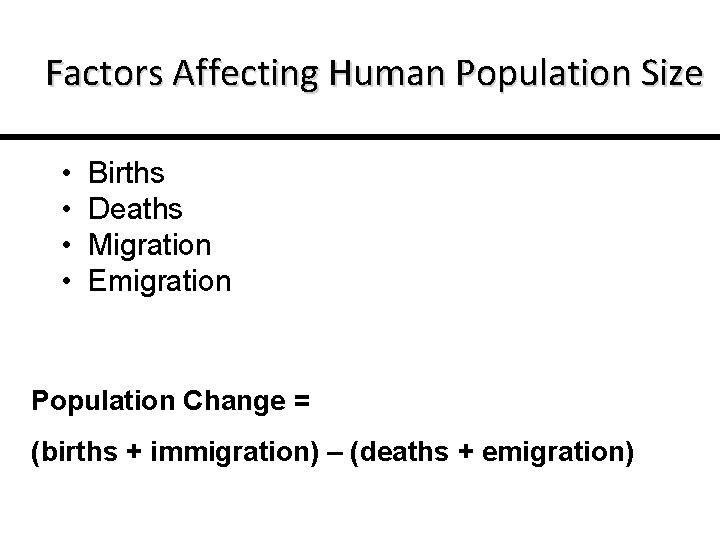
Factors Affecting Human Population Size • • Births Deaths Migration Emigration Population Change = (births + immigration) – (deaths + emigration)
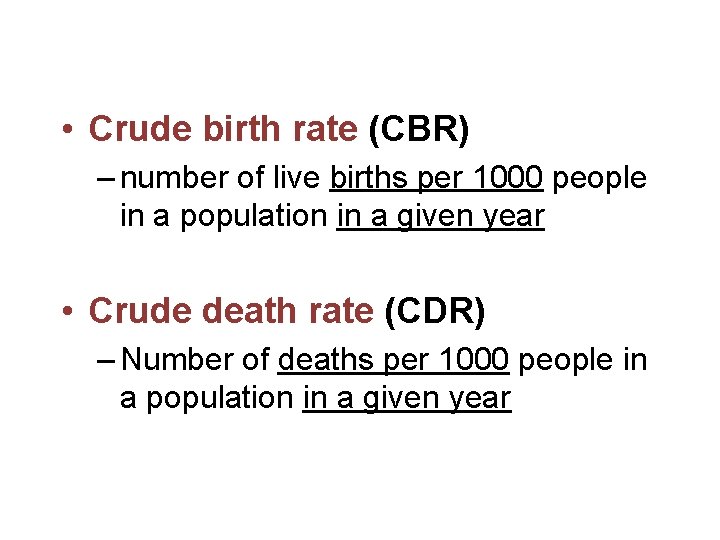
• Crude birth rate (CBR) – number of live births per 1000 people in a population in a given year • Crude death rate (CDR) – Number of deaths per 1000 people in a population in a given year

Crude birth rate CBR Crude death rate CDR World 21 9 All developed countries 11 10 All developing countries 24 8 Developing countries (w/o China) © 2004 Brooks/Cole – Thomson Learning 9 29
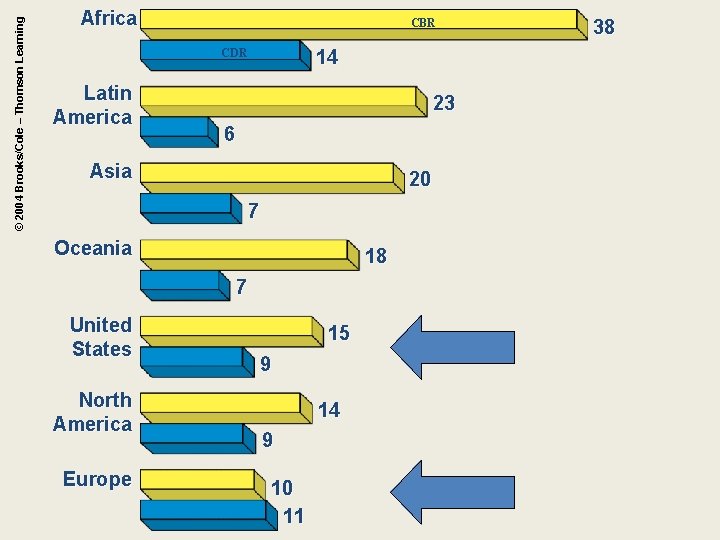
© 2004 Brooks/Cole – Thomson Learning Africa CBR 14 CDR Latin America 23 6 Asia 20 7 Oceania 18 7 United States North America Europe 15 9 14 9 10 11 38
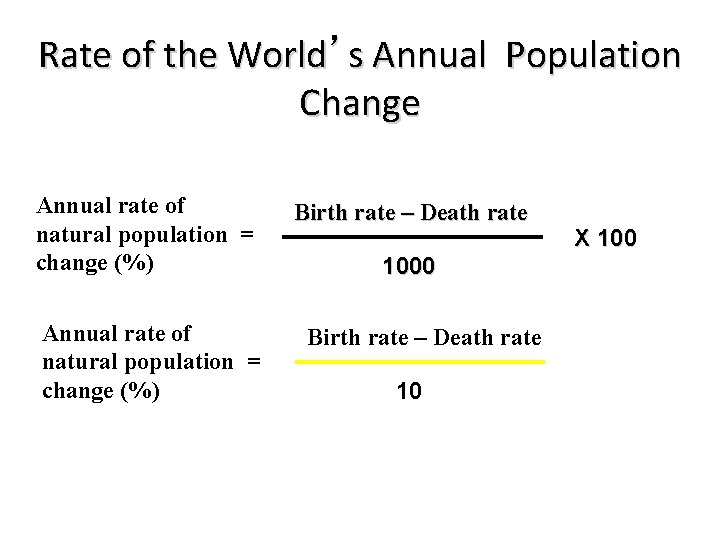
Rate of the World’s Annual Population Change Annual rate of natural population = change (%) Birth rate – Death rate 1000 Birth rate – Death rate 10 X 100
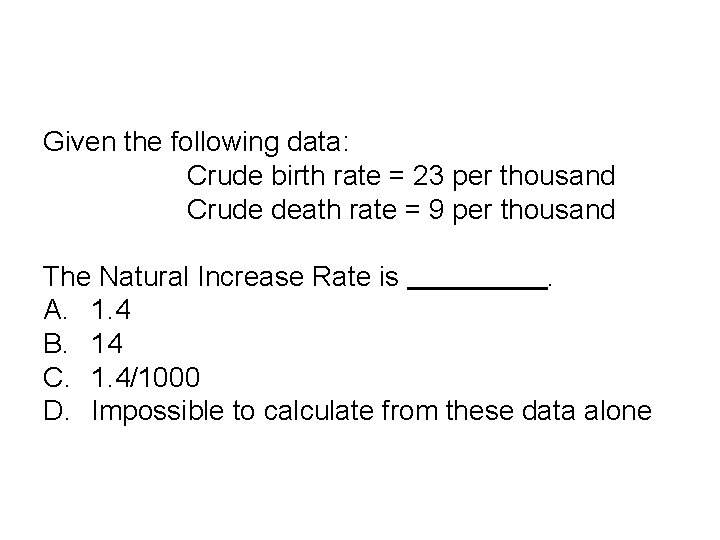
Given the following data: Crude birth rate = 23 per thousand Crude death rate = 9 per thousand The Natural Increase Rate is. A. 1. 4 B. 14 C. 1. 4/1000 D. Impossible to calculate from these data alone
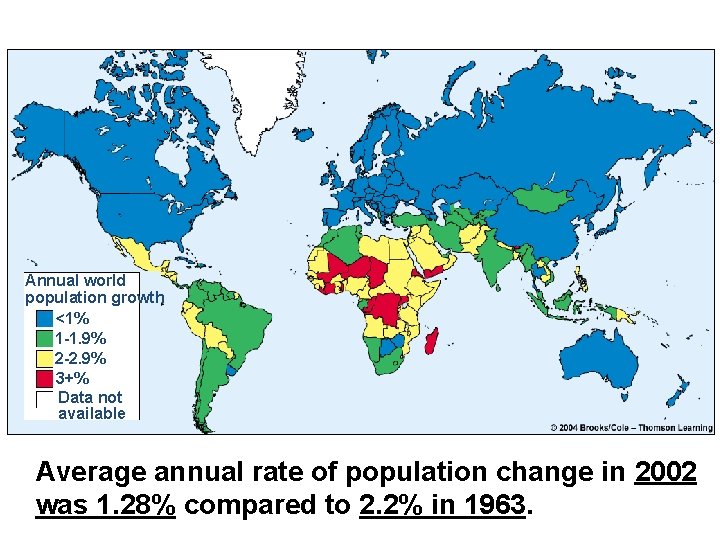
Annual world population growth <1% 1 -1. 9% 2 -2. 9% 3+% Data not available Average annual rate of population change in 2002 was 1. 28% compared to 2. 2% in 1963.
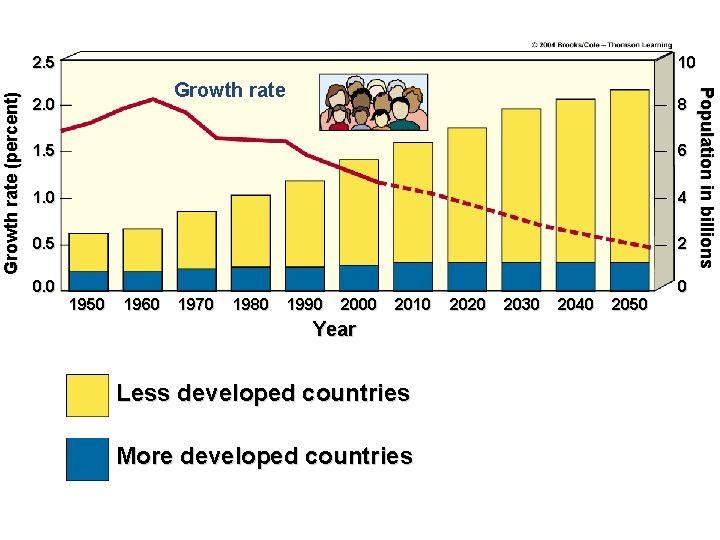
10 Growth rate 2. 0 8 1. 5 6 1. 0 4 0. 5 2 0. 0 0 1950 1960 1970 1980 1990 2000 2010 Year Less developed countries More developed countries 2020 2030 2040 2050 Population in billions Growth rate (percent) 2. 5
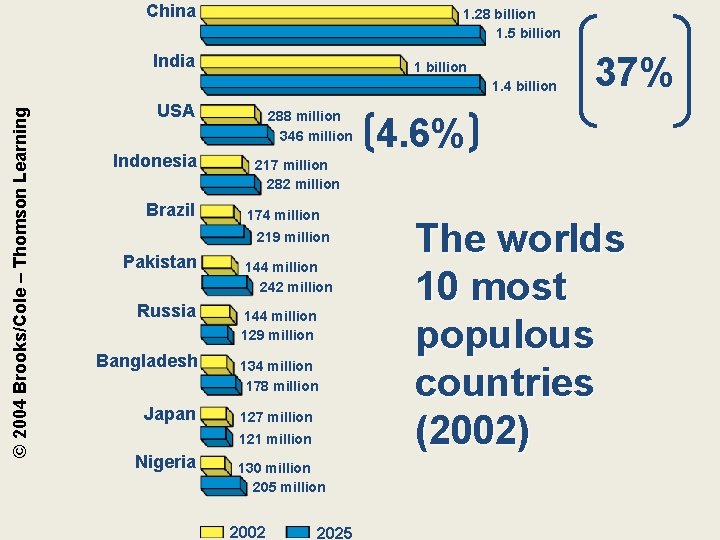
China 1. 28 billion 1. 5 billion India 1 billion © 2004 Brooks/Cole – Thomson Learning 1. 4 billion USA Indonesia Brazil 288 million 346 million Russia Bangladesh Japan 174 million 144 million 242 million 144 million 129 million 134 million 178 million 127 million 121 million Nigeria 4. 6% 217 million 282 million 219 million Pakistan 37% 130 million 205 million 2002 2025 The worlds 10 most populous countries (2002)
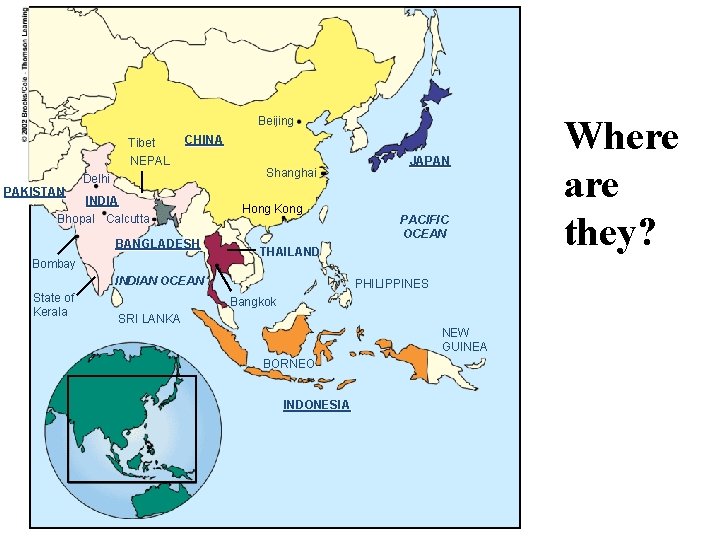
Beijing Tibet NEPAL PAKISTAN CHINA Delhi INDIA Bhopal Calcutta BANGLADESH Bombay Shanghai Hong Kong PACIFIC OCEAN THAILAND INDIAN OCEAN State of Kerala JAPAN PHILIPPINES Bangkok SRI LANKA NEW GUINEA BORNEO INDONESIA Where are they?
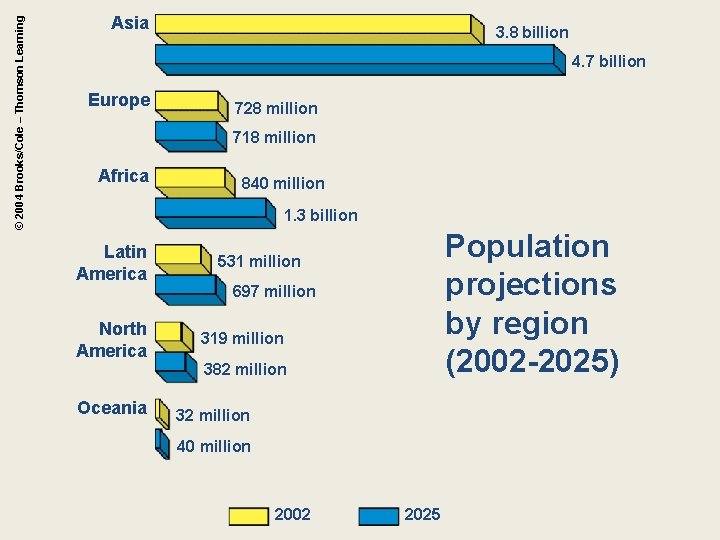
© 2004 Brooks/Cole – Thomson Learning Asia 3. 8 billion 4. 7 billion Europe 728 million 718 million Africa 840 million 1. 3 billion Latin America North America Oceania Population projections by region (2002 -2025) 531 million 697 million 319 million 382 million 32 million 40 million 2002 2025
Global Fertility Rates • Replacement level fertility – the number of children a couple must bear to replace themselves – 2. 1 developed – 2. 5 undeveloped • Total fertility rate (TFR) – Estimate of the average number children a woman will have during her childbearing years
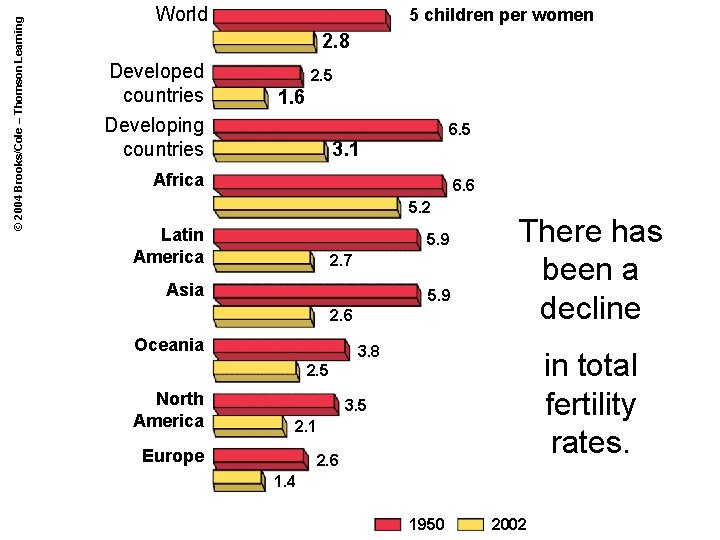
© 2004 Brooks/Cole – Thomson Learning World 5 children per women 2. 8 Developed countries Developing countries 2. 5 1. 6 6. 5 3. 1 Africa 6. 6 5. 2 Latin America 5. 9 2. 7 Asia 5. 9 2. 6 Oceania There has been a decline 3. 8 in total fertility rates. 2. 5 North America 3. 5 2. 1 Europe 2. 6 1. 4 1950 2002
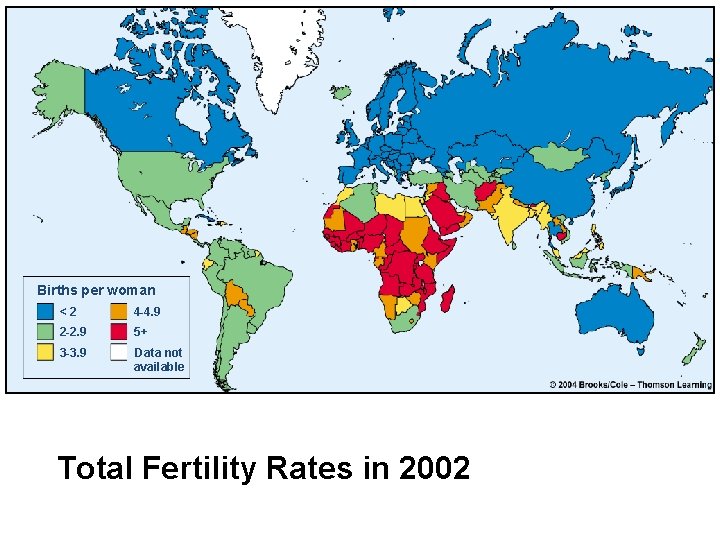
Births per woman <2 4 -4. 9 2 -2. 9 5+ 3 -3. 9 Data not available Total Fertility Rates in 2002
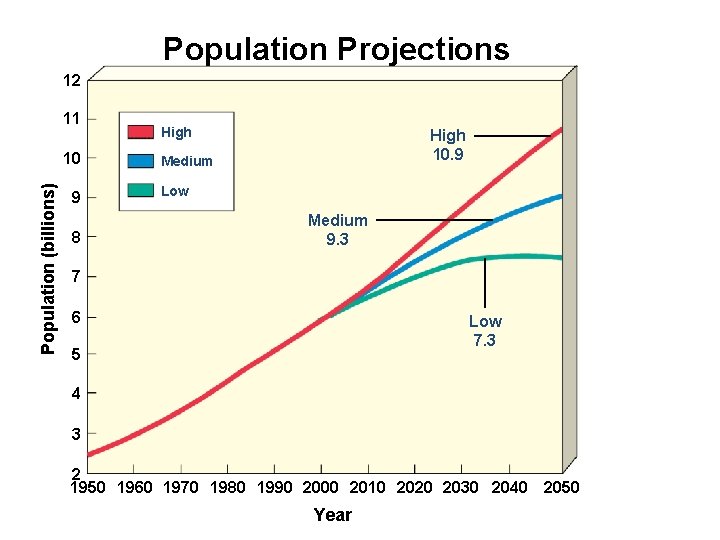
Population Projections 12 11 Population (billions) 10 9 8 High 10. 9 Medium Low Medium 9. 3 7 6 Low 7. 3 5 4 3 2 1950 1960 1970 1980 1990 2000 2010 2020 2030 2040 Year 2050

Total fertility rates for the US Births per woman 4. 0 3. 5 3. 0 2. 5 2. 1 2. 0 Replacement level 1. 5 Baby boom (1946 -64) 1. 0 0. 5 0 1920 1930 1940 1950 1960 1970 Year 1980 1990 2000 2010
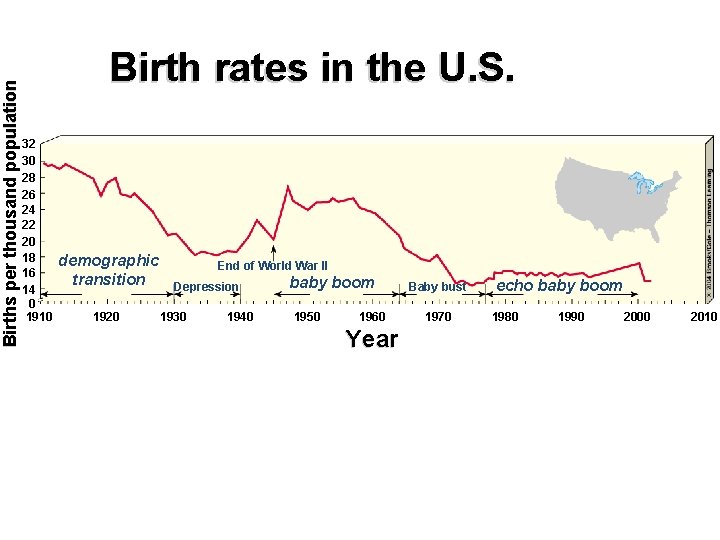
Births per thousand population Birth rates in the U. S. 32 30 28 26 24 22 20 18 16 14 0 1910 demographic transition 1920 End of World War II Depression 1930 1940 baby boom 1950 1960 Year Baby bust 1970 echo baby boom 1980 1990 2000 2010
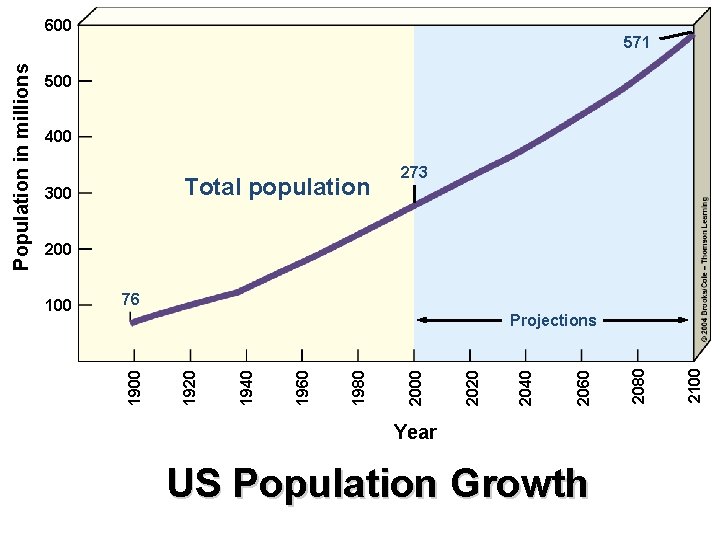
571 500 400 Total population 300 273 200 76 Year US Population Growth 2100 2080 2060 2040 2020 2000 1980 1960 1940 Projections 1920 100 1900 Population in millions 600
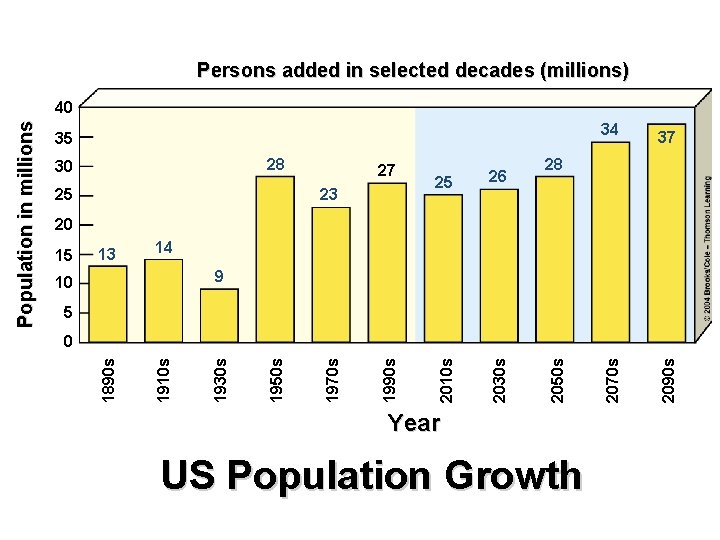
Persons added in selected decades (millions) 25 37 2090 s 23 26 34 2070 s 25 27 2030 s 28 30 2010 s 35 28 20 15 13 14 9 10 5 2050 s 1990 s 1970 s 1950 s 1930 s 1910 s 0 1890 s Population in millions 40 Year US Population Growth
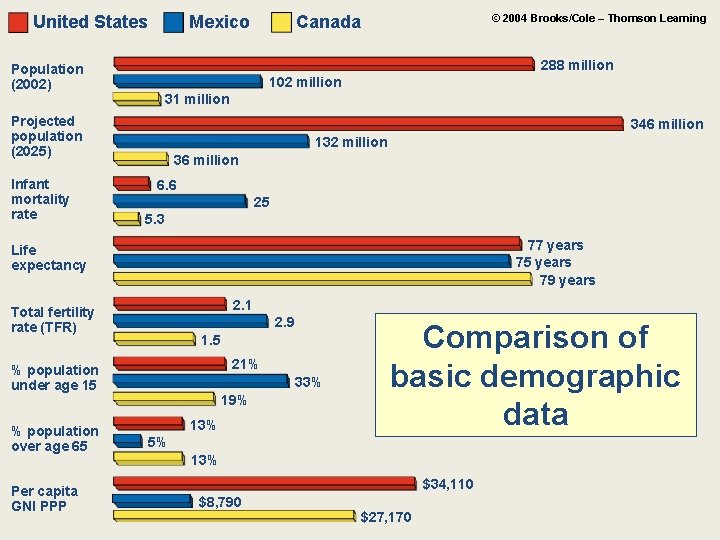
United States Mexico © 2004 Brooks/Cole – Thomson Learning 288 million Population (2002) 102 million 31 million Projected population (2025) Infant mortality rate Canada 346 million 132 million 36 million 6. 6 25 5. 3 77 years 75 years 79 years Life expectancy 2. 1 Total fertility rate (TFR) 2. 9 1. 5 21% % population under age 15 % population over age 65 Per capita GNI PPP 33% 19% 13% Comparison of basic demographic data 5% 13% $34, 110 $8, 790 $27, 170
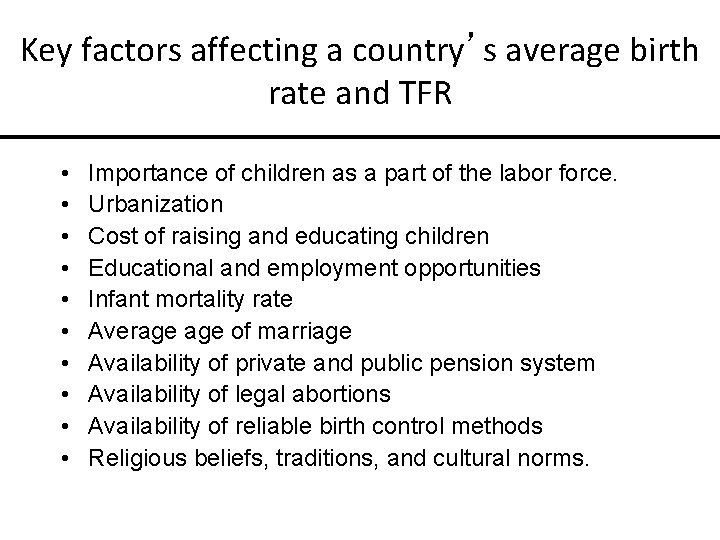
Key factors affecting a country’s average birth rate and TFR • • • Importance of children as a part of the labor force. Urbanization Cost of raising and educating children Educational and employment opportunities Infant mortality rate Average of marriage Availability of private and public pension system Availability of legal abortions Availability of reliable birth control methods Religious beliefs, traditions, and cultural norms.
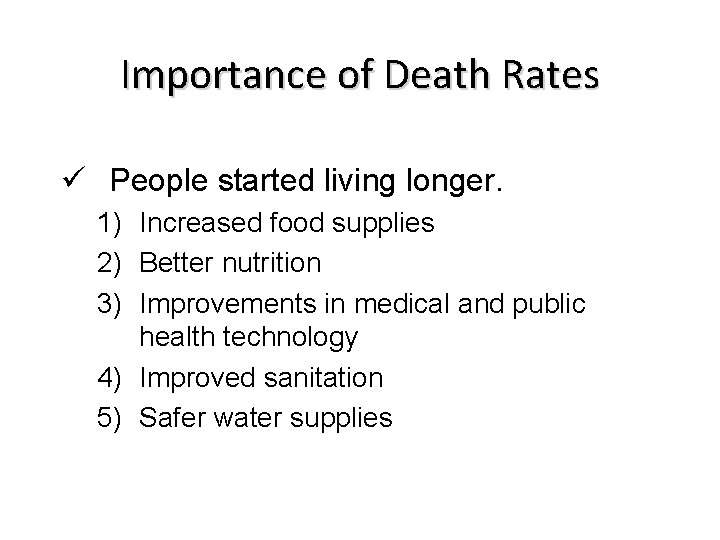
Importance of Death Rates ü People started living longer. 1) Increased food supplies 2) Better nutrition 3) Improvements in medical and public health technology 4) Improved sanitation 5) Safer water supplies
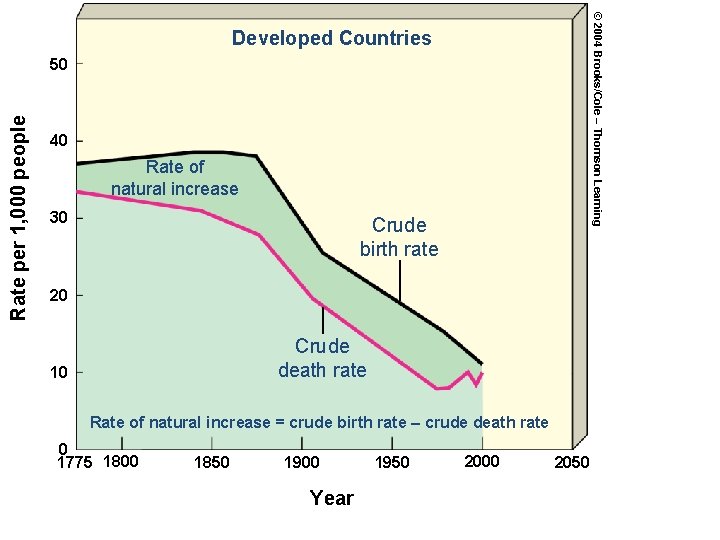
© 2004 Brooks/Cole – Thomson Learning Developed Countries Rate per 1, 000 people 50 40 Rate of natural increase 30 Crude birth rate 20 Crude death rate 10 Rate of natural increase = crude birth rate – crude death rate 0 1775 1800 1850 1900 Year 1950 2000 2050
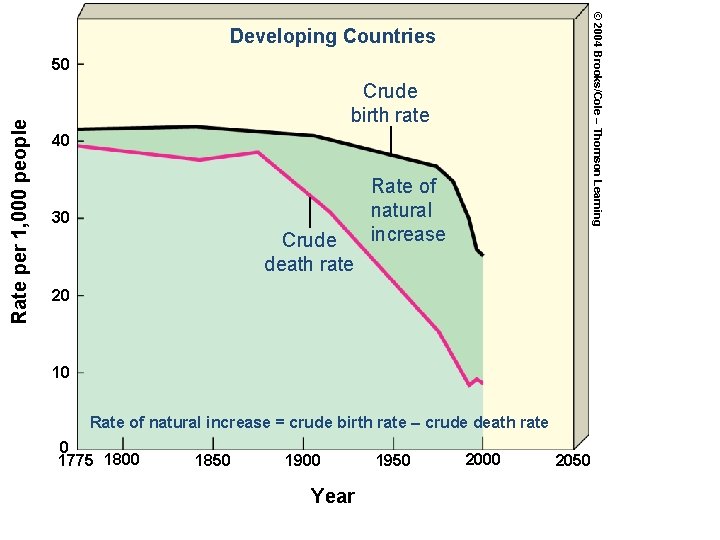
© 2004 Brooks/Cole – Thomson Learning Developing Countries Rate per 1, 000 people 50 Crude birth rate 40 30 Crude death rate Rate of natural increase 20 10 Rate of natural increase = crude birth rate – crude death rate 0 1775 1800 1850 1900 Year 1950 2000 2050
Useful indicators of health • Life Expectancy – Average number of years a newborn infant can expect to live • Infant mortality rate – The number of babies out of every 1000 born who die before their first birthday
Global life expectancy • Good news – Increased from 48 to 67 years in developing countries from 1955 to 2002 – Increased from 48 to 76 years in developed countries during same period • Bad news – Life expectancy in poorest countries is 55 years or less
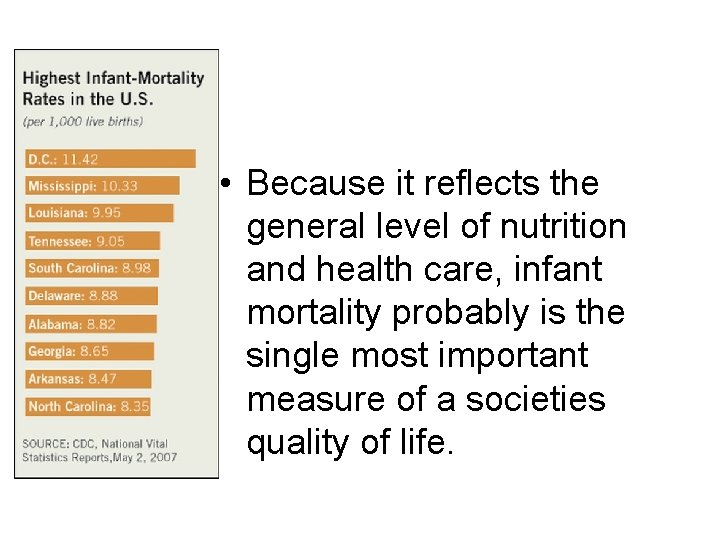
• Because it reflects the general level of nutrition and health care, infant mortality probably is the single most important measure of a societies quality of life.
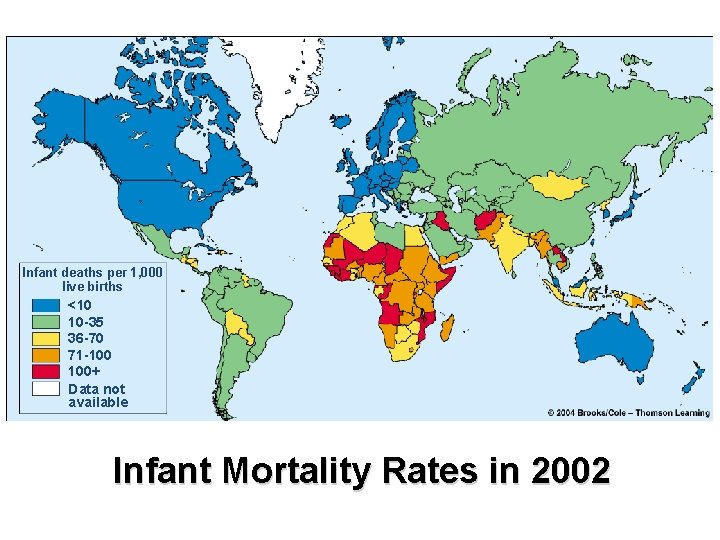
Infant deaths per 1, 000 live births <10 10 -35 36 -70 71 -100 100+ Data not available Infant Mortality Rates in 2002

• 200 Countries, 200 Religions, 4 minutes • http: //www. youtube. com/watch? v=jbk. SRLYSo jo
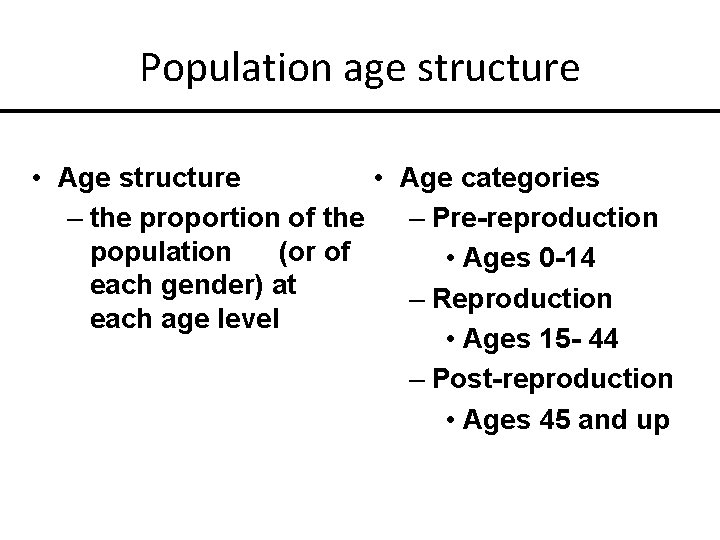
Population age structure • Age categories – the proportion of the – Pre-reproduction population (or of • Ages 0 -14 each gender) at – Reproduction each age level • Ages 15 - 44 – Post-reproduction • Ages 45 and up
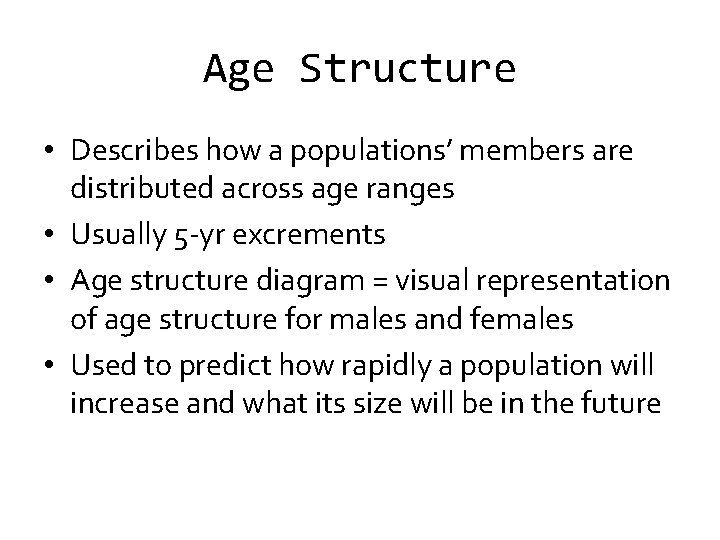
Age Structure • Describes how a populations’ members are distributed across age ranges • Usually 5 -yr excrements • Age structure diagram = visual representation of age structure for males and females • Used to predict how rapidly a population will increase and what its size will be in the future
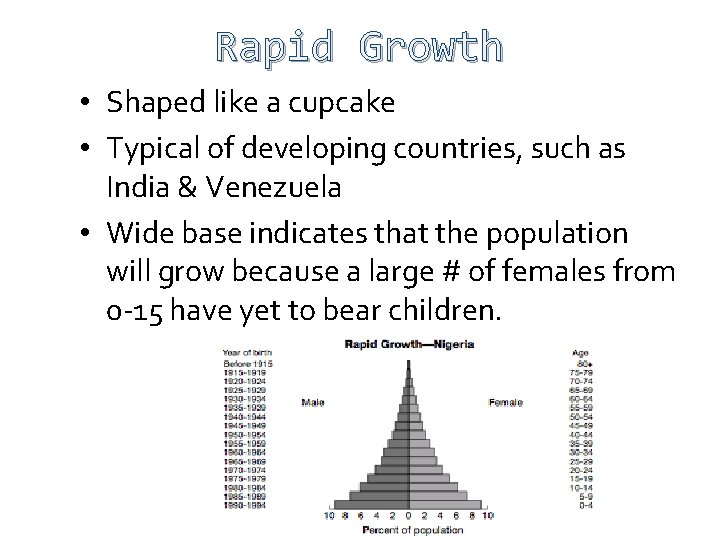
Rapid Growth • Shaped like a cupcake • Typical of developing countries, such as India & Venezuela • Wide base indicates that the population will grow because a large # of females from 0 -15 have yet to bear children.
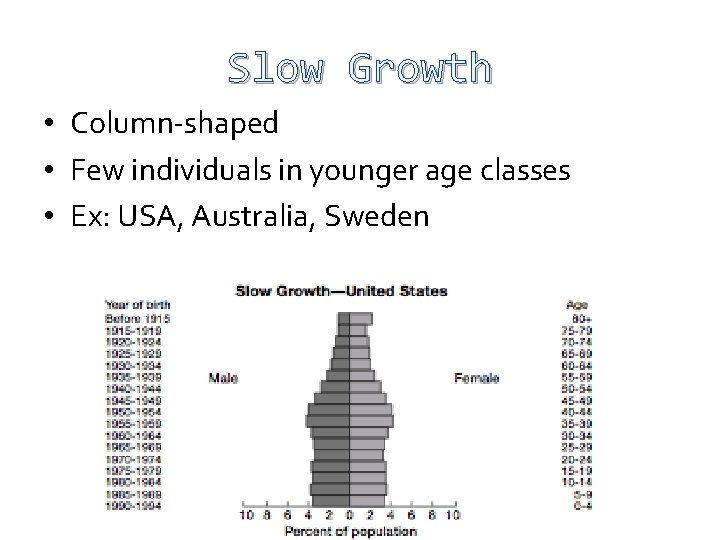
Slow Growth • Column-shaped • Few individuals in younger age classes • Ex: USA, Australia, Sweden
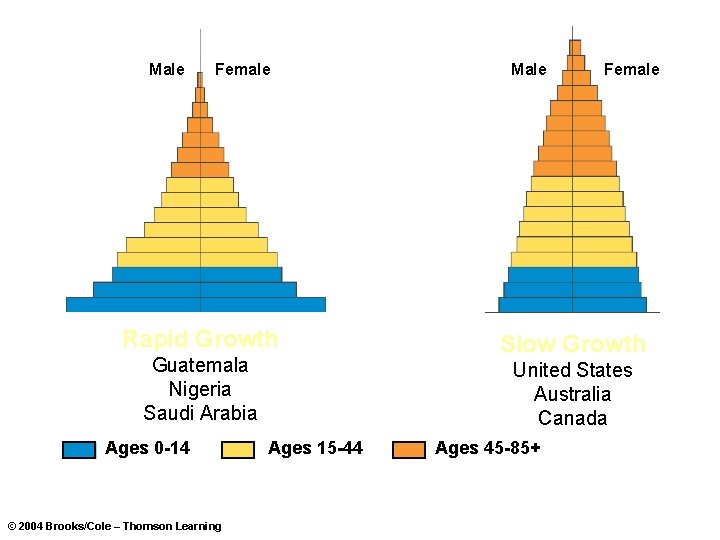
Male Female Rapid Growth Guatemala Nigeria Saudi Arabia Ages 0 -14 © 2004 Brooks/Cole – Thomson Learning Male Female Slow Growth United States Australia Canada Ages 15 -44 Ages 45 -85+
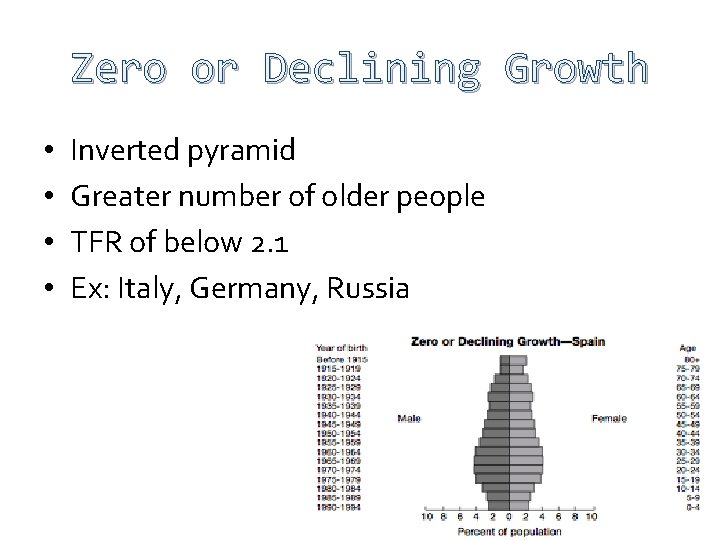
Zero or Declining Growth • • Inverted pyramid Greater number of older people TFR of below 2. 1 Ex: Italy, Germany, Russia
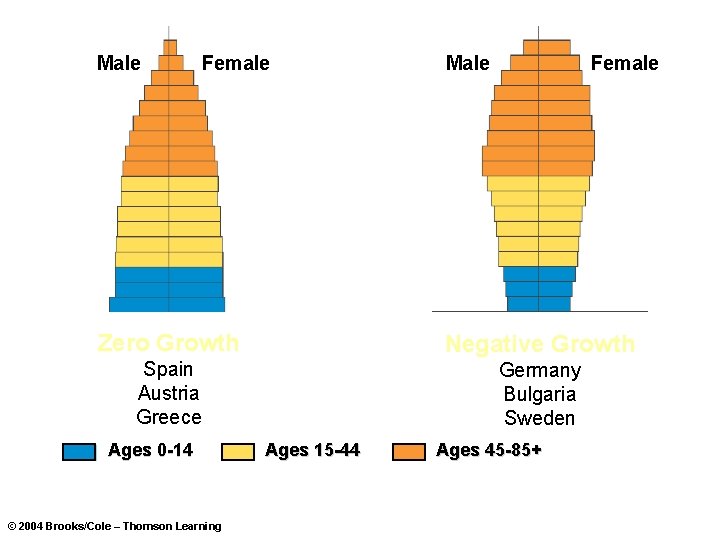
Male Female Zero Growth Negative Growth Spain Austria Greece Germany Bulgaria Sweden Ages 0 -14 © 2004 Brooks/Cole – Thomson Learning Ages 15 -44 Ages 45 -85+
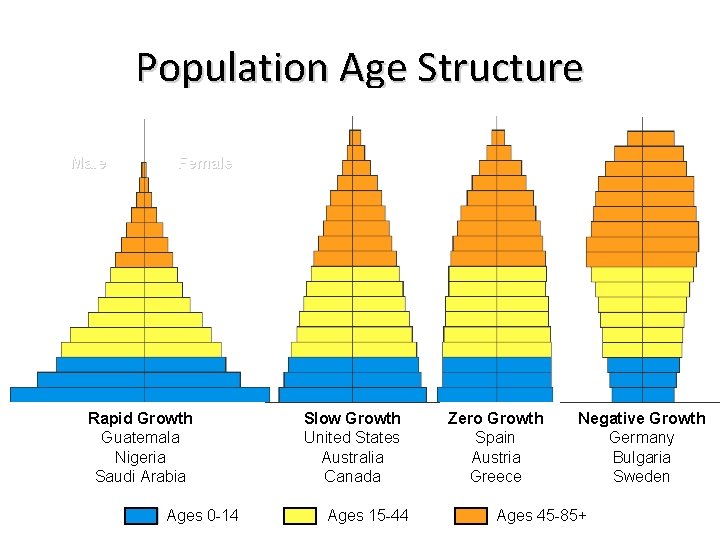
Population Age Structure Male Female Rapid Growth Guatemala Nigeria Saudi Arabia Ages 0 -14 Slow Growth United States Australia Canada Ages 15 -44 Zero Growth Spain Austria Greece Negative Growth Germany Bulgaria Sweden Ages 45 -85+
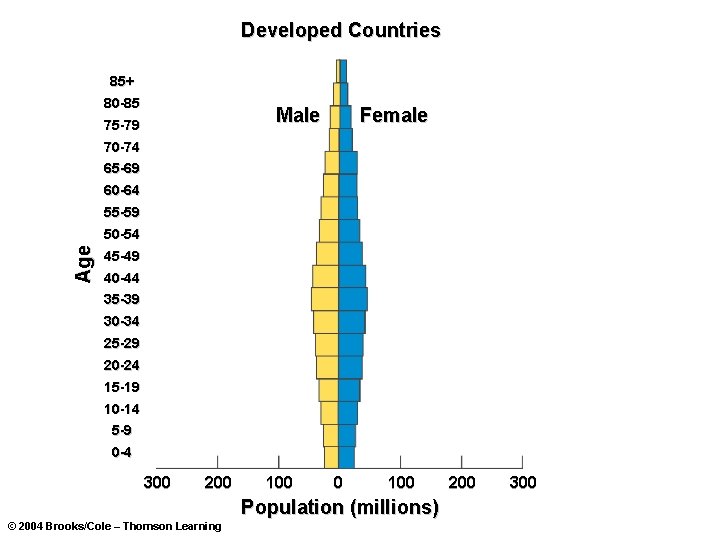
Developed Countries 85+ 80 -85 Male 75 -79 Female 70 -74 65 -69 60 -64 55 -59 Age 50 -54 45 -49 40 -44 35 -39 30 -34 25 -29 20 -24 15 -19 10 -14 5 -9 0 -4 300 200 100 Population (millions) © 2004 Brooks/Cole – Thomson Learning 200 300
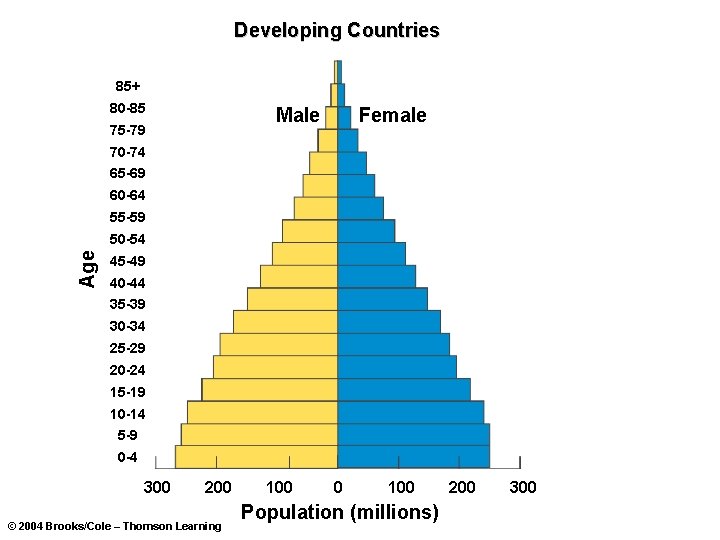
Developing Countries 85+ 80 -85 Male 75 -79 Female 70 -74 65 -69 60 -64 55 -59 Age 50 -54 45 -49 40 -44 35 -39 30 -34 25 -29 20 -24 15 -19 10 -14 5 -9 0 -4 300 200 © 2004 Brooks/Cole – Thomson Learning 100 0 100 Population (millions) 200 300
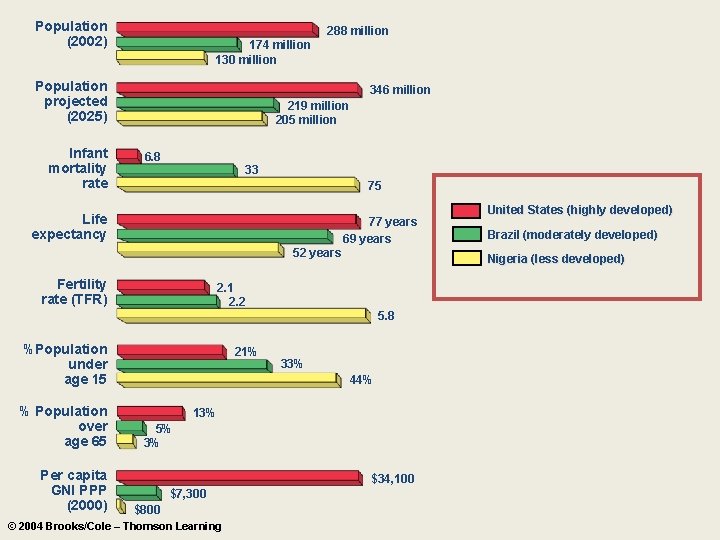
Population (2002) 288 million 174 million 130 million Population projected (2025) Infant mortality rate 346 million 219 million 205 million 6. 8 33 75 Life expectancy 77 years 69 years 52 years Fertility rate (TFR) 5. 8 % Population over age 65 Per capita GNI PPP (2000) 21% 33% 44% 13% 5% 3% $34, 100 $7, 300 $800 © 2004 Brooks/Cole – Thomson Learning Brazil (moderately developed) Nigeria (less developed) 2. 1 2. 2 %Population under age 15 United States (highly developed)
There have never been as many people on earth as there are now. • There are 7 billion people. http: //www. census. gov/popclock/ • How much is a billion? – If you were 1 billion seconds old, you’d be 31. 7 years of age – You’d have to circle the earth 40, 000 times to travel 1 billion miles – There are 44 million words in the Encyclopedia Britannica. You would need more than 136 full sets of the Encyclopedia to get 6 billion words
Migration • Most countries restrict immigration • Accounts for <1 percent in developing countries • Canada, Australia, and U. S. are exceptions – Immigration accounted for 40% of population growth in US in 2000 – Public strongly supports reducing immigration levels – Pros and cons to reducing legal immigration
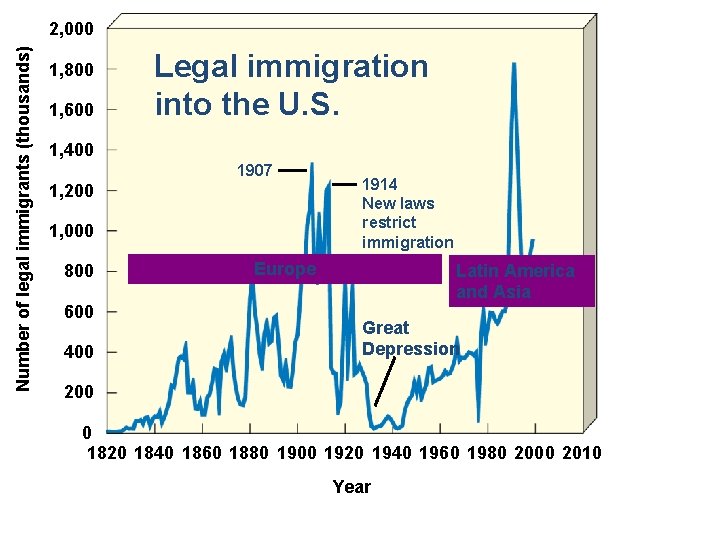
Number of legal immigrants (thousands) 2, 000 1, 800 1, 600 Legal immigration into the U. S. 1, 400 1907 1, 200 1, 000 800 600 400 1914 New laws restrict immigration Europe Latin America and Asia Great Depression 200 0 1820 1840 1860 1880 1900 1920 1940 1960 1980 2000 2010 Year
Political issue – 71% of Hispanics voted for Obama in 2012 election • 11 million The estimated number of undocumented immigrants (UI) in the United States today. That’s an increase of roughly one third since 2000, when there were 8. 5 million UIs, according to the Center for American Progress.

http: //www. youtube. com/watch? v =QSlt. Llwa. K-c • Interesting statistics: $329 billion What passage of the DREAM Act would add to the U. S. economy, according to the Center for American Progress. $4. 5 billion to $5. 4 billion The amount of additional net tax revenue that would accrue to the federal government over 3 years if all current undocumented immigrants were legalized.
• $48. 6 billion The estimated cost to taxpayers of covering 3. 1 million amnestied immigrants during the budget period 2014 -2019, in which Medicaid expansion takes effect, according to the same source. • $40 billion The annual cost of educating illegals and their offspring in this country, according to the Center for Immigration Studies.
People are living longer than ever. • Death rates have decreased in developed countries • Improving nutrition and living standards (not modern medicine) • As population gets older, the cause of death transitions from infectious diseases to chronic diseases such as heart attack and stroke • Japan!
There have never been so many young people • Less developed countries have significantly younger populations (high birth rates) • Improvements in infant mortality. • Contributes to population momentum • Teen childbearing: linked to education, age of marriage, and economic status
People are increasingly on the move • Moving to cities where it is more economically secure • Half of the world is urbanized • World’s largest cities are getting larger – 1960: London, Tokyo, New York – 1995: Tokyo, Sao Paolo (Brazil), Mexico City – 2015: Lagos (Nigeria), Bombay (India), Tokyo

Family Planning • Programs which provide educational and clinical services that help couples choose how many children to have and when. a. Birth spacing b. Birth control c. Health care
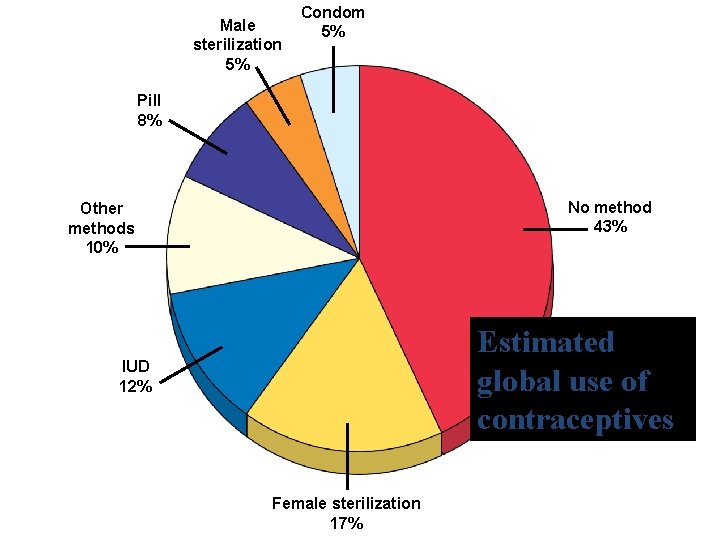
Male sterilization 5% Condom 5% Pill 8% No method 43% Other methods 10% Estimated global use of contraceptives IUD 12% Female sterilization 17%
Women’s lives are changing • Life expectancy , Jobs , Literacy rates , enrollment in secondary school • Women are the key to the family! • “Reproductive revolution” – Family planning! – Saves lives of mothers and children • Work – Less official jobs (more work @ home) – Get paid ¾ of male salary • Connected to family
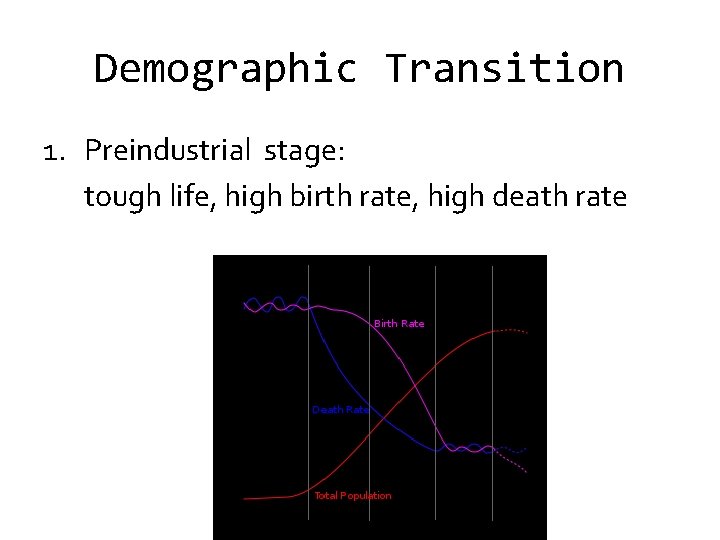
Demographic Transition 1. Preindustrial stage: tough life, high birth rate, high death rate
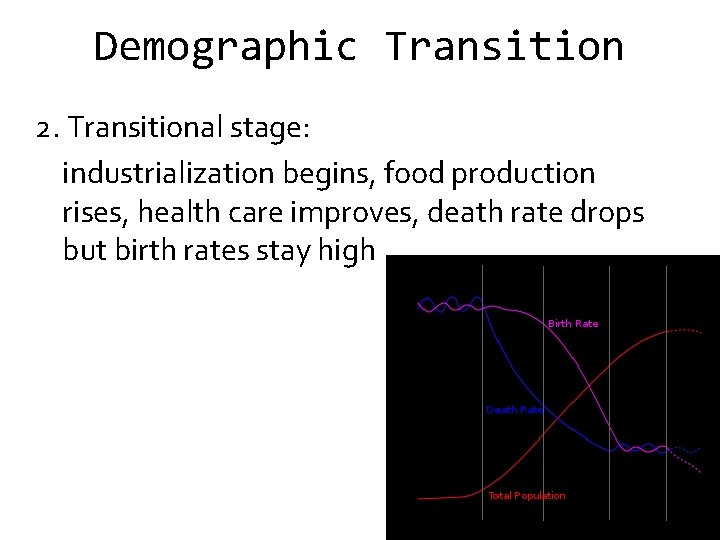
Demographic Transition 2. Transitional stage: industrialization begins, food production rises, health care improves, death rate drops but birth rates stay high
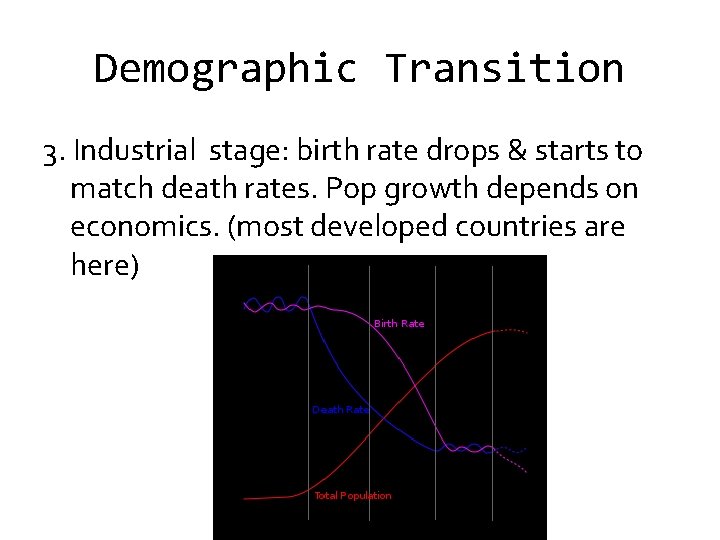
Demographic Transition 3. Industrial stage: birth rate drops & starts to match death rates. Pop growth depends on economics. (most developed countries are here)
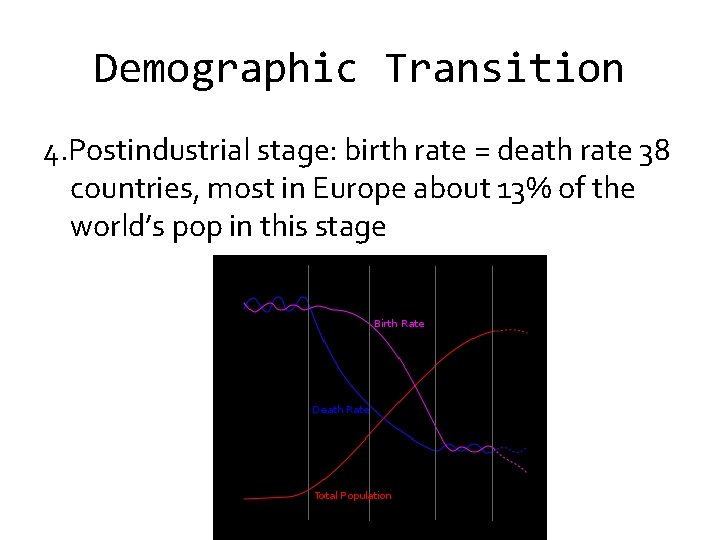
Demographic Transition 4. Postindustrial stage: birth rate = death rate 38 countries, most in Europe about 13% of the world’s pop in this stage
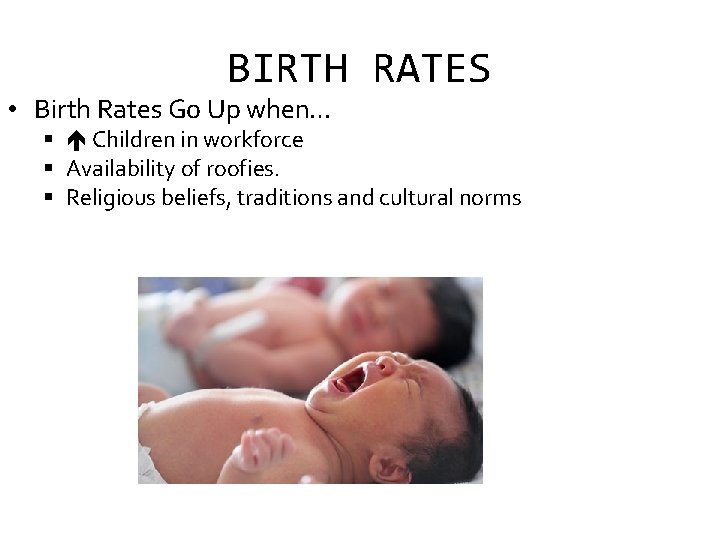
BIRTH RATES • Birth Rates Go Up when… Children in workforce Availability of roofies. Religious beliefs, traditions and cultural norms
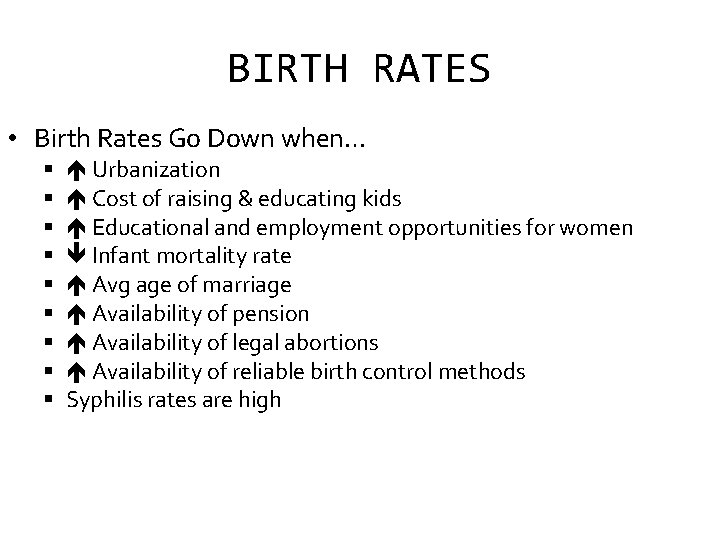
BIRTH RATES • Birth Rates Go Down when… Urbanization Cost of raising & educating kids Educational and employment opportunities for women Infant mortality rate Avg age of marriage Availability of pension Availability of legal abortions Availability of reliable birth control methods Syphilis rates are high

Death Rates • Decreased death rate: – Increased food supplies & distribution – Better nutrition – Improvements in medical & public health technology (immunizations & antibiotics) – Improved sanitation & personal hygiene – Safer water supplies (less infectious diseases) • Healthy country: – Life expectancy = – Infant mortality rate =
SLOWING POPULATION GROWTH IN INDIA AND CHINA • For more than five decades, India has tried to control its population growth with only modest success. • Since 1970, China has used a government -enforced program to cut its birth rate in half and sharply reduce its fertility rate.
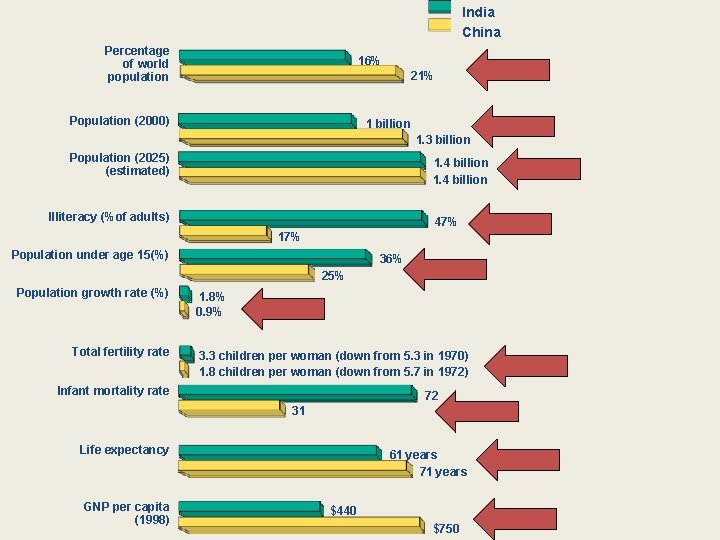
India China Percentage of world population 16% 21% Population (2000) 1 billion 1. 3 billion Population (2025) (estimated) 1. 4 billion Illiteracy (%of adults) 47% 17% Population under age 15(%) 36% 25% Population growth rate (%) Total fertility rate 1. 8% 0. 9% 3. 3 children per woman (down from 5. 3 in 1970) 1. 8 children per woman (down from 5. 7 in 1972) Infant mortality rate 72 31 Life expectancy GNP per capita (1998) 61 years 71 years $440 $750
India’s Failed Family Planning Program • • • Poor planning. Bureaucratic inefficiency. Low status of women. Extreme poverty. Lack of administrative financial support. Disagreement over the best ways to slow population growth.
China’s Family Planning Program • Currently, China’s TFR is 1. 6 children per women. • China has moved 300 million people out of poverty. • Problems: – Strong male preference leads to gender imbalance. – Average population age is increasing. – Not enough resource to support population.
More people affect the environment • Water – Demand exceeds supply – Mainly used for agriculture – Water quality affects availability of safe water • Forests – Valuable for indigenous cultures, ecosystem services, etc… threatened by development • Energy – Developed countries use more energy (proportionally) – Need to import it!
- Slides: 64