
Factors Affecting Equilibrium Le Chatelier principle 1 Effect
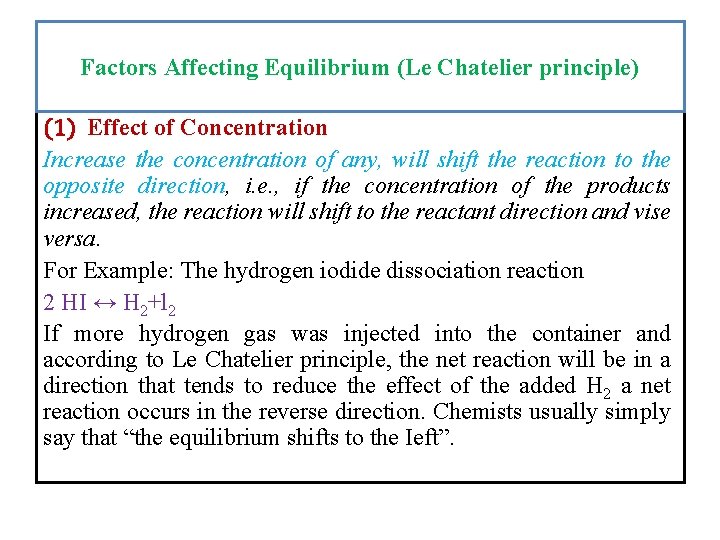
Factors Affecting Equilibrium (Le Chatelier principle) (1) Effect of Concentration Increase the concentration of any, will shift the reaction to the opposite direction, i. e. , if the concentration of the products increased, the reaction will shift to the reactant direction and vise versa. For Example: The hydrogen iodide dissociation reaction 2 HI ↔ H 2+l 2 If more hydrogen gas was injected into the container and according to Le Chatelier principle, the net reaction will be in a direction that tends to reduce the effect of the added H 2 a net reaction occurs in the reverse direction. Chemists usually simply say that “the equilibrium shifts to the Ieft”.
![Example 6. 6: Gaseous isobutane and butane are in equilibrium with: [iso] = 1.](http://slidetodoc.com/presentation_image_h2/52a8ff759a97bbb51b68dd74022caf90/image-2.jpg "Example 6. 6: Gaseous isobutane and butane are in equilibrium with: [iso] = 1.")
Example 6. 6: Gaseous isobutane and butane are in equilibrium with: [iso] = 1. 25 M, and [butane] = 0. 50 M. If we add enough butane to increase the concentration of butane by 1. 50 M when the system comes to equilibrium again, what are [iso] and [butane]? K = 2. 5 Butane ↔isobutane Answer 6. 6 1 - Calculate Q immediately after adding butane
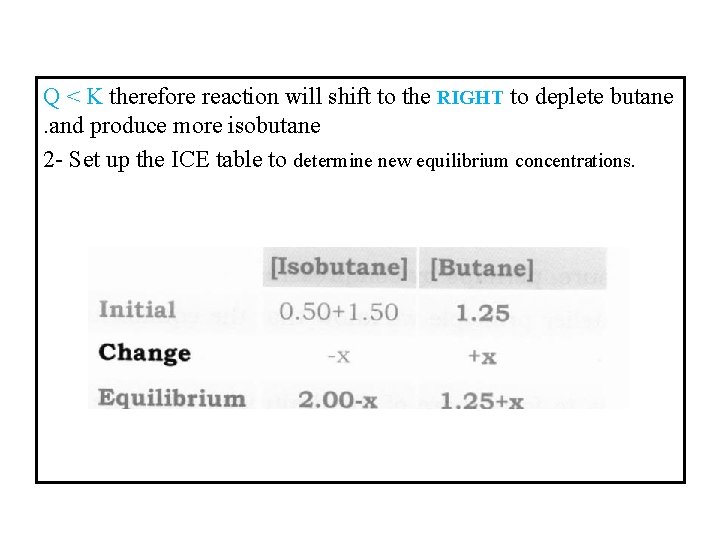
Q < K therefore reaction will shift to the RIGHT to deplete butane. and produce more isobutane 2 - Set up the ICE table to determine new equilibrium concentrations.
![3 - Solve the equilibrium expression for x. K= 2. 5 = [isobutene] /](http://slidetodoc.com/presentation_image_h2/52a8ff759a97bbb51b68dd74022caf90/image-4.jpg "3 - Solve the equilibrium expression for x. K= 2. 5 = [isobutene] /")
3 - Solve the equilibrium expression for x. K= 2. 5 = [isobutene] / [butane] = (1. 25 + x)/(2. 00 - x) x=1. 07 M 4 - Determine new equilibrium concentrations. [isobutene] = 1. 25 + x = 2. 32 M [butane ] = 2. 00 -1. 07 = 0. 93 M Summary Initial Conditions: [butane] = 0. 50 M, [Isobutane] = 1. 25 M, K = [Isobutane] / [butane] = 2. 5. The System was in Equilibrium Change: 1. 5 M butane was added, so the system was no longer in equilibrium (Q ≠ K). Butane had to be consumed in order to re-establish equilibrium. Final Conditions: [Butane] = 0. 93 M, [Isobutane] = 2. 32 M, K = [isobutane]/ [Butane] = 2. 5. System re-established equilibrium, but with different concentrations of butane and isobutane!

(2) Effect of Pressure (only for Gases) Increasing the pressure will shift the reaction to the direction with less number of moles. Suppose that the reaction: 2 NO 2 (g) ↔N 2 O 4 (g) is in equilibrium at temperature and pressure, and that we double the pressure, From the Le Chdtelier principle equilibrium state will change to counteract the increase in pressure. This can occur if some of the NO 2 reacts to form more of the N 2 O 4, thereby decreasing the total volume of the system. Thus increasing the pressure will shift to the right
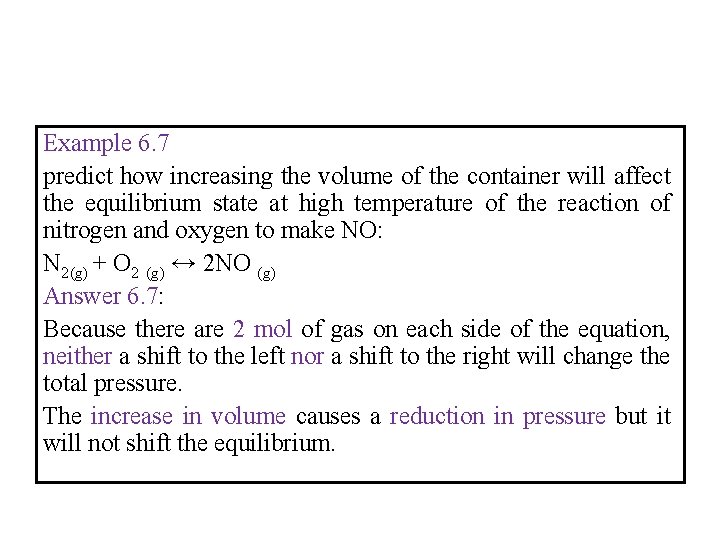
Example 6. 7 predict how increasing the volume of the container will affect the equilibrium state at high temperature of the reaction of nitrogen and oxygen to make NO: N 2(g) + O 2 (g) ↔ 2 NO (g) Answer 6. 7: Because there are 2 mol of gas on each side of the equation, neither a shift to the left nor a shift to the right will change the total pressure. The increase in volume causes a reduction in pressure but it will not shift the equilibrium.
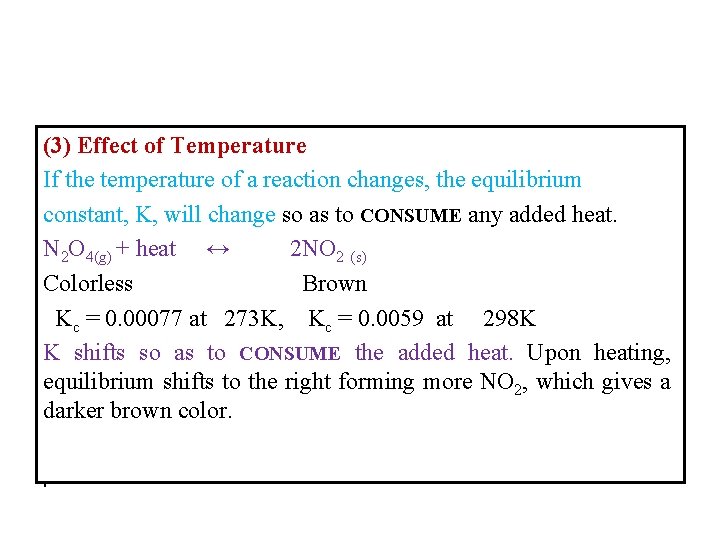
(3) Effect of Temperature If the temperature of a reaction changes, the equilibrium constant, K, will change so as to CONSUME any added heat. N 2 O 4(g) + heat ↔ 2 NO 2 (s) Colorless Brown Kc = 0. 00077 at 273 K, Kc = 0. 0059 at 298 K K shifts so as to CONSUME the added heat. Upon heating, equilibrium shifts to the right forming more NO 2, which gives a darker brown color. .
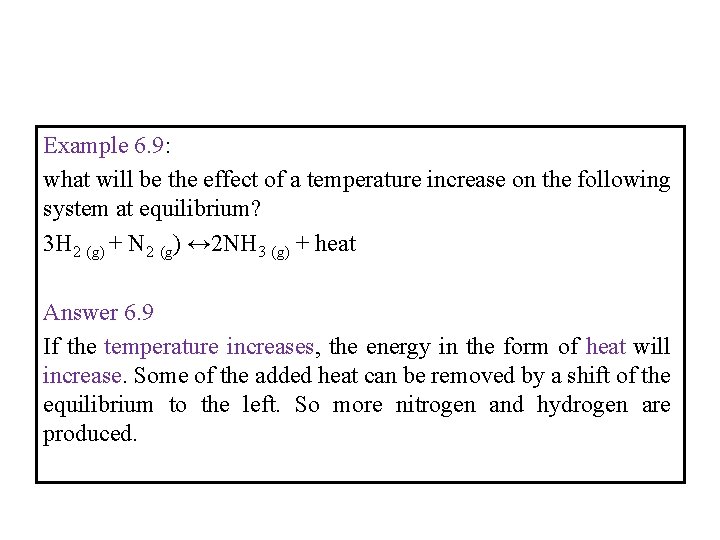
Example 6. 9: what will be the effect of a temperature increase on the following system at equilibrium? 3 H 2 (g) + N 2 (g) ↔ 2 NH 3 (g) + heat Answer 6. 9 If the temperature increases, the energy in the form of heat will increase. Some of the added heat can be removed by a shift of the equilibrium to the left. So more nitrogen and hydrogen are produced.
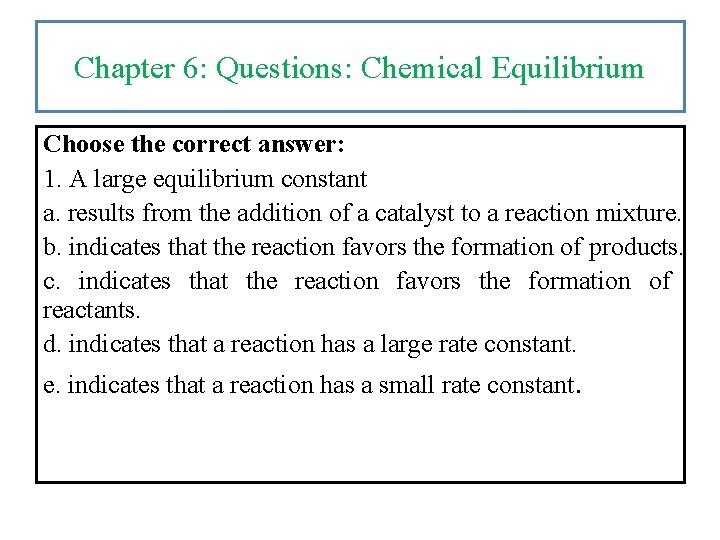
Chapter 6: Questions: Chemical Equilibrium Choose the correct answer: 1. A large equilibrium constant a. results from the addition of a catalyst to a reaction mixture. b. indicates that the reaction favors the formation of products. c. indicates that the reaction favors the formation of reactants. d. indicates that a reaction has a large rate constant. e. indicates that a reaction has a small rate constant.
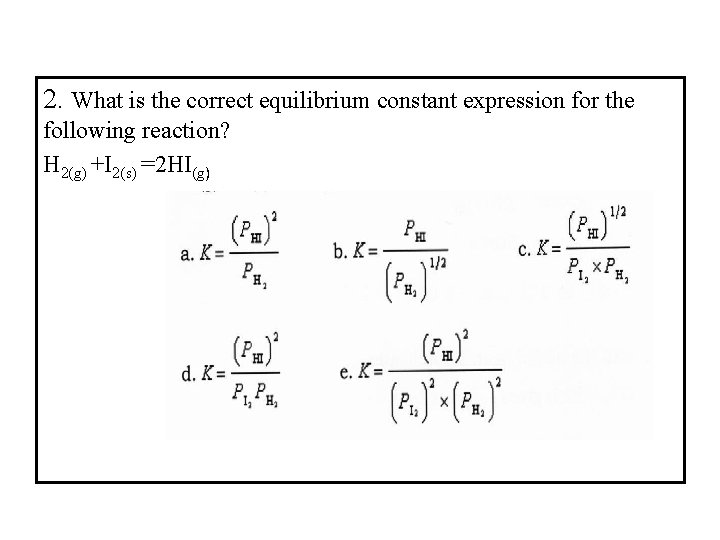
2. What is the correct equilibrium constant expression for the following reaction? H 2(g) +I 2(s) =2 HI(g)
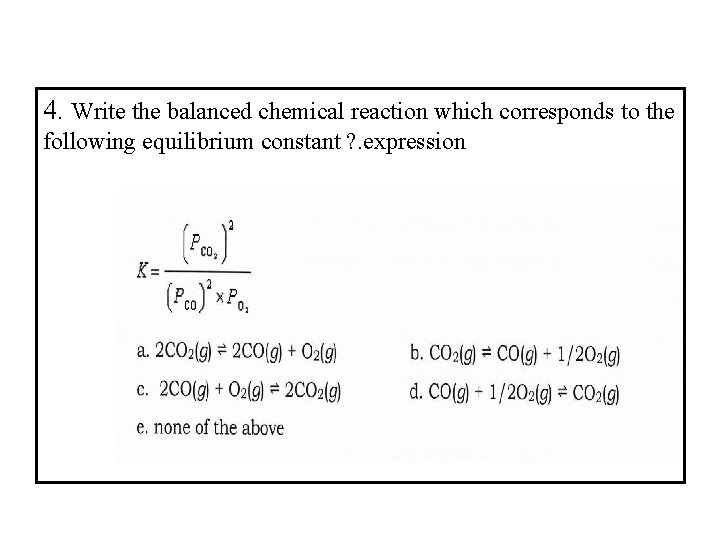
4. Write the balanced chemical reaction which corresponds to the following equilibrium constant ? . expression
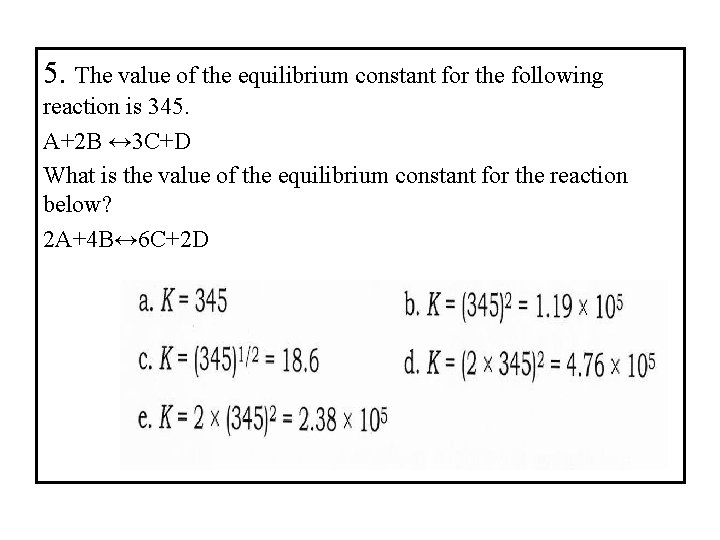
5. The value of the equilibrium constant for the following reaction is 345. A+2 B ↔ 3 C+D What is the value of the equilibrium constant for the reaction below? 2 A+4 B↔ 6 C+2 D
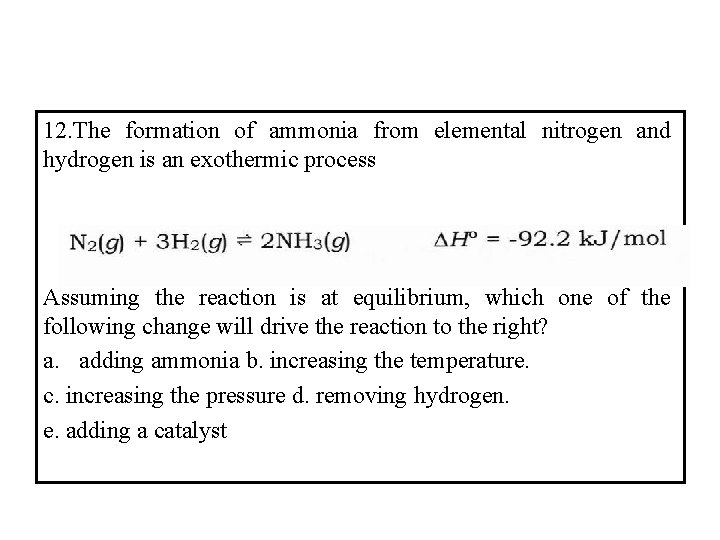
12. The formation of ammonia from elemental nitrogen and hydrogen is an exothermic process Assuming the reaction is at equilibrium, which one of the following change will drive the reaction to the right? a. adding ammonia b. increasing the temperature. c. increasing the pressure d. removing hydrogen. e. adding a catalyst
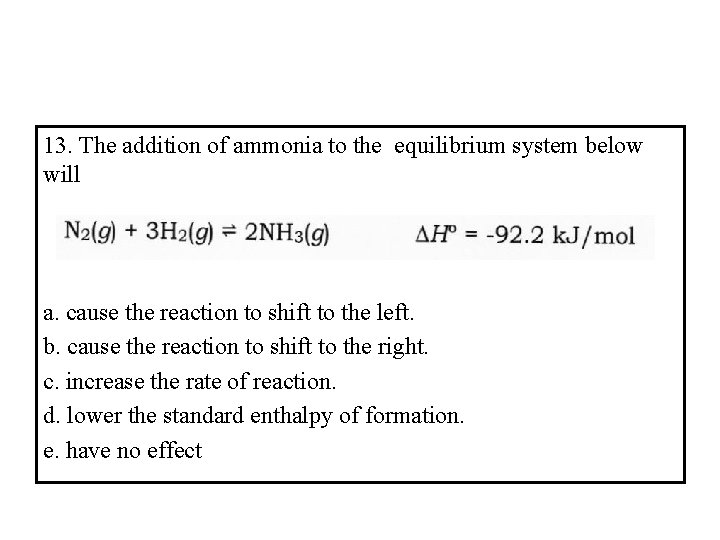
13. The addition of ammonia to the equilibrium system below will a. cause the reaction to shift to the left. b. cause the reaction to shift to the right. c. increase the rate of reaction. d. lower the standard enthalpy of formation. e. have no effect
- Slides: 14