
Factors Affecting Corona Loss Dr Vikas Singh Bhadoria
Factors Affecting Corona Loss Dr. Vikas Singh Bhadoria
Corona Power Loss • The power dissipated in the system due to corona discharges is called corona loss. • Accurate estimation of corona loss is difficult because of its variable nature. • Corona loss under fair weather condition is less than under foul weather conditions.
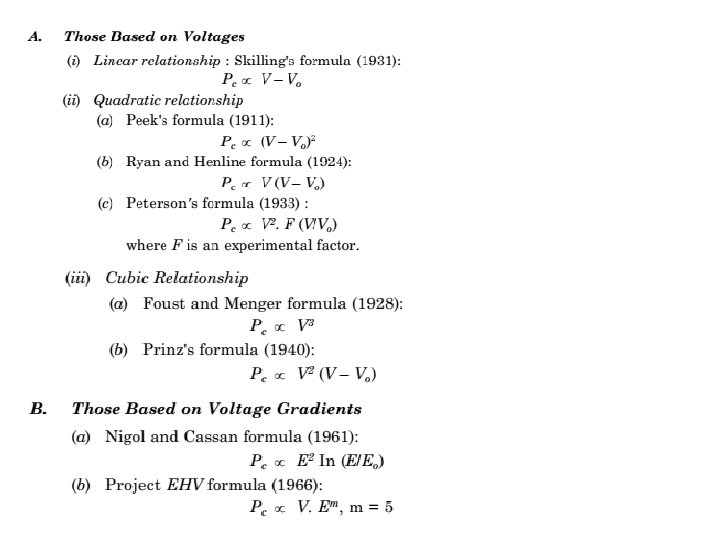
Contd… They all yield the power loss as a function of • the corona-inception voltage, Vo; • the actual voltage of conductor, V; • the excess voltage (V — Vo) above Vo; • conductor surface voltage gradient, E; • corona-inception gradient, Eo; • frequency, f; • conductor size, d, and • number of conductors in bundle, N, as well as line configuration; • atmospheric condition, mainly rate of rainfall, r, and • conductor surface condition.
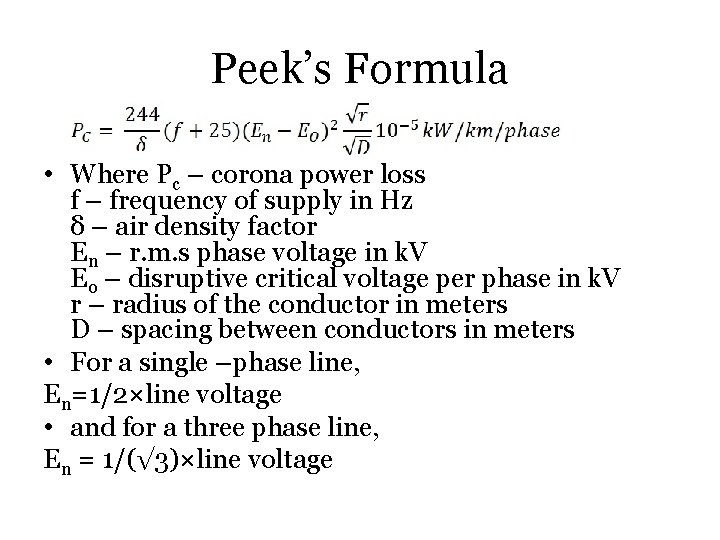
Peek’s Formula • Where Pc – corona power loss f – frequency of supply in Hz δ – air density factor En – r. m. s phase voltage in k. V Eo – disruptive critical voltage per phase in k. V r – radius of the conductor in meters D – spacing between conductors in meters • For a single –phase line, En=1/2×line voltage • and for a three phase line, En = 1/(√ 3)×line voltage
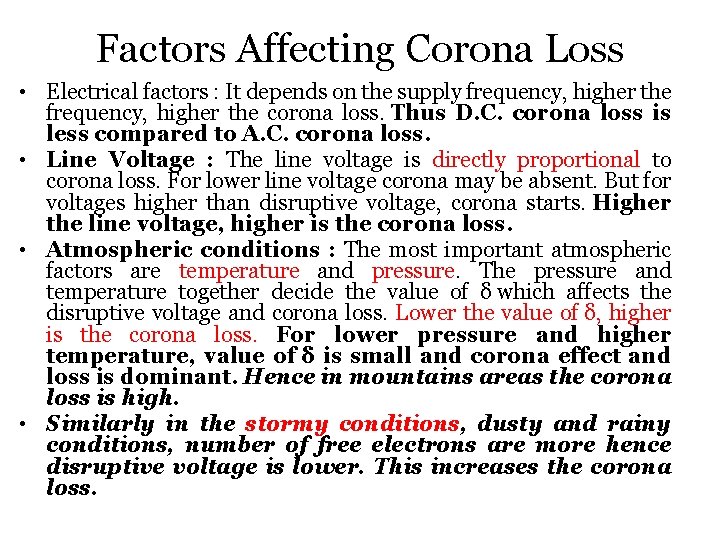
Factors Affecting Corona Loss • Electrical factors : It depends on the supply frequency, higher the frequency, higher the corona loss. Thus D. C. corona loss is less compared to A. C. corona loss. • Line Voltage : The line voltage is directly proportional to corona loss. For lower line voltage corona may be absent. But for voltages higher than disruptive voltage, corona starts. Higher the line voltage, higher is the corona loss. • Atmospheric conditions : The most important atmospheric factors are temperature and pressure. The pressure and temperature together decide the value of δ which affects the disruptive voltage and corona loss. Lower the value of δ, higher is the corona loss. For lower pressure and higher temperature, value of δ is small and corona effect and loss is dominant. Hence in mountains areas the corona loss is high. • Similarly in the stormy conditions, dusty and rainy conditions, number of free electrons are more hence disruptive voltage is lower. This increases the corona loss.
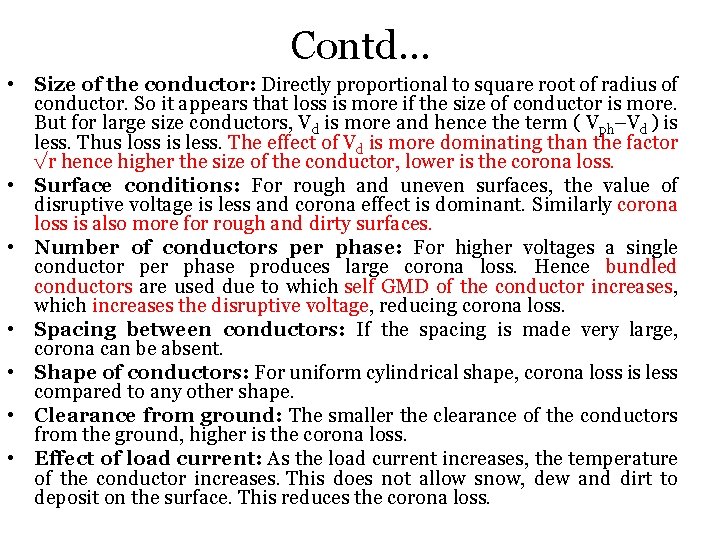
Contd… • Size of the conductor: Directly proportional to square root of radius of conductor. So it appears that loss is more if the size of conductor is more. But for large size conductors, Vd is more and hence the term ( Vph–Vd ) is less. Thus loss is less. The effect of Vd is more dominating than the factor √r hence higher the size of the conductor, lower is the corona loss. • Surface conditions: For rough and uneven surfaces, the value of disruptive voltage is less and corona effect is dominant. Similarly corona loss is also more for rough and dirty surfaces. • Number of conductors per phase: For higher voltages a single conductor per phase produces large corona loss. Hence bundled conductors are used due to which self GMD of the conductor increases, which increases the disruptive voltage, reducing corona loss. • Spacing between conductors: If the spacing is made very large, corona can be absent. • Shape of conductors: For uniform cylindrical shape, corona loss is less compared to any other shape. • Clearance from ground: The smaller the clearance of the conductors from the ground, higher is the corona loss. • Effect of load current: As the load current increases, the temperature of the conductor increases. This does not allow snow, dew and dirt to deposit on the surface. This reduces the corona loss.

- Slides: 8