
Factors affecting cell diferentiation Cell differentiation is important

- Slides: 11
Factors affecting cell diferentiation • Cell differentiation is important for normal cell functions • Factors promoting cell differentiations – high cell density – cell-cell and cell-matrix interaction – inducers: hydrocortisone, retinoid, matrix 2
Factors affecting cell adhesion • Cell adhesion is important for cell proliferation and differentiation (signaling through cytoskeleton) • Cell adhesion molecule – Cell-cell interaction: CAMs, cadherins – Cell-matrix interaction – transmembrame proteoglycan • Tight junctional complex in epithelial cells for cell-cell interaction 3
Factors affecting cell adhesion • Enzymatic disaggregation digests the adhesion molecule and extracellular matrix • Most cells from solid tissues grow as adherent monolayer • Matrix-coated surface promotes cell proliferation and differentiation 4
Factors affect cell culture success • Appropriate cells • Suitable environment – Solid phase • substrate or phase on which the cell grow eg. glass, plastic, collagen, agar – Liquid phase • physicochemical and physiological constitution of the medium – Gaseous phase – Temperature – Aseptic environment 5
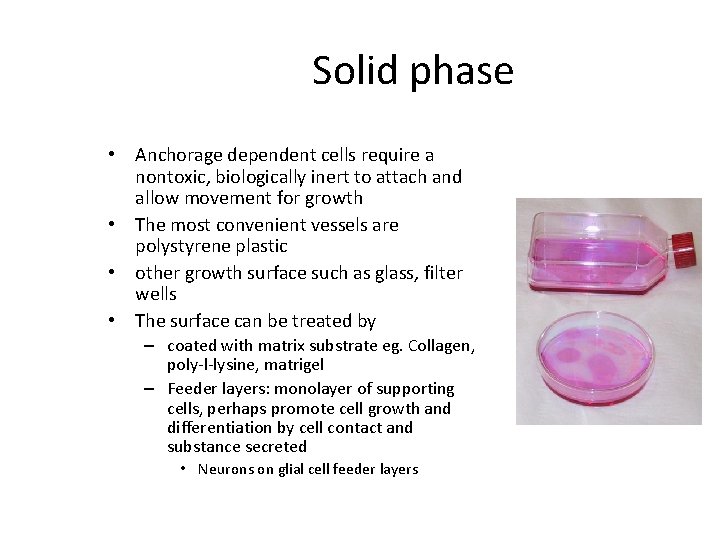
Solid phase • Anchorage dependent cells require a nontoxic, biologically inert to attach and allow movement for growth • The most convenient vessels are polystyrene plastic • other growth surface such as glass, filter wells • The surface can be treated by – coated with matrix substrate eg. Collagen, poly-l-lysine, matrigel – Feeder layers: monolayer of supporting cells, perhaps promote cell growth and differentiation by cell contact and substance secreted • Neurons on glial cell feeder layers
Liquid phase • Components of culture media – Inorganic Salts • retain the osmotic balance of the cells • regulate membrane potential by provision of sodium, potassium and calcium ions. • are required in the cell matrix for cell attachment and as enzyme cofactors. – Carbohydrates • Most media contain 4 -20 m. M glucose • main source of energy from glycolysis
Liquid phase – Proteins and Peptides • are used to replace those normally present in serum eg. transferrin, fibronectin – Amino acids • important for cell proliferation and differentiation • glutamine can enter Kreb’s cycle – Fatty Acids and Lipids • important in serum free media e. g. cholesterol and steroids essential for specialized cells.
Liquid phase – Vitamins • vitamins B are necessary for cell growth and proliferation • precursors for numerous co-factors • The vitamins commonly used in media include thiamine, riboflavin and biotin – Trace Elements • zinc, copper, selenium and tricarboxylic acid intermediates. • Selenium is a detoxifier and helps remove oxygen free radicals.
Liquid phase – Buffering Systems • most cells need optimal p. H conditions in the range 7. 2 - 7. 4 • close control of p. H is essential for optimum culture conditions – bicarbonate/CO 2 buffering systems – Chemical buffering: HEPES (4 -(2 -hydroxyethyl)-1 piperazineethanesulfonic acid ) • Most commercial culture media include phenol red as a p. H indicator – yellow (acid) or purple (alkali) – Osmolarity • similar to plasma osmolarity 290 m. Osm
Liquid phase – Serum • Undefined factors: complex mix of albumins, growth factors and growth inhibitors • increase the buffering capacity of cultures • able to bind and neutralize toxins • can be important for slow growing cells or where the seeding density is low • Subject to batch variation • Heat inactivation of serum (incubation at 56ºC for 30 minutes) can help to reduce the risk of contamination