
Factorization with Gauss Sums Scaling Properties of Ghost
- Slides: 25
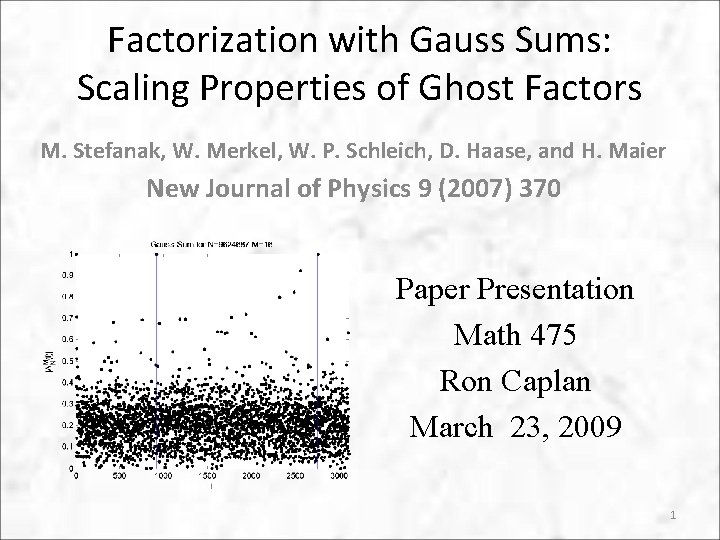
Factorization with Gauss Sums: Scaling Properties of Ghost Factors M. Stefanak, W. Merkel, W. P. Schleich, D. Haase, and H. Maier New Journal of Physics 9 (2007) 370 Paper Presentation Math 475 Ron Caplan March 23, 2009 1
Outline Introduction Factoring with Gauss Sums: Ghost Factors 4 Classes of Trial Factors Truncation Parameter for Complete Suppression of Ghost Factors • Scaling of Ghost Factors with Counting Function • • – Uniform distribution of fractional part – Non-uniform distribution of fractional part • • Optimal scaling law Summery of Results Friendly Ghost Factors? Conclusion 2
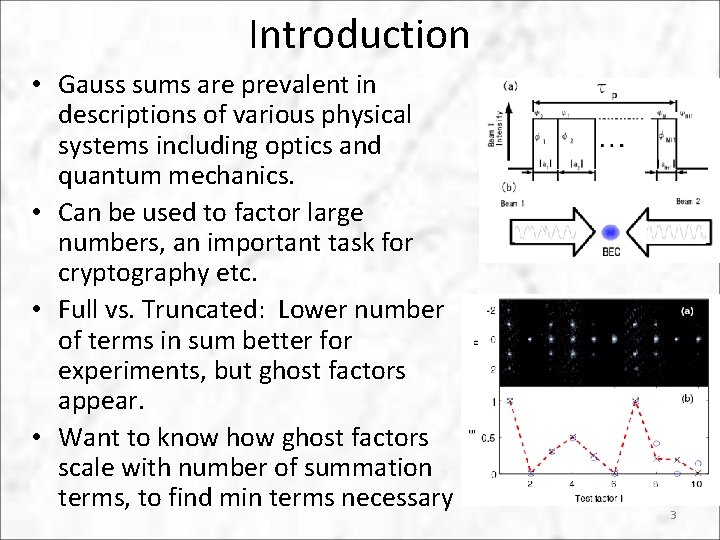
Introduction • Gauss sums are prevalent in descriptions of various physical systems including optics and quantum mechanics. • Can be used to factor large numbers, an important task for cryptography etc. • Full vs. Truncated: Lower number of terms in sum better for experiments, but ghost factors appear. • Want to know how ghost factors scale with number of summation terms, to find min terms necessary 3
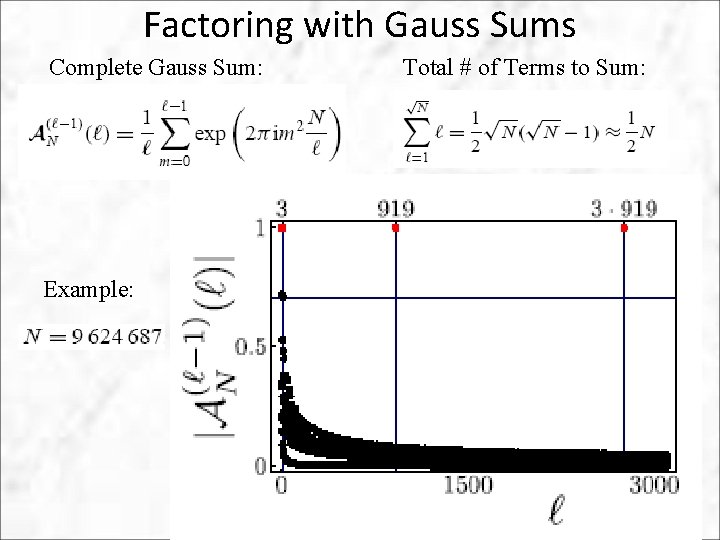
Factoring with Gauss Sums Complete Gauss Sum: Example: Total # of Terms to Sum:
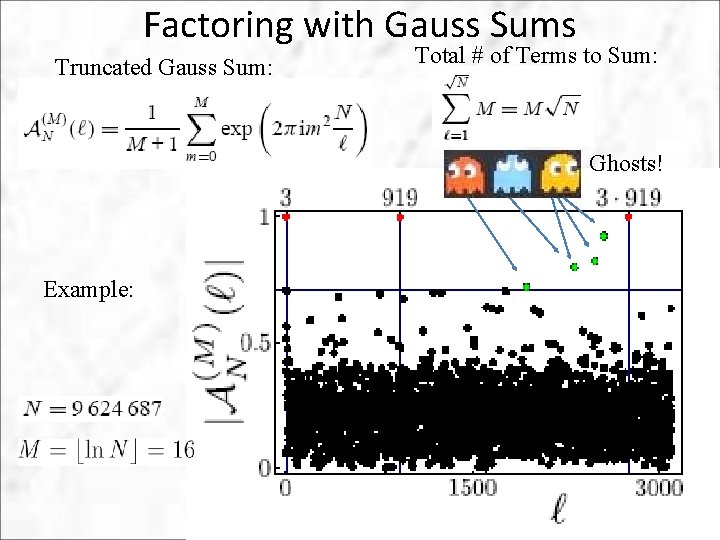
Factoring with Gauss Sums Truncated Gauss Sum: Total # of Terms to Sum: Ghosts! Example:
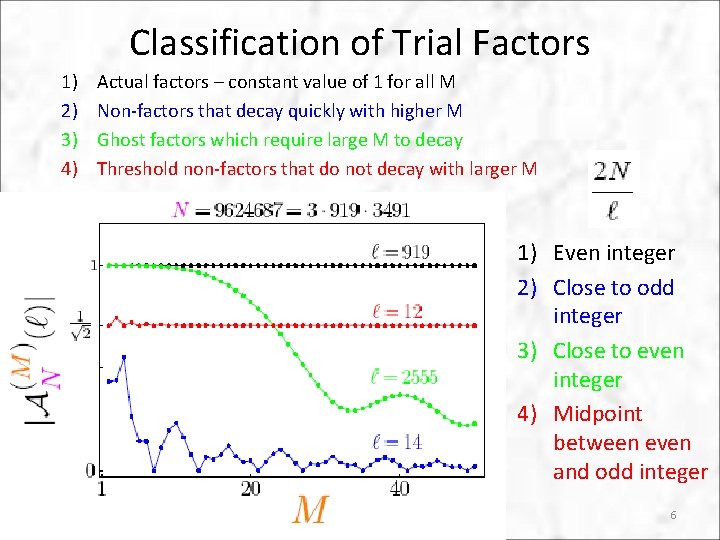
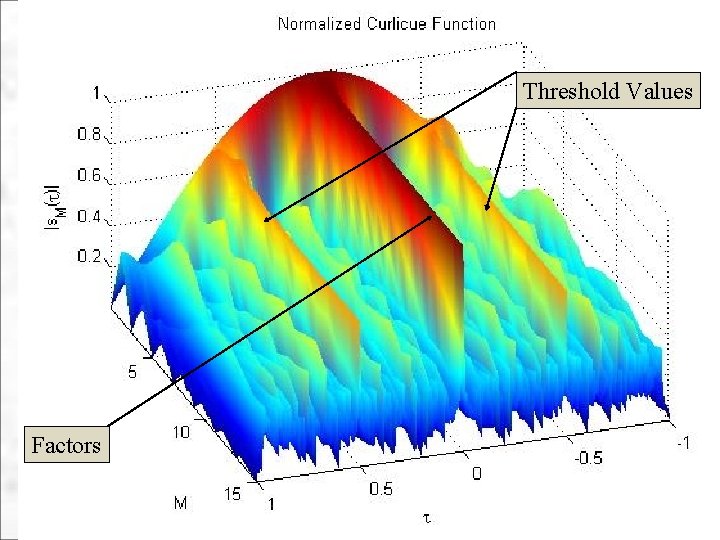
Classification of Trial Factors 1) 2) 3) 4) Actual factors – constant value of 1 for all M Non-factors that decay quickly with higher M Ghost factors which require large M to decay Threshold non-factors that do not decay with larger M 1) Even integer 2) Close to odd integer 3) Close to even integer 4) Midpoint between even and odd integer 6
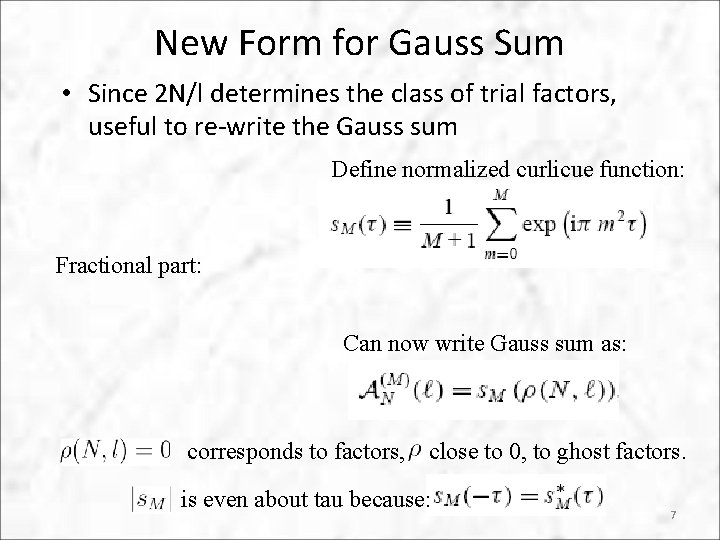
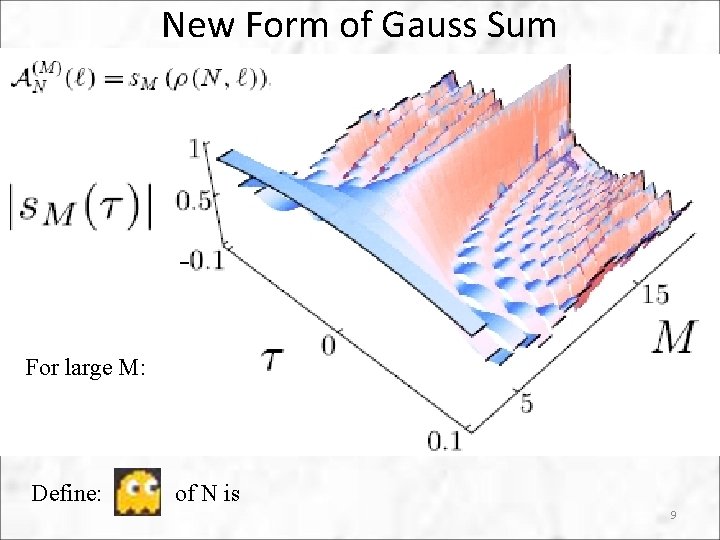
New Form for Gauss Sum • Since 2 N/l determines the class of trial factors, useful to re-write the Gauss sum Define normalized curlicue function: Fractional part: Can now write Gauss sum as: corresponds to factors, close to 0, to ghost factors. is even about tau because: 7
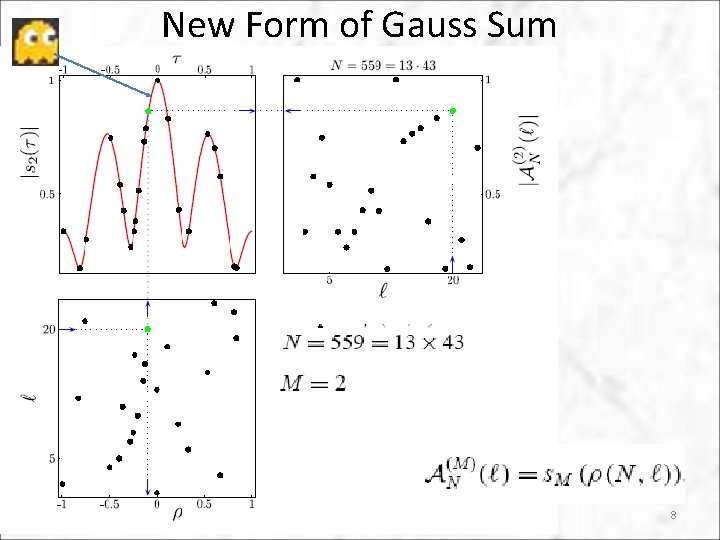
New Form of Gauss Sum 8
New Form of Gauss Sum For large M: Define: of N is 9
Threshold Values Factors 10
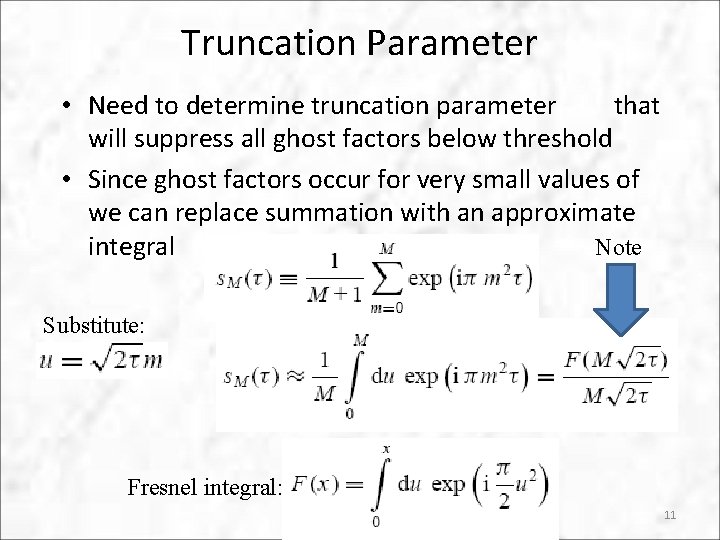
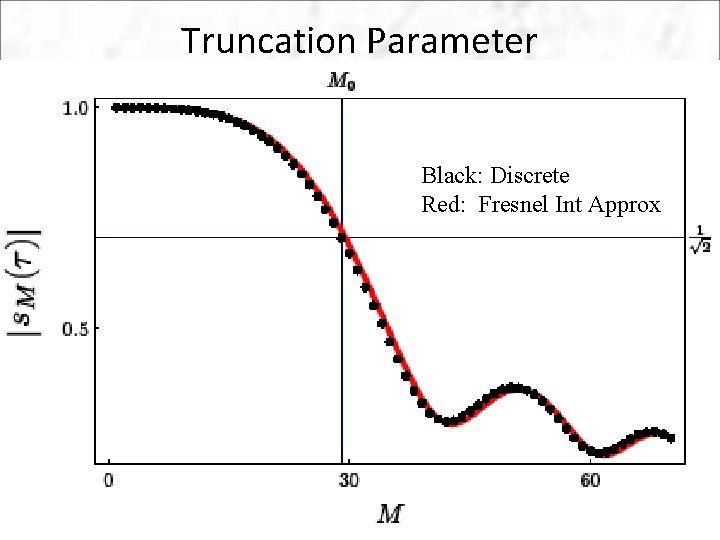
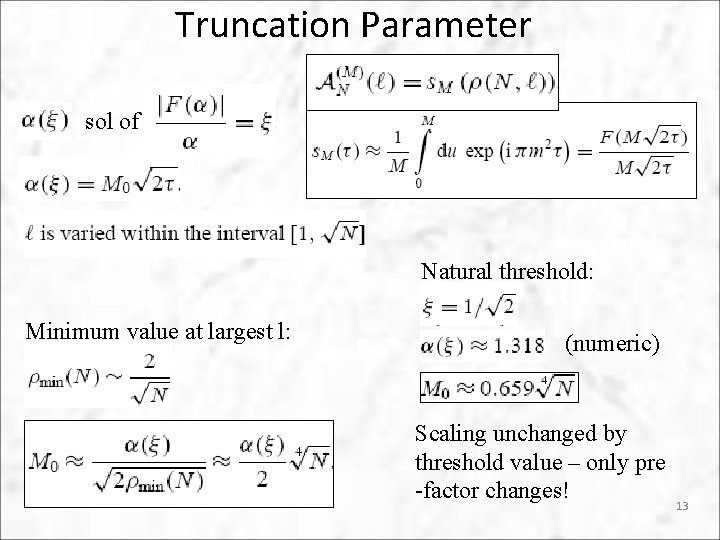
Truncation Parameter • Need to determine truncation parameter that will suppress all ghost factors below threshold • Since ghost factors occur for very small values of we can replace summation with an approximate Note integral Substitute: Fresnel integral: 11
Truncation Parameter Black: Discrete Red: Fresnel Int Approx 12
Truncation Parameter sol of Natural threshold: Minimum value at largest l: (numeric) Scaling unchanged by threshold value – only pre -factor changes! 13
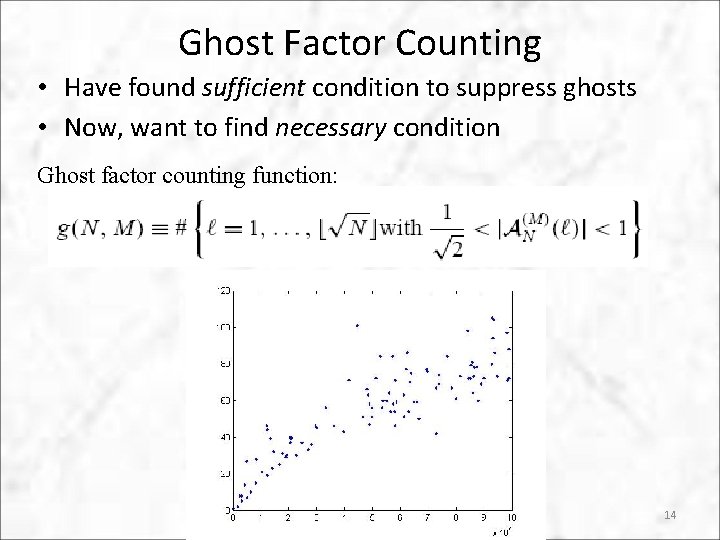
Ghost Factor Counting • Have found sufficient condition to suppress ghosts • Now, want to find necessary condition Ghost factor counting function: 14
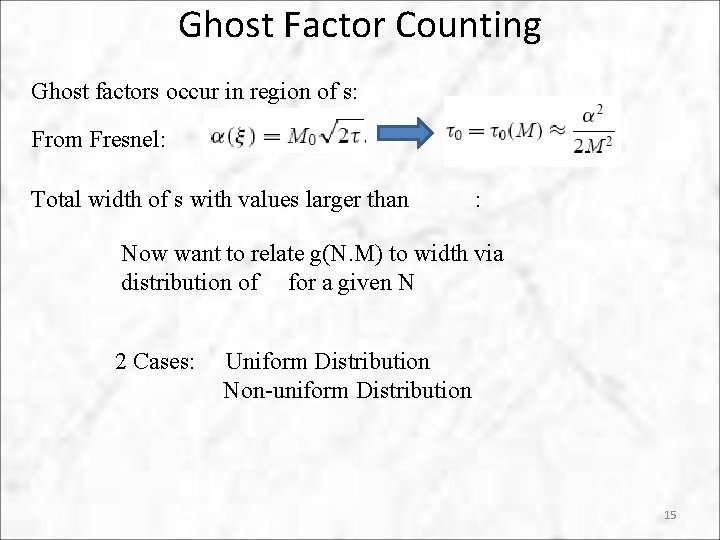
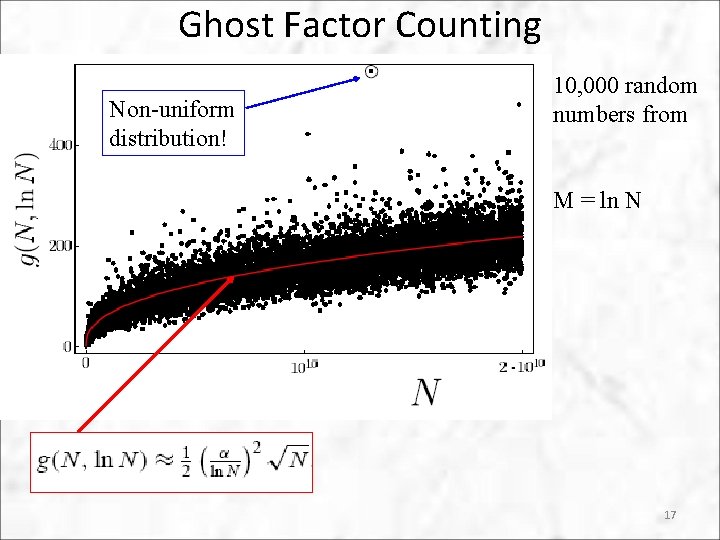
Ghost Factor Counting Ghost factors occur in region of s: From Fresnel: Total width of s with values larger than : Now want to relate g(N. M) to width via distribution of for a given N 2 Cases: Uniform Distribution Non-uniform Distribution 15
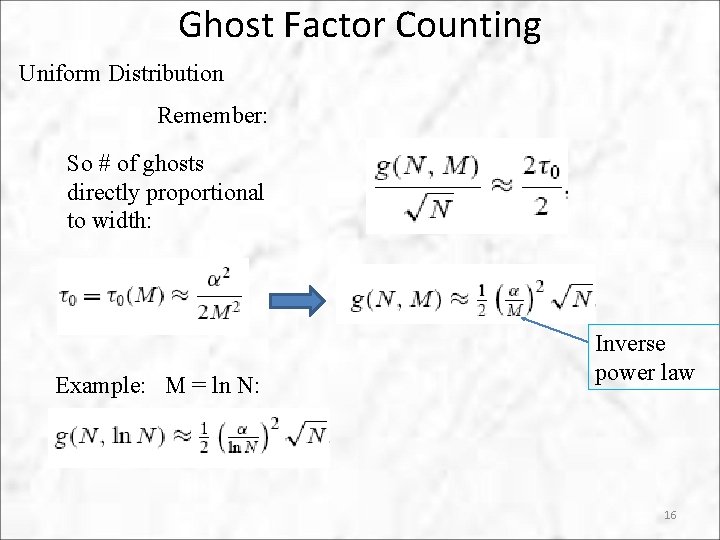
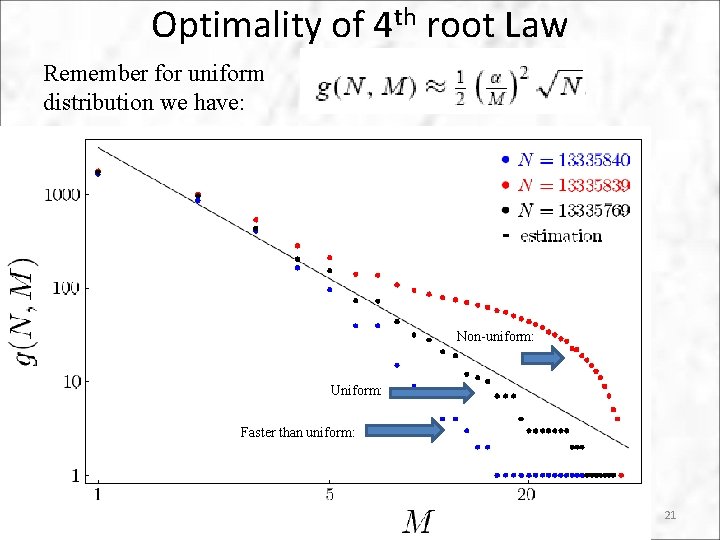
Ghost Factor Counting Uniform Distribution Remember: So # of ghosts directly proportional to width: Example: M = ln N: Inverse power law 16
Ghost Factor Counting Non-uniform distribution! 10, 000 random numbers from M = ln N 17
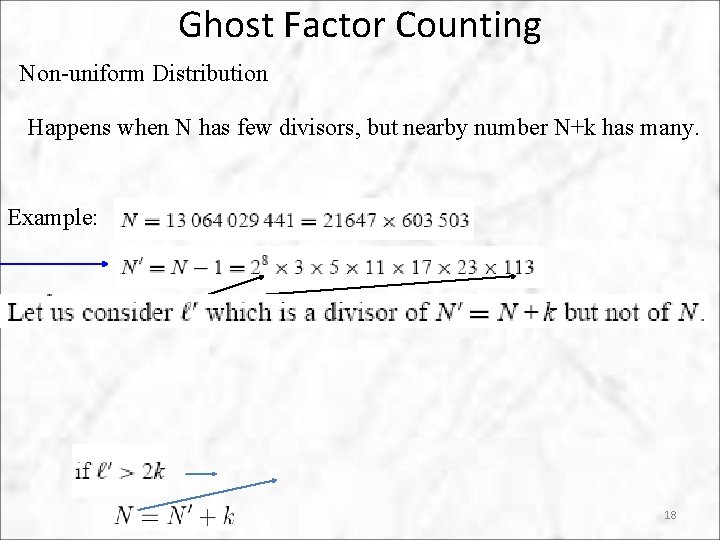
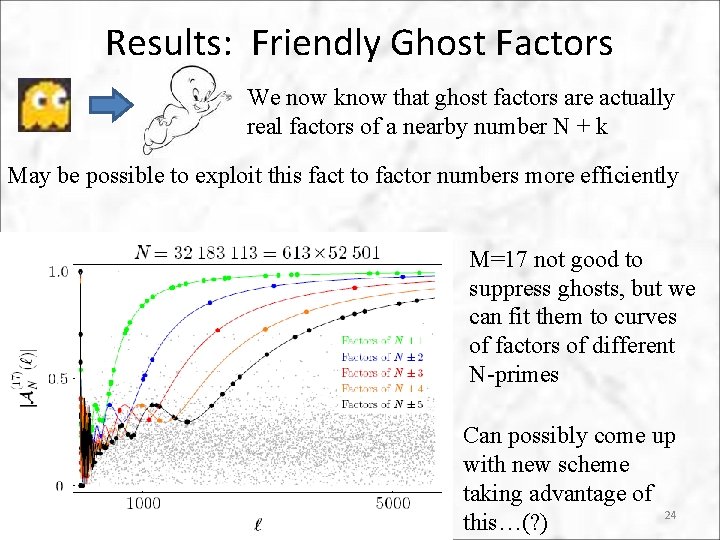
Ghost Factor Counting Non-uniform Distribution Happens when N has few divisors, but nearby number N+k has many. Example: 18
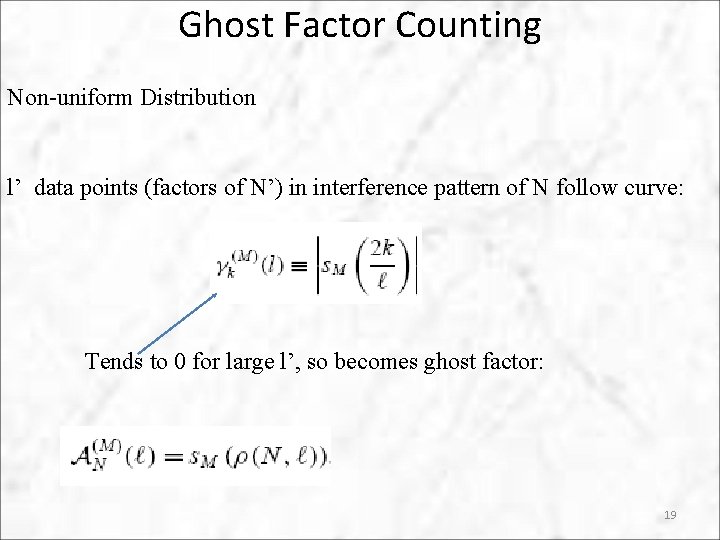
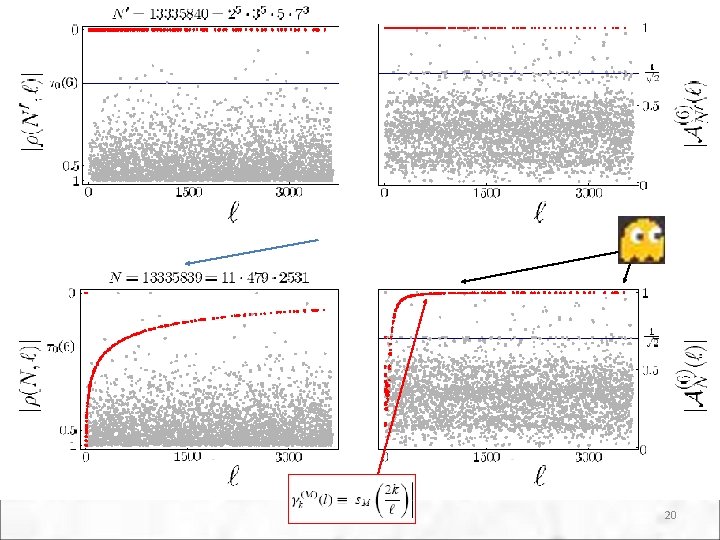
Ghost Factor Counting Non-uniform Distribution l’ data points (factors of N’) in interference pattern of N follow curve: Tends to 0 for large l’, so becomes ghost factor: 19
Ghost Factor Counting 20
Optimality of 4 th root Law Remember for uniform distribution we have: Non-uniform: Uniform: Faster than uniform: 21
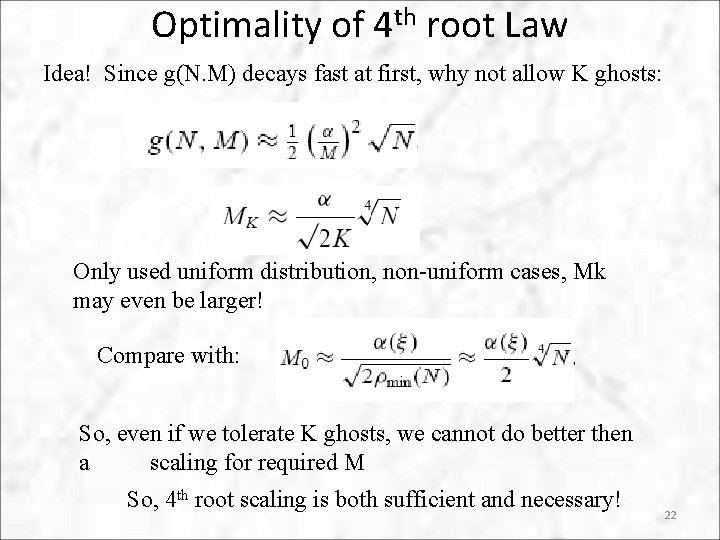
Optimality of 4 th root Law Idea! Since g(N. M) decays fast at first, why not allow K ghosts: Only used uniform distribution, non-uniform cases, Mk may even be larger! Compare with: So, even if we tolerate K ghosts, we cannot do better then a scaling for required M So, 4 th root scaling is both sufficient and necessary! 22
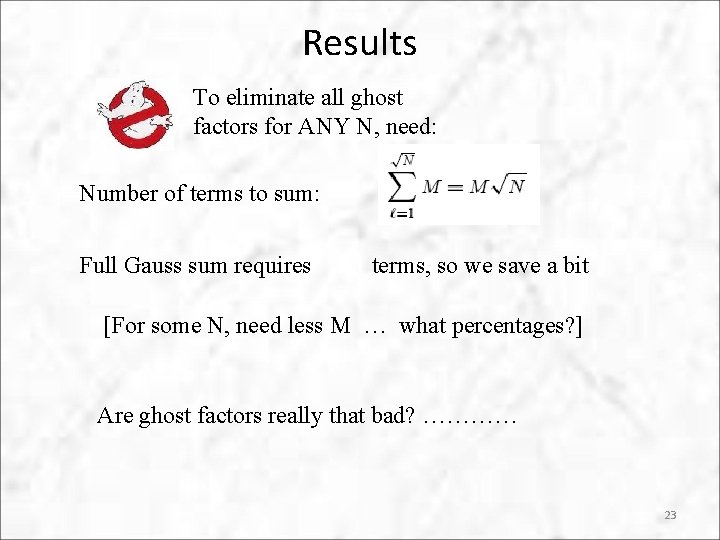
Results To eliminate all ghost factors for ANY N, need: Number of terms to sum: Full Gauss sum requires terms, so we save a bit [For some N, need less M … what percentages? ] Are ghost factors really that bad? ………… 23
Results: Friendly Ghost Factors We now know that ghost factors are actually real factors of a nearby number N + k May be possible to exploit this fact to factor numbers more efficiently M=17 not good to suppress ghosts, but we can fit them to curves of factors of different N-primes Can possibly come up with new scheme taking advantage of 24 this…(? )
Conclusion • Ghost factors are factors of neighboring numbers • Using 4 th root law, can eliminate all ghost factors Outlook • Ghost factors may be helpful in forming new algorithms to factor numbers. • Some experiments (like BEC diffraction) seem to compute higher power Gauss sums (like cubic) which can help the scaling for M 0. 25