
Factorising polynomials This Power Point presentation demonstrates three
- Slides: 38
Factorising polynomials This Power. Point presentation demonstrates three methods of factorising a polynomial when you know one linear factor. Click here to see factorising by inspection Click here to see factorising using a table Click here to see polynomial division
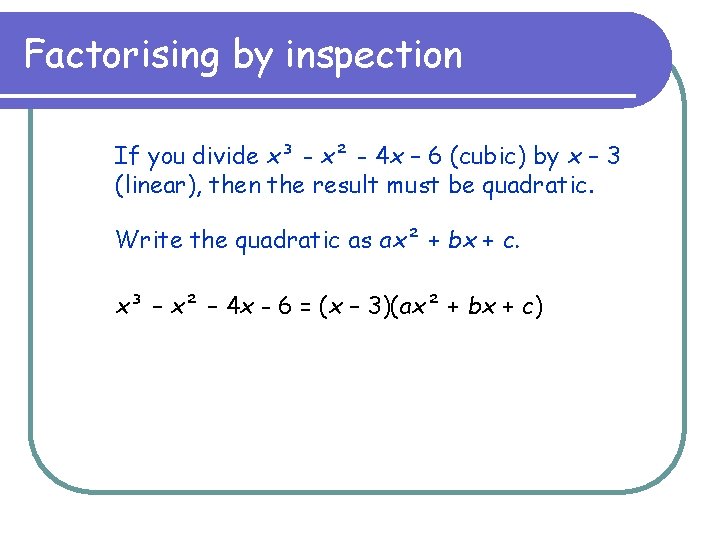
Factorising by inspection If you divide x³ - x² - 4 x – 6 (cubic) by x – 3 (linear), then the result must be quadratic. Write the quadratic as ax² + bx + c. x³ – x² – 4 x - 6 = (x – 3)(ax² + bx + c)
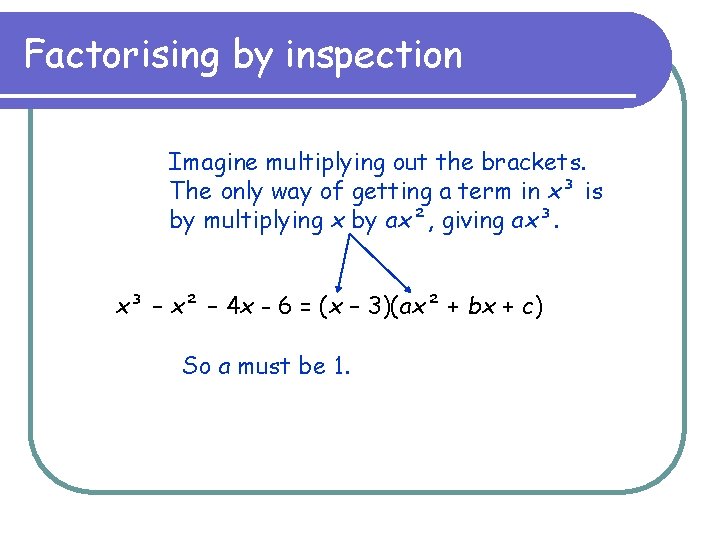
Factorising by inspection Imagine multiplying out the brackets. The only way of getting a term in x³ is by multiplying x by ax², giving ax³. x³ – x² – 4 x - 6 = (x – 3)(ax² + bx + c) So a must be 1.
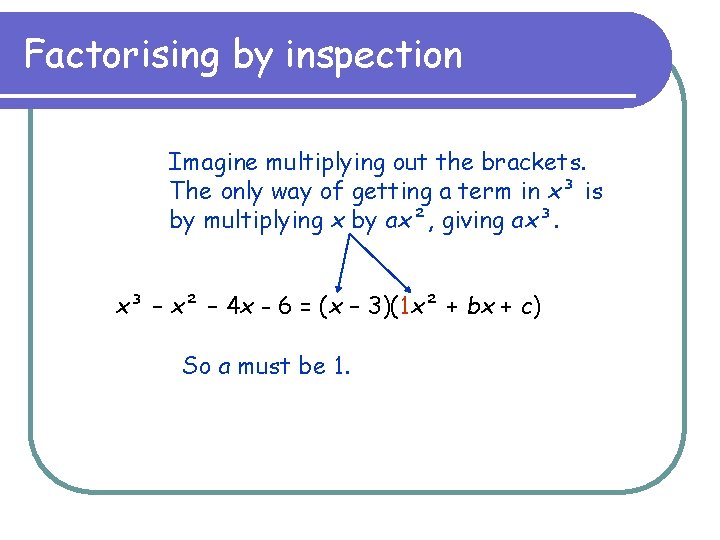
Factorising by inspection Imagine multiplying out the brackets. The only way of getting a term in x³ is by multiplying x by ax², giving ax³. x³ – x² – 4 x - 6 = (x – 3)(1 x² + bx + c) So a must be 1.
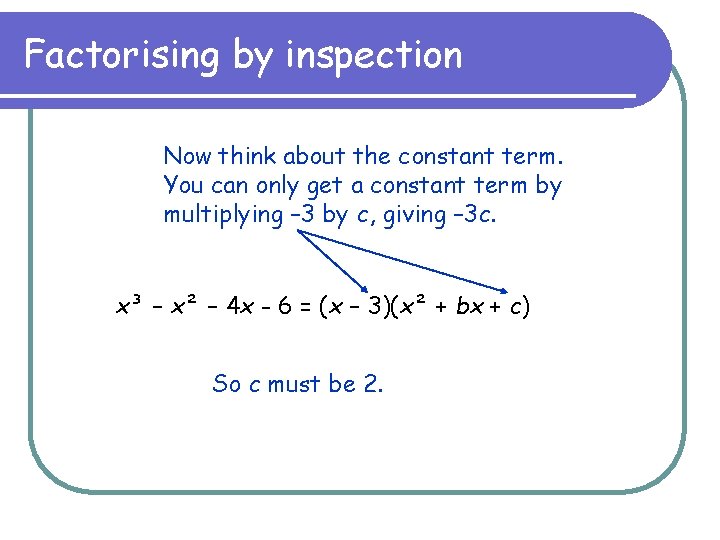
Factorising by inspection Now think about the constant term. You can only get a constant term by multiplying – 3 by c, giving – 3 c. x³ – x² – 4 x - 6 = (x – 3)(x² + bx + c) So c must be 2.
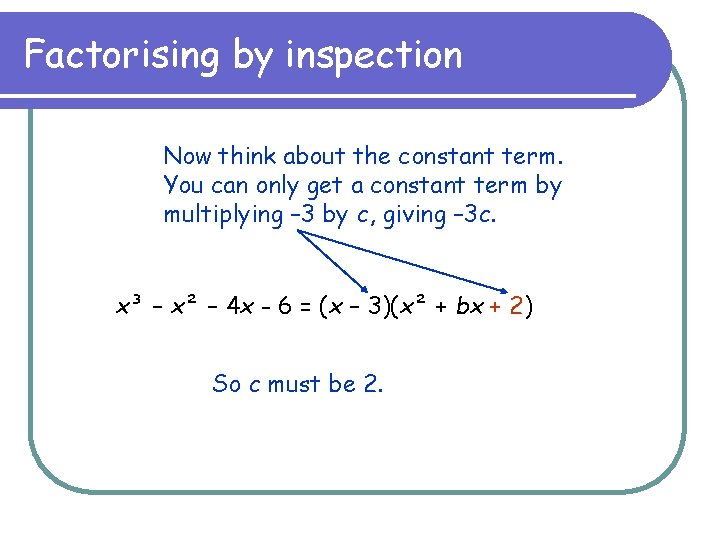
Factorising by inspection Now think about the constant term. You can only get a constant term by multiplying – 3 by c, giving – 3 c. x³ – x² – 4 x - 6 = (x – 3)(x² + bx + 2) So c must be 2.
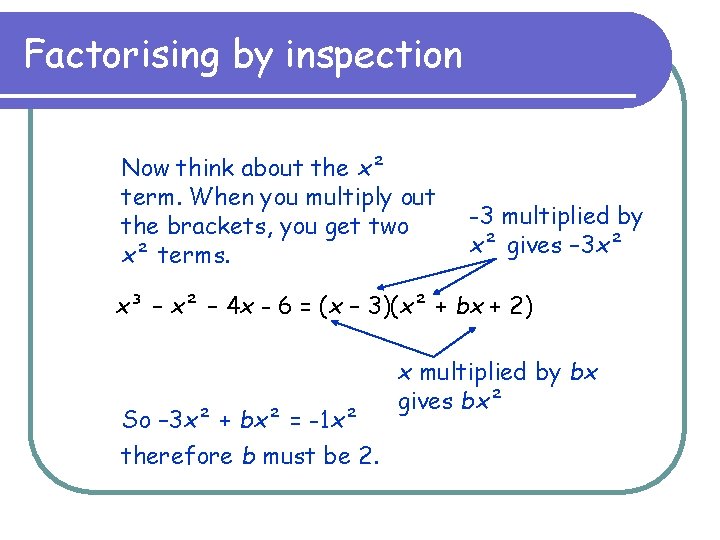
Factorising by inspection Now think about the x² term. When you multiply out the brackets, you get two x² terms. -3 multiplied by x² gives – 3 x² x³ – x² – 4 x - 6 = (x – 3)(x² + bx + 2) So – 3 x² + bx² = -1 x² therefore b must be 2. x multiplied by bx gives bx²
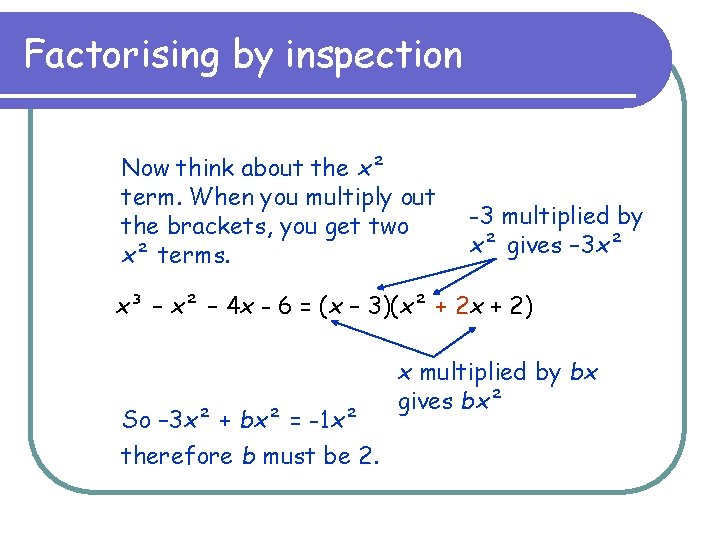
Factorising by inspection Now think about the x² term. When you multiply out the brackets, you get two x² terms. -3 multiplied by x² gives – 3 x² x³ – x² – 4 x - 6 = (x – 3)(x² + 2 x + 2) So – 3 x² + bx² = -1 x² therefore b must be 2. x multiplied by bx gives bx²
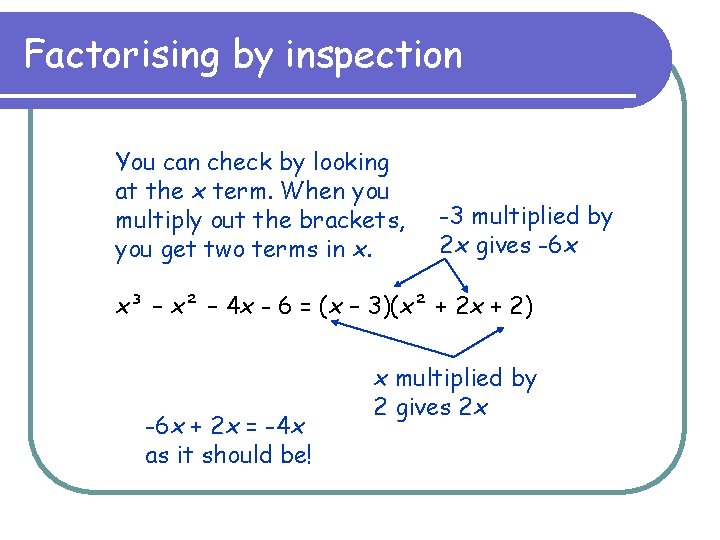
Factorising by inspection You can check by looking at the x term. When you multiply out the brackets, you get two terms in x. -3 multiplied by 2 x gives -6 x x³ – x² – 4 x - 6 = (x – 3)(x² + 2 x + 2) -6 x + 2 x = -4 x as it should be! x multiplied by 2 gives 2 x
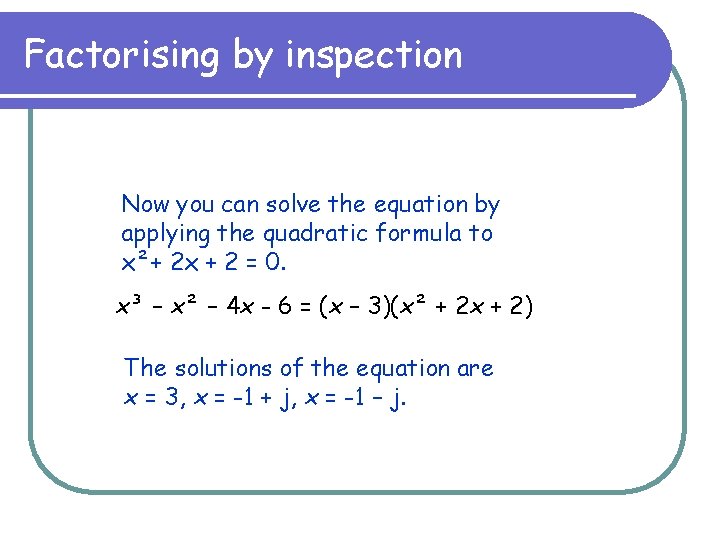
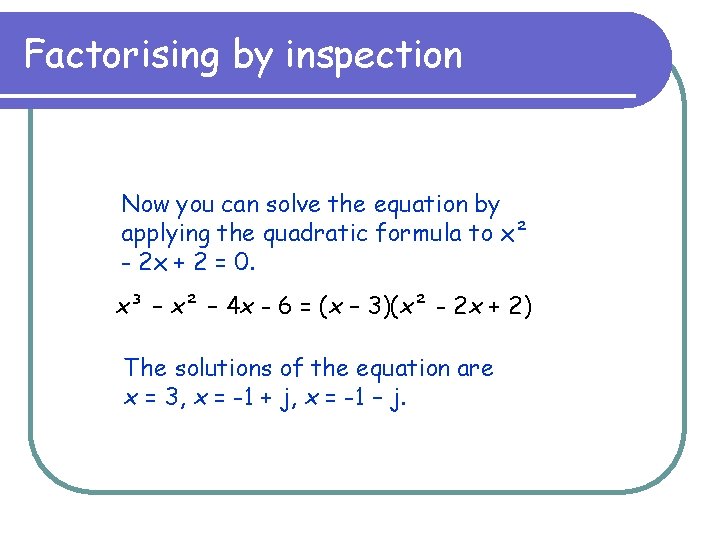
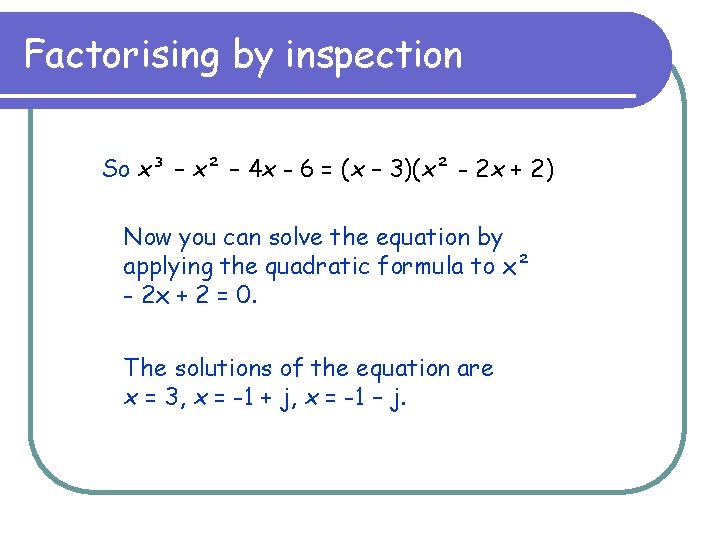
Factorising by inspection Now you can solve the equation by applying the quadratic formula to x²+ 2 x + 2 = 0. x³ – x² – 4 x - 6 = (x – 3)(x² + 2 x + 2) The solutions of the equation are x = 3, x = -1 + j, x = -1 – j.
Factorising polynomials Click here to see this example of factorising by inspection again Click here to see factorising using a table Click here to see polynomial division Click here to end the presentation
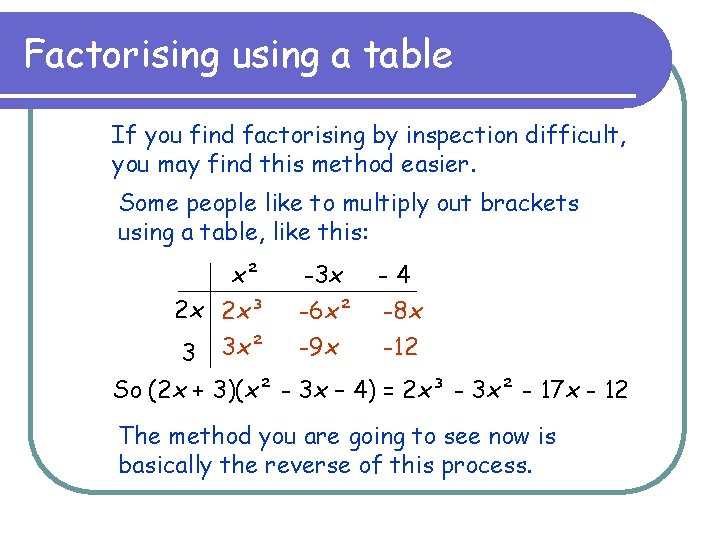
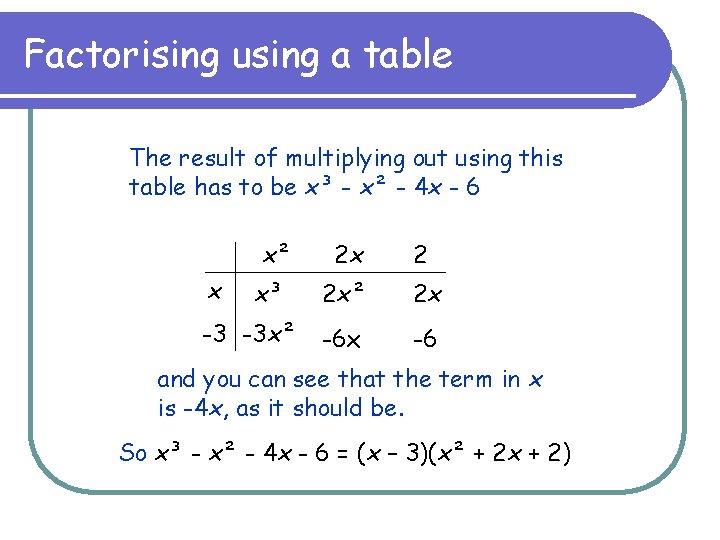
Factorising using a table If you find factorising by inspection difficult, you may find this method easier. Some people like to multiply out brackets using a table, like this: x² 2 x 2 x³ 3 3 x² -3 x -4 -6 x² -9 x -8 x -12 So (2 x + 3)(x² - 3 x – 4) = 2 x³ - 3 x² - 17 x - 12 The method you are going to see now is basically the reverse of this process.
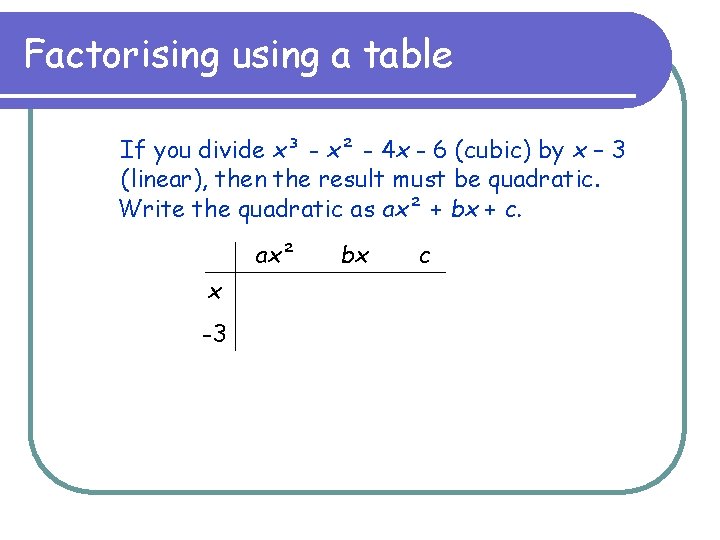
Factorising using a table If you divide x³ - x² - 4 x - 6 (cubic) by x – 3 (linear), then the result must be quadratic. Write the quadratic as ax² + bx + c. ax² x -3 bx c
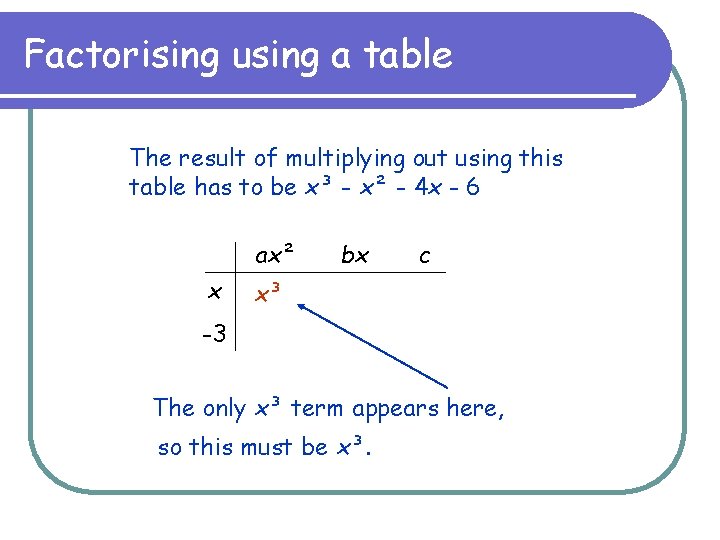
Factorising using a table The result of multiplying out using this table has to be x³ - x² - 4 x - 6 ax² x bx c x³ -3 The only x³ term appears here, so this must be x³.
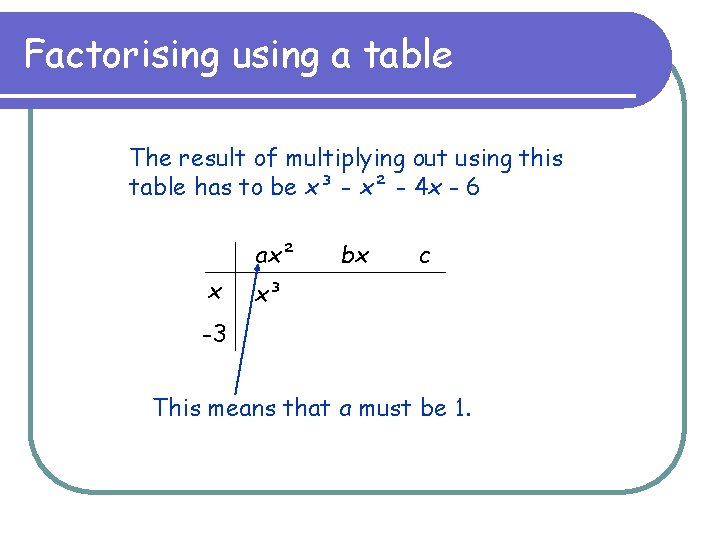
Factorising using a table The result of multiplying out using this table has to be x³ - x² - 4 x - 6 ax² x bx c x³ -3 This means that a must be 1.
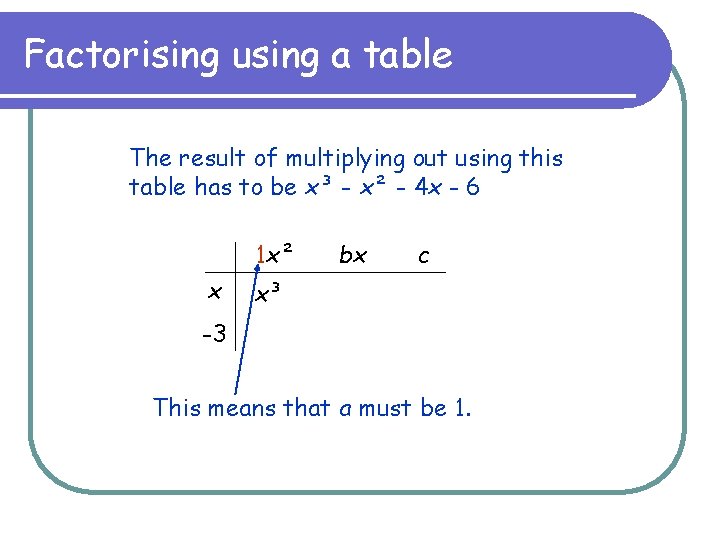
Factorising using a table The result of multiplying out using this table has to be x³ - x² - 4 x - 6 1 x² x bx c x³ -3 This means that a must be 1.
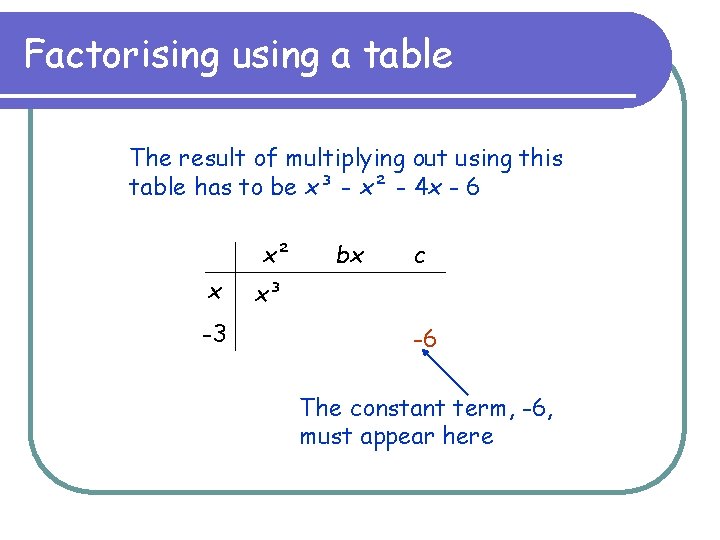
Factorising using a table The result of multiplying out using this table has to be x³ - x² - 4 x - 6 x² x -3 bx c x³ -6 The constant term, -6, must appear here
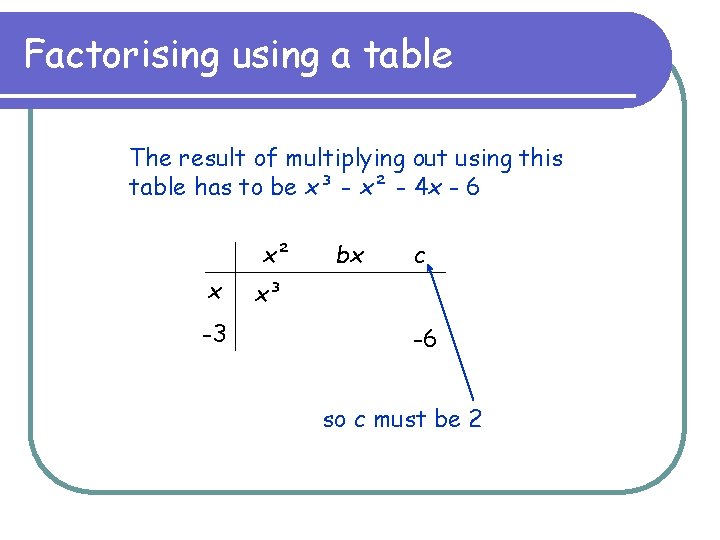
Factorising using a table The result of multiplying out using this table has to be x³ - x² - 4 x - 6 x² x -3 bx c x³ -6 so c must be 2
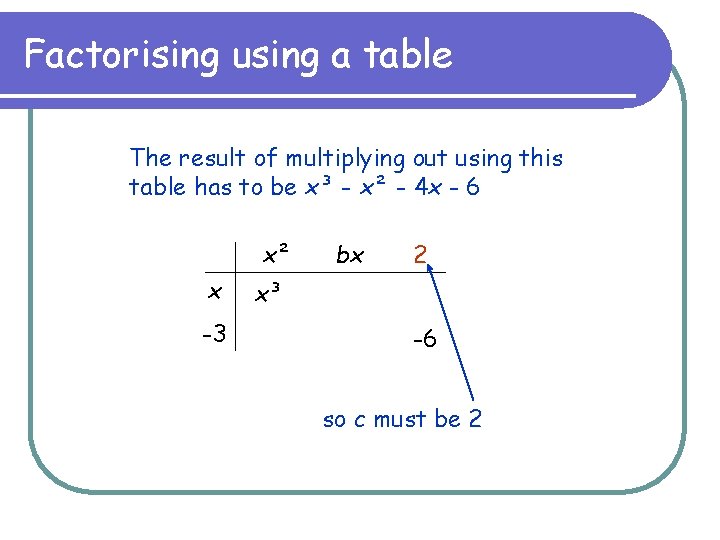
Factorising using a table The result of multiplying out using this table has to be x³ - x² - 4 x - 6 x² x -3 bx 2 x³ -6 so c must be 2
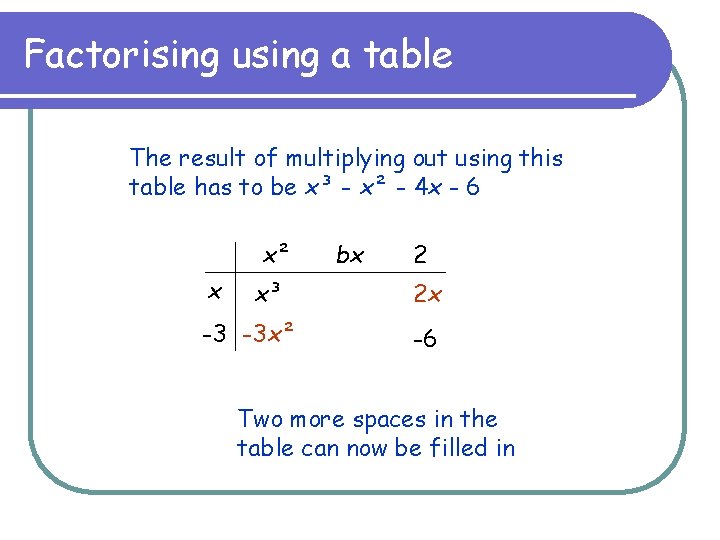
Factorising using a table The result of multiplying out using this table has to be x³ - x² - 4 x - 6 x² x x³ -3 -3 x² bx 2 2 x -6 Two more spaces in the table can now be filled in
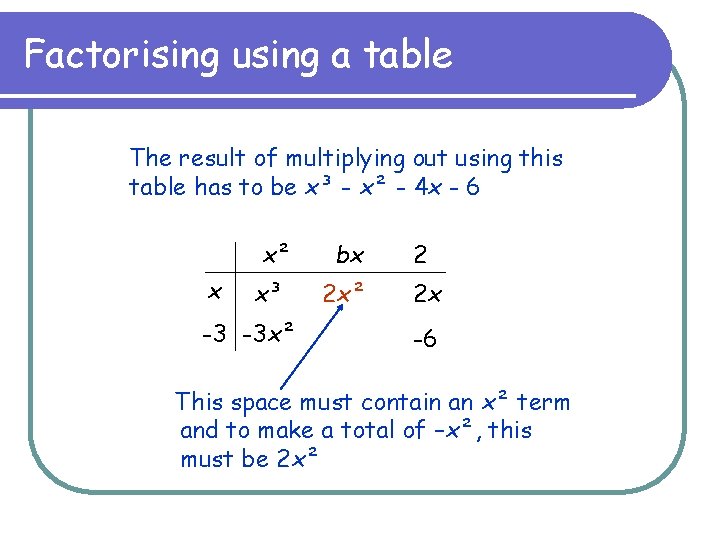
Factorising using a table The result of multiplying out using this table has to be x³ - x² - 4 x - 6 x² x x³ -3 -3 x² bx 2 2 x² 2 x -6 This space must contain an x² term and to make a total of –x², this must be 2 x²
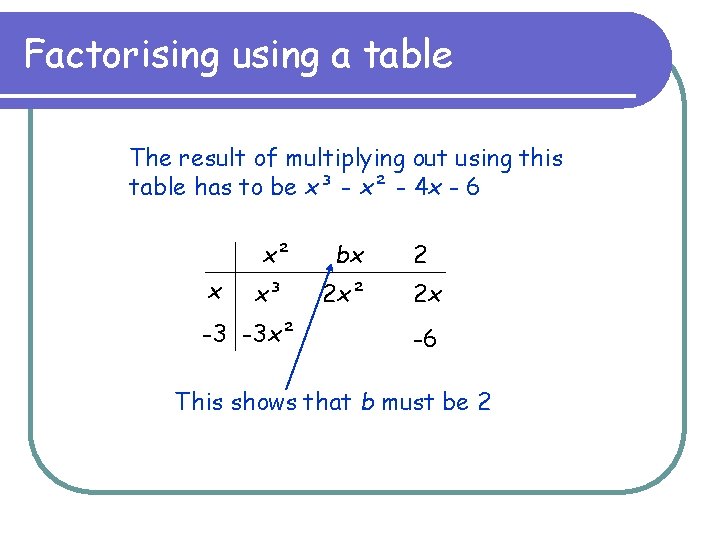
Factorising using a table The result of multiplying out using this table has to be x³ - x² - 4 x - 6 x² x x³ -3 -3 x² bx 2 2 x² 2 x -6 This shows that b must be 2
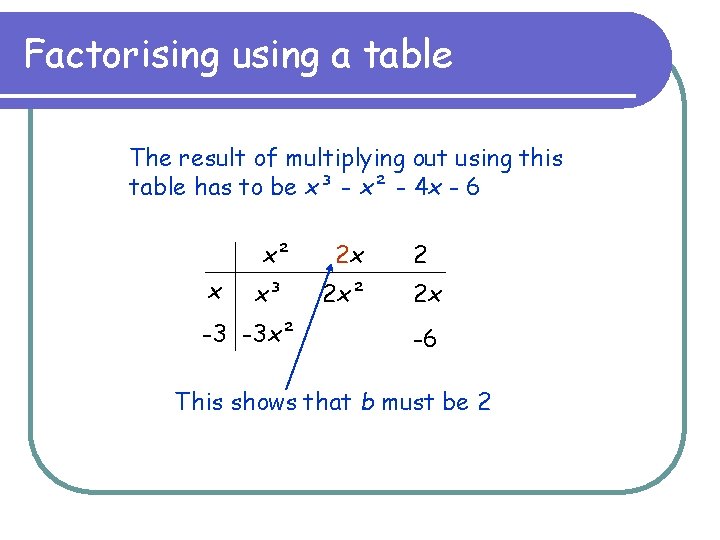
Factorising using a table The result of multiplying out using this table has to be x³ - x² - 4 x - 6 x² x x³ -3 -3 x² 2 x 2 2 x² 2 x -6 This shows that b must be 2
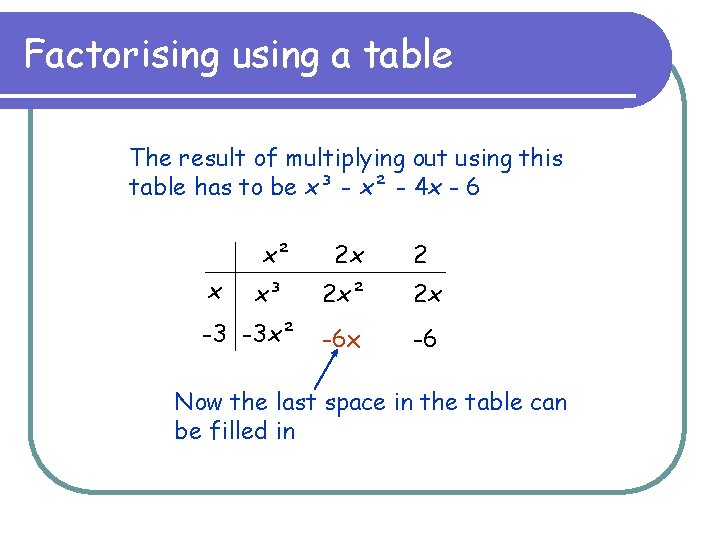
Factorising using a table The result of multiplying out using this table has to be x³ - x² - 4 x - 6 x² x x³ -3 -3 x² 2 x 2 2 x² 2 x -6 Now the last space in the table can be filled in
Factorising using a table The result of multiplying out using this table has to be x³ - x² - 4 x - 6 x² x x³ -3 -3 x² 2 x 2 2 x² 2 x -6 and you can see that the term in x is -4 x, as it should be. So x³ - x² - 4 x - 6 = (x – 3)(x² + 2 x + 2)
Factorising by inspection Now you can solve the equation by applying the quadratic formula to x² - 2 x + 2 = 0. x³ – x² – 4 x - 6 = (x – 3)(x² - 2 x + 2) The solutions of the equation are x = 3, x = -1 + j, x = -1 – j.
Factorising polynomials Click here to see this example of factorising using a table again Click here to see factorising by inspection Click here to see polynomial division Click here to end the presentation
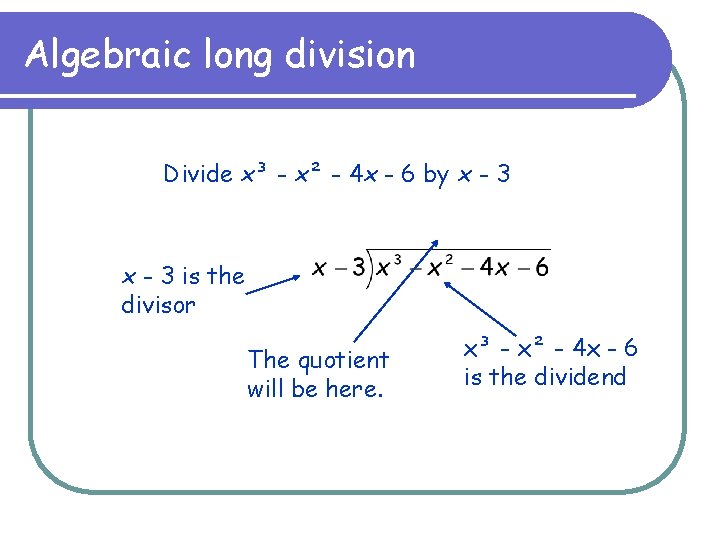
Algebraic long division Divide x³ - x² - 4 x - 6 by x - 3 is the divisor The quotient will be here. x³ - x² - 4 x - 6 is the dividend
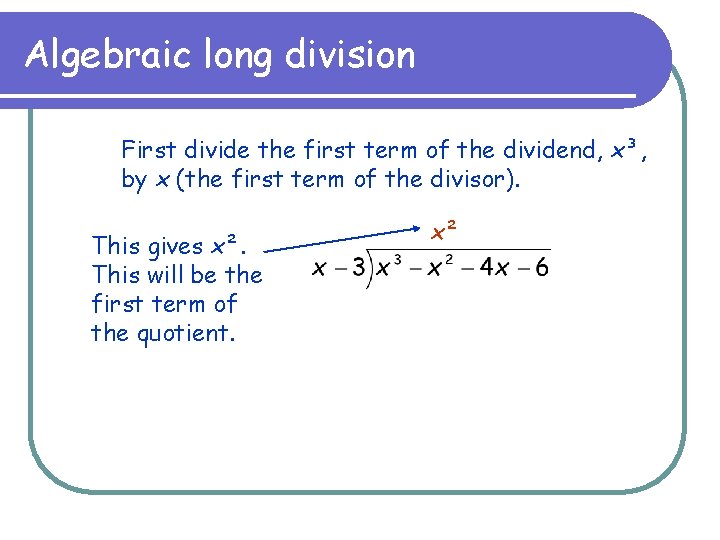
Algebraic long division First divide the first term of the dividend, x³, by x (the first term of the divisor). This gives x². This will be the first term of the quotient. x²
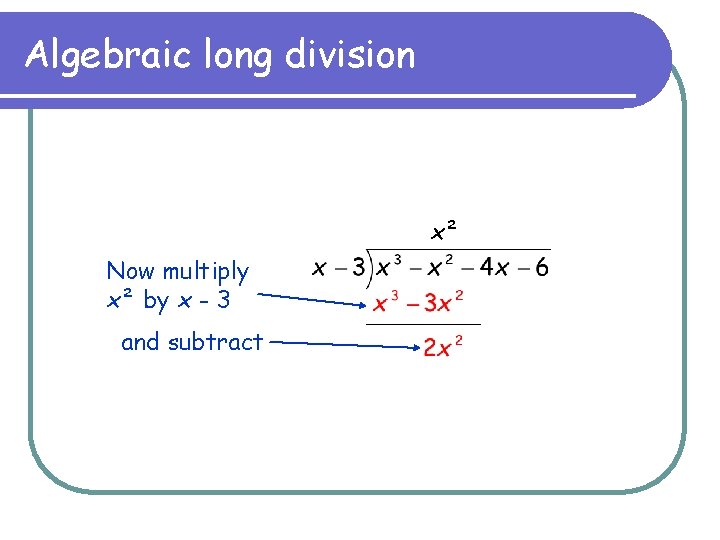
Algebraic long division x² Now multiply x² by x - 3 and subtract
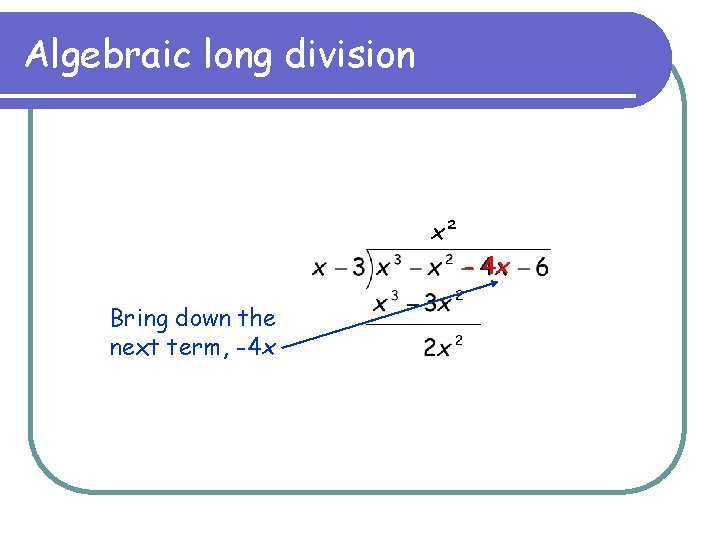
Algebraic long division x² - 4 x Bring down the next term, -4 x
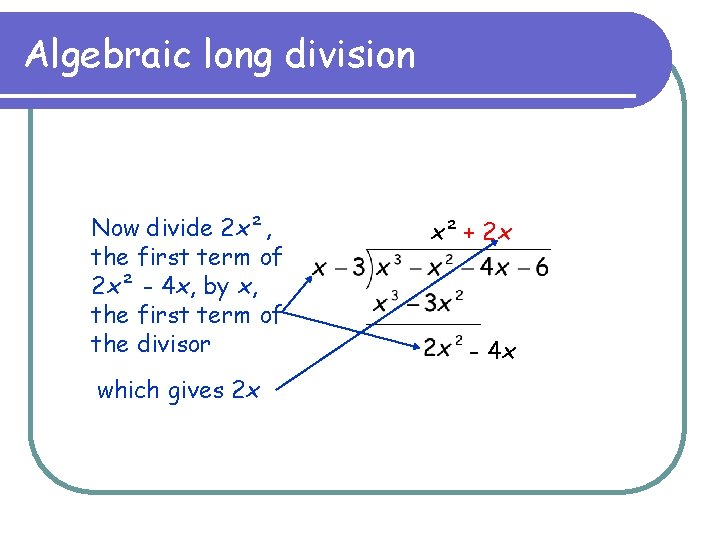
Algebraic long division Now divide 2 x², the first term of 2 x² - 4 x, by x, the first term of the divisor which gives 2 x x² + 2 x - 4 x
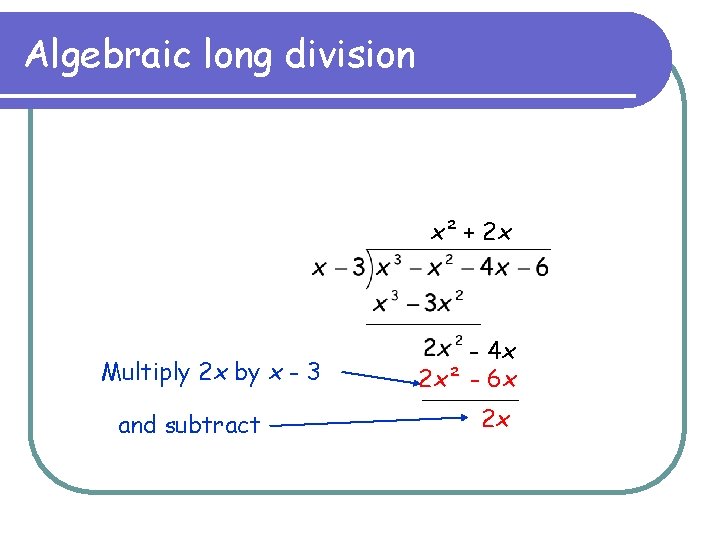
Algebraic long division x² + 2 x Multiply 2 x by x - 3 and subtract - 4 x 2 x² - 6 x 2 x
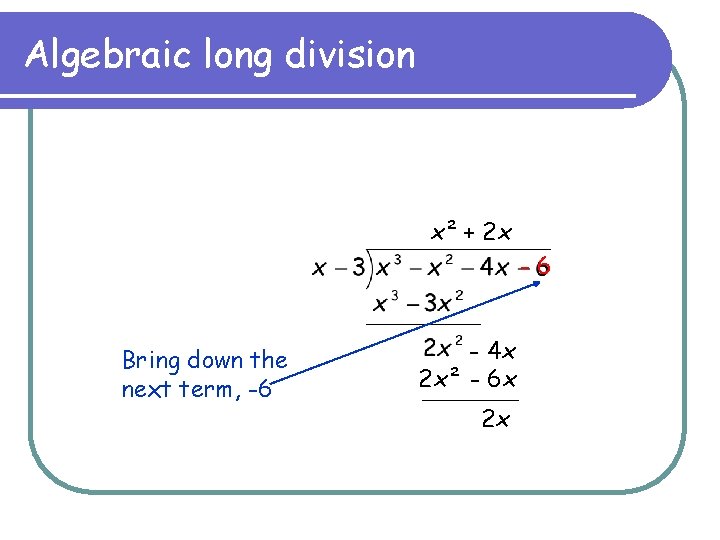
Algebraic long division x² + 2 x -6 Bring down the next term, -6 - 4 x 2 x² - 6 x 2 x
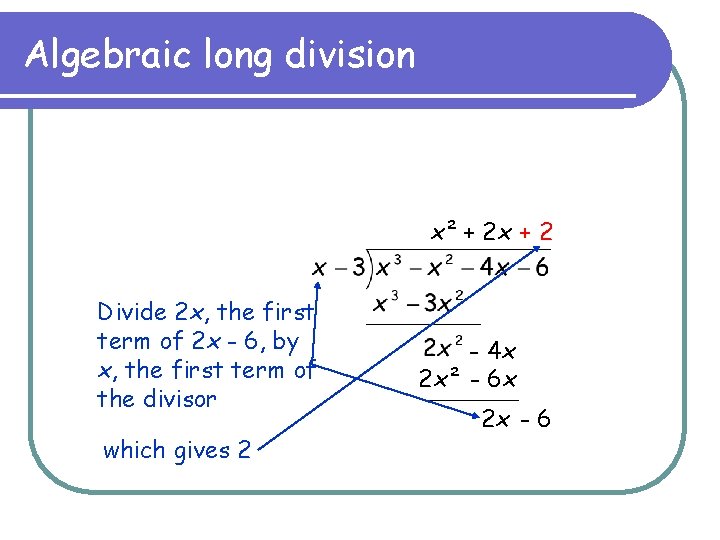
Algebraic long division x² + 2 x + 2 Divide 2 x, the first term of 2 x - 6, by x, the first term of the divisor which gives 2 - 4 x 2 x² - 6 x 2 x - 6
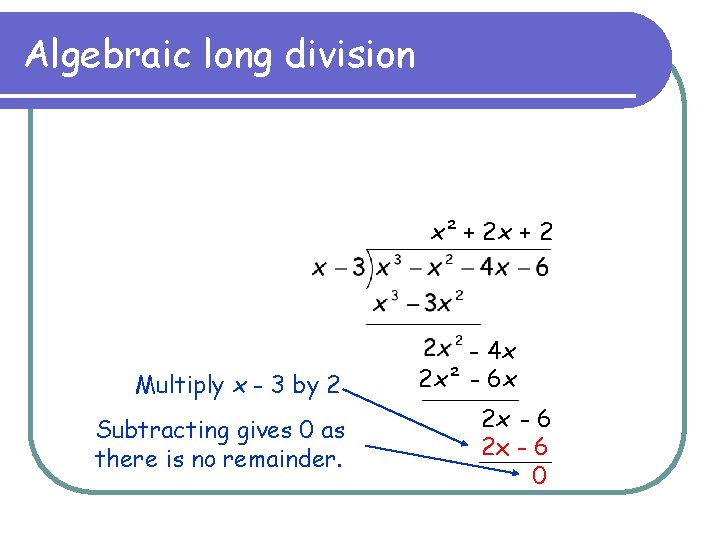
Algebraic long division x² + 2 x + 2 Multiply x - 3 by 2 Subtracting gives 0 as there is no remainder. - 4 x 2 x² - 6 x 2 x - 6 0
Factorising by inspection So x³ – x² – 4 x - 6 = (x – 3)(x² - 2 x + 2) Now you can solve the equation by applying the quadratic formula to x² - 2 x + 2 = 0. The solutions of the equation are x = 3, x = -1 + j, x = -1 – j.
Factorising polynomials Click here to see this example of polynomial division again Click here to see factorising by inspection Click here to see factorising using a table Click here to end the presentation