
Factoring RSA Keys With TLS Perfect Forward Secrecy

- Slides: 15
Factoring RSA Keys With TLS Perfect Forward Secrecy
Sommaire RSA Théoreme des restes chinois TLS Perfect Forward Secrecy Le problème Conclusion
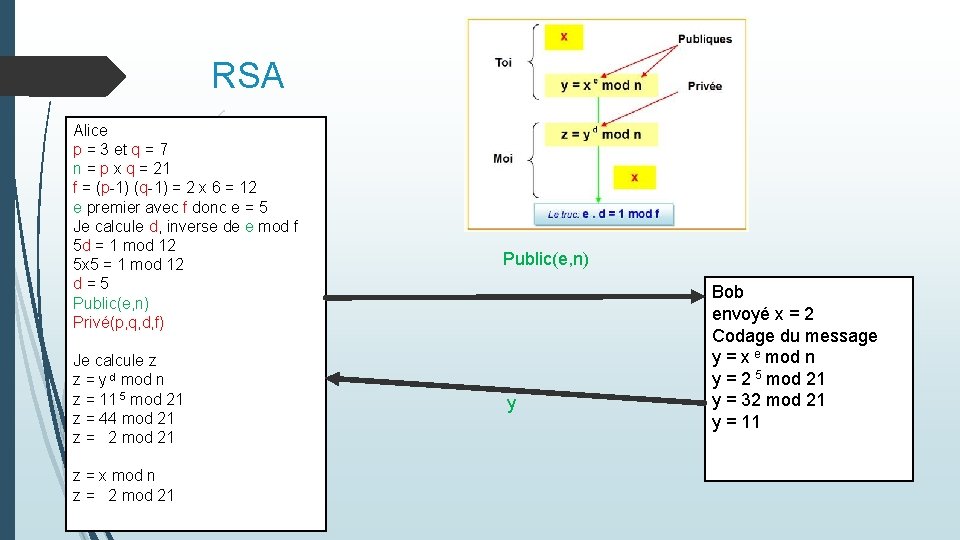
RSA Alice p = 3 et q = 7 n = p x q = 21 f = (p-1) (q-1) = 2 x 6 = 12 e premier avec f donc e = 5 Je calcule d, inverse de e mod f 5 d = 1 mod 12 5 x 5 = 1 mod 12 d = 5 Public(e, n) Privé(p, q, d, f) Je calcule z z = y d mod n z = 11 5 mod 21 z = 44 mod 21 z = 2 mod 21 z = x mod n z = 2 mod 21 Public(e, n) y Bob envoyé x = 2 Codage du message y = x e mod n y = 2 5 mod 21 y = 32 mod 21 y = 11
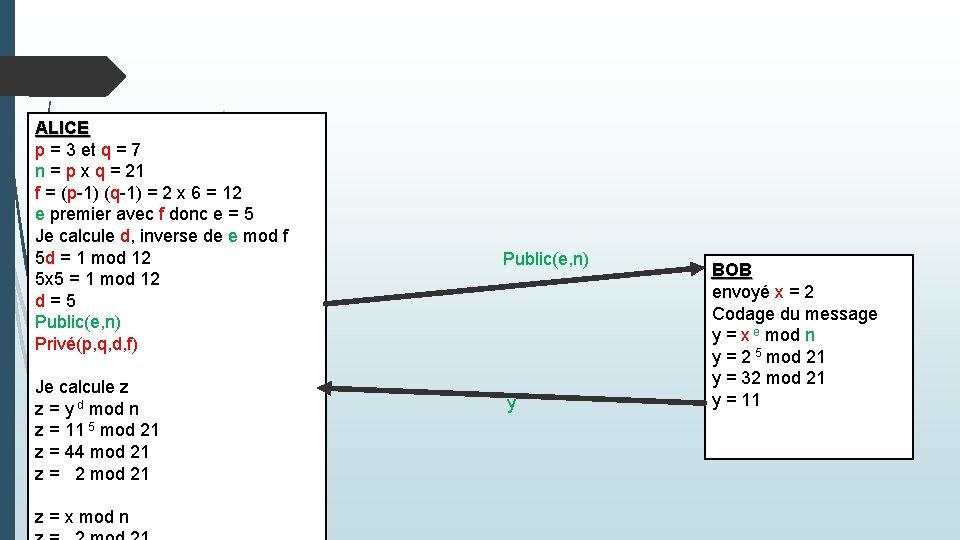
ALICE p = 3 et q = 7 n = p x q = 21 f = (p-1) (q-1) = 2 x 6 = 12 e premier avec f donc e = 5 Je calcule d, inverse de e mod f 5 d = 1 mod 12 5 x 5 = 1 mod 12 d = 5 Public(e, n) Privé(p, q, d, f) Je calcule z z = y d mod n z = 11 5 mod 21 z = 44 mod 21 z = 2 mod 21 z = x mod n Public(e, n) y BOB envoyé x = 2 Codage du message y = x e mod n y = 2 5 mod 21 y = 32 mod 21 y = 11
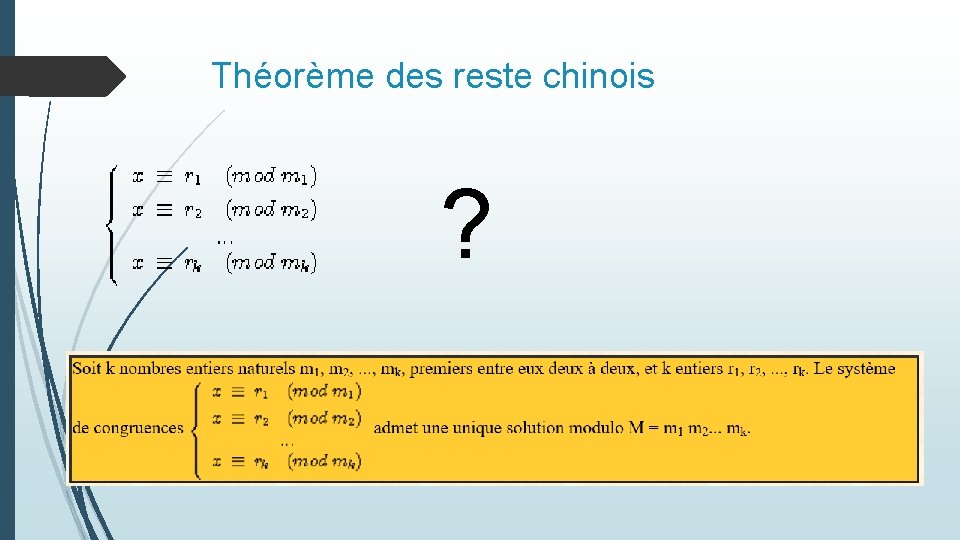
Théorème des reste chinois ?
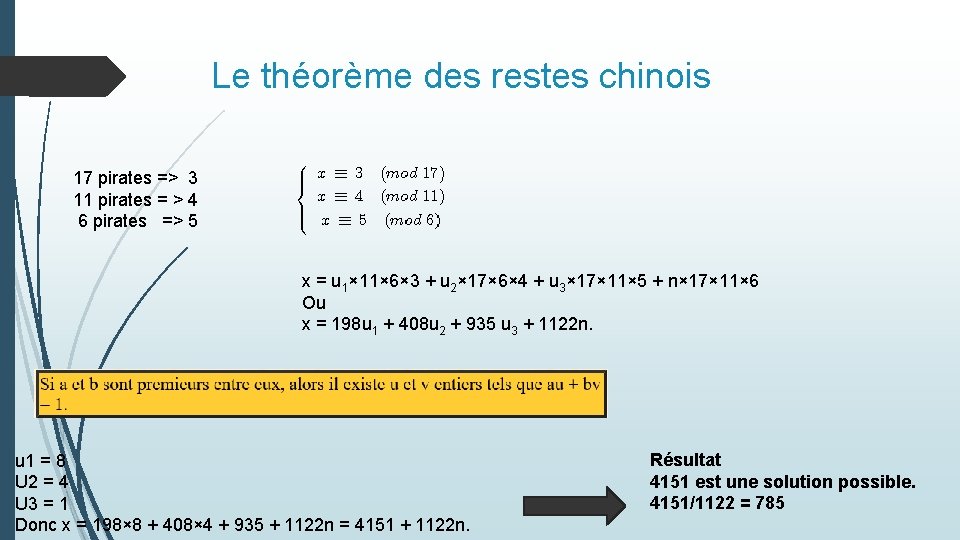
Le théorème des restes chinois 17 pirates => 3 11 pirates = > 4 6 pirates => 5 x = u 1× 11× 6× 3 + u 2× 17× 6× 4 + u 3× 17× 11× 5 + n× 17× 11× 6 Ou x = 198 u 1 + 408 u 2 + 935 u 3 + 1122 n. u 1 = 8 U 2 = 4 U 3 = 1 Donc x = 198× 8 + 408× 4 + 935 + 1122 n = 4151 + 1122 n. Résultat 4151 est une solution possible. 4151/1122 = 785
TLS & Perfect Forward secrecy protocole de sécurisation des échanges sur Internet Perfect Forward secrecy = confidentialité persistante
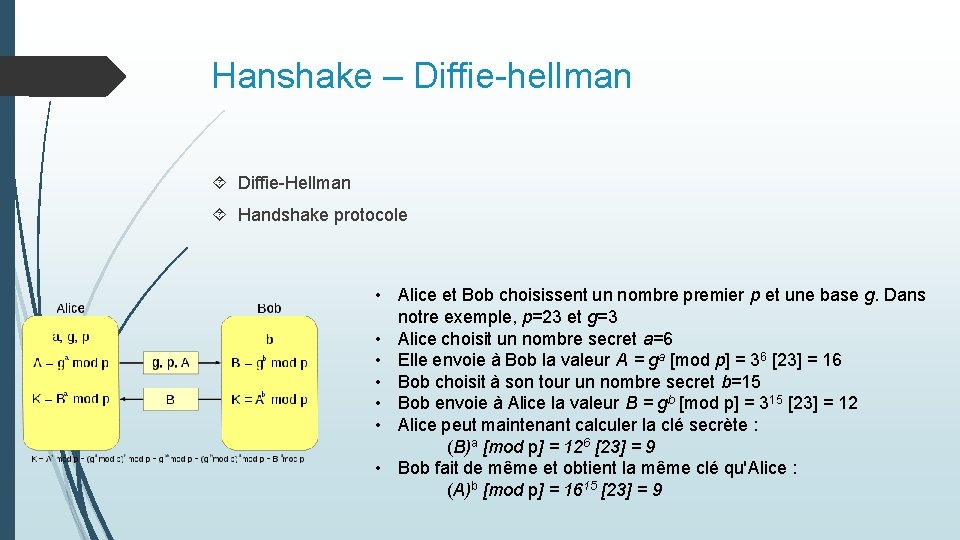
Hanshake – Diffie-hellman Diffie-Hellman Handshake protocole • Alice et Bob choisissent un nombre premier p et une base g. Dans notre exemple, p=23 et g=3 • Alice choisit un nombre secret a=6 • Elle envoie à Bob la valeur A = ga [mod p] = 36 [23] = 16 • Bob choisit à son tour un nombre secret b=15 • Bob envoie à Alice la valeur B = gb [mod p] = 315 [23] = 12 • Alice peut maintenant calculer la clé secrète : (B)a [mod p] = 126 [23] = 9 • Bob fait de même et obtient la même clé qu'Alice : (A)b [mod p] = 1615 [23] = 9
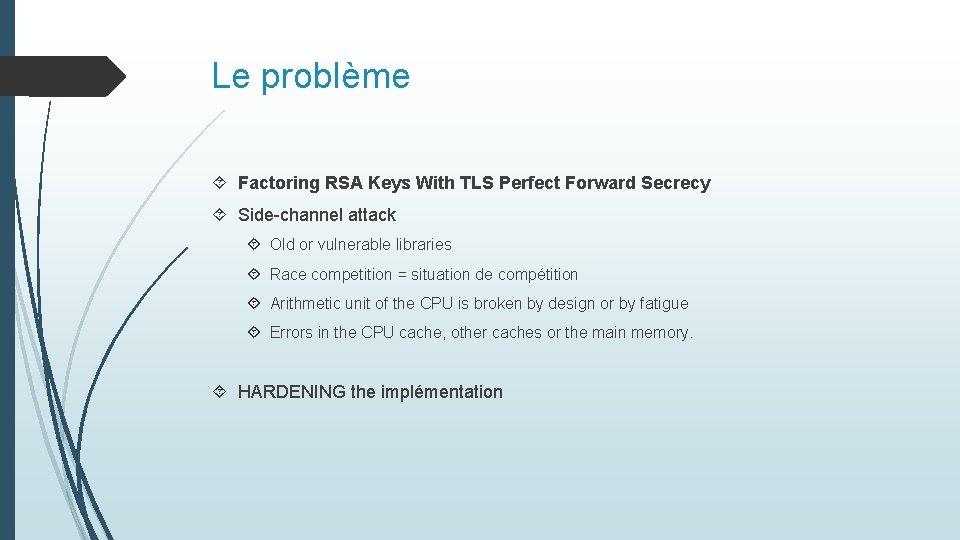
Le problème Factoring RSA Keys With TLS Perfect Forward Secrecy Side-channel attack Old or vulnerable libraries Race competition = situation de compétition Arithmetic unit of the CPU is broken by design or by fatigue Errors in the CPU cache, other caches or the main memory. HARDENING the implémentation
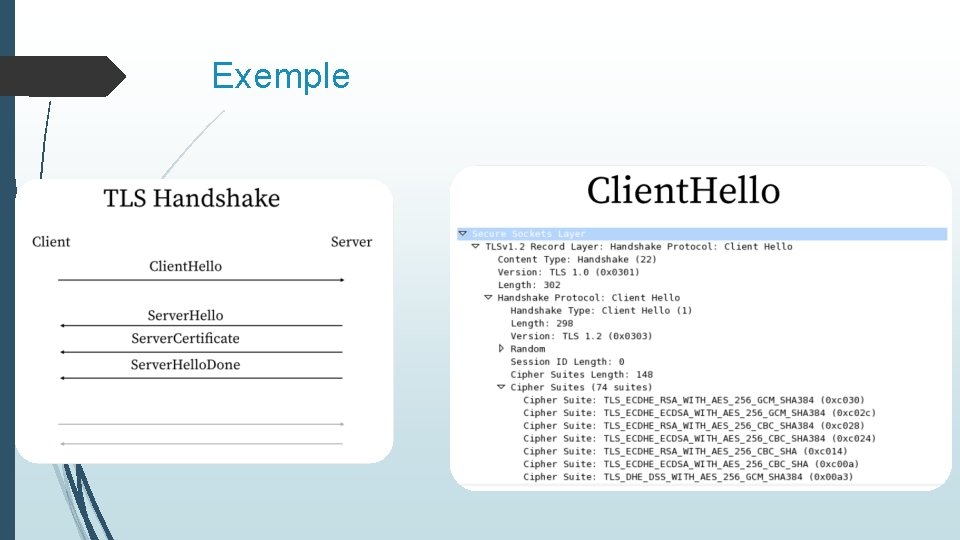
Exemple
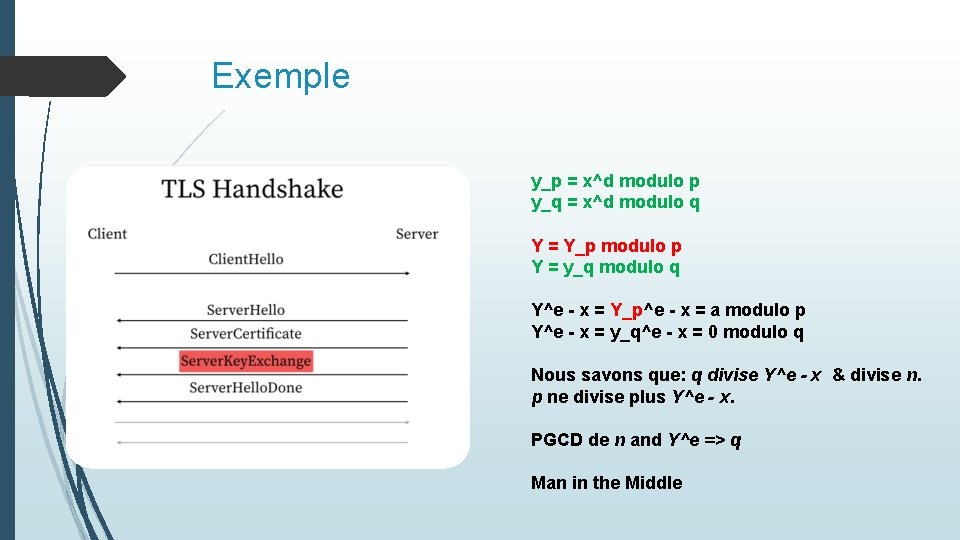
Exemple y_p = x^d modulo p y_q = x^d modulo q Y = Y_p modulo p Y = y_q modulo q Y^e - x = Y_p^e - x = a modulo p Y^e - x = y_q^e - x = 0 modulo q Nous savons que: q divise Y^e - x & divise n. p ne divise plus Y^e - x. PGCD de n and Y^e => q Man in the Middle
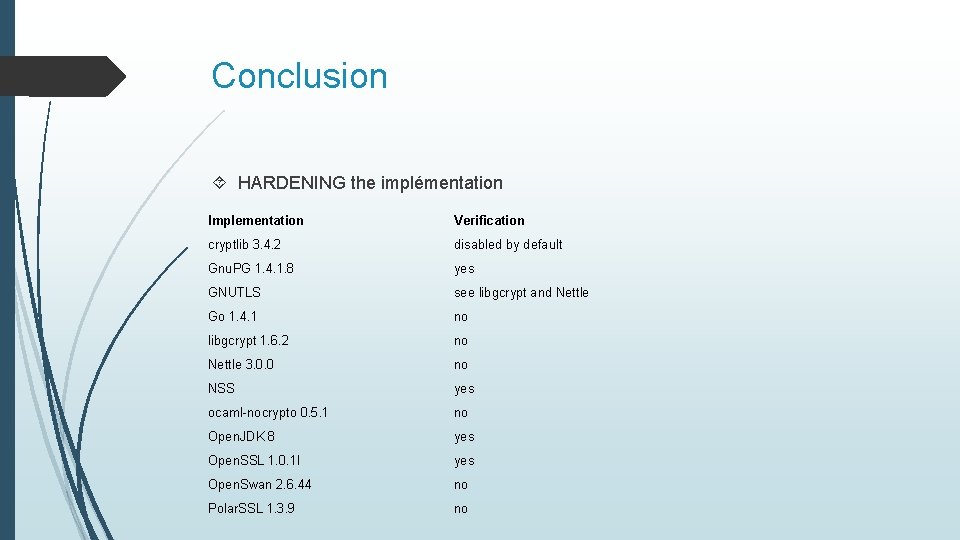
Conclusion HARDENING the implémentation Implementation Verification cryptlib 3. 4. 2 disabled by default Gnu. PG 1. 4. 1. 8 yes GNUTLS see libgcrypt and Nettle Go 1. 4. 1 no libgcrypt 1. 6. 2 no Nettle 3. 0. 0 no NSS yes ocaml-nocrypto 0. 5. 1 no Open. JDK 8 yes Open. SSL 1. 0. 1 l yes Open. Swan 2. 6. 44 no Polar. SSL 1. 3. 9 no
Fin
Documentation https: //securityblog. redhat. com/2015/09/02/factoring-rsa-keys-with-tls-perfect-forwardsecrecy/ http: //crypto. stackexchange. com/questions/2575/chinese-remainder-theorem-and-rsa http: //www. viruslist. com/fr/news? id=197471353 wikipedia. com google. com
Keywords in the report Arjen Lenstra described an attack against an optimization (called the Chinese Remainder Theorem optimization. If a fault happened during the computation of a signature (using the RSA-CRT optimization), an attacker might be able to recover the private key from the signature RSA signatures if they implement hardening against this particular side-channel attack Private key Leak => man-in-the-middle attack Lenstra’s attack is a so-called side-channel attack. it exploits unexpected implementation behavior. RSA, and the RSA-CRT optimization with appropriate hardening, is still considered secure.