
Factoring quadratic expressions 1 of 12 Boardworks Ltd
Factoring quadratic expressions 1 of 12 © Boardworks Ltd 2010
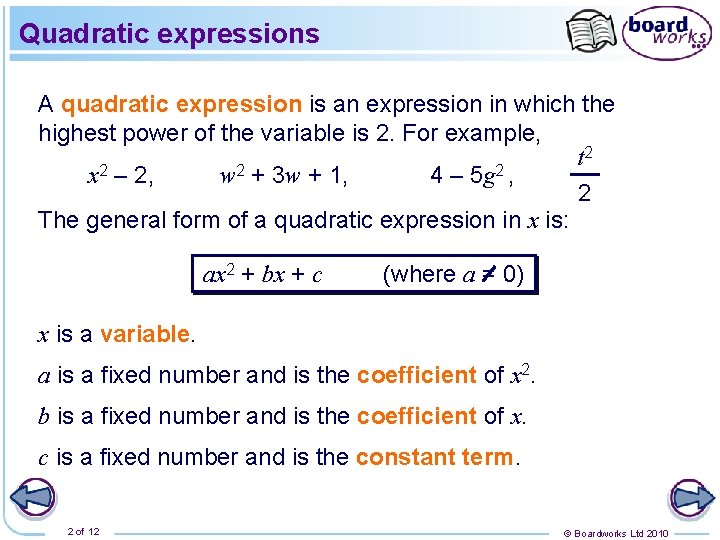
Quadratic expressions A quadratic expression is an expression in which the highest power of the variable is 2. For example, 2 t x 2 – 2, w 2 + 3 w + 1, 4 – 5 g 2 , 2 The general form of a quadratic expression in x is: ax 2 + bx + c (where a = 0) x is a variable. a is a fixed number and is the coefficient of x 2. b is a fixed number and is the coefficient of x. c is a fixed number and is the constant term. 2 of 12 © Boardworks Ltd 2010
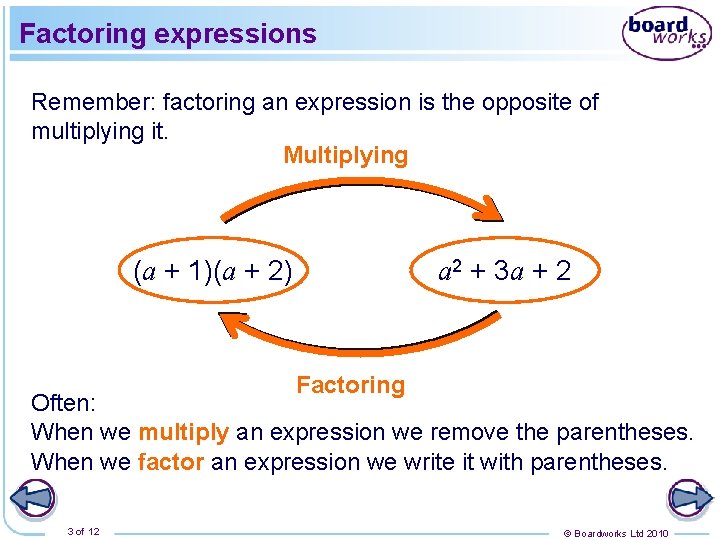
Factoring expressions Remember: factoring an expression is the opposite of multiplying it. Multiplying a 2 + 3 a + 2 (a + 1)(a + 2) Factoring Often: When we multiply an expression we remove the parentheses. When we factor an expression we write it with parentheses. 3 of 12 © Boardworks Ltd 2010
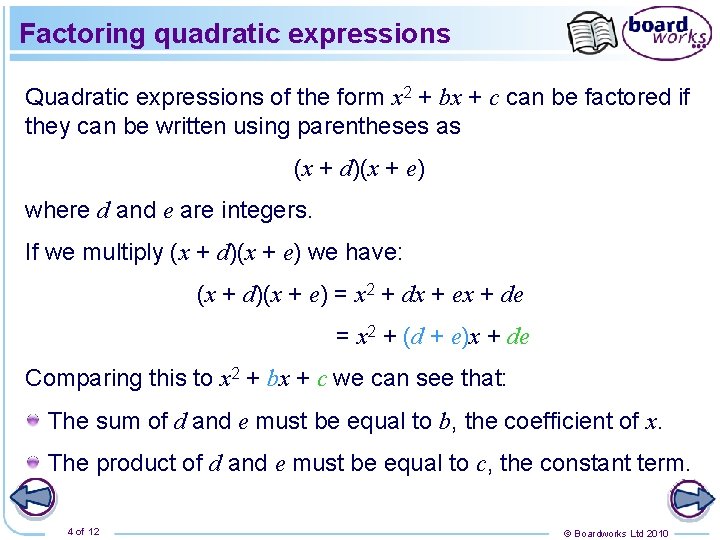
Factoring quadratic expressions Quadratic expressions of the form x 2 + bx + c can be factored if they can be written using parentheses as (x + d)(x + e) where d and e are integers. If we multiply (x + d)(x + e) we have: (x + d)(x + e) = x 2 + dx + ex + de = x 2 + (d + e)x + de Comparing this to x 2 + bx + c we can see that: The sum of d and e must be equal to b, the coefficient of x. The product of d and e must be equal to c, the constant term. 4 of 12 © Boardworks Ltd 2010
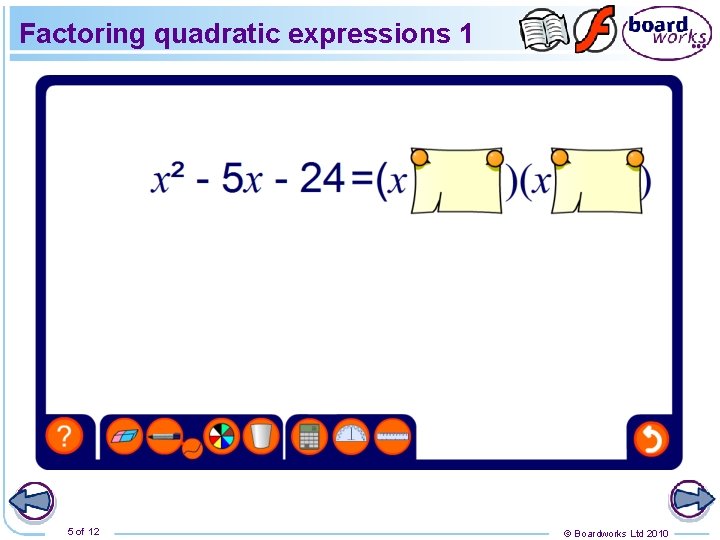
Factoring quadratic expressions 1 5 of 12 © Boardworks Ltd 2010
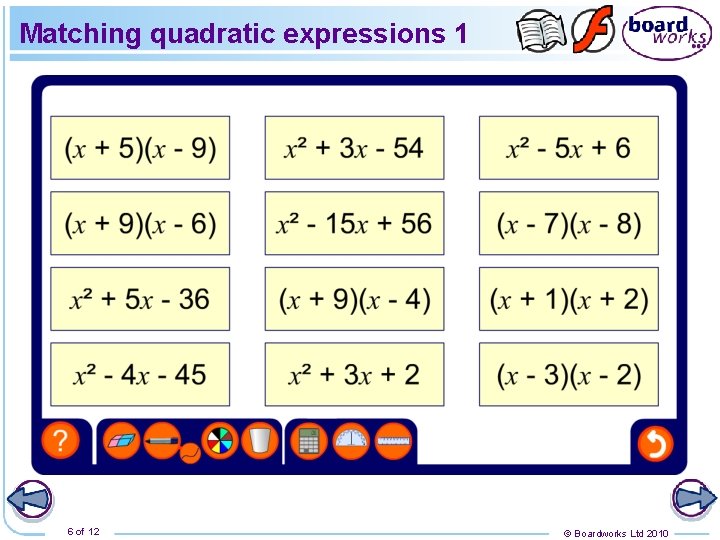
Matching quadratic expressions 1 6 of 12 © Boardworks Ltd 2010
- Slides: 6