
Factoring Distributive Law Special Forms and Tables 1
Factoring Distributive Law Special Forms and Tables
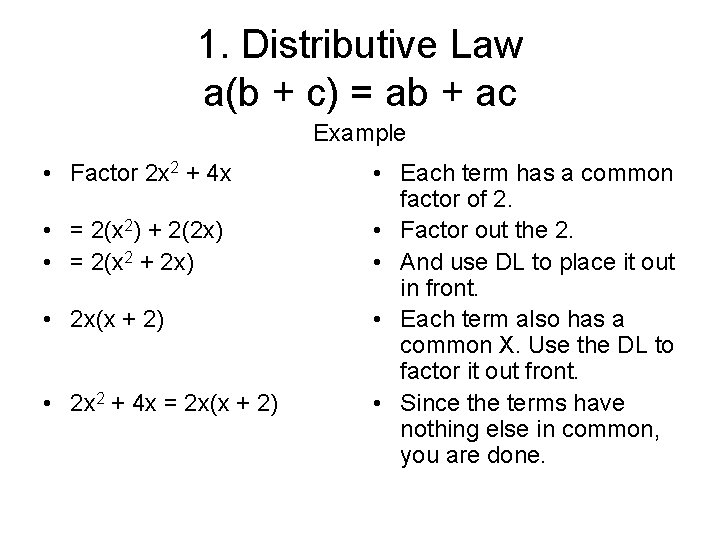
1. Distributive Law a(b + c) = ab + ac Example • Factor 2 x 2 + 4 x • = 2(x 2) + 2(2 x) • = 2(x 2 + 2 x) • 2 x(x + 2) • 2 x 2 + 4 x = 2 x(x + 2) • Each term has a common factor of 2. • Factor out the 2. • And use DL to place it out in front. • Each term also has a common X. Use the DL to factor it out front. • Since the terms have nothing else in common, you are done.
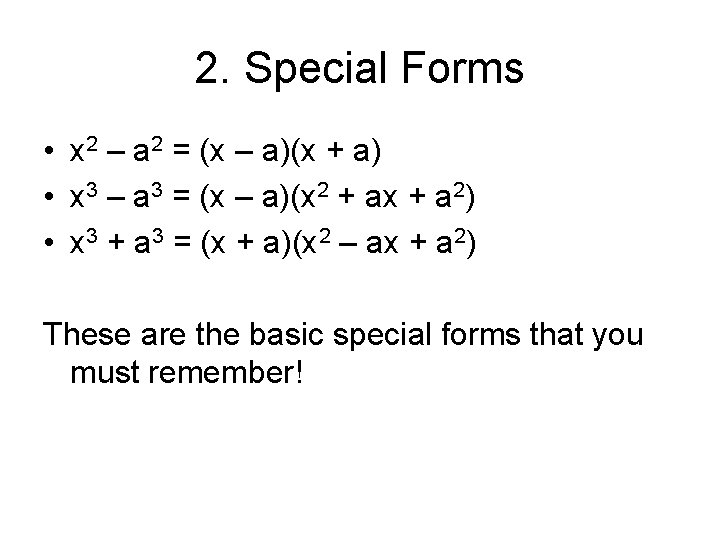
2. Special Forms • x 2 – a 2 = (x – a)(x + a) • x 3 – a 3 = (x – a)(x 2 + ax + a 2) • x 3 + a 3 = (x + a)(x 2 – ax + a 2) These are the basic special forms that you must remember!
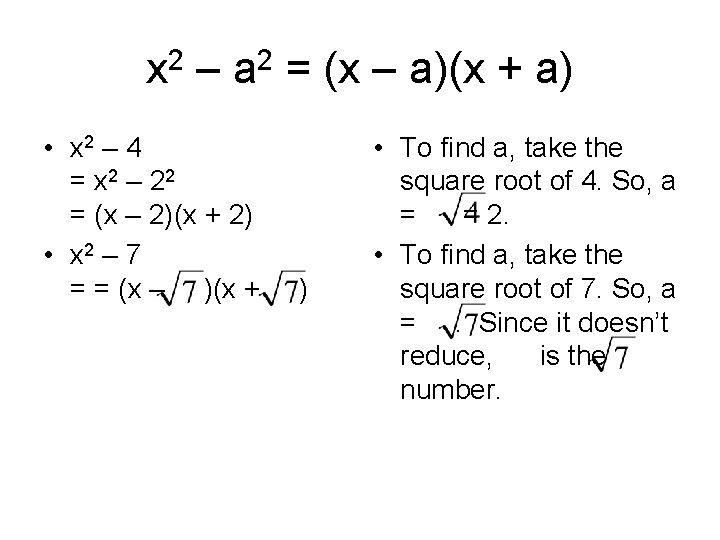
x 2 – a 2 = (x – a)(x + a) • x 2 – 4 = x 2 – 22 = (x – 2)(x + 2) • x 2 – 7 = = (x – )(x + ) • To find a, take the square root of 4. So, a = = 2. • To find a, take the square root of 7. So, a =. Since it doesn’t reduce, is the number.
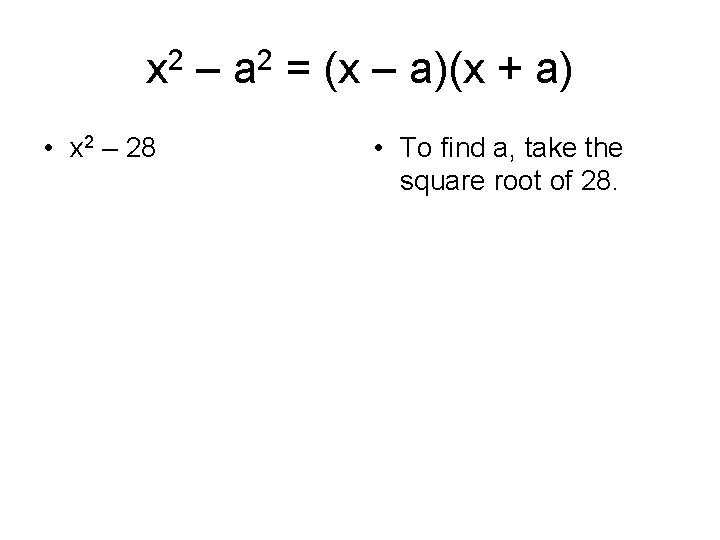
x 2 – a 2 = (x – a)(x + a) • x 2 – 28 • To find a, take the square root of 28.
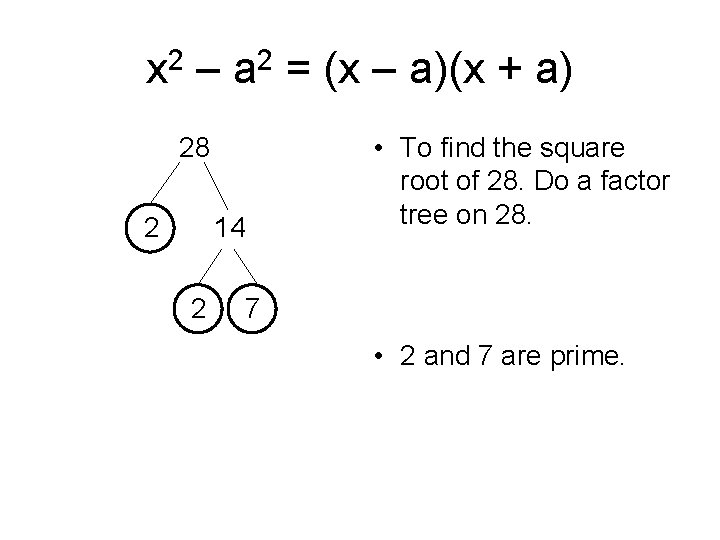
x 2 – a 2 = (x – a)(x + a) 28 2 14 2 • To find the square root of 28. Do a factor tree on 28. 7 • 2 and 7 are prime.
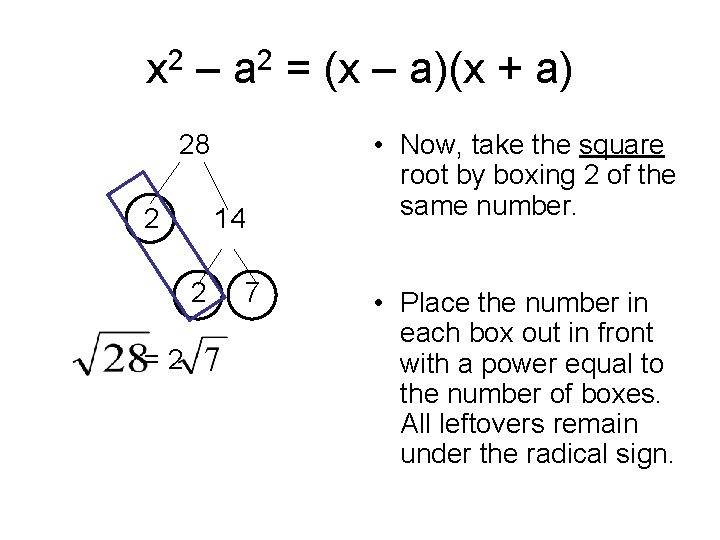
x 2 – a 2 = (x – a)(x + a) 28 2 14 2 =2 7 • Now, take the square root by boxing 2 of the same number. • Place the number in each box out in front with a power equal to the number of boxes. All leftovers remain under the radical sign.
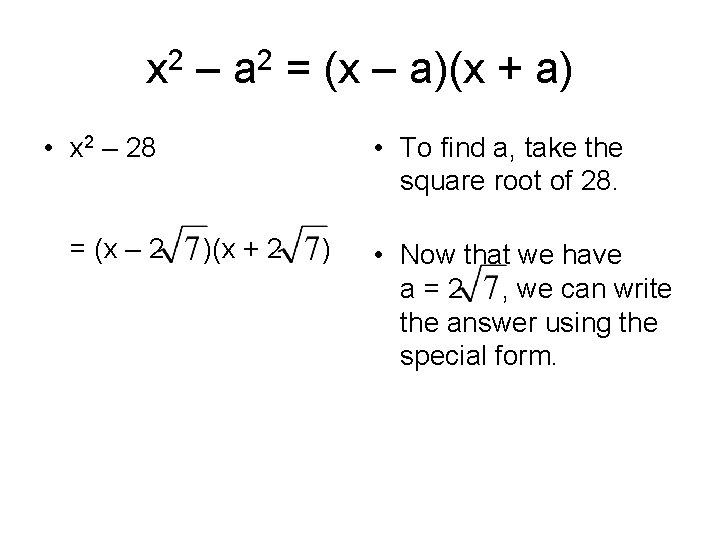
x 2 – a 2 = (x – a)(x + a) • x 2 – 28 = (x – 2 • To find a, take the square root of 28. )(x + 2 ) • Now that we have a = 2 , we can write the answer using the special form.
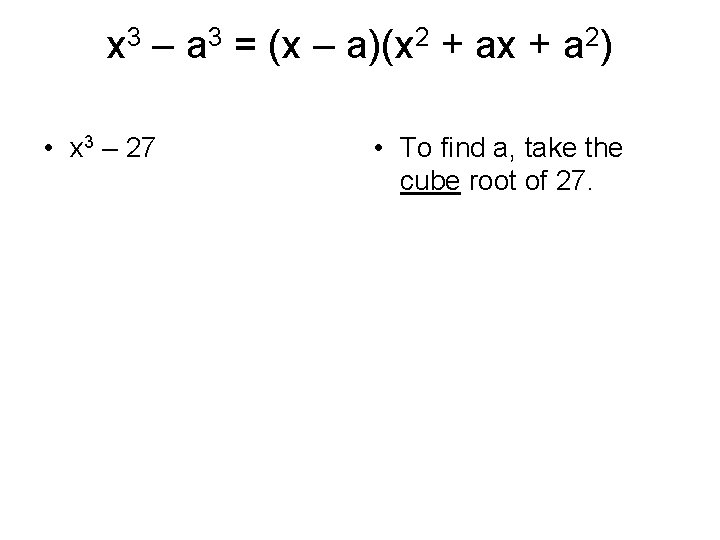
x 3 – a 3 = (x – a)(x 2 + ax + a 2) • x 3 – 27 • To find a, take the cube root of 27.
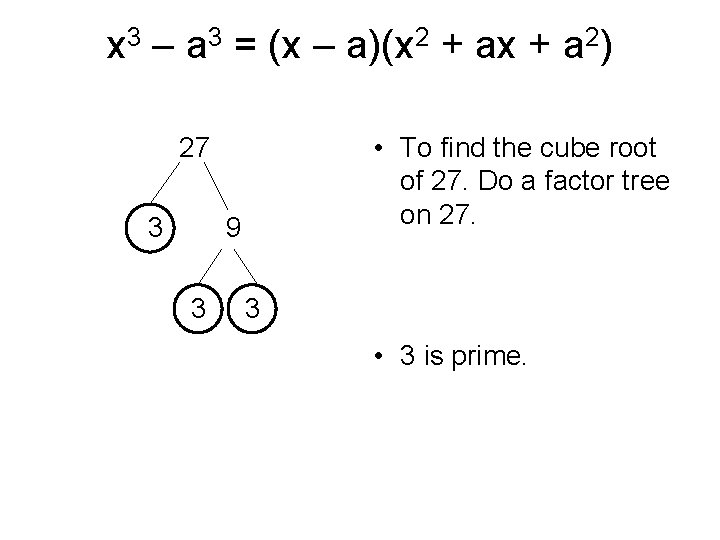
x 3 – a 3 = (x – a)(x 2 + ax + a 2) • To find the cube root of 27. Do a factor tree on 27. 27 3 9 3 3 • 3 is prime.
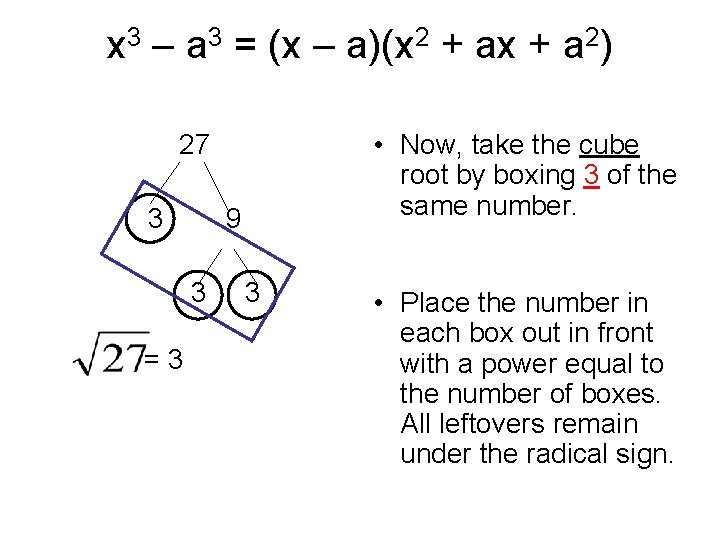
x 3 – a 3 = (x – a)(x 2 + ax + a 2) • Now, take the cube root by boxing 3 of the same number. 27 3 9 3 =3 3 • Place the number in each box out in front with a power equal to the number of boxes. All leftovers remain under the radical sign.
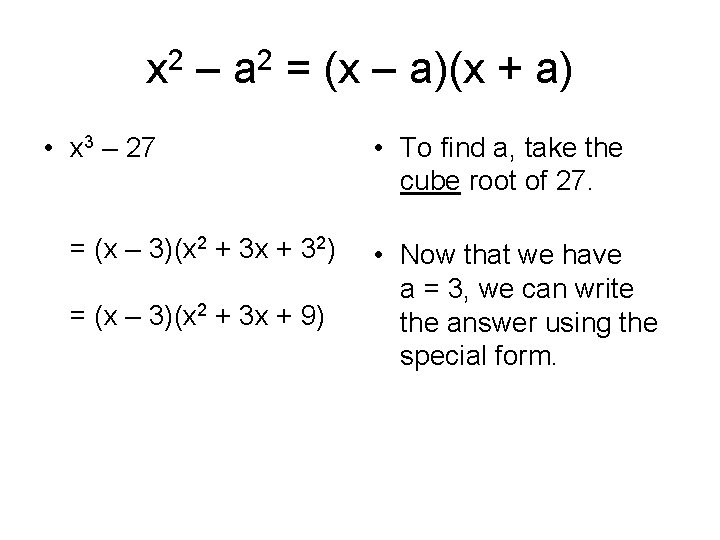
x 2 – a 2 = (x – a)(x + a) • x 3 – 27 = (x – 3)(x 2 + 3 x + 32) = (x – 3)(x 2 + 3 x + 9) • To find a, take the cube root of 27. • Now that we have a = 3, we can write the answer using the special form.
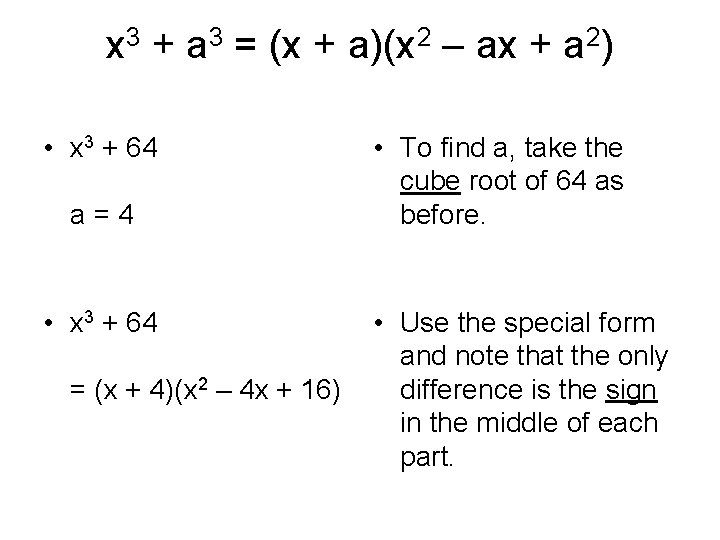
x 3 + a 3 = (x + a)(x 2 – ax + a 2) • x 3 + 64 a=4 • x 3 + 64 = (x + 4)(x 2 – 4 x + 16) • To find a, take the cube root of 64 as before. • Use the special form and note that the only difference is the sign in the middle of each part.
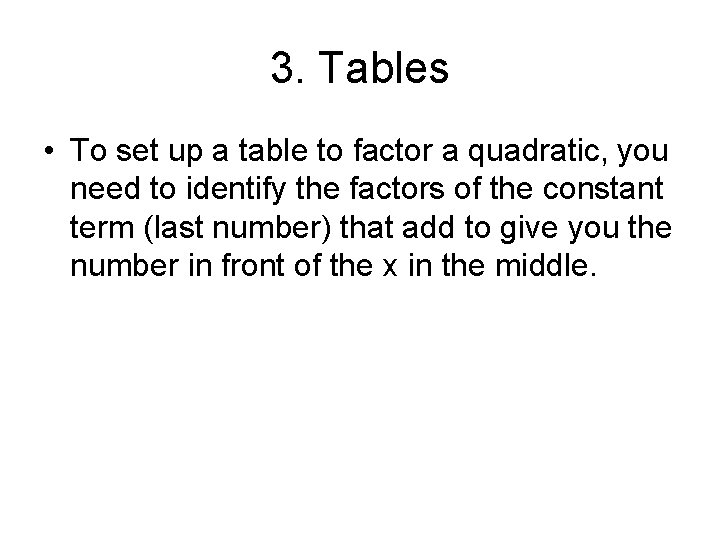
3. Tables • To set up a table to factor a quadratic, you need to identify the factors of the constant term (last number) that add to give you the number in front of the x in the middle.
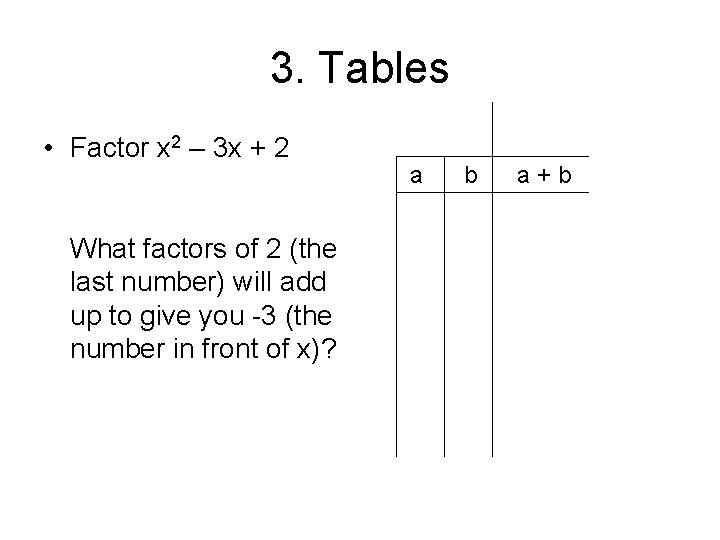
3. Tables • Factor x 2 – 3 x + 2 What factors of 2 (the last number) will add up to give you -3 (the number in front of x)? a b a+b
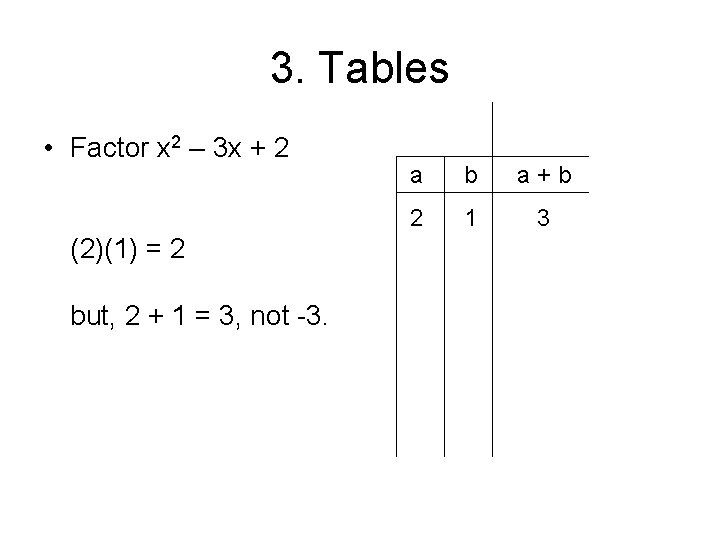
3. Tables • Factor x 2 – 3 x + 2 (2)(1) = 2 but, 2 + 1 = 3, not -3. a b a+b 2 1 3
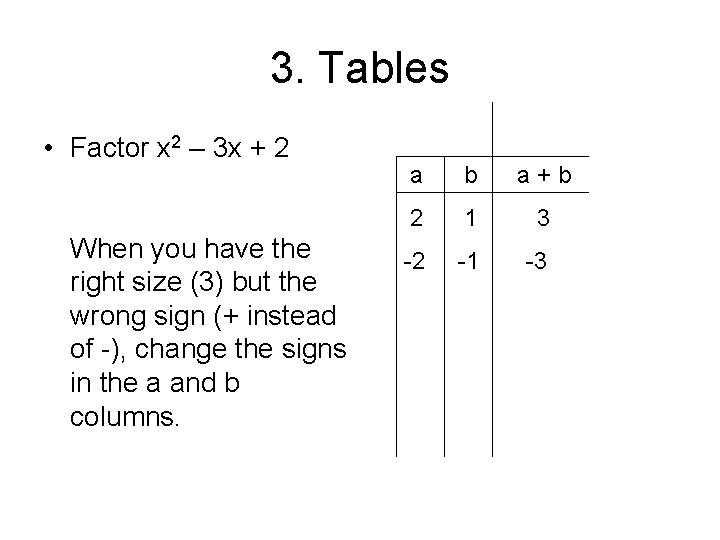
3. Tables • Factor x 2 – 3 x + 2 When you have the right size (3) but the wrong sign (+ instead of -), change the signs in the a and b columns. a b a+b 2 1 3 -2 -1 -3
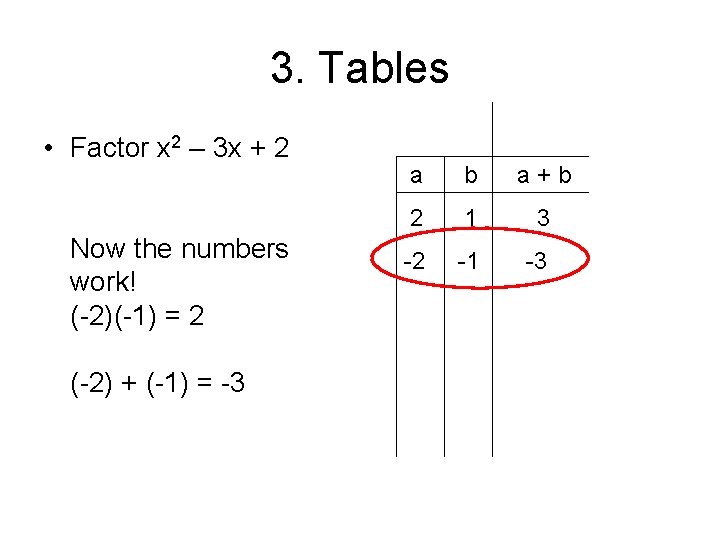
3. Tables • Factor x 2 – 3 x + 2 Now the numbers work! (-2)(-1) = 2 (-2) + (-1) = -3 a b a+b 2 1 3 -2 -1 -3
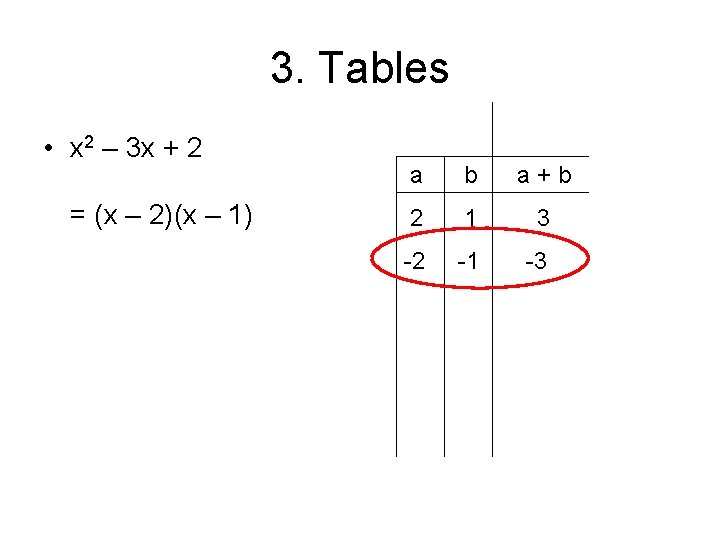
3. Tables • x 2 – 3 x + 2 = (x – 2)(x – 1) a b a+b 2 1 3 -2 -1 -3
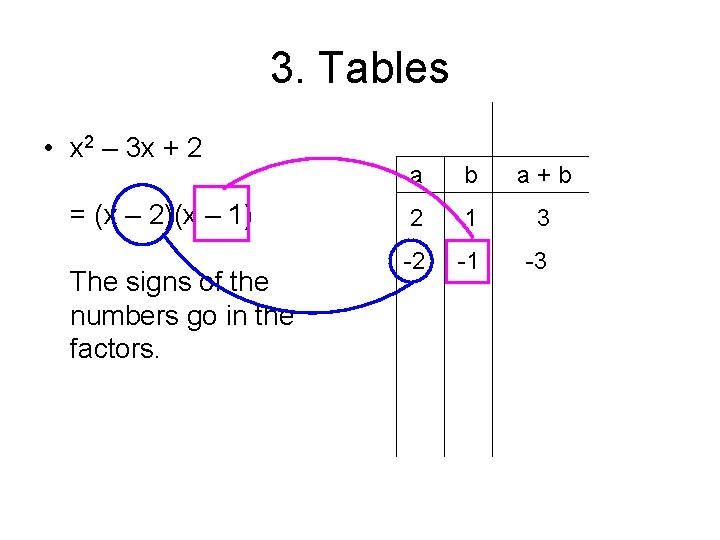
3. Tables • x 2 – 3 x + 2 = (x – 2)(x – 1) The signs of the numbers go in the factors. a b a+b 2 1 3 -2 -1 -3
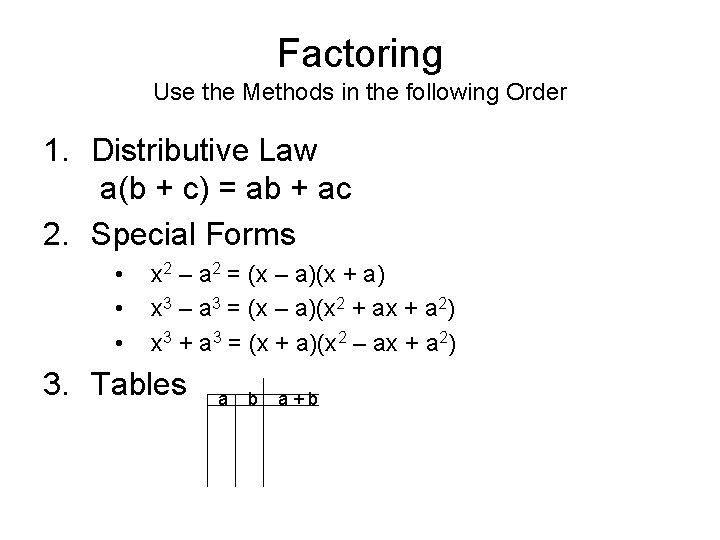
Factoring Use the Methods in the following Order 1. Distributive Law a(b + c) = ab + ac 2. Special Forms • • • x 2 – a 2 = (x – a)(x + a) x 3 – a 3 = (x – a)(x 2 + ax + a 2) x 3 + a 3 = (x + a)(x 2 – ax + a 2) 3. Tables a b a+b
- Slides: 21