
Factoring ax 2 bx c where a 1
Factoring ax 2 + bx + c (where a ≠ 1) In this section, all of the trinomials will have either a positive or negative leading coefficient. The textbook has a method that works based on guess and check – look at page 611 right now. Now look at page 612. It sometimes makes you do a lot of work!
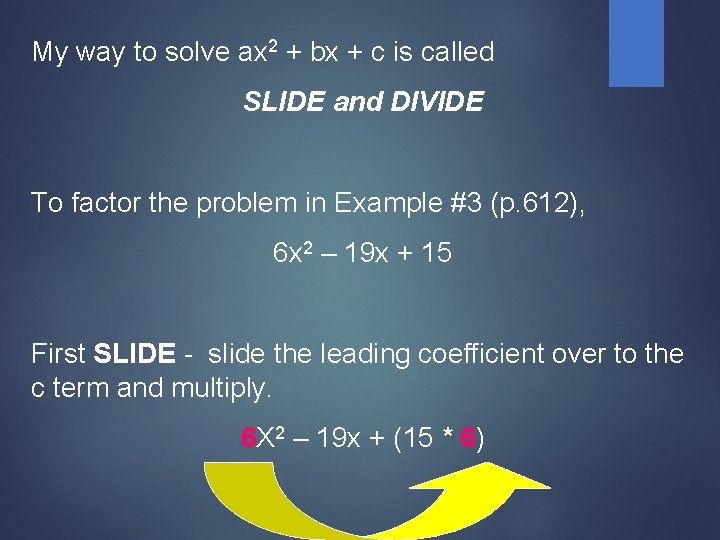
My way to solve ax 2 + bx + c is called SLIDE and DIVIDE To factor the problem in Example #3 (p. 612), 6 x 2 – 19 x + 15 First SLIDE - slide the leading coefficient over to the c term and multiply. 6 X 2 – 19 x + (15 * 6)
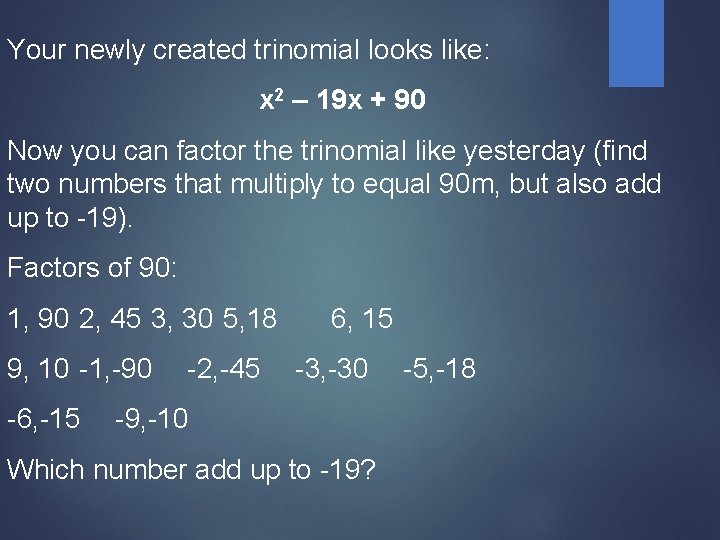
Your newly created trinomial looks like: x 2 – 19 x + 90 Now you can factor the trinomial like yesterday (find two numbers that multiply to equal 90 m, but also add up to -19). Factors of 90: 1, 90 2, 45 3, 30 5, 18 9, 10 -1, -90 -6, -15 -2, -45 6, 15 -3, -30 -9, -10 Which number add up to -19? -5, -18
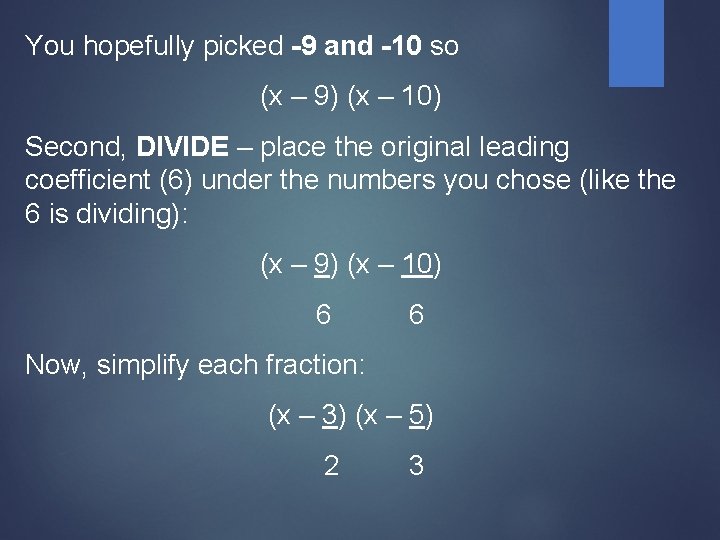
You hopefully picked -9 and -10 so (x – 9) (x – 10) Second, DIVIDE – place the original leading coefficient (6) under the numbers you chose (like the 6 is dividing): (x – 9) (x – 10) 6 6 Now, simplify each fraction: (x – 3) (x – 5) 2 3
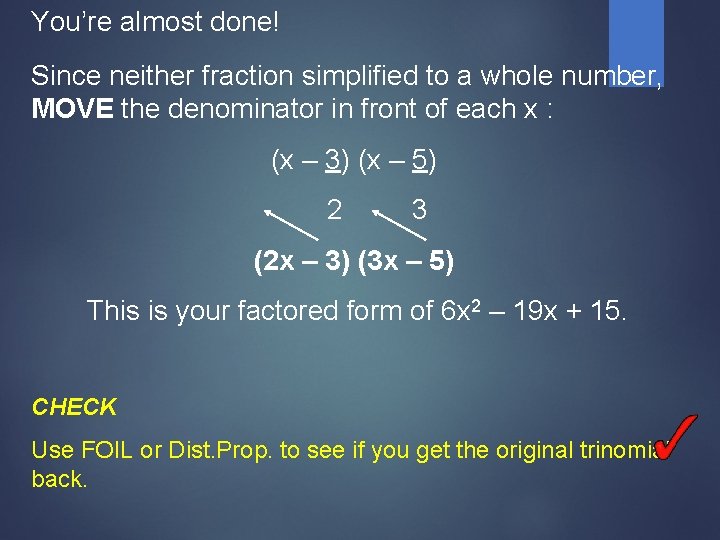
You’re almost done! Since neither fraction simplified to a whole number, MOVE the denominator in front of each x : (x – 3) (x – 5) 2 3 (2 x – 3) (3 x – 5) This is your factored form of 6 x 2 – 19 x + 15. CHECK Use FOIL or Dist. Prop. to see if you get the original trinomial back.
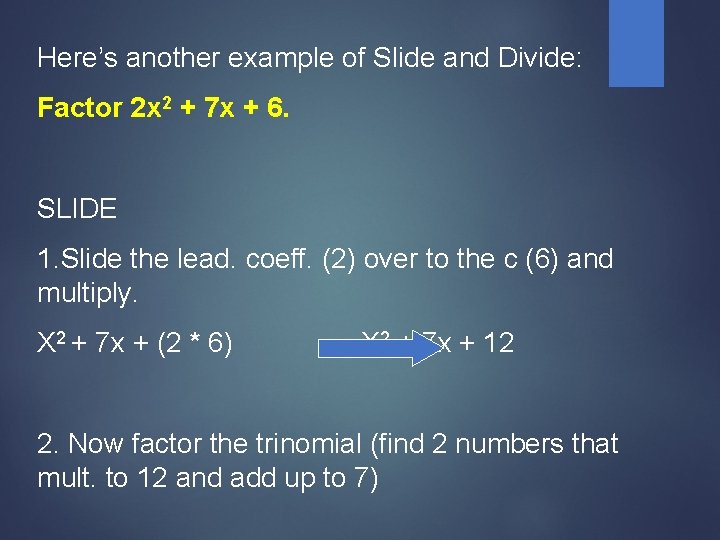
Here’s another example of Slide and Divide: Factor 2 x 2 + 7 x + 6. SLIDE 1. Slide the lead. coeff. (2) over to the c (6) and multiply. X 2 + 7 x + (2 * 6) X 2 + 7 x + 12 2. Now factor the trinomial (find 2 numbers that mult. to 12 and add up to 7)
![You now have (x + 3) (x + 4) [or the reverse] DIVIDE 1.](http://slidetodoc.com/presentation_image_h2/63d919c3e723a6596c8c973007291758/image-7.jpg "You now have (x + 3) (x + 4) [or the reverse] DIVIDE 1.")
You now have (x + 3) (x + 4) [or the reverse] DIVIDE 1. Place the original lead. coeff. under each number in the ( ). (x + 3) (x + 4) 2 2 2. Now simplify each fraction. (x + 3) (x + 2) 2
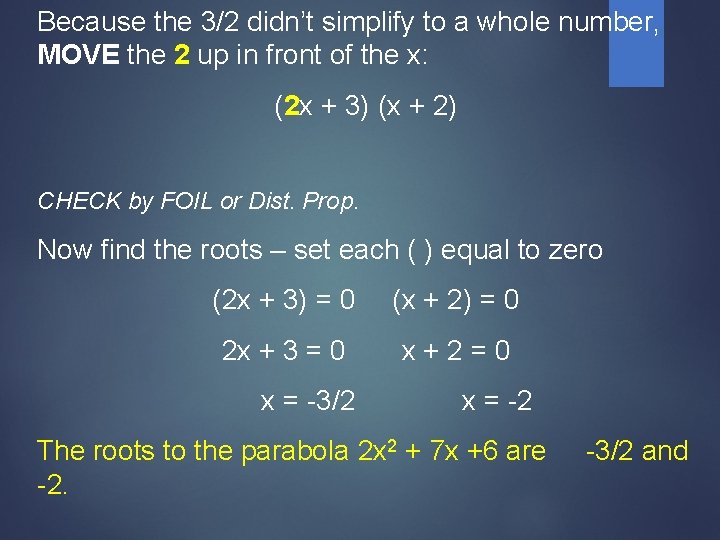
Because the 3/2 didn’t simplify to a whole number, MOVE the 2 up in front of the x: (2 x + 3) (x + 2) CHECK by FOIL or Dist. Prop. Now find the roots – set each ( ) equal to zero (2 x + 3) = 0 (x + 2) = 0 2 x + 3 = 0 x+2=0 x = -3/2 x = -2 The roots to the parabola 2 x 2 + 7 x +6 are -2. -3/2 and
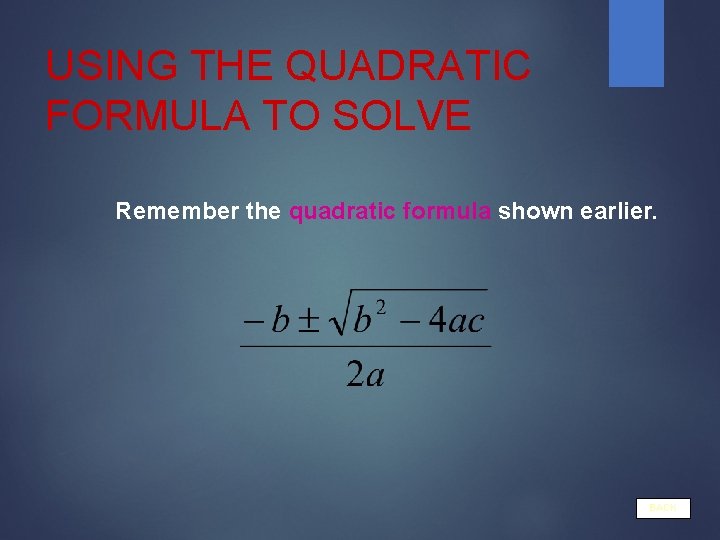
USING THE QUADRATIC FORMULA TO SOLVE Remember the quadratic formula shown earlier. BACK
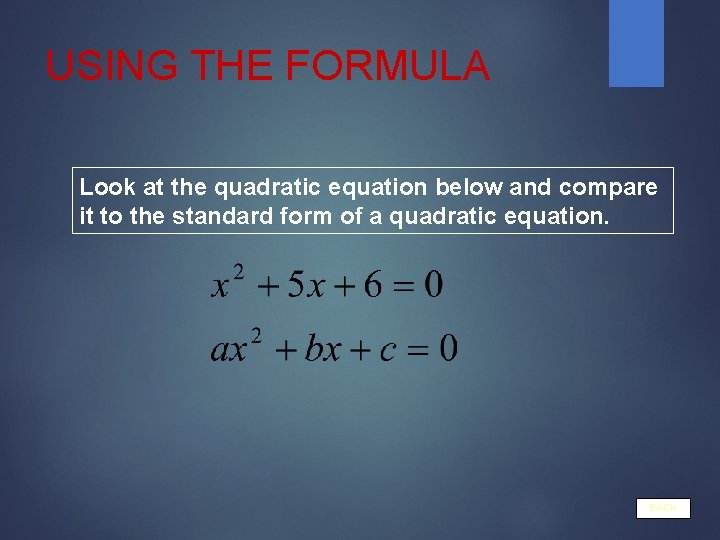
USING THE FORMULA Look at the quadratic equation below and compare it to the standard form of a quadratic equation. BACK
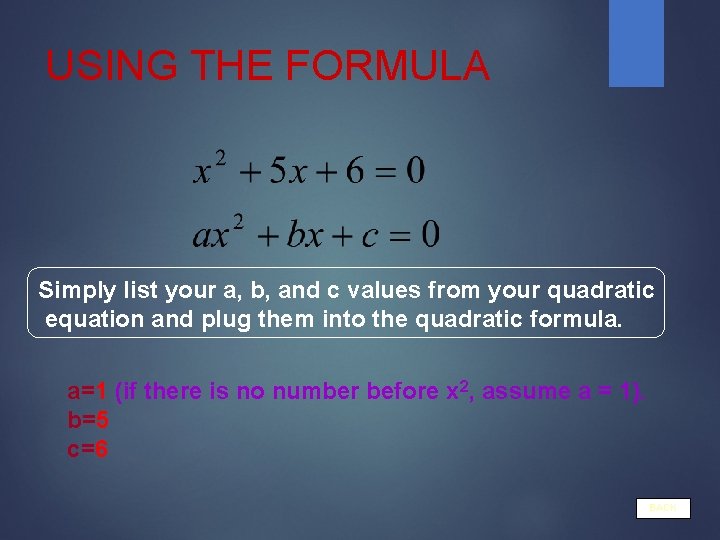
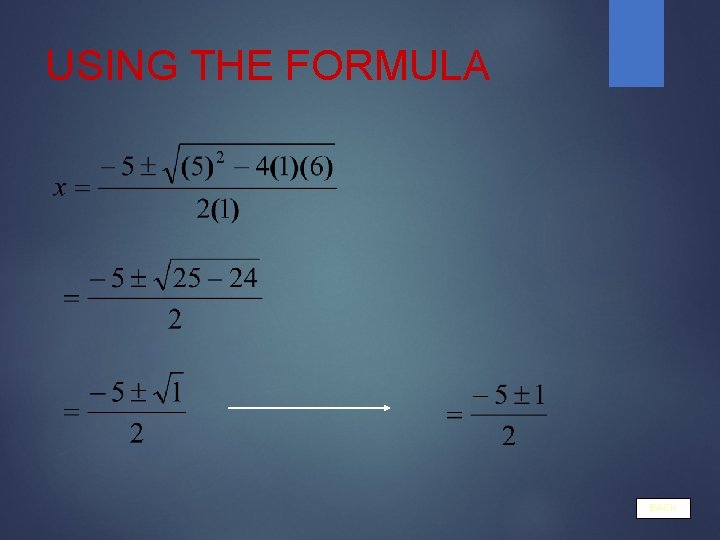
USING THE FORMULA Simply list your a, b, and c values from your quadratic equation and plug them into the quadratic formula. a=1 (if there is no number before x 2, assume a = 1). b=5 c=6 BACK
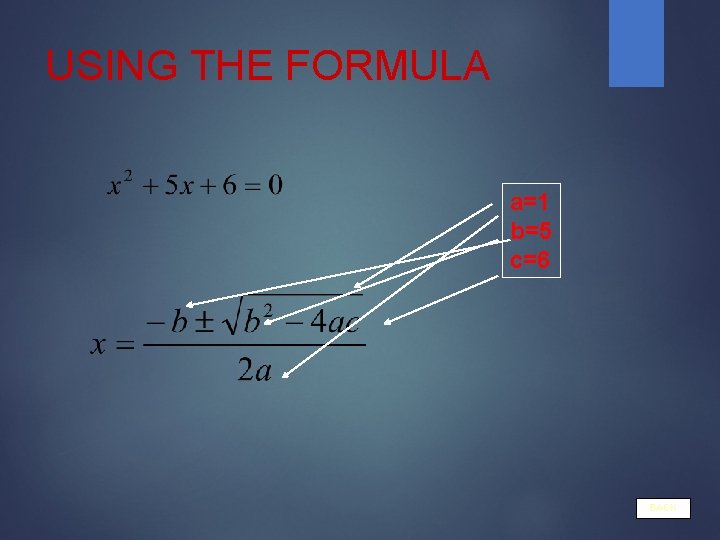
USING THE FORMULA a=1 b=5 c=6 BACK
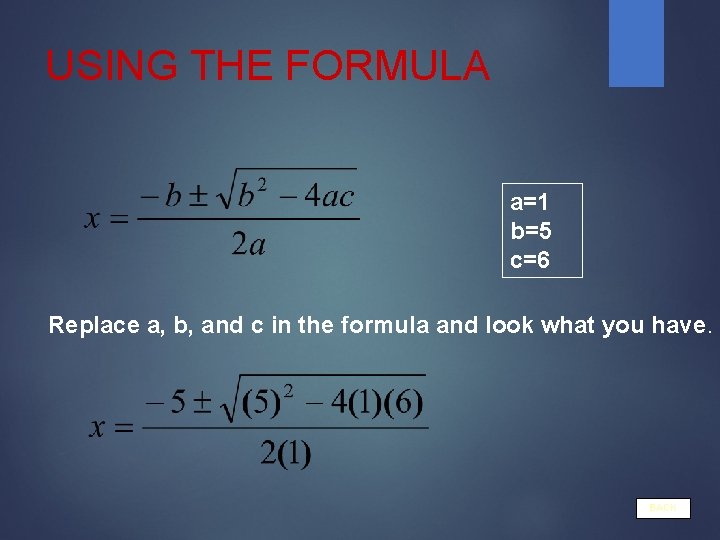
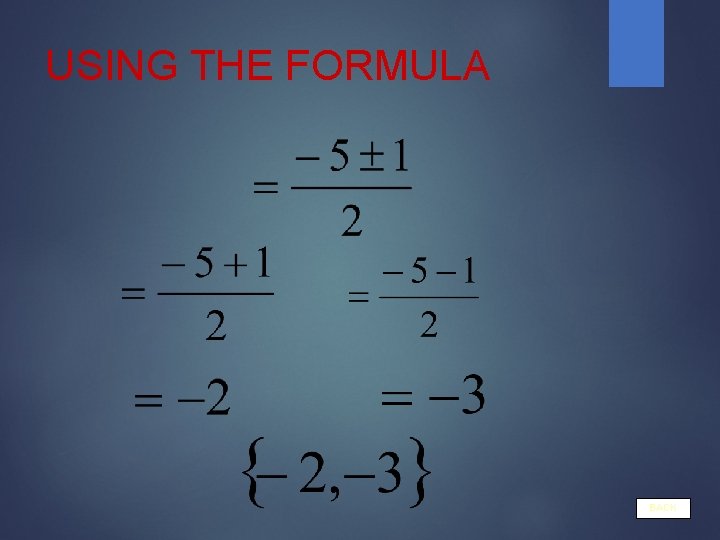
USING THE FORMULA a=1 b=5 c=6 Replace a, b, and c in the formula and look what you have. BACK
USING THE FORMULA BACK
USING THE FORMULA BACK
Your Turn
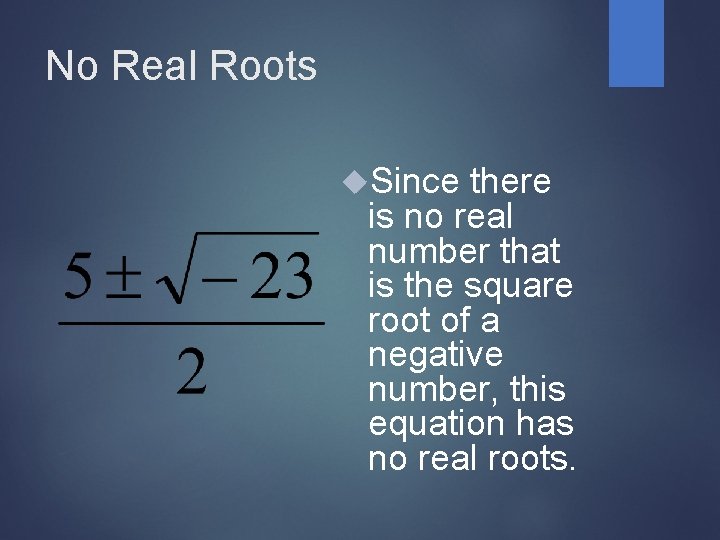
No Real Roots Since there is no real number that is the square root of a negative number, this equation has no real roots.

Confused again? Login to Deltamath and find the questions and click examples. If you are still confused, watch Khan Academy videos and youtube at home! Homework: Deltamath Factoring Quadratics due Friday at the end of the day for a QUIZ GRADE
- Slides: 18