
Factorial Designs Programmatic Research RH Testing Causal Inference
- Slides: 23
Factorial Designs: Programmatic Research, RH: Testing & Causal Inference • Applications of Factorial designs in Programmatic Research • Research Hypotheses for Factorial Designs • Variable Role Explication in Factorial Designs & Causal Interpretation
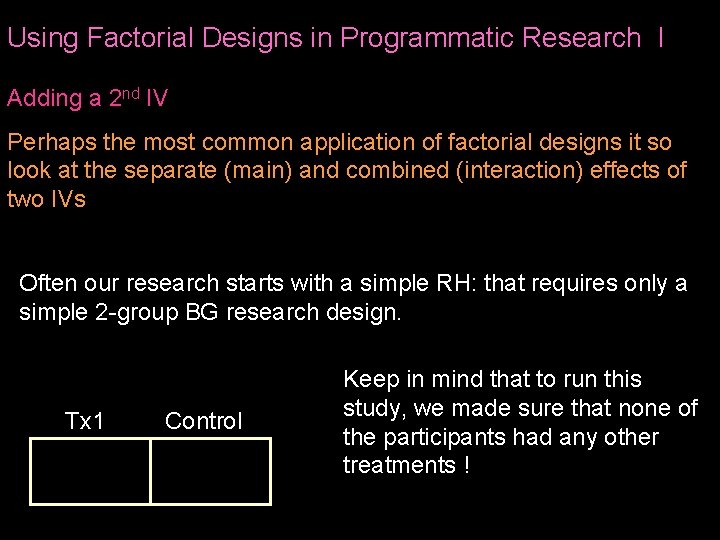
Using Factorial Designs in Programmatic Research I Adding a 2 nd IV Perhaps the most common application of factorial designs it so look at the separate (main) and combined (interaction) effects of two IVs Often our research starts with a simple RH: that requires only a simple 2 -group BG research design. Tx 1 Control Keep in mind that to run this study, we made sure that none of the participants had any other treatments !
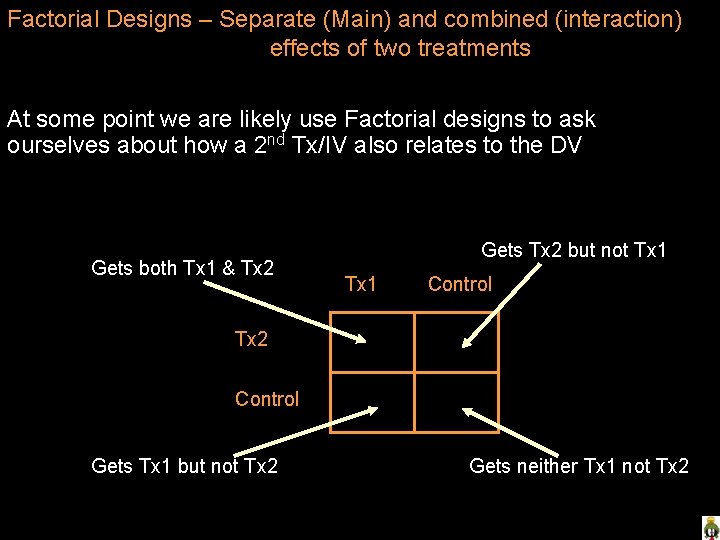
Factorial Designs – Separate (Main) and combined (interaction) effects of two treatments At some point we are likely use Factorial designs to ask ourselves about how a 2 nd Tx/IV also relates to the DV Gets both Tx 1 & Tx 2 Gets Tx 2 but not Tx 1 Control Tx 2 Control Gets Tx 1 but not Tx 2 Gets neither Tx 1 not Tx 2
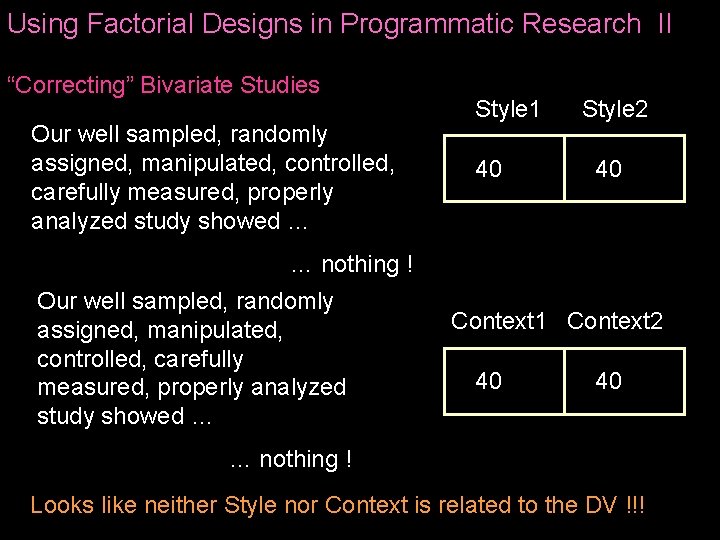
Using Factorial Designs in Programmatic Research II “Correcting” Bivariate Studies Our well sampled, randomly assigned, manipulated, controlled, carefully measured, properly analyzed study showed … Style 1 40 Style 2 40 … nothing ! Our well sampled, randomly assigned, manipulated, controlled, carefully measured, properly analyzed study showed … Context 1 Context 2 40 40 … nothing ! Looks like neither Style nor Context is related to the DV !!!
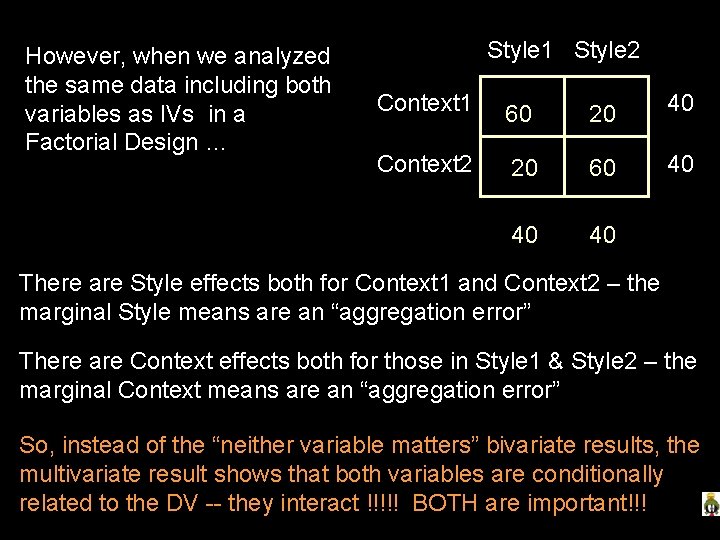
However, when we analyzed the same data including both variables as IVs in a Factorial Design … Style 1 Style 2 Context 1 60 20 40 Context 2 20 60 40 40 40 There are Style effects both for Context 1 and Context 2 – the marginal Style means are an “aggregation error” There are Context effects both for those in Style 1 & Style 2 – the marginal Context means are an “aggregation error” So, instead of the “neither variable matters” bivariate results, the multivariate result shows that both variables are conditionally related to the DV -- they interact !!!!! BOTH are important!!!
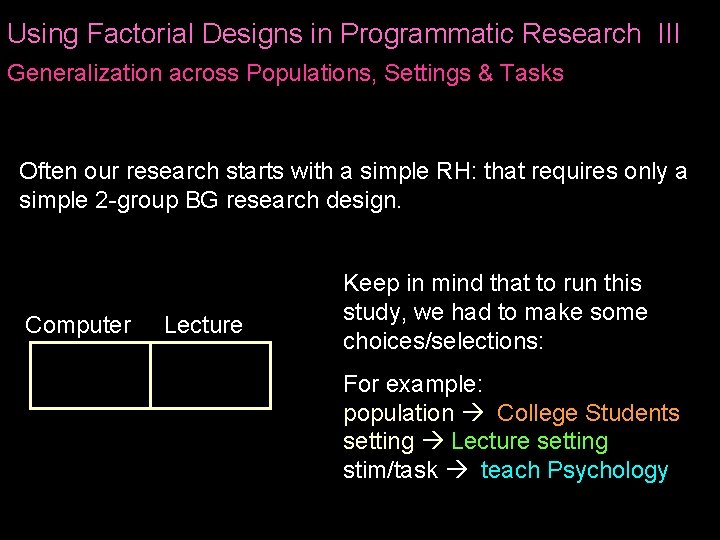
Using Factorial Designs in Programmatic Research III Generalization across Populations, Settings & Tasks Often our research starts with a simple RH: that requires only a simple 2 -group BG research design. Computer Lecture Keep in mind that to run this study, we had to make some choices/selections: For example: population College Students setting Lecture setting stim/task teach Psychology
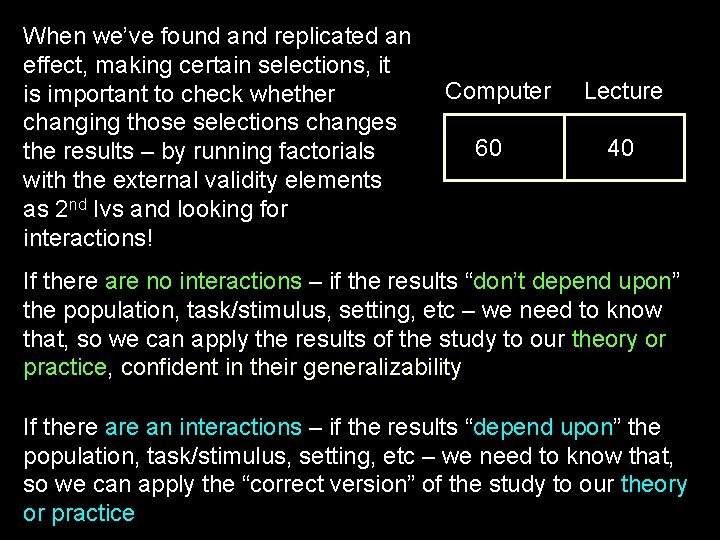
When we’ve found and replicated an effect, making certain selections, it is important to check whether changing those selections changes the results – by running factorials with the external validity elements as 2 nd Ivs and looking for interactions! Computer 60 Lecture 40 If there are no interactions – if the results “don’t depend upon” the population, task/stimulus, setting, etc – we need to know that, so we can apply the results of the study to our theory or practice, confident in their generalizability If there an interactions – if the results “depend upon” the population, task/stimulus, setting, etc – we need to know that, so we can apply the “correct version” of the study to our theory or practice
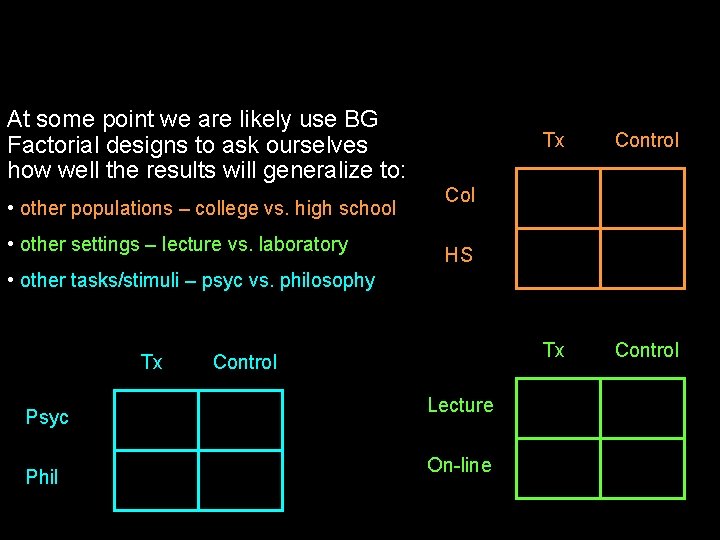
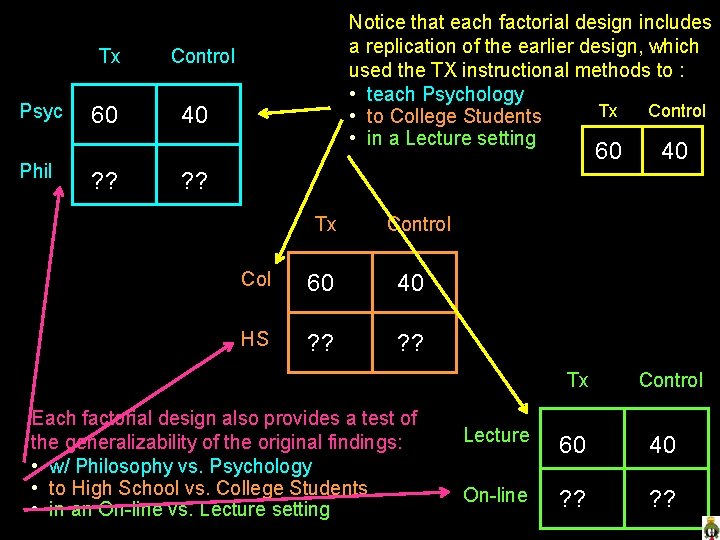
At some point we are likely use BG Factorial designs to ask ourselves how well the results will generalize to: • other populations – college vs. high school • other settings – lecture vs. laboratory Tx Control Col HS • other tasks/stimuli – psyc vs. philosophy Tx Psyc Phil Control Lecture On-line
Tx Psyc Phil 60 Notice that each factorial design includes a replication of the earlier design, which used the TX instructional methods to : • teach Psychology Tx Control • to College Students • in a Lecture setting Control 40 60 ? ? 40 ? ? Tx Control Col 60 40 HS ? ? Tx Each factorial design also provides a test of the generalizability of the original findings: • w/ Philosophy vs. Psychology • to High School vs. College Students • in an On-line vs. Lecture setting Control Lecture 60 40 On-line ? ?
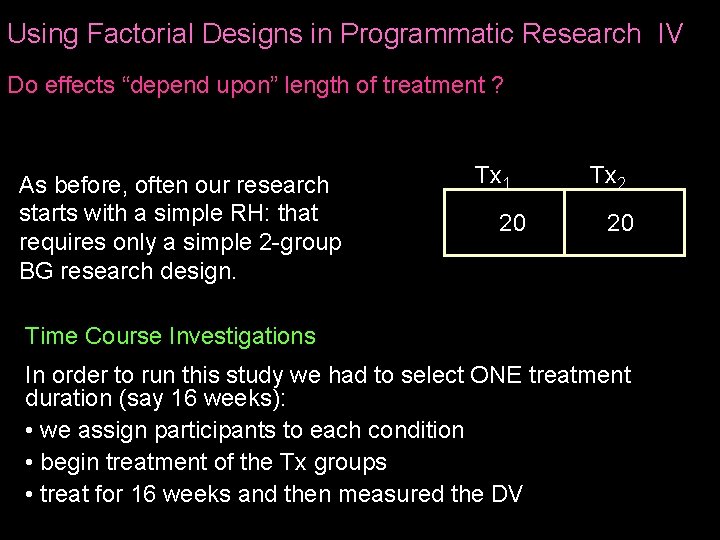
Using Factorial Designs in Programmatic Research IV Do effects “depend upon” length of treatment ? As before, often our research starts with a simple RH: that requires only a simple 2 -group BG research design. Tx 1 20 Tx 2 20 Time Course Investigations In order to run this study we had to select ONE treatment duration (say 16 weeks): • we assign participants to each condition • begin treatment of the Tx groups • treat for 16 weeks and then measured the DV
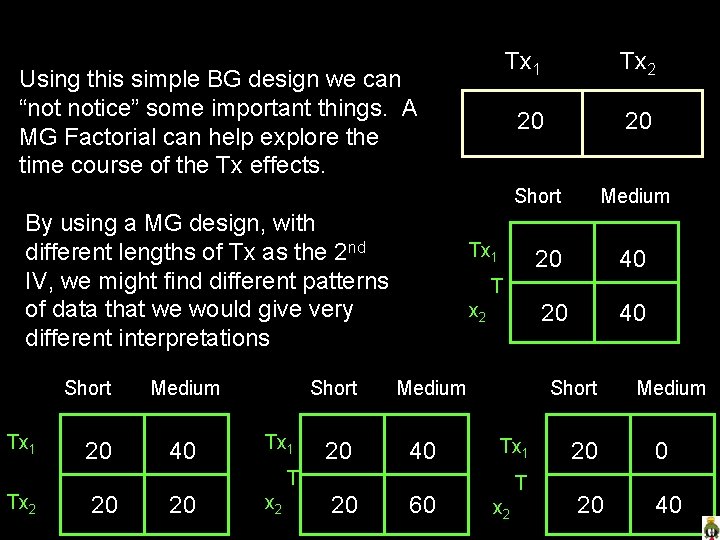
Using this simple BG design we can “not notice” some important things. A MG Factorial can help explore the time course of the Tx effects. Tx 1 Tx 2 20 20 Short By using a MG design, with different lengths of Tx as the 2 nd IV, we might find different patterns of data that we would give very different interpretations Short Tx 1 20 Medium 40 Short Tx 1 20 20 x 2 20 20 40 T x 2 Medium 40 Short Tx 1 T Tx 2 Medium 60 T x 2 Medium 20 0 20 40
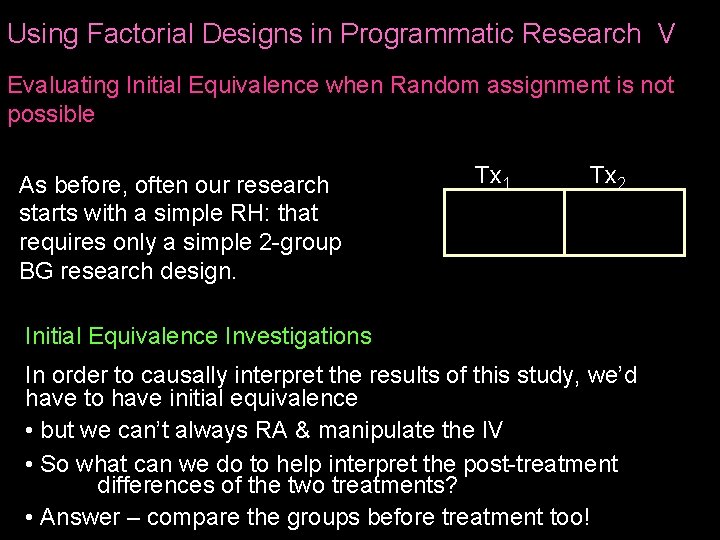
Using Factorial Designs in Programmatic Research V Evaluating Initial Equivalence when Random assignment is not possible As before, often our research starts with a simple RH: that requires only a simple 2 -group BG research design. Tx 1 Tx 2 Initial Equivalence Investigations In order to causally interpret the results of this study, we’d have to have initial equivalence • but we can’t always RA & manipulate the IV • So what can we do to help interpret the post-treatment differences of the two treatments? • Answer – compare the groups before treatment too!
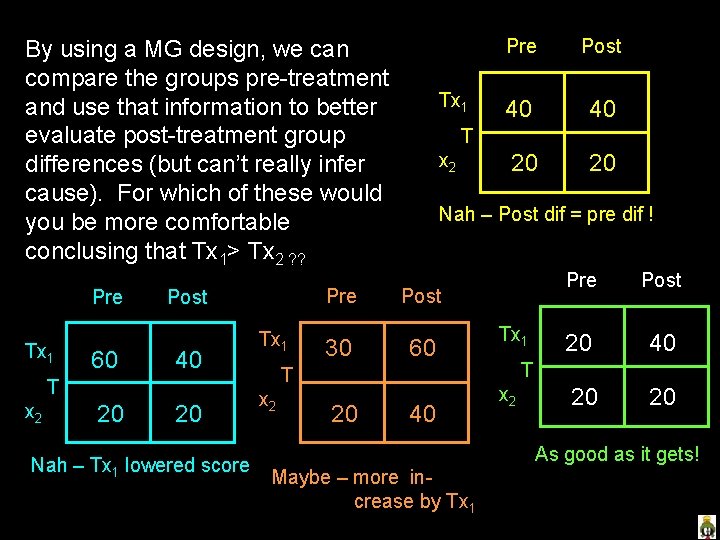
By using a MG design, we can compare the groups pre-treatment and use that information to better evaluate post-treatment group differences (but can’t really infer cause). For which of these would you be more comfortable conclusing that Tx 1> Tx 2 ? ? Pre Tx 1 60 Post 40 T x 2 20 20 Nah – Tx 1 lowered score Tx 1 x 2 40 40 20 20 Nah – Post dif = pre dif ! Pre Post 30 60 20 Post T T x 2 Pre 40 Tx 1 Pre Post 20 40 20 20 T x 2 As good as it gets! Maybe – more increase by Tx 1
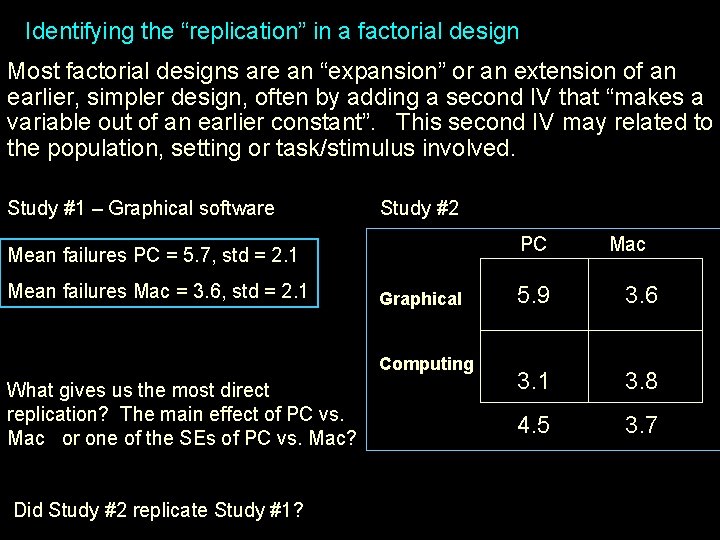
Replication & “replication” Generalization Factorial Designs Identifying the in a in factorial design Most factorial designs are an “expansion” or an extension of an earlier, simpler design, often by adding a second IV that “makes a variable out of an earlier constant”. This second IV may related to the population, setting or task/stimulus involved. Study #1 – Graphical software Study #2 PC Mean failures PC = 5. 7, std = 2. 1 Mean failures Mac = 3. 6, std = 2. 1 Graphical Computing What gives us the most direct replication? The main effect of PC vs. Mac or one of the SEs of PC vs. Mac? Did Study #2 replicate Study #1? Mac 5. 9 3. 6 3. 1 3. 8 4. 5 3. 7
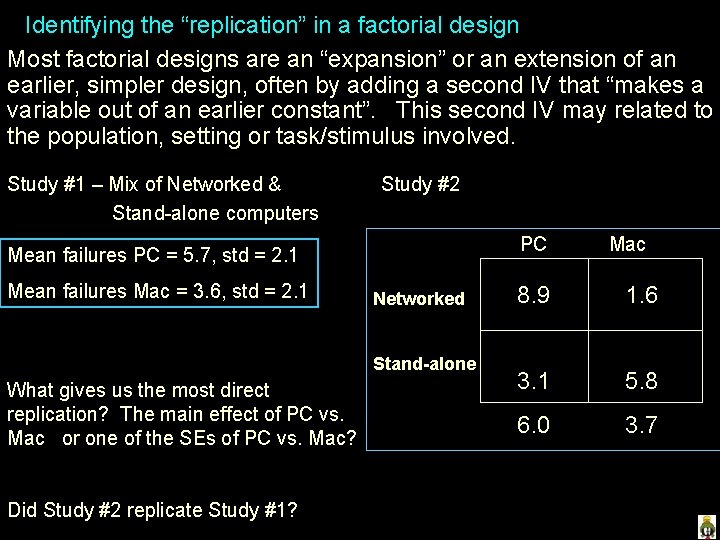
Replication & Generalization Factorial Designs, cont… Identifying the “replication” in ainfactorial design Most factorial designs are an “expansion” or an extension of an earlier, simpler design, often by adding a second IV that “makes a variable out of an earlier constant”. This second IV may related to the population, setting or task/stimulus involved. Study #1 – Mix of Networked & Stand-alone computers Study #2 PC Mean failures PC = 5. 7, std = 2. 1 Mean failures Mac = 3. 6, std = 2. 1 Networked Stand-alone What gives us the most direct replication? The main effect of PC vs. Mac or one of the SEs of PC vs. Mac? Did Study #2 replicate Study #1? Mac 8. 9 1. 6 3. 1 5. 8 6. 0 3. 7
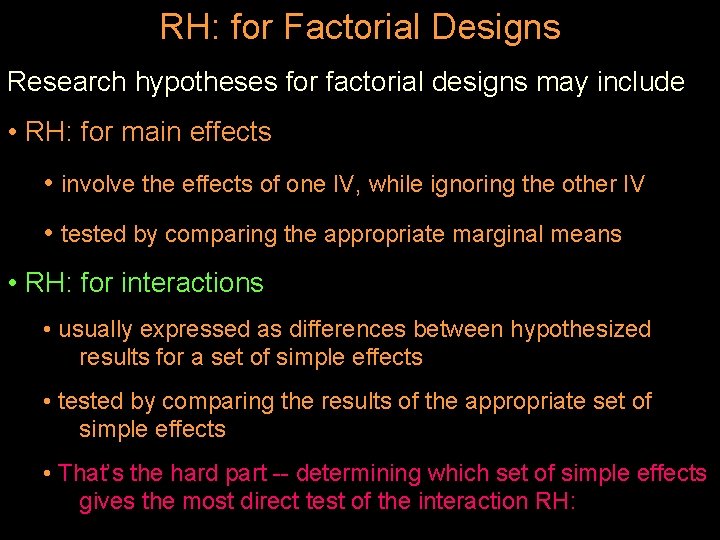
RH: for Factorial Designs Research hypotheses for factorial designs may include • RH: for main effects • involve the effects of one IV, while ignoring the other IV • tested by comparing the appropriate marginal means • RH: for interactions • usually expressed as differences between hypothesized results for a set of simple effects • tested by comparing the results of the appropriate set of simple effects • That’s the hard part -- determining which set of simple effects gives the most direct test of the interaction RH:
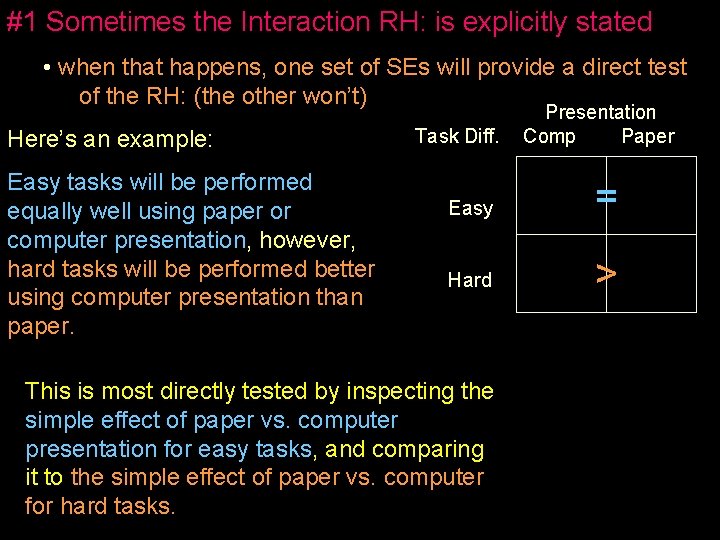
#1 Sometimes the Interaction RH: is explicitly stated • when that happens, one set of SEs will provide a direct test of the RH: (the other won’t) Here’s an example: Easy tasks will be performed equally well using paper or computer presentation, however, hard tasks will be performed better using computer presentation than paper. Task Diff. Presentation Comp Paper Easy = Hard > This is most directly tested by inspecting the simple effect of paper vs. computer presentation for easy tasks, and comparing it to the simple effect of paper vs. computer for hard tasks.
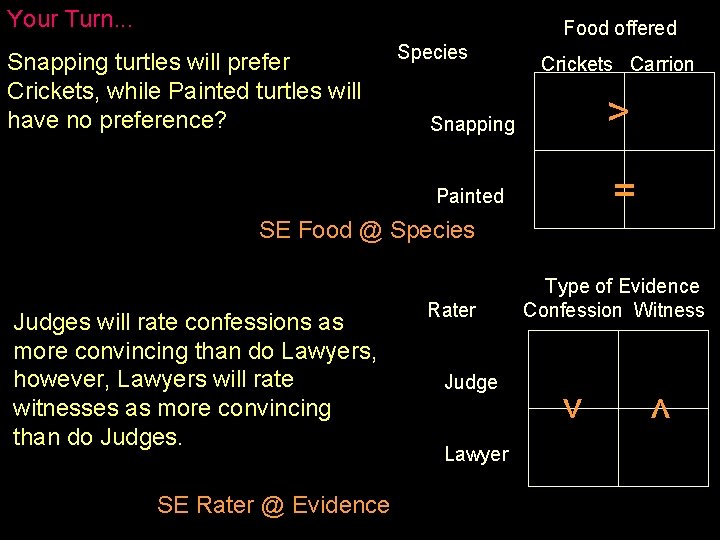
Your Turn. . . Food offered Snapping turtles will prefer Crickets, while Painted turtles will have no preference? Species Crickets Carrion Snapping > Painted = SE Food @ Species Judge Lawyer < SE Rater @ Evidence Rater > Judges will rate confessions as more convincing than do Lawyers, however, Lawyers will rate witnesses as more convincing than do Judges. Type of Evidence Confession Witness
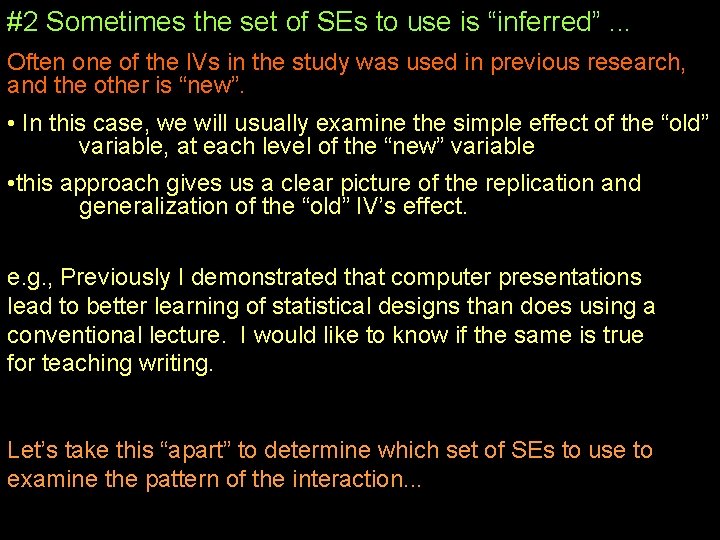
#2 Sometimes the set of SEs to use is “inferred”. . . Often one of the IVs in the study was used in previous research, and the other is “new”. • In this case, we will usually examine the simple effect of the “old” variable, at each level of the “new” variable • this approach gives us a clear picture of the replication and generalization of the “old” IV’s effect. e. g. , Previously I demonstrated that computer presentations lead to better learning of statistical designs than does using a conventional lecture. I would like to know if the same is true for teaching writing. Let’s take this “apart” to determine which set of SEs to use to examine the pattern of the interaction. . .
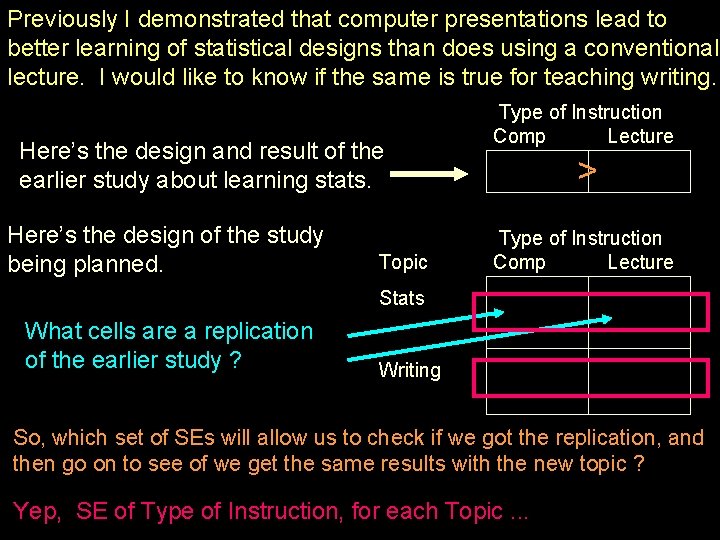
Previously I demonstrated that computer presentations lead to better learning of statistical designs than does using a conventional lecture. I would like to know if the same is true for teaching writing. Here’s the design and result of the earlier study about learning stats. Here’s the design of the study being planned. Topic Type of Instruction Comp Lecture > Type of Instruction Comp Lecture Stats What cells are a replication of the earlier study ? Writing So, which set of SEs will allow us to check if we got the replication, and then go on to see of we get the same results with the new topic ? Yep, SE of Type of Instruction, for each Topic. . .
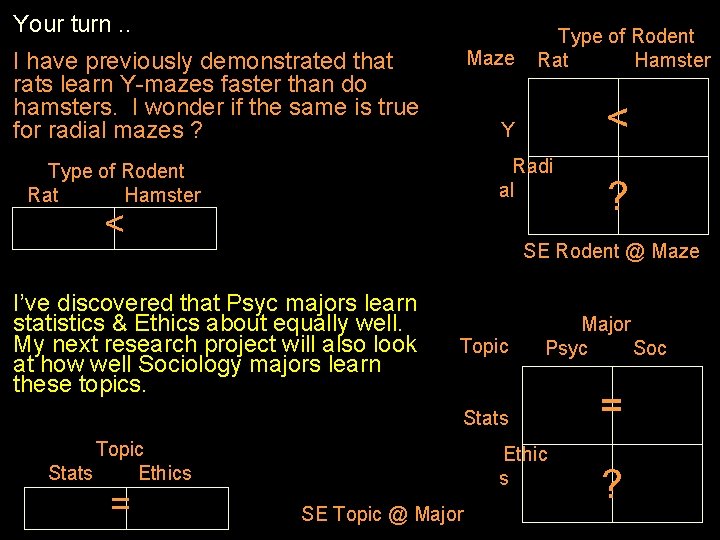
Maze I have previously demonstrated that rats learn Y-mazes faster than do hamsters. I wonder if the same is true for radial mazes ? Type of Rodent Rat Hamster > Your turn. . Y Radi al Type of Rodent Rat Hamster ? > SE Rodent @ Maze Topic Major Psyc Soc Stats = I’ve discovered that Psyc majors learn statistics & Ethics about equally well. My next research project will also look at how well Sociology majors learn these topics. Topic Stats Ethic s SE Topic @ Major ? =
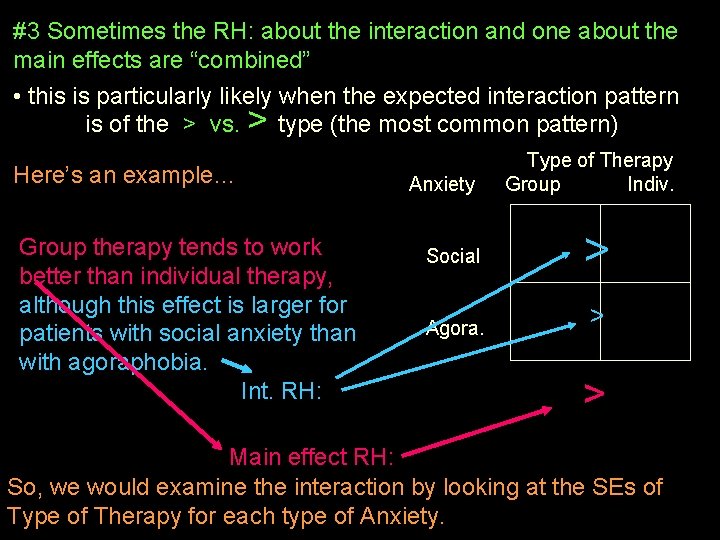
#3 Sometimes the RH: about the interaction and one about the main effects are “combined” • this is particularly likely when the expected interaction pattern is of the > vs. > type (the most common pattern) Here’s an example… Group therapy tends to work better than individual therapy, although this effect is larger for patients with social anxiety than with agoraphobia. Int. RH: Anxiety Type of Therapy Group Indiv. Social > Agora. > > Main effect RH: So, we would examine the interaction by looking at the SEs of Type of Therapy for each type of Anxiety.
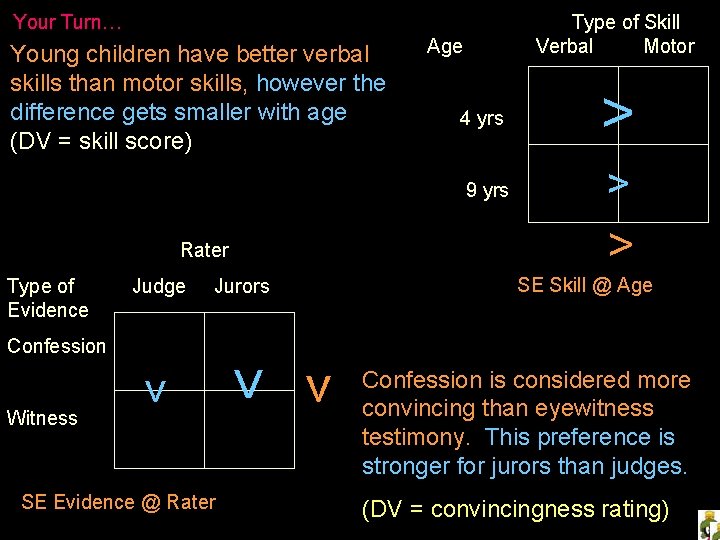
Your Turn… Young children have better verbal skills than motor skills, however the difference gets smaller with age (DV = skill score) Judge Age 4 yrs > 9 yrs > > Rater Type of Evidence Type of Skill Verbal Motor SE Skill @ Age Jurors Confession SE Evidence @ Rater > > > Witness Confession is considered more convincing than eyewitness testimony. This preference is stronger for jurors than judges. (DV = convincingness rating)