
Factorial BG ANOVA Psy 420 Ainsworth Topics in
Factorial BG ANOVA Psy 420 Ainsworth
Topics in Factorial Designs • Factorial? • Crossing and Nesting • Assumptions • Analysis • • • Traditional and Regression Approaches Main Effects of IVs Interactions among IVs Higher order designs “Dangling control group” factorial designs • Specific Comparisons • Main Effects • Simple Effects • Interaction Contrasts • Effect Size estimates • Power and Sample Size
Factorial? • Factorial – means that all levels of one IV are completely crossed with all level of the other IV(s). • Crossed – all levels of one variable occur in combination with all levels of the other variable(s) • Nested – levels of one variable appear at different levels of the other variable(s)
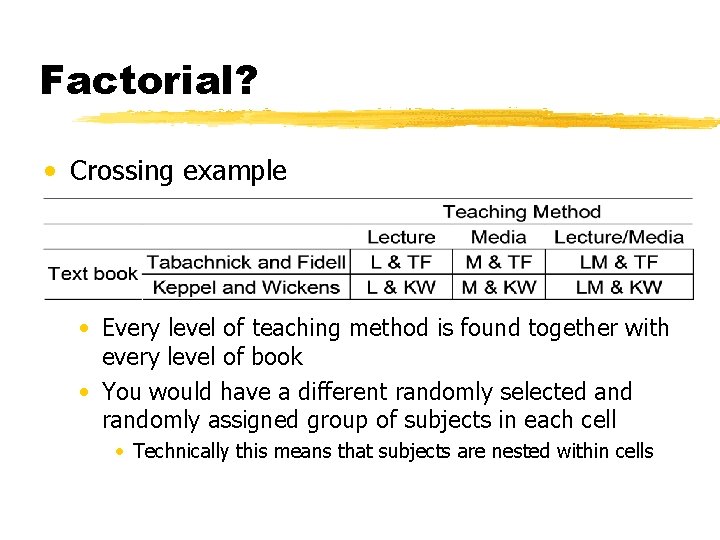
Factorial? • Crossing example • Every level of teaching method is found together with every level of book • You would have a different randomly selected and randomly assigned group of subjects in each cell • Technically this means that subjects are nested within cells
Factorial? • Crossing Example 2 – repeated measures • In repeated measures designs subjects cross the levels of the IV
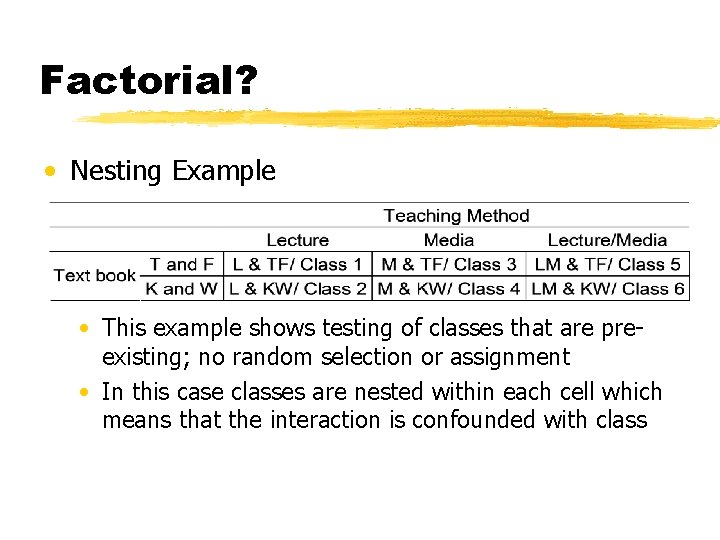
Factorial? • Nesting Example • This example shows testing of classes that are preexisting; no random selection or assignment • In this case classes are nested within each cell which means that the interaction is confounded with class
Assumptions • Normality of Sampling distribution of means • Applies to the individual cells • 20+ DFs for error and assumption met • Homogeneity of Variance • Same assumption as one-way; applies to cells • In order to use ANOVA you need to assume that all cells are from the same population
Assumptions • Independence of errors • Thinking in terms of regression; an error associated with one score is independent of other scores, etc. • Absence of outliers • Relates back to normality and assuming a common population
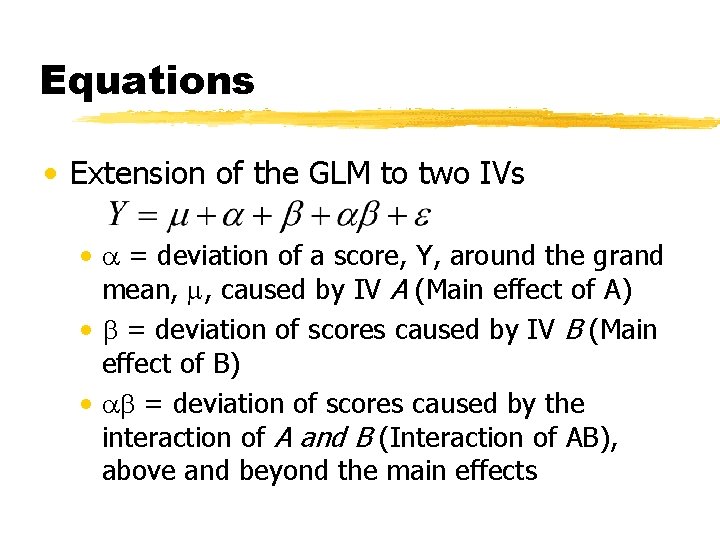
Equations • Extension of the GLM to two IVs • = deviation of a score, Y, around the grand mean, , caused by IV A (Main effect of A) • = deviation of scores caused by IV B (Main effect of B) • = deviation of scores caused by the interaction of A and B (Interaction of AB), above and beyond the main effects
Equations • Performing a factorial analysis essentially does the job of three analyses in one • Two one-way ANOVAs, one for each main effect • And a test of the interaction • Interaction – the effect of one IV depends on the level of another IV • e. g. The T and F book works better with a combo of media and lecture, while the K and W book works better with just lecture
Equations • The between groups sums of squares from previous is further broken down; • Before SSbg = SSeffect • Now SSbg = SSA + SSB + SSAB • In a two IV factorial design A, B and Ax. B all differentiate between groups, therefore they all add to the SSbg
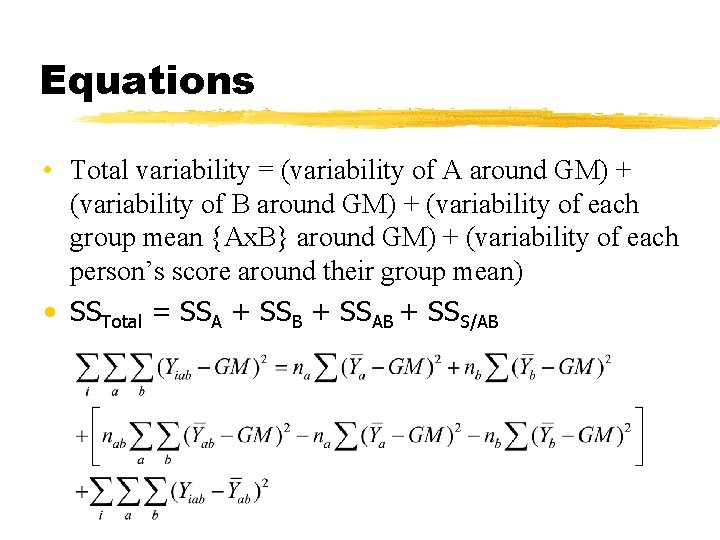
Equations • Total variability = (variability of A around GM) + (variability of B around GM) + (variability of each group mean {Ax. B} around GM) + (variability of each person’s score around their group mean) • SSTotal = SSA + SSB + SSAB + SSS/AB
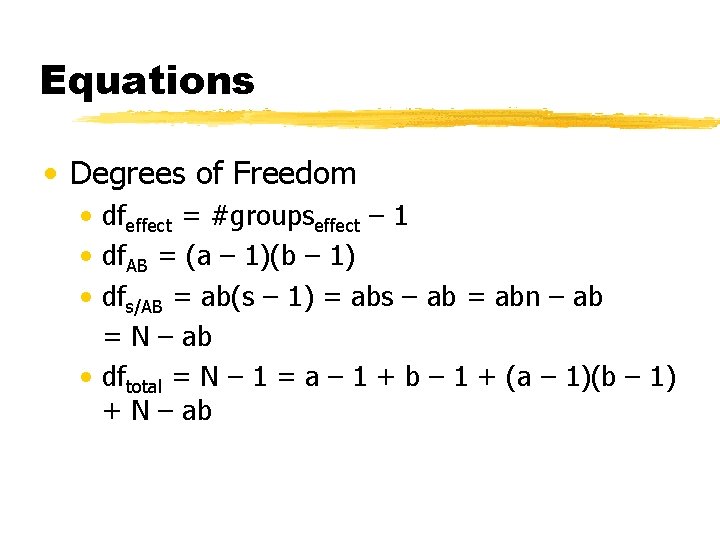
Equations • Degrees of Freedom • dfeffect = #groupseffect – 1 • df. AB = (a – 1)(b – 1) • dfs/AB = ab(s – 1) = abs – ab = abn – ab = N – ab • dftotal = N – 1 = a – 1 + b – 1 + (a – 1)(b – 1) + N – ab
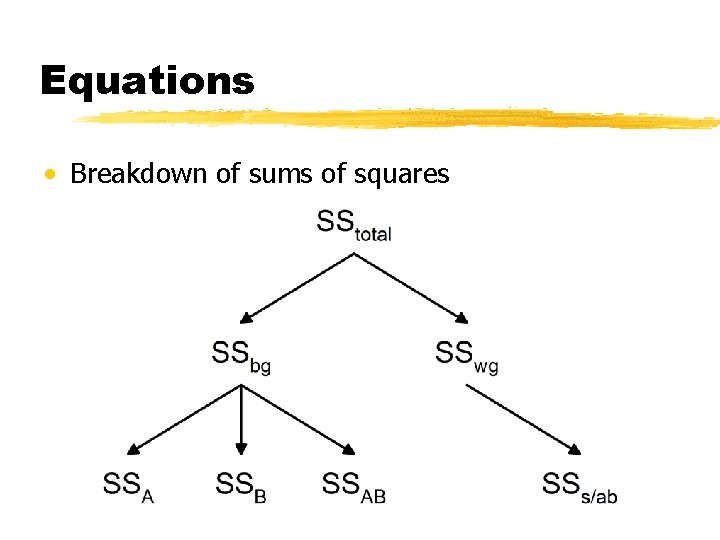
Equations • Breakdown of sums of squares
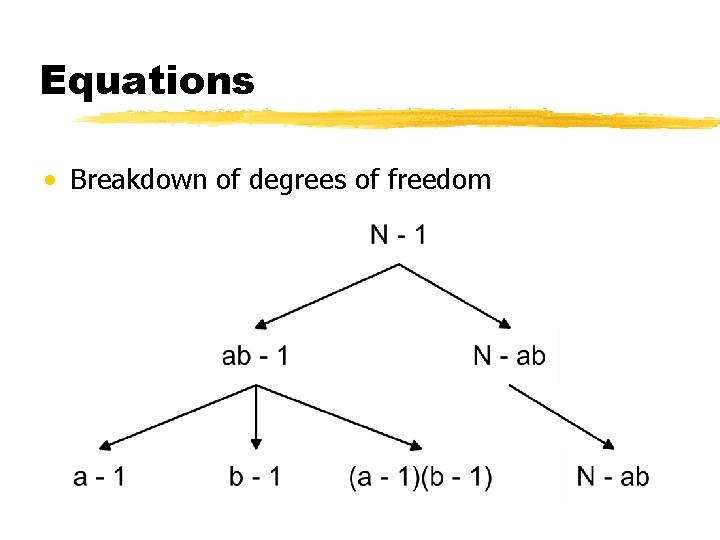
Equations • Breakdown of degrees of freedom
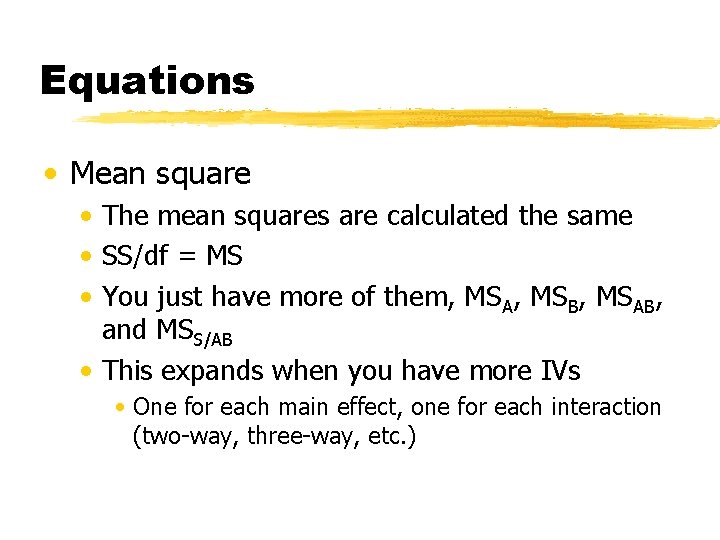
Equations • Mean square • The mean squares are calculated the same • SS/df = MS • You just have more of them, MSA, MSB, MSAB, and MSS/AB • This expands when you have more IVs • One for each main effect, one for each interaction (two-way, three-way, etc. )

Equations • F-test • Each effect and interaction is a separate Ftest • Calculated the same way: MSeffect/MSS/AB since MSS/AB is our variance estimate • You look up a separate Fcrit for each test using the dfeffect, df. S/AB and tabled values
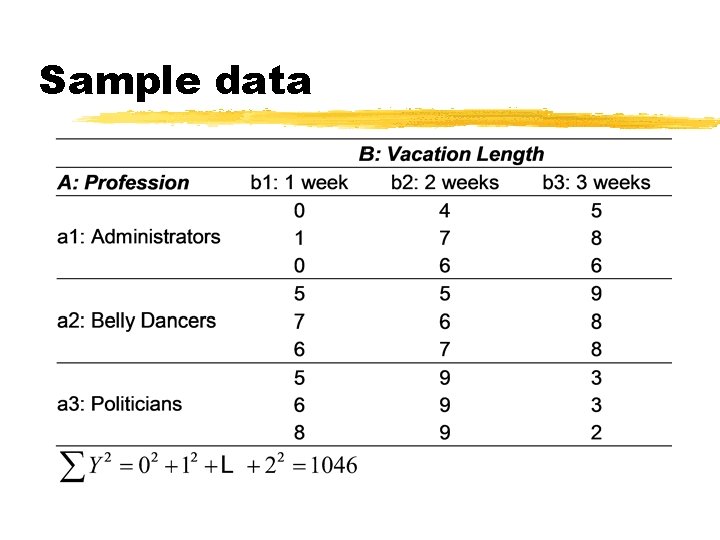
Sample data
Sample data • Sample info • So we have 3 subjects per cell • A has 3 levels, B has 3 levels • So this is a 3 x 3 design
Analysis – Computational • Marginal Totals – we look in the margins of a data set when computing main effects • Cell totals – we look at the cell totals when computing interactions • In order to use the computational formulas we need to compute both marginal and cell totals
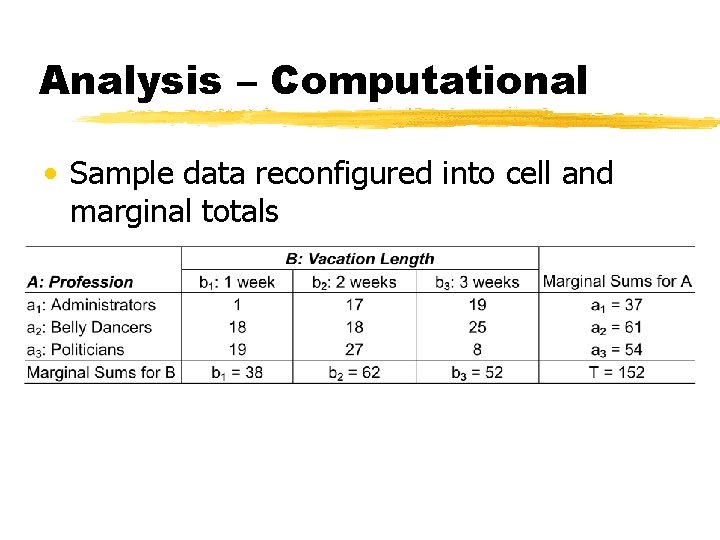
Analysis – Computational • Sample data reconfigured into cell and marginal totals
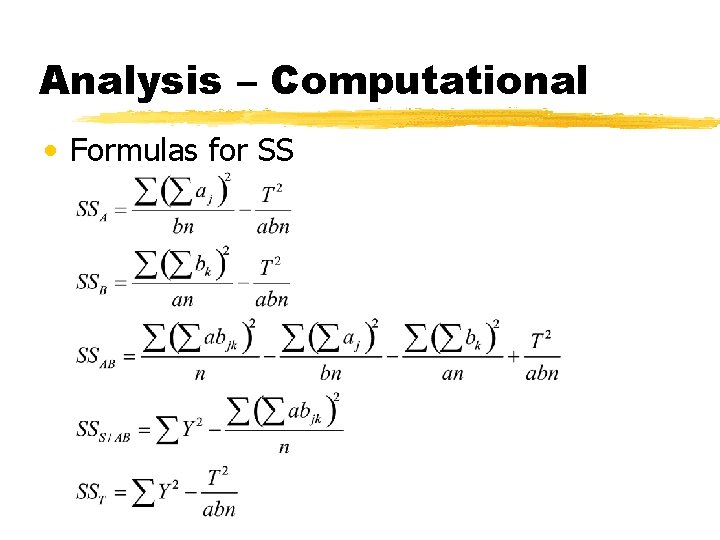
Analysis – Computational • Formulas for SS
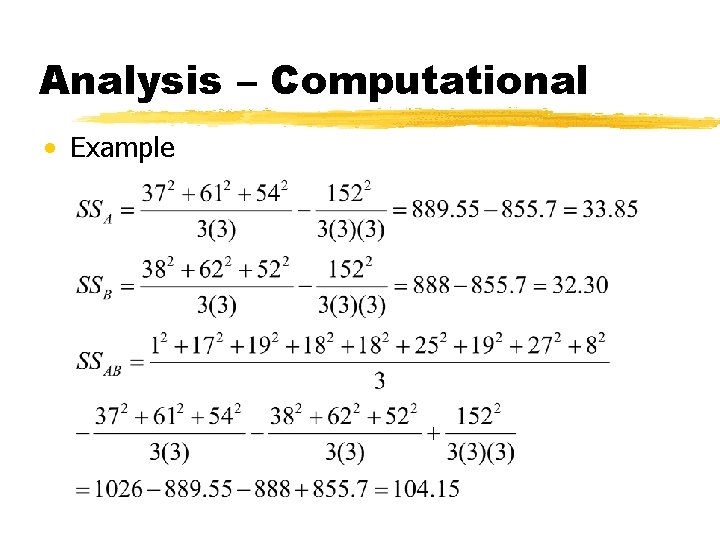
Analysis – Computational • Example
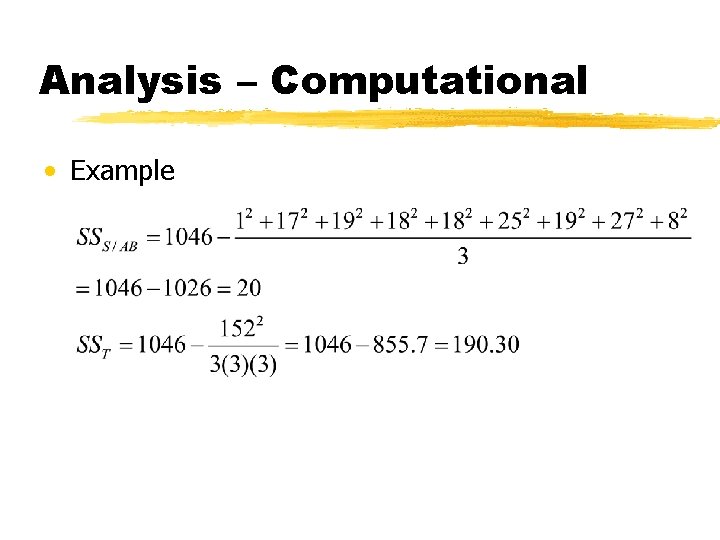
Analysis – Computational • Example
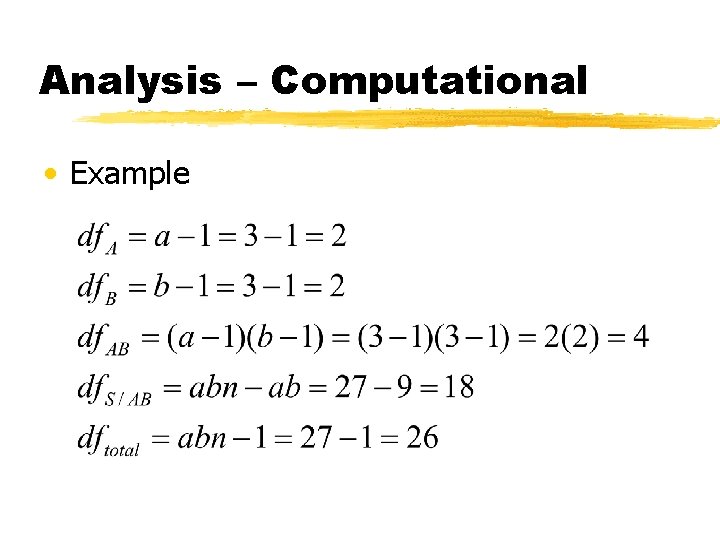
Analysis – Computational • Example
Analysis – Computational • Example
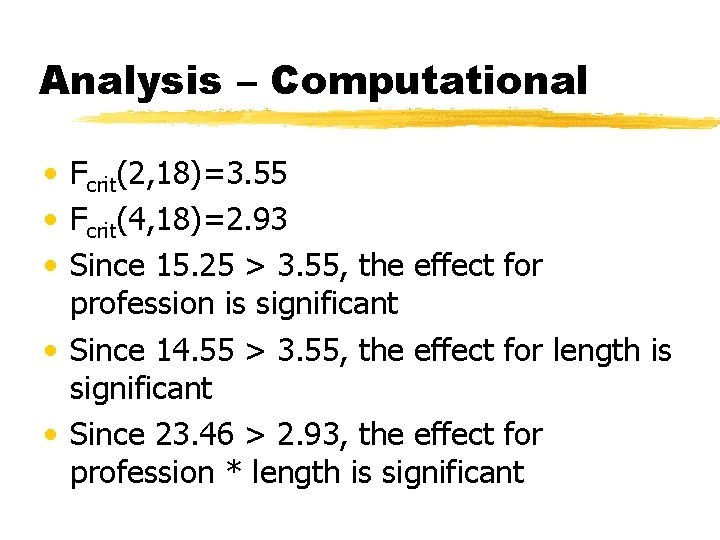
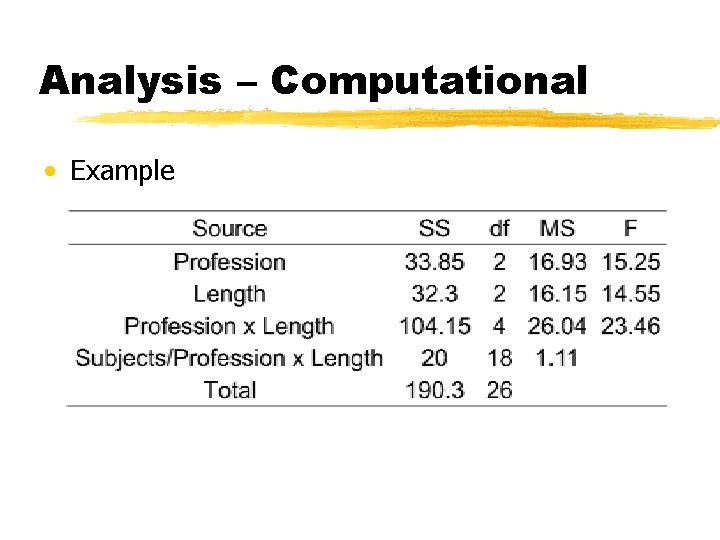
Analysis – Computational • Fcrit(2, 18)=3. 55 • Fcrit(4, 18)=2. 93 • Since 15. 25 > 3. 55, the effect for profession is significant • Since 14. 55 > 3. 55, the effect for length is significant • Since 23. 46 > 2. 93, the effect for profession * length is significant
- Slides: 27