
FACTOR LABEL METHOD Also know as DIMENSIONAL ANALYSIS
FACTOR LABEL METHOD Also know as DIMENSIONAL ANALYSIS
DO NOW � Pick up Factor Label Notes. � Turn in any missing work.
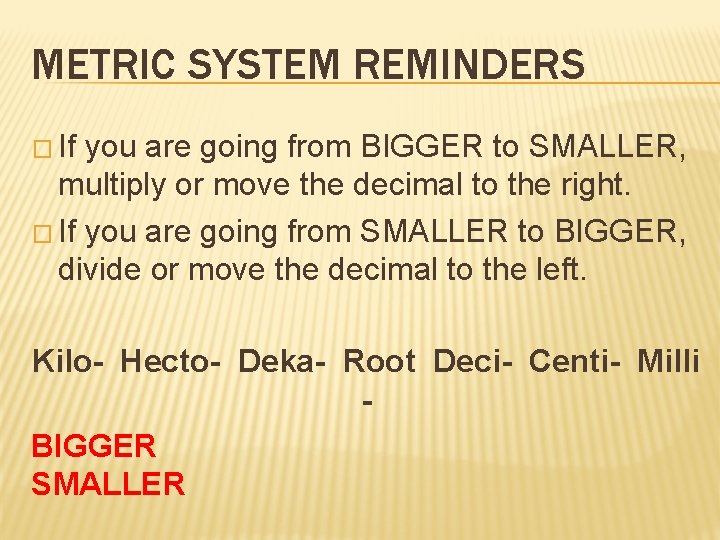
METRIC SYSTEM REMINDERS � If you are going from BIGGER to SMALLER, multiply or move the decimal to the right. � If you are going from SMALLER to BIGGER, divide or move the decimal to the left. Kilo- Hecto- Deka- Root Deci- Centi- Milli BIGGER SMALLER
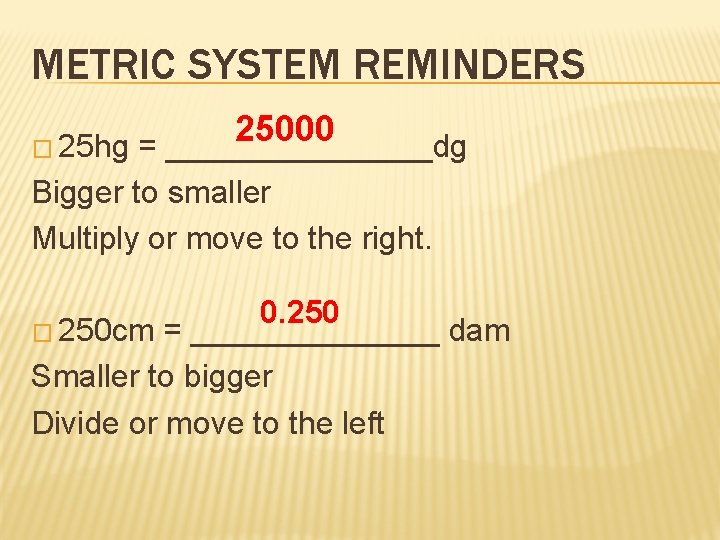
METRIC SYSTEM REMINDERS 25000 � 25 hg = ________dg Bigger to smaller Multiply or move to the right. 0. 250 � 250 cm = _______ dam Smaller to bigger Divide or move to the left
QUIZ TOMORROW OVER METRICS
FACTOR LABEL METHOD How many seconds are in 30 minutes? How many seconds are in 125 years?
FACTOR LABEL METHOD Many types of problems in chemistry can be solved by the factor-label method, which makes use of conversion factors. A conversion factor shows the relationship between various units with a ratio equal to one. For instance: 1 meter = 100 centimeters OR 1 kg OR 1000 g 1 kg
FACTOR LABEL METHOD � Either factor is numerically equal to one, and therefore, may be multiplied by any quantity without changing its value. � When writing conversion factors, it is important always to label each number with its unit. � It is from the use of factors and unit-labeled numbers that this method gets its name: “Factor Label”.
FACTOR LABEL METHOD Example One: How many kilograms are there in 125 grams of a substance? From the two conversion factors that can be formed from the equality between grams and kilograms, as shown above, we choose the one that will cause the unit GRAMS to divide or cancel out and leave the unit KILOGRAMS in the answer:
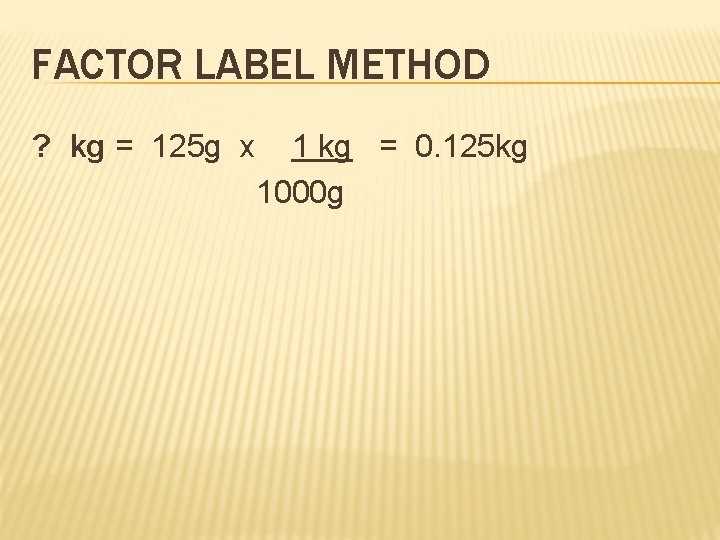
FACTOR LABEL METHOD ? kg = 125 g x 1 kg = 0. 125 kg 1000 g
FACTOR LABEL METHOD
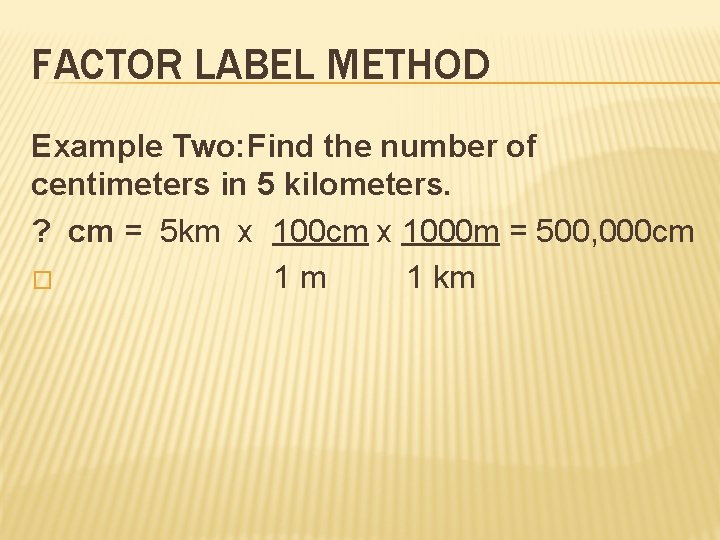
FACTOR LABEL METHOD Example Two: Find the number of centimeters in 5 kilometers. ? cm = 5 km x 100 cm x 1000 m = 500, 000 cm � 1 m 1 km
TO DO � Metric and Factor-Label Practice handout
- Slides: 13