
Factor Analysis Ulf H Olsson Professor of Statistics


- Slides: 27
Factor Analysis Ulf H. Olsson Professor of Statistics
From the Kaplan book • Page 40 – 45 (ch. 3) • Page 24 – 30 (ch. 2) • Page 48 – 53 (ch. 3) Ulf H. Olsson
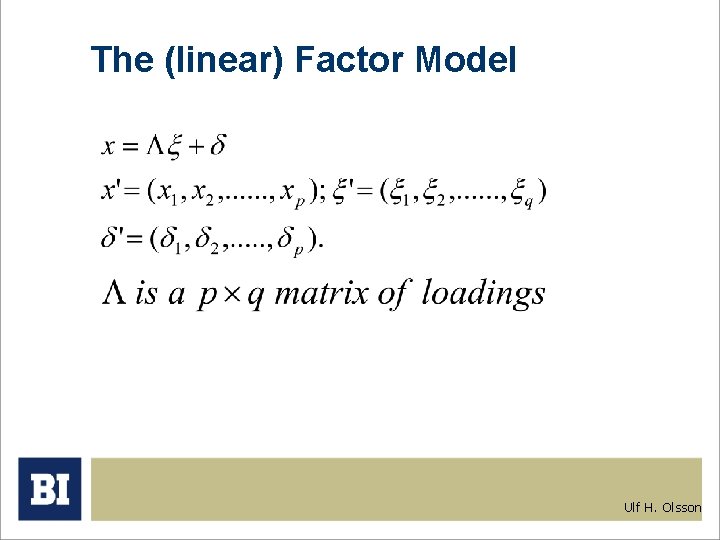
The (linear) Factor Model Ulf H. Olsson
Nine Psychological Tests(EFA) Ulf H. Olsson
Nine Psychological Tests(CFA) Ulf H. Olsson
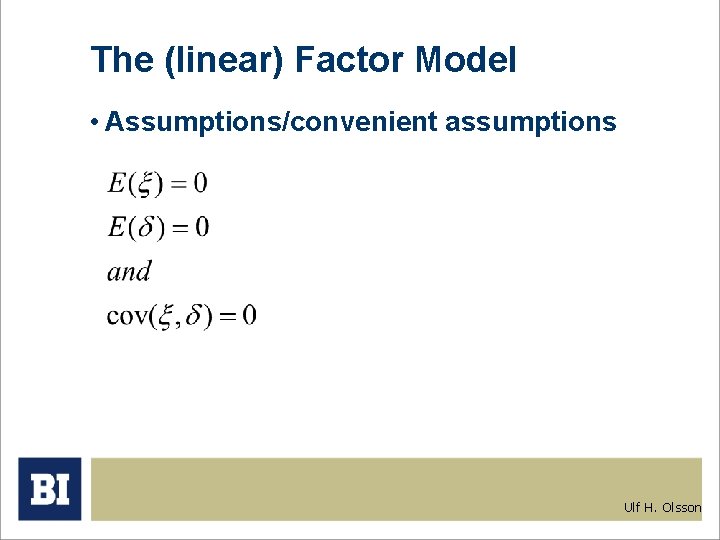
The (linear) Factor Model • Assumptions/convenient assumptions Ulf H. Olsson
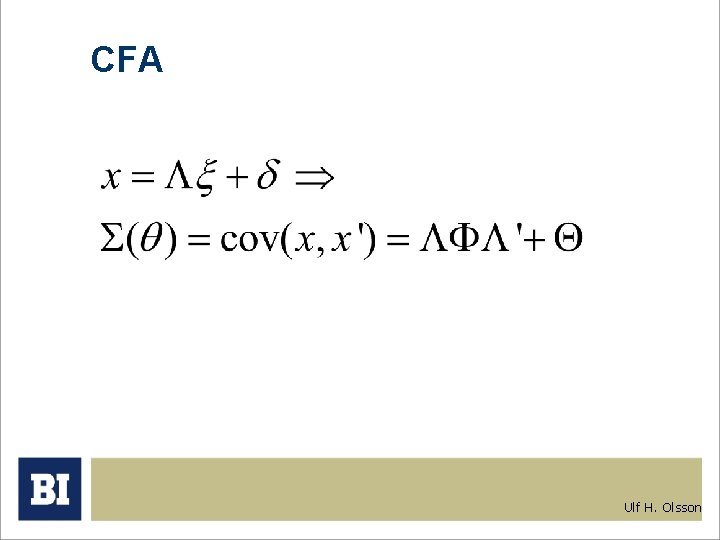
CFA Ulf H. Olsson
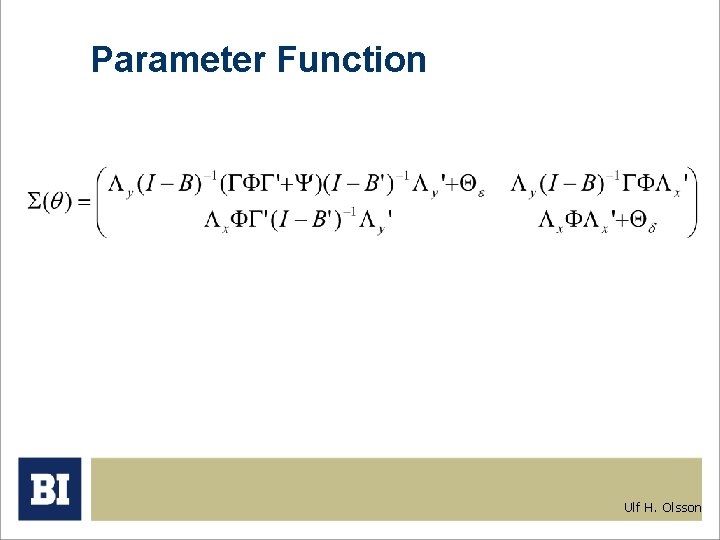
Parameter Function Ulf H. Olsson
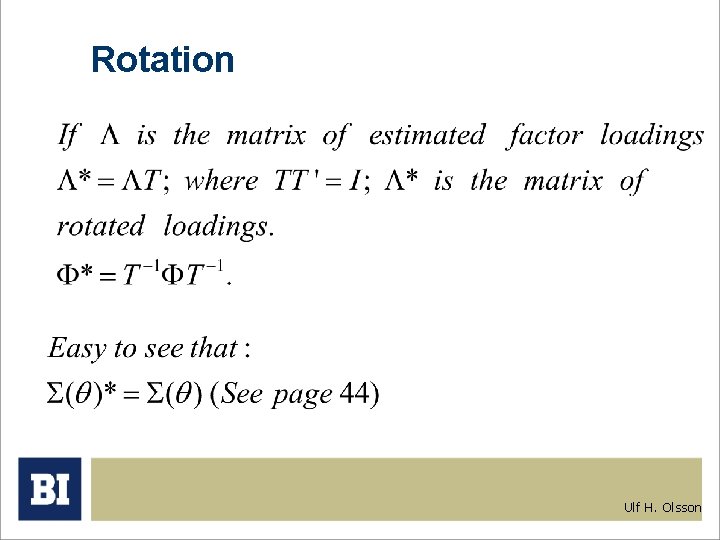
Rotation Ulf H. Olsson
Factor Analysis • Exploratory Factor Analysis (EFA) • One wants to explore the empirical data to discover and detect characteristic features and interesting relationships without imposing any definite model on the data • Confirmatory Factor Analysis (CFA) • One builds a model assumed to describe, explain, or account for the empirical data in terms of relatively few parameters. The model is based on a priori information about the data structure in form of a specified theory or hypothesis Ulf H. Olsson
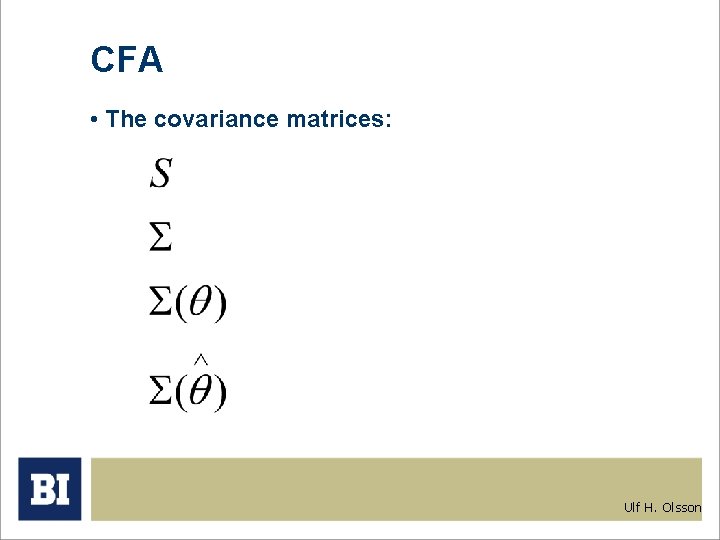
CFA • The covariance matrices: Ulf H. Olsson
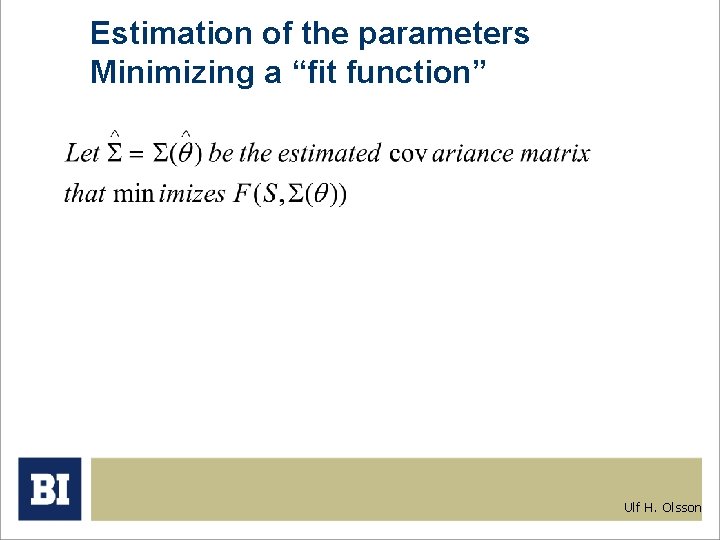
Estimation of the parameters Minimizing a “fit function” Ulf H. Olsson
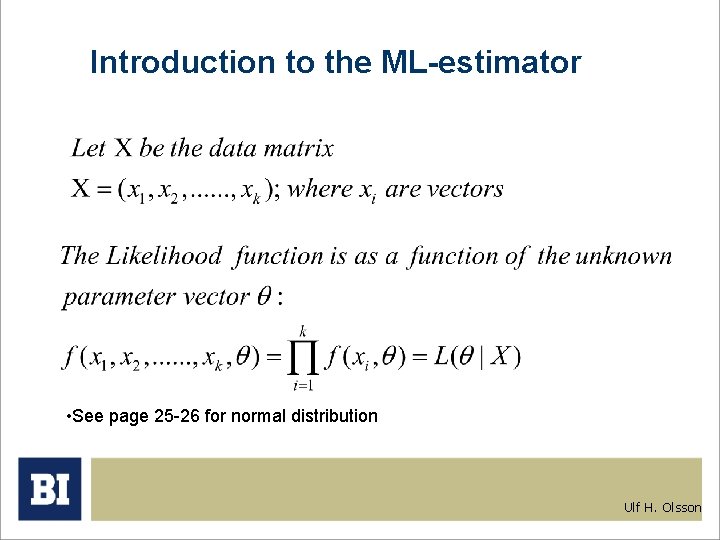
Introduction to the ML-estimator • See page 25 -26 for normal distribution Ulf H. Olsson
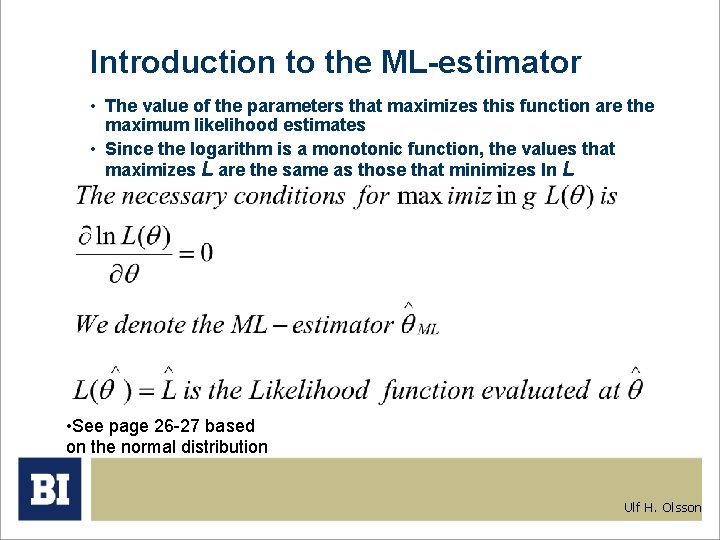
Introduction to the ML-estimator • The value of the parameters that maximizes this function are the maximum likelihood estimates • Since the logarithm is a monotonic function, the values that maximizes L are the same as those that minimizes ln L • See page 26 -27 based on the normal distribution Ulf H. Olsson
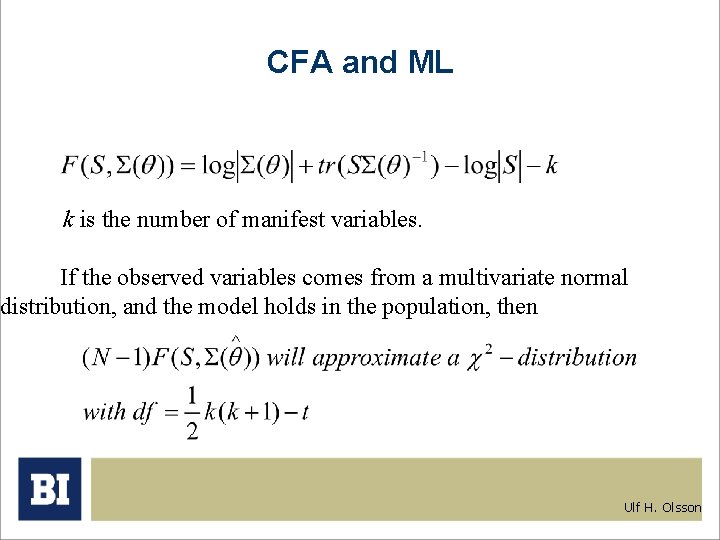
CFA and ML k is the number of manifest variables. If the observed variables comes from a multivariate normal distribution, and the model holds in the population, then Ulf H. Olsson
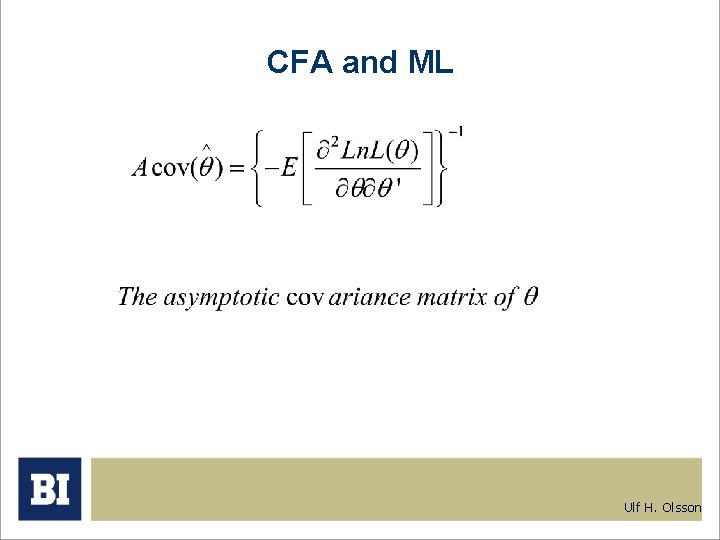
CFA and ML Ulf H. Olsson
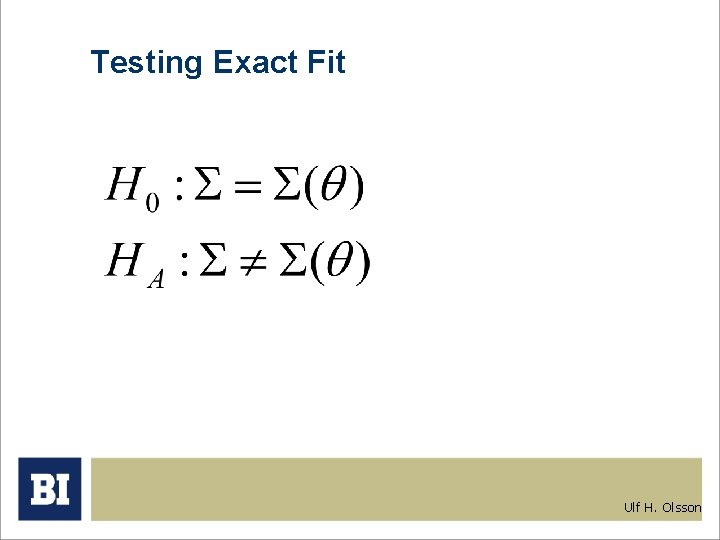
Testing Exact Fit Ulf H. Olsson
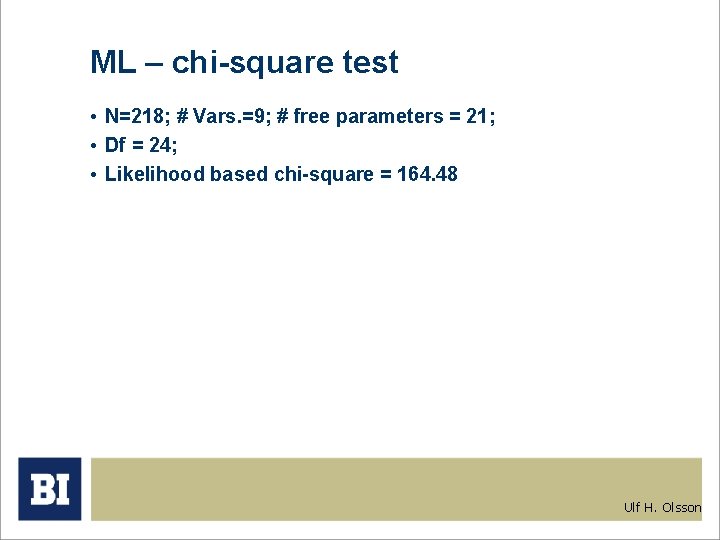
ML – chi-square test • N=218; # Vars. =9; # free parameters = 21; • Df = 24; • Likelihood based chi-square = 164. 48 Ulf H. Olsson
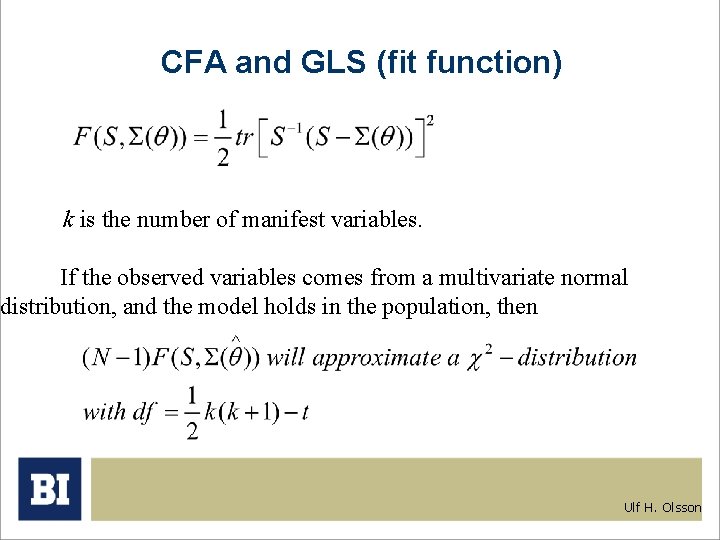
CFA and GLS (fit function) k is the number of manifest variables. If the observed variables comes from a multivariate normal distribution, and the model holds in the population, then Ulf H. Olsson
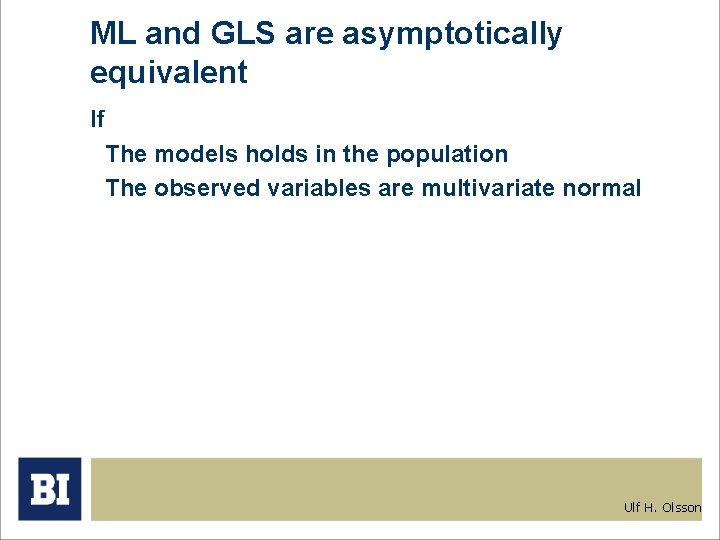
ML and GLS are asymptotically equivalent If The models holds in the population The observed variables are multivariate normal Ulf H. Olsson
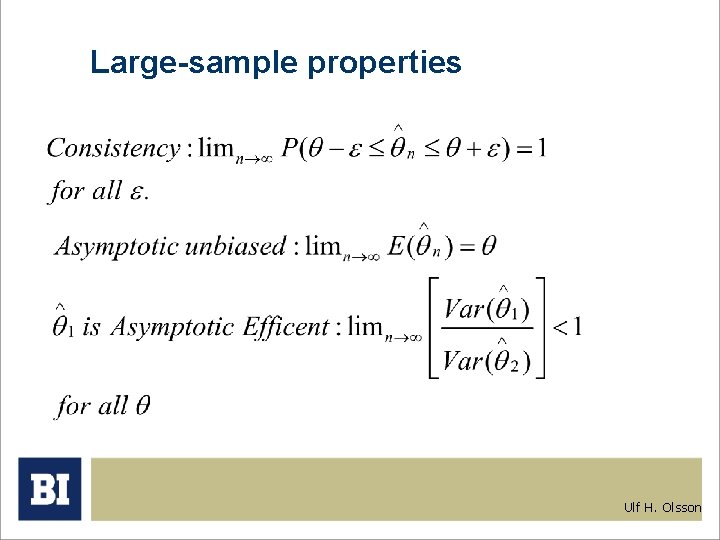
Large-sample properties Ulf H. Olsson
CFA example NPV-data set • • Chi-square tests Modification indices T (Z)-values df Ulf H. Olsson
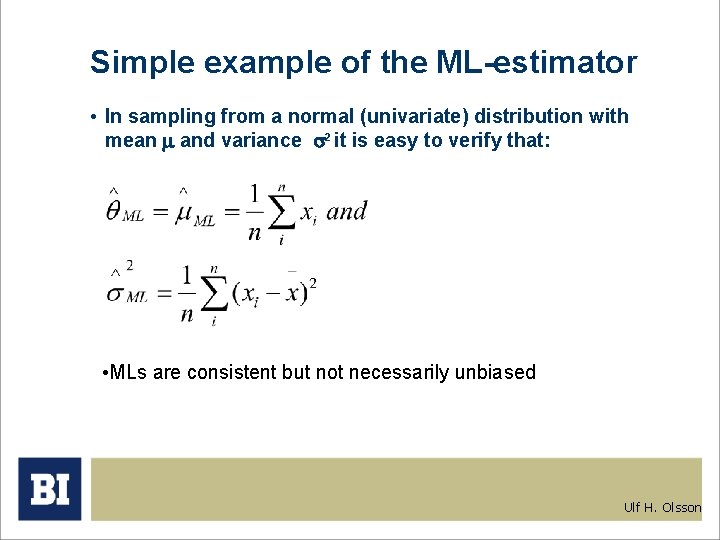
Simple example of the ML-estimator • In sampling from a normal (univariate) distribution with mean and variance 2 it is easy to verify that: • MLs are consistent but not necessarily unbiased Ulf H. Olsson
Two asymptotically Equivalent Tests Likelihood ratio test Wald test
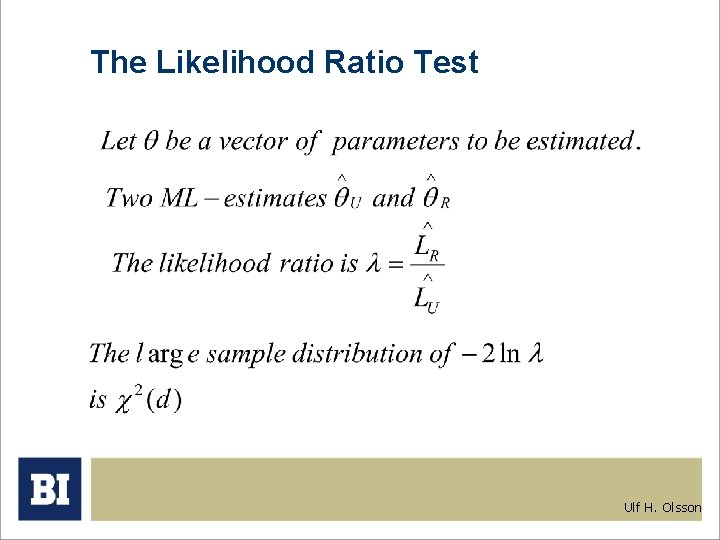
The Likelihood Ratio Test Ulf H. Olsson
The Wald Test Ulf H. Olsson
Example of the Wald test • Consider a simple regression model Ulf H. Olsson