
FACT SHEET ETHICS SUBGROUP IOT VERSION 4 0
FACT SHEET – ETHICS SUBGROUP IOT – VERSION 4. 0 Jeroen Van Den Hoven Delft University of Technology Presented By: Amanda Crawford University of Pittsburgh CS 3720 – Internet of Things
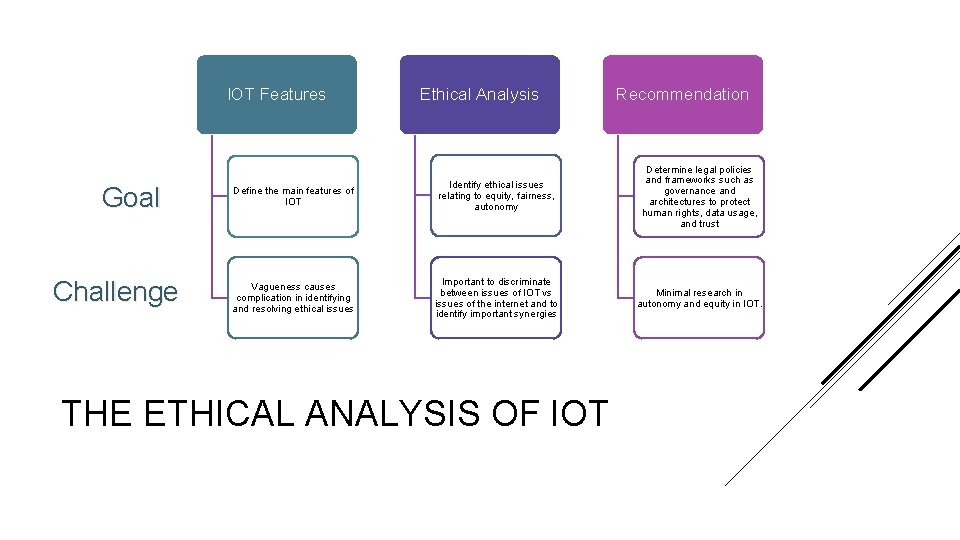
IOT Features Goal Challenge Ethical Analysis Recommendation Define the main features of IOT Identify ethical issues relating to equity, fairness, autonomy Determine legal policies and frameworks such as governance and architectures to protect human rights, data usage, and trust Vagueness causes complication in identifying and resolving ethical issues Important to discriminate between issues of IOT vs issues of the internet and to identify important synergies Minimal research in autonomy and equity in IOT. THE ETHICAL ANALYSIS OF IOT
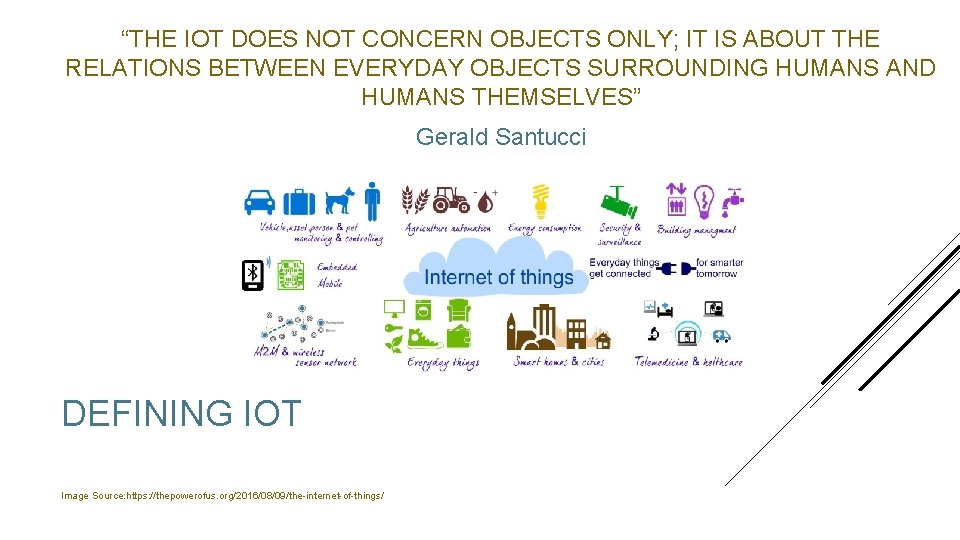
“THE IOT DOES NOT CONCERN OBJECTS ONLY; IT IS ABOUT THE RELATIONS BETWEEN EVERYDAY OBJECTS SURROUNDING HUMANS AND HUMANS THEMSELVES” Gerald Santucci DEFINING IOT Image Source: https: //thepowerofus. org/2016/08/09/the-internet-of-things/
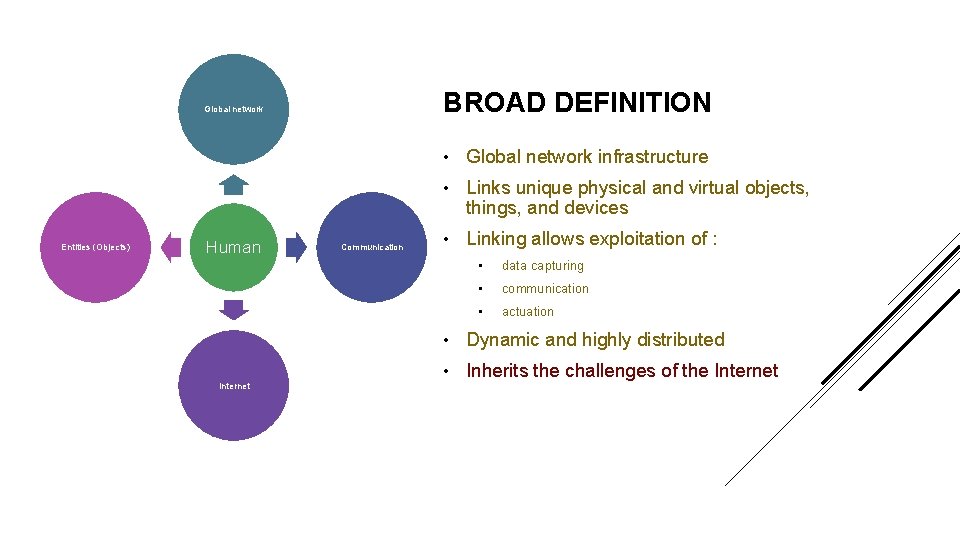
BROAD DEFINITION Global network Entities (Objects) Human Internet Communication • Global network infrastructure • Links unique physical and virtual objects, things, and devices • Linking allows exploitation of : • data capturing • communication • actuation • Dynamic and highly distributed • Inherits the challenges of the Internet
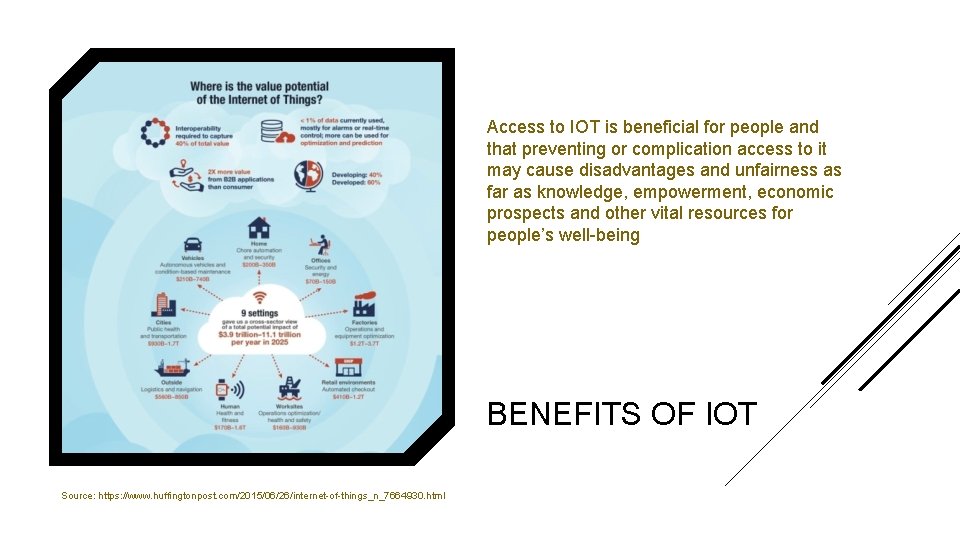
Access to IOT is beneficial for people and that preventing or complication access to it may cause disadvantages and unfairness as far as knowledge, empowerment, economic prospects and other vital resources for people’s well-being BENEFITS OF IOT Source: https: //www. huffingtonpost. com/2015/06/26/internet-of-things_n_7664930. html
Ubiquity and Pervasiveness Miniaturization and Invisibility Ambiguity and Ontology Identification Connectivity Mediation and Autonomous Agency Embedded Intelligence and Extended Mind Seamless Transfer Distributed Control Big Data Unpredictability and Uncertainty IOT FEATURES
1. Social Justice 2. Trust 3. Blurring of Contexts 4. Non-Neutrality of Metaphors 5. Agency 6. Autonomy KEY ETHICAL ISSUES IN IOT Original Image Source https: //www. standardsuniversity. org/e-magazine/march-2017/ethics-and-technology/
IOT Related Features Ethical Analysis Recommendations SOCIAL JUSTICE
Connectivity The shape of a network affects the information position of users and citizens Doesn’t include the “ordinary” user’s point of view No institutional framework to evaluate distribution benefits discriminates and differentiates access UBIQUITY, PERVASIVENESS, INIVISIBILITY Prevention of evaluating impact of data transactions within everyday lives Only educated elite will have the skills for evaluation KEY IOT RELATED FEATURES

Digital Divide Knowledge Divide Recommendations AN ETHICAL ANALYSIS
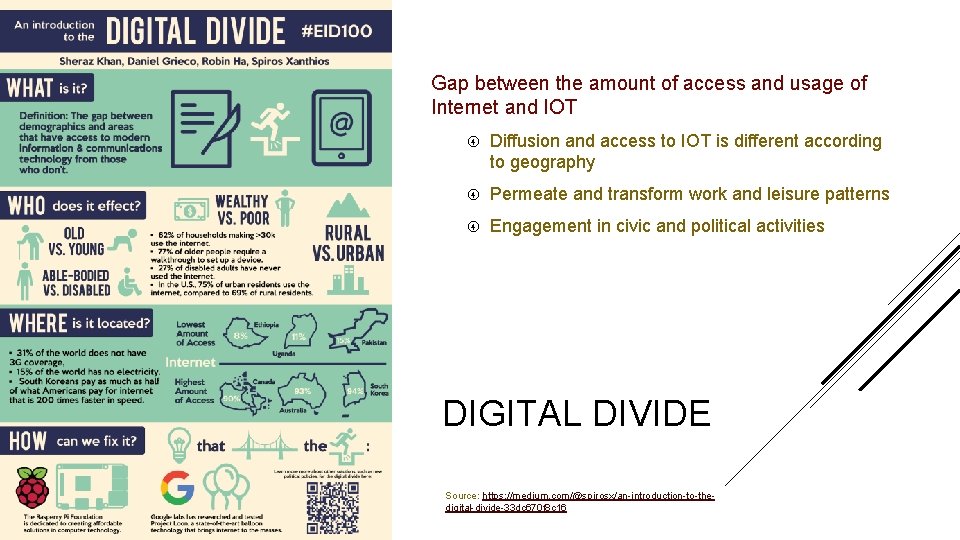
Gap between the amount of access and usage of Internet and IOT Diffusion and access to IOT is different according to geography Permeate and transform work and leisure patterns Engagement in civic and political activities DIGITAL DIVIDE Source: https: //medium. com/@spirosx/an-introduction-to-thedigital-divide-33 dc 670 f 8 c 16
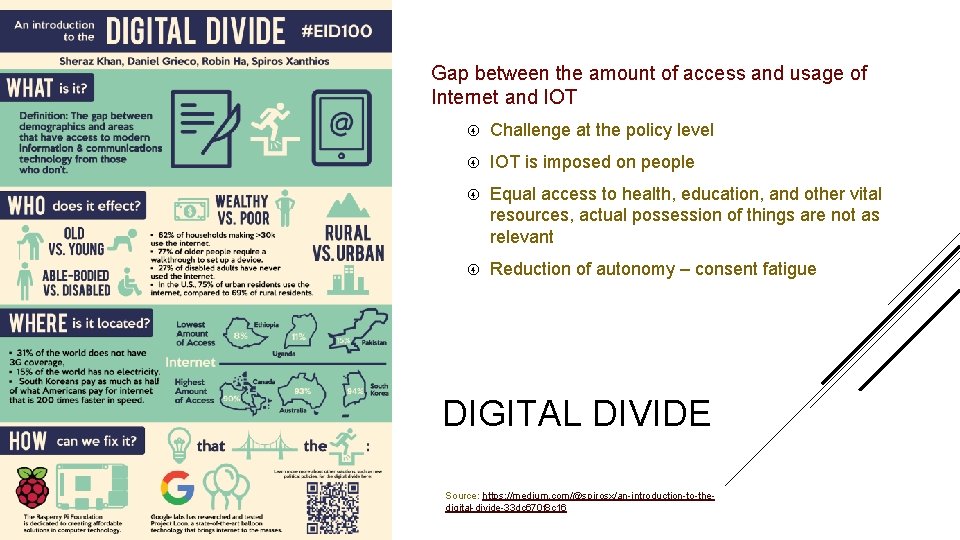
Gap between the amount of access and usage of Internet and IOT Challenge at the policy level IOT is imposed on people Equal access to health, education, and other vital resources, actual possession of things are not as relevant Reduction of autonomy – consent fatigue DIGITAL DIVIDE Source: https: //medium. com/@spirosx/an-introduction-to-thedigital-divide-33 dc 670 f 8 c 16
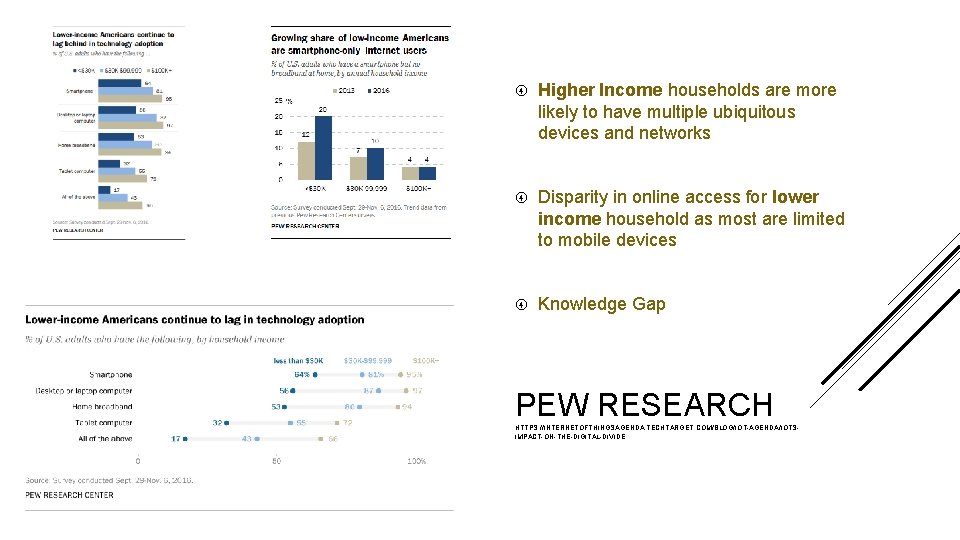
Higher Income households are more likely to have multiple ubiquitous devices and networks Disparity in online access for lower income household as most are limited to mobile devices Knowledge Gap PEW RESEARCH HTTPS: //INTERNETOFTHINGSAGENDA. TECHTARGET. COM/BLOG/IOT-AGENDA/IOTSIMPACT-ON-THE-DIGITAL-DIVIDE
Progressive disempowerment and deskilling provoked by ubiquitous and invisible smart automation of data transactions Those who are knowledgeable and skilled are empowered to control the working of the technology and will be able to protect themselves against abuse and choose to opt in or out Incompetence Trap- when technologies do what people could do themselves – further deskilling people and make people more dependent on experts and tools Democratization of knowledge production Small fraction of population has access to knowledge and benefits the from the whole set of opportunities Questions What is that people are missing when they do not benefit from access to IOT? What kinds of alternatives are put in place in order to guarantee that those that voluntarily(or not) are engaged in the web of device communications and sensing do not get hampered with their lifestyles, hindered with personal endeavors or even excluded from their communities? KNOWLEDGE DIVIDE
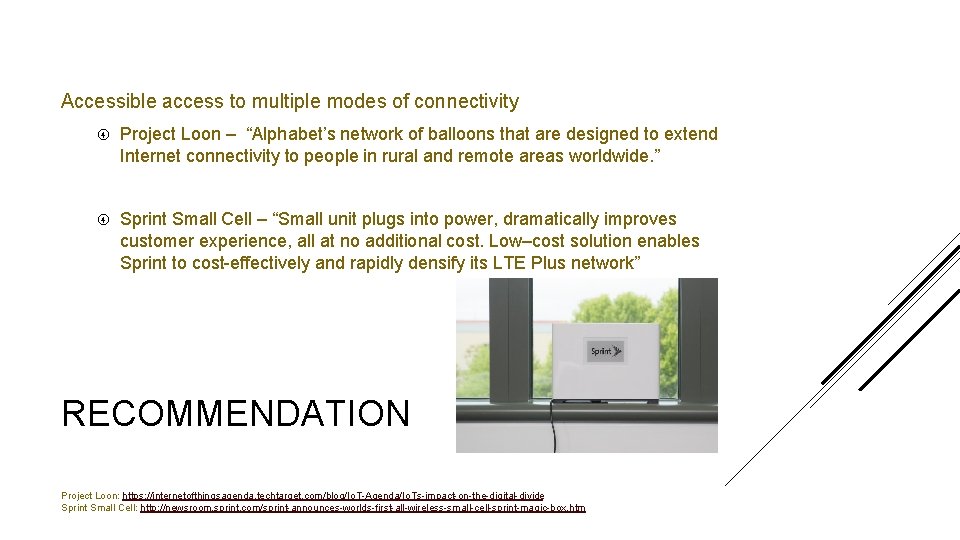
Accessible access to multiple modes of connectivity Project Loon – “Alphabet’s network of balloons that are designed to extend Internet connectivity to people in rural and remote areas worldwide. ” Sprint Small Cell – “Small unit plugs into power, dramatically improves customer experience, all at no additional cost. Low–cost solution enables Sprint to cost-effectively and rapidly densify its LTE Plus network” RECOMMENDATION Project Loon: https: //internetofthingsagenda. techtarget. com/blog/Io. T-Agenda/Io. Ts-impact-on-the-digital-divide Sprint Small Cell: http: //newsroom. sprint. com/sprint-announces-worlds-first-all-wireless-small-cell-sprint-magic-box. htm
IOT Related Features Ethical Analysis Recommendations TRUST
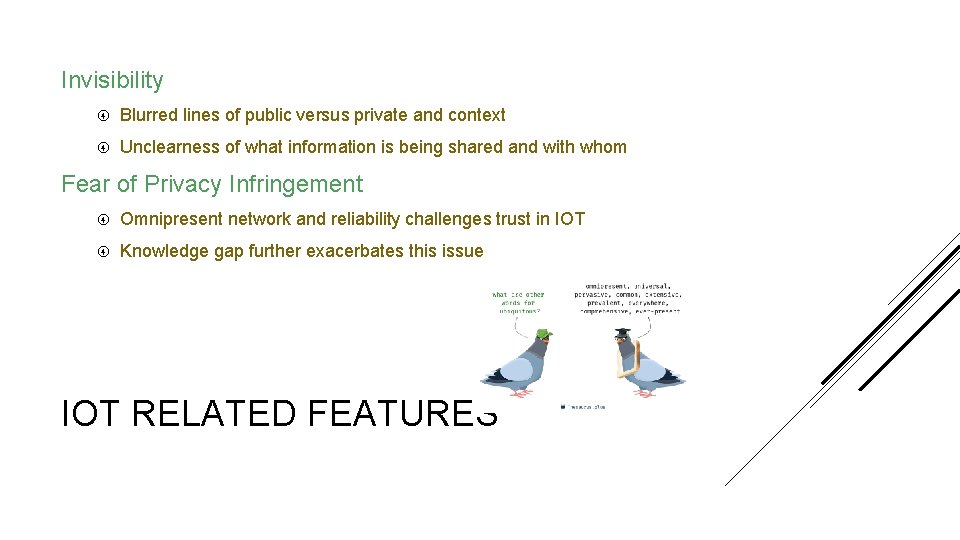
Invisibility Blurred lines of public versus private and context Unclearness of what information is being shared and with whom Fear of Privacy Infringement Omnipresent network and reliability challenges trust in IOT Knowledge gap further exacerbates this issue IOT RELATED FEATURES
Distributed IOT is dynamic, distributed and ubiquitous Establishing trust among unfamiliar and dynamic ubiquitous entities due to the challenge of proper identification mechanisms Decentralization causes complexity in management of privacy and security Heterogenous Lack of homogeneity and hierarchical structure calls for evaluation in it means to trust an entity in IOT context Heterarchical structures in autonomous entities can further prevent user intervention and mediation IOT RELATED FEATURES
Concept of Trust Reliability vs. Trust Relationships Reputation Systems AN ETHICAL ANALYSIS
“Accepted vulnerability to another’s possible but not expected ill will toward one” Climate of trust eases cooperation, cuts transaction cost and foster reciprocal care taking- resources could be used for more constructed efforts E- Trusting what is said to be true on a website, operations of an e-commerce sight, search engine enquiry are highlighted appropriately. Entities are given the ability to mediate trust relationships, reducing autonomy and control over data privacy and distribution CONCEPT OF TRUST
Reliability is the generic form of trust Relying on something or someone to display a trait or behavior is just acting in a way that is shaped by the more of less confident belief that they will display it Static versus dynamic reliability Static reliability is the generic form and can be achieved as a whole Dynamic reliability is synonymous to trust and can’t be fully achieved Reliance is measure or level of confidence a person or thing displays towards another thing acting in a certain way RELIABILITY VS TRUST
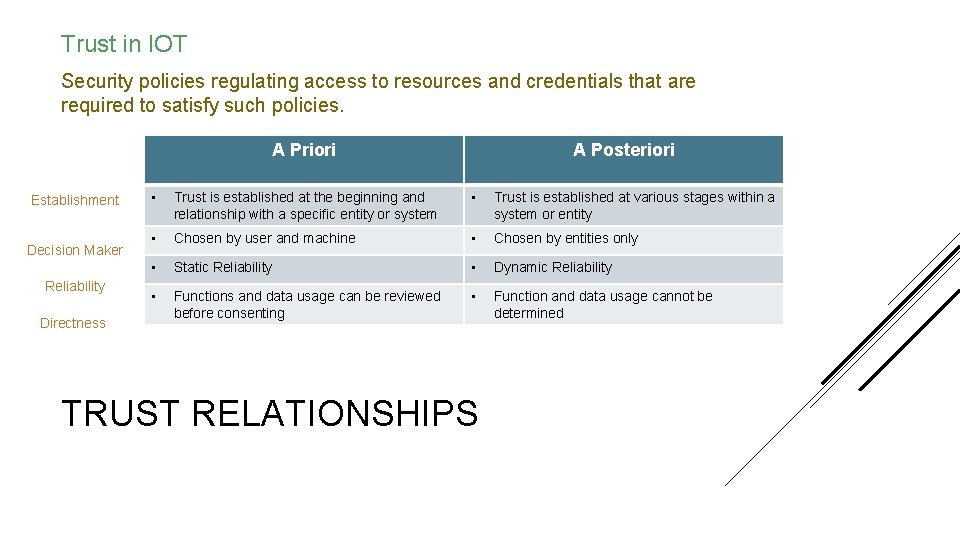
Trust in IOT Security policies regulating access to resources and credentials that are required to satisfy such policies. A Priori Establishment Decision Maker Reliability Directness A Posteriori • Trust is established at the beginning and relationship with a specific entity or system • Trust is established at various stages within a system or entity • Chosen by user and machine • Chosen by entities only • Static Reliability • Dynamic Reliability • Functions and data usage can be reviewed before consenting • Function and data usage cannot be determined TRUST RELATIONSHIPS
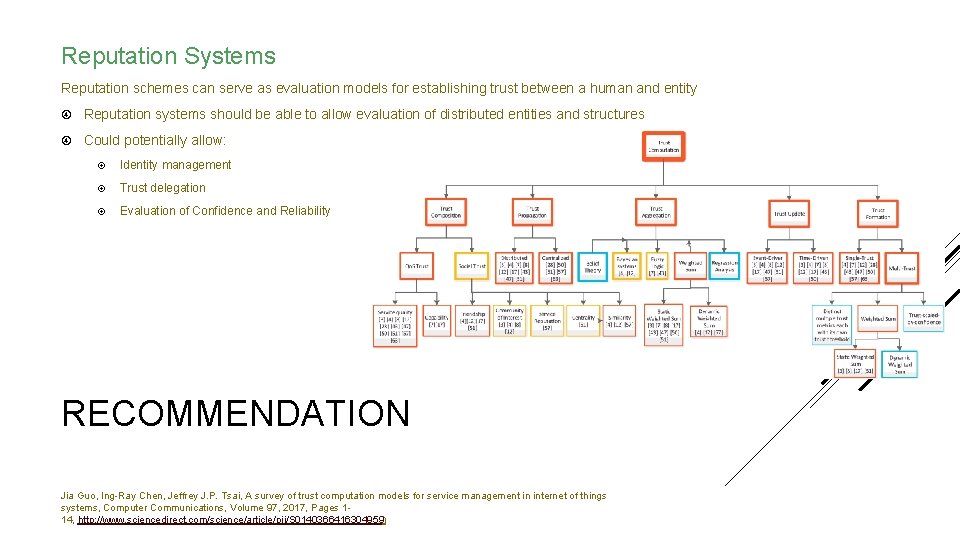
Reputation Systems Reputation schemes can serve as evaluation models for establishing trust between a human and entity Reputation systems should be able to allow evaluation of distributed entities and structures Could potentially allow: Identity management Trust delegation Evaluation of Confidence and Reliability RECOMMENDATION Jia Guo, Ing-Ray Chen, Jeffrey J. P. Tsai, A survey of trust computation models for service management in internet of things systems, Computer Communications, Volume 97, 2017, Pages 114, http: //www. sciencedirect. com/science/article/pii/S 0140366416304959)
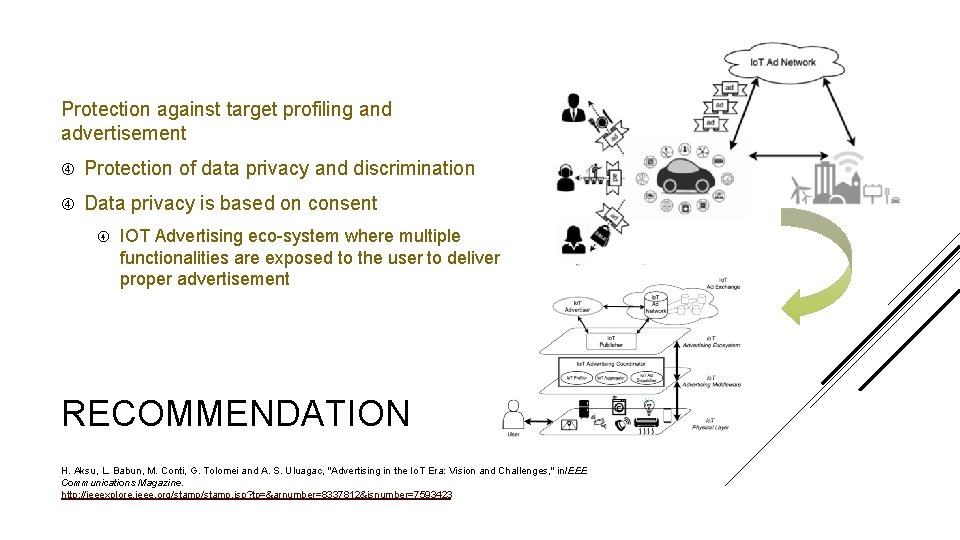
Protection against target profiling and advertisement Protection of data privacy and discrimination Data privacy is based on consent IOT Advertising eco-system where multiple functionalities are exposed to the user to deliver proper advertisement RECOMMENDATION H. Aksu, L. Babun, M. Conti, G. Tolomei and A. S. Uluagac, "Advertising in the Io. T Era: Vision and Challenges, " in. IEEE Communications Magazine. http: //ieeexplore. ieee. org/stamp. jsp? tp=&arnumber=8337812&isnumber=7593423
It's important to know how to decide whether a design choice or device is ethical The designer should be aware of its own biases being embedded in IOT structures There is wider field of IOT research needed in building viable and equitable technologies. In agreeance with the suggestion that application design should be trustworthy from the beginning of development as it allows the consideration of: Protection of personal data Ensuring privacy Providing usable security management REMARKS
![FURTHER READING https: //arxiv. org/pdf/1802. 04102. pdf [1] https: //ec. europa. eu/research/swafs/pdf/pub_archive/bernd-carsten-stahl_en. pdf https:](http://slidetodoc.com/presentation_image_h2/6b6ee137179a117762e3d4de622c5f36/image-26.jpg "FURTHER READING https: //arxiv. org/pdf/1802. 04102. pdf [1] https: //ec. europa. eu/research/swafs/pdf/pub_archive/bernd-carsten-stahl_en. pdf https:")
FURTHER READING https: //arxiv. org/pdf/1802. 04102. pdf [1] https: //ec. europa. eu/research/swafs/pdf/pub_archive/bernd-carsten-stahl_en. pdf https: //pdfs. semanticscholar. org/0487/c 5 dac 2 d 04 aac 6977 dcec 0 bb 43 dc 6182 d 5222. pdf http: //www. cs. rpi. edu/~bermaf/Berman+Cerf_Io. T. pdf Jia Guo, Ing-Ray Chen, Jeffrey J. P. Tsai, A survey of trust computation models for service management in internet of things systems, Computer Communications, Volume 97, 2017, Pages 114, http: //www. sciencedirect. com/science/article/pii/S 0140366416304959)
- Slides: 26